SHRI DADAJI INSTITUTE OF
TECHNOLOGY AND SCIENCE
SEMINAR ON
PLASMA ANTENNA
SUBMITTED TO:
EC DEPARTMENT
SUBMITTED BY:
SHIVRANJAN GITE
EC 6th SEM
CONTENTS:-
 INTRODUCTION
 PLASMAANTENNA
 ANTENNA PRINCIPLE
 OPERATION OF PLASMA ANTENNA
 CHARACTERSTICS
 ADVANTAGES
 LIMITATIONS
 APPLICATIONS
 CONCLUSION
 REFERENCE
INTRODUCTION
 An antenna is an electrical device which converts electric currents
into radio waves at transmitter and inverse of this operation at
receiver
 A plasma antenna is a radio frequency (RF) antenna based on
plasma elements instead of metal conductors.
PLASMA ANTENNA
 It is a tube type structure
 In plasma antenna low Pressured Ionized Gasses are used
 It based on Conductivity of Ionized Gasses
 It Provide Electromagnetic Wave Radiation
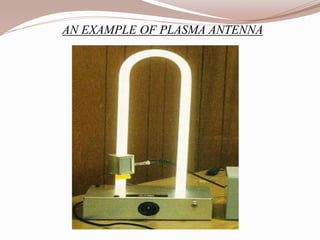
AN EXAMPLE OF PLASMA ANTENNA
ANTENNA PRINCIPLE
 When voltage is applied to an antenna, electric field is
produced
 It causes current to flow in antenna
 Due to current flow, magnetic field is produced.
 These two fields are emitted from an antenna and propagate
through space over very long distance
OPERATION OF PLASMA ANTENNA
 In an ionized gas plasma antenna, a gas is ionized to create a
plasma.
 Plasma state act as a driven element to radiate radio waves, or
to receive them.
 Alternatively the plasma can be used as a reflector or a lens to
guide and focus radio waves from another source
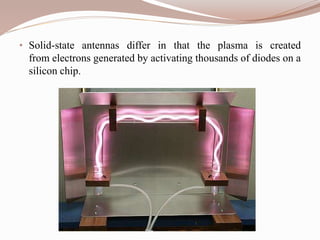
• Solid-state antennas differ in that the plasma is created
from electrons generated by activating thousands of diodes on a
silicon chip.
CHARACTERISTICS
 Gas ionizing process can manipulate resistance and when
deionized, the gas has infinite resistance and doesn't interact
with RF radiation.
 Operates up to 90 GHz.
 It use ionized gas as conducting material.
 The gas is ionized only for the time of transmission or
reception.
ADVANTAGES
 Higher Efficiency
 Lower Noise
 Low in Weight
 Enhanced Bandwidth
 Higher Power
LIMITATIONS
• It can not be used in mobile environment
• Plasma antennas are expensive and hard to manufacture.
 Ionozer increases power consumption .
APPLICATIONS
 Military Applications
 Public Safety Networks
 Radar Systems
 High Frequency Applications
CONCLUSION
• Plasma antenna is requirment of morden day because it has
many advantages over traditional antenna as we discussed
today.
• This technology is not possible practically but in future it is
practically provided.
• It is more advantageous than other antenna due to ionized gas.
REFERENCE
 www.google.co.in
 www.wikipedia.org
 www.slideshare.com
 www.technopdf.com
plasma antenna
plasma antenna

plasma antenna

  • 1.
    SHRI DADAJI INSTITUTEOF TECHNOLOGY AND SCIENCE SEMINAR ON PLASMA ANTENNA SUBMITTED TO: EC DEPARTMENT SUBMITTED BY: SHIVRANJAN GITE EC 6th SEM
  • 2.
    CONTENTS:-  INTRODUCTION  PLASMAANTENNA ANTENNA PRINCIPLE  OPERATION OF PLASMA ANTENNA  CHARACTERSTICS  ADVANTAGES  LIMITATIONS  APPLICATIONS  CONCLUSION  REFERENCE
  • 3.
    INTRODUCTION  An antennais an electrical device which converts electric currents into radio waves at transmitter and inverse of this operation at receiver  A plasma antenna is a radio frequency (RF) antenna based on plasma elements instead of metal conductors.
  • 4.
    PLASMA ANTENNA  Itis a tube type structure  In plasma antenna low Pressured Ionized Gasses are used  It based on Conductivity of Ionized Gasses  It Provide Electromagnetic Wave Radiation
  • 5.
    AN EXAMPLE OFPLASMA ANTENNA
  • 6.
    ANTENNA PRINCIPLE  Whenvoltage is applied to an antenna, electric field is produced  It causes current to flow in antenna  Due to current flow, magnetic field is produced.  These two fields are emitted from an antenna and propagate through space over very long distance
  • 7.
    OPERATION OF PLASMAANTENNA  In an ionized gas plasma antenna, a gas is ionized to create a plasma.  Plasma state act as a driven element to radiate radio waves, or to receive them.  Alternatively the plasma can be used as a reflector or a lens to guide and focus radio waves from another source
  • 8.
    • Solid-state antennasdiffer in that the plasma is created from electrons generated by activating thousands of diodes on a silicon chip.
  • 9.
    CHARACTERISTICS  Gas ionizingprocess can manipulate resistance and when deionized, the gas has infinite resistance and doesn't interact with RF radiation.  Operates up to 90 GHz.  It use ionized gas as conducting material.  The gas is ionized only for the time of transmission or reception.
  • 10.
    ADVANTAGES  Higher Efficiency Lower Noise  Low in Weight  Enhanced Bandwidth  Higher Power
  • 11.
    LIMITATIONS • It cannot be used in mobile environment • Plasma antennas are expensive and hard to manufacture.  Ionozer increases power consumption .
  • 12.
    APPLICATIONS  Military Applications Public Safety Networks  Radar Systems  High Frequency Applications
  • 13.
    CONCLUSION • Plasma antennais requirment of morden day because it has many advantages over traditional antenna as we discussed today. • This technology is not possible practically but in future it is practically provided. • It is more advantageous than other antenna due to ionized gas.
  • 14.
    REFERENCE  www.google.co.in  www.wikipedia.org www.slideshare.com  www.technopdf.com