Effective Trauma 
Treatment: 
The Long and 
Winding Road 
Presented by: 
Sophia Deborah Erez, MS, LPC, MFT 
Shared Hope International 
November 30, 2011 
Slide by Sophia Deborah Erez © 2008 520.302.5859
What are your perceptions of recovery? 
Slide by Sophia Deborah Erez © 2008 520.302.5859
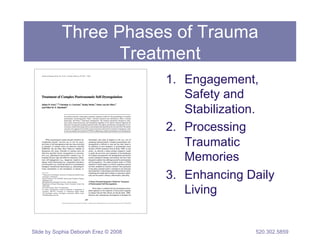
Three Phases of Trauma 
Treatment 
1. Engagement, 
Safety and 
Stabilization. 
2. Processing 
Traumatic 
Memories 
3. Enhancing Daily 
Living 
Slide by Sophia Deborah Erez © 2008 520.302.5859
Treatment throughout all phases: 
1. Must enhance the client’s ability to manage 
extreme arousal states. 
2. Should enhance the client’s sense of 
personal control and self efficacy. 
3. Must assist the client in maintaining an 
adequate level of functioning consistent with 
his and her past and current lifestyle and 
circumstances. 
Slide by Sophia Deborah Erez © 2008 520.302.5859
Treatment throughout all phases: 
4. Must enhance the client’s ability to 
approach and master rather than avoid 
experiences ( internal bodily-affective states 
as well as external events) that trigger 
intrusive re-experiencing, emotional 
numbing, and hyperarousal or hypoarousal. 
Slide by Sophia Deborah Erez © 2008 520.302.5859
Treatment throughout all phases: 
5. Therapists must be aware of and effectively 
manage clients’ transferential reactions and 
countertransference. 
Slide by Sophia Deborah Erez © 2008 520.302.5859
What stages of recovery does 
your program assist? 
1. Engagement, Safety and Stabilization. 
2. Processing Traumatic Memories 
3. Enhancing Daily Living. (Integration with self and community) 
Slide by Sophia Deborah Erez © 2008 520.302.5859
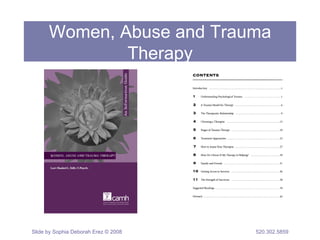
Women, Abuse and Trauma 
Therapy 
Slide by Sophia Deborah Erez © 2008 520.302.5859
Stages 
1. Stabilizing and managing responses 
• Establishing safety 
• Psycho education 
• Managing trauma responses 
2. Processing and grieving traumatic memories 
• CBT 
• EMDR 
• Body and Sensorimotor Psychotherapy 
3. Reconnecting with the world 
Slide by Sophia Deborah Erez © 2008 520.302.5859
Treatment Considerations 
Engagement 
– What does the client want? 
– What is their willingness to change? 
– Motivational interviewing 
Safety 
– Physical safety 
– Address suicidality and self harming behaviors 
– Harm reduction 
– Address medical needs 
– Address substance abuse and addictions 
– Therapeutic relationship 
Slide by Sophia Deborah Erez © 2008 520.302.5859
Treatment Considerations 
Containment 
– Affect regulation skills 
– Positive affect tolerance 
– Does the client have the skills to tolerate disturbing material 
without resorting to harmful coping mechanisms? 
Slide by Sophia Deborah Erez © 2008 520.302.5859
What clinical considerations 
apply to your clients? 
1. The complex role of the body. 
2. Trauma bonding. 
3. Betrayal of the social contract. 
4. And . . . 
Slide by Sophia Deborah Erez © 2008 520.302.5859
Five Principles 
to break free 
from the cycle 
of shame and 
self harm. 
Presented by: 
Sophia Deborah Erez, MS, LPC, MFT 
Shared Hope International 
November 30, 2011 
Copyright © 2000 by Autumn Burris. 
Slide by Sophia Deborah Erez © 2008 520.302.5859
Five principles . . . 
1. The behaviors we do that appear to 
sabotage our well-being are often our 
best attempt at creating safety in the 
present moment. 
Slide by Sophia Deborah Erez © 2008 520.302.5859
Five principles . . . 
2. We do these things because, 
historically, they worked. Ironically, we 
know they worked because we are alive 
today and often struggle with how these 
behaviors are no longer helpful. 
Slide by Sophia Deborah Erez © 2008 520.302.5859
Five principles . . . 
3. We cannot expect to stop utilizing the 
templates our nervous systems have 
learned to trust unless we have access to 
at least one other template that works just 
as well. 
Slide by Sophia Deborah Erez © 2008 520.302.5859
Five principles . . . 
4. The healing process includes: 
– honoring what has outlived its usefulness 
– learning to pause when feeling 
threatened 
– and accessing healthier, more effective 
ways of sensing safety in the present 
moment. 
Slide by Sophia Deborah Erez © 2008 520.302.5859
Five principles . . . 
5. The more moments we 
have of sensing safety in 
healthy ways, the more 
likely these "new" 
templates will became the 
default response in times 
of crisis and the more we 
learn to trust ourselves. 
Slide by Sophia Deborah Erez © 2008 520.302.5859
“You did then, 
what you knew how to do 
and when you knew better . . . 
you did better!” 
Maya Angelou 
Slide by Sophia Deborah Erez © 2008 520.302.5859
Negative Positive 
I don’t deserve love 
I am a bad person 
I am terrible 
I am worthless (inadequate) 
I am shameful 
I am not loveable 
I am not good enough 
I deserve only bad things 
I cannot be trusted 
I cannot trust my judgment 
I cannot succeed 
I am not in control 
I am powerless 
I am weak 
I cannot protect myself 
I am stupid 
I deserve love; I can have love 
I am a good (loving) person 
I am fine as I am 
I am worthy; I am worthwhile 
I am honorable 
I am loveable 
I am deserving; I am a good person 
I deserve good things 
I can (learn to) trust myself 
I can trust my judgment 
I can succeed 
I am now in control 
I now have choices 
I am strong 
I can (lean) to take care of myself 
I have intelligence 
Slide by Sophia Deborah Erez © 2008 520.302.5859
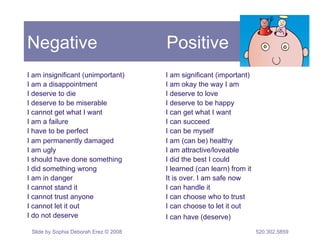
Negative Positive 
I am insignificant (unimportant) 
I am a disappointment 
I deserve to die 
I deserve to be miserable 
I cannot get what I want 
I am a failure 
I have to be perfect 
I am permanently damaged 
I am ugly 
I should have done something 
I did something wrong 
I am in danger 
I cannot stand it 
I cannot trust anyone 
I cannot let it out 
I do not deserve 
I am significant (important) 
I am okay the way I am 
I deserve to love 
I deserve to be happy 
I can get what I want 
I can succeed 
I can be myself 
I am (can be) healthy 
I am attractive/loveable 
I did the best I could 
I learned (can learn) from it 
It is over. I am safe now 
I can handle it 
I can choose who to trust 
I can choose to let it out 
I can have (deserve) 
Slide by Sophia Deborah Erez © 2008 520.302.5859
Negative Positive 
I am broken 
I do not belong 
I am capable of healing 
Slide by Sophia Deborah Erez © 2008 520.302.5859

Effective Trauma Treatment

  • 1.
    Effective Trauma Treatment: The Long and Winding Road Presented by: Sophia Deborah Erez, MS, LPC, MFT Shared Hope International November 30, 2011 Slide by Sophia Deborah Erez © 2008 520.302.5859
  • 2.
    What are yourperceptions of recovery? Slide by Sophia Deborah Erez © 2008 520.302.5859
  • 3.
    Slide by SophiaDeborah Erez © 2008 520.302.5859
  • 4.
    Slide by SophiaDeborah Erez © 2008 520.302.5859
  • 5.
    Three Phases ofTrauma Treatment 1. Engagement, Safety and Stabilization. 2. Processing Traumatic Memories 3. Enhancing Daily Living Slide by Sophia Deborah Erez © 2008 520.302.5859
  • 6.
    Treatment throughout allphases: 1. Must enhance the client’s ability to manage extreme arousal states. 2. Should enhance the client’s sense of personal control and self efficacy. 3. Must assist the client in maintaining an adequate level of functioning consistent with his and her past and current lifestyle and circumstances. Slide by Sophia Deborah Erez © 2008 520.302.5859
  • 7.
    Treatment throughout allphases: 4. Must enhance the client’s ability to approach and master rather than avoid experiences ( internal bodily-affective states as well as external events) that trigger intrusive re-experiencing, emotional numbing, and hyperarousal or hypoarousal. Slide by Sophia Deborah Erez © 2008 520.302.5859
  • 8.
    Treatment throughout allphases: 5. Therapists must be aware of and effectively manage clients’ transferential reactions and countertransference. Slide by Sophia Deborah Erez © 2008 520.302.5859
  • 9.
    What stages ofrecovery does your program assist? 1. Engagement, Safety and Stabilization. 2. Processing Traumatic Memories 3. Enhancing Daily Living. (Integration with self and community) Slide by Sophia Deborah Erez © 2008 520.302.5859
  • 10.
    Slide by SophiaDeborah Erez © 2008 520.302.5859
  • 11.
    Women, Abuse andTrauma Therapy Slide by Sophia Deborah Erez © 2008 520.302.5859
  • 12.
    Stages 1. Stabilizingand managing responses • Establishing safety • Psycho education • Managing trauma responses 2. Processing and grieving traumatic memories • CBT • EMDR • Body and Sensorimotor Psychotherapy 3. Reconnecting with the world Slide by Sophia Deborah Erez © 2008 520.302.5859
  • 13.
    Treatment Considerations Engagement – What does the client want? – What is their willingness to change? – Motivational interviewing Safety – Physical safety – Address suicidality and self harming behaviors – Harm reduction – Address medical needs – Address substance abuse and addictions – Therapeutic relationship Slide by Sophia Deborah Erez © 2008 520.302.5859
  • 14.
    Treatment Considerations Containment – Affect regulation skills – Positive affect tolerance – Does the client have the skills to tolerate disturbing material without resorting to harmful coping mechanisms? Slide by Sophia Deborah Erez © 2008 520.302.5859
  • 15.
    What clinical considerations apply to your clients? 1. The complex role of the body. 2. Trauma bonding. 3. Betrayal of the social contract. 4. And . . . Slide by Sophia Deborah Erez © 2008 520.302.5859
  • 16.
    Five Principles tobreak free from the cycle of shame and self harm. Presented by: Sophia Deborah Erez, MS, LPC, MFT Shared Hope International November 30, 2011 Copyright © 2000 by Autumn Burris. Slide by Sophia Deborah Erez © 2008 520.302.5859
  • 17.
    Five principles .. . 1. The behaviors we do that appear to sabotage our well-being are often our best attempt at creating safety in the present moment. Slide by Sophia Deborah Erez © 2008 520.302.5859
  • 18.
    Five principles .. . 2. We do these things because, historically, they worked. Ironically, we know they worked because we are alive today and often struggle with how these behaviors are no longer helpful. Slide by Sophia Deborah Erez © 2008 520.302.5859
  • 19.
    Five principles .. . 3. We cannot expect to stop utilizing the templates our nervous systems have learned to trust unless we have access to at least one other template that works just as well. Slide by Sophia Deborah Erez © 2008 520.302.5859
  • 20.
    Five principles .. . 4. The healing process includes: – honoring what has outlived its usefulness – learning to pause when feeling threatened – and accessing healthier, more effective ways of sensing safety in the present moment. Slide by Sophia Deborah Erez © 2008 520.302.5859
  • 21.
    Five principles .. . 5. The more moments we have of sensing safety in healthy ways, the more likely these "new" templates will became the default response in times of crisis and the more we learn to trust ourselves. Slide by Sophia Deborah Erez © 2008 520.302.5859
  • 22.
    “You did then, what you knew how to do and when you knew better . . . you did better!” Maya Angelou Slide by Sophia Deborah Erez © 2008 520.302.5859
  • 23.
    Negative Positive Idon’t deserve love I am a bad person I am terrible I am worthless (inadequate) I am shameful I am not loveable I am not good enough I deserve only bad things I cannot be trusted I cannot trust my judgment I cannot succeed I am not in control I am powerless I am weak I cannot protect myself I am stupid I deserve love; I can have love I am a good (loving) person I am fine as I am I am worthy; I am worthwhile I am honorable I am loveable I am deserving; I am a good person I deserve good things I can (learn to) trust myself I can trust my judgment I can succeed I am now in control I now have choices I am strong I can (lean) to take care of myself I have intelligence Slide by Sophia Deborah Erez © 2008 520.302.5859
  • 24.
    Negative Positive Iam insignificant (unimportant) I am a disappointment I deserve to die I deserve to be miserable I cannot get what I want I am a failure I have to be perfect I am permanently damaged I am ugly I should have done something I did something wrong I am in danger I cannot stand it I cannot trust anyone I cannot let it out I do not deserve I am significant (important) I am okay the way I am I deserve to love I deserve to be happy I can get what I want I can succeed I can be myself I am (can be) healthy I am attractive/loveable I did the best I could I learned (can learn) from it It is over. I am safe now I can handle it I can choose who to trust I can choose to let it out I can have (deserve) Slide by Sophia Deborah Erez © 2008 520.302.5859
  • 25.
    Negative Positive Iam broken I do not belong I am capable of healing Slide by Sophia Deborah Erez © 2008 520.302.5859