PhRMA: Some Early Thoughts
Philip E. Bourne Ph.D.
Associate Director for Data Science
National Institutes of Health
Prior History
 Professor UCSD - Research structural bioinformatics,
systems pharmacology
 Assoc. Vice Chancellor for Innovation UCSD
 Co-directed the RCSB Protein Data Bank
 Co-founded PLOS Computational Biology; First EIC
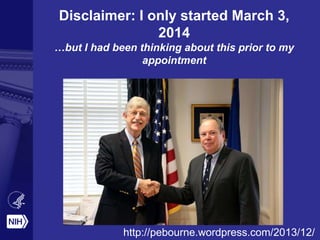
Disclaimer: I only started March 3,
2014
…but I had been thinking about this prior to my
appointment
http://pebourne.wordpress.com/2013/12/
Numberofreleasedentries
Year
Why Am I Here?
PDB Growth in Numbers and Complexity
[From the RCSB Protein Data Bank]
Why Am I Here?
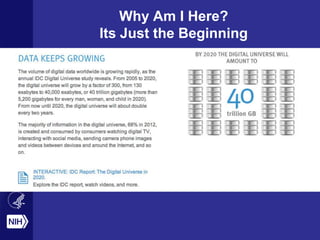
Its Just the Beginning
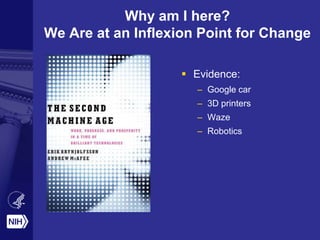
Why am I here?
We Are at an Inflexion Point for Change
 Evidence:
– Google car
– 3D printers
– Waze
– Robotics
Some History
NIH Data & Informatics Working
Group
In response to the growth of large biomedical
datasets, the Director of NIH established a
special Data and Informatics Working Group
(DIWG).
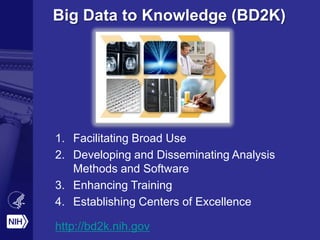
Big Data to Knowledge (BD2K)
1. Facilitating Broad Use
2. Developing and Disseminating Analysis
Methods and Software
3. Enhancing Training
4. Establishing Centers of Excellence
http://bd2k.nih.gov
Policies
 PubMed Central
 Data sharing policy
 OSTP Directive
– Genomic data sharing policy
 Leading edge of further policies for different data
types including clinical data eg to address issues with
DbGap
Some Early Observations
Don’t Hesitate to Push Back, I May Be
Speaking Out of Ignorance
Some Early Observations
1. We don’t know enough about how existing data are
used
* http://www.cdc.gov/h1n1flu/estimates/April_March_13.htm
Jan. 2008 Jan. 2009 Jan. 2010Jul. 2009Jul. 2008 Jul. 2010
1RUZ: 1918 H1 Hemagglutinin
Structure Summary page activity for
H1N1 Influenza related structures
3B7E: Neuraminidase of A/Brevig Mission/1/1918
H1N1 strain in complex with zanamivir
[Andreas Prlic]
Consider What
Might Be Possible
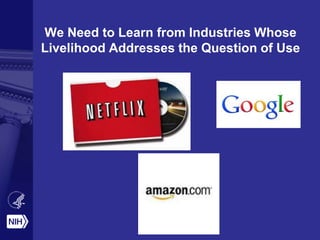
We Need to Learn from Industries Whose
Livelihood Addresses the Question of Use
Some Early Observations
1. We don’t know enough about how existing data are
used
2. We have focused on the why, but not the how
2. We have focused on the why, but
not the how
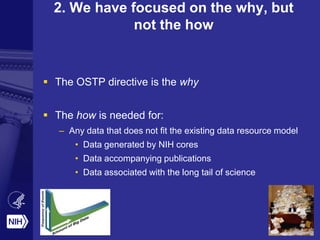
 The OSTP directive is the why
 The how is needed for:
– Any data that does not fit the existing data resource model
• Data generated by NIH cores
• Data accompanying publications
• Data associated with the long tail of science
Considering a Data Commons to
Address this Need
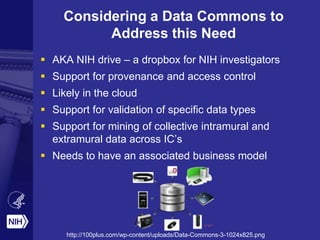
 AKA NIH drive – a dropbox for NIH investigators
 Support for provenance and access control
 Likely in the cloud
 Support for validation of specific data types
 Support for mining of collective intramural and
extramural data across IC’s
 Needs to have an associated business model
http://100plus.com/wp-content/uploads/Data-Commons-3-1024x825.png
Some Early Observations
1. We don’t know enough about how existing data are
used
2. We have focused on the why, but not the how
3. We do not have an NIH-wide sustainability plan for
data (not heard of an IC-based plan either)
3. Sustainability
 Problems
– Maintaining a work force – lack of reward
– Too much data; too few dollars
– Resources
• In different stages of maturity but treated the same
• Funded by a few used by many
– True as measured by IC
– True as measured by agency
– True as measured by country
• Reviews can be problematic
3. Sustainability
 Solutions
– Establish a central fund to support
– New funding models eg open submission and review
– Split innovation from core support and review separately
– Policies for uniform metric reporting
– Discuss with the private sector possible funding models
– More cooperation, less redundancy across agencies
– Bring foundations into the discussion
– Discuss with libraries, repositories their role
– Educate decision makes as to the changing landscape
Some Early Observations
1. We don’t know enough about how existing data are
used
2. We have focused on the why, but not the how
3. We do not have an NIH-wide sustainability plan for
data (not heard of an IC-based plan either)
4. Training in biomedical data science is spotty
4. Training in biomedical data science
is spotty
 Problem
– Coverage of the domain is unclear
– There may well be redundancies
 Solution
– Cold Spring Harbor like training facility(s)
• Training coordinator
• Rolling hands on courses in key areas
• Appropriate materials on-line
Some Early Observations
1. We don’t know enough about how existing data are
used
2. We have focused on the why, but not the how
3. We do not have an NIH-wide sustainability plan for
data (not heard of an IC-based plan either)
4. Training in biomedical data science is spotty
5. Reproducibility will need to be embraced
47/53 “landmark” publications
could not be replicated
[Begley, Ellis Nature,
483, 2012] [Carole Goble]
Long Term I think of these solutions
as something I call the digital
enterprise
Any institution is a candidate to be a digital
enterprise, but lets explore it in the context
of the academic medical center
Components of The Academic Digital
Enterprise
 Consists of digital assets
– E.g. datasets, papers, software, lab notes
 Each asset is uniquely identified and has
provenance, including access control
– E.g. publishing simply involves changing the access control
 Digital assets are interoperable across the enterprise
Life in the Academic Digital Enterprise
 Jane scores extremely well in parts of her graduate on-line neurology class.
Neurology professors, whose research profiles are on-line and well described, are
automatically notified of Jane’s potential based on a computer analysis of her scores
against the background interests of the neuroscience professors. Consequently,
professor Smith interviews Jane and offers her a research rotation. During the
rotation she enters details of her experiments related to understanding a widespread
neurodegenerative disease in an on-line laboratory notebook kept in a shared on-line
research space – an institutional resource where stakeholders provide metadata,
including access rights and provenance beyond that available in a commercial
offering. According to Jane’s preferences, the underlying computer system may
automatically bring to Jane’s attention Jack, a graduate student in the chemistry
department whose notebook reveals he is working on using bacteria for purposes of
toxic waste cleanup. Why the connection? They reference the same gene a number
of times in their notes, which is of interest to two very different disciplines – neurology
and environmental sciences. In the analog academic health center they would never
have discovered each other, but thanks to the Digital Enterprise, pooled knowledge
can lead to a distinct advantage. The collaboration results in the discovery of a
homologous human gene product as a putative target in treating the
neurodegenerative disorder. A new chemical entity is developed and patented.
Accordingly, by automatically matching details of the innovation with biotech
companies worldwide that might have potential interest, a licensee is found. The
licensee hires Jack to continue working on the project. Jane joins Joe’s laboratory,
and he hires another student using the revenue from the license. The research
continues and leads to a federal grant award. The students are employed, further
research is supported and in time societal benefit arises from the technology.
From What Big Data Means to Me JAMIA 2014 21:194
Life in the NIH Digital Enterprise
 Researcher x is made aware of researcher y through
commonalities in their data located in the data commons.
Researcher x reviews the grants profile of researcher y and
publication history and impact from those grants in the past 5
years and decides to contact her. A fruitful collaboration ensues
and they generate papers, data sets and software. Metrics
automatically pushed to company z for all relevant NIH data and
software in a specific domain with utilization above a threshold
indicate that their data and software are heavily utilized and
respected by the community. An open source version remains,
but the company adds services on top of the software for the
novice user and revenue flows back to the labs of researchers x
and y which is used to develop new innovative software for
open distribution. Researchers x and y come to the NIH training
center periodically to provide hands-on advice in the use of their
new version and their course is offered as a MOOC.
To get to that end point we have to
consider the complete research
lifecycle
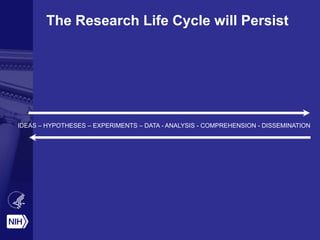
The Research Life Cycle will Persist
IDEAS – HYPOTHESES – EXPERIMENTS – DATA - ANALYSIS - COMPREHENSION - DISSEMINATION
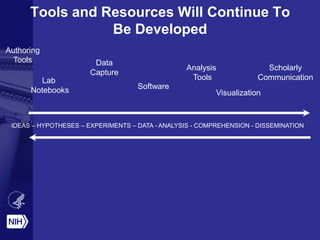
Tools and Resources Will Continue To
Be Developed
IDEAS – HYPOTHESES – EXPERIMENTS – DATA - ANALYSIS - COMPREHENSION - DISSEMINATION
Authoring
Tools
Lab
Notebooks
Data
Capture
Software
Analysis
Tools
Visualization
Scholarly
Communication
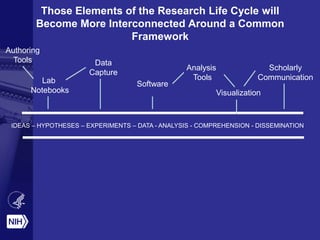
Those Elements of the Research Life Cycle will
Become More Interconnected Around a Common
Framework
IDEAS – HYPOTHESES – EXPERIMENTS – DATA - ANALYSIS - COMPREHENSION - DISSEMINATION
Authoring
Tools
Lab
Notebooks
Data
Capture
Software
Analysis
Tools
Visualization
Scholarly
Communication
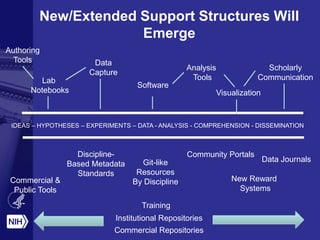
New/Extended Support Structures Will
Emerge
IDEAS – HYPOTHESES – EXPERIMENTS – DATA - ANALYSIS - COMPREHENSION - DISSEMINATION
Authoring
Tools
Lab
Notebooks
Data
Capture
Software
Analysis
Tools
Visualization
Scholarly
Communication
Commercial &
Public Tools
Git-like
Resources
By Discipline
Data Journals
Discipline-
Based Metadata
Standards
Community Portals
Institutional Repositories
New Reward
Systems
Commercial Repositories
Training
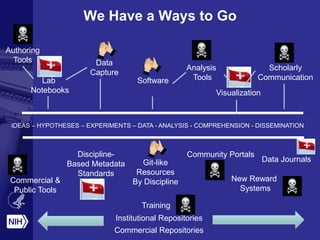
We Have a Ways to Go
IDEAS – HYPOTHESES – EXPERIMENTS – DATA - ANALYSIS - COMPREHENSION - DISSEMINATION
Authoring
Tools
Lab
Notebooks
Data
Capture
Software
Analysis
Tools
Visualization
Scholarly
Communication
Commercial &
Public Tools
Git-like
Resources
By Discipline
Data Journals
Discipline-
Based Metadata
Standards
Community Portals
Institutional Repositories
New Reward
Systems
Commercial Repositories
Training
How PhRMA Can Be Engaged?
 Representation on ADDS Advisory?
 Participate in forthcoming workshops
– High level strategy
– Implementation
 Other ideas?
Thank You!
Questions?
philip.bourne@nih.gov
NIH…
Turning Discovery Into Health

PhRMA Some Early Thoughts

  • 1.
    PhRMA: Some EarlyThoughts Philip E. Bourne Ph.D. Associate Director for Data Science National Institutes of Health
  • 2.
    Prior History  ProfessorUCSD - Research structural bioinformatics, systems pharmacology  Assoc. Vice Chancellor for Innovation UCSD  Co-directed the RCSB Protein Data Bank  Co-founded PLOS Computational Biology; First EIC
  • 3.
    Disclaimer: I onlystarted March 3, 2014 …but I had been thinking about this prior to my appointment http://pebourne.wordpress.com/2013/12/
  • 4.
    Numberofreleasedentries Year Why Am IHere? PDB Growth in Numbers and Complexity [From the RCSB Protein Data Bank]
  • 5.
    Why Am IHere? Its Just the Beginning
  • 6.
    Why am Ihere? We Are at an Inflexion Point for Change  Evidence: – Google car – 3D printers – Waze – Robotics
  • 7.
  • 8.
    NIH Data &Informatics Working Group In response to the growth of large biomedical datasets, the Director of NIH established a special Data and Informatics Working Group (DIWG).
  • 9.
    Big Data toKnowledge (BD2K) 1. Facilitating Broad Use 2. Developing and Disseminating Analysis Methods and Software 3. Enhancing Training 4. Establishing Centers of Excellence http://bd2k.nih.gov
  • 10.
    Policies  PubMed Central Data sharing policy  OSTP Directive – Genomic data sharing policy  Leading edge of further policies for different data types including clinical data eg to address issues with DbGap
  • 11.
    Some Early Observations Don’tHesitate to Push Back, I May Be Speaking Out of Ignorance
  • 12.
    Some Early Observations 1.We don’t know enough about how existing data are used
  • 13.
    * http://www.cdc.gov/h1n1flu/estimates/April_March_13.htm Jan. 2008Jan. 2009 Jan. 2010Jul. 2009Jul. 2008 Jul. 2010 1RUZ: 1918 H1 Hemagglutinin Structure Summary page activity for H1N1 Influenza related structures 3B7E: Neuraminidase of A/Brevig Mission/1/1918 H1N1 strain in complex with zanamivir [Andreas Prlic] Consider What Might Be Possible
  • 14.
    We Need toLearn from Industries Whose Livelihood Addresses the Question of Use
  • 15.
    Some Early Observations 1.We don’t know enough about how existing data are used 2. We have focused on the why, but not the how
  • 16.
    2. We havefocused on the why, but not the how  The OSTP directive is the why  The how is needed for: – Any data that does not fit the existing data resource model • Data generated by NIH cores • Data accompanying publications • Data associated with the long tail of science
  • 17.
    Considering a DataCommons to Address this Need  AKA NIH drive – a dropbox for NIH investigators  Support for provenance and access control  Likely in the cloud  Support for validation of specific data types  Support for mining of collective intramural and extramural data across IC’s  Needs to have an associated business model http://100plus.com/wp-content/uploads/Data-Commons-3-1024x825.png
  • 18.
    Some Early Observations 1.We don’t know enough about how existing data are used 2. We have focused on the why, but not the how 3. We do not have an NIH-wide sustainability plan for data (not heard of an IC-based plan either)
  • 19.
    3. Sustainability  Problems –Maintaining a work force – lack of reward – Too much data; too few dollars – Resources • In different stages of maturity but treated the same • Funded by a few used by many – True as measured by IC – True as measured by agency – True as measured by country • Reviews can be problematic
  • 20.
    3. Sustainability  Solutions –Establish a central fund to support – New funding models eg open submission and review – Split innovation from core support and review separately – Policies for uniform metric reporting – Discuss with the private sector possible funding models – More cooperation, less redundancy across agencies – Bring foundations into the discussion – Discuss with libraries, repositories their role – Educate decision makes as to the changing landscape
  • 21.
    Some Early Observations 1.We don’t know enough about how existing data are used 2. We have focused on the why, but not the how 3. We do not have an NIH-wide sustainability plan for data (not heard of an IC-based plan either) 4. Training in biomedical data science is spotty
  • 22.
    4. Training inbiomedical data science is spotty  Problem – Coverage of the domain is unclear – There may well be redundancies  Solution – Cold Spring Harbor like training facility(s) • Training coordinator • Rolling hands on courses in key areas • Appropriate materials on-line
  • 23.
    Some Early Observations 1.We don’t know enough about how existing data are used 2. We have focused on the why, but not the how 3. We do not have an NIH-wide sustainability plan for data (not heard of an IC-based plan either) 4. Training in biomedical data science is spotty 5. Reproducibility will need to be embraced
  • 24.
    47/53 “landmark” publications couldnot be replicated [Begley, Ellis Nature, 483, 2012] [Carole Goble]
  • 25.
    Long Term Ithink of these solutions as something I call the digital enterprise Any institution is a candidate to be a digital enterprise, but lets explore it in the context of the academic medical center
  • 26.
    Components of TheAcademic Digital Enterprise  Consists of digital assets – E.g. datasets, papers, software, lab notes  Each asset is uniquely identified and has provenance, including access control – E.g. publishing simply involves changing the access control  Digital assets are interoperable across the enterprise
  • 27.
    Life in theAcademic Digital Enterprise  Jane scores extremely well in parts of her graduate on-line neurology class. Neurology professors, whose research profiles are on-line and well described, are automatically notified of Jane’s potential based on a computer analysis of her scores against the background interests of the neuroscience professors. Consequently, professor Smith interviews Jane and offers her a research rotation. During the rotation she enters details of her experiments related to understanding a widespread neurodegenerative disease in an on-line laboratory notebook kept in a shared on-line research space – an institutional resource where stakeholders provide metadata, including access rights and provenance beyond that available in a commercial offering. According to Jane’s preferences, the underlying computer system may automatically bring to Jane’s attention Jack, a graduate student in the chemistry department whose notebook reveals he is working on using bacteria for purposes of toxic waste cleanup. Why the connection? They reference the same gene a number of times in their notes, which is of interest to two very different disciplines – neurology and environmental sciences. In the analog academic health center they would never have discovered each other, but thanks to the Digital Enterprise, pooled knowledge can lead to a distinct advantage. The collaboration results in the discovery of a homologous human gene product as a putative target in treating the neurodegenerative disorder. A new chemical entity is developed and patented. Accordingly, by automatically matching details of the innovation with biotech companies worldwide that might have potential interest, a licensee is found. The licensee hires Jack to continue working on the project. Jane joins Joe’s laboratory, and he hires another student using the revenue from the license. The research continues and leads to a federal grant award. The students are employed, further research is supported and in time societal benefit arises from the technology. From What Big Data Means to Me JAMIA 2014 21:194
  • 28.
    Life in theNIH Digital Enterprise  Researcher x is made aware of researcher y through commonalities in their data located in the data commons. Researcher x reviews the grants profile of researcher y and publication history and impact from those grants in the past 5 years and decides to contact her. A fruitful collaboration ensues and they generate papers, data sets and software. Metrics automatically pushed to company z for all relevant NIH data and software in a specific domain with utilization above a threshold indicate that their data and software are heavily utilized and respected by the community. An open source version remains, but the company adds services on top of the software for the novice user and revenue flows back to the labs of researchers x and y which is used to develop new innovative software for open distribution. Researchers x and y come to the NIH training center periodically to provide hands-on advice in the use of their new version and their course is offered as a MOOC.
  • 29.
    To get tothat end point we have to consider the complete research lifecycle
  • 30.
    The Research LifeCycle will Persist IDEAS – HYPOTHESES – EXPERIMENTS – DATA - ANALYSIS - COMPREHENSION - DISSEMINATION
  • 31.
    Tools and ResourcesWill Continue To Be Developed IDEAS – HYPOTHESES – EXPERIMENTS – DATA - ANALYSIS - COMPREHENSION - DISSEMINATION Authoring Tools Lab Notebooks Data Capture Software Analysis Tools Visualization Scholarly Communication
  • 32.
    Those Elements ofthe Research Life Cycle will Become More Interconnected Around a Common Framework IDEAS – HYPOTHESES – EXPERIMENTS – DATA - ANALYSIS - COMPREHENSION - DISSEMINATION Authoring Tools Lab Notebooks Data Capture Software Analysis Tools Visualization Scholarly Communication
  • 33.
    New/Extended Support StructuresWill Emerge IDEAS – HYPOTHESES – EXPERIMENTS – DATA - ANALYSIS - COMPREHENSION - DISSEMINATION Authoring Tools Lab Notebooks Data Capture Software Analysis Tools Visualization Scholarly Communication Commercial & Public Tools Git-like Resources By Discipline Data Journals Discipline- Based Metadata Standards Community Portals Institutional Repositories New Reward Systems Commercial Repositories Training
  • 34.
    We Have aWays to Go IDEAS – HYPOTHESES – EXPERIMENTS – DATA - ANALYSIS - COMPREHENSION - DISSEMINATION Authoring Tools Lab Notebooks Data Capture Software Analysis Tools Visualization Scholarly Communication Commercial & Public Tools Git-like Resources By Discipline Data Journals Discipline- Based Metadata Standards Community Portals Institutional Repositories New Reward Systems Commercial Repositories Training
  • 35.
    How PhRMA CanBe Engaged?  Representation on ADDS Advisory?  Participate in forthcoming workshops – High level strategy – Implementation  Other ideas?
  • 36.
  • 37.