Why should my institution
support RRIDs?
RRIDs were created jointly by NIH, Journal Editors, UCSD and other researchers
and function in support of NIH guidelines for Rigor and Transparency
RRIDs are funded and maintained jointly by the following:
U24-DA039832 to The Neuroscience Information Framework, U24-DK097771 to
dkNet, R43-OD024432 to SciCrunch Inc, and Leona M. and Harry B. Helmsley
Charitable Trust
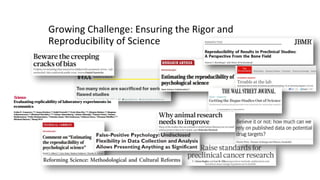
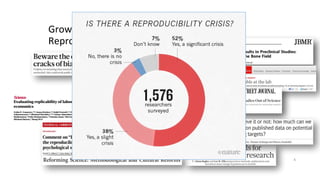
Reproducibility woes touch all aspects of the
research enterprise
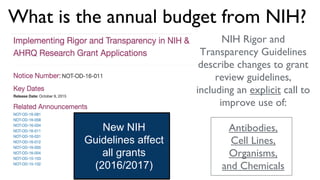
New NIH
Guidelines affect
all grants
(2016/2017)
NIH Rigor and
Transparency Guidelines
describe changes to grant
review guidelines,
including an explicit call to
improve use of:
Antibodies,
Cell Lines,
Organisms,
and Chemicals
What is the annual budget from NIH?
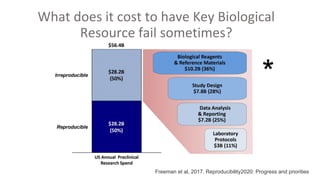
Freeman et al, 2017. Reproducibility2020: Progress and priorities
*
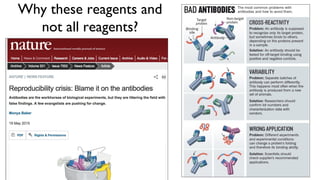
Why these reagents and
not all reagents?
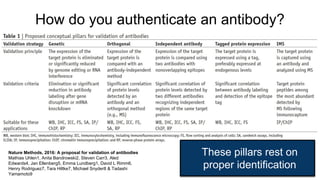
How do you authenticate an antibody?
Nature Methods, 2016: A proposal for validation of antibodies
Mathias Uhlen1, Anita Bandrowski2, Steven Carr3, Aled
Edwards4, Jan Ellenberg5, Emma Lundberg1, David L Rimm6,
Henry Rodriguez7, Tara Hiltke7, Michael Snyder8 & Tadashi
Yamamoto9
These pillars rest on
proper identification
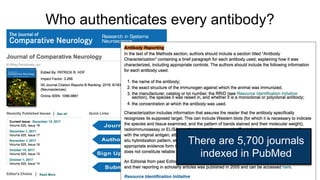
Who authenticates every antibody?
There are 5,700 journals
indexed in PubMed
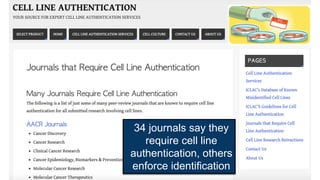
34 journals say they
require cell line
authentication, others
enforce identification
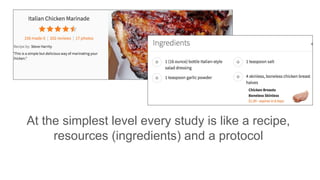
At the simplest level every study is like a recipe,
resources (ingredients) and a protocol
•
•
•
•
•
•
The State of The Art in Publishing
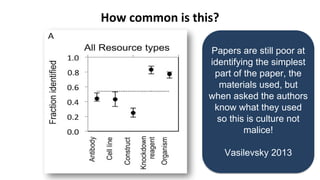
Papers are still poor at
identifying the simplest
part of the paper, the
materials used, but
when asked the authors
know what they used
so this is culture not
malice!
Vasilevsky 2013
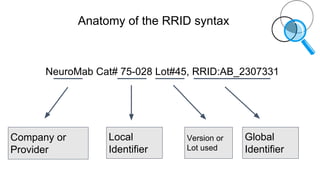
Anatomy of the RRID syntax
NeuroMab Cat# 75-028 Lot#45, RRID:AB_2307331
Company or
Provider
Local
Identifier
Version or
Lot used
Global
Identifier
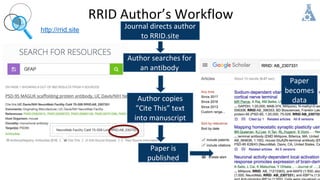
http://rrid.site
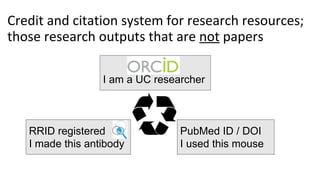
PubMed ID / DOI
I used this mouse
RRID registered
I made this antibody
I am a UC researcher
•
•
•
•
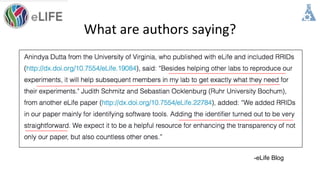
-eLife Blog
RRIDs in the wild
But why should my institution care?
1.
RRIDs help researchers demonstrate
they comply with NIH guidelines
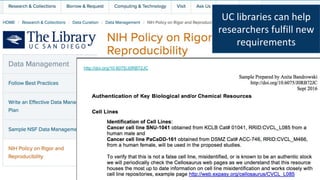
http://doi.org/10.6075/J0RB72JC
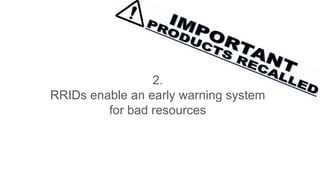
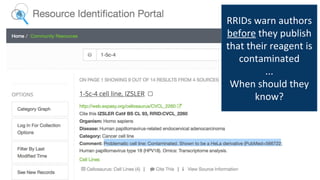
2.
RRIDs enable an early warning system
for bad resources
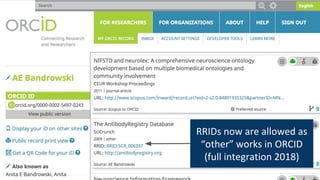
3.
RRIDs enable UC to track resources as
intellectual output of faculty/staff
To recommend that researchers use RRIDs
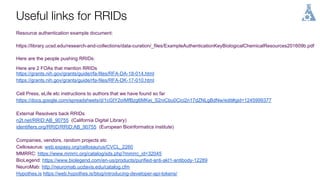
Useful links for RRIDs
Resource authentication example document:
https://library.ucsd.edu/research-and-collections/data-curation/_files/ExampleAuthenticationKeyBiologicalChemicalResources201609b.pdf
Here are the people pushing RRIDs:
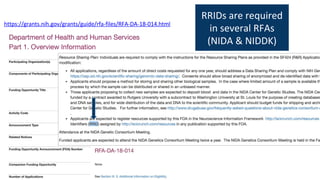
Here are 2 FOAs that mention RRIDs
https://grants.nih.gov/grants/guide/rfa-files/RFA-DA-18-014.html
https://grants.nih.gov/grants/guide/rfa-files/RFA-DK-17-010.html
Cell Press, eLife etc instructions to authors that we have found so far
https://docs.google.com/spreadsheets/d/1cGtY2oIMfBzg6MKei_S2niCbu0Cici2n17dZNLgBdNw/edit#gid=1245999377
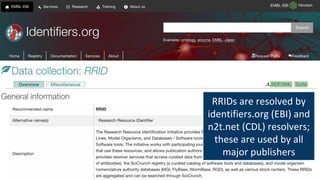
External Resolvers back RRIDs
n2t.net/RRID:AB_90755 (California Digital Library)
identifiers.org/RRID/RRID:AB_90755 (European Bioinformatics institute)
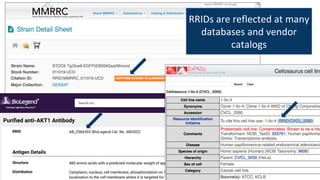
Companies, vendors, random projects etc
Cellosaurus: web.expasy.org/cellosaurus/CVCL_2260
MMRRC: https://www.mmrrc.org/catalog/sds.php?mmrrc_id=32045
BioLegend: https://www.biolegend.com/en-us/products/purified-anti-akt1-antibody-12289
NeuroMab: http://neuromab.ucdavis.edu/catalog.cfm
Hypothes.is https://web.hypothes.is/blog/introducing-developer-api-tokens/

Why should my institution support RRIDs?

  • 1.
    Why should myinstitution support RRIDs? RRIDs were created jointly by NIH, Journal Editors, UCSD and other researchers and function in support of NIH guidelines for Rigor and Transparency RRIDs are funded and maintained jointly by the following: U24-DA039832 to The Neuroscience Information Framework, U24-DK097771 to dkNet, R43-OD024432 to SciCrunch Inc, and Leona M. and Harry B. Helmsley Charitable Trust
  • 2.
    Reproducibility woes touchall aspects of the research enterprise
  • 5.
    New NIH Guidelines affect allgrants (2016/2017) NIH Rigor and Transparency Guidelines describe changes to grant review guidelines, including an explicit call to improve use of: Antibodies, Cell Lines, Organisms, and Chemicals What is the annual budget from NIH?
  • 6.
    Freeman et al,2017. Reproducibility2020: Progress and priorities *
  • 7.
    Why these reagentsand not all reagents?
  • 8.
    How do youauthenticate an antibody? Nature Methods, 2016: A proposal for validation of antibodies Mathias Uhlen1, Anita Bandrowski2, Steven Carr3, Aled Edwards4, Jan Ellenberg5, Emma Lundberg1, David L Rimm6, Henry Rodriguez7, Tara Hiltke7, Michael Snyder8 & Tadashi Yamamoto9 These pillars rest on proper identification
  • 9.
    Who authenticates everyantibody? There are 5,700 journals indexed in PubMed
  • 10.
    34 journals saythey require cell line authentication, others enforce identification
  • 11.
    At the simplestlevel every study is like a recipe, resources (ingredients) and a protocol
  • 12.
  • 13.
  • 14.
    The State ofThe Art in Publishing
  • 16.
    Papers are stillpoor at identifying the simplest part of the paper, the materials used, but when asked the authors know what they used so this is culture not malice! Vasilevsky 2013
  • 18.
    Anatomy of theRRID syntax NeuroMab Cat# 75-028 Lot#45, RRID:AB_2307331 Company or Provider Local Identifier Version or Lot used Global Identifier
  • 19.
  • 20.
    PubMed ID /DOI I used this mouse RRID registered I made this antibody I am a UC researcher
  • 21.
  • 24.
  • 26.
  • 30.
    But why shouldmy institution care?
  • 31.
    1. RRIDs help researchersdemonstrate they comply with NIH guidelines
  • 32.
  • 33.
    2. RRIDs enable anearly warning system for bad resources
  • 35.
    3. RRIDs enable UCto track resources as intellectual output of faculty/staff
  • 37.
    To recommend thatresearchers use RRIDs
  • 38.
    Useful links forRRIDs Resource authentication example document: https://library.ucsd.edu/research-and-collections/data-curation/_files/ExampleAuthenticationKeyBiologicalChemicalResources201609b.pdf Here are the people pushing RRIDs: Here are 2 FOAs that mention RRIDs https://grants.nih.gov/grants/guide/rfa-files/RFA-DA-18-014.html https://grants.nih.gov/grants/guide/rfa-files/RFA-DK-17-010.html Cell Press, eLife etc instructions to authors that we have found so far https://docs.google.com/spreadsheets/d/1cGtY2oIMfBzg6MKei_S2niCbu0Cici2n17dZNLgBdNw/edit#gid=1245999377 External Resolvers back RRIDs n2t.net/RRID:AB_90755 (California Digital Library) identifiers.org/RRID/RRID:AB_90755 (European Bioinformatics institute) Companies, vendors, random projects etc Cellosaurus: web.expasy.org/cellosaurus/CVCL_2260 MMRRC: https://www.mmrrc.org/catalog/sds.php?mmrrc_id=32045 BioLegend: https://www.biolegend.com/en-us/products/purified-anti-akt1-antibody-12289 NeuroMab: http://neuromab.ucdavis.edu/catalog.cfm Hypothes.is https://web.hypothes.is/blog/introducing-developer-api-tokens/