





The Cochrane Library
Finding quality reviews of research evidence
@ncllibmed
Walton Library
Explore the possibilities
@ncllibmed
Walton Library
Explore the possibilities
What is the Cochrane Library?
The Cochrane Library is the single most reliable
source for evidence on the effects of health care.
Health care in the 21st Century relies not only on
individual medical skills, but also on the best
information on the effectiveness of each intervention
being accessible to practitioners, patients, and policy
makers. This approach is known as “evidence-based
medicine”.
@ncllibmed
Walton Library
Explore the possibilities
What is the Cochrane Library?
• The Cochrane Library is a collection of evidence-based medicine databases.
Cochrane Database of Systematic Reviews (CDSR)
Cochrane Central Register of Controlled Trials (CENTRAL)
Cochrane Methodology Register (CMR)
Database of Abstracts of Reviews of Effects (DARE)
Health Technology Assessment Database (HTA)
NHS Economic Evaluation Database (EED)
It also contains information about The Cochrane Collaboration and the
Cochrane Collaborative Review Groups.
@ncllibmed
Walton Library
Explore the possibilities
Cochrane Database of Systematic Reviews (CDSR)
• What is a Systematic Review
A systematic review attempts to identify, appraise and synthesize all the empirical evidence
that meets pre-specified eligibility criteria to answer a given research question.
Researchers conducting systematic reviews use explicit methods aimed at minimizing
bias, in order to produce more reliable findings that can be used to inform decision
making.
They summarise conclusions about effectiveness, and provide a unique collation of the
known evidence on a given topic, so that others can easily review the primary studies for
intervention.
@ncllibmed
Walton Library
Explore the possibilities
Why are Cochrane Systematic Reviews so important?
Cochrane Reviews are conducted to the highest standard of methodological quality.
They have been found to be of comparable or better quality and are updated more frequently
than reviews published in print journals.*
Cochrane reviews address clearly formulated questions.
*Source:
Jadad AR, Cook DJ, Jones A, Klassen TP, Tugwell P, Moher M, Moher D. Methodology and reports of systematic reviews and meta-
analyses: a comparison of Cochrane reviews with articles published in paper-based journals. JAMA 1998;280:278-280.
@ncllibmed
Walton Library
Explore the possibilities
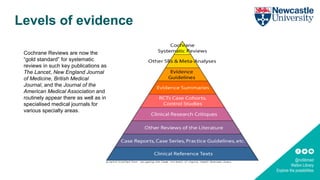
Cochrane Reviews are now the
“gold standard” for systematic
reviews in such key publications as
The Lancet, New England Journal
of Medicine, British Medical
Journal, and the Journal of the
American Medical Association and
routinely appear there as well as in
specialised medical journals for
various specialty areas.
Levels of evidence
@ncllibmed
Walton Library
Explore the possibilities
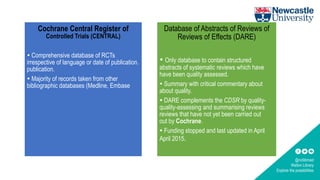
Cochrane Central Register of
Controlled Trials (CENTRAL)
 Comprehensive database of RCTs
irrespective of language or date of publication.
publication.
 Majority of records taken from other
bibliographic databases (Medline, Embase
Database of Abstracts of Reviews of
Reviews of Effects (DARE)
 Only database to contain structured
abstracts of systematic reviews which have
have been quality assessed.
 Summary with critical commentary about
about quality.
 DARE complements the CDSR by quality-
quality-assessing and summarising reviews
reviews that have not yet been carried out
out by Cochrane.
 Funding stopped and last updated in April
April 2015.
@ncllibmed
Walton Library
Explore the possibilities
Cochrane Methodology Register
Register (CMR)
 A bibliography of publications that
that report on methods used in the
the conduct of controlled trials.
 Includes journal articles, books and
books and conference proceedings.
proceedings. Content sourced from
from Medline and hand searching.
searching.
@ncllibmed
Walton Library
Explore the possibilities
Health Technology Assessment
 Details of completed and ongoing health
health technology assessments. (Studies of
(Studies of the medical, social, ethical and
ethical and economic implications of
healthcare interventions).
 Overall aim to improve the quality and
and cost effectiveness of health care.
care.
 Produced by CRD, University of York
York using information from International
International Network of Agencies for Health
for Health Technology Assessment
(INAHTA).
 Last updated October 2016.
Economic Evaluations Database
 Assists decision-makers by systematically
systematically identifying economic
evaluations from around the world,
appraising their quality, and highlighting their
highlighting their relative strengths and
and weaknesses.
 Was produced by the Centre for Reviews
Reviews and Dissemination (CRD) at the
libhelp.ncl.ac.uk
Phone
0191 208 7550
Text / SMS
0191 328 0570
Email
libraryhelp@ncl.ac.uk
Live 24/7 chat
libhelp.ncl.ac.uk@ncllibmed
@NULibraries
newcastleunilibrary

The Cochrane library

  • 1.
    The Cochrane Library Findingquality reviews of research evidence @ncllibmed Walton Library Explore the possibilities
  • 2.
    @ncllibmed Walton Library Explore thepossibilities What is the Cochrane Library? The Cochrane Library is the single most reliable source for evidence on the effects of health care. Health care in the 21st Century relies not only on individual medical skills, but also on the best information on the effectiveness of each intervention being accessible to practitioners, patients, and policy makers. This approach is known as “evidence-based medicine”.
  • 3.
    @ncllibmed Walton Library Explore thepossibilities What is the Cochrane Library? • The Cochrane Library is a collection of evidence-based medicine databases. Cochrane Database of Systematic Reviews (CDSR) Cochrane Central Register of Controlled Trials (CENTRAL) Cochrane Methodology Register (CMR) Database of Abstracts of Reviews of Effects (DARE) Health Technology Assessment Database (HTA) NHS Economic Evaluation Database (EED) It also contains information about The Cochrane Collaboration and the Cochrane Collaborative Review Groups.
  • 4.
    @ncllibmed Walton Library Explore thepossibilities Cochrane Database of Systematic Reviews (CDSR) • What is a Systematic Review A systematic review attempts to identify, appraise and synthesize all the empirical evidence that meets pre-specified eligibility criteria to answer a given research question. Researchers conducting systematic reviews use explicit methods aimed at minimizing bias, in order to produce more reliable findings that can be used to inform decision making. They summarise conclusions about effectiveness, and provide a unique collation of the known evidence on a given topic, so that others can easily review the primary studies for intervention.
  • 5.
    @ncllibmed Walton Library Explore thepossibilities Why are Cochrane Systematic Reviews so important? Cochrane Reviews are conducted to the highest standard of methodological quality. They have been found to be of comparable or better quality and are updated more frequently than reviews published in print journals.* Cochrane reviews address clearly formulated questions. *Source: Jadad AR, Cook DJ, Jones A, Klassen TP, Tugwell P, Moher M, Moher D. Methodology and reports of systematic reviews and meta- analyses: a comparison of Cochrane reviews with articles published in paper-based journals. JAMA 1998;280:278-280.
  • 6.
    @ncllibmed Walton Library Explore thepossibilities Cochrane Reviews are now the “gold standard” for systematic reviews in such key publications as The Lancet, New England Journal of Medicine, British Medical Journal, and the Journal of the American Medical Association and routinely appear there as well as in specialised medical journals for various specialty areas. Levels of evidence
  • 7.
    @ncllibmed Walton Library Explore thepossibilities Cochrane Central Register of Controlled Trials (CENTRAL)  Comprehensive database of RCTs irrespective of language or date of publication. publication.  Majority of records taken from other bibliographic databases (Medline, Embase Database of Abstracts of Reviews of Reviews of Effects (DARE)  Only database to contain structured abstracts of systematic reviews which have have been quality assessed.  Summary with critical commentary about about quality.  DARE complements the CDSR by quality- quality-assessing and summarising reviews reviews that have not yet been carried out out by Cochrane.  Funding stopped and last updated in April April 2015.
  • 8.
    @ncllibmed Walton Library Explore thepossibilities Cochrane Methodology Register Register (CMR)  A bibliography of publications that that report on methods used in the the conduct of controlled trials.  Includes journal articles, books and books and conference proceedings. proceedings. Content sourced from from Medline and hand searching. searching.
  • 9.
    @ncllibmed Walton Library Explore thepossibilities Health Technology Assessment  Details of completed and ongoing health health technology assessments. (Studies of (Studies of the medical, social, ethical and ethical and economic implications of healthcare interventions).  Overall aim to improve the quality and and cost effectiveness of health care. care.  Produced by CRD, University of York York using information from International International Network of Agencies for Health for Health Technology Assessment (INAHTA).  Last updated October 2016. Economic Evaluations Database  Assists decision-makers by systematically systematically identifying economic evaluations from around the world, appraising their quality, and highlighting their highlighting their relative strengths and and weaknesses.  Was produced by the Centre for Reviews Reviews and Dissemination (CRD) at the
  • 10.
    libhelp.ncl.ac.uk Phone 0191 208 7550 Text/ SMS 0191 328 0570 Email libraryhelp@ncl.ac.uk Live 24/7 chat libhelp.ncl.ac.uk@ncllibmed @NULibraries newcastleunilibrary