Type of Share Capital
Submitted by :
Your Name
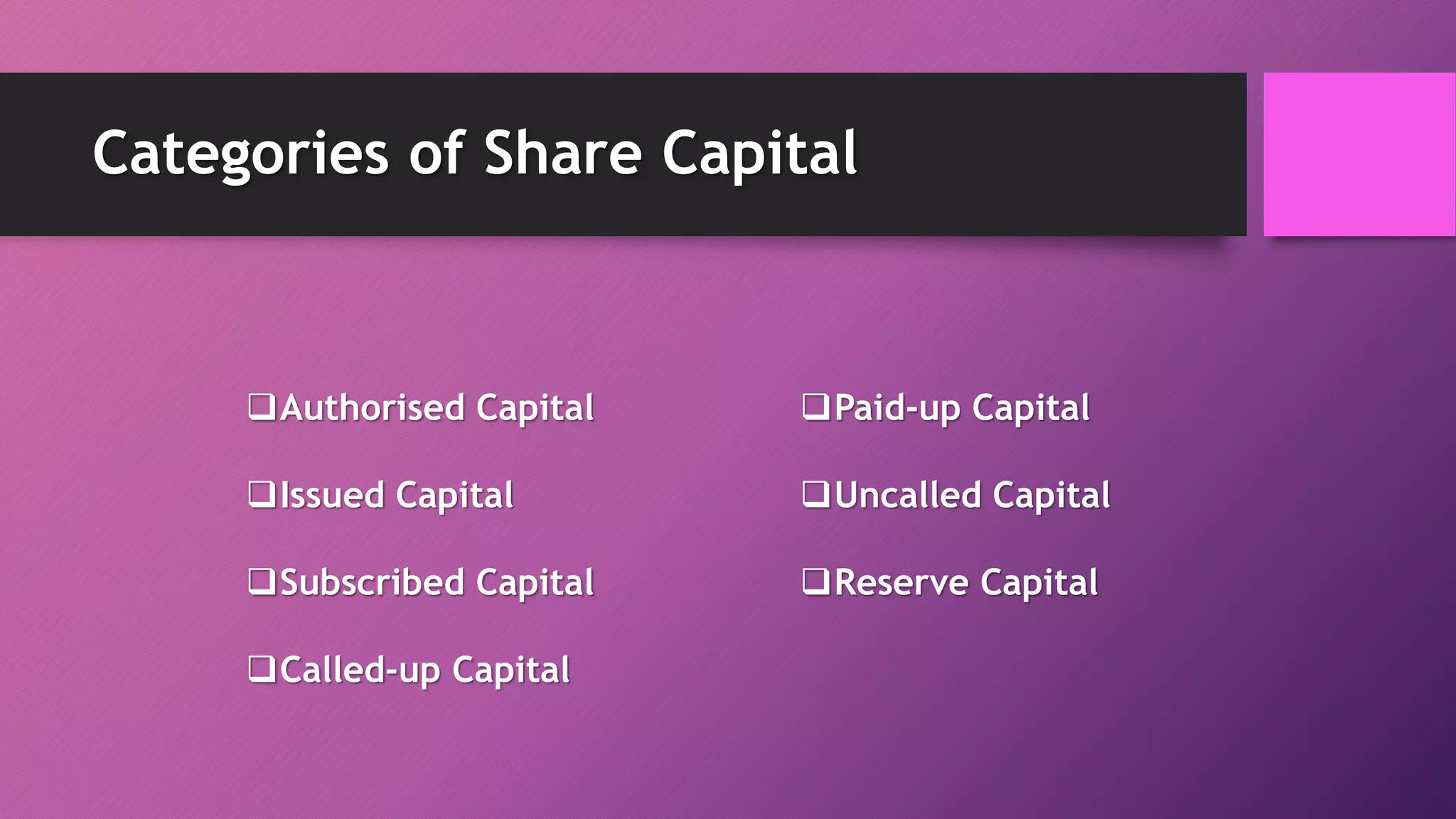
Categories of Share Capital
Authorised Capital
Issued Capital
Subscribed Capital
Called-up Capital
Paid-up Capital
Uncalled Capital
Reserve Capital
Authorised Capital
 Authorised capital is the amount of share capital which a company is authorised to
issue by its Memorandum of Association.
 The company cannot raise more than the amount of capital as specified in the
Memorandum of Association.
 It is also called Nominal or Registered capital.
 It should be noted that the company need not issue the entire authorised capital for
public subscription at a time. The company can not issue its share capital more than
its Authorised Capital.
Issued Capital
 It is that part of the authorised capital which is actually issued to
the public by directors or promoters for subscription.
 The authorised capital which is not offered for public subscription is
known as ‘unissued capital’.
 Unissued capital may be offered for public subscription at a later
date.
Subscribed Capital
 It is that part of the issued capital which has been
actually subscribed by the public.
Called-up Capital
 It is that part of the subscribed capital which has been called up on the shares.
 The company may decide to call the entire amount or part of the face value of the
shares.
 For example, if the face value (also called nominal value) of a share allotted is ₹ 10
and the company has called up only ₹ 7 per share, in that scenario, the called up
capital is ₹ 7 per share. The remaining ₹ 3 may be collected from its shareholders as
and when needed.
Paid-up Capital
 It is that portion of the called up capital which has been actually
received from the shareholders.
 If any of the shareholders has not paid amount on calls, such an
amount may be called as ‘calls in arrears’.
 Therefore, Paid-up capital = the called-up capital - call-in-arrears
Uncalled Capital
 That portion of the subscribed capital which has not yet been called-up.
 The company may collect this amount any time when it needs further
funds.
Reserve Capital
 A company may reserve a portion of its uncalled capital to be called
only in the event of winding up of the company.
 Such uncalled amount is called ‘Reserve Capital’ of the company. It is
available only for the creditors on winding up of the company.
Thank You

Type of share capital

  • 1.
    Type of ShareCapital Submitted by : Your Name
  • 2.
    Categories of ShareCapital Authorised Capital Issued Capital Subscribed Capital Called-up Capital Paid-up Capital Uncalled Capital Reserve Capital
  • 3.
    Authorised Capital  Authorisedcapital is the amount of share capital which a company is authorised to issue by its Memorandum of Association.  The company cannot raise more than the amount of capital as specified in the Memorandum of Association.  It is also called Nominal or Registered capital.  It should be noted that the company need not issue the entire authorised capital for public subscription at a time. The company can not issue its share capital more than its Authorised Capital.
  • 4.
    Issued Capital  Itis that part of the authorised capital which is actually issued to the public by directors or promoters for subscription.  The authorised capital which is not offered for public subscription is known as ‘unissued capital’.  Unissued capital may be offered for public subscription at a later date.
  • 5.
    Subscribed Capital  Itis that part of the issued capital which has been actually subscribed by the public.
  • 6.
    Called-up Capital  Itis that part of the subscribed capital which has been called up on the shares.  The company may decide to call the entire amount or part of the face value of the shares.  For example, if the face value (also called nominal value) of a share allotted is ₹ 10 and the company has called up only ₹ 7 per share, in that scenario, the called up capital is ₹ 7 per share. The remaining ₹ 3 may be collected from its shareholders as and when needed.
  • 7.
    Paid-up Capital  Itis that portion of the called up capital which has been actually received from the shareholders.  If any of the shareholders has not paid amount on calls, such an amount may be called as ‘calls in arrears’.  Therefore, Paid-up capital = the called-up capital - call-in-arrears
  • 8.
    Uncalled Capital  Thatportion of the subscribed capital which has not yet been called-up.  The company may collect this amount any time when it needs further funds.
  • 9.
    Reserve Capital  Acompany may reserve a portion of its uncalled capital to be called only in the event of winding up of the company.  Such uncalled amount is called ‘Reserve Capital’ of the company. It is available only for the creditors on winding up of the company.
  • 10.