SHARES
1
Definitions:
Sec 2(46) of THE COMPANIES ACT,1956:
“A share is a share in the share capital of a Company.”
i.e. Amount of capital to be raised by a Company is
always divided into small parts or units of equal value
known as shares.
SHARES
2
 Share capital of the company is collected by issue of
shares.
 Share is one of the units into which total capital is
divided.
 The person who owns the share is called shareholder.
3
KINDS OF SHARES
4
The different kinds of shares which can be raised by
Companies are :
1.EQUITY SHARES
2.PREFERENCE SHARES
3. DEFERRED SHARES
5
• Equity shares / ordinary shares
• Shares on which the dividend is paid after the dividend on fixed
rate has been paid on preference shares.
Characteristics:
No fixed rate of dividend.
Dividend is paid after dividend at a fixed rate is paid on
preference shares.
EQUITY SHARES
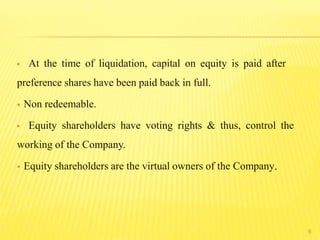
 At the time of liquidation, capital on equity is paid after
preference shares have been paid back in full.
 Non redeemable.
 Equity shareholders have voting rights & thus, control the
working of the Company.
 Equity shareholders are the virtual owners of the Company.
6
7
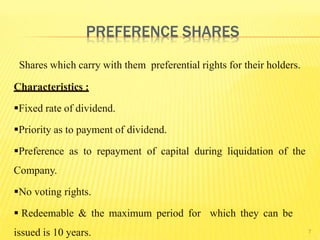
Shares which carry with them preferential rights for their holders.
Characteristics :
Fixed rate of dividend.
Priority as to payment of dividend.
Preference as to repayment of capital during liquidation of the
Company.
No voting rights.
 Redeemable & the maximum period for which they can be
issued is 10 years.
PREFERENCE SHARES
8
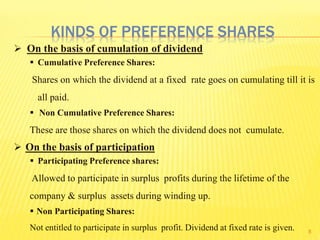
 On the basis of cumulation of dividend
 Cumulative Preference Shares:
Shares on which the dividend at a fixed rate goes on cumulating till it is
all paid.
 Non Cumulative Preference Shares:
These are those shares on which the dividend does not cumulate.
 On the basis of participation
 Participating Preference shares:
Allowed to participate in surplus profits during the lifetime of the
company & surplus assets during winding up.
 Non Participating Shares:
Not entitled to participate in surplus profit. Dividend at fixed rate is given.
KINDS OF PREFERENCE SHARES
9
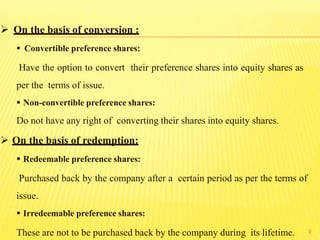
 On the basis of conversion :
 Convertible preference shares:
Have the option to convert their preference shares into equity shares as
per the terms of issue.
 Non-convertible preference shares:
Do not have any right of converting their shares into equity shares.
 On the basis of redemption:
 Redeemable preference shares:
Purchased back by the company after a certain period as per the terms of
issue.
 Irredeemable preference shares:
These are not to be purchased back by the company during its lifetime.
10
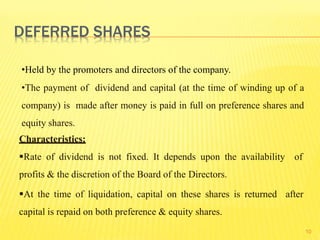
•Held by the promoters and directors of the company.
•The payment of dividend and capital (at the time of winding up of a
company) is made after money is paid in full on preference shares and
equity shares.
Characteristics:
Rate of dividend is not fixed. It depends upon the availability of
profits & the discretion of the Board of the Directors.
At the time of liquidation, capital on these shares is returned after
capital is repaid on both preference & equity shares.
DEFERRED SHARES
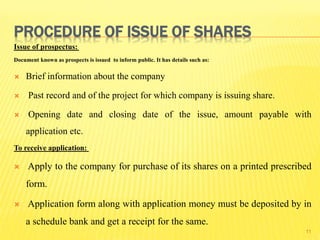
PROCEDURE OF ISSUE OF SHARES
Issue of prospectus:
Document known as prospects is issued to inform public. It has details such as:
 Brief information about the company
 Past record and of the project for which company is issuing share.
 Opening date and closing date of the issue, amount payable with
application etc.
To receive application:
 Apply to the company for purchase of its shares on a printed prescribed
form.
 Application form along with application money must be deposited by in
a schedule bank and get a receipt for the same.
11
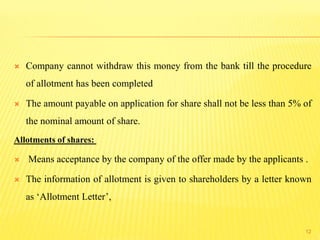
 Company cannot withdraw this money from the bank till the procedure
of allotment has been completed
 The amount payable on application for share shall not be less than 5% of
the nominal amount of share.
Allotments of shares:
 Means acceptance by the company of the offer made by the applicants .
 The information of allotment is given to shareholders by a letter known
as ‘Allotment Letter’,
12
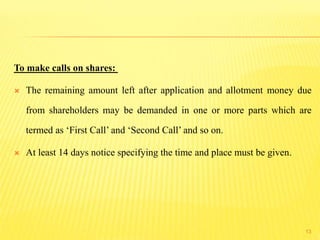
To make calls on shares:
 The remaining amount left after application and allotment money due
from shareholders may be demanded in one or more parts which are
termed as ‘First Call’ and ‘Second Call’ and so on.
 At least 14 days notice specifying the time and place must be given.
13
14

Business law(Shares)

  • 1.
  • 2.
    Definitions: Sec 2(46) ofTHE COMPANIES ACT,1956: “A share is a share in the share capital of a Company.” i.e. Amount of capital to be raised by a Company is always divided into small parts or units of equal value known as shares. SHARES 2
  • 3.
     Share capitalof the company is collected by issue of shares.  Share is one of the units into which total capital is divided.  The person who owns the share is called shareholder. 3
  • 4.
    KINDS OF SHARES 4 Thedifferent kinds of shares which can be raised by Companies are : 1.EQUITY SHARES 2.PREFERENCE SHARES 3. DEFERRED SHARES
  • 5.
    5 • Equity shares/ ordinary shares • Shares on which the dividend is paid after the dividend on fixed rate has been paid on preference shares. Characteristics: No fixed rate of dividend. Dividend is paid after dividend at a fixed rate is paid on preference shares. EQUITY SHARES
  • 6.
     At thetime of liquidation, capital on equity is paid after preference shares have been paid back in full.  Non redeemable.  Equity shareholders have voting rights & thus, control the working of the Company.  Equity shareholders are the virtual owners of the Company. 6
  • 7.
    7 Shares which carrywith them preferential rights for their holders. Characteristics : Fixed rate of dividend. Priority as to payment of dividend. Preference as to repayment of capital during liquidation of the Company. No voting rights.  Redeemable & the maximum period for which they can be issued is 10 years. PREFERENCE SHARES
  • 8.
    8  On thebasis of cumulation of dividend  Cumulative Preference Shares: Shares on which the dividend at a fixed rate goes on cumulating till it is all paid.  Non Cumulative Preference Shares: These are those shares on which the dividend does not cumulate.  On the basis of participation  Participating Preference shares: Allowed to participate in surplus profits during the lifetime of the company & surplus assets during winding up.  Non Participating Shares: Not entitled to participate in surplus profit. Dividend at fixed rate is given. KINDS OF PREFERENCE SHARES
  • 9.
    9  On thebasis of conversion :  Convertible preference shares: Have the option to convert their preference shares into equity shares as per the terms of issue.  Non-convertible preference shares: Do not have any right of converting their shares into equity shares.  On the basis of redemption:  Redeemable preference shares: Purchased back by the company after a certain period as per the terms of issue.  Irredeemable preference shares: These are not to be purchased back by the company during its lifetime.
  • 10.
    10 •Held by thepromoters and directors of the company. •The payment of dividend and capital (at the time of winding up of a company) is made after money is paid in full on preference shares and equity shares. Characteristics: Rate of dividend is not fixed. It depends upon the availability of profits & the discretion of the Board of the Directors. At the time of liquidation, capital on these shares is returned after capital is repaid on both preference & equity shares. DEFERRED SHARES
  • 11.
    PROCEDURE OF ISSUEOF SHARES Issue of prospectus: Document known as prospects is issued to inform public. It has details such as:  Brief information about the company  Past record and of the project for which company is issuing share.  Opening date and closing date of the issue, amount payable with application etc. To receive application:  Apply to the company for purchase of its shares on a printed prescribed form.  Application form along with application money must be deposited by in a schedule bank and get a receipt for the same. 11
  • 12.
     Company cannotwithdraw this money from the bank till the procedure of allotment has been completed  The amount payable on application for share shall not be less than 5% of the nominal amount of share. Allotments of shares:  Means acceptance by the company of the offer made by the applicants .  The information of allotment is given to shareholders by a letter known as ‘Allotment Letter’, 12
  • 13.
    To make callson shares:  The remaining amount left after application and allotment money due from shareholders may be demanded in one or more parts which are termed as ‘First Call’ and ‘Second Call’ and so on.  At least 14 days notice specifying the time and place must be given. 13
  • 14.