Sources of Finance
Dr. Mangesh Bhople
MIT ACSC, Alandi 1
Sources of Finance
• Sources of Finance:
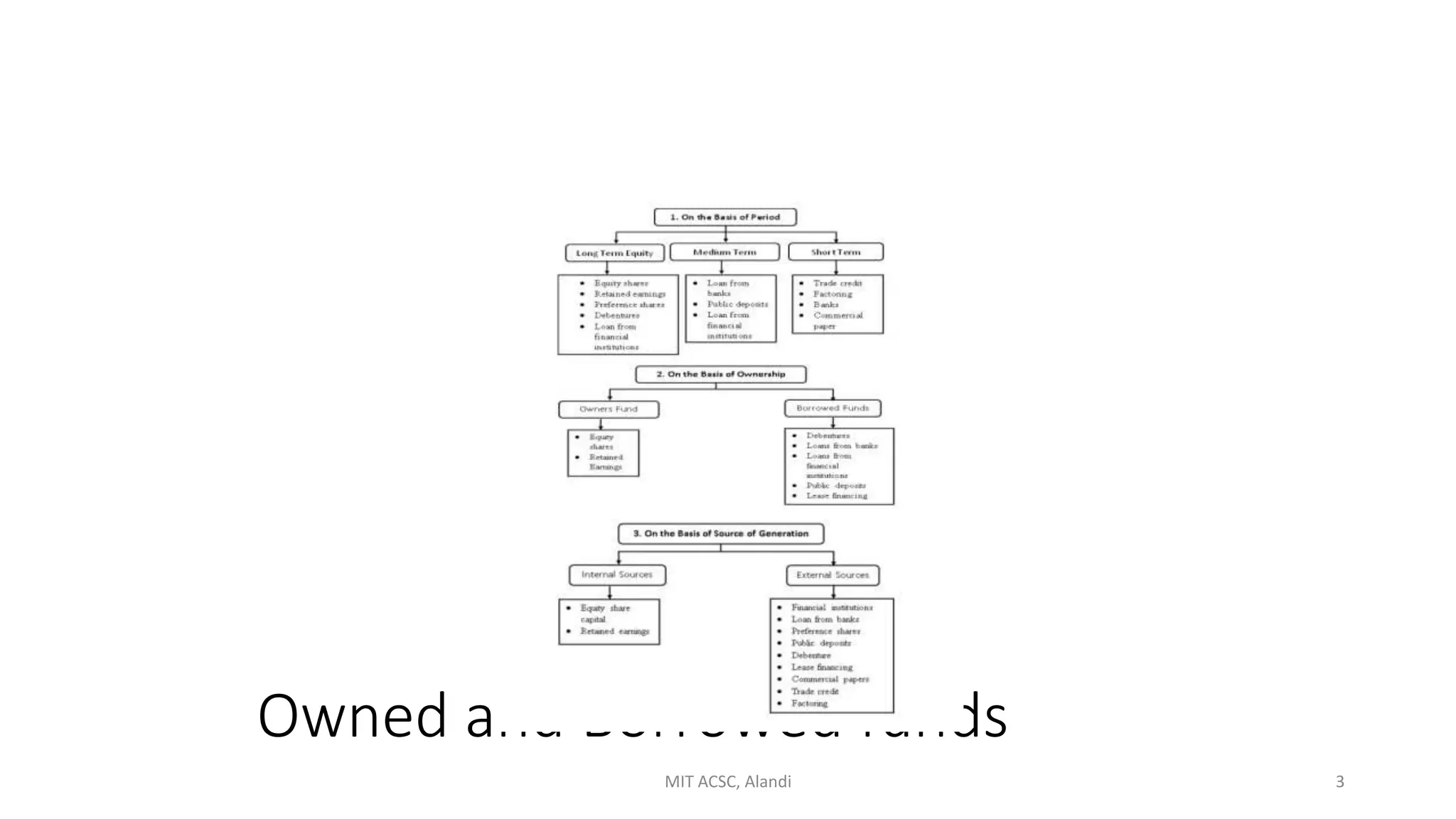
• 1.1 Owned and Borrowed funds
• 1.2 Equity Shares, Preference Shares
• 1.3 Debentures, Term Loan, Lease Financing, Hire Purchasing
MIT ACSC, Alandi 2
Owned and Borrowed funds
MIT ACSC, Alandi 3
Equity Shares
• Equity Share Meaning
• An equity share, normally known as ordinary share is a part
ownership where each member is a fractional owner and initiates the
maximum entrepreneurial liability related with a trading concern.
These types of shareholders in any organization possess the right to
vote.
MIT ACSC, Alandi 4
Features of Equity Shares Capital
• Equity share capital remains with the company. It is given back only
when the company is closed
• Equity Shareholders possess voting rights and select the company’s
management
• The dividend rate on the equity capital relies upon the obtainability of
the surplus capital. However, there is no fixed rate of dividend on the
equity capital
MIT ACSC, Alandi 5
Merits
• ES (equity shares) does not create a sense of obligation and accountability to pay a rate of dividend that is
fixed
• ES can be circulated even without establishing any extra charges over the assets of an enterprise
• It is a perpetual source of funding and the enterprise has to pay back; exceptional case – under liquidation
• Equity shareholders are the authentic owners of the enterprise who possess the voting rights
Demerits of Equity Shares Capital
• The enterprise cannot take either the credit or an advantage if trading on equity when only equity shares are
issued
• There is a risk or a liability over capitalization as equity capital cannot be reclaimed
• The management can face hindrances by the equity shareholders by guidance and systematizing themselves
• When the firm earns more profits, then, higher dividends have to be paid which leads to raising in the value
of the shares in the marketplace and its edges to speculation as well.
MIT ACSC, Alandi 6
Some other concepts about equity Shares
• Authorized Share Capital- This amount is the highest amount an
organization can issue. This amount can be changed time as per the
companies recommendation and with the help of few formalities.
• Issued Share Capital- This is the approved capital which an organization
gives to the investors.
• Subscribed Share Capital- This is a portion of the issued capital which an
investor accepts and agrees upon.
• Paid Up Capital- This is a section of the subscribed capital, that the
investors give. Paid-up capital is the money that an organization really
invests in the company’s operation.
• Right Share- These are those type of share that an organization issue to
their existing stockholders. This type of share is issued by the company to
preserve the proprietary rights of old investors.
• Bonus Share- When a business split the stock to its stockholders in the
dividend form, we call it a bonus share.
• Sweat Equity Share- This type of share is allocated only to the outstanding
workers or executives of an organization for their excellent work on
providing intellectual property rights to an organization.
MIT ACSC, Alandi 7
Preference Shares Meaning
• These are shares which are preferred over equity shares in payment of dividend, the preference
shareholders are the first to get dividends if the company decides to distribute or pay dividends.
• Let’s study below in depth what are preference shares?
• Preference shares are shares having preferential rights to claim dividends during the lifetime of the
company and to claim repayment of capital on wind up. In case of preference shares, the
percentage of dividend is fixed i.e. the holders get the fixed dividend before any dividend is paid to
other classes of shareholders.
• Preference shares are one important source of hybrid financing because it has some features of
equity shares and some features of debentures. The preference shareholders enjoy preferential
rights with regard to receiving dividends and getting back capital in case the company winds-up.
MIT ACSC, Alandi 8
Features of preference shares:
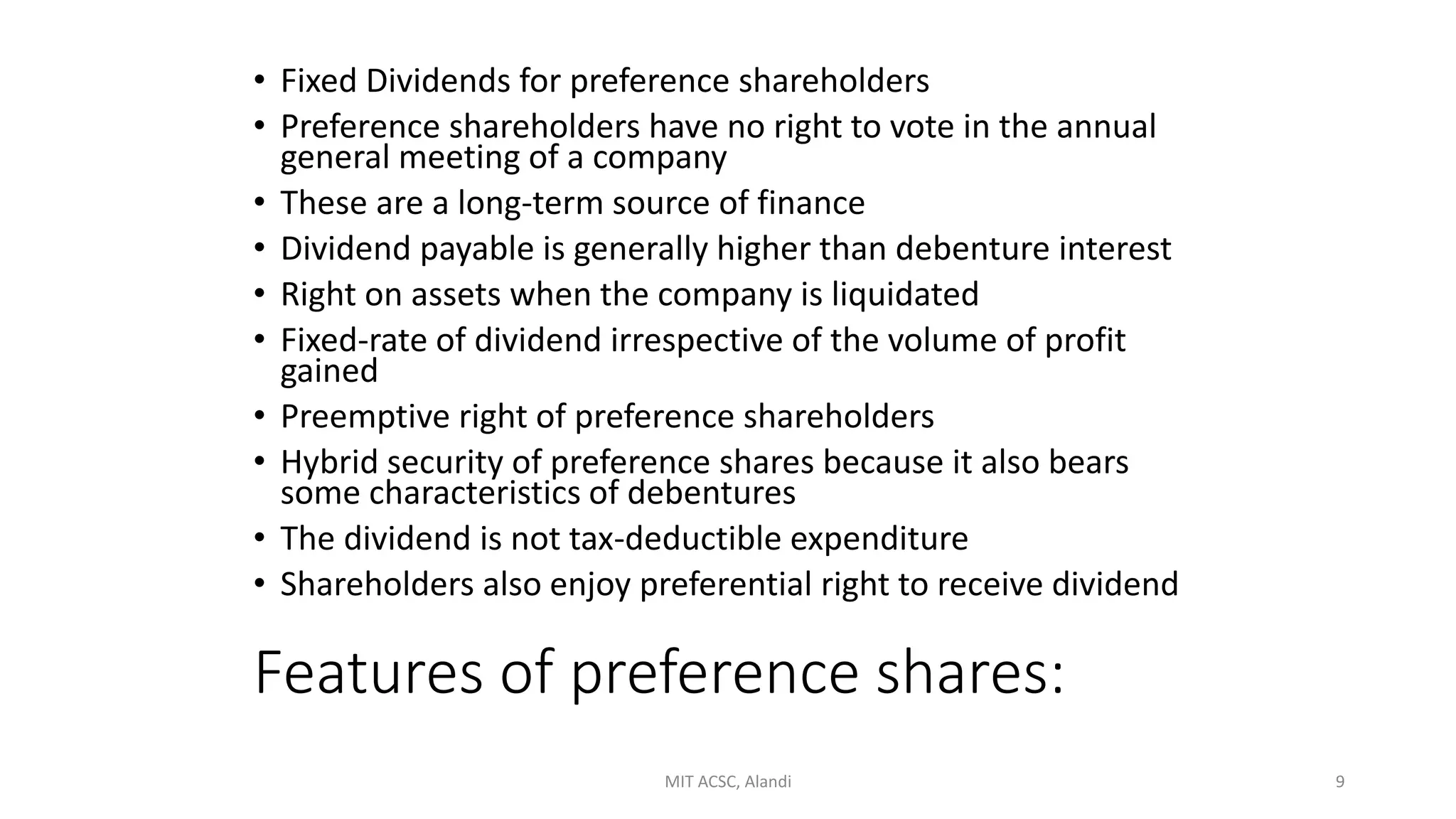
• Fixed Dividends for preference shareholders
• Preference shareholders have no right to vote in the annual
general meeting of a company
• These are a long-term source of finance
• Dividend payable is generally higher than debenture interest
• Right on assets when the company is liquidated
• Fixed-rate of dividend irrespective of the volume of profit
gained
• Preemptive right of preference shareholders
• Hybrid security of preference shares because it also bears
some characteristics of debentures
• The dividend is not tax-deductible expenditure
• Shareholders also enjoy preferential right to receive dividend
MIT ACSC, Alandi 9
Types of preference shares:
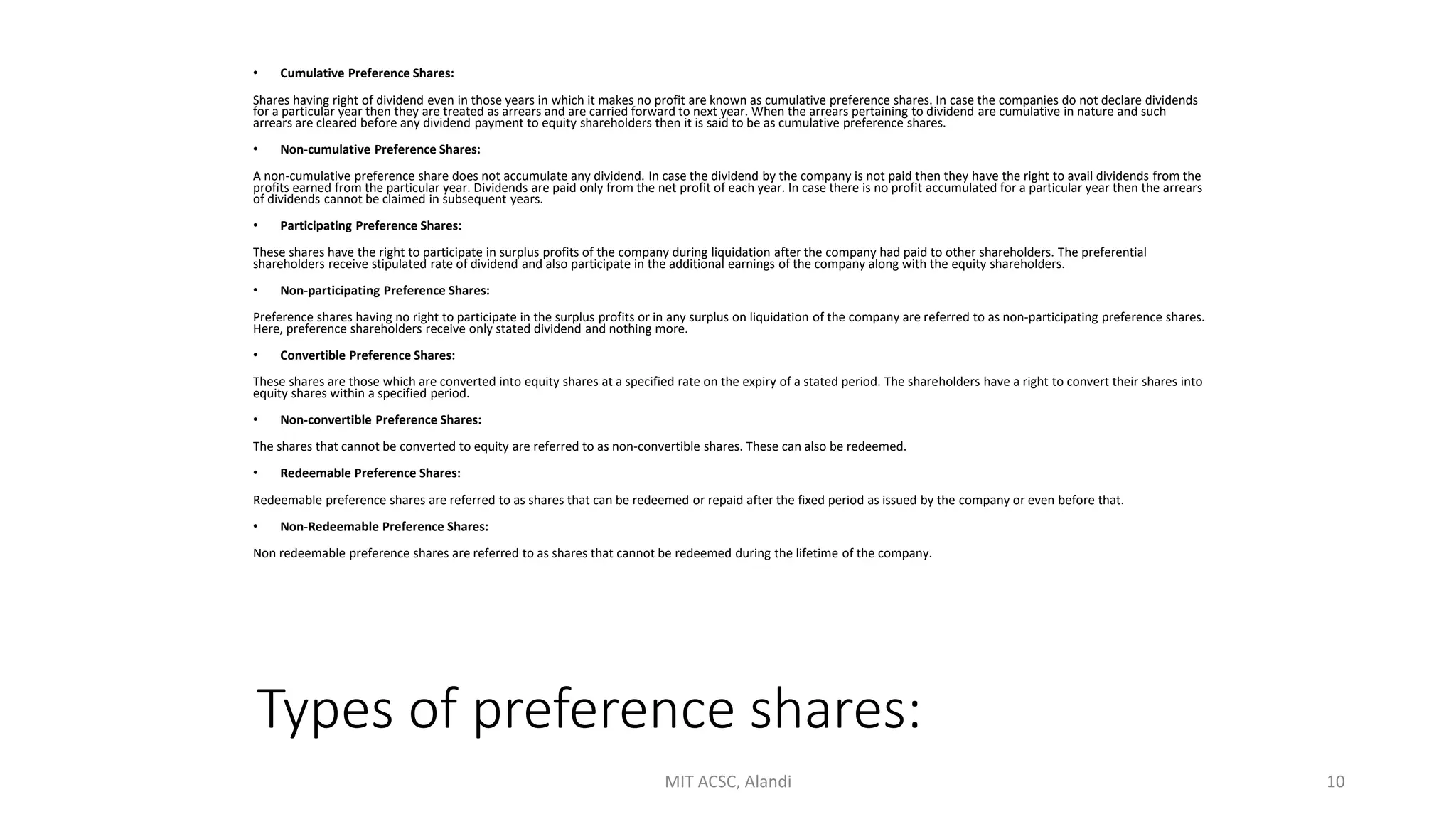
• Cumulative Preference Shares:
Shares having right of dividend even in those years in which it makes no profit are known as cumulative preference shares. In case the companies do not declare dividends
for a particular year then they are treated as arrears and are carried forward to next year. When the arrears pertaining to dividend are cumulative in nature and such
arrears are cleared before any dividend payment to equity shareholders then it is said to be as cumulative preference shares.
• Non-cumulative Preference Shares:
A non-cumulative preference share does not accumulate any dividend. In case the dividend by the company is not paid then they have the right to avail dividends from the
profits earned from the particular year. Dividends are paid only from the net profit of each year. In case there is no profit accumulated for a particular year then the arrears
of dividends cannot be claimed in subsequent years.
• Participating Preference Shares:
These shares have the right to participate in surplus profits of the company during liquidation after the company had paid to other shareholders. The preferential
shareholders receive stipulated rate of dividend and also participate in the additional earnings of the company along with the equity shareholders.
• Non-participating Preference Shares:
Preference shares having no right to participate in the surplus profits or in any surplus on liquidation of the company are referred to as non-participating preference shares.
Here, preference shareholders receive only stated dividend and nothing more.
• Convertible Preference Shares:
These shares are those which are converted into equity shares at a specified rate on the expiry of a stated period. The shareholders have a right to convert their shares into
equity shares within a specified period.
• Non-convertible Preference Shares:
The shares that cannot be converted to equity are referred to as non-convertible shares. These can also be redeemed.
• Redeemable Preference Shares:
Redeemable preference shares are referred to as shares that can be redeemed or repaid after the fixed period as issued by the company or even before that.
• Non-Redeemable Preference Shares:
Non redeemable preference shares are referred to as shares that cannot be redeemed during the lifetime of the company.
MIT ACSC, Alandi 10
BENEFITS OF PREFERENCE SHARES
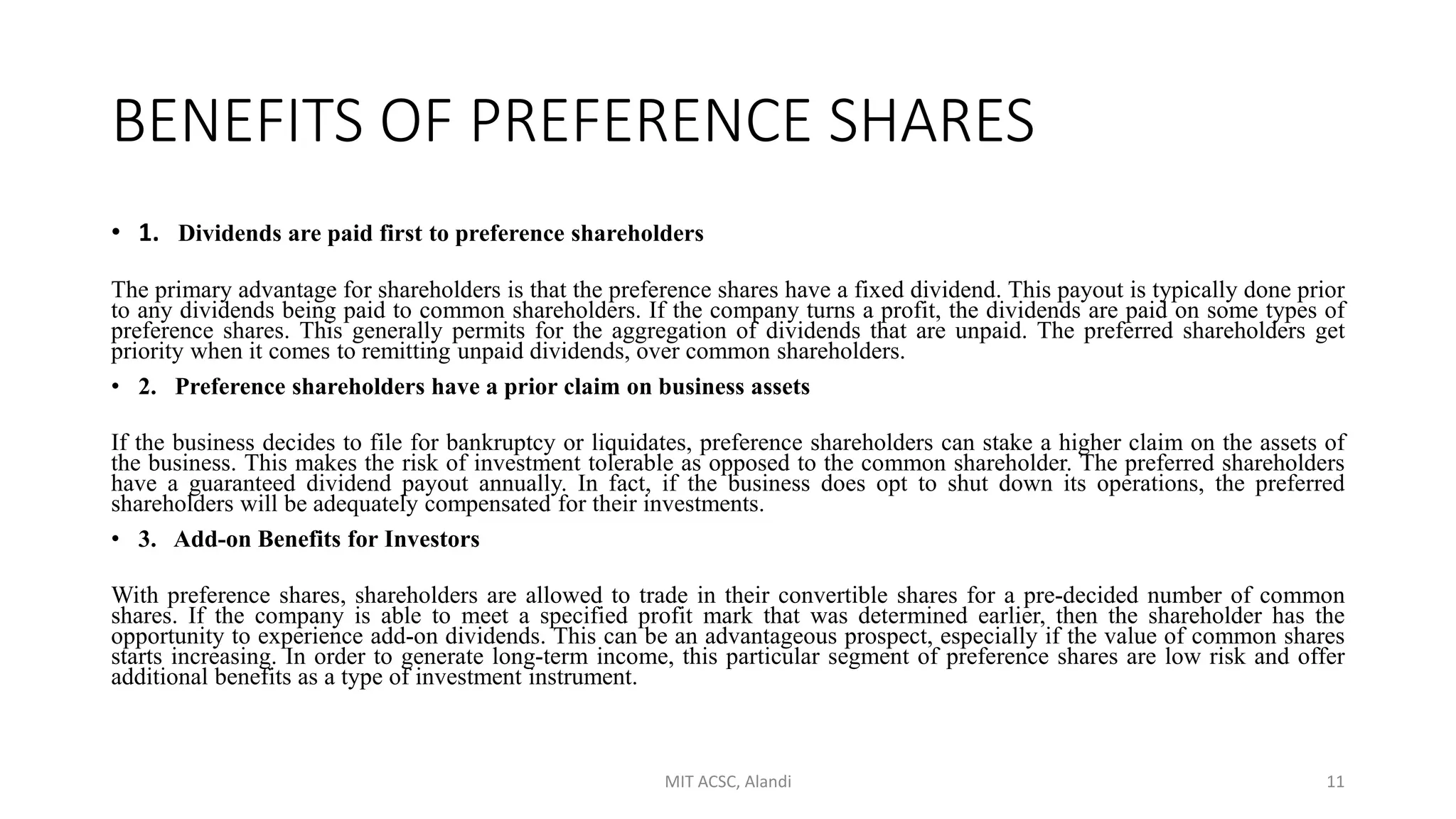
• 1. Dividends are paid first to preference shareholders
The primary advantage for shareholders is that the preference shares have a fixed dividend. This payout is typically done prior
to any dividends being paid to common shareholders. If the company turns a profit, the dividends are paid on some types of
preference shares. This generally permits for the aggregation of dividends that are unpaid. The preferred shareholders get
priority when it comes to remitting unpaid dividends, over common shareholders.
• 2. Preference shareholders have a prior claim on business assets
If the business decides to file for bankruptcy or liquidates, preference shareholders can stake a higher claim on the assets of
the business. This makes the risk of investment tolerable as opposed to the common shareholder. The preferred shareholders
have a guaranteed dividend payout annually. In fact, if the business does opt to shut down its operations, the preferred
shareholders will be adequately compensated for their investments.
• 3. Add-on Benefits for Investors
With preference shares, shareholders are allowed to trade in their convertible shares for a pre-decided number of common
shares. If the company is able to meet a specified profit mark that was determined earlier, then the shareholder has the
opportunity to experience add-on dividends. This can be an advantageous prospect, especially if the value of common shares
starts increasing. In order to generate long-term income, this particular segment of preference shares are low risk and offer
additional benefits as a type of investment instrument.
MIT ACSC, Alandi 11
DISADVANTAGES OF PREFERENCE
SHARE
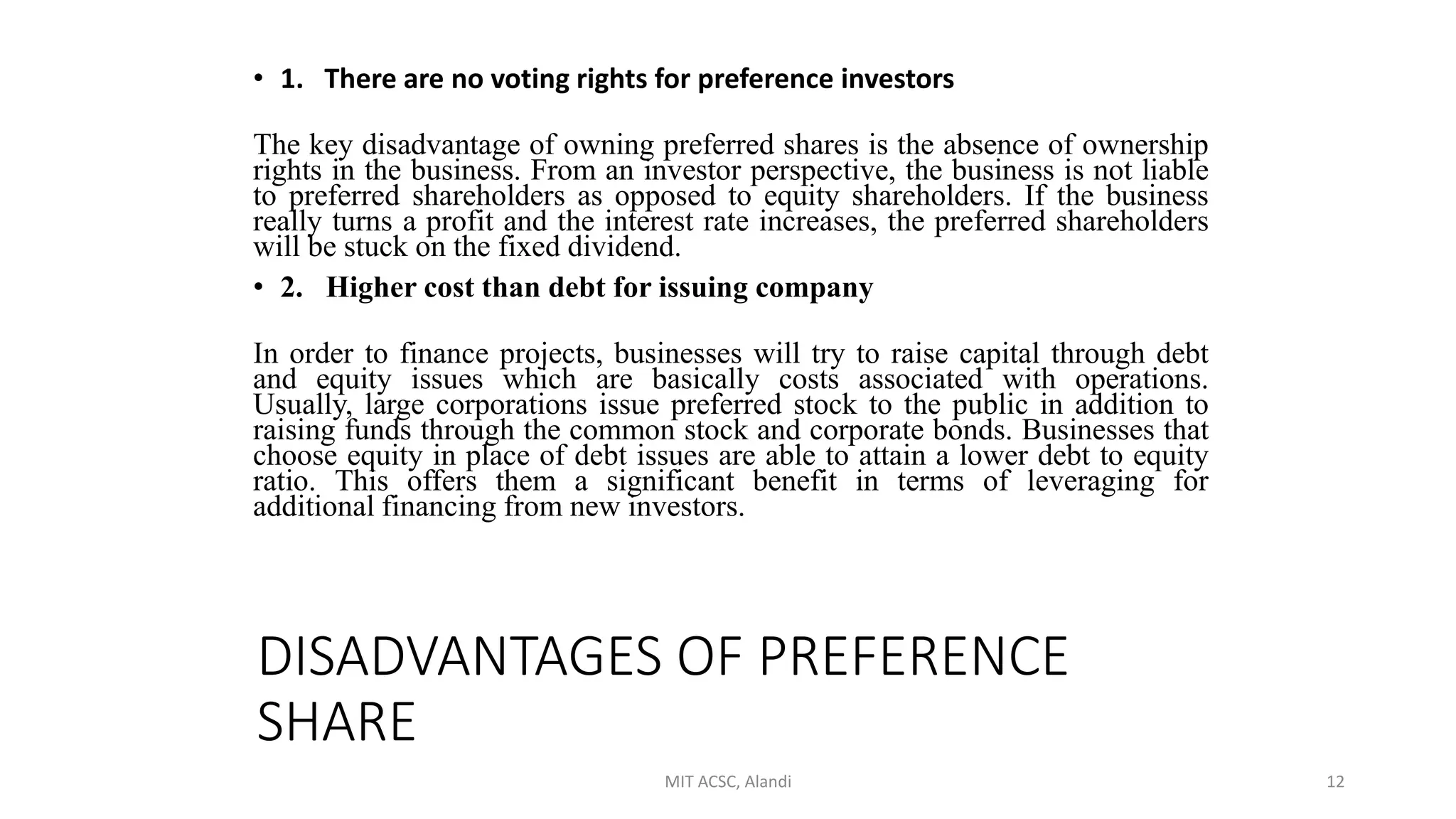
• 1. There are no voting rights for preference investors
The key disadvantage of owning preferred shares is the absence of ownership
rights in the business. From an investor perspective, the business is not liable
to preferred shareholders as opposed to equity shareholders. If the business
really turns a profit and the interest rate increases, the preferred shareholders
will be stuck on the fixed dividend.
• 2. Higher cost than debt for issuing company
In order to finance projects, businesses will try to raise capital through debt
and equity issues which are basically costs associated with operations.
Usually, large corporations issue preferred stock to the public in addition to
raising funds through the common stock and corporate bonds. Businesses that
choose equity in place of debt issues are able to attain a lower debt to equity
ratio. This offers them a significant benefit in terms of leveraging for
additional financing from new investors.
MIT ACSC, Alandi 12
Retained Earnings: Meaning, Features, Advantages and
Disadvantages
Like an individual, companies too, set aside a part of their profit to meet
future requirements. The portion of profits not distributed among the
shareholders but retained and used in business is called retained earnings. It
is also referred to as ploughing back of profit. This is one of the important
sources of internal financing used for fixed as well as working capital.
Retained earnings increase the value of shareholders in case of a growing
firm.
MIT ACSC, Alandi 13
Features of Retained Earnings:
• 1. Cost of Financing : It is the general belief that retained
earnings have no cost to the company.
• 2. Floatation Cost:
• Unlike other sources of financing, the use of retained
earnings helps avoid issue- related costs.
• 3. Control:
• Use of retained earnings avoids the possibility of
change/dilution of the control of existing shareholders
that results from issue of new issues.
• 4. Legal Formalities:
• Use of retained earnings does not require compliance of
any legal formalities. It just requires a resolution to be
passed in the annual general meeting of the company.
MIT ACSC, Alandi 14
Advantages of Retained Earnings:
• i. Cheaper Source of Financing:
• The use of retained earnings does not involve any acquisition cost. The company
has no obligation to pay anything in respect of retained earnings.
• ii. Financial Stability:
• Retained earnings strengthen the financial position of a business and thereby
give financial stability to the business.
• iii. Stable Dividend:
• Shareholders may get stable dividend even if the company does not earn enough
profit.
• iv. Market Value:
• Retained earnings strengthen the financial position of a company and appreciate
the capital which ultimately increases the market value of shares.
MIT ACSC, Alandi 15
Disadvantages of Retained Earnings:
• i. Improper Utilization of Funds:
• If the purpose for utilization of retained earnings is not clearly stated, it
may lead to careless spending of funds.
• ii. Over-capitalization:
• Conservative dividend policy leads to huge accumulation of retained
earnings leading to over-capitalization.
• iii. Lower Rate of Dividend:
• Retained earnings do not allow shareholders to enjoy full benefit of the
actual earnings of the company. This creates not only dissatisfaction among
the shareholders but also adversely affect the market value of shares.
MIT ACSC, Alandi 16
Debentures: Meaning, Characteristics and
Types
• Meaning of Debentures:
Debentures are one of the frequently used methods by which a business can
procure long-term funds for its initial financial needs or for its subsequent
requirements of growth and modernization. Funds acquired by means of
debentures represent debt and its holders are the company’s creditors.
In common parlance, debenture is merely a written instrument signed by the
company under its common seal, acknowledging the debt due by it to its
holders. Through this instrument the company promises to pay a specific
amount of money as stated therein at a fixed date in future together with
periodic payment of interest to compensate the holders for the use of the
funds.
MIT ACSC, Alandi 17
• The Companies Act, 1956 has not defined as to what debenture means. It simply
states that a “debenture includes debenture stock, bonds and any other securities
of a company whether constituting a charge on the assets of the company or not
[Sec. 2 (12)]. Thus, the Act only states that it is a kind of security which constitutes
a charge by way of security on issuing debentures. In sum, debenture is a long-
term promissory note which usually runs for a duration of not less than ten
years”.
• At the very outset it is necessary to have a clear understanding of two terms viz.
debenture and bond, used very frequently to denote a security for raising loan
capital. In America, the term bond refers to a security instrument that has lien on
specific assets of the enterprise and the word ‘mortgage bond’ is very often used as
alternative to the word bond.
• Debenture, on the other hand, refers to unsecured bond which is not secured by a
lien on any specific asset. Of course, it is secured by all the assets of the company
not otherwise mortgaged. In the event of liquidation, debenture-holders become
general creditors.
• In our country, no such distinction is made between the two terms. For debentures
which are secured by pledging certain assets, term ‘secured debentures’ or bonds
is used and unsecured debentures refer to those having no lien on specific assets.
MIT ACSC, Alandi 18
Characteristics of Debentures:
• 1. Maturity:
Unlike stock which has no maturity date, debenture matures. The principal amount of
bond must be repaid at a definite time stipulated in bond indenture otherwise
creditors may bring foreclosure upon the company.
When a company floats a bond issue, the company and the creditors devote a
considerable time in deciding about the timing of bond’s maturity and mode of
retiring the bond. Timing of maturity is essentially dependent upon conditions of
money and capital market at the time of issue of bonds, prevailing interest rates and
credit standing of the company.
When conditions of money and capital markets are favorable, financial health of the
enterprise is sound, credit standing of the company is unquestioned and interest rates
are low, the management would like to use bonded funds indefinitely. But the
bondholders would not be willing to lend money forever. In order to ensure liquidity
and safety of their funds, they would insist on rapid return of their money.
The greater the risk inherent in the enterprise, the earlier maturity is insisted upon by
the creditors. The company may also be interested in early debt reduction so as to
improve the market price of its stock. Regarding methods of retirement of bond it
may be observed that bonds can be retired by way of ‘refunding’ or by conversion.
MIT ACSC, Alandi 19
Characteristics of Debentures:
• 2. Claims on Income:
• Bondholders have priority of claim to income over stockholders. They have
legal recourse for enforcing their rights. For protecting their claim to
income and assuring regularity of receipt of that income, they may even
put restriction on dividend payment to residual owners, and maintenance
of adequate liquidity.
• Another aspect of claim to income is its certainty. Bondholder’s claim to
income is fixed and certain and the borrowing company is under legal
obligation to pay it in cash regardless of the level of earnings of the
company. Default in payment of interest may entail the company in
extreme predicament and bondholders may even approach court of law for
foreclosure. Further, bondholders do not have right to share in profits of
the company.
MIT ACSC, Alandi 20
Characteristics of Debentures:
• 3. Claims on Assets:
• Bondholders have also priority over stockholders in respect of their claim on assets. Such
a claim arises only in the event of liquidation or reorganization of the company. As
against this superior position, the creditors are entitled to get only the principal amount
they had lent out plus unpaid interest.
• To ensure against risk of loss of principal money, bondholders prefer to have loan
secured by a lien on specific assets. However, if creditors believe that earnings of the
company are sufficient enough to satisfy their claims, they may not be adamant to
security of the loan and may accept bonds without having specific assets pledged.
• Bonds that are secured by a lien on specific assets of the company are called ‘Secured
Bonds’ and those that do not have specific assets pledged to secure payment of interest
and principal are termed ‘Unsecured Bonds’. In the event of reorganization or liquidation,
assets pledged to secured bonds will be used to satisfy creditors’ claims.
MIT ACSC, Alandi 21
Characteristics of Debentures:
• 4. Controlling Power:
• Holders of debentures are creditors of the company. They do not have controlling
power because they have no right to vote for the election of directors and for the
determination of important managerial policies. They may, however, indirectly
influence managerial decisions through protective covenants in indenture.
• For instance, to protect their interest, bond indenture may provide for
maintenance of minimum liquidity ratio and for building up stipulated amount of
reserves before making dividend payments to stockholders. An after-acquired
clause in indenture further restricts managements’ freedom of action.
• Undoubtedly, debenture-holders cannot interfere in managerial activities so long
as the company is working in accordance with the terms of the indenture and
there are no managerial lapses. In the event of default to pay interest or principal
money, the bondholders will, in effect, take control of the company.
MIT ACSC, Alandi 22
Types of Debentures:
In recent few years following cataclysmic reformatory economic policy of the Government, the Indian corporate enterprises—both public and private sectors—issued a variety of debt instruments to cater to
the ever widening needs of investors. These instruments would certainly help broaden the debt market and bring in new participants into the market.
The following kinds of bonds are used b Indian corporate for raising funds from the debt market:
• 1. Non-Cumulative Debentures:
Indian Companies can now issue non-cumulative debentures. There is no ceiling on interest rate. Similarly, if the debentures are for less than 18 months, they need not be
secured. Any debenture which is offered for more than 18 months has to be secured, credit rated and listed as per SEBI guidelines.
• 2. Cumulative Debentures:
In this type of debentures, interest not paid by the company in a year gets accumulated and paid at the time of maturity of the instrument.
• 3. Floating Rate Bonds:
The major drawback of plain Vanilla bonds is that they carry a risk of loss from fluctuations in interest rates, Issuers lose when the interest rates drop and subscribers lose
when interest rates rise. The greater the maturity period, the higher is the loss from fluctuating interest rates.
Floating rate bonds, which came into existence in the early seventies, eliminate the interest rate risk of plain Vanilla bonds since the coupon rate is reset periodically, based
on the prevailing interest rates in the market. These bonds have already made their appearance in the Indian market.
The SBI was one of the earliest institutions to successfully market these bonds. The IDBI too used the instrument. However, the use of this kind of bonds is still very limited.
Complete deregulation of interest will give a fillip to such bonds.
• 4. Secured Premium Notes:
In this type of bonds, the principal amount is refunded along-with interest and ‘premium’ in instalments. The premium can be treated as a long-term income by the
investor. The issuer can pay the premium amount by charging the reserves and surplus.
Such bonds also carry warrants which would allow the holders to get equity shares of the company at a pre-fixed price. In the recent TISCO issue, the original investment of
Rs. 300/- was repaid in four instalments of Rs. 150/- each starting from the 4th year.
• 5. Zero Coupon Bonds:
Zero Coupon bonds constitute one of the major innovative instruments in the Indian Capital market. In this kind of bonds, the instrument is issued without fixed coupon
rate. Difference between maturity value and acquisition cost is gain to investors. For instance, Lloyds Steel issued Zero Coupon bond at Rs. 35 each having maturity period
of -45 months. Maturity value of the bond was Rs. 60. The bond did not carry any fixed interest rate. Similarly, Best and Crompton issued bond of Rs. 70 with maturity
period of 36 months and maturity value of Rs. 100.
• 6. Deep Discount Bonds (DDB):
Another innovative debt instrument issued in recent years by the Companies is deep discount bond which is issued at discount to the face value. The IDBI was the first
institution to issue DDB for a ‘deep discount’ price of Rs. 2700. Face value of the bond is Rs. 1 lakh. DDB appreciates to its face value over the maturity period of 25 yrs.
Issuing company has the advantage of lower effective cost in such bonds. Further, the issuer need not incur service cost immediately. However, the issuer may stand to loss
if interest rates fall.
MIT ACSC, Alandi 23
Types of Debentures:
• 7. Convertible Bond/Debentures:
Traditionally, Indian corporate preferred to raise debt through the issue of debentures. These could be fully Convertible Debentures (FCDs), Non-Convertible Debentures or Partially Convertible Debentures. A lion’s share
of these debentures was privately placed with financial institutions and other corporations. Publicly issued debentures are listed in stock exchange.
Recently, the Government has allowed listing of even privately placed debentures, provided they are of investment grade. Fully convertible debentures are traded more actively in the stock exchanges than non-
convertible ones. There are specialist traders in Khokhas (the non-convertible portion of partially convertible debentures), though these are mostly traded on one-to-one basis.
• The convertible bonds could be one of the following:
• (i) Partly Convertible Debentures:
Under this, a portion of the debentures is converted into equity shares of the issuing company. The conversion can take place at any time upon or after allotment of the debentures. If the conversion takes place within 18
months of the date of allotment, the premium of the shares could be fixed up front.
In case conversion takes place after 18 months but within 36 months, the investor will have a put option. In case the conversion is to take place after 36 months, the investor will have a call option. In case the debentures
are to be issued with a maturity of more than 18 months, they have to be secured and the issuer has to get the issue credit rated.
• (ii) Fully Convertible Debentures:
In case of this kind of debentures, the entire amount is converted into equity shares of the issuing company. All other features of partly convertible debentures like credit rating put and call option etc. are also applicable
in case of fully convertible debentures.
• (iii) Optionally Fully Convertible Debentures:
In this kind of instrument, debt can be converted into shares by the triple option. Convertible Debentures of Reliance Petro and Multiple Option Convertible Debentures of DLF Company Ltd. were of this kind of
instrument.
• (iv) Zero Coupon Convertible Bonds:
Zero Coupon Convertible bonds carry no coupon rate. These bonds can be either partly or fully convertible Mahindra and Mahindra issued zero coupon convertible bonds of Rs. 90/- each fully convertible into two shares
of Rs. 10/- each at Premium of Rs. 35/- per share after the expiry of 18 months.
• 8. Public Sector Bonds:
Many public sector undertakings have, of late, issued bonds in the market to raise funds. These bonds are of two categories; taxable bonds and tax free bonds. Though major chunk of these bonds were privately placed
with financial institutions, they have lately become popular in the secondary market with active trading.
Certificates are normally issued against the bonds. There is no concept of marketable lot and splitting of certificates is affected at the request of holders. In many cases, letters of allotment are issued and transfer is also
affected on the basis of such letters. Dividend on the above bonds is paid either by way of post dated warrants or on periodical basis.
• 9. Other Bonds:
Customized bonds have also been issued with maturities matching investors’ demands. Other bonds which are in circulation are the bonds with put and call options. Some bonds also carry warrants which could be
converted into equities.
MIT ACSC, Alandi 24
Term Loan
• A term loan is a loan from a bank for a specific
amount that has a specified repayment schedule and
either a fixed or floating interest rate. A term loan is
often appropriate for an established small business
with sound financial statements. Also, a term loan
may require a substantial down payment to reduce
the payment amounts and the total cost of the loan.
MIT ACSC, Alandi 25
Types of Term Loans
• Term loans come in several varieties, usually reflecting the lifespan of the
loan.
• A short-term loan, usually offered to firms that don't qualify for a line of
credit, generally runs less than a year, though it can also refer to a loan of
up to 18 months or so.
• An intermediate-term loan generally runs more than one—but less than
three—years and is paid in monthly installments from a company’s cash
flow.
• A long-term loan runs for three to 25 years, uses company assets as
collateral, and requires monthly or quarterly payments from profits or cash
flow. The loan limits other financial commitments the company may take
on, including other debts, dividends, or principals' salaries and can require
an amount of profit set aside for loan repayment.
MIT ACSC, Alandi 26
Features of Term Loan?
• Among multiple financing options available, term loans are one of the most convenient ones to avail as they
come with pre-determined loan value, interest rates, EMIs, etc. Falling under a single line of credit makes it
easy to understand the term loan process.
Below is explained how term loan works for an easy understanding of its functioning.
• Fixed loan amount
Terms loans come with a fixed amount. Depending on the type of term loan chosen, the loan value may vary.
Meeting the lender’s eligibility criteria is also essential in determining the actual loan amount.
• Fixed tenor of repayment
You must repay the amount availed in EMIs throughout a fixed tenor as determined during availing the loan.
Depending on the duration of loan repayment, it is classified as a short, mid or long-term loan.
• May or may not require collateral
Depending on the loan amount required, borrower’s eligibility and choice, term loans are available as both,
secured and unsecured credits. While personal loans, business loans, etc. are unsecured form of term loans,
advances like home loans qualify as secured term loans sanctioned against a collateral.
• Fixed or floating interest rate
Term loans are available at both fixed and floating rates of interest. It is up to the borrower to decide which
type of interest to opt for.
• Fixed repayment schedule
Every term loan comes with a repayment schedule and a borrower is required to pay EMIs based on this
schedule. The EMI comprises both principal component and interest component calculated as per the term
loan interest rates applicable, thus enabling borrower to repay easily. You can determine the EMI amount
prior to availing the loan using an online EMI calculator.
MIT ACSC, Alandi 27
Advantages & Disadvantages of Term
Loans
Advantages of term loans
• Flexibility of tenor - With an option to choose a suitable tenor for loan repayment, borrowers can
select a suitable term that allows them pay EMIs as per their repayment capacity.
• Ease of repayment through affordable EMIs - Select a repayment tenor as per your income and
keep your EMIs affordable.
• Minimum eligibility requirements and hassle-free documentation – You can easily avail these
loans against minimum eligibility and submissions of few basic documents, which makes the process
hassle-free.
• Cost of loan limited –You can have an idea of the total cost of loan you are required to pay during
the application process itself. It makes budgeting your finances easier.
Disadvantages of term loans
Although term loans are among the best sources of external credit, they must be cautiously used to avoid
landing in a detrimental financial circumstance. To do so, borrowers must –
• Charge on assets
• Overdebtness
• Risk of overcapitalization
• Keep a track of due dates for EMI payment
• Pay EMIs in time
• Make optimum use of the loan amount
MIT ACSC, Alandi 28
Lease Financing
• Lease financing is one of the important sources of
medium- and long-term financing where the owner
of an asset gives another person, the right to use that
asset against periodical payments. The owner of the
asset is known as lessor and the user is called lessee.
• The periodical payment made by the lessee to the
lessor is known as lease rental. Under lease financing,
lessee is given the right to use the asset but the
ownership lies with the lessor and at the end of the
lease contract, the asset is returned to the lessor or
an option is given to the lessee either to purchase the
asset or to renew the lease agreement.
MIT ACSC, Alandi 29
Different Types of Lease:
• i. Finance Lease:
It is the lease where the lessor transfers substantially
all the risks and rewards of ownership of assets to the
lessee for lease rentals. In other words, it puts the
lessee in the same condition as he/she would have
been if he/she had purchased the asset. Finance lease
has two phases: The first one is called primary period.
This is non-cancellable period and in this period, the
lessor recovers his total investment through lease
rental. The primary period may last for indefinite
period of time. The lease rental for the secondary
period is much smaller than that of primary period.
MIT ACSC, Alandi 30
Features of Finance Lease:
• 1. A finance lease is a device that gives the lessee a
right to use an asset.
• 2. The lease rental charged by the lessor during the
primary period of lease is sufficient to recover his/her
investment.
• 3. The lease rental for the secondary period is much
smaller. This is often known as peppercorn rental.
• 4. Lessee is responsible for the maintenance of asset.
• 5. No asset-based risk and rewards is taken by lessor.
• 6. Such type of lease is non-cancellable; the lessor’s
investment is assured.
MIT ACSC, Alandi 31
Operating Lease:
• Lease other than finance lease is called operating
lease. Here risks and rewards incidental to the
ownership of asset are not transferred by the lessor
to the lessee. The term of such lease is much less
than the economic life of the asset and thus the total
investment of the lessor is not recovered through
lease rental during the primary period of lease. In
case of operating lease, the lessor usually provides
advice to the lessee for repair, maintenance and
technical knowhow of the leased asset and that is
why this type of lease is also known as service lease.
MIT ACSC, Alandi 32
Features of Operating Lease:
• 1. The lease term is much lower than the economic
life of the asset.
• 2. The lessee has the right to terminate the lease by
giving a short notice and no penalty is charged for
that.
• 3. The lessor provides the technical knowhow of the
leased asset to the lessee.
• 4. Risks and rewards incidental to the ownership of
asset are borne by the lessor.
• 5. Lessor has to depend on leasing of an asset to
different lessee for recovery of his/her investment.
MIT ACSC, Alandi 33
Advantages:
• a. To Lessor:
• The advantages of lease financing from the point of view of lessor are summarized below
• Assured Regular Income:
• Lessor gets lease rental by leasing an asset during the period of lease which is an assured and
regular income.
• Preservation of Ownership:
• In case of finance lease, the lessor transfers all the risk and rewards incidental to ownership to the
lessee without the transfer of ownership of asset hence the ownership lies with the lessor.
• Benefit of Tax:
• As ownership lies with the lessor, tax benefit is enjoyed by the lessor by way of depreciation in
respect of leased asset.
• High Profitability:
• The business of leasing is highly profitable since the rate of return based on lease rental, is much
higher than the interest payable on financing the asset.
• High Potentiality of Growth:
• The demand for leasing is steadily increasing because it is one of the cost efficient forms of
financing. Economic growth can be maintained even during the period of depression. Thus, the
growth potentiality of leasing is much higher as compared to other forms of business.
• Recovery of Investment:
• In case of finance lease, the lessor can recover the total investment through lease rentals.
MIT ACSC, Alandi 34
• To Lessee:
• The advantages of lease financing from the point of view of lessee are discussed below:
• Use of Capital Goods:
• A business will not have to spend a lot of money for acquiring an asset but it can use an asset by paying small monthly or yearly
rentals.
• Tax Benefits:
• A company is able to enjoy the tax advantage on lease payments as lease payments can be deducted as a business expense.
• Cheaper:
• Leasing is a source of financing which is cheaper than almost all other sources of financing.
• Technical Assistance:
• Lessee gets some sort of technical support from the lessor in respect of leased asset.
• Inflation Friendly:
• Leasing is inflation friendly, the lessee has to pay fixed amount of rentals each year even if the cost of the asset goes up.
• Ownership:
• After the expiry of primary period, lessor offers the lessee to purchase the assets— by paying a very small sum of money.
MIT ACSC, Alandi 35
Disadvantages:
• Lease financing suffers from the following disadvantages
• a. To Lessor:
• Lessor suffers from certain limitations which are discussed below:
• Unprofitable in Case of Inflation:
• Lessor gets fixed amount of lease rental every year and they cannot increase this even if the cost of asset goes up.
• Double Taxation:
• Sales tax may be charged twice:
• First at the time of purchase of asset and second at the time of leasing the asset.
• Greater Chance of Damage of Asset:
• As ownership is not transferred, the lessee uses the asset carelessly and there is a great chance that asset cannot be useable after the expiry of
primary period of lease.
• b. To Lessee:
• The disadvantages of lease financing from lessee’s point of view are given below:
• Compulsion:
• Finance lease is non-cancellable and even if a company does not want to use the asset, lessee is required to pay the lease rentals.
• Ownership:
• The lessee will not become the owner of the asset at the end of lease agreement unless he decides to purchase it.
• Costly:
• Lease financing is more costly than other sources of financing because lessee has to pay lease rental as well as expenses incidental to the ownership of
the asset.
• Understatement of Asset:
• As lessee is not the owner of the asset, such an asset cannot be shown in the balance sheet which leads to understatement of lessee’s asset.
MIT ACSC, Alandi 36
Hire Purchase
1. The hire purchaser becomes the owner of the asset after paying the
last installment.
2. Every installment is treated as hire charge for using the asset.
3. Hire purchaser can use the asset right after making the agreement
with the hire vendor.
4. The hire vendor has the right to repossess the asset in case of
difficulties in obtaining the payment of installment.
MIT ACSC, Alandi 37
• Advantages of Hire Purchase:
• Hire purchase as a source of finance has the following advantages:
• ADVERTISEMENTS:
• i. Financing of an asset through hire purchase is very easy.
• ii. Hire purchaser becomes the owner of the asset in future.
• iii. Hire purchaser gets the benefit of depreciation on asset hired by
him/her.
• iv. Hire purchasers also enjoy the tax benefit on the interest payable by
them.
• Disadvantages of Hire Purchase:
• ADVERTISEMENTS:
• Hire purchase financing suffers from following disadvantages:
• i. Ownership of asset is transferred only after the payment of the last
installment.
• ii. The magnitude of funds involved in hire purchase are very small and only
small types of assets like office equipment’s, automobiles, etc., are
purchased through it.
• iii. The cost of financing through hire purchase is very high.
MIT ACSC, Alandi 38
Hire Purchase system
• Meaning:
• Hire purchase is a method of financing of the fixed asset to be
purchased on future date. Under this method of financing, the
purchase price is paid in installments. Ownership of the asset is
transferred after the payment of the last installment.
MIT ACSC, Alandi 39
• https://www.yourarticlelibrary.com/financial-management/sources-
of-finance/hire-purchase-meaning-features-advantages-and-
disadvantages/43841
• https://www.moneycontrol.com/india/stockpricequote/tyres/balkrish
naindustries/BI03
• https://www.yourarticlelibrary.com/financial-management/retained-
earnings-meaning-features-advantages-and-disadvantages/43835
MIT ACSC, Alandi 40

Sources of Finance in Business detailed notes

  • 1.
    Sources of Finance Dr.Mangesh Bhople MIT ACSC, Alandi 1
  • 2.
    Sources of Finance •Sources of Finance: • 1.1 Owned and Borrowed funds • 1.2 Equity Shares, Preference Shares • 1.3 Debentures, Term Loan, Lease Financing, Hire Purchasing MIT ACSC, Alandi 2
  • 3.
    Owned and Borrowedfunds MIT ACSC, Alandi 3
  • 4.
    Equity Shares • EquityShare Meaning • An equity share, normally known as ordinary share is a part ownership where each member is a fractional owner and initiates the maximum entrepreneurial liability related with a trading concern. These types of shareholders in any organization possess the right to vote. MIT ACSC, Alandi 4
  • 5.
    Features of EquityShares Capital • Equity share capital remains with the company. It is given back only when the company is closed • Equity Shareholders possess voting rights and select the company’s management • The dividend rate on the equity capital relies upon the obtainability of the surplus capital. However, there is no fixed rate of dividend on the equity capital MIT ACSC, Alandi 5
  • 6.
    Merits • ES (equityshares) does not create a sense of obligation and accountability to pay a rate of dividend that is fixed • ES can be circulated even without establishing any extra charges over the assets of an enterprise • It is a perpetual source of funding and the enterprise has to pay back; exceptional case – under liquidation • Equity shareholders are the authentic owners of the enterprise who possess the voting rights Demerits of Equity Shares Capital • The enterprise cannot take either the credit or an advantage if trading on equity when only equity shares are issued • There is a risk or a liability over capitalization as equity capital cannot be reclaimed • The management can face hindrances by the equity shareholders by guidance and systematizing themselves • When the firm earns more profits, then, higher dividends have to be paid which leads to raising in the value of the shares in the marketplace and its edges to speculation as well. MIT ACSC, Alandi 6
  • 7.
    Some other conceptsabout equity Shares • Authorized Share Capital- This amount is the highest amount an organization can issue. This amount can be changed time as per the companies recommendation and with the help of few formalities. • Issued Share Capital- This is the approved capital which an organization gives to the investors. • Subscribed Share Capital- This is a portion of the issued capital which an investor accepts and agrees upon. • Paid Up Capital- This is a section of the subscribed capital, that the investors give. Paid-up capital is the money that an organization really invests in the company’s operation. • Right Share- These are those type of share that an organization issue to their existing stockholders. This type of share is issued by the company to preserve the proprietary rights of old investors. • Bonus Share- When a business split the stock to its stockholders in the dividend form, we call it a bonus share. • Sweat Equity Share- This type of share is allocated only to the outstanding workers or executives of an organization for their excellent work on providing intellectual property rights to an organization. MIT ACSC, Alandi 7
  • 8.
    Preference Shares Meaning •These are shares which are preferred over equity shares in payment of dividend, the preference shareholders are the first to get dividends if the company decides to distribute or pay dividends. • Let’s study below in depth what are preference shares? • Preference shares are shares having preferential rights to claim dividends during the lifetime of the company and to claim repayment of capital on wind up. In case of preference shares, the percentage of dividend is fixed i.e. the holders get the fixed dividend before any dividend is paid to other classes of shareholders. • Preference shares are one important source of hybrid financing because it has some features of equity shares and some features of debentures. The preference shareholders enjoy preferential rights with regard to receiving dividends and getting back capital in case the company winds-up. MIT ACSC, Alandi 8
  • 9.
    Features of preferenceshares: • Fixed Dividends for preference shareholders • Preference shareholders have no right to vote in the annual general meeting of a company • These are a long-term source of finance • Dividend payable is generally higher than debenture interest • Right on assets when the company is liquidated • Fixed-rate of dividend irrespective of the volume of profit gained • Preemptive right of preference shareholders • Hybrid security of preference shares because it also bears some characteristics of debentures • The dividend is not tax-deductible expenditure • Shareholders also enjoy preferential right to receive dividend MIT ACSC, Alandi 9
  • 10.
    Types of preferenceshares: • Cumulative Preference Shares: Shares having right of dividend even in those years in which it makes no profit are known as cumulative preference shares. In case the companies do not declare dividends for a particular year then they are treated as arrears and are carried forward to next year. When the arrears pertaining to dividend are cumulative in nature and such arrears are cleared before any dividend payment to equity shareholders then it is said to be as cumulative preference shares. • Non-cumulative Preference Shares: A non-cumulative preference share does not accumulate any dividend. In case the dividend by the company is not paid then they have the right to avail dividends from the profits earned from the particular year. Dividends are paid only from the net profit of each year. In case there is no profit accumulated for a particular year then the arrears of dividends cannot be claimed in subsequent years. • Participating Preference Shares: These shares have the right to participate in surplus profits of the company during liquidation after the company had paid to other shareholders. The preferential shareholders receive stipulated rate of dividend and also participate in the additional earnings of the company along with the equity shareholders. • Non-participating Preference Shares: Preference shares having no right to participate in the surplus profits or in any surplus on liquidation of the company are referred to as non-participating preference shares. Here, preference shareholders receive only stated dividend and nothing more. • Convertible Preference Shares: These shares are those which are converted into equity shares at a specified rate on the expiry of a stated period. The shareholders have a right to convert their shares into equity shares within a specified period. • Non-convertible Preference Shares: The shares that cannot be converted to equity are referred to as non-convertible shares. These can also be redeemed. • Redeemable Preference Shares: Redeemable preference shares are referred to as shares that can be redeemed or repaid after the fixed period as issued by the company or even before that. • Non-Redeemable Preference Shares: Non redeemable preference shares are referred to as shares that cannot be redeemed during the lifetime of the company. MIT ACSC, Alandi 10
  • 11.
    BENEFITS OF PREFERENCESHARES • 1. Dividends are paid first to preference shareholders The primary advantage for shareholders is that the preference shares have a fixed dividend. This payout is typically done prior to any dividends being paid to common shareholders. If the company turns a profit, the dividends are paid on some types of preference shares. This generally permits for the aggregation of dividends that are unpaid. The preferred shareholders get priority when it comes to remitting unpaid dividends, over common shareholders. • 2. Preference shareholders have a prior claim on business assets If the business decides to file for bankruptcy or liquidates, preference shareholders can stake a higher claim on the assets of the business. This makes the risk of investment tolerable as opposed to the common shareholder. The preferred shareholders have a guaranteed dividend payout annually. In fact, if the business does opt to shut down its operations, the preferred shareholders will be adequately compensated for their investments. • 3. Add-on Benefits for Investors With preference shares, shareholders are allowed to trade in their convertible shares for a pre-decided number of common shares. If the company is able to meet a specified profit mark that was determined earlier, then the shareholder has the opportunity to experience add-on dividends. This can be an advantageous prospect, especially if the value of common shares starts increasing. In order to generate long-term income, this particular segment of preference shares are low risk and offer additional benefits as a type of investment instrument. MIT ACSC, Alandi 11
  • 12.
    DISADVANTAGES OF PREFERENCE SHARE •1. There are no voting rights for preference investors The key disadvantage of owning preferred shares is the absence of ownership rights in the business. From an investor perspective, the business is not liable to preferred shareholders as opposed to equity shareholders. If the business really turns a profit and the interest rate increases, the preferred shareholders will be stuck on the fixed dividend. • 2. Higher cost than debt for issuing company In order to finance projects, businesses will try to raise capital through debt and equity issues which are basically costs associated with operations. Usually, large corporations issue preferred stock to the public in addition to raising funds through the common stock and corporate bonds. Businesses that choose equity in place of debt issues are able to attain a lower debt to equity ratio. This offers them a significant benefit in terms of leveraging for additional financing from new investors. MIT ACSC, Alandi 12
  • 13.
    Retained Earnings: Meaning,Features, Advantages and Disadvantages Like an individual, companies too, set aside a part of their profit to meet future requirements. The portion of profits not distributed among the shareholders but retained and used in business is called retained earnings. It is also referred to as ploughing back of profit. This is one of the important sources of internal financing used for fixed as well as working capital. Retained earnings increase the value of shareholders in case of a growing firm. MIT ACSC, Alandi 13
  • 14.
    Features of RetainedEarnings: • 1. Cost of Financing : It is the general belief that retained earnings have no cost to the company. • 2. Floatation Cost: • Unlike other sources of financing, the use of retained earnings helps avoid issue- related costs. • 3. Control: • Use of retained earnings avoids the possibility of change/dilution of the control of existing shareholders that results from issue of new issues. • 4. Legal Formalities: • Use of retained earnings does not require compliance of any legal formalities. It just requires a resolution to be passed in the annual general meeting of the company. MIT ACSC, Alandi 14
  • 15.
    Advantages of RetainedEarnings: • i. Cheaper Source of Financing: • The use of retained earnings does not involve any acquisition cost. The company has no obligation to pay anything in respect of retained earnings. • ii. Financial Stability: • Retained earnings strengthen the financial position of a business and thereby give financial stability to the business. • iii. Stable Dividend: • Shareholders may get stable dividend even if the company does not earn enough profit. • iv. Market Value: • Retained earnings strengthen the financial position of a company and appreciate the capital which ultimately increases the market value of shares. MIT ACSC, Alandi 15
  • 16.
    Disadvantages of RetainedEarnings: • i. Improper Utilization of Funds: • If the purpose for utilization of retained earnings is not clearly stated, it may lead to careless spending of funds. • ii. Over-capitalization: • Conservative dividend policy leads to huge accumulation of retained earnings leading to over-capitalization. • iii. Lower Rate of Dividend: • Retained earnings do not allow shareholders to enjoy full benefit of the actual earnings of the company. This creates not only dissatisfaction among the shareholders but also adversely affect the market value of shares. MIT ACSC, Alandi 16
  • 17.
    Debentures: Meaning, Characteristicsand Types • Meaning of Debentures: Debentures are one of the frequently used methods by which a business can procure long-term funds for its initial financial needs or for its subsequent requirements of growth and modernization. Funds acquired by means of debentures represent debt and its holders are the company’s creditors. In common parlance, debenture is merely a written instrument signed by the company under its common seal, acknowledging the debt due by it to its holders. Through this instrument the company promises to pay a specific amount of money as stated therein at a fixed date in future together with periodic payment of interest to compensate the holders for the use of the funds. MIT ACSC, Alandi 17
  • 18.
    • The CompaniesAct, 1956 has not defined as to what debenture means. It simply states that a “debenture includes debenture stock, bonds and any other securities of a company whether constituting a charge on the assets of the company or not [Sec. 2 (12)]. Thus, the Act only states that it is a kind of security which constitutes a charge by way of security on issuing debentures. In sum, debenture is a long- term promissory note which usually runs for a duration of not less than ten years”. • At the very outset it is necessary to have a clear understanding of two terms viz. debenture and bond, used very frequently to denote a security for raising loan capital. In America, the term bond refers to a security instrument that has lien on specific assets of the enterprise and the word ‘mortgage bond’ is very often used as alternative to the word bond. • Debenture, on the other hand, refers to unsecured bond which is not secured by a lien on any specific asset. Of course, it is secured by all the assets of the company not otherwise mortgaged. In the event of liquidation, debenture-holders become general creditors. • In our country, no such distinction is made between the two terms. For debentures which are secured by pledging certain assets, term ‘secured debentures’ or bonds is used and unsecured debentures refer to those having no lien on specific assets. MIT ACSC, Alandi 18
  • 19.
    Characteristics of Debentures: •1. Maturity: Unlike stock which has no maturity date, debenture matures. The principal amount of bond must be repaid at a definite time stipulated in bond indenture otherwise creditors may bring foreclosure upon the company. When a company floats a bond issue, the company and the creditors devote a considerable time in deciding about the timing of bond’s maturity and mode of retiring the bond. Timing of maturity is essentially dependent upon conditions of money and capital market at the time of issue of bonds, prevailing interest rates and credit standing of the company. When conditions of money and capital markets are favorable, financial health of the enterprise is sound, credit standing of the company is unquestioned and interest rates are low, the management would like to use bonded funds indefinitely. But the bondholders would not be willing to lend money forever. In order to ensure liquidity and safety of their funds, they would insist on rapid return of their money. The greater the risk inherent in the enterprise, the earlier maturity is insisted upon by the creditors. The company may also be interested in early debt reduction so as to improve the market price of its stock. Regarding methods of retirement of bond it may be observed that bonds can be retired by way of ‘refunding’ or by conversion. MIT ACSC, Alandi 19
  • 20.
    Characteristics of Debentures: •2. Claims on Income: • Bondholders have priority of claim to income over stockholders. They have legal recourse for enforcing their rights. For protecting their claim to income and assuring regularity of receipt of that income, they may even put restriction on dividend payment to residual owners, and maintenance of adequate liquidity. • Another aspect of claim to income is its certainty. Bondholder’s claim to income is fixed and certain and the borrowing company is under legal obligation to pay it in cash regardless of the level of earnings of the company. Default in payment of interest may entail the company in extreme predicament and bondholders may even approach court of law for foreclosure. Further, bondholders do not have right to share in profits of the company. MIT ACSC, Alandi 20
  • 21.
    Characteristics of Debentures: •3. Claims on Assets: • Bondholders have also priority over stockholders in respect of their claim on assets. Such a claim arises only in the event of liquidation or reorganization of the company. As against this superior position, the creditors are entitled to get only the principal amount they had lent out plus unpaid interest. • To ensure against risk of loss of principal money, bondholders prefer to have loan secured by a lien on specific assets. However, if creditors believe that earnings of the company are sufficient enough to satisfy their claims, they may not be adamant to security of the loan and may accept bonds without having specific assets pledged. • Bonds that are secured by a lien on specific assets of the company are called ‘Secured Bonds’ and those that do not have specific assets pledged to secure payment of interest and principal are termed ‘Unsecured Bonds’. In the event of reorganization or liquidation, assets pledged to secured bonds will be used to satisfy creditors’ claims. MIT ACSC, Alandi 21
  • 22.
    Characteristics of Debentures: •4. Controlling Power: • Holders of debentures are creditors of the company. They do not have controlling power because they have no right to vote for the election of directors and for the determination of important managerial policies. They may, however, indirectly influence managerial decisions through protective covenants in indenture. • For instance, to protect their interest, bond indenture may provide for maintenance of minimum liquidity ratio and for building up stipulated amount of reserves before making dividend payments to stockholders. An after-acquired clause in indenture further restricts managements’ freedom of action. • Undoubtedly, debenture-holders cannot interfere in managerial activities so long as the company is working in accordance with the terms of the indenture and there are no managerial lapses. In the event of default to pay interest or principal money, the bondholders will, in effect, take control of the company. MIT ACSC, Alandi 22
  • 23.
    Types of Debentures: Inrecent few years following cataclysmic reformatory economic policy of the Government, the Indian corporate enterprises—both public and private sectors—issued a variety of debt instruments to cater to the ever widening needs of investors. These instruments would certainly help broaden the debt market and bring in new participants into the market. The following kinds of bonds are used b Indian corporate for raising funds from the debt market: • 1. Non-Cumulative Debentures: Indian Companies can now issue non-cumulative debentures. There is no ceiling on interest rate. Similarly, if the debentures are for less than 18 months, they need not be secured. Any debenture which is offered for more than 18 months has to be secured, credit rated and listed as per SEBI guidelines. • 2. Cumulative Debentures: In this type of debentures, interest not paid by the company in a year gets accumulated and paid at the time of maturity of the instrument. • 3. Floating Rate Bonds: The major drawback of plain Vanilla bonds is that they carry a risk of loss from fluctuations in interest rates, Issuers lose when the interest rates drop and subscribers lose when interest rates rise. The greater the maturity period, the higher is the loss from fluctuating interest rates. Floating rate bonds, which came into existence in the early seventies, eliminate the interest rate risk of plain Vanilla bonds since the coupon rate is reset periodically, based on the prevailing interest rates in the market. These bonds have already made their appearance in the Indian market. The SBI was one of the earliest institutions to successfully market these bonds. The IDBI too used the instrument. However, the use of this kind of bonds is still very limited. Complete deregulation of interest will give a fillip to such bonds. • 4. Secured Premium Notes: In this type of bonds, the principal amount is refunded along-with interest and ‘premium’ in instalments. The premium can be treated as a long-term income by the investor. The issuer can pay the premium amount by charging the reserves and surplus. Such bonds also carry warrants which would allow the holders to get equity shares of the company at a pre-fixed price. In the recent TISCO issue, the original investment of Rs. 300/- was repaid in four instalments of Rs. 150/- each starting from the 4th year. • 5. Zero Coupon Bonds: Zero Coupon bonds constitute one of the major innovative instruments in the Indian Capital market. In this kind of bonds, the instrument is issued without fixed coupon rate. Difference between maturity value and acquisition cost is gain to investors. For instance, Lloyds Steel issued Zero Coupon bond at Rs. 35 each having maturity period of -45 months. Maturity value of the bond was Rs. 60. The bond did not carry any fixed interest rate. Similarly, Best and Crompton issued bond of Rs. 70 with maturity period of 36 months and maturity value of Rs. 100. • 6. Deep Discount Bonds (DDB): Another innovative debt instrument issued in recent years by the Companies is deep discount bond which is issued at discount to the face value. The IDBI was the first institution to issue DDB for a ‘deep discount’ price of Rs. 2700. Face value of the bond is Rs. 1 lakh. DDB appreciates to its face value over the maturity period of 25 yrs. Issuing company has the advantage of lower effective cost in such bonds. Further, the issuer need not incur service cost immediately. However, the issuer may stand to loss if interest rates fall. MIT ACSC, Alandi 23
  • 24.
    Types of Debentures: •7. Convertible Bond/Debentures: Traditionally, Indian corporate preferred to raise debt through the issue of debentures. These could be fully Convertible Debentures (FCDs), Non-Convertible Debentures or Partially Convertible Debentures. A lion’s share of these debentures was privately placed with financial institutions and other corporations. Publicly issued debentures are listed in stock exchange. Recently, the Government has allowed listing of even privately placed debentures, provided they are of investment grade. Fully convertible debentures are traded more actively in the stock exchanges than non- convertible ones. There are specialist traders in Khokhas (the non-convertible portion of partially convertible debentures), though these are mostly traded on one-to-one basis. • The convertible bonds could be one of the following: • (i) Partly Convertible Debentures: Under this, a portion of the debentures is converted into equity shares of the issuing company. The conversion can take place at any time upon or after allotment of the debentures. If the conversion takes place within 18 months of the date of allotment, the premium of the shares could be fixed up front. In case conversion takes place after 18 months but within 36 months, the investor will have a put option. In case the conversion is to take place after 36 months, the investor will have a call option. In case the debentures are to be issued with a maturity of more than 18 months, they have to be secured and the issuer has to get the issue credit rated. • (ii) Fully Convertible Debentures: In case of this kind of debentures, the entire amount is converted into equity shares of the issuing company. All other features of partly convertible debentures like credit rating put and call option etc. are also applicable in case of fully convertible debentures. • (iii) Optionally Fully Convertible Debentures: In this kind of instrument, debt can be converted into shares by the triple option. Convertible Debentures of Reliance Petro and Multiple Option Convertible Debentures of DLF Company Ltd. were of this kind of instrument. • (iv) Zero Coupon Convertible Bonds: Zero Coupon Convertible bonds carry no coupon rate. These bonds can be either partly or fully convertible Mahindra and Mahindra issued zero coupon convertible bonds of Rs. 90/- each fully convertible into two shares of Rs. 10/- each at Premium of Rs. 35/- per share after the expiry of 18 months. • 8. Public Sector Bonds: Many public sector undertakings have, of late, issued bonds in the market to raise funds. These bonds are of two categories; taxable bonds and tax free bonds. Though major chunk of these bonds were privately placed with financial institutions, they have lately become popular in the secondary market with active trading. Certificates are normally issued against the bonds. There is no concept of marketable lot and splitting of certificates is affected at the request of holders. In many cases, letters of allotment are issued and transfer is also affected on the basis of such letters. Dividend on the above bonds is paid either by way of post dated warrants or on periodical basis. • 9. Other Bonds: Customized bonds have also been issued with maturities matching investors’ demands. Other bonds which are in circulation are the bonds with put and call options. Some bonds also carry warrants which could be converted into equities. MIT ACSC, Alandi 24
  • 25.
    Term Loan • Aterm loan is a loan from a bank for a specific amount that has a specified repayment schedule and either a fixed or floating interest rate. A term loan is often appropriate for an established small business with sound financial statements. Also, a term loan may require a substantial down payment to reduce the payment amounts and the total cost of the loan. MIT ACSC, Alandi 25
  • 26.
    Types of TermLoans • Term loans come in several varieties, usually reflecting the lifespan of the loan. • A short-term loan, usually offered to firms that don't qualify for a line of credit, generally runs less than a year, though it can also refer to a loan of up to 18 months or so. • An intermediate-term loan generally runs more than one—but less than three—years and is paid in monthly installments from a company’s cash flow. • A long-term loan runs for three to 25 years, uses company assets as collateral, and requires monthly or quarterly payments from profits or cash flow. The loan limits other financial commitments the company may take on, including other debts, dividends, or principals' salaries and can require an amount of profit set aside for loan repayment. MIT ACSC, Alandi 26
  • 27.
    Features of TermLoan? • Among multiple financing options available, term loans are one of the most convenient ones to avail as they come with pre-determined loan value, interest rates, EMIs, etc. Falling under a single line of credit makes it easy to understand the term loan process. Below is explained how term loan works for an easy understanding of its functioning. • Fixed loan amount Terms loans come with a fixed amount. Depending on the type of term loan chosen, the loan value may vary. Meeting the lender’s eligibility criteria is also essential in determining the actual loan amount. • Fixed tenor of repayment You must repay the amount availed in EMIs throughout a fixed tenor as determined during availing the loan. Depending on the duration of loan repayment, it is classified as a short, mid or long-term loan. • May or may not require collateral Depending on the loan amount required, borrower’s eligibility and choice, term loans are available as both, secured and unsecured credits. While personal loans, business loans, etc. are unsecured form of term loans, advances like home loans qualify as secured term loans sanctioned against a collateral. • Fixed or floating interest rate Term loans are available at both fixed and floating rates of interest. It is up to the borrower to decide which type of interest to opt for. • Fixed repayment schedule Every term loan comes with a repayment schedule and a borrower is required to pay EMIs based on this schedule. The EMI comprises both principal component and interest component calculated as per the term loan interest rates applicable, thus enabling borrower to repay easily. You can determine the EMI amount prior to availing the loan using an online EMI calculator. MIT ACSC, Alandi 27
  • 28.
    Advantages & Disadvantagesof Term Loans Advantages of term loans • Flexibility of tenor - With an option to choose a suitable tenor for loan repayment, borrowers can select a suitable term that allows them pay EMIs as per their repayment capacity. • Ease of repayment through affordable EMIs - Select a repayment tenor as per your income and keep your EMIs affordable. • Minimum eligibility requirements and hassle-free documentation – You can easily avail these loans against minimum eligibility and submissions of few basic documents, which makes the process hassle-free. • Cost of loan limited –You can have an idea of the total cost of loan you are required to pay during the application process itself. It makes budgeting your finances easier. Disadvantages of term loans Although term loans are among the best sources of external credit, they must be cautiously used to avoid landing in a detrimental financial circumstance. To do so, borrowers must – • Charge on assets • Overdebtness • Risk of overcapitalization • Keep a track of due dates for EMI payment • Pay EMIs in time • Make optimum use of the loan amount MIT ACSC, Alandi 28
  • 29.
    Lease Financing • Leasefinancing is one of the important sources of medium- and long-term financing where the owner of an asset gives another person, the right to use that asset against periodical payments. The owner of the asset is known as lessor and the user is called lessee. • The periodical payment made by the lessee to the lessor is known as lease rental. Under lease financing, lessee is given the right to use the asset but the ownership lies with the lessor and at the end of the lease contract, the asset is returned to the lessor or an option is given to the lessee either to purchase the asset or to renew the lease agreement. MIT ACSC, Alandi 29
  • 30.
    Different Types ofLease: • i. Finance Lease: It is the lease where the lessor transfers substantially all the risks and rewards of ownership of assets to the lessee for lease rentals. In other words, it puts the lessee in the same condition as he/she would have been if he/she had purchased the asset. Finance lease has two phases: The first one is called primary period. This is non-cancellable period and in this period, the lessor recovers his total investment through lease rental. The primary period may last for indefinite period of time. The lease rental for the secondary period is much smaller than that of primary period. MIT ACSC, Alandi 30
  • 31.
    Features of FinanceLease: • 1. A finance lease is a device that gives the lessee a right to use an asset. • 2. The lease rental charged by the lessor during the primary period of lease is sufficient to recover his/her investment. • 3. The lease rental for the secondary period is much smaller. This is often known as peppercorn rental. • 4. Lessee is responsible for the maintenance of asset. • 5. No asset-based risk and rewards is taken by lessor. • 6. Such type of lease is non-cancellable; the lessor’s investment is assured. MIT ACSC, Alandi 31
  • 32.
    Operating Lease: • Leaseother than finance lease is called operating lease. Here risks and rewards incidental to the ownership of asset are not transferred by the lessor to the lessee. The term of such lease is much less than the economic life of the asset and thus the total investment of the lessor is not recovered through lease rental during the primary period of lease. In case of operating lease, the lessor usually provides advice to the lessee for repair, maintenance and technical knowhow of the leased asset and that is why this type of lease is also known as service lease. MIT ACSC, Alandi 32
  • 33.
    Features of OperatingLease: • 1. The lease term is much lower than the economic life of the asset. • 2. The lessee has the right to terminate the lease by giving a short notice and no penalty is charged for that. • 3. The lessor provides the technical knowhow of the leased asset to the lessee. • 4. Risks and rewards incidental to the ownership of asset are borne by the lessor. • 5. Lessor has to depend on leasing of an asset to different lessee for recovery of his/her investment. MIT ACSC, Alandi 33
  • 34.
    Advantages: • a. ToLessor: • The advantages of lease financing from the point of view of lessor are summarized below • Assured Regular Income: • Lessor gets lease rental by leasing an asset during the period of lease which is an assured and regular income. • Preservation of Ownership: • In case of finance lease, the lessor transfers all the risk and rewards incidental to ownership to the lessee without the transfer of ownership of asset hence the ownership lies with the lessor. • Benefit of Tax: • As ownership lies with the lessor, tax benefit is enjoyed by the lessor by way of depreciation in respect of leased asset. • High Profitability: • The business of leasing is highly profitable since the rate of return based on lease rental, is much higher than the interest payable on financing the asset. • High Potentiality of Growth: • The demand for leasing is steadily increasing because it is one of the cost efficient forms of financing. Economic growth can be maintained even during the period of depression. Thus, the growth potentiality of leasing is much higher as compared to other forms of business. • Recovery of Investment: • In case of finance lease, the lessor can recover the total investment through lease rentals. MIT ACSC, Alandi 34
  • 35.
    • To Lessee: •The advantages of lease financing from the point of view of lessee are discussed below: • Use of Capital Goods: • A business will not have to spend a lot of money for acquiring an asset but it can use an asset by paying small monthly or yearly rentals. • Tax Benefits: • A company is able to enjoy the tax advantage on lease payments as lease payments can be deducted as a business expense. • Cheaper: • Leasing is a source of financing which is cheaper than almost all other sources of financing. • Technical Assistance: • Lessee gets some sort of technical support from the lessor in respect of leased asset. • Inflation Friendly: • Leasing is inflation friendly, the lessee has to pay fixed amount of rentals each year even if the cost of the asset goes up. • Ownership: • After the expiry of primary period, lessor offers the lessee to purchase the assets— by paying a very small sum of money. MIT ACSC, Alandi 35
  • 36.
    Disadvantages: • Lease financingsuffers from the following disadvantages • a. To Lessor: • Lessor suffers from certain limitations which are discussed below: • Unprofitable in Case of Inflation: • Lessor gets fixed amount of lease rental every year and they cannot increase this even if the cost of asset goes up. • Double Taxation: • Sales tax may be charged twice: • First at the time of purchase of asset and second at the time of leasing the asset. • Greater Chance of Damage of Asset: • As ownership is not transferred, the lessee uses the asset carelessly and there is a great chance that asset cannot be useable after the expiry of primary period of lease. • b. To Lessee: • The disadvantages of lease financing from lessee’s point of view are given below: • Compulsion: • Finance lease is non-cancellable and even if a company does not want to use the asset, lessee is required to pay the lease rentals. • Ownership: • The lessee will not become the owner of the asset at the end of lease agreement unless he decides to purchase it. • Costly: • Lease financing is more costly than other sources of financing because lessee has to pay lease rental as well as expenses incidental to the ownership of the asset. • Understatement of Asset: • As lessee is not the owner of the asset, such an asset cannot be shown in the balance sheet which leads to understatement of lessee’s asset. MIT ACSC, Alandi 36
  • 37.
    Hire Purchase 1. Thehire purchaser becomes the owner of the asset after paying the last installment. 2. Every installment is treated as hire charge for using the asset. 3. Hire purchaser can use the asset right after making the agreement with the hire vendor. 4. The hire vendor has the right to repossess the asset in case of difficulties in obtaining the payment of installment. MIT ACSC, Alandi 37
  • 38.
    • Advantages ofHire Purchase: • Hire purchase as a source of finance has the following advantages: • ADVERTISEMENTS: • i. Financing of an asset through hire purchase is very easy. • ii. Hire purchaser becomes the owner of the asset in future. • iii. Hire purchaser gets the benefit of depreciation on asset hired by him/her. • iv. Hire purchasers also enjoy the tax benefit on the interest payable by them. • Disadvantages of Hire Purchase: • ADVERTISEMENTS: • Hire purchase financing suffers from following disadvantages: • i. Ownership of asset is transferred only after the payment of the last installment. • ii. The magnitude of funds involved in hire purchase are very small and only small types of assets like office equipment’s, automobiles, etc., are purchased through it. • iii. The cost of financing through hire purchase is very high. MIT ACSC, Alandi 38
  • 39.
    Hire Purchase system •Meaning: • Hire purchase is a method of financing of the fixed asset to be purchased on future date. Under this method of financing, the purchase price is paid in installments. Ownership of the asset is transferred after the payment of the last installment. MIT ACSC, Alandi 39
  • 40.