SHARES
INTRODUCTION
Companies issue shares as a
means to raise money. This may be
to finance company expansion, a
new development, or to move into
overseas markets. When you buy
shares, you effectively become a
part owner of the company. The
bigger the investment you make,
the bigger your stake will be in the
company.
5/6/2023 PRESENTATION TITLE 2
TYPES OF SHARES
• Equity shares
• Preference shares
• Deferred shares
3
4
EQUITY SHARES
• An equity share, normally
known as ordinary share is a
part ownership where each
member is a fractional owner
and initiates the maximum
entrepreneurial liability
related to a trading concern.
These types of shareholders
in any organization possess
the right to vote.
FEATU R ES OF EQU ITY
SH AR ES C APITAL
•Equity share capital
remains with the company.
It is given back only when
the company is closed.
•Equity Shareholders
possess voting rights and
select the company’s
management.
•The dividend rate on the
equity capital relies upon
the obtainability of the
surfeit capital. However,
there is no fixed rate of
dividend on the equity
capital.
PRESENTATION TITLE 5
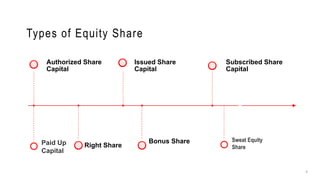
Types of Equity Share
Authorized Share
Capital
Right Share
Issued Share
Capital
Bonus Share
Subscribed Share
Capital
6
Paid Up
Capital
Sweat Equity
Share
PREFERENCE
SHARES
• Preference shares,
also known as
preferred stock, is an
exclusive share option
which enables
shareholders to
receive dividends
announced by the
company before the
equity shareholders.
• Preference shares
provide the
shareholders with the
special right to claim
dividends during the
company lifetime, and
also with the option to
claim repayment of
capital, in case of the
wind up of the
company.
PRESENTATION TITLE 7
F E AT U R E S O F P R E F E R E N C E S H A R E S
• Preferential dividend
option for
shareholders.
• Preference
shareholders do not
have the right to vote.
• Shareholders have a
right to claim the
assets in case of a
wind up of the
company.
• Fixed dividend payout
for shareholders,
irrespective of profit
earned.
• Acts as a source of
hybrid financing.
TYPES OF PREFERENCE
SHARES
• Cumulative preference
share
• Non-cumulative
preference shares
• Participating
preference shares
• Non-participating
preference shares
• Redeemable
Preference Share
• Non-redeemable
Preference Shares
• Convertible Preference
Shares
• Non-convertible
Preference Shares
WHAT ARE
DEFERRED
SHARES?
A deferred share is a type of
share that does not include any
access to the assets of a firm
that is going through bankruptcy
until all of the common
shareholders and preferred
shareholders have been
compensated.
10
FEATURES OF DEFERRED
SHARES
• Rate of dividend is not
fixed. It depends upon
the availability of profits.
• Dividend is paid after
payment of dividend on
equity & preference
shares.
• At the time of
liquidation, capital on
these shares is returned
after capital is repaid on
both preference & equity
shares.
TYPES OF DEFERRED
SHARES
• Convertible
Preferred
Shares
• Convertible
Bonds
12
“
”
The more you share,
the more you have.
Leonard Nimoy
13
THANK YOU

Shares & it's types

  • 1.
  • 2.
    INTRODUCTION Companies issue sharesas a means to raise money. This may be to finance company expansion, a new development, or to move into overseas markets. When you buy shares, you effectively become a part owner of the company. The bigger the investment you make, the bigger your stake will be in the company. 5/6/2023 PRESENTATION TITLE 2
  • 3.
    TYPES OF SHARES •Equity shares • Preference shares • Deferred shares 3
  • 4.
    4 EQUITY SHARES • Anequity share, normally known as ordinary share is a part ownership where each member is a fractional owner and initiates the maximum entrepreneurial liability related to a trading concern. These types of shareholders in any organization possess the right to vote.
  • 5.
    FEATU R ESOF EQU ITY SH AR ES C APITAL •Equity share capital remains with the company. It is given back only when the company is closed. •Equity Shareholders possess voting rights and select the company’s management. •The dividend rate on the equity capital relies upon the obtainability of the surfeit capital. However, there is no fixed rate of dividend on the equity capital. PRESENTATION TITLE 5
  • 6.
    Types of EquityShare Authorized Share Capital Right Share Issued Share Capital Bonus Share Subscribed Share Capital 6 Paid Up Capital Sweat Equity Share
  • 7.
    PREFERENCE SHARES • Preference shares, alsoknown as preferred stock, is an exclusive share option which enables shareholders to receive dividends announced by the company before the equity shareholders. • Preference shares provide the shareholders with the special right to claim dividends during the company lifetime, and also with the option to claim repayment of capital, in case of the wind up of the company. PRESENTATION TITLE 7
  • 8.
    F E ATU R E S O F P R E F E R E N C E S H A R E S • Preferential dividend option for shareholders. • Preference shareholders do not have the right to vote. • Shareholders have a right to claim the assets in case of a wind up of the company. • Fixed dividend payout for shareholders, irrespective of profit earned. • Acts as a source of hybrid financing.
  • 9.
    TYPES OF PREFERENCE SHARES •Cumulative preference share • Non-cumulative preference shares • Participating preference shares • Non-participating preference shares • Redeemable Preference Share • Non-redeemable Preference Shares • Convertible Preference Shares • Non-convertible Preference Shares
  • 10.
    WHAT ARE DEFERRED SHARES? A deferredshare is a type of share that does not include any access to the assets of a firm that is going through bankruptcy until all of the common shareholders and preferred shareholders have been compensated. 10
  • 11.
    FEATURES OF DEFERRED SHARES •Rate of dividend is not fixed. It depends upon the availability of profits. • Dividend is paid after payment of dividend on equity & preference shares. • At the time of liquidation, capital on these shares is returned after capital is repaid on both preference & equity shares.
  • 12.
    TYPES OF DEFERRED SHARES •Convertible Preferred Shares • Convertible Bonds 12
  • 13.
    “ ” The more youshare, the more you have. Leonard Nimoy 13
  • 14.