Shared Mobility & BRT
Susan Shaheen, UC Berkeley
© UC Berkeley, 2015
Presentation Overview
 Mobility Hubs & BRT
 Challenges & Opportunities
 Examples & Best Practices
 Competition & Complementarity
© UC Berkeley, 2015
Mobility Hubs
 Provide multi-modal connections in a high density
urban environment without extensive adjacent
parking infrastructure
Challenge:
 How to integrate more modes in less space
© UC Berkeley, 2015
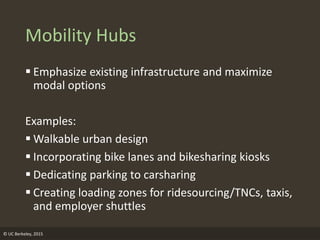
Mobility Hubs
 Emphasize existing infrastructure and maximize
modal options
Examples:
 Walkable urban design
 Incorporating bike lanes and bikesharing kiosks
 Dedicating parking to carsharing
 Creating loading zones for ridesourcing/TNCs, taxis,
and employer shuttles
© UC Berkeley, 2015
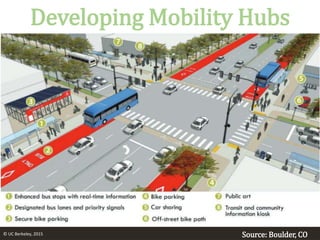
Developing Mobility Hubs
Source: Boulder, CO© UC Berkeley, 2015
7
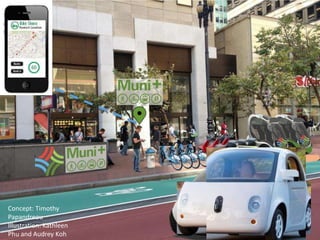
Rapid Network Boarding Island
Concept: Timothy
Papandreou
Illustration: Kathleen
Phu and Audrey Koh
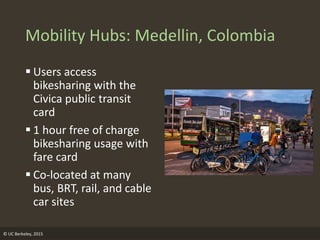
Mobility Hubs: Medellin, Colombia
 Users access
bikesharing with the
Civica public transit
card
 1 hour free of charge
bikesharing usage with
fare card
 Co-located at many
bus, BRT, rail, and cable
car sites
© UC Berkeley, 2015
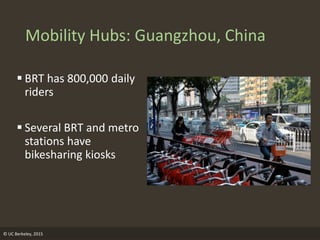
Mobility Hubs: Guangzhou, China
 BRT has 800,000 daily
riders
 Several BRT and metro
stations have
bikesharing kiosks
© UC Berkeley, 2015
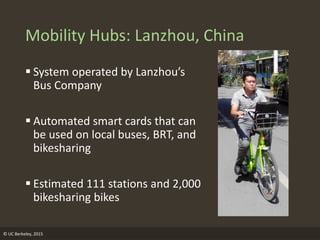
Mobility Hubs: Lanzhou, China
 System operated by Lanzhou’s
Bus Company
 Automated smart cards that can
be used on local buses, BRT, and
bikesharing
 Estimated 111 stations and 2,000
bikesharing bikes
© UC Berkeley, 2015
© UC Berkeley, 2015
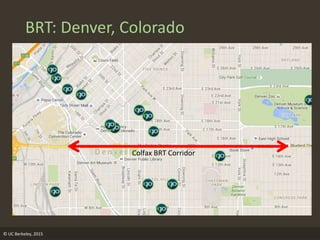
BRT: Denver, Colorado
 City has set aside $1.2M to design a 9-mile BRT route
along Colfax Avenue between Denver and Aurora
 City’s busiest bus corridor, with approximately
22,000 riders/weekday
 Under proposed plan, buses would have a dedicated
lane, transit signal prioritization, and 5-minute
headways
 Estimated cost savings over light rail:
 $335M capital
 $11M (operations annually)
© UC Berkeley, 2015
BRT: Denver, Colorado
Colfax BRT Corridor
© UC Berkeley, 2015
Hourcar Partnership with Metro Transit
Announced in August 2015, Metro
Transit to partner with Hourcar
(local carsharing operator in the
Twin Cities) to use Metro Transit
passes to access carsharing vehicles
© UC Berkeley, 2015
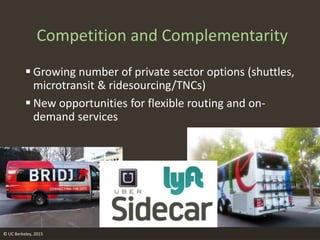
Competition and Complementarity
 Growing number of private sector options (shuttles,
microtransit & ridesourcing/TNCs)
 New opportunities for flexible routing and on-
demand services
© UC Berkeley, 2015
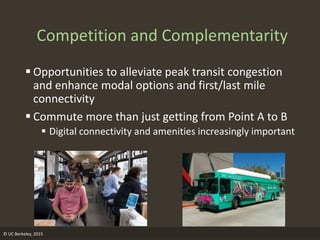
Competition and Complementarity
 Opportunities to alleviate peak transit congestion
and enhance modal options and first/last mile
connectivity
 Commute more than just getting from Point A to B
 Digital connectivity and amenities increasingly important
© UC Berkeley, 2015
Competition and Complementarity
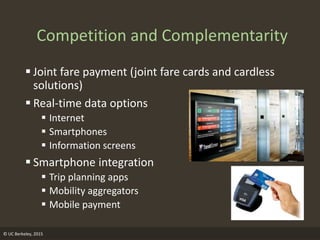
 Joint fare payment (joint fare cards and cardless
solutions)
 Real-time data options
 Internet
 Smartphones
 Information screens
 Smartphone integration
 Trip planning apps
 Mobility aggregators
 Mobile payment
Acknowledgements
 Mineta Transportation
Institute, San Jose State
University
 California Department of
Transportation
 Adam Cohen, TSRC
www.tsrc.berkeley.edu
Email: sshaheen@berkeley.edu
Twitter: SusanShaheen1
LinkedIn: Susan Shaheen
© UC Berkeley, 2015

Shared Mobility & BRT

  • 1.
    Shared Mobility &BRT Susan Shaheen, UC Berkeley
  • 2.
    © UC Berkeley,2015 Presentation Overview  Mobility Hubs & BRT  Challenges & Opportunities  Examples & Best Practices  Competition & Complementarity
  • 3.
  • 4.
    Mobility Hubs  Providemulti-modal connections in a high density urban environment without extensive adjacent parking infrastructure Challenge:  How to integrate more modes in less space © UC Berkeley, 2015
  • 5.
    Mobility Hubs  Emphasizeexisting infrastructure and maximize modal options Examples:  Walkable urban design  Incorporating bike lanes and bikesharing kiosks  Dedicating parking to carsharing  Creating loading zones for ridesourcing/TNCs, taxis, and employer shuttles © UC Berkeley, 2015
  • 6.
    Developing Mobility Hubs Source:Boulder, CO© UC Berkeley, 2015
  • 7.
    7 Rapid Network BoardingIsland Concept: Timothy Papandreou Illustration: Kathleen Phu and Audrey Koh
  • 8.
    Mobility Hubs: Medellin,Colombia  Users access bikesharing with the Civica public transit card  1 hour free of charge bikesharing usage with fare card  Co-located at many bus, BRT, rail, and cable car sites © UC Berkeley, 2015
  • 9.
    Mobility Hubs: Guangzhou,China  BRT has 800,000 daily riders  Several BRT and metro stations have bikesharing kiosks © UC Berkeley, 2015
  • 10.
    Mobility Hubs: Lanzhou,China  System operated by Lanzhou’s Bus Company  Automated smart cards that can be used on local buses, BRT, and bikesharing  Estimated 111 stations and 2,000 bikesharing bikes © UC Berkeley, 2015
  • 11.
    © UC Berkeley,2015 BRT: Denver, Colorado  City has set aside $1.2M to design a 9-mile BRT route along Colfax Avenue between Denver and Aurora  City’s busiest bus corridor, with approximately 22,000 riders/weekday  Under proposed plan, buses would have a dedicated lane, transit signal prioritization, and 5-minute headways  Estimated cost savings over light rail:  $335M capital  $11M (operations annually)
  • 12.
    © UC Berkeley,2015 BRT: Denver, Colorado Colfax BRT Corridor
  • 13.
    © UC Berkeley,2015 Hourcar Partnership with Metro Transit Announced in August 2015, Metro Transit to partner with Hourcar (local carsharing operator in the Twin Cities) to use Metro Transit passes to access carsharing vehicles
  • 14.
    © UC Berkeley,2015 Competition and Complementarity  Growing number of private sector options (shuttles, microtransit & ridesourcing/TNCs)  New opportunities for flexible routing and on- demand services
  • 15.
    © UC Berkeley,2015 Competition and Complementarity  Opportunities to alleviate peak transit congestion and enhance modal options and first/last mile connectivity  Commute more than just getting from Point A to B  Digital connectivity and amenities increasingly important
  • 16.
    © UC Berkeley,2015 Competition and Complementarity  Joint fare payment (joint fare cards and cardless solutions)  Real-time data options  Internet  Smartphones  Information screens  Smartphone integration  Trip planning apps  Mobility aggregators  Mobile payment
  • 17.
    Acknowledgements  Mineta Transportation Institute,San Jose State University  California Department of Transportation  Adam Cohen, TSRC www.tsrc.berkeley.edu Email: sshaheen@berkeley.edu Twitter: SusanShaheen1 LinkedIn: Susan Shaheen © UC Berkeley, 2015

Editor's Notes

  • #3 Start by talking about macro trends impacting multi-modal choices (e.g., demographic trends, new modal options, growth of smartphone apps, Internet, and real-time features. Introduce the concept of mobility hubs. Specifically, pairing shared mobility with BRT. Provide challenges, opportunities, and examples of best practices from around the globe. Discuss the ways shared mobility can both compete and complement BRT and public transportation. Convergence between public and private transportation options.
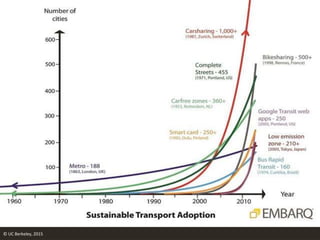
  • #4 - Discuss the opportunities and challenges with scaling sustainable transportation. Excerpt text from the blog with the figure below: In terms of the number of cities where implemented, the graph shows that carsharing and bikesharing are the fastest growing sustainable transport solutions. However, the impact of both measures is still relatively modest: carsharing schemes operate in more than 1,000 cities, but global membership is only about 5 million. By contrast, high impact solutions usually face larger obstacles to adoption. Metro rail and congestion pricing, for example, require greater institutional capacity and financial resources. Identifying and scaling the smart solutions – those with both high impact and relatively low strain on institutional and financial resources – is the key to achieving widespread implementation of sustainable transport measures. http://thecityfix.com/blog/on-the-move-advancing-sustainable-transport-getting-from-here-to-there-holger-dalkmann/
  • #5 - Urban locations with significant multi-modal connections and public transit access. Best mobility hubs have good urban design, highly walkable, with very limited adjacent parking. BRT is good for mobility hubs because it offers some of “rail-like” features without many of the challenges associated with heavy rail (higher cost, grade crossings that interrupt walkability etc.) Goal is to increase the number of modes and access without increasing the space allocated to infrastructure.
  • #6 - BRT is also ideal because it most often uses existing roadway rights-of-way.
  • #7 - Image from Boulder, CO depicting ideal mobility hubs. Multi-modal options using existing rights-of-way Real-time information included in the concept
  • #8 Similar concept from Tim P. of SFMTA Depicting a user accessing a smartphone app and trip planning their route, distance, time and cost. User can select from a variety of modes depending on distance and time required to get to their destination.
  • #9 About: - The second-largest city in Colombia and the capital of the department of Antioquia. It is located in the Aburrá Valley, a central region of the Andes Mountains in South America. According to the National Administrative Department of Statistics, the city has an estimated population of 2.44 million as of 2014.[1] With its surrounding area that includes nine other cities, the metropolitan area of Medellín is the second-largest urban agglomeration in Colombia in terms of population and economy, with more than 3.5 million people. Note the density is comparable to San Francisco Impressive 4th generation bikesharing system Kiosks are located at rail, BRT and cable car public transit stops Bicycles can be accessed free of charge for up to 1 hour using the transit fare card. Additional usage billed to the fare card. Bicycles are secured (from theft) based on the fare card. If a bicycle is stolen, it can be tracked to the person’s fare card that checked it out. Fare card is basically enabling a “free bikes” system, while imposing user accountability.
  • #10 About: The capital and largest city of Guangdong province in South China. Located approximate 75 miles NW of Hong Kong. Guangzhou serves as an important national transportation hub and trading port. Guangzhou is the third largest Chinese city and the largest city in South Central China. In 2014 the city's administrative area was estimated to have a population of 13,080,500. - However the density is quite a bit lower than Medellin. Average density (people/per sq mi) is only slightly higher than Portland, OR. - Guangzhou has one of the most extensive BRT systems in the world with 800,000 daily riders. Like Medellin, several BRT and metro stations have bikesharing kiosks. For more information, please see: https://youtu.be/mo50OvHvt1g
  • #11 About: The capital and largest city of Gansu Province in Northwest China. Lanzhou is home to 3,616,163 inhabitants at the 2010 census. The Lanzhou Bus Company operates both BRT and the city’s bikesharing system. Like Medellin, the smart cards can be used to access and pay for local buses, BRT and bikesharing.
  • #12 In Denver, the city has set aside money in the 2016 budget to plan a BRT line between Denver and Aurora. The bus corridor is the city’s busiest with approximately 22,000 daily riders. The bus corridor will align closely with existing modal options in Denver, particularly carsharing services offered by local provider e-Go. (See map on the next slide).
  • #13 Note, if built, the BRT line will be within walking distance of numerous e-Go carsharing locations. http://denver.streetsblog.org/2015/10/05/hancock-makes-room-for-colfax-brt-in-2016-budget/?utm_source=feedburner&utm_medium=email&utm_campaign=Feed%3A%20StreetsblogDenver%20%28Streetsblog%20Denver%29
  • #14 In August 2015, Metro Transit (Twin Cities) made a major announcement that they will be partnering with Hourcar to allow transit riders to access carsharing with their transit passes. Although additional details haven’t been released, it is believed the card will provide similar services and functions as Chicago’s old joint fare card. http://finance-commerce.com/transit/2015/08/17/metro-transit-partnering-with-hourcar-car-sharing-service/
  • #15 Increasing number of private sector transportation options May augment public transportation providing first/last mile connectivity, mobility insurance, additional options; or may compete
  • #16 One way these services can complement public transportation is through first/last mile connectivity and by increasing capacity at peak times Transit operators may not be able to manage peak capacity; private sector solutions may help alleviate transit congestion during these times Note, Lyft bus wrap. Competition or complementarity – unsure. “Use your own mode” – could be interpreted by some to use Lyft instead of transit. Others may interpret it as providing a link to transit. SF Ridesourcing study – 4% identified a transit station as either their origin or desintation. 28% of trips began or ended within ¼ mile of rail transit; 85% within 1/8th mile of a bus stop. People increasingly using the commute for more than getting from Point A to Point B. Amenities such as plugs, WiFi, even coffee/beverages are becoming increasingly important. May want to discuss Leap (depicted above) now defunct due to CPUC cease and desist order.
  • #17 A number of “e” features are complementing BRT, and public transportation. This includes joint fare payments (previously discussed) as well as contactless payment such as Visa PayWave, Apple Pay and other solutions Real-time data support via internet, smartphone apps, and information screens such as TransitScreen (pictured) and Nextbus Growth in trip planning apps and mobility aggreators