Feasibility of electric
buses in public transport
Dr. Student Olli Vilppo
Tampere University of Technology (Finland)
olli.vilppo@tut.fi
Nordic Electric Bus Initiatives 2
12.5.2016
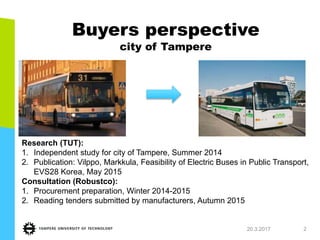
Buyers perspective
city of Tampere
20.3.2017 2
Research (TUT):
1. Independent study for city of Tampere, Summer 2014
2. Publication: Vilppo, Markkula, Feasibility of Electric Buses in Public Transport,
EVS28 Korea, May 2015
Consultation (Robustco):
1. Procurement preparation, Winter 2014-2015
2. Reading tenders submitted by manufacturers, Autumn 2015
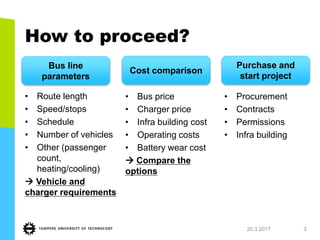
How to proceed?
• Route length
• Speed/stops
• Schedule
• Number of vehicles
• Other (passenger
count,
heating/cooling)
 Vehicle and
charger requirements
20.3.2017 3
Bus line
parameters
Cost comparison
Purchase and
start project
• Bus price
• Charger price
• Infra building cost
• Operating costs
• Battery wear cost
 Compare the
options
• Procurement
• Contracts
• Permissions
• Infra building
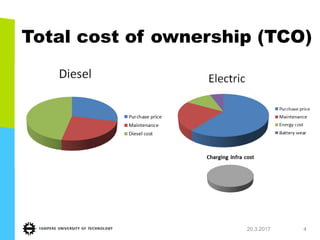
Total cost of ownership (TCO)
20.3.2017 4
5.5.2015 5
eBus system building blocks
Electric buses Battery
Charging
infrastructure
Energy
consumption
Investment
cost
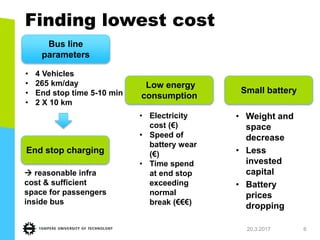
Finding lowest cost
20.3.2017 6
End stop charging
Low energy
consumption
Small battery
Bus line
parameters
• 4 Vehicles
• 265 km/day
• End stop time 5-10 min
• 2 X 10 km
• Electricity
cost (€)
• Speed of
battery wear
(€)
• Time spend
at end stop
exceeding
normal
break (€€€)
• Weight and
space
decrease
• Less
invested
capital
• Battery
prices
dropping
 reasonable infra
cost & sufficient
space for passengers
inside bus
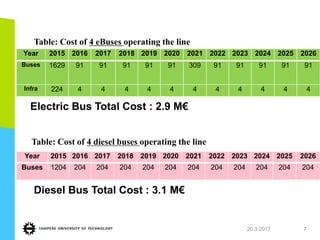
Year 2015 2016 2017 2018 2019 2020 2021 2022 2023 2024 2025 2026
Buses 1629 91 91 91 91 91 309 91 91 91 91 91
Infra 224 4 4 4 4 4 4 4 4 4 4 4
20.3.2017 7
Table: Cost of 4 eBuses operating the line
Year 2015 2016 2017 2018 2019 2020 2021 2022 2023 2024 2025 2026
Buses 1204 204 204 204 204 204 204 204 204 204 204 204
Table: Cost of 4 diesel buses operating the line
Electric Bus Total Cost : 2.9 M€
Diesel Bus Total Cost : 3.1 M€
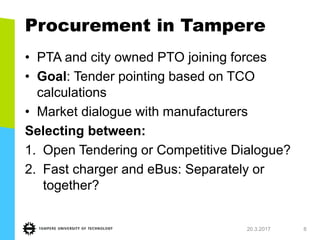
Procurement in Tampere
• PTA and city owned PTO joining forces
• Goal: Tender pointing based on TCO
calculations
• Market dialogue with manufacturers
Selecting between:
1. Open Tendering or Competitive Dialogue?
2. Fast charger and eBus: Separately or
together?
20.3.2017 8
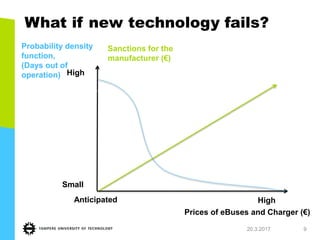
What if new technology fails?
20.3.2017 9
High
Small
Sanctions for the
manufacturer (€)
Prices of eBuses and Charger (€)
Anticipated High
Probability density
function,
(Days out of
operation)
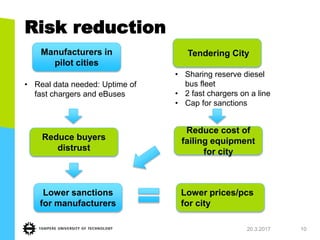
Risk reduction
20.3.2017 10
Manufacturers in
pilot cities
Tendering City
• Real data needed: Uptime of
fast chargers and eBuses
• Sharing reserve diesel
bus fleet
• 2 fast chargers on a line
• Cap for sanctions
Reduce buyers
distrust
Reduce cost of
failing equipment
for city
Lower prices/pcs
for city
Lower sanctions
for manufacturers
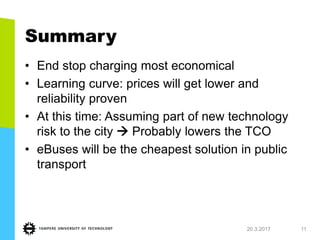
Summary
• End stop charging most economical
• Learning curve: prices will get lower and
reliability proven
• At this time: Assuming part of new technology
risk to the city  Probably lowers the TCO
• eBuses will be the cheapest solution in public
transport
20.3.2017 11

Electric buses presentation

  • 1.
    Feasibility of electric busesin public transport Dr. Student Olli Vilppo Tampere University of Technology (Finland) olli.vilppo@tut.fi Nordic Electric Bus Initiatives 2 12.5.2016
  • 2.
    Buyers perspective city ofTampere 20.3.2017 2 Research (TUT): 1. Independent study for city of Tampere, Summer 2014 2. Publication: Vilppo, Markkula, Feasibility of Electric Buses in Public Transport, EVS28 Korea, May 2015 Consultation (Robustco): 1. Procurement preparation, Winter 2014-2015 2. Reading tenders submitted by manufacturers, Autumn 2015
  • 3.
    How to proceed? •Route length • Speed/stops • Schedule • Number of vehicles • Other (passenger count, heating/cooling)  Vehicle and charger requirements 20.3.2017 3 Bus line parameters Cost comparison Purchase and start project • Bus price • Charger price • Infra building cost • Operating costs • Battery wear cost  Compare the options • Procurement • Contracts • Permissions • Infra building
  • 4.
    Total cost ofownership (TCO) 20.3.2017 4
  • 5.
    5.5.2015 5 eBus systembuilding blocks Electric buses Battery Charging infrastructure Energy consumption Investment cost
  • 6.
    Finding lowest cost 20.3.20176 End stop charging Low energy consumption Small battery Bus line parameters • 4 Vehicles • 265 km/day • End stop time 5-10 min • 2 X 10 km • Electricity cost (€) • Speed of battery wear (€) • Time spend at end stop exceeding normal break (€€€) • Weight and space decrease • Less invested capital • Battery prices dropping  reasonable infra cost & sufficient space for passengers inside bus
  • 7.
    Year 2015 20162017 2018 2019 2020 2021 2022 2023 2024 2025 2026 Buses 1629 91 91 91 91 91 309 91 91 91 91 91 Infra 224 4 4 4 4 4 4 4 4 4 4 4 20.3.2017 7 Table: Cost of 4 eBuses operating the line Year 2015 2016 2017 2018 2019 2020 2021 2022 2023 2024 2025 2026 Buses 1204 204 204 204 204 204 204 204 204 204 204 204 Table: Cost of 4 diesel buses operating the line Electric Bus Total Cost : 2.9 M€ Diesel Bus Total Cost : 3.1 M€
  • 8.
    Procurement in Tampere •PTA and city owned PTO joining forces • Goal: Tender pointing based on TCO calculations • Market dialogue with manufacturers Selecting between: 1. Open Tendering or Competitive Dialogue? 2. Fast charger and eBus: Separately or together? 20.3.2017 8
  • 9.
    What if newtechnology fails? 20.3.2017 9 High Small Sanctions for the manufacturer (€) Prices of eBuses and Charger (€) Anticipated High Probability density function, (Days out of operation)
  • 10.
    Risk reduction 20.3.2017 10 Manufacturersin pilot cities Tendering City • Real data needed: Uptime of fast chargers and eBuses • Sharing reserve diesel bus fleet • 2 fast chargers on a line • Cap for sanctions Reduce buyers distrust Reduce cost of failing equipment for city Lower prices/pcs for city Lower sanctions for manufacturers
  • 11.
    Summary • End stopcharging most economical • Learning curve: prices will get lower and reliability proven • At this time: Assuming part of new technology risk to the city  Probably lowers the TCO • eBuses will be the cheapest solution in public transport 20.3.2017 11

Editor's Notes

  • #4 How to define the blocks and get going?
  • #7 How to define the blocks and get going?
  • #10 Safety margin/ sanction high enough to get the promblem fixed fast but not to bankrupt the manufacturer