November 2015
Dr Rupert Booth, FIET FRICS FCMA PMP CEng
Chief Economist
Smart Cities
Agenda
• What is a Smart City?
• Urbanization: Trends & Risks
• Smart Utopia?
• Links to Sustainability
• Smart City standards
• Data, Sensors and Internet of Things
• Making the Transition
• Performance Measures
• What it all means for RICS Members
What is a Smart City? Many very different definitions
Integration (from British Standards Institute, PAS180, 2014):
The effective integration of physical, digital and human systems in the built
environment to deliver sustainable, prosperous and inclusive future for its
citizens
Qualifying criteria (Dept. Bus Innovation & Skills, 2013):
1. Modern digital infrastructure, providing access to re-usable data
2. Citizen-centric services
3. Intelligent physical infrastructure, i.e. Internet of Things
4. Openness to learn from others
5. Transparency of outcomes
6. Clear and consistent vision
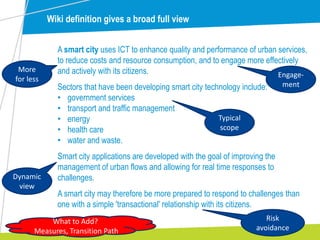
Wiki definition gives a broad full view
A smart city uses ICT to enhance quality and performance of urban services,
to reduce costs and resource consumption, and to engage more effectively
and actively with its citizens.
Sectors that have been developing smart city technology include:
• government services
• transport and traffic management
• energy
• health care
• water and waste.
Smart city applications are developed with the goal of improving the
management of urban flows and allowing for real time responses to
challenges.
A smart city may therefore be more prepared to respond to challenges than
one with a simple 'transactional' relationship with its citizens.
More
for less
Engage-
ment
Typical
scope
Dynamic
view
Risk
avoidance
What to Add?
Measures, Transition Path
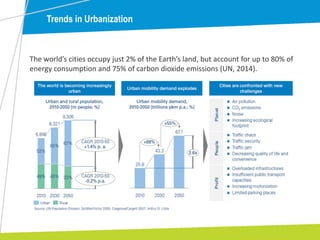
Trends in Urbanization
The world’s cities occupy just 2% of the Earth’s land, but account for up to 80% of
energy consumption and 75% of carbon dioxide emissions (UN, 2014).
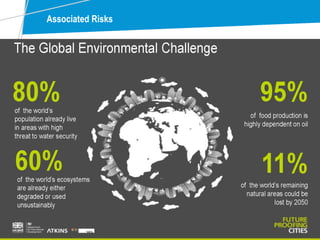
Associated Risks
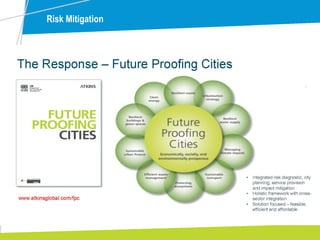
Risk Mitigation
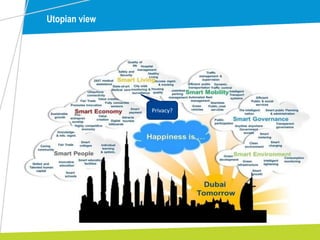
Utopian view
Privacy?
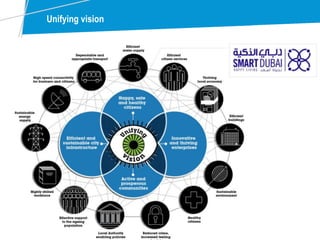
Unifying vision
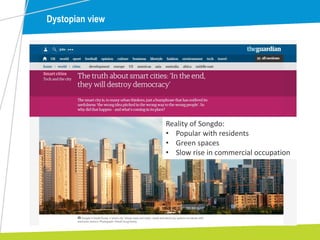
Dystopian view
Reality of Songdo:
• Popular with residents
• Green spaces
• Slow rise in commercial occupation
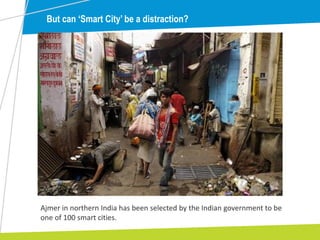
But can ‘Smart City’ be a distraction?
Ajmer in northern India has been selected by the Indian government to be
one of 100 smart cities.
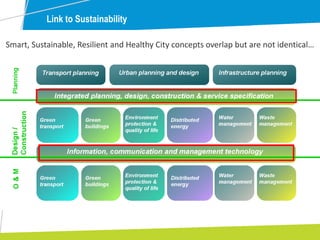
Link to Sustainability
Smart, Sustainable, Resilient and Healthy City concepts overlap but are not identical…
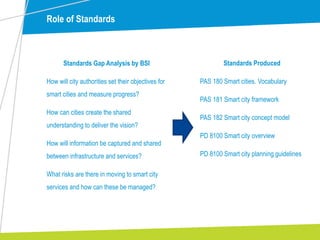
Role of Standards
Standards Gap Analysis by BSI
How will city authorities set their objectives for
smart cities and measure progress?
How can cities create the shared
understanding to deliver the vision?
How will information be captured and shared
between infrastructure and services?
What risks are there in moving to smart city
services and how can these be managed?
Standards Produced
PAS 180 Smart cities. Vocabulary
PAS 181 Smart city framework
PAS 182 Smart city concept model
PD 8100 Smart city overview
PD 8100 Smart city planning guidelines
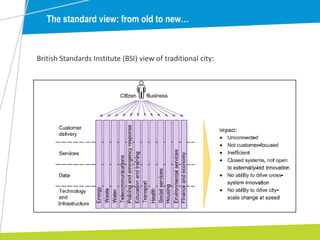
The standard view: from old to new…
British Standards Institute (BSI) view of traditional city:
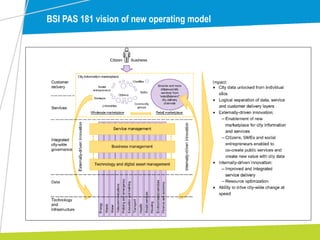
BSI PAS 181 vision of new operating model
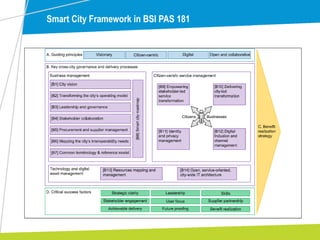
Smart City Framework in BSI PAS 181
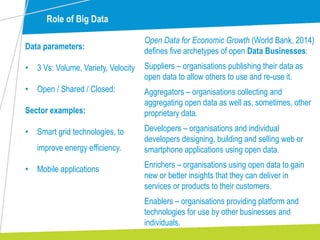
Role of Big Data
Data parameters:
• 3 Vs: Volume, Variety, Velocity
• Open / Shared / Closed:
Sector examples:
• Smart grid technologies, to
improve energy efficiency.
• Mobile applications
Open Data for Economic Growth (World Bank, 2014)
defines five archetypes of open Data Businesses:
Suppliers – organisations publishing their data as
open data to allow others to use and re-use it.
Aggregators – organisations collecting and
aggregating open data as well as, sometimes, other
proprietary data.
Developers – organisations and individual
developers designing, building and selling web or
smartphone applications using open data.
Enrichers – organisations using open data to gain
new or better insights that they can deliver in
services or products to their customers.
Enablers – organisations providing platform and
technologies for use by other businesses and
individuals.
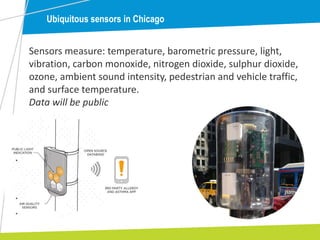
Ubiquitous sensors in Chicago
Sensors measure: temperature, barometric pressure, light,
vibration, carbon monoxide, nitrogen dioxide, sulphur dioxide,
ozone, ambient sound intensity, pedestrian and vehicle traffic,
and surface temperature.
Data will be public
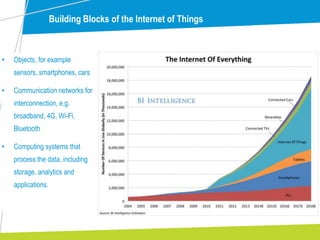
Building Blocks of the Internet of Things
• Objects, for example
sensors, smartphones, cars
• Communication networks for
interconnection, e.g.
broadband, 4G, Wi-Fi,
Bluetooth
• Computing systems that
process the data, including
storage, analytics and
applications.
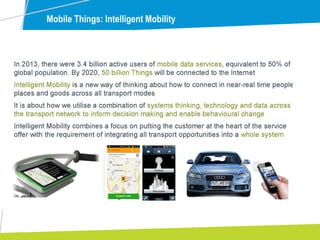
Mobile Things: Intelligent Mobility
Barriers: Royal Academy of Engineering
Smart government – the need to create the right environment for investment in smart
infrastructure, particularly procurement that recognises the need to invest now to save
in the long term.
Data quality and management – the quality of data has to be known before it can be
used to optimise a system.
Privacy – an abundance of data already exists but a lack of availability or use derives
from security and privacy concerns as well as commercial considerations.
Investment – traditional methods of proving return on investment fail to take into
account the full complexity of a ‘system of systems’.
Vulnerability – interconnected systems introduce more vulnerabilities, particularly in
ICT systems, which could lead to a cascade of system failures.
Lifetime – infrastructure can be designed to last up to 100 years. If sensors are
embedded into this infrastructure, will their lifetime match that of the infrastructure
itself?
Anything missing?
Multiple Stakeholder perspectives
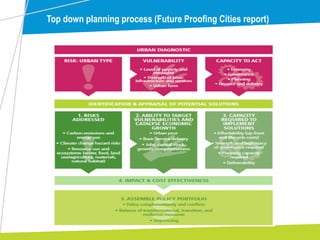
Top down planning process (Future Proofing Cities report)
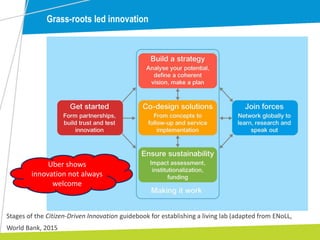
Grass-roots led innovation
Stages of the Citizen-Driven Innovation guidebook for establishing a living lab (adapted from ENoLL,
World Bank, 2015
Uber shows
innovation not always
welcome
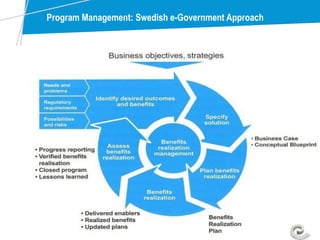
Program Management: Swedish e-Government Approach
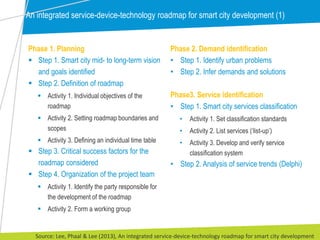
An integrated service-device-technology roadmap for smart city development (1)
Phase 1. Planning
 Step 1. Smart city mid- to long-term vision
and goals identified
 Step 2. Definition of roadmap
 Activity 1. Individual objectives of the
roadmap
 Activity 2. Setting roadmap boundaries and
scopes
 Activity 3. Defining an individual time table
 Step 3. Critical success factors for the
roadmap considered
 Step 4. Organization of the project team
 Activity 1. Identify the party responsible for
the development of the roadmap
 Activity 2. Form a working group
Phase 2. Demand identification
• Step 1. Identify urban problems
• Step 2. Infer demands and solutions
Phase3. Service identification
• Step 1. Smart city services classification
• Activity 1. Set classification standards
• Activity 2. List services (‘list-up’)
• Activity 3. Develop and verify service
classification system
• Step 2. Analysis of service trends (Delphi)
Source: Lee, Phaal & Lee (2013), An integrated service-device-technology roadmap for smart city development
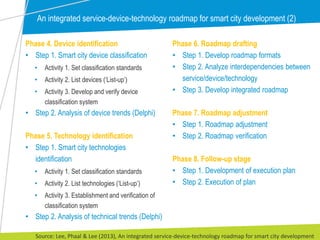
Phase 4. Device identification
• Step 1. Smart city device classification
• Activity 1. Set classification standards
• Activity 2. List devices (‘List-up’)
• Activity 3. Develop and verify device
classification system
• Step 2. Analysis of device trends (Delphi)
Phase 5. Technology identification
• Step 1. Smart city technologies
identification
• Activity 1. Set classification standards
• Activity 2. List technologies (‘List-up’)
• Activity 3. Establishment and verification of
classification system
• Step 2. Analysis of technical trends (Delphi)
Phase 6. Roadmap drafting
• Step 1. Develop roadmap formats
• Step 2. Analyze interdependencies between
service/device/technology
• Step 3. Develop integrated roadmap
Phase 7. Roadmap adjustment
• Step 1. Roadmap adjustment
• Step 2. Roadmap verification
Phase 8. Follow-up stage
• Step 1. Development of execution plan
• Step 2. Execution of plan
An integrated service-device-technology roadmap for smart city development (2)
Source: Lee, Phaal & Lee (2013), An integrated service-device-technology roadmap for smart city development
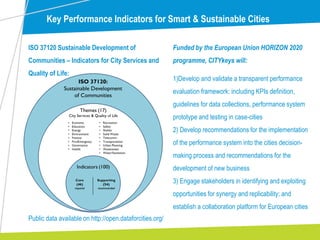
Key Performance Indicators for Smart & Sustainable Cities
ISO 37120 Sustainable Development of
Communities – Indicators for City Services and
Quality of Life:
Public data available on http://open.dataforcities.org/
Funded by the European Union HORIZON 2020
programme, CITYkeys will:
1)Develop and validate a transparent performance
evaluation framework: including KPIs definition,
guidelines for data collections, performance system
prototype and testing in case-cities
2) Develop recommendations for the implementation
of the performance system into the cities decision-
making process and recommendations for the
development of new business
3) Engage stakeholders in identifying and exploiting
opportunities for synergy and replicability; and
establish a collaboration platform for European cities
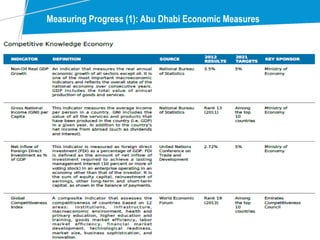
Measuring Progress (1): Abu Dhabi Economic Measures
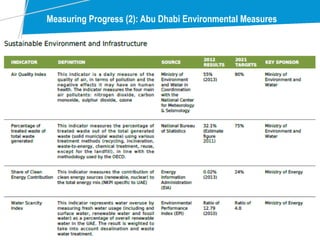
Measuring Progress (2): Abu Dhabi Environmental Measures
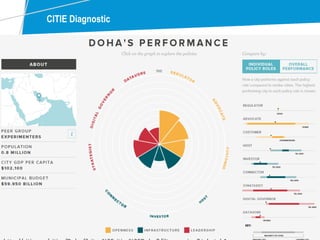
CITIE Diagnostic
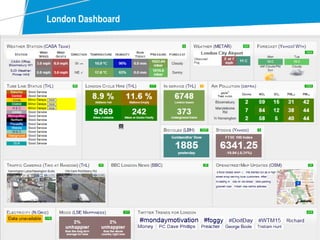
London Dashboard
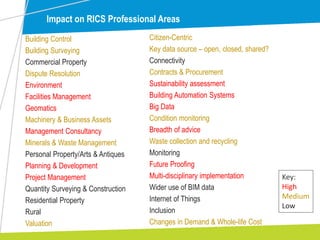
Impact on RICS Professional Areas
Building Control
Building Surveying
Commercial Property
Dispute Resolution
Environment
Facilities Management
Geomatics
Machinery & Business Assets
Management Consultancy
Minerals & Waste Management
Personal Property/Arts & Antiques
Planning & Development
Project Management
Quantity Surveying & Construction
Residential Property
Rural
Valuation
Citizen-Centric
Key data source – open, closed, shared?
Connectivity
Contracts & Procurement
Sustainability assessment
Building Automation Systems
Big Data
Condition monitoring
Breadth of advice
Waste collection and recycling
Monitoring
Future Proofing
Multi-disciplinary implementation
Wider use of BIM data
Internet of Things
Inclusion
Changes in Demand & Whole-life Cost
Key:
High
Medium
Low

Smart Cities

  • 1.
    November 2015 Dr RupertBooth, FIET FRICS FCMA PMP CEng Chief Economist Smart Cities
  • 2.
    Agenda • What isa Smart City? • Urbanization: Trends & Risks • Smart Utopia? • Links to Sustainability • Smart City standards • Data, Sensors and Internet of Things • Making the Transition • Performance Measures • What it all means for RICS Members
  • 3.
    What is aSmart City? Many very different definitions Integration (from British Standards Institute, PAS180, 2014): The effective integration of physical, digital and human systems in the built environment to deliver sustainable, prosperous and inclusive future for its citizens Qualifying criteria (Dept. Bus Innovation & Skills, 2013): 1. Modern digital infrastructure, providing access to re-usable data 2. Citizen-centric services 3. Intelligent physical infrastructure, i.e. Internet of Things 4. Openness to learn from others 5. Transparency of outcomes 6. Clear and consistent vision
  • 4.
    Wiki definition givesa broad full view A smart city uses ICT to enhance quality and performance of urban services, to reduce costs and resource consumption, and to engage more effectively and actively with its citizens. Sectors that have been developing smart city technology include: • government services • transport and traffic management • energy • health care • water and waste. Smart city applications are developed with the goal of improving the management of urban flows and allowing for real time responses to challenges. A smart city may therefore be more prepared to respond to challenges than one with a simple 'transactional' relationship with its citizens. More for less Engage- ment Typical scope Dynamic view Risk avoidance What to Add? Measures, Transition Path
  • 5.
    Trends in Urbanization Theworld’s cities occupy just 2% of the Earth’s land, but account for up to 80% of energy consumption and 75% of carbon dioxide emissions (UN, 2014).
  • 6.
  • 7.
  • 8.
  • 9.
  • 10.
    Dystopian view Reality ofSongdo: • Popular with residents • Green spaces • Slow rise in commercial occupation
  • 11.
    But can ‘SmartCity’ be a distraction? Ajmer in northern India has been selected by the Indian government to be one of 100 smart cities.
  • 12.
    Link to Sustainability Smart,Sustainable, Resilient and Healthy City concepts overlap but are not identical…
  • 13.
    Role of Standards StandardsGap Analysis by BSI How will city authorities set their objectives for smart cities and measure progress? How can cities create the shared understanding to deliver the vision? How will information be captured and shared between infrastructure and services? What risks are there in moving to smart city services and how can these be managed? Standards Produced PAS 180 Smart cities. Vocabulary PAS 181 Smart city framework PAS 182 Smart city concept model PD 8100 Smart city overview PD 8100 Smart city planning guidelines
  • 14.
    The standard view:from old to new… British Standards Institute (BSI) view of traditional city:
  • 15.
    BSI PAS 181vision of new operating model
  • 16.
    Smart City Frameworkin BSI PAS 181
  • 17.
    Role of BigData Data parameters: • 3 Vs: Volume, Variety, Velocity • Open / Shared / Closed: Sector examples: • Smart grid technologies, to improve energy efficiency. • Mobile applications Open Data for Economic Growth (World Bank, 2014) defines five archetypes of open Data Businesses: Suppliers – organisations publishing their data as open data to allow others to use and re-use it. Aggregators – organisations collecting and aggregating open data as well as, sometimes, other proprietary data. Developers – organisations and individual developers designing, building and selling web or smartphone applications using open data. Enrichers – organisations using open data to gain new or better insights that they can deliver in services or products to their customers. Enablers – organisations providing platform and technologies for use by other businesses and individuals.
  • 18.
    Ubiquitous sensors inChicago Sensors measure: temperature, barometric pressure, light, vibration, carbon monoxide, nitrogen dioxide, sulphur dioxide, ozone, ambient sound intensity, pedestrian and vehicle traffic, and surface temperature. Data will be public
  • 19.
    Building Blocks ofthe Internet of Things • Objects, for example sensors, smartphones, cars • Communication networks for interconnection, e.g. broadband, 4G, Wi-Fi, Bluetooth • Computing systems that process the data, including storage, analytics and applications.
  • 20.
  • 21.
    Barriers: Royal Academyof Engineering Smart government – the need to create the right environment for investment in smart infrastructure, particularly procurement that recognises the need to invest now to save in the long term. Data quality and management – the quality of data has to be known before it can be used to optimise a system. Privacy – an abundance of data already exists but a lack of availability or use derives from security and privacy concerns as well as commercial considerations. Investment – traditional methods of proving return on investment fail to take into account the full complexity of a ‘system of systems’. Vulnerability – interconnected systems introduce more vulnerabilities, particularly in ICT systems, which could lead to a cascade of system failures. Lifetime – infrastructure can be designed to last up to 100 years. If sensors are embedded into this infrastructure, will their lifetime match that of the infrastructure itself? Anything missing? Multiple Stakeholder perspectives
  • 22.
    Top down planningprocess (Future Proofing Cities report)
  • 23.
    Grass-roots led innovation Stagesof the Citizen-Driven Innovation guidebook for establishing a living lab (adapted from ENoLL, World Bank, 2015 Uber shows innovation not always welcome
  • 24.
    Program Management: Swedishe-Government Approach
  • 25.
    An integrated service-device-technologyroadmap for smart city development (1) Phase 1. Planning  Step 1. Smart city mid- to long-term vision and goals identified  Step 2. Definition of roadmap  Activity 1. Individual objectives of the roadmap  Activity 2. Setting roadmap boundaries and scopes  Activity 3. Defining an individual time table  Step 3. Critical success factors for the roadmap considered  Step 4. Organization of the project team  Activity 1. Identify the party responsible for the development of the roadmap  Activity 2. Form a working group Phase 2. Demand identification • Step 1. Identify urban problems • Step 2. Infer demands and solutions Phase3. Service identification • Step 1. Smart city services classification • Activity 1. Set classification standards • Activity 2. List services (‘list-up’) • Activity 3. Develop and verify service classification system • Step 2. Analysis of service trends (Delphi) Source: Lee, Phaal & Lee (2013), An integrated service-device-technology roadmap for smart city development
  • 26.
    Phase 4. Deviceidentification • Step 1. Smart city device classification • Activity 1. Set classification standards • Activity 2. List devices (‘List-up’) • Activity 3. Develop and verify device classification system • Step 2. Analysis of device trends (Delphi) Phase 5. Technology identification • Step 1. Smart city technologies identification • Activity 1. Set classification standards • Activity 2. List technologies (‘List-up’) • Activity 3. Establishment and verification of classification system • Step 2. Analysis of technical trends (Delphi) Phase 6. Roadmap drafting • Step 1. Develop roadmap formats • Step 2. Analyze interdependencies between service/device/technology • Step 3. Develop integrated roadmap Phase 7. Roadmap adjustment • Step 1. Roadmap adjustment • Step 2. Roadmap verification Phase 8. Follow-up stage • Step 1. Development of execution plan • Step 2. Execution of plan An integrated service-device-technology roadmap for smart city development (2) Source: Lee, Phaal & Lee (2013), An integrated service-device-technology roadmap for smart city development
  • 27.
    Key Performance Indicatorsfor Smart & Sustainable Cities ISO 37120 Sustainable Development of Communities – Indicators for City Services and Quality of Life: Public data available on http://open.dataforcities.org/ Funded by the European Union HORIZON 2020 programme, CITYkeys will: 1)Develop and validate a transparent performance evaluation framework: including KPIs definition, guidelines for data collections, performance system prototype and testing in case-cities 2) Develop recommendations for the implementation of the performance system into the cities decision- making process and recommendations for the development of new business 3) Engage stakeholders in identifying and exploiting opportunities for synergy and replicability; and establish a collaboration platform for European cities
  • 28.
    Measuring Progress (1):Abu Dhabi Economic Measures
  • 29.
    Measuring Progress (2):Abu Dhabi Environmental Measures
  • 30.
  • 31.
  • 32.
    Impact on RICSProfessional Areas Building Control Building Surveying Commercial Property Dispute Resolution Environment Facilities Management Geomatics Machinery & Business Assets Management Consultancy Minerals & Waste Management Personal Property/Arts & Antiques Planning & Development Project Management Quantity Surveying & Construction Residential Property Rural Valuation Citizen-Centric Key data source – open, closed, shared? Connectivity Contracts & Procurement Sustainability assessment Building Automation Systems Big Data Condition monitoring Breadth of advice Waste collection and recycling Monitoring Future Proofing Multi-disciplinary implementation Wider use of BIM data Internet of Things Inclusion Changes in Demand & Whole-life Cost Key: High Medium Low