By: Anthony Price & Juan Balbuena
United States Dept. of Transportation
2009 STIPDG Summer Interns
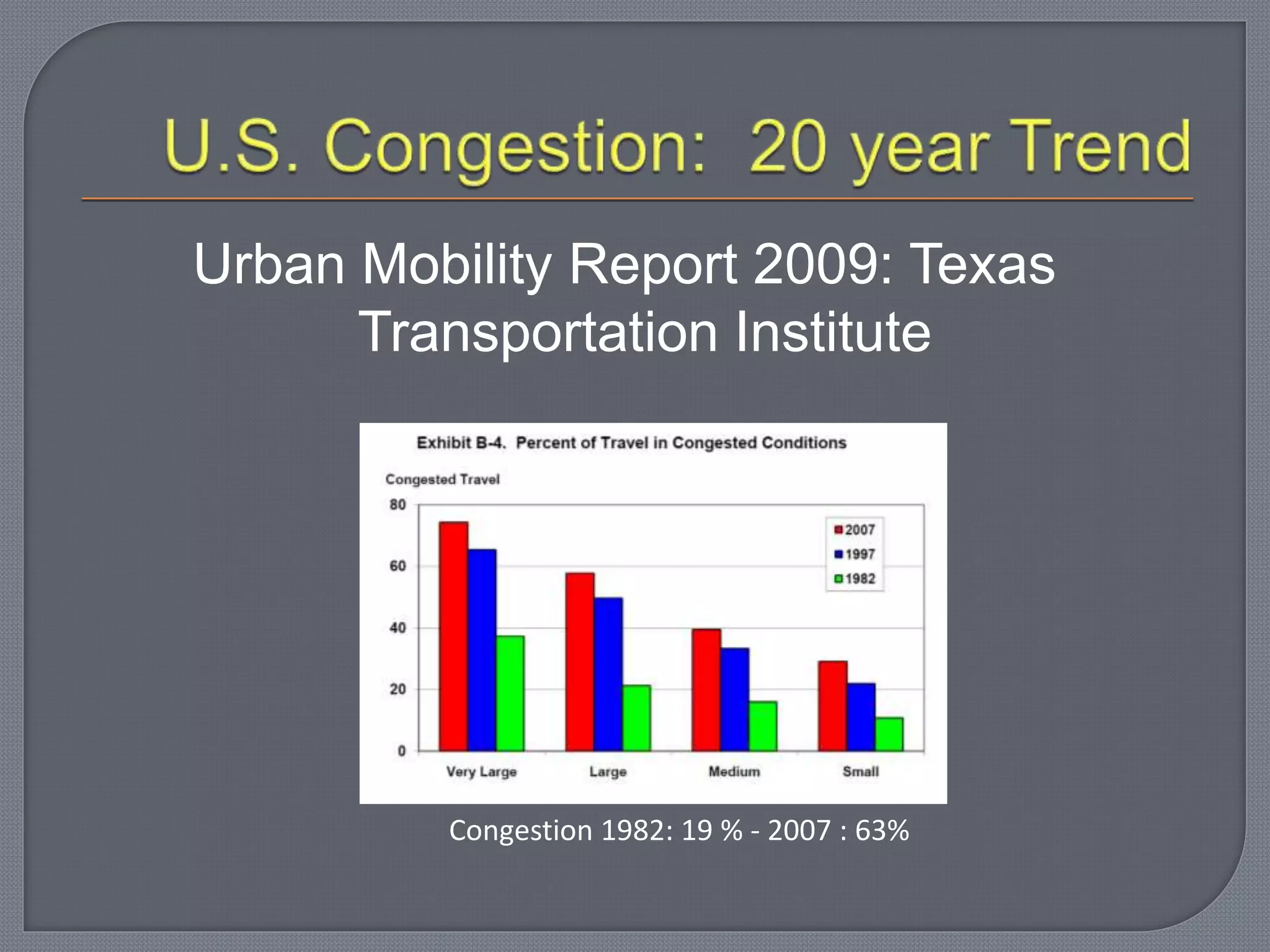
Urban Mobility Report 2009: Texas
Transportation Institute
Congestion 1982: 19 % - 2007 : 63%
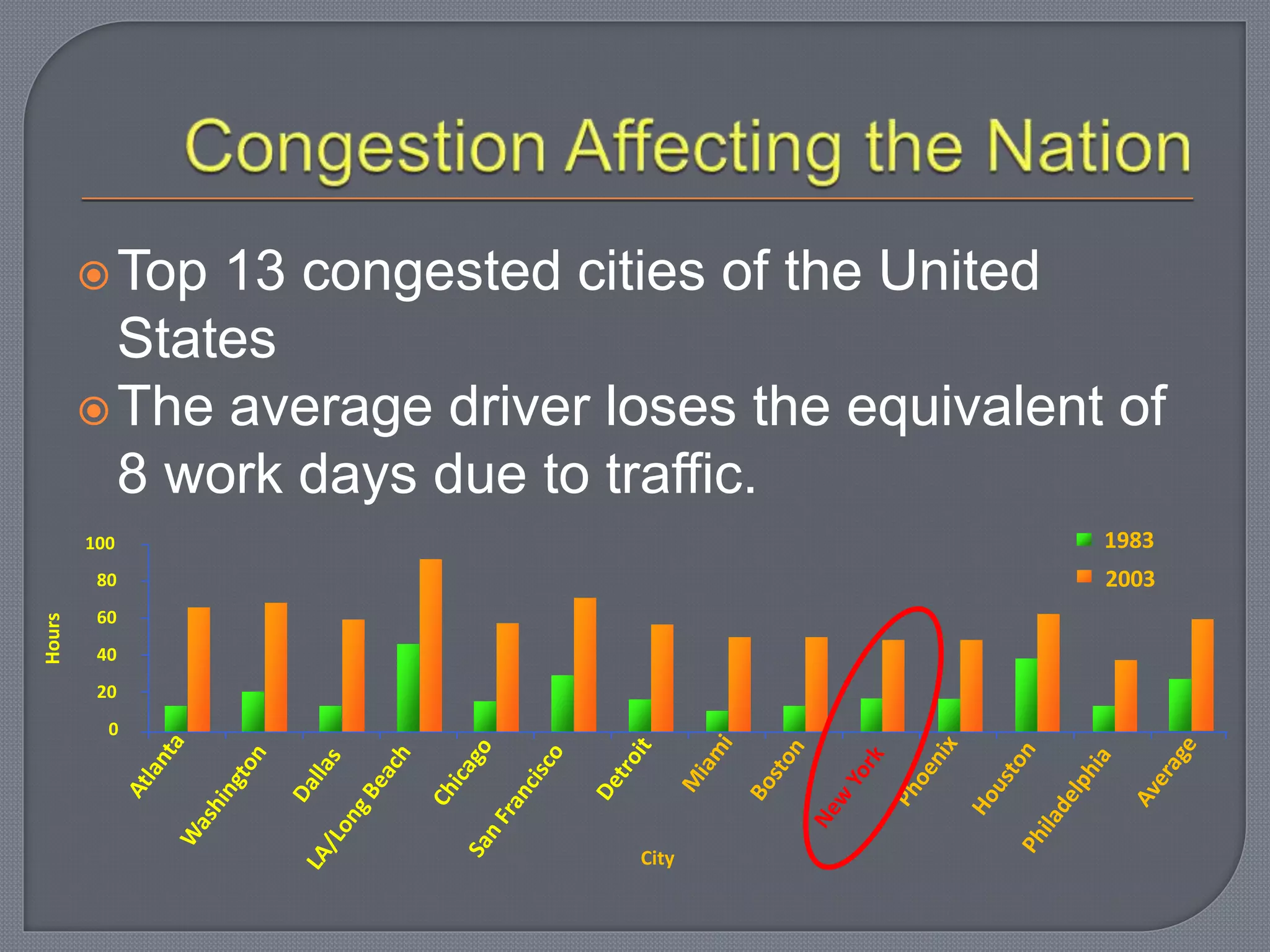
Top 13 congested cities of the United
States
The average driver loses the equivalent of
8 work days due to traffic.
Hours
100
80
60
40
20
0
1983
2003
City
 Congestion is cause of when demand volume exceeds
capacity.
 In Manhattan alone, transit ridership has increased by 60%
since 1990 resulting in crowed buses and subway.
 The city is currently suffering a heavy subway ridership
along the east side of Manhattan subway lines because of
a lack of available lines and the constant delay of the 2nd
Avenue line.
 In 2030 the projected population is expected to increase by
one million people and add an additional 750,000 new jobs
in New York City. Meaning a bigger traffic headache.
1. Do nothing alternative
2. Many would call for adding a new lane to an
overburdened highway or street and in New
York’s case a subway line under the assumption
that this may alleviate the problem. This could
possibly prove to be financially unaffordable, and
cost tens of millions of dollars to construct.
3. Congestion pricing, which the City of New York
has turned down already a few years back.
4. License plate lottery, which is practiced in
Columbia and other countries.
5. Implement Bus Rapid Transit.
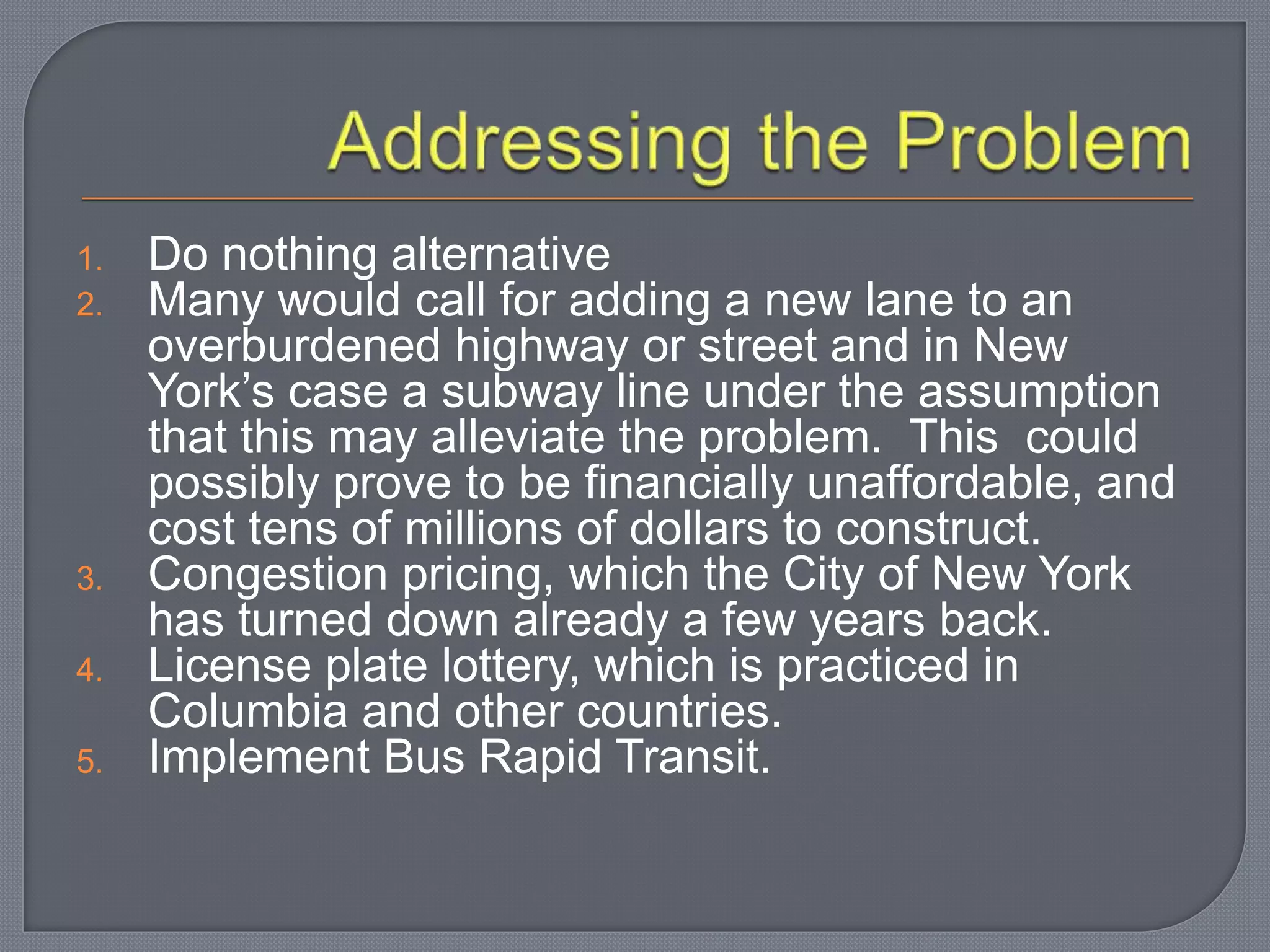
Bus Rapid Transit (BRT) is a public
transportation system that uses buses to
provide a service that is of a higher speed
that an ordinary bus line.
Goal: Combine the advantages of a metro
system with that of a bus system.
Can include exclusive right of way lanes.
Can take the place of existing roadways.
People of diverse types of financial
backgrounds can take part in its usage
Faster than regular bus service and is
more time oriented.
Traffic signal priority for longer green time
at lights.
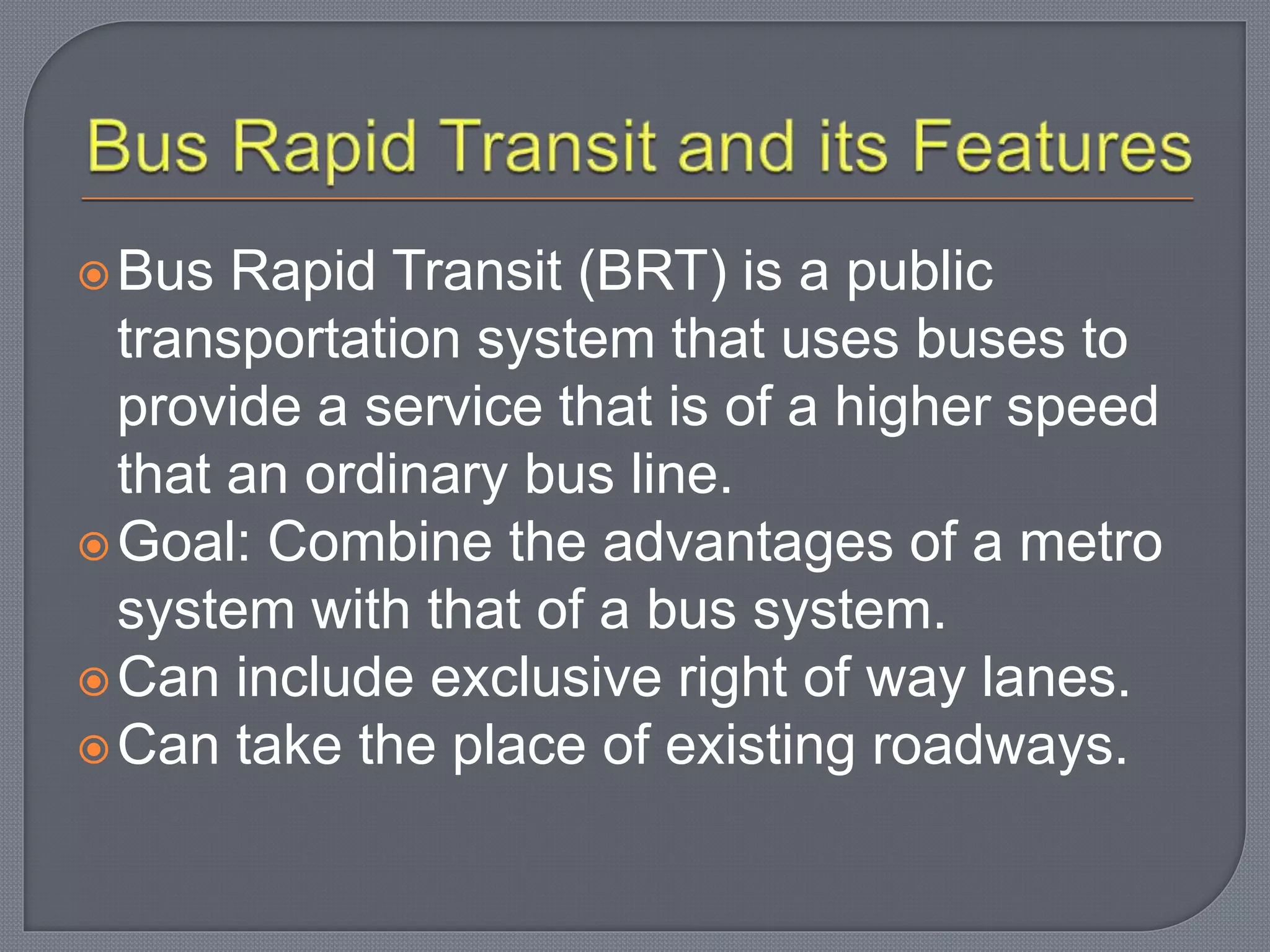
Off-bus fare collection.
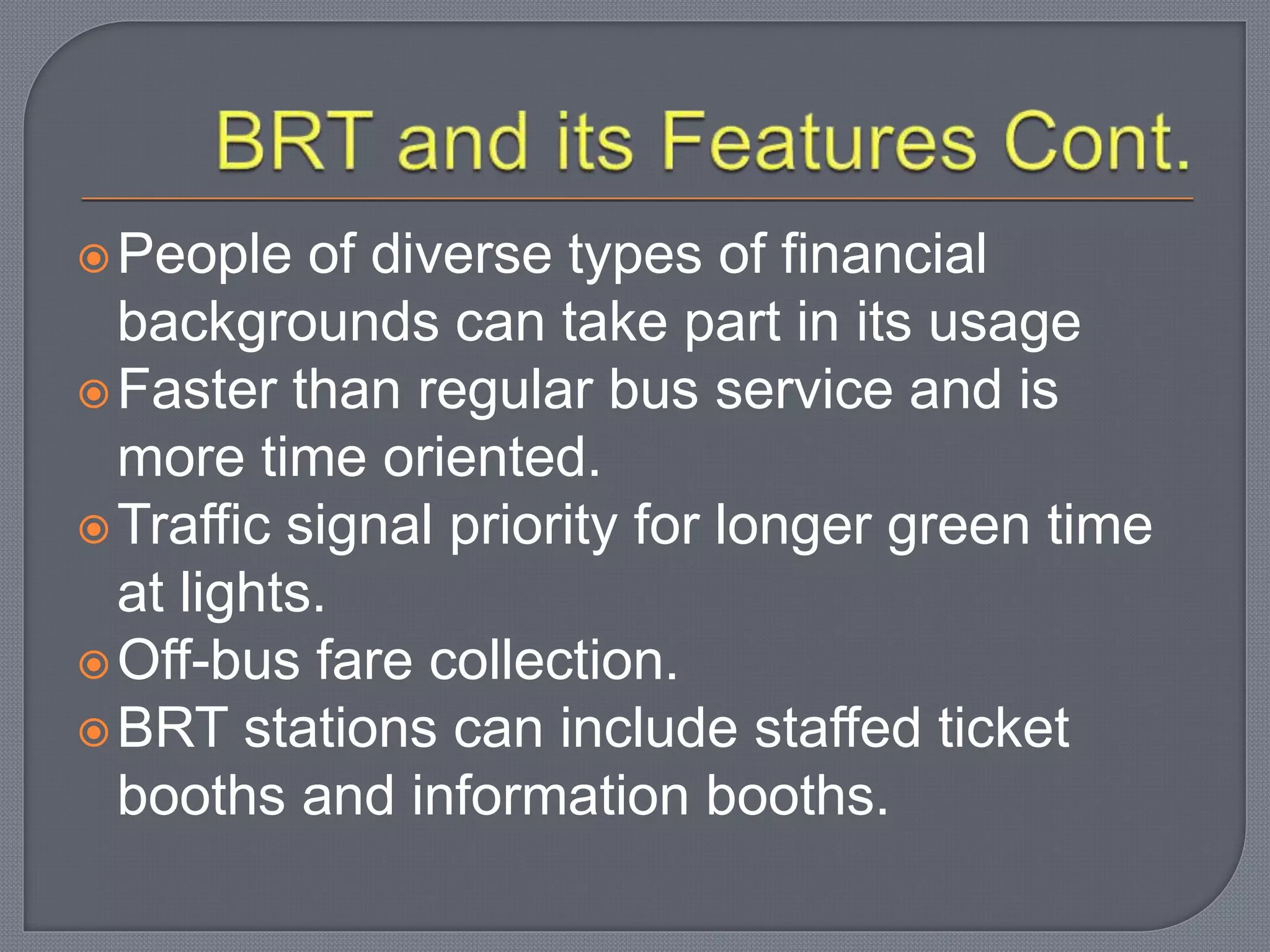
BRT stations can include staffed ticket
booths and information booths.
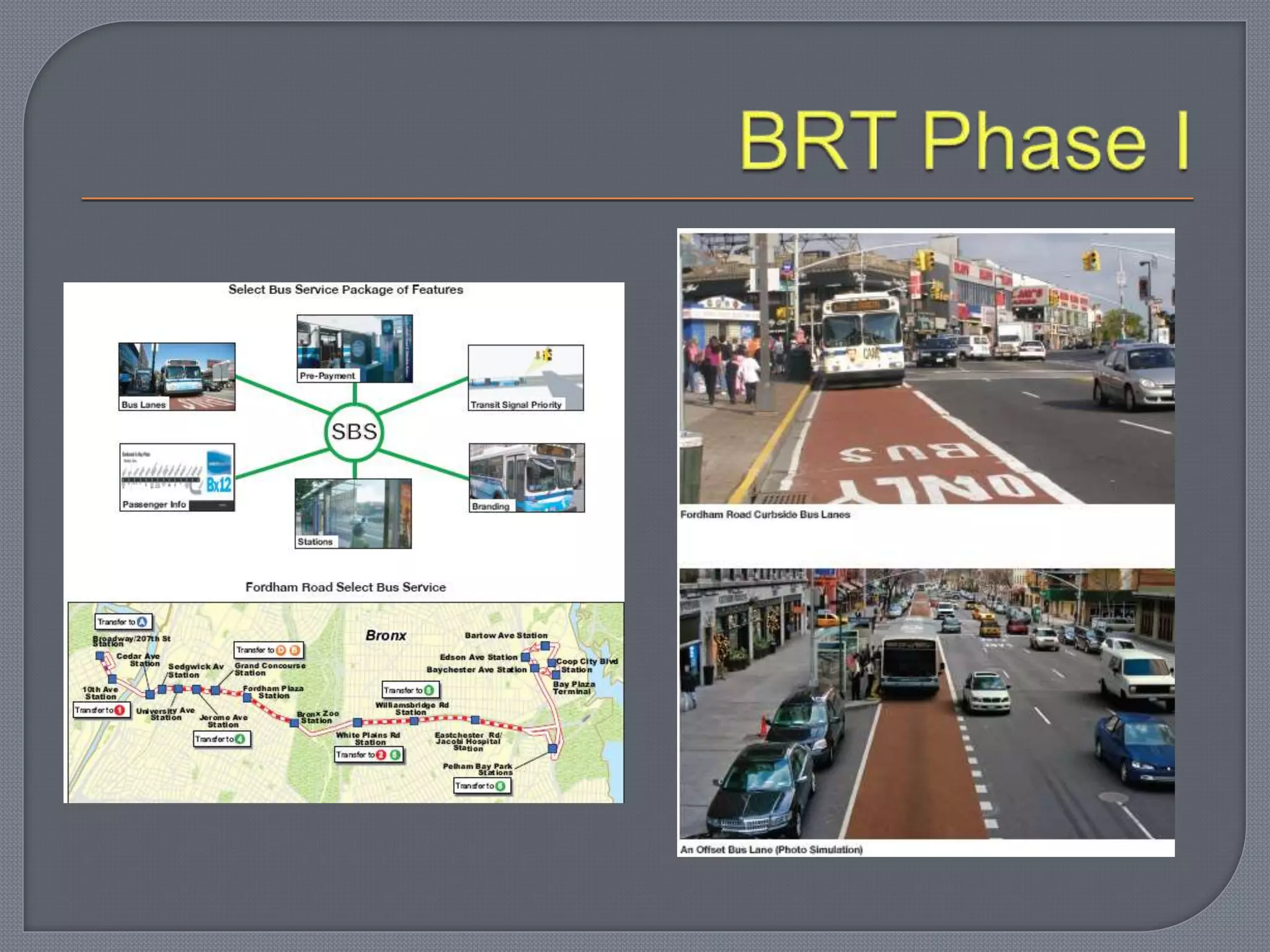
 NYCT and DOT launched the City's first BRT Phase I route, the Bx12 Select
Bus Service (SBS) on Fordham Road in the Bronx on June 29, 2008.
 This route replaced the existing limited-stop service on the Bx12 line, and
added dedicated bus lanes, fewer bus stops, traffic signal prioritization, and
more buses for rapid subway like service.
 This resulted in up to a twenty percent time savings, which is the estimated
equivalent of 5 minutes in rush hour traffic and increased by 5,000 riders per
day.
 Other lines to be included in Phase I are the First/Second Avenue SBS, 34th
Street Enhanced Bus Priority, Hylan Blvd SBS and Transitway, 34th Street
Phase II, and Nostrand Avenue SBS.
 Phase II of the this initiative is expected to expand into different parts of the
city and will attempt to be complete with links to subways, ferries, and major
destinations.
 To gain more public awareness of this transit innovation, NYCT and DOT are
offering interactive workshops so that citizens can see the groundwork for
this phase and also give input.
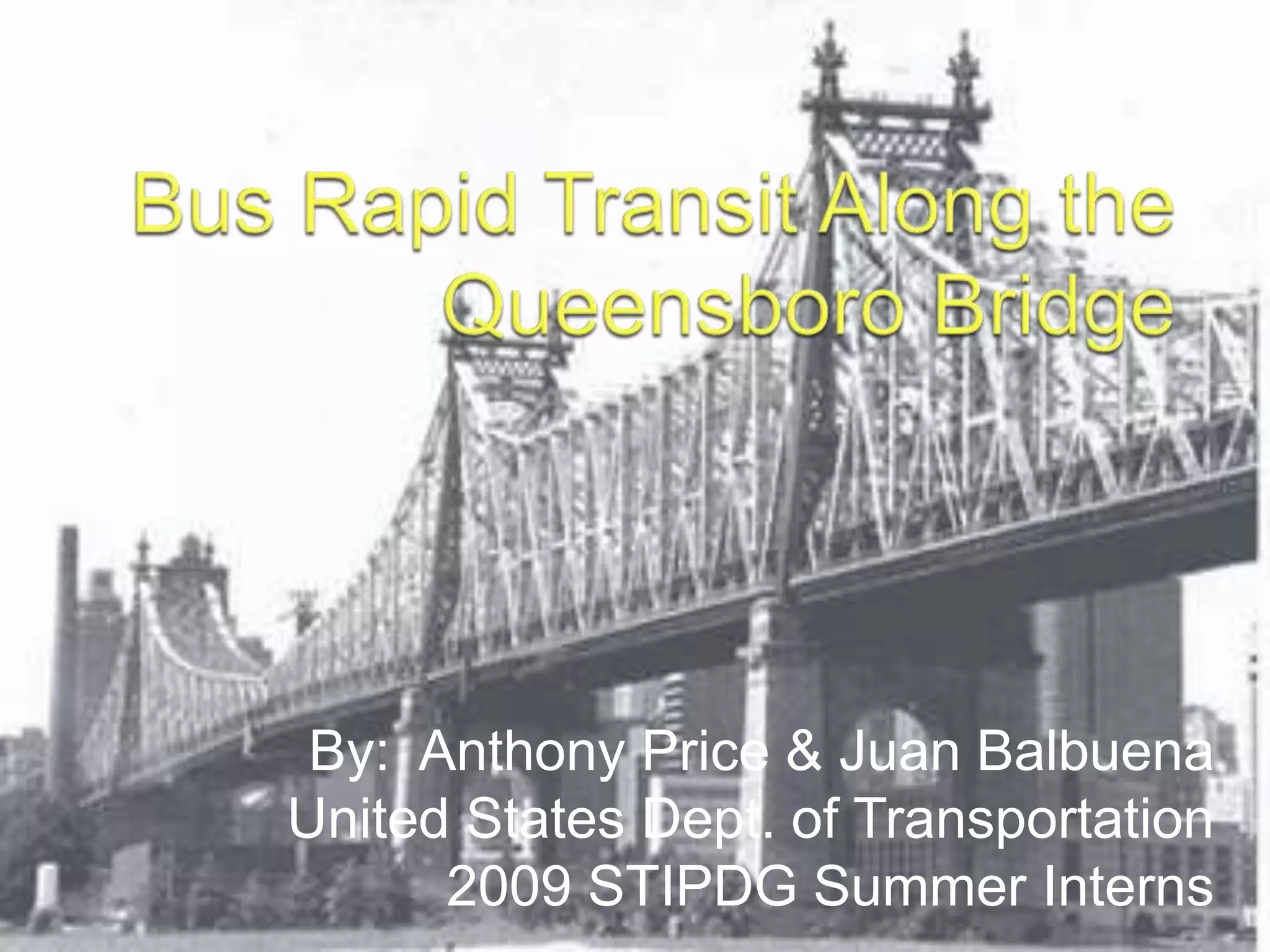
 The Queensboro Bridge that connects Queens to
Manhattan uses a lane reversal technique on the two
upper level east bound (M to Q) lanes of the bridge to
make these lanes go the opposite direction (Q to M).
 This procedure is important because of the large volume
of people that commute to Manhattan in the morning in
an attempt to reduce the amount of congestion on the
bridge.
 Bridge already has two west bound lanes on both the
upper and lower levels, HOV makes this total six.
 This technique is enforced from 6 to 10 A.M. and can
only be used with vehicles with 2 or more occupants.
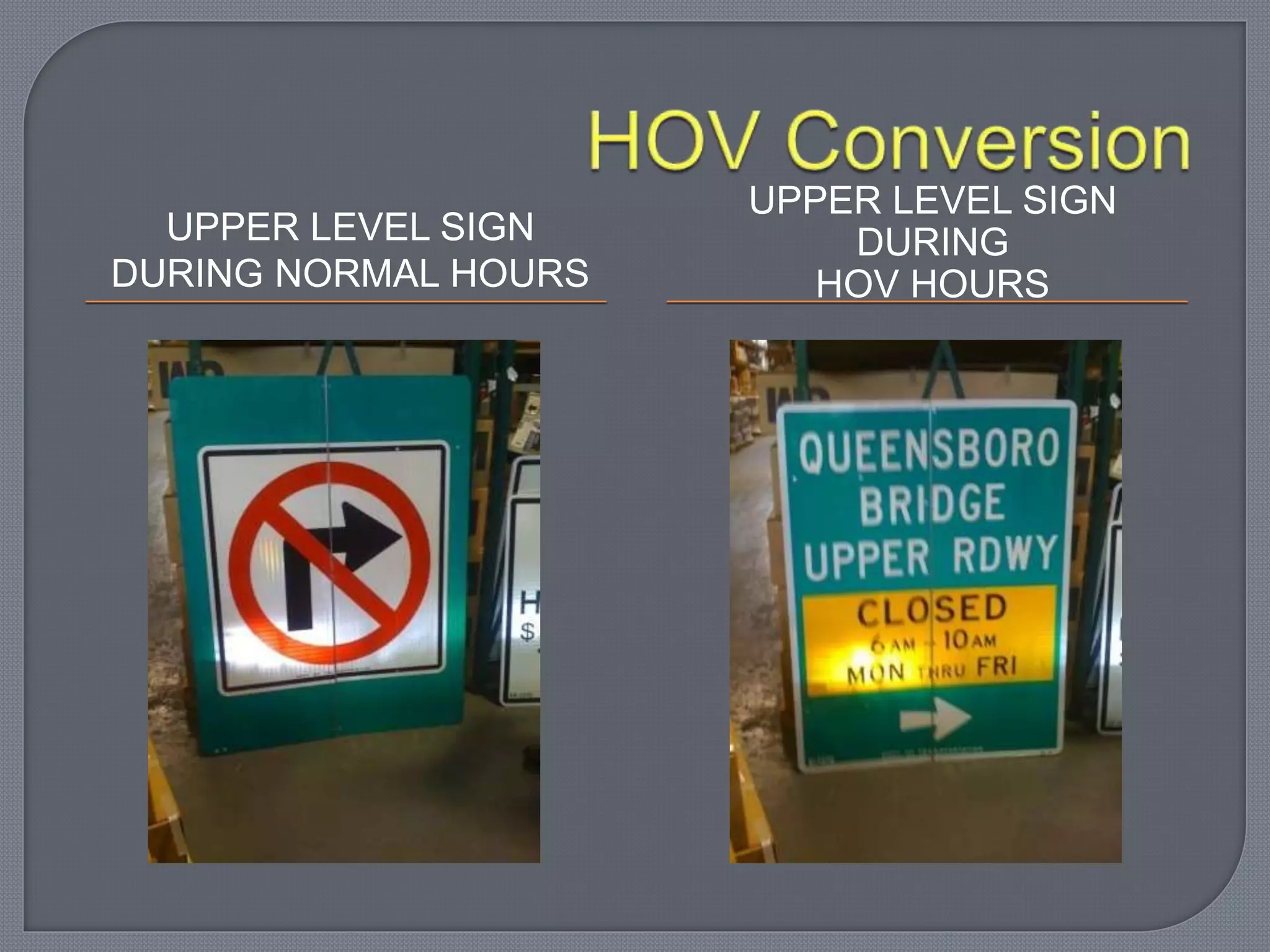
UPPER LEVEL SIGN
DURING NORMAL HOURS
UPPER LEVEL SIGN
DURING
HOV HOURS
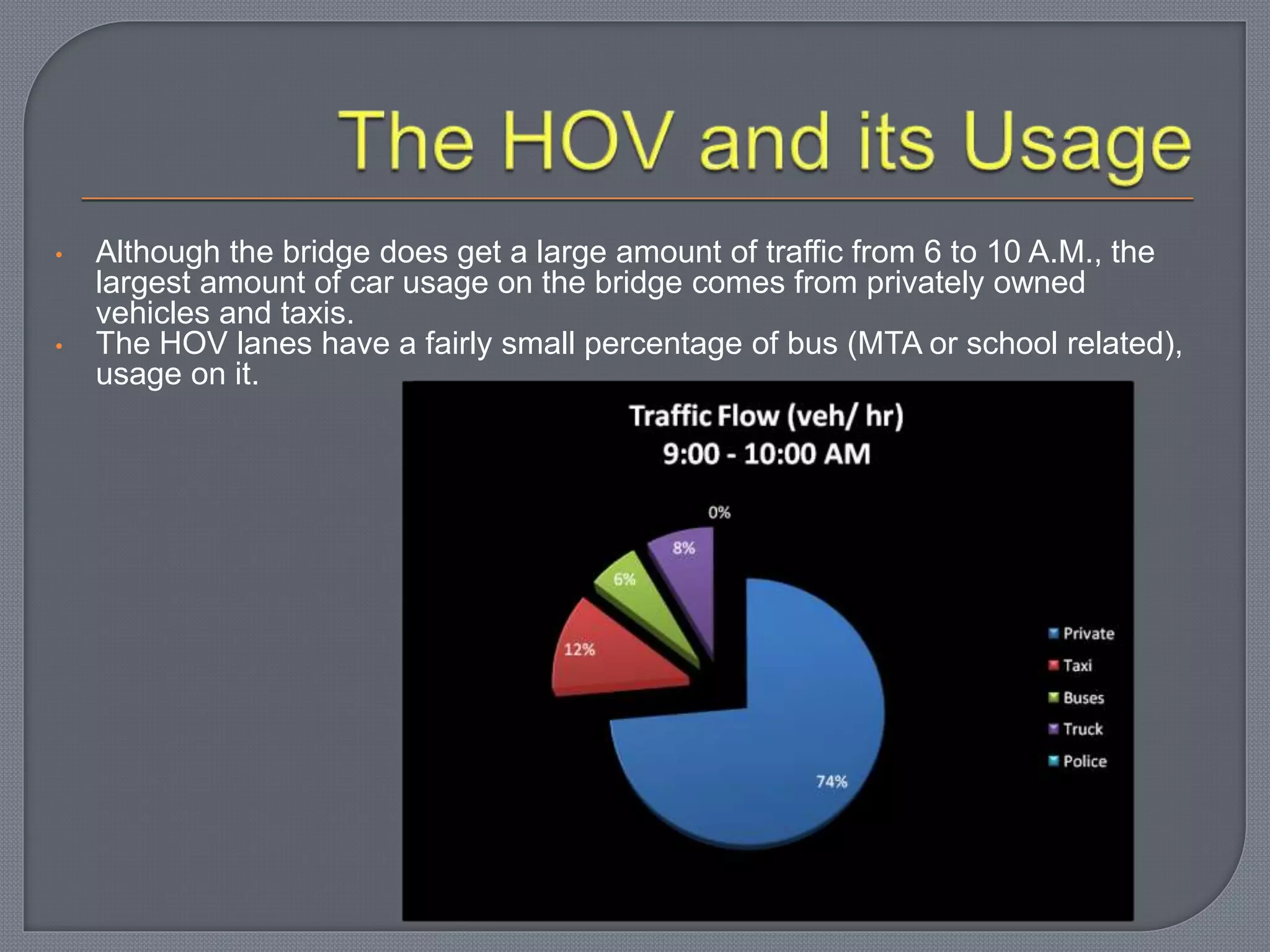
• Although the bridge does get a large amount of traffic from 6 to 10 A.M., the
largest amount of car usage on the bridge comes from privately owned
vehicles and taxis.
• The HOV lanes have a fairly small percentage of bus (MTA or school related),
usage on it.
 By reducing the amount of privately owned vehicles and to
reduce traffic we propose to convert the already implemented
HOV lanes that are set upon the upper level of the Queensboro
Bridge to become strictly of Bus Rapid Transit use and/or usage
with vehicles with three or more occupants in it.
 Would not be as costly and time consuming to implement upon
the of the city as opposed to building a new subway line or
creating new lanes upon a roadway.
 This push would also cut down on time lost, money lost, and
emissions put in the air due to D or worse grade Level of
Service upon the bridge.
 It would also cut down on the already crowded subways and
generate more revenue for MTA so it could renovate or build
other structures.
 BRT doesn’t require the addition of more roadways
so major road construction wouldn’t be required.
 Transform an existing lane into an exclusive BRT
lane.
 Purchasing more buses so service would become
more rapid.
 Off board ticket purchasing system i.e. a vending
system, internet payment, or a staffed ticket booth.
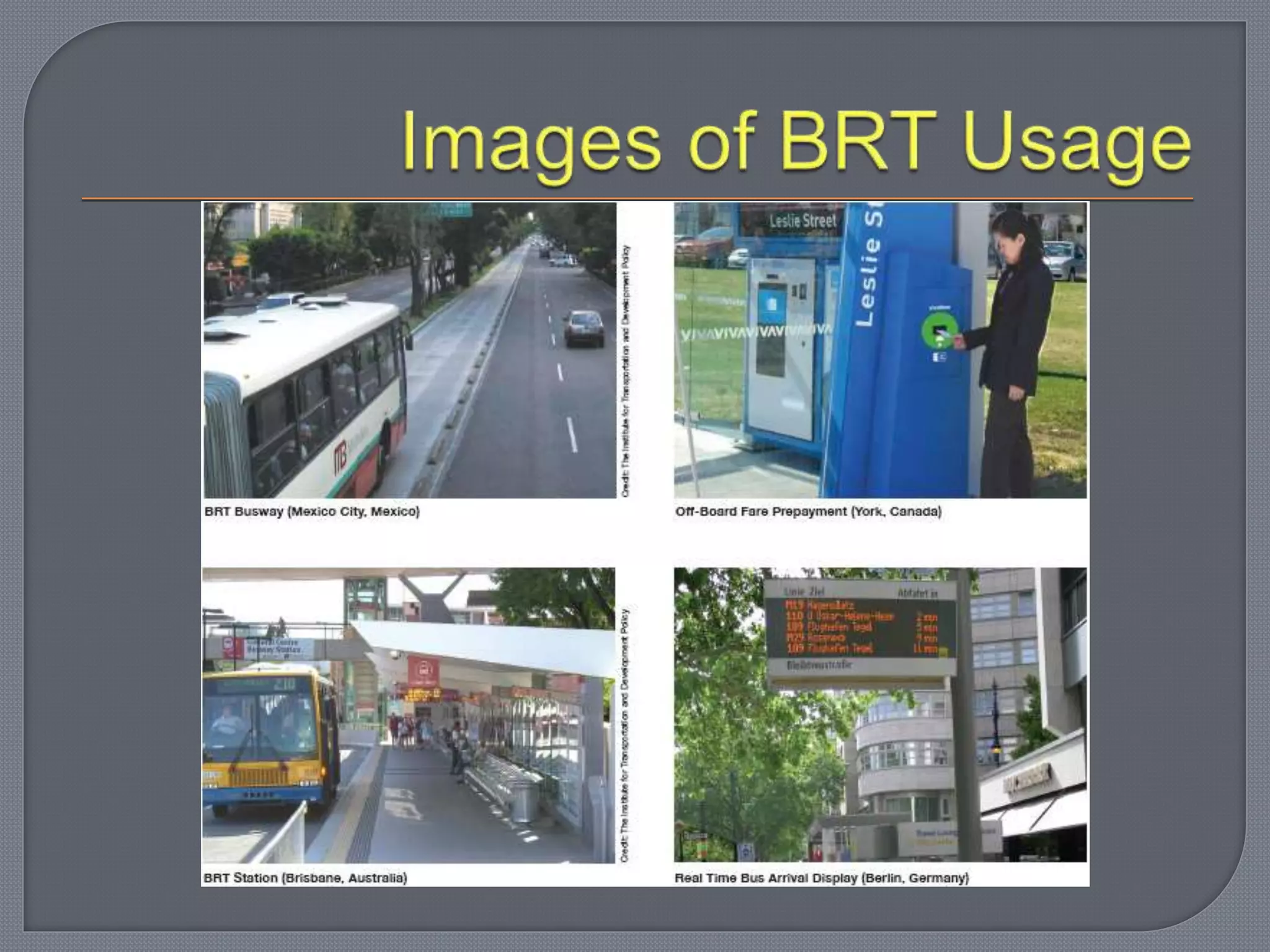
 ITS applications such as VMS signs, camera usage,
and a Traffic Signal Prioritization can also be
effective in making this initiative a success.
 Using traffic signal prioritization can be
responsible for holding a green signal by several
seconds to allow a bus to travel through an
intersection without stopping, or expediting the
changing of a red signal back to green when a
bus is approaching.
 The routes of the BRT could replace the bus
lines associated with the Queens area
particularly the Q60, Q32, and Q101 because
these buses utilize the Queensboro Bridge while
in service.
Possible internet ad on the MTA website,
and in NYC periodicals.
Design a brochure of the advantages of
BRT and how accessible it is to citizens.
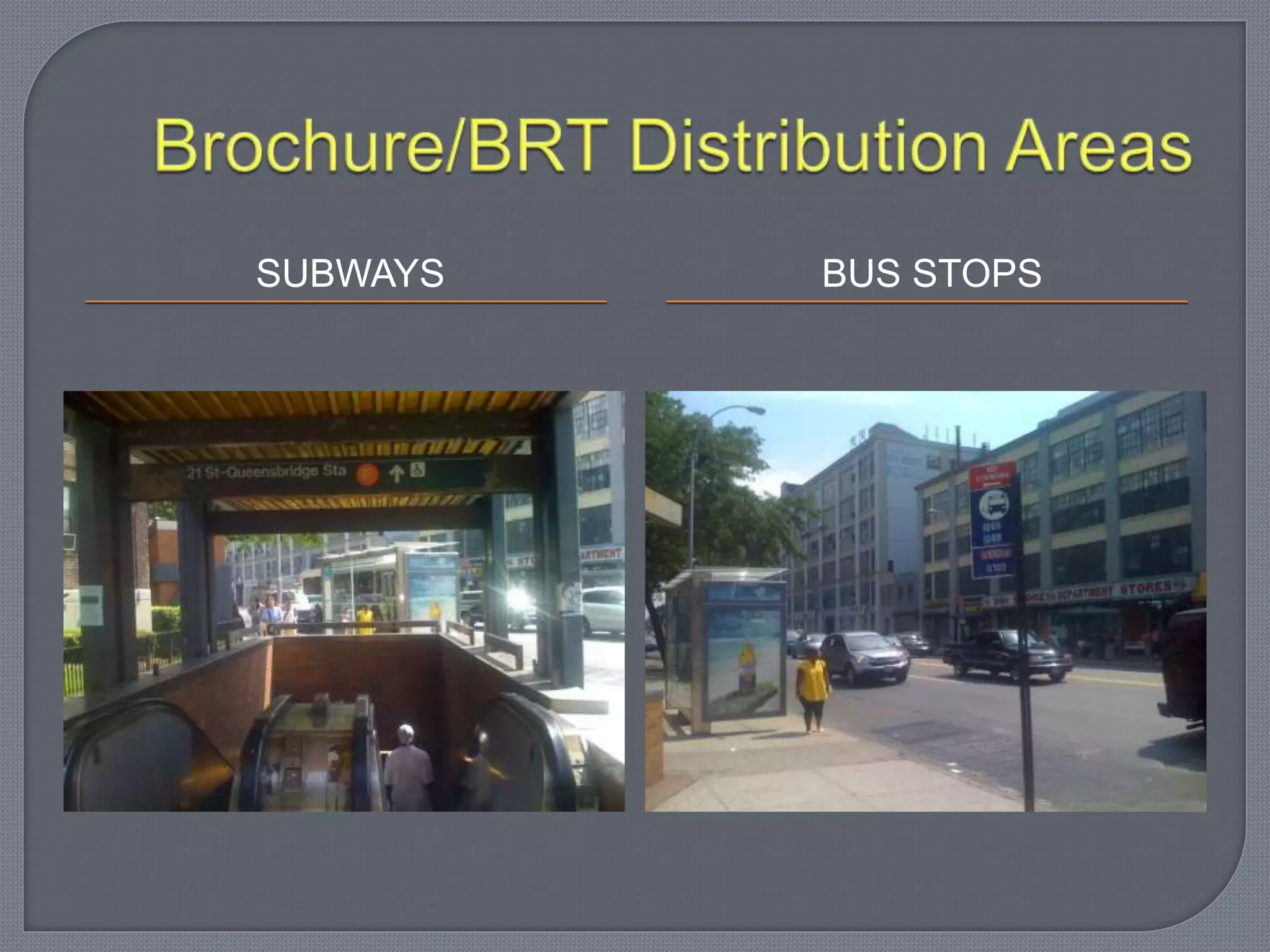
Pass brochures out at major intersections,
bus stops, and subway stations within a 2
mile radius of the QBB on both the
Manhattan and Queens side.
Distribution in toll booths and along
highways.
SUBWAYS BUS STOPS
In a recent survey of riders who have used
and/or frequently use the Fordham SBS,
98% of riders gave a satisfactory or better
approval of the new service.
With this type of satisfactory in addition to
the time saved in traffic, imagine how well
this feature could work on the bridge.
Nothing to lose and so much to gain by
trying this system.
S.T.I.P.D.G. Program
The Washington Center
The operators at the TMC in Queens
Mr. Arthur O’Connor
Mr. Rachid Roumilia
Mr. Mohamad Talas
Mr. Sam Mikhail
Mr. Jimmy Haro

BRT Power point - Summer 2009 PWPT

  • 1.
    By: Anthony Price& Juan Balbuena United States Dept. of Transportation 2009 STIPDG Summer Interns
  • 2.
    Urban Mobility Report2009: Texas Transportation Institute Congestion 1982: 19 % - 2007 : 63%
  • 3.
    Top 13 congestedcities of the United States The average driver loses the equivalent of 8 work days due to traffic. Hours 100 80 60 40 20 0 1983 2003 City
  • 4.
     Congestion iscause of when demand volume exceeds capacity.  In Manhattan alone, transit ridership has increased by 60% since 1990 resulting in crowed buses and subway.  The city is currently suffering a heavy subway ridership along the east side of Manhattan subway lines because of a lack of available lines and the constant delay of the 2nd Avenue line.  In 2030 the projected population is expected to increase by one million people and add an additional 750,000 new jobs in New York City. Meaning a bigger traffic headache.
  • 5.
    1. Do nothingalternative 2. Many would call for adding a new lane to an overburdened highway or street and in New York’s case a subway line under the assumption that this may alleviate the problem. This could possibly prove to be financially unaffordable, and cost tens of millions of dollars to construct. 3. Congestion pricing, which the City of New York has turned down already a few years back. 4. License plate lottery, which is practiced in Columbia and other countries. 5. Implement Bus Rapid Transit.
  • 6.
    Bus Rapid Transit(BRT) is a public transportation system that uses buses to provide a service that is of a higher speed that an ordinary bus line. Goal: Combine the advantages of a metro system with that of a bus system. Can include exclusive right of way lanes. Can take the place of existing roadways.
  • 7.
    People of diversetypes of financial backgrounds can take part in its usage Faster than regular bus service and is more time oriented. Traffic signal priority for longer green time at lights. Off-bus fare collection. BRT stations can include staffed ticket booths and information booths.
  • 9.
     NYCT andDOT launched the City's first BRT Phase I route, the Bx12 Select Bus Service (SBS) on Fordham Road in the Bronx on June 29, 2008.  This route replaced the existing limited-stop service on the Bx12 line, and added dedicated bus lanes, fewer bus stops, traffic signal prioritization, and more buses for rapid subway like service.  This resulted in up to a twenty percent time savings, which is the estimated equivalent of 5 minutes in rush hour traffic and increased by 5,000 riders per day.  Other lines to be included in Phase I are the First/Second Avenue SBS, 34th Street Enhanced Bus Priority, Hylan Blvd SBS and Transitway, 34th Street Phase II, and Nostrand Avenue SBS.  Phase II of the this initiative is expected to expand into different parts of the city and will attempt to be complete with links to subways, ferries, and major destinations.  To gain more public awareness of this transit innovation, NYCT and DOT are offering interactive workshops so that citizens can see the groundwork for this phase and also give input.
  • 11.
     The QueensboroBridge that connects Queens to Manhattan uses a lane reversal technique on the two upper level east bound (M to Q) lanes of the bridge to make these lanes go the opposite direction (Q to M).  This procedure is important because of the large volume of people that commute to Manhattan in the morning in an attempt to reduce the amount of congestion on the bridge.  Bridge already has two west bound lanes on both the upper and lower levels, HOV makes this total six.  This technique is enforced from 6 to 10 A.M. and can only be used with vehicles with 2 or more occupants.
  • 12.
    UPPER LEVEL SIGN DURINGNORMAL HOURS UPPER LEVEL SIGN DURING HOV HOURS
  • 13.
    • Although thebridge does get a large amount of traffic from 6 to 10 A.M., the largest amount of car usage on the bridge comes from privately owned vehicles and taxis. • The HOV lanes have a fairly small percentage of bus (MTA or school related), usage on it.
  • 14.
     By reducingthe amount of privately owned vehicles and to reduce traffic we propose to convert the already implemented HOV lanes that are set upon the upper level of the Queensboro Bridge to become strictly of Bus Rapid Transit use and/or usage with vehicles with three or more occupants in it.  Would not be as costly and time consuming to implement upon the of the city as opposed to building a new subway line or creating new lanes upon a roadway.  This push would also cut down on time lost, money lost, and emissions put in the air due to D or worse grade Level of Service upon the bridge.  It would also cut down on the already crowded subways and generate more revenue for MTA so it could renovate or build other structures.
  • 15.
     BRT doesn’trequire the addition of more roadways so major road construction wouldn’t be required.  Transform an existing lane into an exclusive BRT lane.  Purchasing more buses so service would become more rapid.  Off board ticket purchasing system i.e. a vending system, internet payment, or a staffed ticket booth.  ITS applications such as VMS signs, camera usage, and a Traffic Signal Prioritization can also be effective in making this initiative a success.
  • 16.
     Using trafficsignal prioritization can be responsible for holding a green signal by several seconds to allow a bus to travel through an intersection without stopping, or expediting the changing of a red signal back to green when a bus is approaching.  The routes of the BRT could replace the bus lines associated with the Queens area particularly the Q60, Q32, and Q101 because these buses utilize the Queensboro Bridge while in service.
  • 17.
    Possible internet adon the MTA website, and in NYC periodicals. Design a brochure of the advantages of BRT and how accessible it is to citizens. Pass brochures out at major intersections, bus stops, and subway stations within a 2 mile radius of the QBB on both the Manhattan and Queens side. Distribution in toll booths and along highways.
  • 18.
  • 19.
    In a recentsurvey of riders who have used and/or frequently use the Fordham SBS, 98% of riders gave a satisfactory or better approval of the new service. With this type of satisfactory in addition to the time saved in traffic, imagine how well this feature could work on the bridge. Nothing to lose and so much to gain by trying this system.
  • 20.
    S.T.I.P.D.G. Program The WashingtonCenter The operators at the TMC in Queens Mr. Arthur O’Connor Mr. Rachid Roumilia Mr. Mohamad Talas Mr. Sam Mikhail Mr. Jimmy Haro