Burn Management
Burn Management
Tad Kim, M.D.
UF Surgery
tad.kim@surgery.ufl.edu
(c) 682-3793; (p) 413-3222
Burn Management
Overview
• Pathophysiology of Burns
• Burn Classifications
• Criteria for Transfer to Burn Center
• Initial Assessment & Management
• Airway Management
– Smoke Inhalation Injury
• Shock & Fluid Resuscitation
• Burn Wound Management
– Electrical Injury & Chemical Burns
Burn Management
Pathophysiology of Burns
• Burns cause coagulative necrosis
– Chemical/Electricity also cause direct injury to
cell membranes, in addition to heat transfer
• Causes:
– Flame, Scald, Contact, Chemical, Electricity
• Depth of burn depends on:
– 1. Temperature
– 2. Time exposed
– 3. Specific heat (higher for grease)
Burn Management
Pathophysiology of Burns
• Burns a/w release of inflamm. mediators
• Increased capillary permeability
– Leak proteins into interstitium
• Get edema in burned & non-burned skin
• Large fluid loss due to fluid shifts & also
losses from exposed burned skin
• Characteristic “Ebb and Flow” of burns
– Ebb: Low metabolism/cardiac output, ↓Temp
– Flow: hypermetabolism, high cardiac output,
hyperglycemia, increased heat produx
Burn Management
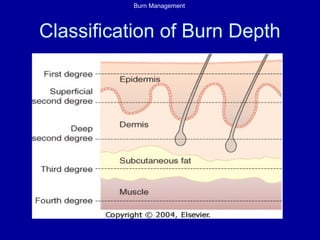
Classification of Burn Depth
• 1st
degree: localize to epidermis (sunburn)
• 2nd
degree: injury to both dermis/epidermis
– Superficial 2nd
: papillary dermis
• Typically red, painful, blister, “wet” appearing
• Regen in 7-14 days from hair follicles/sweat glands
– Deep 2nd
: reticular dermis
• Typically more pale/mottled, dry, ↓sensation
• 3rd
degree: full thickness epidermis/dermis
– Hard, leathery eschar, painless
• 4th
degree: involves muscle, bone, etc.
Burn Management
Classification of Burn Depth
Burn Management
Criteria for Burn Center Referral
• Partial thickness > 10%
• Inv. face, hands, feet,
genital/perineum, joints
• Any full thickness burn
• Electrical injury
• Chemical burn
• Inhalational injury
• Comorbidities (CHF)
• Concomitant trauma
• Children
• Special emotional,
social, or rehab needs
Burn Management
Initial Assessment
• Called to the ER for a 35yo male rescued
from housefire w face/trunk/extrem burns
• Always start with ABC
– In trauma/burns, ABCDE (disability/exposure)
• Airway can be an issue with severe burns
or inhalational injury (esp. with indoor fire)
– Direct injury from heated air/smoke -> edema
– Edema from inflammatory response to burns
– Edema from the resuscitation fluids
Burn Management
Initial Assessment
• Suspect airway injury if:
– Facial burns, singed nasal hairs, wheezing,
carbonaceous sputum, tachypnea
• Give pt oxygen & put on pulse oximetry
• Progressive hoarseness is a sign of
impending airway obstruction
• Pre-emptively intubate anyone with:
– Respiratory distress, inhalational injury, large
burns (due to inevitable edema from resusc)
– Bronchoscopy to help dx inhalational injury
Burn Management
Initial Assessment
• Breathing (Breath sounds, chest rise, ET CO2)
– Chest escharotomies if constrictive eschar
• Circulation: get vitals (HR & BP)
– 2 large bore IV (unburned before burned skin)
– Start burn resuscitation with Lactated Ringer’s
– Place patient on continuous EKG / monitor
– Palpate or doppler extremity signals with
circumferential extremity burns
• Disability (GCS less than eight -> intubate)
• Exposure: remove all clothing
Burn Management
Initial Assessment
• AMPLE history
– Allergies
– Medications (also ask about last tetanus)
– Past medical history (CHF – careful w fluids)
– Last meal
– Events regarding the injury (how did the fire
start, how long was the exposure, what type
of exposure – flame, grease)
Burn Management
Initial Assessment
• Burn Resuscitation with Lactated Ringer’s
• Figure out burn size by “rule of nines” or
entire palmar surface of pt’s hand = 1%
• Parkland formula
– 4 x Wt(kg) x %TBSA = mL to give in 1 day
– Half over 1st
8hrs (subtract what was given)
– Give other Half over next 16 hours
– In reality, titrate to UOP of 0.5mL/kg/hr in
adults and 1mL/kg/hr in children
• Do not give colloid in first 24 hrs
Burn Management
Burn Resuscitation
• 70kg male with 40% TBSA
– EMS administered 1.5L of fluids already
• What rate of LR should he receive?
Burn Management
Burn Wound Management
• Circumferential deep 2nd
or 3rd
degree
extremity burn can compromise circulation
• Assess for the 6 P’s
– Pain, pallor, pulselessness (check Doppler),
paresthesias, paralysis, poikilothermia
– Directly measure tissue pressure (30 is cutoff)
• Dx: Compartment syndrome
• Tx: Escharotomy
• (Give tetanus toxoid if not up to date)
Burn Management
Burn Wound Management
• Burn patients are susceptible to infection
– Due to immunologic insult of large burns
– Also because dead tissue is easily colonized
• Initially clean/debride & cover with topical
antimicrobial (no data for oral or IV abx)
• Superficial 2nd
: can use temporary pigskin
• 3rd
& (most) deep 2nd
need early excision &
grafting, except palm/soles/face/genitals
– Perform at ~3-7 days post-burn
Burn Management
Topical Antimicrobials
• Sulfamylon for ears
– Good at penetrating eschar & is painful
– Side effect: metabolic acidosis via carbonic
anhydrase inhibition
• Bacitracin for face
– Few side effects
• Silvadene for trunk, neck, extremities
– Does not penetrate eschar very well
– Side effects: neutropenia/thrombocytopenia
Burn Management
Electrical Burns
• Most significant injury is within deep tissue
• Edema can compromise circulation
• Be ready to perform eschar-/fasciotomies
• Explore & debride necrotic tissue
• May have to re-explore questionable
areas
• EKG if heart was in conduction path
• Follow serial CPK & urine myoglobin due
to possibility of rhabdomyolysis
Burn Management
Chemical Burns
• Speed is essential
• ABCDE – remove all clothing
• Irrigate with 15-20L of water
– Brush off any dry powder before irrigation
• Alkalis generally cause worse damage
• Do not attempt to counteract acid burns
using alkali or alkali burns using acid
Burn Management
Take Home Points
• Always start with ABCDE for trauma/burns
• Know what can compromise airway in
burn patients
– Chest escharotomy may be needed
• Know and apply the Parkland formula
• Recognize the need for limb escharotomy
• Know depths of burn & which req excision
• Know the types & side effects of topicals
• Basics of treating chemical/electrical burns

share slide topic

  • 1.
    Burn Management Burn Management TadKim, M.D. UF Surgery tad.kim@surgery.ufl.edu (c) 682-3793; (p) 413-3222
  • 2.
    Burn Management Overview • Pathophysiologyof Burns • Burn Classifications • Criteria for Transfer to Burn Center • Initial Assessment & Management • Airway Management – Smoke Inhalation Injury • Shock & Fluid Resuscitation • Burn Wound Management – Electrical Injury & Chemical Burns
  • 3.
    Burn Management Pathophysiology ofBurns • Burns cause coagulative necrosis – Chemical/Electricity also cause direct injury to cell membranes, in addition to heat transfer • Causes: – Flame, Scald, Contact, Chemical, Electricity • Depth of burn depends on: – 1. Temperature – 2. Time exposed – 3. Specific heat (higher for grease)
  • 4.
    Burn Management Pathophysiology ofBurns • Burns a/w release of inflamm. mediators • Increased capillary permeability – Leak proteins into interstitium • Get edema in burned & non-burned skin • Large fluid loss due to fluid shifts & also losses from exposed burned skin • Characteristic “Ebb and Flow” of burns – Ebb: Low metabolism/cardiac output, ↓Temp – Flow: hypermetabolism, high cardiac output, hyperglycemia, increased heat produx
  • 5.
    Burn Management Classification ofBurn Depth • 1st degree: localize to epidermis (sunburn) • 2nd degree: injury to both dermis/epidermis – Superficial 2nd : papillary dermis • Typically red, painful, blister, “wet” appearing • Regen in 7-14 days from hair follicles/sweat glands – Deep 2nd : reticular dermis • Typically more pale/mottled, dry, ↓sensation • 3rd degree: full thickness epidermis/dermis – Hard, leathery eschar, painless • 4th degree: involves muscle, bone, etc.
  • 6.
  • 7.
    Burn Management Criteria forBurn Center Referral • Partial thickness > 10% • Inv. face, hands, feet, genital/perineum, joints • Any full thickness burn • Electrical injury • Chemical burn • Inhalational injury • Comorbidities (CHF) • Concomitant trauma • Children • Special emotional, social, or rehab needs
  • 8.
    Burn Management Initial Assessment •Called to the ER for a 35yo male rescued from housefire w face/trunk/extrem burns • Always start with ABC – In trauma/burns, ABCDE (disability/exposure) • Airway can be an issue with severe burns or inhalational injury (esp. with indoor fire) – Direct injury from heated air/smoke -> edema – Edema from inflammatory response to burns – Edema from the resuscitation fluids
  • 9.
    Burn Management Initial Assessment •Suspect airway injury if: – Facial burns, singed nasal hairs, wheezing, carbonaceous sputum, tachypnea • Give pt oxygen & put on pulse oximetry • Progressive hoarseness is a sign of impending airway obstruction • Pre-emptively intubate anyone with: – Respiratory distress, inhalational injury, large burns (due to inevitable edema from resusc) – Bronchoscopy to help dx inhalational injury
  • 10.
    Burn Management Initial Assessment •Breathing (Breath sounds, chest rise, ET CO2) – Chest escharotomies if constrictive eschar • Circulation: get vitals (HR & BP) – 2 large bore IV (unburned before burned skin) – Start burn resuscitation with Lactated Ringer’s – Place patient on continuous EKG / monitor – Palpate or doppler extremity signals with circumferential extremity burns • Disability (GCS less than eight -> intubate) • Exposure: remove all clothing
  • 11.
    Burn Management Initial Assessment •AMPLE history – Allergies – Medications (also ask about last tetanus) – Past medical history (CHF – careful w fluids) – Last meal – Events regarding the injury (how did the fire start, how long was the exposure, what type of exposure – flame, grease)
  • 12.
    Burn Management Initial Assessment •Burn Resuscitation with Lactated Ringer’s • Figure out burn size by “rule of nines” or entire palmar surface of pt’s hand = 1% • Parkland formula – 4 x Wt(kg) x %TBSA = mL to give in 1 day – Half over 1st 8hrs (subtract what was given) – Give other Half over next 16 hours – In reality, titrate to UOP of 0.5mL/kg/hr in adults and 1mL/kg/hr in children • Do not give colloid in first 24 hrs
  • 13.
    Burn Management Burn Resuscitation •70kg male with 40% TBSA – EMS administered 1.5L of fluids already • What rate of LR should he receive?
  • 14.
    Burn Management Burn WoundManagement • Circumferential deep 2nd or 3rd degree extremity burn can compromise circulation • Assess for the 6 P’s – Pain, pallor, pulselessness (check Doppler), paresthesias, paralysis, poikilothermia – Directly measure tissue pressure (30 is cutoff) • Dx: Compartment syndrome • Tx: Escharotomy • (Give tetanus toxoid if not up to date)
  • 15.
    Burn Management Burn WoundManagement • Burn patients are susceptible to infection – Due to immunologic insult of large burns – Also because dead tissue is easily colonized • Initially clean/debride & cover with topical antimicrobial (no data for oral or IV abx) • Superficial 2nd : can use temporary pigskin • 3rd & (most) deep 2nd need early excision & grafting, except palm/soles/face/genitals – Perform at ~3-7 days post-burn
  • 16.
    Burn Management Topical Antimicrobials •Sulfamylon for ears – Good at penetrating eschar & is painful – Side effect: metabolic acidosis via carbonic anhydrase inhibition • Bacitracin for face – Few side effects • Silvadene for trunk, neck, extremities – Does not penetrate eschar very well – Side effects: neutropenia/thrombocytopenia
  • 17.
    Burn Management Electrical Burns •Most significant injury is within deep tissue • Edema can compromise circulation • Be ready to perform eschar-/fasciotomies • Explore & debride necrotic tissue • May have to re-explore questionable areas • EKG if heart was in conduction path • Follow serial CPK & urine myoglobin due to possibility of rhabdomyolysis
  • 18.
    Burn Management Chemical Burns •Speed is essential • ABCDE – remove all clothing • Irrigate with 15-20L of water – Brush off any dry powder before irrigation • Alkalis generally cause worse damage • Do not attempt to counteract acid burns using alkali or alkali burns using acid
  • 19.
    Burn Management Take HomePoints • Always start with ABCDE for trauma/burns • Know what can compromise airway in burn patients – Chest escharotomy may be needed • Know and apply the Parkland formula • Recognize the need for limb escharotomy • Know depths of burn & which req excision • Know the types & side effects of topicals • Basics of treating chemical/electrical burns