Early Management of
Burn
Supervisor: Mr Naveen, Dr Zahir
Presenter: HO Mary Chan
Outline
• Definition
• Classification
• Complications
• Assessment
• Management
• Case study
Definition
A burn is an injury to the skin or other
organic tissue primarily caused by heat or
due to radiation, radioactivity, electricity,
friction or contact with chemicals. (WHO ,
2018)
BURNS
ELECTRICAL
INJURIES
THERMAL
INJURIES
CHEMICAL
INJURIES
RADIATION
INJURIES
INHALATION
INJURIES
- SCALDS
- FLAME
- CONTACT
Types of burns
• Scald burn
• frequent home injuries ; hot water, liquids such as grease
• Flame burn
• gasoline, kerosene, burning materials
• Chemical burn
• acid burn most common, alkaline cause more severe burn
• Electrical burn
• worse than the other types ; with an entrance and exit wounds ; may cause cardiac
arrhythmia, rhabdomyolysis & bowel ischaemia
• Radiation burns
• from radioactive radiation or nuclear exposure
Classification Of Burns
Burns
First Degree
(superficial)
Second
Degree
Superficial Deep
Third
Degree
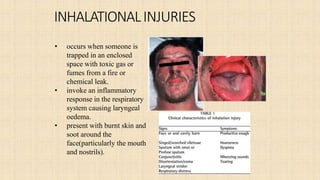
• occurs when someone is
trapped in an enclosed
space with toxic gas or
fumes from a fire or
chemical leak.
• invoke an inflammatory
response in the respiratory
system causing laryngeal
oedema.
• present with burnt skin and
soot around the
face(particularly the mouth
and nostrils).
INHALATIONALINJURIES
Complications
Local
1. Wound infection
• Due to extensive epidermal loss & presence of necrotic tissue
• Main organisms : Strep. pyogenes, Pseudo. aeruginosa
• Increases risk of sepsis
• Can cause organ failure & mortality
2. Scarring & contractures
• Except for the superficial dermal burns, all deeper burns (2nd degree deep dermal
and full thickness) heal by scarring
• Also can causes keloids
• Systemic
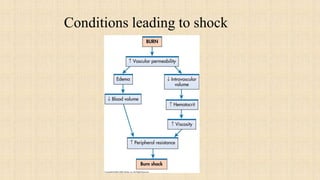
1. Fluid loss
• Extensive burns can cause substantial fluid losses
• Due to inflammation & damaged of blood vessels result in low blood volume (hypovolemia)
• Prevents heart from pumping enough blood to the body
• Inflammatory exudation of protein-rich fluid into extracellular space leads to local edema and
blisters
2. Sepsis
• Chest infection ( inhalation injury )
• Septicaemia ( wound infection )
3. Respiratory failure
• Breathing hot air or smoke can burn airways and cause breathing difficulties
• Smoke inhalation can cause bronchoconstriction & ARDS
4. Psychological disturbances
• flashback, sleep disturbance, anger, panic attacks, avoidance behaviour
Assessment of Burn Wound
1. Burn size
• Influence the size of inflammatory response
• Measured as percentage of total body area
• Rule of nines
• Lund and Browder chart
• Palm method
•
•
2. Burn depth
Influence healing time/ scarring
Superficial / Partial / Full thickness burns (1st / 2nd / 3rd
degree)
Wallace’s
RulesofNines
Children have
different body
surface area
proportions than
adults.
•Smaller hips and legs
•Larger shoulders and
heads
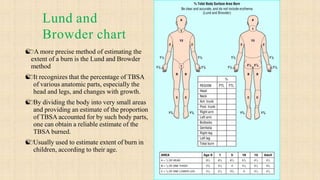
Lund and
Browder chart

A more precise method of estimating the
extent of a burn is the Lund and Browder
method

It recognizes that the percentage of TBSA
of various anatomic parts, especially the
head and legs, and changes with growth.

By dividing the body into very small areas
and providing an estimate of the proportion
of TBSA accounted for by such body parts,
one can obtain a reliable estimate of the
TBSA burned.

Usually used to estimate extent of burn in
children, according to their age.
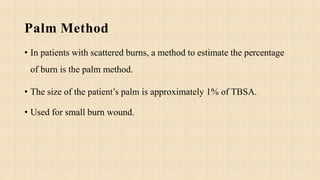
Palm Method
• In patients with scattered burns, a method to estimate the percentage
of burn is the palm method.
• The size of the patient’s palm is approximately 1% of TBSA.
• Used for small burn wound.
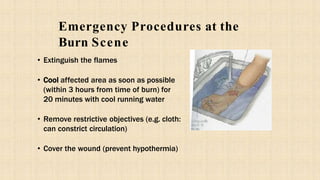
Emergency Procedures at the
Burn Scene
• Extinguish the flames
• Cool affected area as soon as possible
(within 3 hours from time of burn) for
20 minutes with cool running water
• Remove restrictive objectives (e.g. cloth:
can constrict circulation)
• Cover the wound (prevent hypothermia)
• For mild pulmonary injury, inspired air is humidified and the
patient is encouraged to cough so that secretions can be
removed by suctioning.
• For more severe situations, it is necessary to remove
secretions by bronchial suctioning and to administer
bronchodilators and mucolytic agents.
• If edema of the airway develops, endotracheal intubation may
be necessary.
Airway
Signs of airway burn/
inhalation injury: stridor, hoarseness, black
sputum, respiratory distress or facial swelling
Sign of oropharyngeal burn: intraoral oedema
and erythema
Significant neck burn
If above present, consider early intubation
If suspicion of airway burns or carbon monoxide
intoxication apply high flow oxygen
Protect the cervical spine with immobilisation if
there is associated trauma
Breathing
Full thickness and/or circumferential chest burns
may require escharotomy to permit chest
expansion
Circulation
Assess peripheral pulses & blood pressure
Iv fluid administration as required
IV or IO access (preferably 2 access)
Start IV fluids administration using Parkland formula
Disability
If altered conscious state, consider airway support
Assess neurovascular status if limb involved
Exposure - burn assessment and initial
management
Assessment of burn depth
Burns are dynamic wounds, it is difficult to
accurately estimate the true depth and extent
of the wound in the first 48-72 hours
Do NOT include area with epidermal burn
(erythema only)
MANAGEMENT
Management of fluid loss and shock
• Assessment of both the TBSA burned and the depth of the burn is completed after soot and
debris have been gently cleansed from the burn wound.
• An indwelling urinary catheter is inserted to provide more accurate monitoring of urine
output and renal function for patients with moderate to severe burns.
• Fluid Replacement Therapy:
The adequacy of fluid resuscitation is determined by:
• Urine output at least 30 to 50
mL/hour
1 ml/kg/hr (children) OR
0.5ml/kg/hr (adult)
• systolic blood pressure more than 100 mm Hg
• pulse rate less than 110/minute.
• The estimated fluid requirements for the first 24 hours are
calculated based on the extent of the burn injury.
Parkland Formula:
• 4 mL × kg body weight × % TBSA burned (adult)
• 3 mL × kg body weight × % TBSA burned (children)
• Use Hartmann solution
• Day 1: Half to be given in first 8 hours; half to be given
over next 16 hours
• Calculated from the time of burn (not time of arrival to A&E)
• Day 2: Depends on patient’s vital signs and urine output.
• The formula above is a guide,
• each patient needs close monitoring & adjust accordingly
Conditions leading to shock
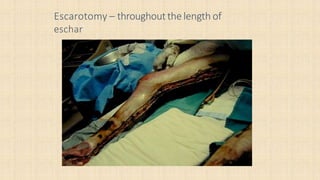
Escharatomy
• done in majorburn with generalized
edema, circumferential burn and full
thickness burn (painless)
• To prevent compartment syndrome (constricting
circulation, impaired tissue perfusion )
• To prevent respiratory compromise (inflexible
eschar and edema over chest and abdomen can
prevent chest wall motion and thus limit
ventilation )
• Eschar is removed down to subcutaneous or
fascia until soft tissue
Escarotomy – throughoutthelength of
eschar
Case study
Patient A, 11M, Female
NKMI/NKDFA
1st hospitalisation
CW: 9.2kg
HOPI
1/ Alleged right hand dipped into hot porridge on
26/4/22 at 11:30am
- was taken care by mother
- just cooked porridge and placed on dining table
- while waiting for it to cool down pt played around
the table
- child's hand dipped into the hot porridge for few
seconds
post trauma sustained:
- peeling and redness of skin
- vesicles started after few minutes
Mother ran tap water onto the child's hand for few
minutes then dipped in basin of water
also put on condensed milk over the burn site
at night put on Amway cream - Alano
claimed skin dried up after applying
Went to GP and treated as second degree burn
wound dressing done, given TCA on Thursday to
review symptoms and wound dressing
given topical cream and Amway cream
became shrunken and dried
29/4/2022
Went to GP for dressing today, but referred to here
for further management
prescribed with syr augmentin 3mls BD X5/7 and syr
PCM 2.5mls QID
• Otherwise
• no fever
• no URTI
• active as usual
• good oral intake
• no GI losses
• no abd pain
• PU/BO regular
ED assessment,
Vital Signs Chart
Temperature 36.7 ° C
Pulse 149 /min
Respiration 35 /min
Systolic Blood Pressure 90 mmHg
Diastolic Blood Pressure 65 mmHg
MAP 78 mmHg
SPO2 100 %
Lungs clear
CVS DRNM
Per abd soft non tender
Right hand examination
blisters seen over dorsal and ventral aspect of hand
+ circumferential
+ involving flexure area
+ yellowish crusty lesion seen
+ erythematous
Impression: Second degree burn of right hand
(1.5%)
PLAN
Syr PCM 15mg/kg STAT
IVD HSD5 46cc/hr (TF120cc/kg/d)
FBC, RP, SE
Referred to surgical for 2nd degree burn
Upon surgical review
Alert, cheerful
pink
warm peripheries
good pulse volume
CRT<2s
Lungs : clear
CVS : DRNM
Per abd: soft non tender
Right hand examination
multiple blister seen over dorsal and ventral aspect
of hand
with contact bleeding
no pus discharge
burn up to MTPJ
Preprocdure:
given oral chloral hydrate 267mg and IV midazolam
0.9mg
Wound scrubbed down until area of dermis
exposed
Then covered with bactigrass and wrapped in
bandage
Impression:
2nd degree burn of right hand: TBSA 1%
Plan:
Admit ward 5B
Refer paeds surgical team - case d/w Dr A
Start NP3L in view of sedation given during
procedure (supplemental oxygenation)
Allow orally once fully conscious
For full maintainance drip (46cc/h) TF 120cc/kg/d
Daily normal saline and bactigrass dressing
Syr PCM 15ml/kg
Investigations 29/4/2022 1/5/2022
FBC Hb
Hct
Plt
WCC
10.1
30.5
407
7.57
11.9
36.3
266
4.36
RP Urea
Na
K
Creatinine
1.9
134
4.2
37
SE
CRP
Mg
Ca
PO4
0.88
2.42
1.74
7.0
Blood culture Aerobe
Anaerobe
NG D5
NG D5
After admitted to ward 5A, overnight pt has spike of temp T 38.9C
Subsequently started on :
• Syrup PCM 135mg QID (15mg/kg)
• Syrup Cloxacillin 135mg QID (15mg/kg)
Otherwise, the child
• Breastfeeding as usual, no vomiting
• BO x2
30/4/2022 1/5/2022 2/5/2022 3/5/2022
Plan:
- Allow orally as
tolerated
- Cont full
maintainance drip
(46cc/hr)
- Daily normal saline
and bactigrass
dressing
- Syr PCM 135mg QID
(15ml/kg)
- Syrup Cloxacillin
135mg QID (15mg/kg)
- cont tepid sponging
- Allow orally as
tolerated
- Reduce to half
maintenance 23cc/hr
- cont Syr PCM &
Syrup Cloxacillin
--------------------------------
Case d/w Dr A Mo Paeds
surgical (burn unit)
- observe for 1 more day
- Cont Syrup cloxacillin
and syrup PCM
- Cont dressing
bactigrass and splinting
- KIV discharge cm if well
- if discharge, discharge
with syrup cloxacliin to
complete for 1 week
Progress,
Another temp spike
39.3 degree
Septic workup, FBC,
CRP taken
Right hand dressing
intact, not tight, not
soaked
CRP 7
WCC 4.36
--------------------------------
Plan
- To observe for at least
24hour since last
temperature spike
- Trace septic workup
- Cont Syr PCM &
cloxacillin
- tepid sponging if temp
spike
- Cont dressing
bactigrass and splinting
Comfortable under RA
active as usual
tolerating breastfeeding & solid food
afebrile >24hrs, last temp spike 39.3 at 12am 2/5/22
Wound inspection: all fingers on right hand pink, CRT <2s ,
clean and no discharge, no bleeding , done aquacell
dressing
------------------------------------------------------------------------------
*case progress and updated to Dr A MO Paeds surgical
- ivo their side clinic is fully booked , for the patient to
follow up at SOPD clinic on friday 6/5/22
to update Dr A MO Paeds surgical HTA regarding the clinic
follow up findings and progress
otherwise for now, can allow discharge *
Plan
Allow discharge with
-- Syr PCM 135mg QID (15ml/kg) QID x1/52
-- Syrup cloxacillin 135mg QID x 3/7
TCA SOPD on Friday 6/5/22
Update back Dr Anfar MO PAEDS Surgery HTA on friday
6/5/22 for the latest progress and findings
During clinic follow up,
6/5/2022
IMP:
Post-alleged scalded injury D11 sustained second degree burn of right hand, TBSA 1%
- Alleged right hand dipped into hot porridge on 26/4/22
Wound inspection: wound healed, no discharge
All fingers pink, CRT <2s
No fingers contracture
Updated to to Dr A MO Paeds surgical
Plan:
Cont aquacel ag dressing + splinting
TCA SOPD next Tuesday - to update back paeds surgical
TCA 10/5-pt defaulted
Burn CME .pptx

Burn CME .pptx

  • 1.
    Early Management of Burn Supervisor:Mr Naveen, Dr Zahir Presenter: HO Mary Chan
  • 2.
    Outline • Definition • Classification •Complications • Assessment • Management • Case study
  • 3.
    Definition A burn isan injury to the skin or other organic tissue primarily caused by heat or due to radiation, radioactivity, electricity, friction or contact with chemicals. (WHO , 2018)
  • 4.
  • 5.
    Types of burns •Scald burn • frequent home injuries ; hot water, liquids such as grease • Flame burn • gasoline, kerosene, burning materials • Chemical burn • acid burn most common, alkaline cause more severe burn • Electrical burn • worse than the other types ; with an entrance and exit wounds ; may cause cardiac arrhythmia, rhabdomyolysis & bowel ischaemia • Radiation burns • from radioactive radiation or nuclear exposure
  • 6.
    Classification Of Burns Burns FirstDegree (superficial) Second Degree Superficial Deep Third Degree
  • 12.
    • occurs whensomeone is trapped in an enclosed space with toxic gas or fumes from a fire or chemical leak. • invoke an inflammatory response in the respiratory system causing laryngeal oedema. • present with burnt skin and soot around the face(particularly the mouth and nostrils). INHALATIONALINJURIES
  • 13.
    Complications Local 1. Wound infection •Due to extensive epidermal loss & presence of necrotic tissue • Main organisms : Strep. pyogenes, Pseudo. aeruginosa • Increases risk of sepsis • Can cause organ failure & mortality 2. Scarring & contractures • Except for the superficial dermal burns, all deeper burns (2nd degree deep dermal and full thickness) heal by scarring • Also can causes keloids
  • 14.
    • Systemic 1. Fluidloss • Extensive burns can cause substantial fluid losses • Due to inflammation & damaged of blood vessels result in low blood volume (hypovolemia) • Prevents heart from pumping enough blood to the body • Inflammatory exudation of protein-rich fluid into extracellular space leads to local edema and blisters 2. Sepsis • Chest infection ( inhalation injury ) • Septicaemia ( wound infection ) 3. Respiratory failure • Breathing hot air or smoke can burn airways and cause breathing difficulties • Smoke inhalation can cause bronchoconstriction & ARDS 4. Psychological disturbances • flashback, sleep disturbance, anger, panic attacks, avoidance behaviour
  • 15.
    Assessment of BurnWound 1. Burn size • Influence the size of inflammatory response • Measured as percentage of total body area • Rule of nines • Lund and Browder chart • Palm method • • 2. Burn depth Influence healing time/ scarring Superficial / Partial / Full thickness burns (1st / 2nd / 3rd degree)
  • 16.
    Wallace’s RulesofNines Children have different body surfacearea proportions than adults. •Smaller hips and legs •Larger shoulders and heads
  • 17.
    Lund and Browder chart  Amore precise method of estimating the extent of a burn is the Lund and Browder method  It recognizes that the percentage of TBSA of various anatomic parts, especially the head and legs, and changes with growth.  By dividing the body into very small areas and providing an estimate of the proportion of TBSA accounted for by such body parts, one can obtain a reliable estimate of the TBSA burned.  Usually used to estimate extent of burn in children, according to their age.
  • 18.
    Palm Method • Inpatients with scattered burns, a method to estimate the percentage of burn is the palm method. • The size of the patient’s palm is approximately 1% of TBSA. • Used for small burn wound.
  • 19.
    Emergency Procedures atthe Burn Scene • Extinguish the flames • Cool affected area as soon as possible (within 3 hours from time of burn) for 20 minutes with cool running water • Remove restrictive objectives (e.g. cloth: can constrict circulation) • Cover the wound (prevent hypothermia)
  • 20.
    • For mildpulmonary injury, inspired air is humidified and the patient is encouraged to cough so that secretions can be removed by suctioning. • For more severe situations, it is necessary to remove secretions by bronchial suctioning and to administer bronchodilators and mucolytic agents. • If edema of the airway develops, endotracheal intubation may be necessary.
  • 21.
    Airway Signs of airwayburn/ inhalation injury: stridor, hoarseness, black sputum, respiratory distress or facial swelling Sign of oropharyngeal burn: intraoral oedema and erythema Significant neck burn If above present, consider early intubation If suspicion of airway burns or carbon monoxide intoxication apply high flow oxygen Protect the cervical spine with immobilisation if there is associated trauma Breathing Full thickness and/or circumferential chest burns may require escharotomy to permit chest expansion Circulation Assess peripheral pulses & blood pressure Iv fluid administration as required IV or IO access (preferably 2 access) Start IV fluids administration using Parkland formula Disability If altered conscious state, consider airway support Assess neurovascular status if limb involved Exposure - burn assessment and initial management Assessment of burn depth Burns are dynamic wounds, it is difficult to accurately estimate the true depth and extent of the wound in the first 48-72 hours Do NOT include area with epidermal burn (erythema only) MANAGEMENT
  • 22.
    Management of fluidloss and shock • Assessment of both the TBSA burned and the depth of the burn is completed after soot and debris have been gently cleansed from the burn wound. • An indwelling urinary catheter is inserted to provide more accurate monitoring of urine output and renal function for patients with moderate to severe burns. • Fluid Replacement Therapy: The adequacy of fluid resuscitation is determined by: • Urine output at least 30 to 50 mL/hour 1 ml/kg/hr (children) OR 0.5ml/kg/hr (adult) • systolic blood pressure more than 100 mm Hg • pulse rate less than 110/minute.
  • 23.
    • The estimatedfluid requirements for the first 24 hours are calculated based on the extent of the burn injury. Parkland Formula: • 4 mL × kg body weight × % TBSA burned (adult) • 3 mL × kg body weight × % TBSA burned (children) • Use Hartmann solution • Day 1: Half to be given in first 8 hours; half to be given over next 16 hours • Calculated from the time of burn (not time of arrival to A&E) • Day 2: Depends on patient’s vital signs and urine output. • The formula above is a guide, • each patient needs close monitoring & adjust accordingly
  • 24.
  • 25.
    Escharatomy • done inmajorburn with generalized edema, circumferential burn and full thickness burn (painless) • To prevent compartment syndrome (constricting circulation, impaired tissue perfusion ) • To prevent respiratory compromise (inflexible eschar and edema over chest and abdomen can prevent chest wall motion and thus limit ventilation ) • Eschar is removed down to subcutaneous or fascia until soft tissue
  • 26.
  • 27.
    Case study Patient A,11M, Female NKMI/NKDFA 1st hospitalisation CW: 9.2kg HOPI 1/ Alleged right hand dipped into hot porridge on 26/4/22 at 11:30am - was taken care by mother - just cooked porridge and placed on dining table - while waiting for it to cool down pt played around the table - child's hand dipped into the hot porridge for few seconds post trauma sustained: - peeling and redness of skin - vesicles started after few minutes Mother ran tap water onto the child's hand for few minutes then dipped in basin of water also put on condensed milk over the burn site at night put on Amway cream - Alano claimed skin dried up after applying Went to GP and treated as second degree burn wound dressing done, given TCA on Thursday to review symptoms and wound dressing given topical cream and Amway cream became shrunken and dried 29/4/2022 Went to GP for dressing today, but referred to here for further management prescribed with syr augmentin 3mls BD X5/7 and syr PCM 2.5mls QID
  • 28.
    • Otherwise • nofever • no URTI • active as usual • good oral intake • no GI losses • no abd pain • PU/BO regular
  • 29.
    ED assessment, Vital SignsChart Temperature 36.7 ° C Pulse 149 /min Respiration 35 /min Systolic Blood Pressure 90 mmHg Diastolic Blood Pressure 65 mmHg MAP 78 mmHg SPO2 100 % Lungs clear CVS DRNM Per abd soft non tender Right hand examination blisters seen over dorsal and ventral aspect of hand + circumferential + involving flexure area + yellowish crusty lesion seen + erythematous Impression: Second degree burn of right hand (1.5%) PLAN Syr PCM 15mg/kg STAT IVD HSD5 46cc/hr (TF120cc/kg/d) FBC, RP, SE Referred to surgical for 2nd degree burn
  • 30.
    Upon surgical review Alert,cheerful pink warm peripheries good pulse volume CRT<2s Lungs : clear CVS : DRNM Per abd: soft non tender Right hand examination multiple blister seen over dorsal and ventral aspect of hand with contact bleeding no pus discharge burn up to MTPJ Preprocdure: given oral chloral hydrate 267mg and IV midazolam 0.9mg Wound scrubbed down until area of dermis exposed Then covered with bactigrass and wrapped in bandage Impression: 2nd degree burn of right hand: TBSA 1% Plan: Admit ward 5B Refer paeds surgical team - case d/w Dr A Start NP3L in view of sedation given during procedure (supplemental oxygenation) Allow orally once fully conscious For full maintainance drip (46cc/h) TF 120cc/kg/d Daily normal saline and bactigrass dressing Syr PCM 15ml/kg
  • 32.
    Investigations 29/4/2022 1/5/2022 FBCHb Hct Plt WCC 10.1 30.5 407 7.57 11.9 36.3 266 4.36 RP Urea Na K Creatinine 1.9 134 4.2 37 SE CRP Mg Ca PO4 0.88 2.42 1.74 7.0 Blood culture Aerobe Anaerobe NG D5 NG D5
  • 33.
    After admitted toward 5A, overnight pt has spike of temp T 38.9C Subsequently started on : • Syrup PCM 135mg QID (15mg/kg) • Syrup Cloxacillin 135mg QID (15mg/kg) Otherwise, the child • Breastfeeding as usual, no vomiting • BO x2
  • 34.
    30/4/2022 1/5/2022 2/5/20223/5/2022 Plan: - Allow orally as tolerated - Cont full maintainance drip (46cc/hr) - Daily normal saline and bactigrass dressing - Syr PCM 135mg QID (15ml/kg) - Syrup Cloxacillin 135mg QID (15mg/kg) - cont tepid sponging - Allow orally as tolerated - Reduce to half maintenance 23cc/hr - cont Syr PCM & Syrup Cloxacillin -------------------------------- Case d/w Dr A Mo Paeds surgical (burn unit) - observe for 1 more day - Cont Syrup cloxacillin and syrup PCM - Cont dressing bactigrass and splinting - KIV discharge cm if well - if discharge, discharge with syrup cloxacliin to complete for 1 week Progress, Another temp spike 39.3 degree Septic workup, FBC, CRP taken Right hand dressing intact, not tight, not soaked CRP 7 WCC 4.36 -------------------------------- Plan - To observe for at least 24hour since last temperature spike - Trace septic workup - Cont Syr PCM & cloxacillin - tepid sponging if temp spike - Cont dressing bactigrass and splinting Comfortable under RA active as usual tolerating breastfeeding & solid food afebrile >24hrs, last temp spike 39.3 at 12am 2/5/22 Wound inspection: all fingers on right hand pink, CRT <2s , clean and no discharge, no bleeding , done aquacell dressing ------------------------------------------------------------------------------ *case progress and updated to Dr A MO Paeds surgical - ivo their side clinic is fully booked , for the patient to follow up at SOPD clinic on friday 6/5/22 to update Dr A MO Paeds surgical HTA regarding the clinic follow up findings and progress otherwise for now, can allow discharge * Plan Allow discharge with -- Syr PCM 135mg QID (15ml/kg) QID x1/52 -- Syrup cloxacillin 135mg QID x 3/7 TCA SOPD on Friday 6/5/22 Update back Dr Anfar MO PAEDS Surgery HTA on friday 6/5/22 for the latest progress and findings
  • 35.
    During clinic followup, 6/5/2022 IMP: Post-alleged scalded injury D11 sustained second degree burn of right hand, TBSA 1% - Alleged right hand dipped into hot porridge on 26/4/22 Wound inspection: wound healed, no discharge All fingers pink, CRT <2s No fingers contracture Updated to to Dr A MO Paeds surgical Plan: Cont aquacel ag dressing + splinting TCA SOPD next Tuesday - to update back paeds surgical TCA 10/5-pt defaulted