BURNMeenakshi sharma
Pharm.D
Chitkara university
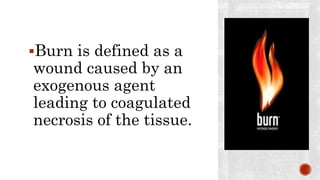
๏‚งBurn is defined as a
wound caused by an
exogenous agent
leading to coagulated
necrosis of the tissue.
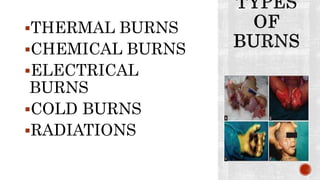
๏‚งTHERMAL BURNS
๏‚งCHEMICAL BURNS
๏‚งELECTRICAL
BURNS
๏‚งCOLD BURNS
๏‚งRADIATIONS
THERM
AL
BURNS
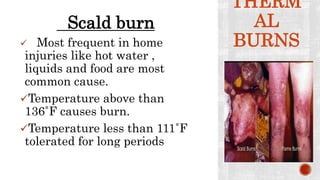
Scald burn
๏ƒผ Most frequent in home
injuries like hot water ,
liquids and food are most
common cause.
๏ƒผTemperature above than
136หšF causes burn.
๏ƒผTemperature less than 111หšF
tolerated for long periods
CHEMIC
AL
BURN
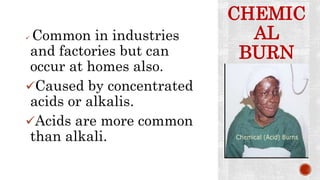
๏ƒผ Common in industries
and factories but can
occur at homes also.
๏ƒผCaused by concentrated
acids or alkalis.
๏ƒผAcids are more common
than alkali.
ELECTRIC
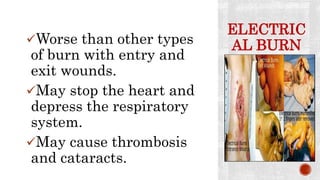
AL BURN๏ƒผWorse than other types
of burn with entry and
exit wounds.
๏ƒผMay stop the heart and
depress the respiratory
system.
๏ƒผMay cause thrombosis
and cataracts.
RADIATI
ON
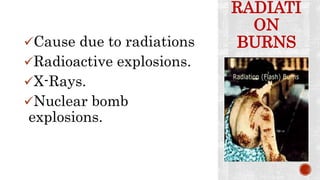
BURNS๏ƒผCause due to radiations
๏ƒผRadioactive explosions.
๏ƒผX-Rays.
๏ƒผNuclear bomb
explosions.
Pโ€™PHYSIOLO
GY
OF BURNS
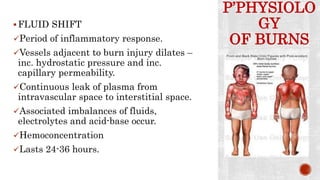
๏‚งFLUID SHIFT
๏ƒผPeriod of inflammatory response.
๏ƒผVessels adjacent to burn injury dilates โ€“
inc. hydrostatic pressure and inc.
capillary permeability.
๏ƒผContinuous leak of plasma from
intravascular space to interstitial space.
๏ƒผAssociated imbalances of fluids,
electrolytes and acid-base occur.
๏ƒผHemoconcentration
๏ƒผLasts 24-36 hours.
VIDEO
REPRESENTA
TION OF
BURNS
Pโ€™PHYSIOLO
GY
OF BURNS
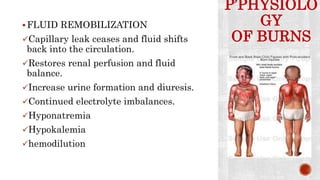
๏‚งFLUID REMOBILIZATION
๏ƒผCapillary leak ceases and fluid shifts
back into the circulation.
๏ƒผRestores renal perfusion and fluid
balance.
๏ƒผIncrease urine formation and diuresis.
๏ƒผContinued electrolyte imbalances.
๏ƒผHyponatremia
๏ƒผHypokalemia
๏ƒผhemodilution
BODYโ€™S
RESPON
SE TO
BURN.
๏‚งEmergent phase (STAGE 1)
๏ƒผPain response
๏ƒผCatecholamine response
๏ƒผTachycardia ,tachypnea ,
mild hypertension , mild
anxiety
BODYโ€™S
RESPON
SE TO
BURN.
๏‚งFLUID SHIFT PHASE (STAGE
2)
๏ƒผLength 18-24 hours.
๏ƒผBegins after emergent phase
๏ƒผReaches peak level in 6-8 hours.
๏ƒผDamaged cells initiate
inflammatory response.
๏ƒผIncreased blood flow to cells
๏ƒผShift of fluid from
intravascularto extravascular
space
BODYโ€™S
RESPON
SE TO
BURN.
๏‚งHYPERMETABOLIC PHASE (
STAGE 3)
๏ƒผLast for days to weeks
๏ƒผLarge increase in bodyโ€™s need for
nutrients as it repairs itself
๏‚งRESOLUTION PHASE (STAGE
4)
๏ƒผScar formation
๏ƒผGeneral rehabilitation and
progression to normal function.
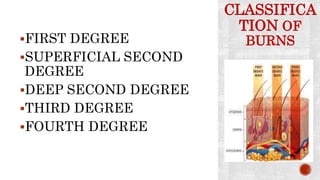
CLASSIFICA
TION OF
BURNS๏‚งFIRST DEGREE
๏‚งSUPERFICIAL SECOND
DEGREE
๏‚งDEEP SECOND DEGREE
๏‚งTHIRD DEGREE
๏‚งFOURTH DEGREE
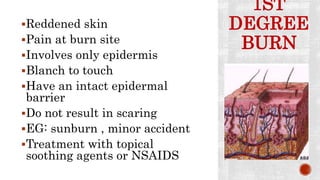
1ST
DEGREE
BURN
๏‚งReddened skin
๏‚งPain at burn site
๏‚งInvolves only epidermis
๏‚งBlanch to touch
๏‚งHave an intact epidermal
barrier
๏‚งDo not result in scaring
๏‚งEG: sunburn , minor accident
๏‚งTreatment with topical
soothing agents or NSAIDS
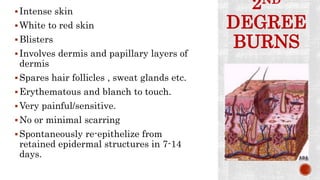
2ND
DEGREE
BURNS
๏‚งIntense skin
๏‚งWhite to red skin
๏‚งBlisters
๏‚งInvolves dermis and papillary layers of
dermis
๏‚งSpares hair follicles , sweat glands etc.
๏‚งErythematous and blanch to touch.
๏‚งVery painful/sensitive.
๏‚งNo or minimal scarring
๏‚งSpontaneously re-epithelize from
retained epidermal structures in 7-14
days.
SECOND
DEGREE
BURN
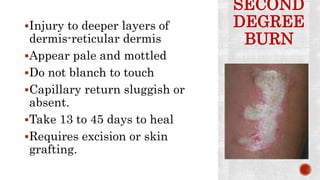
๏‚งInjury to deeper layers of
dermis-reticular dermis
๏‚งAppear pale and mottled
๏‚งDo not blanch to touch
๏‚งCapillary return sluggish or
absent.
๏‚งTake 13 to 45 days to heal
๏‚งRequires excision or skin
grafting.
3RD
DEGREE
BURN
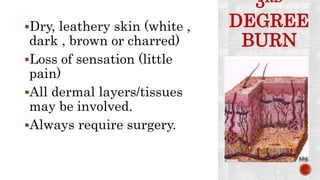
๏‚งDry, leathery skin (white ,
dark , brown or charred)
๏‚งLoss of sensation (little
pain)
๏‚งAll dermal layers/tissues
may be involved.
๏‚งAlways require surgery.
4TH
DEGREE
BURN
๏‚งInvolves structure
beneath the skin-
muscle , bone
ASSESEM
ENT OF
BURNS
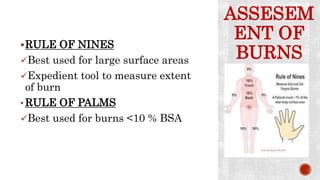
๏‚งRULE OF NINES
๏ƒผBest used for large surface areas
๏ƒผExpedient tool to measure extent
of burn
โ€ข RULE OF PALMS
๏ƒผBest used for burns <10 % BSA
MANAGEM
ENT๏‚งPRE HOSPITAL CARE
๏‚งEnsure rescuer safety
๏‚งStop the burning process :
stop , drop and fall.
๏‚งCheck for other injuries
๏‚งA standard ABC (AIRWAY ,
BREATHING ,
CIRCULATION) check
followed by a rapid secondary
survey.
MANAGEM
ENT
๏‚งCool the burnt wound
๏‚งGive oxygen
๏‚งElevate
๏‚งGive analgesic
HOSPIT
AL
CARE
๏‚งA : Airway control
๏‚งB : Breathing and ventilation
๏‚งC : Circulation
๏‚งD : Disability โ€“ neurological
status
๏‚งE : exposure with environmental
control
๏‚งF : fluid resuscitation
AIRW
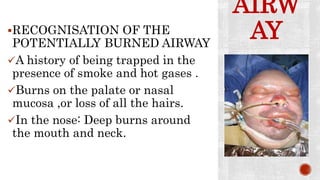
AY๏‚งRECOGNISATION OF THE
POTENTIALLY BURNED AIRWAY
๏ƒผA history of being trapped in the
presence of smoke and hot gases .
๏ƒผBurns on the palate or nasal
mucosa ,or loss of all the hairs.
๏ƒผIn the nose: Deep burns around
the mouth and neck.
AIRW
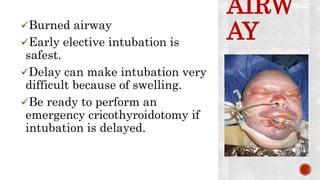
AY๏ƒผBurned airway
๏ƒผEarly elective intubation is
safest.
๏ƒผDelay can make intubation very
difficult because of swelling.
๏ƒผBe ready to perform an
emergency cricothyroidotomy if
intubation is delayed.
BREATHI
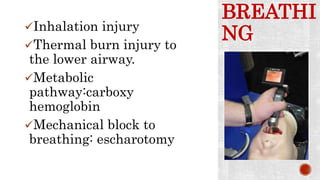
NG๏ƒผInhalation injury
๏ƒผThermal burn injury to
the lower airway.
๏ƒผMetabolic
pathway:carboxy
hemoglobin
๏ƒผMechanical block to
breathing: escharotomy
CIRCULATI
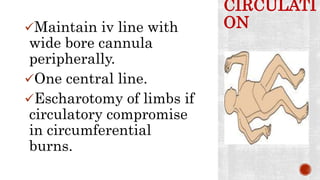
ON๏ƒผMaintain iv line with
wide bore cannula
peripherally.
๏ƒผOne central line.
๏ƒผEscharotomy of limbs if
circulatory compromise
in circumferential
burns.
FLUIDS
FOR
RESUSCITAT
ION
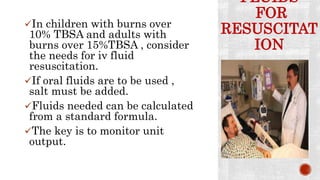
๏ƒผIn children with burns over
10% TBSA and adults with
burns over 15%TBSA , consider
the needs for iv fluid
resuscitation.
๏ƒผIf oral fluids are to be used ,
salt must be added.
๏ƒผFluids needed can be calculated
from a standard formula.
๏ƒผThe key is to monitor unit
output.
FLUIDS
FOR
RESUSCITAT
ION
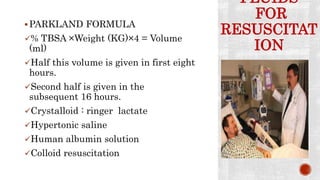
๏‚งPARKLAND FORMULA
๏ƒผ% TBSA ร—Weight (KG)ร—4 = Volume
(ml)
๏ƒผHalf this volume is given in first eight
hours.
๏ƒผSecond half is given in the
subsequent 16 hours.
๏ƒผCrystalloid : ringer lactate
๏ƒผHypertonic saline
๏ƒผHuman albumin solution
๏ƒผColloid resuscitation
NUTRITI
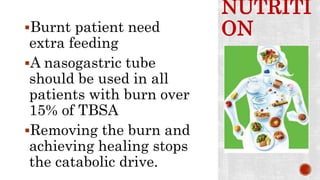
ON๏‚งBurnt patient need
extra feeding
๏‚งA nasogastric tube
should be used in all
patients with burn over
15% of TBSA
๏‚งRemoving the burn and
achieving healing stops
the catabolic drive.
NUTRITI
ONSUTHERAND FORMULA
๏ƒผChildren : 60 kcal/kg +35
%kcal TBSA
๏ƒผAdults : 20 kcal/kg +70
%kcal TBSA
โ€ขPROTEIN
๏ƒผ20% of energy
๏ƒผ1.5 to 2 g/kg protein/day
MONITORING
AND
CONTROL OF
INFECTION
๏‚งBurn patients are
immunocompromised.
๏‚งThey are susceptible to infections
through many routes.
๏‚งSterile precautions should be
taken.
๏‚งSwabs should be used regularly.
๏‚งA rise in WBC count
,thrombocytosis, and increase
catabolism are warnings of
infections.
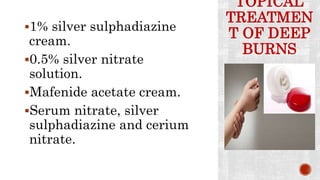
TOPICAL
TREATMEN
T OF DEEP
BURNS
๏‚ง1% silver sulphadiazine
cream.
๏‚ง0.5% silver nitrate
solution.
๏‚งMafenide acetate cream.
๏‚งSerum nitrate, silver
sulphadiazine and cerium
nitrate.
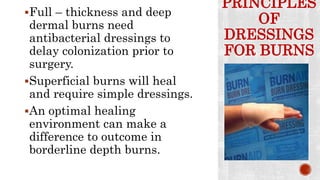
PRINCIPLES
OF
DRESSINGS
FOR BURNS
๏‚งFull โ€“ thickness and deep
dermal burns need
antibacterial dressings to
delay colonization prior to
surgery.
๏‚งSuperficial burns will heal
and require simple dressings.
๏‚งAn optimal healing
environment can make a
difference to outcome in
borderline depth burns.
Burn

Burn