BURNS
ANAGHA MURALI
TYPES OF BURNS
• Thermal Injury
 Scald
 Flame burns
 Contact burns
 Flash burns
• Electrical injury
• Chemical burns
• Cold injury
• Ionising radiation
• Sun burns
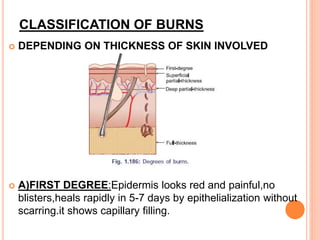
CLASSIFICATION OF BURNS
 DEPENDING ON THICKNESS OF SKIN INVOLVED
 A)FIRST DEGREE:Epidermis looks red and painful,no
blisters,heals rapidly in 5-7 days by epithelialization without
scarring.it shows capillary filling.
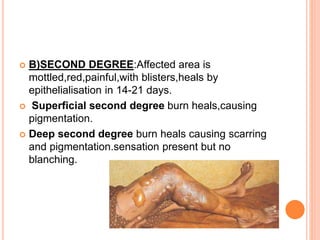
 B)SECOND DEGREE:Affected area is
mottled,red,painful,with blisters,heals by
epithelialisation in 14-21 days.
 Superficial second degree burn heals,causing
pigmentation.
 Deep second degree burn heals causing scarring
and pigmentation.sensation present but no
blanching.
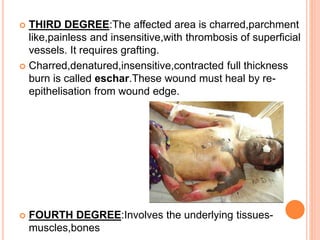
 THIRD DEGREE:The affected area is charred,parchment
like,painless and insensitive,with thrombosis of superficial
vessels. It requires grafting.
 Charred,denatured,insensitive,contracted full thickness
burn is called eschar.These wound must heal by re-
epithelisation from wound edge.
 FOURTH DEGREE:Involves the underlying tissues-
muscles,bones
 DEPENDING ON THICKNESS OF SKIN
INVOLVED
 Partial thickness burns:either first or second
degree burn which is red and painful,often with
blisters.
 Full thickness burns:third degree burns which is
charred,insensitive,deep involving all layers of skin.
 DEPENDING ON THE PERCENTAGE OF BURNS
 MILD
 Partial thickness burns<15% in adult or <10% in
chidren,Full thickness burns <2%
 MODERATE:
 Partial thickness burns 15-25%in adult or 10-20% in
chidren,Full thickness burns 2-10%
 SEVERE:
 Partial thickness burns>25% in adult or >20% in
chidren,Full thickness burns >10%.
 Burns involving eyes,ears,feet,hand,perineum.
ASSESSMENT OF BURNS
 Wallace’s rule of nine
Lund and Browder Chart
 Clinical Features:
 h/o burns
 Pain,burning,anxious
status,tachycardia,tachypnoea,fluid loss.
 In severe degree-features of shock.
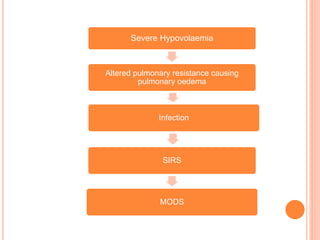
PATHOPHYSIOLOGY
Heat causes coagulation necrosis of skin and
subcutaneous tissue
Release of vasoactive peptides
Altered capillary permeability
Loss of fluid
Severe Hypovolaemia
Altered pulmonary resistance causing
pulmonary oedema
Infection
SIRS
MODS
EFFECTS OF BURN INJURY
 Shock due to hypovolaemia
 Renal failure
 Pulmonary Oedema,Respiratory
Infection,ARDS,Respiratory failure.
 Infections
 GIT:Curling’s Ulcer
 Fluid and Electrolyte imbalance.
 Eschar formation.
 Electrical Injuries often causes fractures,major
internal organ injury,convulsions.
 Development of contracture
 Inhalational burns causes Pulmonary
Oedema,Respiratory arrest ,ARDS.
 Chemical injury causes severe GIT disturbances
like erosions,perforation,stricture
oesophagus(alkali),pyloric
stenosis(acid),mediastinal injury.
 Toxic Shock Syndrome.
 Other problems commonly seen are
DVT,pulmonary embolism,urinary infection,bed-
sores,severe malnutrition with catabolic
status,respiratory infection.
MANAGEMENT OF BURNS
 FIRST AID
 DEFINITIVE TREATMENT
 FLIUD RESUSCITATION
 LOCAL MANAGEMENT
 FIRST AID
 Stop burning process and keep the patient away
from burning area.
 Cool the area with tap water by continuous
irrigation for 20 min(not by cold water as it causes
hypothermia)
 DEFINITIVE TREATMENT
 Admit the patient
 Maintain airway,breathing,circulation(ABC)
 Assess the percentage,degree, and type of burn
 Keep the patient in a clean environment
 Sedation and proper analgesia
 Patient should be in burns unit with barrier
nursing,sterile clothes,bed sheets with all aseptic
methods.
 FLIUD RESUSCITATION
 Formulas to calculate the fluid replacement:
 1)Parkland regime: 4 ml/% burn/kg body
weight/24 hours. Maximum percentage considered
is 50%. Half the volume is given in first 8 hours, rest
given in 16 hours.
 2) Muir and Burclay regime:
% Burns x Body weight in kg /2= 1 Ration
3 Rations given in first 12 hours.
2 Rations in second 12 hours.
1 Ration in third 12 hours
 3) Galveston regime (pediatric): 5000 ml/m 2 burned +
1500 ml/m 2 total
 4)Modified Brooke formula:
 First 24 hours: RL: 4 ml/kg/% bums in 24 hours (first half
in first 8 hours) Colloid — none.
 Second 24 hours: Crystalloids — to maintain urine
output Colloids — 0.3 ml to 0.5 ml/kg/bums in 24 hours.
(Albumin in RL solution) (Albumin alone should be given
with care if really indicated only).
 5)Evan’s formula: In first 24 hours: Normal saline 1
ml/kg/% burns Colloids 1 ml/kg/% bums 5 % dextrose in
water, 2000 ml in adult. In second 24 hours: Half of the
volume used in first 24 hours.
 Fluids used are normal saline, ringer lactate,
Hartmann fluid, plasma. Ringer lactate is the fluid
of choice. Blood is transfused in later period (after
48 hours).
 First 24 hours only crystalloids should be given.
 After 24 hours up to 30-48 hours, colloids should be
given to compensate plasma loss.
 Urinary catheterization to monitor output; 30-50 ml/hour should
be the urine output.
 Tetanus toxoid.
 Monitoring the patient: Hourly pulse, BP, P0 2 , PC0 2 ,
electrolyte analysis, blood urea, nasal oxygen, often intubation is
required.
 IV ranitidine 50 mg 8th hourly.
 Ryle’s tube insertion initially for aspiration purpose later for
feeding (Enteral feeding).
 Antibiotics: Penicillins, aminoglycosides, cephalosporins,
metronidazole.
 Culture of the discharge; total white cell count and platelet count
at regular intervals are essential to identify the sepsis along with
fever, tachycardia and tachypnoea.
 In burns of oral cavity tracheostomy may be required to maintain
the airway.
 Total parenteral nutrition (TPN) is required for faster recovery,
using carbohydrates, lipids, vitamins (through a CVP line).
 Tracheostomy/intubation tube may be required in impending
respiratory failure or upper airway block.
 Intensive nursing care.
 Local Management
 Dressing at regular intervals under general anaesthesia
using paraffin gauze, hydrocolloids, plastic films,
vaseline impregnated gauze or fenestrated silicone
sheet or biological dressings like amniotic membrane or
synthetic biobrane.
 Open method.
 Closed method.
 Tangential excision of burn wound with skin grafting.
 Slough excision is done regularly.
 After cleaning with povidone iodine solution silver
sulfadiazine ointment is used. It is an antiseptic and
soothening agent. It causes neutropenia.
 Wound Coverage
1)Cultured skin
2)Synthetic dressings in burn wound
 Vaseline impregnated gauze
 Hydrocolloid dressing
 Opsite
 Biobrane
 Transcyte
 Integra
3) Biologic dressings
ESCHAR
 It is charred, denatured, full thickness, deep burns with
contracted dermis. It is insensitive, with thrombosed
superficial veins.
 Circumferential eschar in the upper limb, lower limb,
neck, thorax can cause more oedema which initially
causes venous compression and later arterial
compression causing ischaemia, gangrene of the distal
part. So distal area should be monitored for circulation.
Escharotomy causes large quantity of blood loss and so
blood transfusion is needed while doing escharotomy.
Eschar should be excised and the area is allowed to
granulate and skin grafting should be done.
 Pseudoeschar is thickened burnt skin due to repeated
silver sulphadiazine application.
CONTRACTURE IN BURN WOUND
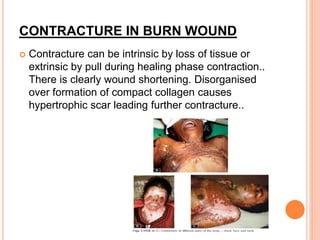
 Contracture can be intrinsic by loss of tissue or
extrinsic by pull during healing phase contraction..
There is clearly wound shortening. Disorganised
over formation of compact collagen causes
hypertrophic scar leading further contracture..
Classification of Burns Contracture in the Neck (BM
Achauer)
 Mild (less than l/3rd) — inability to see ceiling.
 Moderate (l/3rd to 2/3rd) — flexion is possible but
not extension.
 Severe (more than 2/3rd) — fully contracted in
flexed position with pull on lower lip.
 Extensive — contraction is extensive with
mentosternal adhesions..
Complications of Burns Contracture
 Ectropion of eyelid causing keratitis and corneal ulcer.
 Disfigurement in face.
 Narrowing of mouth (microstomia. )
 Contracture in the neck causing restricted neck
movements.
 Disability and nonfunctioning of joints due to
contracture.
 Hypertrophic scar and keloid formation.
 Repeated breaking of scar and infection, ulcer, cellulitis.
 Pain and tenderness in the scar contracture.
 Marjolin ’s ulcer
Treatment for Contracture
 Release of contracture surgically and use of skin
graft or “Z” plasty or different flaps.
 Proper physiotherapy and rehabilitation is essential.
 Pressure garments to prevent hypertrophic scars.
 Management of itching in the scar using aloe vera,
antihistamines and moisturizing creams.
Prevention of development of contracture
o Joint exercise in full range during recovery period of
burns
o Pressure garments for a long period
o Topical silicon sheeting
o Saline expanders for scars
ELECTRICAL BURNS
 Low tension injury: Less than 1000 volts.
 High tension injury : More than 1000 volts
 It is always a deep burn ( always a major burn).
 There is a wound of entry and wound of exit.
 Patient may also have major internal organ
injuries.GIT, thoracic injuries.
 Often convulsions can develop.
 Death may occur due to cardiac arrhythmias
(instant death due to ventricular fibrillation).
 Gas gangrene is common after electric injury.
 Release of myoglobin can cause renal tubular
damage and renal failure.
 Acidosis is common and so often bicarbonate
infusion is needed.
 Patient should always be admitted and should be
assessed by ECG, cardiac monitor, U/S abdomen,
chest X-ray, sometimes even CT scan head, cardiac
enzyme analysis.
 Depending on the injury it is managed accordingly.
 Fractures and dislocations are common in
electrical injuries which is treated accordingly.
 Mafenide acetate is better agent as it penetrates
well and it is useful against clostridial infection.
 Mannitol is used to prevent myoglobin induced
renal failure.
 Wound excision, amputation, surgery for internal
organ injury, cardiac monitoring are essential part of
the surgical management.
INHALATION INJURY
 It occurs after major fire burns.
 It is due to:
 Inhalation of heat.
 Noxious gases and incomplete products of combustion. ♦
 At the site of fire, oxygen concentration is less than 2% which
can cause death in 45 seconds due to hypoxia.
 Inhaled carbon monoxide.
 Smoke contains hydrocyanide which causes tissue hypoxia
and profound acidosis.
 Laryngeal oedema and laryngospasm.
 Bronchial oedema and bronchospasm.
 Formation of bronchial cast is typical which is due to oedema,
lymph exudation, separation of ciliated epithelial cells from
basement membrane.
 Later Problems
 ARDS, pneumonia.
 Atelectasis, pulmonary embolism.
 Pulmonary oedema, pneumothorax.
 Clinical Features
 They have low oxygen saturation.
 Charring of mouth, oropharynx with facial burns.
 Carbon sputum.
 Change in the voice, singed facial and nasal hair.
 Decreased level of consciousness with stridor or dyspnoea.
 Acute pulmonary insufficiency with asphyxia, CO poisoning,
upper airway obstruction. After 3 to 5 days, ARDS and
hypoxia develops. Bronchopneumonia with septicaemia
occurs after 5 days.
 Management
 Replacing the patient from the site earliest.
 Ventilator support for several weeks.
 Antibiotics.
 Bronchoscopy, at regular intervals to remove
bronchial cast.
 Tracheostomy whenever required.
 Hyperbaric oxygen.
 IV heparin to reduce bronchial cast.
 Monitoring the patient with arterial blood gas
analysis regularly.
CHEMICAL BURNS
 In chemical burns, tissue destruction is more and progressive.
 It is always a deep burn.
 Acid burns
 Acid burns occurs in skin, soft tissues and GIT.
 In GIT, it is common in stomach either due to nitric acid or
sulphuric acid which may lead to severe gastritis or pyloric
stenosis. Other acids are formic acid, hydrofluoric acid. They
cause metabolic acidosis, renal failure, ARDS, haemolysis.
Acidaemia should be corrected by IV sodium bicarbonate.
 Hydrofluoric acid is strongest inorganic acid that can produce
corrosion and dehydration. It chelates blood calcium causing
hypocalcaemia and arrhythmias. It is managed with water
irrigation, application of 2.5% calcium gluconate gel at 15
minutes interval, local intradermal and intra-arterial injection of
10% calcium gluconate. Continuous cardiac monitoring, IV
calcium gluconate or calcium chloride administration is needed.
 Alkali burns
 Alkali burns occur in oral cavity and oesophagus
which leads to multiple oesophageal strictures.
Sodium hydroxide, lime, potassium hydroxide and
bleach are common alkalis involved. They cause
saponification of fat, fluid loss, release of alkali
proteinates and hydroxide ions which are toxic.
 Initial treatment is dilution with water ( Hydrotherapy ).
It is done using 15-20 litres of running tap water.
 Neutralisation with antidote should never be done at
initial phase of treatment as it creates exothermic
reaction which aggravates the tissue damage.
 Treatment should always be with hospitalisation.
 Mannitol diuresis, haemodialysis, calcium gluconate
IV, pain relief, serum electrolyte management, TPN,
ventilator support are systemic management
required.
 Late treatment is reconstmction of the face.
 Oesophageal dilatation or colonic transposition is
done for oesophageal stricture due to alkali burn.
 Gastrojejunostomy is done for acid induced pyloric
stenosis.

 Medicolegal and ethical aspects in burns
 Police should be informed whenever a female, pregnant
patient arrives with burns
 Consent for high-risk should be taken especially in
burns > 30%
 Burns should be assessed whether it is accidental or
homi- cidal
 Relatives should be informed about the duration of stay,
problems, repeated surgeries
 In patients with severe burns who is likely to die, when
suspected, dying declaration should be arranged
 Cost of therapy, long duration of stay and cosmetic
problems should be informed to the relatives
REFERENCE
 SRB’s Manual of Surgery
Burns

Burns

  • 1.
  • 2.
    TYPES OF BURNS •Thermal Injury  Scald  Flame burns  Contact burns  Flash burns • Electrical injury • Chemical burns • Cold injury • Ionising radiation • Sun burns
  • 3.
    CLASSIFICATION OF BURNS DEPENDING ON THICKNESS OF SKIN INVOLVED  A)FIRST DEGREE:Epidermis looks red and painful,no blisters,heals rapidly in 5-7 days by epithelialization without scarring.it shows capillary filling.
  • 4.
     B)SECOND DEGREE:Affectedarea is mottled,red,painful,with blisters,heals by epithelialisation in 14-21 days.  Superficial second degree burn heals,causing pigmentation.  Deep second degree burn heals causing scarring and pigmentation.sensation present but no blanching.
  • 5.
     THIRD DEGREE:Theaffected area is charred,parchment like,painless and insensitive,with thrombosis of superficial vessels. It requires grafting.  Charred,denatured,insensitive,contracted full thickness burn is called eschar.These wound must heal by re- epithelisation from wound edge.  FOURTH DEGREE:Involves the underlying tissues- muscles,bones
  • 6.
     DEPENDING ONTHICKNESS OF SKIN INVOLVED  Partial thickness burns:either first or second degree burn which is red and painful,often with blisters.  Full thickness burns:third degree burns which is charred,insensitive,deep involving all layers of skin.
  • 7.
     DEPENDING ONTHE PERCENTAGE OF BURNS  MILD  Partial thickness burns<15% in adult or <10% in chidren,Full thickness burns <2%  MODERATE:  Partial thickness burns 15-25%in adult or 10-20% in chidren,Full thickness burns 2-10%  SEVERE:  Partial thickness burns>25% in adult or >20% in chidren,Full thickness burns >10%.  Burns involving eyes,ears,feet,hand,perineum.
  • 8.
    ASSESSMENT OF BURNS Wallace’s rule of nine
  • 9.
  • 10.
     Clinical Features: h/o burns  Pain,burning,anxious status,tachycardia,tachypnoea,fluid loss.  In severe degree-features of shock.
  • 11.
    PATHOPHYSIOLOGY Heat causes coagulationnecrosis of skin and subcutaneous tissue Release of vasoactive peptides Altered capillary permeability Loss of fluid
  • 12.
    Severe Hypovolaemia Altered pulmonaryresistance causing pulmonary oedema Infection SIRS MODS
  • 13.
    EFFECTS OF BURNINJURY  Shock due to hypovolaemia  Renal failure  Pulmonary Oedema,Respiratory Infection,ARDS,Respiratory failure.  Infections  GIT:Curling’s Ulcer  Fluid and Electrolyte imbalance.  Eschar formation.  Electrical Injuries often causes fractures,major internal organ injury,convulsions.
  • 14.
     Development ofcontracture  Inhalational burns causes Pulmonary Oedema,Respiratory arrest ,ARDS.  Chemical injury causes severe GIT disturbances like erosions,perforation,stricture oesophagus(alkali),pyloric stenosis(acid),mediastinal injury.  Toxic Shock Syndrome.  Other problems commonly seen are DVT,pulmonary embolism,urinary infection,bed- sores,severe malnutrition with catabolic status,respiratory infection.
  • 15.
    MANAGEMENT OF BURNS FIRST AID  DEFINITIVE TREATMENT  FLIUD RESUSCITATION  LOCAL MANAGEMENT
  • 16.
     FIRST AID Stop burning process and keep the patient away from burning area.  Cool the area with tap water by continuous irrigation for 20 min(not by cold water as it causes hypothermia)
  • 17.
     DEFINITIVE TREATMENT Admit the patient  Maintain airway,breathing,circulation(ABC)  Assess the percentage,degree, and type of burn  Keep the patient in a clean environment  Sedation and proper analgesia  Patient should be in burns unit with barrier nursing,sterile clothes,bed sheets with all aseptic methods.
  • 18.
     FLIUD RESUSCITATION Formulas to calculate the fluid replacement:  1)Parkland regime: 4 ml/% burn/kg body weight/24 hours. Maximum percentage considered is 50%. Half the volume is given in first 8 hours, rest given in 16 hours.  2) Muir and Burclay regime: % Burns x Body weight in kg /2= 1 Ration 3 Rations given in first 12 hours. 2 Rations in second 12 hours. 1 Ration in third 12 hours
  • 19.
     3) Galvestonregime (pediatric): 5000 ml/m 2 burned + 1500 ml/m 2 total  4)Modified Brooke formula:  First 24 hours: RL: 4 ml/kg/% bums in 24 hours (first half in first 8 hours) Colloid — none.  Second 24 hours: Crystalloids — to maintain urine output Colloids — 0.3 ml to 0.5 ml/kg/bums in 24 hours. (Albumin in RL solution) (Albumin alone should be given with care if really indicated only).  5)Evan’s formula: In first 24 hours: Normal saline 1 ml/kg/% burns Colloids 1 ml/kg/% bums 5 % dextrose in water, 2000 ml in adult. In second 24 hours: Half of the volume used in first 24 hours.
  • 20.
     Fluids usedare normal saline, ringer lactate, Hartmann fluid, plasma. Ringer lactate is the fluid of choice. Blood is transfused in later period (after 48 hours).  First 24 hours only crystalloids should be given.  After 24 hours up to 30-48 hours, colloids should be given to compensate plasma loss.
  • 21.
     Urinary catheterizationto monitor output; 30-50 ml/hour should be the urine output.  Tetanus toxoid.  Monitoring the patient: Hourly pulse, BP, P0 2 , PC0 2 , electrolyte analysis, blood urea, nasal oxygen, often intubation is required.  IV ranitidine 50 mg 8th hourly.  Ryle’s tube insertion initially for aspiration purpose later for feeding (Enteral feeding).  Antibiotics: Penicillins, aminoglycosides, cephalosporins, metronidazole.  Culture of the discharge; total white cell count and platelet count at regular intervals are essential to identify the sepsis along with fever, tachycardia and tachypnoea.  In burns of oral cavity tracheostomy may be required to maintain the airway.  Total parenteral nutrition (TPN) is required for faster recovery, using carbohydrates, lipids, vitamins (through a CVP line).  Tracheostomy/intubation tube may be required in impending respiratory failure or upper airway block.  Intensive nursing care.
  • 22.
     Local Management Dressing at regular intervals under general anaesthesia using paraffin gauze, hydrocolloids, plastic films, vaseline impregnated gauze or fenestrated silicone sheet or biological dressings like amniotic membrane or synthetic biobrane.  Open method.  Closed method.  Tangential excision of burn wound with skin grafting.  Slough excision is done regularly.  After cleaning with povidone iodine solution silver sulfadiazine ointment is used. It is an antiseptic and soothening agent. It causes neutropenia.
  • 23.
     Wound Coverage 1)Culturedskin 2)Synthetic dressings in burn wound  Vaseline impregnated gauze  Hydrocolloid dressing  Opsite  Biobrane  Transcyte  Integra 3) Biologic dressings
  • 24.
    ESCHAR  It ischarred, denatured, full thickness, deep burns with contracted dermis. It is insensitive, with thrombosed superficial veins.  Circumferential eschar in the upper limb, lower limb, neck, thorax can cause more oedema which initially causes venous compression and later arterial compression causing ischaemia, gangrene of the distal part. So distal area should be monitored for circulation. Escharotomy causes large quantity of blood loss and so blood transfusion is needed while doing escharotomy. Eschar should be excised and the area is allowed to granulate and skin grafting should be done.  Pseudoeschar is thickened burnt skin due to repeated silver sulphadiazine application.
  • 25.
    CONTRACTURE IN BURNWOUND  Contracture can be intrinsic by loss of tissue or extrinsic by pull during healing phase contraction.. There is clearly wound shortening. Disorganised over formation of compact collagen causes hypertrophic scar leading further contracture..
  • 26.
    Classification of BurnsContracture in the Neck (BM Achauer)  Mild (less than l/3rd) — inability to see ceiling.  Moderate (l/3rd to 2/3rd) — flexion is possible but not extension.  Severe (more than 2/3rd) — fully contracted in flexed position with pull on lower lip.  Extensive — contraction is extensive with mentosternal adhesions..
  • 27.
    Complications of BurnsContracture  Ectropion of eyelid causing keratitis and corneal ulcer.  Disfigurement in face.  Narrowing of mouth (microstomia. )  Contracture in the neck causing restricted neck movements.  Disability and nonfunctioning of joints due to contracture.  Hypertrophic scar and keloid formation.  Repeated breaking of scar and infection, ulcer, cellulitis.  Pain and tenderness in the scar contracture.  Marjolin ’s ulcer
  • 28.
    Treatment for Contracture Release of contracture surgically and use of skin graft or “Z” plasty or different flaps.  Proper physiotherapy and rehabilitation is essential.  Pressure garments to prevent hypertrophic scars.  Management of itching in the scar using aloe vera, antihistamines and moisturizing creams. Prevention of development of contracture o Joint exercise in full range during recovery period of burns o Pressure garments for a long period o Topical silicon sheeting o Saline expanders for scars
  • 29.
    ELECTRICAL BURNS  Lowtension injury: Less than 1000 volts.  High tension injury : More than 1000 volts  It is always a deep burn ( always a major burn).  There is a wound of entry and wound of exit.  Patient may also have major internal organ injuries.GIT, thoracic injuries.  Often convulsions can develop.  Death may occur due to cardiac arrhythmias (instant death due to ventricular fibrillation).
  • 30.
     Gas gangreneis common after electric injury.  Release of myoglobin can cause renal tubular damage and renal failure.  Acidosis is common and so often bicarbonate infusion is needed.  Patient should always be admitted and should be assessed by ECG, cardiac monitor, U/S abdomen, chest X-ray, sometimes even CT scan head, cardiac enzyme analysis.  Depending on the injury it is managed accordingly.  Fractures and dislocations are common in electrical injuries which is treated accordingly.
  • 31.
     Mafenide acetateis better agent as it penetrates well and it is useful against clostridial infection.  Mannitol is used to prevent myoglobin induced renal failure.  Wound excision, amputation, surgery for internal organ injury, cardiac monitoring are essential part of the surgical management.
  • 32.
    INHALATION INJURY  Itoccurs after major fire burns.  It is due to:  Inhalation of heat.  Noxious gases and incomplete products of combustion. ♦  At the site of fire, oxygen concentration is less than 2% which can cause death in 45 seconds due to hypoxia.  Inhaled carbon monoxide.  Smoke contains hydrocyanide which causes tissue hypoxia and profound acidosis.  Laryngeal oedema and laryngospasm.  Bronchial oedema and bronchospasm.  Formation of bronchial cast is typical which is due to oedema, lymph exudation, separation of ciliated epithelial cells from basement membrane.
  • 33.
     Later Problems ARDS, pneumonia.  Atelectasis, pulmonary embolism.  Pulmonary oedema, pneumothorax.  Clinical Features  They have low oxygen saturation.  Charring of mouth, oropharynx with facial burns.  Carbon sputum.  Change in the voice, singed facial and nasal hair.  Decreased level of consciousness with stridor or dyspnoea.  Acute pulmonary insufficiency with asphyxia, CO poisoning, upper airway obstruction. After 3 to 5 days, ARDS and hypoxia develops. Bronchopneumonia with septicaemia occurs after 5 days.
  • 34.
     Management  Replacingthe patient from the site earliest.  Ventilator support for several weeks.  Antibiotics.  Bronchoscopy, at regular intervals to remove bronchial cast.  Tracheostomy whenever required.  Hyperbaric oxygen.  IV heparin to reduce bronchial cast.  Monitoring the patient with arterial blood gas analysis regularly.
  • 35.
    CHEMICAL BURNS  Inchemical burns, tissue destruction is more and progressive.  It is always a deep burn.  Acid burns  Acid burns occurs in skin, soft tissues and GIT.  In GIT, it is common in stomach either due to nitric acid or sulphuric acid which may lead to severe gastritis or pyloric stenosis. Other acids are formic acid, hydrofluoric acid. They cause metabolic acidosis, renal failure, ARDS, haemolysis. Acidaemia should be corrected by IV sodium bicarbonate.  Hydrofluoric acid is strongest inorganic acid that can produce corrosion and dehydration. It chelates blood calcium causing hypocalcaemia and arrhythmias. It is managed with water irrigation, application of 2.5% calcium gluconate gel at 15 minutes interval, local intradermal and intra-arterial injection of 10% calcium gluconate. Continuous cardiac monitoring, IV calcium gluconate or calcium chloride administration is needed.
  • 36.
     Alkali burns Alkali burns occur in oral cavity and oesophagus which leads to multiple oesophageal strictures. Sodium hydroxide, lime, potassium hydroxide and bleach are common alkalis involved. They cause saponification of fat, fluid loss, release of alkali proteinates and hydroxide ions which are toxic.  Initial treatment is dilution with water ( Hydrotherapy ). It is done using 15-20 litres of running tap water.  Neutralisation with antidote should never be done at initial phase of treatment as it creates exothermic reaction which aggravates the tissue damage.
  • 37.
     Treatment shouldalways be with hospitalisation.  Mannitol diuresis, haemodialysis, calcium gluconate IV, pain relief, serum electrolyte management, TPN, ventilator support are systemic management required.  Late treatment is reconstmction of the face.  Oesophageal dilatation or colonic transposition is done for oesophageal stricture due to alkali burn.  Gastrojejunostomy is done for acid induced pyloric stenosis. 
  • 38.
     Medicolegal andethical aspects in burns  Police should be informed whenever a female, pregnant patient arrives with burns  Consent for high-risk should be taken especially in burns > 30%  Burns should be assessed whether it is accidental or homi- cidal  Relatives should be informed about the duration of stay, problems, repeated surgeries  In patients with severe burns who is likely to die, when suspected, dying declaration should be arranged  Cost of therapy, long duration of stay and cosmetic problems should be informed to the relatives
  • 39.