ONLINE ASSIGNMENT 
2014 
TECHNO PEDAGOGIC 
CONTENT ANALYSIS IN 
COMMERCE 
EDUCATION 
SHAMNAD B.ED COMMERCE BNVCTE
P a g e | 2 
INTRODUCTION 
Technology has a pivotal role to play in the dynamic changing field 
of commerce, trade and industry. It can provide coverage of a growing 
knowledge base association with the information explosion in all areas 
including commerce Technology in professional development is a complex issue. 
Technology can, and has, helped higher education overcome previous outreach 
barriers, particularly in reaching students in remote locations. The output of 
Commerce Education should be multidimensional and with full global 
competitiveness. But we have to realize that the Commerce graduate have lack of 
practical knowledge. The practical oriented Commerce Education is a need of the 
age. 
Commerce has grown from a subject to a full-fledged faculty in 
most of the universities and had acquired a pride of place amongst different 
academic disciplines. The growing phenomena on of globalization, liberalization and 
privatization, has been influencing the Commerce education. The technological 
revolution has further provided new dimensions’ E-banking, E-marketing, E-commerce, 
E-finance, E-investment paper less trading and governance has been 
gaining importance of all over the world. At the same time, the outsourcing business, 
call Centre, small business operation, IT based services etc. are expanding very fast. 
These developments demands paradigm shift in teaching and learning process. The 
new skills and training are required to cope up with these changes. The technological 
advances must be integrated into the basic fabric of Commerce education
P a g e | 3 
TECHNO-PEDAGOGY 
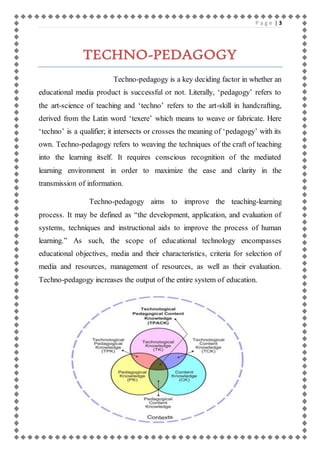
Techno-pedagogy is a key deciding factor in whether an 
educational media product is successful or not. Literally, ‘pedagogy’ refers to 
the art-science of teaching and ‘techno’ refers to the art-skill in handcrafting, 
derived from the Latin word ‘texere’ which means to weave or fabricate. Here 
‘techno’ is a qualifier; it intersects or crosses the meaning of ‘pedagogy’ with its 
own. Techno-pedagogy refers to weaving the techniques of the craft of teaching 
into the learning itself. It requires conscious recognition of the mediated 
learning environment in order to maximize the ease and clarity in the 
transmission of information. 
Techno-pedagogy aims to improve the teaching-learning 
process. It may be defined as “the development, application, and evaluation of 
systems, techniques and instructional aids to improve the process of human 
learning.” As such, the scope of educational technology encompasses 
educational objectives, media and their characteristics, criteria for selection of 
media and resources, management of resources, as well as their evaluation. 
Techno-pedagogy increases the output of the entire system of education.
P a g e | 4 
Importance of TECHNO-PEDAGOGIC ANALYSIS 
IN COMMERCE EDUCATION 
As today’s a learner centered education system, the importance 
of techno –pedagogy has increased very much. Techno-pedagogy is important 
because of the following:- 
 It develops a positive attitude towards learning among students. 
 It increases skills of students. 
 It increases the work skills for the work force. 
 It prepares students for the future. 
 It breaks the mundane learning cycle, and learning becomes more 
interesting. 
 It helps students explore resources and construct their own 
knowledge. 
 It helps in determining objectives, inputs, strategies, methods of 
teaching, learning experiences, evaluation etc. with the help of 
technology. 
 It helps to create a scientific temperament in students. 
 It helps the teachers to create effective instructional aids and 
strategies. 
 It helps the teacher in pooling the resources required for effective 
technology based instruction. 
 It helps in improving the quality of instruction and thereby 
improves the quality of education.
P a g e | 5 
e-commerce 
Commerce involves conducting business using modern communication 
instrument like Internet, Fax, Telephone, E-data interchange, E-payment, Money 
transfer system. E-Commerce provides multiple benefits to the consumers in the 
form of availability of goods at lower cost, wider choice and save times. People or 
Consumer can buy goods with a click of mouse button without moving out of their 
house or offices. Similarly, online services such as Internet Banking, Tickets includes 
Airlines, Railway, Bus Bill Payment, Hotel Booking etc. have been tremendous benefit 
for the customers. E-Commerce education has been phenomenal in making a deep 
impact on higher education. Growth in the Internet over the last few decades has led 
to great impact on communication and research in the institutes. 
Online education 
It has become an important mode of education. Since the regular courses 
in India are getting very expensive and highly competitive, distance and online 
education is fast developing as an amazing option for the students E-learning 
opportunities are immense in India. Even the distance education programs are 
serving wonderfully. Distance learning can be availed through various types such as 
interactive CD-ROM programs, Mobile learning programs, Tele courses or Broadcast 
course via Television or Radio, Postal correspondence programs and many more. 
Challenges and Opportunities in Commerce Education Commerce is 
considered as one of the most popular career options in India. Commerce education 
is the backbone of the business and serial development of the nation. This education
P a g e | 6 
stresses on developing the people and making effective use of available resources. 
Commerce education develops the relationship of people with one another. 
Commerce education covers wide area of business and society. Commerce education 
provides to the business and society that how to use it for the betterment of self and 
oneself. Commerce education gives to the people for democratic living, good 
citizenship and proper utilization of resources. It provides skill oriented education to 
students and society. 
Methods of TECHNOLOGY IN 
COMMERCE CLASSROOMS. 
In the era of dynamic changes in the field of 
commerce, trade and industry, IT has a pivotal role to play in the education of 
that discipline. The role of IT in commerce education goes far beyond the direct 
use of instructional devices. Some of the methods of technology for effective 
instruction in commerce classrooms (techno-pedagogic analysis in commerce 
education) are discussed below:- 
I. E-LEARNING 
. E-Learning is defined as ‘learning facilitated and 
supported through the use of information and communications technology 
(ICT).’ The e-learning and Pedagogy programme aims to ensure that e-Learning 
should be ‘pedagogically sound, learner-focused and accessible’.E-Learning 
includes the delivery of content via all electronic media, including the 
internet,intranets,extranets,satellite broadcasts, audio/video tapes, interactive 
TV, and CD-ROM.
P a g e | 7 
II. Virtual learning environment (VLE) 
A virtual learning environment or learning platform, 
an e-learning education system based on the web that models conventional in-person 
education by providing equivalent virtual access to classes, class content, 
tests, homework, grades, assessments, and other external resources such as 
academic or museum website links. 
III. Virtual field trip 
A virtual field trip is a guided exploration through the 
World Wide Web that organizes a collection of pre-screened, thematically based 
web pages into a structured online learning experience. It is an inter-related 
collection of images, supporting text and/or other media, delivered 
electronically via the World Wide Web, in a format that can be professionally 
presented to relate the essence of a visit to a time or place. The virtual 
experience becomes a unique part of the participants' life experience. 
IV. PEDAGOGY AND E-LEARNING 
E-Learning and collaborative/co-constructive 
pedagogies go together. The dynamics of classrooms change when e-Learning 
is part of the regular learning environment. Using collaborative, interactive 
pedagogies that also foster co-operation appear to lead to effective learning and 
better teacher/student relationships over time. Technology in classrooms 
becomes an effective tool when teachers deliberately use them in relation to 
appropriate and targeted pedagogical practices. 
V. Internet as a Mass Media 
Main functions: 
i) Collection, distribution & interpretation of information
P a g e | 8 
ii) Provision of a medium for different type’s communication like text 
voice, on-line etc. 
iii) Entertainment & Socialization 
iv) Transmission of social heritage from one region to another & from 
one generation to other 
v) Enrichment of economy & culture. 
vi) Provision of a worldwide single communication channel 
vi) Blended Learning. 
Blended learning refers to learning models that 
combine traditional classroom practice with e-learning solutions. For example, 
students in a traditional class can be assigned both print-based and online 
materials, have online mentoring sessions with their teacher through chat, and 
are subscribed to a class email list. “Blending” was prompted by the recognition 
that not all learning is best achieved in an electronically-mediated environment, 
particularly one that dispenses with a live Instructor altogether. 
VII. INTERACTIVE CD-ROMS. 
CD-ROMs are the storage media used to record, 
retrieve, read and replay the digitally formatted content of programmes and 
packages. The content or topic taught are programmed and stored in the CDs 
with multimedia features and effect. Such CDs are developed to help the users 
interact easily. Here interaction is not just like a teacher-pupil interaction. The 
CD on a specific topic is inserted into the computer system and the learner sits 
in front of the console. He can choose any of the areas from the content of the 
disc and can read, hear and visualize any relevant aspect of the topic.
P a g e | 9 
VIII. POWER POINT PRESENTATION 
Power point is one of the most powerful presentation-softwares 
developed by the Microsoft Corporation. Presentation softwares are 
used to present an idea, topic, message, lecture, information, etc. on a subject, in 
front of an audience using computer system and LCD projector. In power point 
presentation software, the teachers and students can develop their own slides in 
their subject of interest. Power point package gives user-friendly menus and 
instructions to create one’s own slides. 
IX. COMPUTERISED ACCOUNTING 
Computerised accounting means accounting with the 
help of computers. This is a mechanized system of accounting. Under this 
system, accounting software is used to transform the data into various 
accounting reports. Increasing complexity of business and the emergence of 
computers, has absolutely taken away the system of manual accounting. A 
number of accounting softwares available in the market. They are EXNG, 
FINPACK, TALLY, WINGS etc. 
OPPORTUNITIES OF COMMERCE STUDENTS 
At the undergraduate level, Bachelor of Commerce, a three year full time 
course. And Master of Commerce at the postgraduate level. After completing course 
in the field of Commerce, a student can join any private institute or government 
organization as a specialist in any of the Commerce stream and they can also pursue 
professional courses such as Company Secretary, Chartered Accountant, and ICWA.
P a g e | 10 
A graduate in Commerce can also opt careers in financial services as a 
Financial Consultants, Stock Brokers, Merchant Bankers, Budget Consultant, Financial 
Portfolio Manager, Project Formulation Manager, Tax Consultants. 
Careers in Management are also available in the field of Personnel Management, 
Production Management, Financial Management, Marketing Management, and 
Material Management, other areas of Management such as Hotel Management, 
Hospital Management, Tourism Management, Event Management, Office 
Management, Export and Import Management. 
In the Bank, call for Commerce graduates and post graduates with specialization of 
Banking. 
Insurance Companies can also call for Commerce graduates and post graduates with 
specialization of Insurance. 
Industrial segment are also call for Commerce graduates and post graduates with 
specialization of accounting skill including Computer Technology. 
With a growing emphasis on information, global economy, Higher Education was 
viewed as increasingly essential for the world’s population. Information Technology 
and Mobile Technology is now forcing education sector to change according to the 
need of the time. The most emerging dimension of the Business and Commerce 
education in the 21stcentury is the need for Business School to use technology and 
make it integral part of course contents. Education now becomes an industry, there 
is explosion of technologies and knowledge in all sphere. The quality of Commerce 
Education has become a major marketing issue in the changing environment. As per 
specialization, a practical training should be provided to the students. By making 
relevant and practical oriented Commerce Education, we may impact global
P a g e | 11 
competitiveness to our students. As a part of the society the social awareness among 
Commerce students is the emerging need of present time. 
CONCLUSION 
Techno-pedagogic analysis is very much important in a 
learner centered education system. Now-a- days it is an integral part of 
curriculum in all teacher education programmes. Techno-pedagogic analysis is a 
very complex process which is to be done with skill and utmost care. Through 
the techno-pedagogy we can make the learning experiences vivid and thorough. 
Techno-pedagogic analysis will be more useful to arts discipline like commerce, 
as it can dramatically improve the learning performance of students as well as 
the teaching productivity and effectiveness of teachers.

Shamnad's assignment

  • 1.
    ONLINE ASSIGNMENT 2014 TECHNO PEDAGOGIC CONTENT ANALYSIS IN COMMERCE EDUCATION SHAMNAD B.ED COMMERCE BNVCTE
  • 2.
    P a ge | 2 INTRODUCTION Technology has a pivotal role to play in the dynamic changing field of commerce, trade and industry. It can provide coverage of a growing knowledge base association with the information explosion in all areas including commerce Technology in professional development is a complex issue. Technology can, and has, helped higher education overcome previous outreach barriers, particularly in reaching students in remote locations. The output of Commerce Education should be multidimensional and with full global competitiveness. But we have to realize that the Commerce graduate have lack of practical knowledge. The practical oriented Commerce Education is a need of the age. Commerce has grown from a subject to a full-fledged faculty in most of the universities and had acquired a pride of place amongst different academic disciplines. The growing phenomena on of globalization, liberalization and privatization, has been influencing the Commerce education. The technological revolution has further provided new dimensions’ E-banking, E-marketing, E-commerce, E-finance, E-investment paper less trading and governance has been gaining importance of all over the world. At the same time, the outsourcing business, call Centre, small business operation, IT based services etc. are expanding very fast. These developments demands paradigm shift in teaching and learning process. The new skills and training are required to cope up with these changes. The technological advances must be integrated into the basic fabric of Commerce education
  • 3.
    P a ge | 3 TECHNO-PEDAGOGY Techno-pedagogy is a key deciding factor in whether an educational media product is successful or not. Literally, ‘pedagogy’ refers to the art-science of teaching and ‘techno’ refers to the art-skill in handcrafting, derived from the Latin word ‘texere’ which means to weave or fabricate. Here ‘techno’ is a qualifier; it intersects or crosses the meaning of ‘pedagogy’ with its own. Techno-pedagogy refers to weaving the techniques of the craft of teaching into the learning itself. It requires conscious recognition of the mediated learning environment in order to maximize the ease and clarity in the transmission of information. Techno-pedagogy aims to improve the teaching-learning process. It may be defined as “the development, application, and evaluation of systems, techniques and instructional aids to improve the process of human learning.” As such, the scope of educational technology encompasses educational objectives, media and their characteristics, criteria for selection of media and resources, management of resources, as well as their evaluation. Techno-pedagogy increases the output of the entire system of education.
  • 4.
    P a ge | 4 Importance of TECHNO-PEDAGOGIC ANALYSIS IN COMMERCE EDUCATION As today’s a learner centered education system, the importance of techno –pedagogy has increased very much. Techno-pedagogy is important because of the following:-  It develops a positive attitude towards learning among students.  It increases skills of students.  It increases the work skills for the work force.  It prepares students for the future.  It breaks the mundane learning cycle, and learning becomes more interesting.  It helps students explore resources and construct their own knowledge.  It helps in determining objectives, inputs, strategies, methods of teaching, learning experiences, evaluation etc. with the help of technology.  It helps to create a scientific temperament in students.  It helps the teachers to create effective instructional aids and strategies.  It helps the teacher in pooling the resources required for effective technology based instruction.  It helps in improving the quality of instruction and thereby improves the quality of education.
  • 5.
    P a ge | 5 e-commerce Commerce involves conducting business using modern communication instrument like Internet, Fax, Telephone, E-data interchange, E-payment, Money transfer system. E-Commerce provides multiple benefits to the consumers in the form of availability of goods at lower cost, wider choice and save times. People or Consumer can buy goods with a click of mouse button without moving out of their house or offices. Similarly, online services such as Internet Banking, Tickets includes Airlines, Railway, Bus Bill Payment, Hotel Booking etc. have been tremendous benefit for the customers. E-Commerce education has been phenomenal in making a deep impact on higher education. Growth in the Internet over the last few decades has led to great impact on communication and research in the institutes. Online education It has become an important mode of education. Since the regular courses in India are getting very expensive and highly competitive, distance and online education is fast developing as an amazing option for the students E-learning opportunities are immense in India. Even the distance education programs are serving wonderfully. Distance learning can be availed through various types such as interactive CD-ROM programs, Mobile learning programs, Tele courses or Broadcast course via Television or Radio, Postal correspondence programs and many more. Challenges and Opportunities in Commerce Education Commerce is considered as one of the most popular career options in India. Commerce education is the backbone of the business and serial development of the nation. This education
  • 6.
    P a ge | 6 stresses on developing the people and making effective use of available resources. Commerce education develops the relationship of people with one another. Commerce education covers wide area of business and society. Commerce education provides to the business and society that how to use it for the betterment of self and oneself. Commerce education gives to the people for democratic living, good citizenship and proper utilization of resources. It provides skill oriented education to students and society. Methods of TECHNOLOGY IN COMMERCE CLASSROOMS. In the era of dynamic changes in the field of commerce, trade and industry, IT has a pivotal role to play in the education of that discipline. The role of IT in commerce education goes far beyond the direct use of instructional devices. Some of the methods of technology for effective instruction in commerce classrooms (techno-pedagogic analysis in commerce education) are discussed below:- I. E-LEARNING . E-Learning is defined as ‘learning facilitated and supported through the use of information and communications technology (ICT).’ The e-learning and Pedagogy programme aims to ensure that e-Learning should be ‘pedagogically sound, learner-focused and accessible’.E-Learning includes the delivery of content via all electronic media, including the internet,intranets,extranets,satellite broadcasts, audio/video tapes, interactive TV, and CD-ROM.
  • 7.
    P a ge | 7 II. Virtual learning environment (VLE) A virtual learning environment or learning platform, an e-learning education system based on the web that models conventional in-person education by providing equivalent virtual access to classes, class content, tests, homework, grades, assessments, and other external resources such as academic or museum website links. III. Virtual field trip A virtual field trip is a guided exploration through the World Wide Web that organizes a collection of pre-screened, thematically based web pages into a structured online learning experience. It is an inter-related collection of images, supporting text and/or other media, delivered electronically via the World Wide Web, in a format that can be professionally presented to relate the essence of a visit to a time or place. The virtual experience becomes a unique part of the participants' life experience. IV. PEDAGOGY AND E-LEARNING E-Learning and collaborative/co-constructive pedagogies go together. The dynamics of classrooms change when e-Learning is part of the regular learning environment. Using collaborative, interactive pedagogies that also foster co-operation appear to lead to effective learning and better teacher/student relationships over time. Technology in classrooms becomes an effective tool when teachers deliberately use them in relation to appropriate and targeted pedagogical practices. V. Internet as a Mass Media Main functions: i) Collection, distribution & interpretation of information
  • 8.
    P a ge | 8 ii) Provision of a medium for different type’s communication like text voice, on-line etc. iii) Entertainment & Socialization iv) Transmission of social heritage from one region to another & from one generation to other v) Enrichment of economy & culture. vi) Provision of a worldwide single communication channel vi) Blended Learning. Blended learning refers to learning models that combine traditional classroom practice with e-learning solutions. For example, students in a traditional class can be assigned both print-based and online materials, have online mentoring sessions with their teacher through chat, and are subscribed to a class email list. “Blending” was prompted by the recognition that not all learning is best achieved in an electronically-mediated environment, particularly one that dispenses with a live Instructor altogether. VII. INTERACTIVE CD-ROMS. CD-ROMs are the storage media used to record, retrieve, read and replay the digitally formatted content of programmes and packages. The content or topic taught are programmed and stored in the CDs with multimedia features and effect. Such CDs are developed to help the users interact easily. Here interaction is not just like a teacher-pupil interaction. The CD on a specific topic is inserted into the computer system and the learner sits in front of the console. He can choose any of the areas from the content of the disc and can read, hear and visualize any relevant aspect of the topic.
  • 9.
    P a ge | 9 VIII. POWER POINT PRESENTATION Power point is one of the most powerful presentation-softwares developed by the Microsoft Corporation. Presentation softwares are used to present an idea, topic, message, lecture, information, etc. on a subject, in front of an audience using computer system and LCD projector. In power point presentation software, the teachers and students can develop their own slides in their subject of interest. Power point package gives user-friendly menus and instructions to create one’s own slides. IX. COMPUTERISED ACCOUNTING Computerised accounting means accounting with the help of computers. This is a mechanized system of accounting. Under this system, accounting software is used to transform the data into various accounting reports. Increasing complexity of business and the emergence of computers, has absolutely taken away the system of manual accounting. A number of accounting softwares available in the market. They are EXNG, FINPACK, TALLY, WINGS etc. OPPORTUNITIES OF COMMERCE STUDENTS At the undergraduate level, Bachelor of Commerce, a three year full time course. And Master of Commerce at the postgraduate level. After completing course in the field of Commerce, a student can join any private institute or government organization as a specialist in any of the Commerce stream and they can also pursue professional courses such as Company Secretary, Chartered Accountant, and ICWA.
  • 10.
    P a ge | 10 A graduate in Commerce can also opt careers in financial services as a Financial Consultants, Stock Brokers, Merchant Bankers, Budget Consultant, Financial Portfolio Manager, Project Formulation Manager, Tax Consultants. Careers in Management are also available in the field of Personnel Management, Production Management, Financial Management, Marketing Management, and Material Management, other areas of Management such as Hotel Management, Hospital Management, Tourism Management, Event Management, Office Management, Export and Import Management. In the Bank, call for Commerce graduates and post graduates with specialization of Banking. Insurance Companies can also call for Commerce graduates and post graduates with specialization of Insurance. Industrial segment are also call for Commerce graduates and post graduates with specialization of accounting skill including Computer Technology. With a growing emphasis on information, global economy, Higher Education was viewed as increasingly essential for the world’s population. Information Technology and Mobile Technology is now forcing education sector to change according to the need of the time. The most emerging dimension of the Business and Commerce education in the 21stcentury is the need for Business School to use technology and make it integral part of course contents. Education now becomes an industry, there is explosion of technologies and knowledge in all sphere. The quality of Commerce Education has become a major marketing issue in the changing environment. As per specialization, a practical training should be provided to the students. By making relevant and practical oriented Commerce Education, we may impact global
  • 11.
    P a ge | 11 competitiveness to our students. As a part of the society the social awareness among Commerce students is the emerging need of present time. CONCLUSION Techno-pedagogic analysis is very much important in a learner centered education system. Now-a- days it is an integral part of curriculum in all teacher education programmes. Techno-pedagogic analysis is a very complex process which is to be done with skill and utmost care. Through the techno-pedagogy we can make the learning experiences vivid and thorough. Techno-pedagogic analysis will be more useful to arts discipline like commerce, as it can dramatically improve the learning performance of students as well as the teaching productivity and effectiveness of teachers.