Technological Pedagogical Content
Knowledge: A Framework for Teacher
Knowledge
Presented by Rianna Lopez
Reading for Week 4
This presentation is based on the following reading, as part of the Master of
Education topic EDUC 9701 Effective Use of ICT for Learning & Teaching:
Mishra, P & Koehler, MJ. (2006). Technological Pedagogical Content Knowledge: A
Framework for Teacher Knowledge. Teachers College Record, 108(6), 1017-1054.
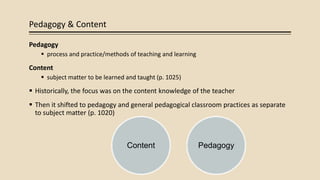
Pedagogy & Content
Pedagogy
 process and practice/methods of teaching and learning
Content
 subject matter to be learned and taught (p. 1025)
 Historically, the focus was on the content knowledge of the teacher
 Then it shifted to pedagogy and general pedagogical classroom practices as separate
to subject matter (p. 1020)
Content Pedagogy
Pedagogical Content Knowledge
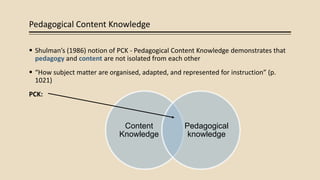
 Shulman’s (1986) notion of PCK - Pedagogical Content Knowledge demonstrates that
pedagogy and content are not isolated from each other
 “How subject matter are organised, adapted, and represented for instruction” (p.
1021)
PCK:
Content
Knowledge
Pedagogical
knowledge
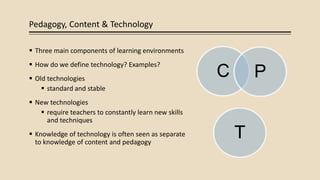
Pedagogy, Content & Technology
 Three main components of learning environments
 How do we define technology? Examples?
 Old technologies
 standard and stable
 New technologies
 require teachers to constantly learn new skills
and techniques
 Knowledge of technology is often seen as separate
to knowledge of content and pedagogy
C
T
P
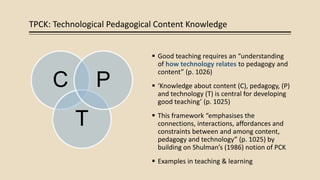
TPCK: Technological Pedagogical Content Knowledge
 Good teaching requires an “understanding
of how technology relates to pedagogy and
content” (p. 1026)
 ‘Knowledge about content (C), pedagogy, (P)
and technology (T) is central for developing
good teaching’ (p. 1025)
 This framework “emphasises the
connections, interactions, affordances and
constraints between and among content,
pedagogy and technology” (p. 1025) by
building on Shulman’s (1986) notion of PCK
 Examples in teaching & learning
C
T
P
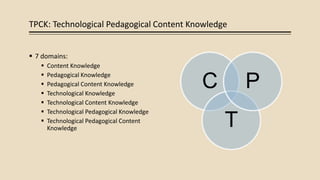
TPCK: Technological Pedagogical Content Knowledge
 7 domains:
 Content Knowledge
 Pedagogical Knowledge
 Pedagogical Content Knowledge
 Technological Knowledge
 Technological Content Knowledge
 Technological Pedagogical Knowledge
 Technological Pedagogical Content
Knowledge
C
T
P
Discussion Group Questions
 Complete the blank TPCK diagram by identifying and labelling the 7 parts
 Each participant choose one of the parts and give an example of how it looks in your
teaching/training context (see p. 1026)
 How would knowledge of the TPCK Framework benefit you/other teachers in your
context?
In summary
 TPCK is a conceptual framework for educational technology, building on PCK by teachers
integrating technology into their pedagogy.
 Supports & links to:
 constructivist teaching & inquiry based learning
 Teachers’ Professional Development
 Learning technology by design
 Cultural Historical Activity Theory (CHAT)
 Based on the understanding that teaching is ‘a highly complex activity…occurring in an ill-
structured, dynamic environment’ (p.1020).

Technological pedagogical content knowledge

  • 1.
    Technological Pedagogical Content Knowledge:A Framework for Teacher Knowledge Presented by Rianna Lopez
  • 2.
    Reading for Week4 This presentation is based on the following reading, as part of the Master of Education topic EDUC 9701 Effective Use of ICT for Learning & Teaching: Mishra, P & Koehler, MJ. (2006). Technological Pedagogical Content Knowledge: A Framework for Teacher Knowledge. Teachers College Record, 108(6), 1017-1054.
  • 3.
    Pedagogy & Content Pedagogy process and practice/methods of teaching and learning Content  subject matter to be learned and taught (p. 1025)  Historically, the focus was on the content knowledge of the teacher  Then it shifted to pedagogy and general pedagogical classroom practices as separate to subject matter (p. 1020) Content Pedagogy
  • 4.
    Pedagogical Content Knowledge Shulman’s (1986) notion of PCK - Pedagogical Content Knowledge demonstrates that pedagogy and content are not isolated from each other  “How subject matter are organised, adapted, and represented for instruction” (p. 1021) PCK: Content Knowledge Pedagogical knowledge
  • 5.
    Pedagogy, Content &Technology  Three main components of learning environments  How do we define technology? Examples?  Old technologies  standard and stable  New technologies  require teachers to constantly learn new skills and techniques  Knowledge of technology is often seen as separate to knowledge of content and pedagogy C T P
  • 6.
    TPCK: Technological PedagogicalContent Knowledge  Good teaching requires an “understanding of how technology relates to pedagogy and content” (p. 1026)  ‘Knowledge about content (C), pedagogy, (P) and technology (T) is central for developing good teaching’ (p. 1025)  This framework “emphasises the connections, interactions, affordances and constraints between and among content, pedagogy and technology” (p. 1025) by building on Shulman’s (1986) notion of PCK  Examples in teaching & learning C T P
  • 7.
    TPCK: Technological PedagogicalContent Knowledge  7 domains:  Content Knowledge  Pedagogical Knowledge  Pedagogical Content Knowledge  Technological Knowledge  Technological Content Knowledge  Technological Pedagogical Knowledge  Technological Pedagogical Content Knowledge C T P
  • 8.
    Discussion Group Questions Complete the blank TPCK diagram by identifying and labelling the 7 parts  Each participant choose one of the parts and give an example of how it looks in your teaching/training context (see p. 1026)  How would knowledge of the TPCK Framework benefit you/other teachers in your context?
  • 9.
    In summary  TPCKis a conceptual framework for educational technology, building on PCK by teachers integrating technology into their pedagogy.  Supports & links to:  constructivist teaching & inquiry based learning  Teachers’ Professional Development  Learning technology by design  Cultural Historical Activity Theory (CHAT)  Based on the understanding that teaching is ‘a highly complex activity…occurring in an ill- structured, dynamic environment’ (p.1020).