FLOWER
Modified shoot
Develops from floral primordia
Primordia develop first into floral bud and then
into a flower.
Reproductive part of plant
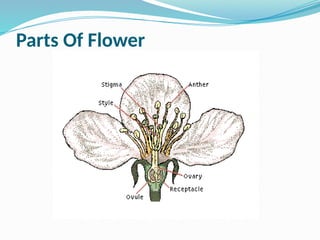
Androecium is male reproductive whorl, consists
of stamens.
Gynoecium is female reproductive part of flower,
consists of carpel(S).
4.
Stamen
Male reproductiveunit.
Consists of two parts- fillament and anther
Fillament is attached to thalamus or petal.
Structure Of Anther(Microsporangium)
Bilobed and dithecus.
A longitudinal groove separate the theca.
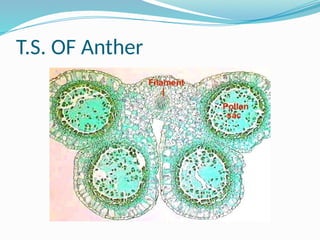
In a cross- section anther is a tetragonal
structure, consisting of 4 microsporangia, two in
each lobes.
Later two microsporangia of each lobe fuse as a
pollen sac.
7.
Structure Of Anther
A microsporangium is circular and surrounded
by 4 layers.
These are epidermis, endothecium, middle layers
tapetum.
Outermost layers protect the pollen and help in
dehiscence of anther to release pollen.
8.
Structure Of Anther
Tapetum nourishes he developing pollen grains.
When the anther is young a group of compactly
arranged homogenous cells called sporogenous
tissue occupies the centre of each
microsporangium.
10.
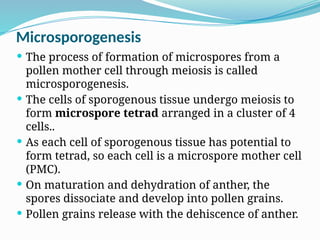
Microsporogenesis
The processof formation of microspores from a
pollen mother cell through meiosis is called
microsporogenesis.
The cells of sporogenous tissue undergo meiosis to
form microspore tetrad arranged in a cluster of 4
cells..
As each cell of sporogenous tissue has potential to
form tetrad, so each cell is a microspore mother cell
(PMC).
On maturation and dehydration of anther, the
spores dissociate and develop into pollen grains.
Pollen grains release with the dehiscence of anther.
11.
Pollen Grain (MaleGametophyte)
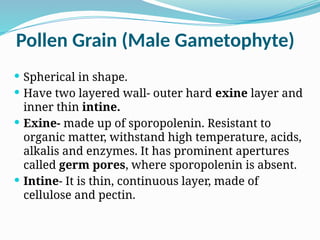
Spherical in shape.
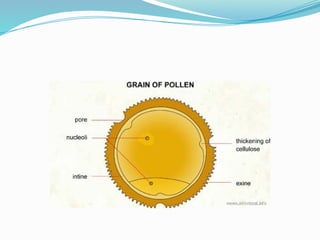
Have two layered wall- outer hard exine layer and
inner thin intine.
Exine- made up of sporopolenin. Resistant to
organic matter, withstand high temperature, acids,
alkalis and enzymes. It has prominent apertures
called germ pores, where sporopolenin is absent.
Intine- It is thin, continuous layer, made of
cellulose and pectin.
12.
Pollen Grain (MaleGametophyte)
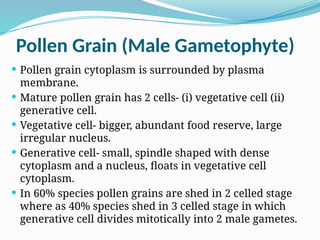
Pollen grain cytoplasm is surrounded by plasma
membrane.
Mature pollen grain has 2 cells- (i) vegetative cell (ii)
generative cell.
Vegetative cell- bigger, abundant food reserve, large
irregular nucleus.
Generative cell- small, spindle shaped with dense
cytoplasm and a nucleus, floats in vegetative cell
cytoplasm.
In 60% species pollen grains are shed in 2 celled stage
where as 40% species shed in 3 celled stage in which
generative cell divides mitotically into 2 male gametes.
14.
Female Reproductive Unit-Pistil
Pistil- female reproductive part of flower.
It may be mono or bi or tri or polycarpellary,
syncarpous or apocarpous.
Each pistil consists of ovary, style and stigma.
The ovary has one or more cavities called locules.
Placenta in locules bears ovules.
Number of ovules may be one or more.
15.
Ovule
Arises asprimordium on placenta.
The short stalk which attach ovule with placenta
is funicle.
The primordium grows into a mass of cells
forming nucellus, the body of ovule.
The two protective covering of nucellus is
integuments, except at the tip leaving a small
opening called Micropyle.
16.
Ovule
Basal partof ovule is called chalaza that lie
opposite to micropyle.
Cells of nucellus are rich in reserve food.
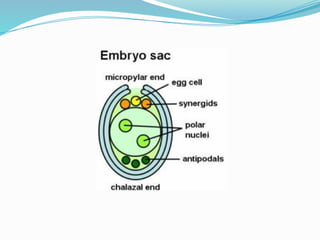
A single embryo sac or female gametophyte
located in the nucellus, which is developed from
megaspore.
18.
Megasporogenesis And Development
OfFemale Gametophyte
One of the nucellar cell in the micropylar region
is differentiated into megaspore mother cell.
The cell is larger, contains dense cytoplasm and a
prominent nucleus.
It undergoes meiosis forming 4 haploid cells
called megaspore tetrad.
3 megaspores degenerate and only one
megaspore become functional.
20.
Megasporogenesis And Development
OfFemale Gametophyte
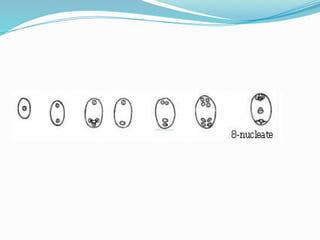
Functional megaspore is the first cell of female
gametophyte.
Its nucleus undergoes mitosis and the two nuclei
move to opposite poles and form 2 nucleate
embryo sac.
Two successive mitotic division in each of these 2
nuclei form an 8 nucleate embryo sac.
21.
Devices For Autogamy
Simultaneous maturation of anther and pistil.
Anther and stigma lie close to each other.
Cleistogamous flower (oxalis, commelina,viola)
22.
Devices For Xenogamy
Unisexual flower and diocious plants.
Pollen release and stigma receptivity are not
synchronised.
Different orientation of anther and stigma of
flower.
Self incompability.
23.
Adaptation Of WindPollinated
Flowers
Pollen grains are light, nonsticky/ dry, sometimes
winged.
Well exposed anther.
Large feathery stigma.
Flowers arranged as inflorescence.
Single ovules.
24.
Adaptation Of WaterPollinated Flowers
Seen in submerged flowers like Vallisneria and
Hydrilla and Zostera.
In Vallisneria male flowers released on water
surface and female flowers reaches the surface for
pollination.
In sea grasses, pollen grains are long ribbon like and
carried passively to submerged female flowers.
Mucilage coated pollen grains.
25.
Adaptation In InsectPollinated
Flowers
Large
Brightly coloured and showy.
If flowers are small, grouped into inflorescence.
Highly fragrant
Produce nectar
Sticky pollen and stigmatic surface
Provide rewards to animal pollinator such as
nectar, food (pollen) or provide safe place for
laying eggs.
26.
Pollen-pistil Interaction
Recognitionof compatible pollen-It is the
interaction between chemical components of
pollen and those of stigma.
Germination of pollen and development of
male gametophyte-
(a) compatible pollen starts its germination,
stimulated by certain secretion of stigma.
(b) intine grows out through one of germ pore.
(c) content of pollen moves into the tube i.e.
vegetative and generative / 2 male gametes.
27.
Pollen-pistil Interaction
(d)pollen tube grows through the tissues of stigma
and style by secreting enzymes to digest them and
enters ovule through micropyle.
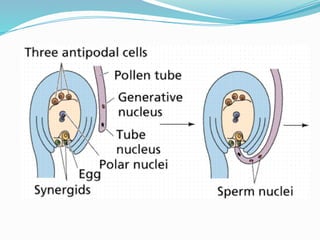
(e)It enters the embryo sac through filliform
apparatus of one synergids to liberate male
gametes.
(f) germinated pollen grain with pollen tube
carrying vegetative nucleus and 2 male gametes is
the fully developed female gametophyte.
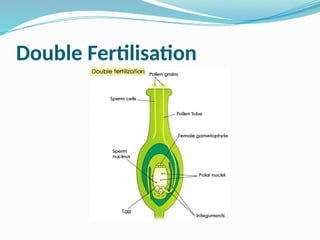
Double Fertilisation
Releaseof 2 male gametes from pollen tube into
cytoplasm of synergids.
Fusion of one male gamete with egg cell called
Syngamy and form zygote(2n) which develops into
embryo.
Fusion of 2nd male gamete with polar nuclei of central
cell to form PEN(3n).
As syngamy and triple fusion occur in an embryo sac,
the phenomenon is known as double fertilisation.
Central cell with PEN is called PEC which develops into
endosperm.
30.
Post Fertilisation Events
Development of endosperm
Development of embryo
Maturation of ovule into seed
Maturation of ovary into fruit.
31.
Endosperm
Its developmentprecedes embryo development.
There are 3 methods of embryo development :
nuclear, cellular, helobial.
In nuclear type PEN divides mitotically without
cytokinesis and endosperm is free nuclear, then cell
wall formation starts from periphery and
endosperm become nuclear.
It provides food to developing embryo.
If endosperm is completely utilised by embryo, seed
is non-albuminous, if present ,seed is albuminous.
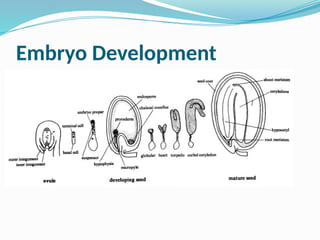
Embryo
It startsafter certain embryo formation.
Zygote divides mitotically and form proembryo.
Then it develops into globular and heart shaped
embryo and then horse shoe shaped mature
embryo with one or two cotyledon.
34.
Special Reproduction
(Apomixis /Agamospory)
Seeds are formed without fertilisation.
It may develop if a diploid egg cell develops into
embryo without fertilisation.
If cells of nucellus may develop into embryo and
pushed into the embryo.
35.
Special Reproduction
(Polyembryony)
Ifmore than one egg may form in embryo sac.
If more than one embryo sac formed in an ovule.
Other cells like synergids or nucellus develop
into embryo.
E.g. orange, lemon, mango, onion, groundnut etc.