WELCOME TO
AGRICULTURAL CROP
PRODUCTION (NCII)
640 hours (42 days)
COC1: PERFORM NURSERY
OPERATIONS
Prepare nursery tools, farm implements and simple
equipment
Maintain nursery facilities
Handle seeds/planting material
Prepare growing media
LEARNING OBJECTIVE
PRAYER
ATTENDANCE
AIM FOR EXCELLENCE
CLASSROOM RULES
Invest in Learning
Grant Respect
Remain Responsible
A
G
R
I
RECAP
ENERGIZER
ACTIVITY NO. 1
Direction:
Provide the correct answer below
each set of jumbled letters.
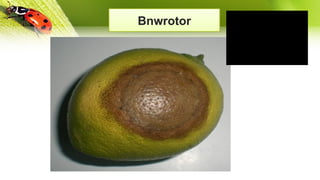
Bnwrotor
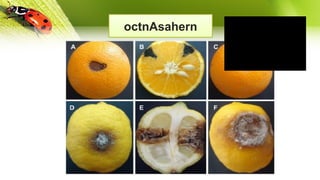
octnAsahern
Bctaeiralfostrto
Rewceiisvel
Rdeorulfbeelte
Maintain nursery
facilities
LEARNING OUTCOME
OBJECTIVES
1) To maintain nursery sanitation according to GAP
standard.
2) To repair and maintenance of nursery facilities.
3) To practice safety measure according to
OSHS( Occupation safety and health standard)
NURSERY SANITATION
• Nursery sanitation is very important part in performing nursery
operation in order to ensure the production of vigorous and healthy
seedlings/ stocks of different kinds of species.
• Good agricultural practices(GAP) are ways to produce growers can
prevent nursery contamination of fruits and vegetables seedlings.
• Sanitation is important year around, avoid accumulation of any
plant debris or weeds inside and outside of the greehouse.
• Implement 5’s
NURSERY SANITATION
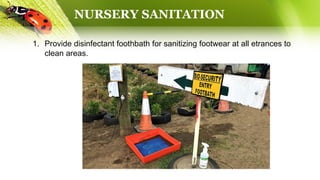
1. Provide disinfectant foothbath for sanitizing footwear at all etrances to
clean areas.
NURSERY SANITATION
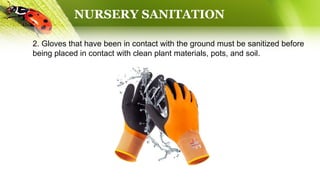
2. Gloves that have been in contact with the ground must be sanitized before
being placed in contact with clean plant materials, pots, and soil.
NURSERY SANITATION
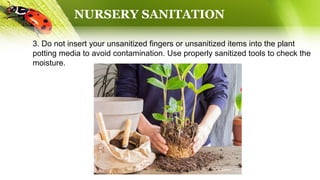
3. Do not insert your unsanitized fingers or unsanitized items into the plant
potting media to avoid contamination. Use properly sanitized tools to check the
moisture.
NURSERY SANITATION
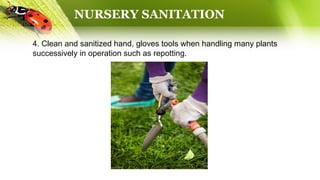
4. Clean and sanitized hand, gloves tools when handling many plants
successively in operation such as repotting.
NURSERY SANITATION
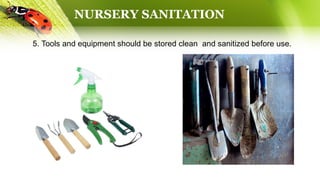
5. Tools and equipment should be stored clean and sanitized before use.
NURSERY SANITATION
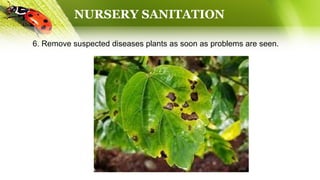
6. Remove suspected diseases plants as soon as problems are seen.
NURSERY SANITATION
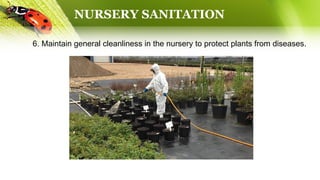
6. Maintain general cleanliness in the nursery to protect plants from diseases.
Identifying Nursery Tasks
• Only a few required tasks must happen each day; these tasks are
the essential activities that keep the crops alive and healthy and
the nursery functioning on a daily basis.
• These tasks include:
• watering
• keeping daily records
• monitoring crops as they go through the establishment
• rapid growth
• hardening phases
Identifying Nursery Tasks
1. Planning and Scheduling
2. Nursey Management Checklist
3. Routine Tasks (daily)
4. Record keeping
Planning and Scheduling
1) Immediate Needs:
• Check for any plants that need immediate watering or pest control.
2) Periodic Tasks:
• Schedule regular watering schedules for different plant varieties.
• Plan for weekly fertilization or pruning tasks.
3) Long-Term Goals:
• Plan for seasonal planting or harvesting schedules.
• Develop a nursery expansion plan to accommodate growing demand.
• Implement sustainable practices like composting or water conservation
techniques.
4) Prioritize Tasks:
• Identify which plants need repotting or transplanting soon.
5) Plan Ahead:
• Create a weekly task list or calendar for nursery activities.
• Allocate time for inventory management and stock replenishment.
• Review and adjust your plan based on weather forecasts or market
demand.
Planning and Scheduling
Nursey Management Checklist
1) Make a list of what needs to be done based on daily observations, l
ogs, and crop development records.
Daily Observations and Records:
• Check plants daily for pests and diseases.
• Log growth and health details.
• Monitor soil moisture and temperature.
Nursey Management Checklist
2) Establish propagation protocols.
Propagation Protocols:
• Set standard methods for planting seeds and grafting.
• Record success rates and adjust techniques.
• Train staff on these procedures.
Nursey Management Checklist
3) Create and update crop-growing schedules and facilities schedules.
Crop and Facilities Schedules:
• Plan when to plant, water, fertilize, and treat pests.
• Update schedules based on seasons and crop needs.
• Schedule maintenance for equipment and facilities.
Nursey Management Checklist
4) Prioritize and delegate tasks.
Task Prioritization and Delegation:
• Decide what tasks are most urgent.
• Assign jobs based on staff skills.
• Monitor progress and give feedback.
Nursey Management Checklist
5) Follow up to ensure tasks were done.
Follow-Up on Task Completion:
• Inspect to ensure tasks are done correctly.
• Use checklists to track tasks.
• Address any issues promptly.
Nursey Management Checklist
6) Refine nursery vision and objectives annually; anticipate new crops
to grow, changes in production, infrastructure improvements
or expansion, and other planning for the future.
Annual Planning and Vision Refinement:
• Review goals and market trends.
• Plan for new crops or facility improvements.
• Update strategies for sustainability and technology.
Routine Tasks (daily)
1) Irrigate
2) Crop culturing (for example, weed or pest control, fertilizing).
3) Monitor and observe the crops.
Record keeping
1) Record observations and actions in a daily journal or log (daily).
2) Make notes in the plant development records for each crop (daily or
weekly).
3) Update and revise plant protocols (at the end of each crop).
4) Conduct crop inventory assessment (ongoing).
Crop-Phase Production Tasks
1. Watering
2. Manuring
3. Fertilizer application
4. Pests and Disease Control
5. work place hazards-Workplace health and safety affects every farm
worker and agriculte business.
The chance that these hazards will result in an injury for young
workers is higher when combined with risk factors such as:
1. Lack of supervision
2. Lack of training
3. Working alone
4. Working long days
5. Temporary employment
6. Trying to impress the boss, supervisor or co-workers.
SAFETY WORK PLACE
1. Keep work areas clean
2. Use proper tool for the job
3. Always wear the proper PPE for the work task
4. Never workvon live equipment
5. Make sure chemicals are properly labeled and stored
6. Communicate hazards to other personnel
7. Stop work when needed to address hazards
EASY WORKPLACE SAFETY TIPS
1. Train employees well.
2. Reward employees for safe behavior.
3. Partner with occupational clinicians.
4. Use labels and signs.
5. Keep things clean.
6. Make sure employees have right tools and have regular
equipment inspections
7. Encourage stretch breaks.
8. Implements safety protocols from the start.
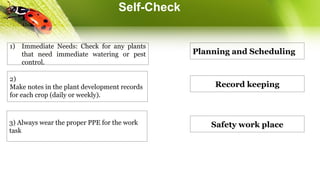
Self-Check
Planning and Scheduling
2)
Make notes in the plant development records
for each crop (daily or weekly).
1) Immediate Needs: Check for any plants
that need immediate watering or pest
control.
Record keeping
Safety work place
3) Always wear the proper PPE for the work
task
ACTIVITIES
INSTRUCTION:
1) Proceed to the tool room.
2) Prepare the needed materials and tools for the activity.
3) Conduct an ocular inspection of the unit.
4) Perform the activity according to standards.
5) Submit your records to the instructor.
6) Implement 5’s on the different materials, tools and equipment.
THANK YOU

LO2 MAINTAIN NURSERY FACILITIES.ppt. power pointx

  • 1.
    WELCOME TO AGRICULTURAL CROP PRODUCTION(NCII) 640 hours (42 days)
  • 2.
  • 3.
    Prepare nursery tools,farm implements and simple equipment Maintain nursery facilities Handle seeds/planting material Prepare growing media LEARNING OBJECTIVE
  • 4.
  • 5.
    AIM FOR EXCELLENCE CLASSROOMRULES Invest in Learning Grant Respect Remain Responsible A G R I
  • 6.
  • 7.
    ACTIVITY NO. 1 Direction: Providethe correct answer below each set of jumbled letters.
  • 8.
  • 9.
  • 10.
  • 11.
  • 12.
  • 13.
  • 14.
    OBJECTIVES 1) To maintainnursery sanitation according to GAP standard. 2) To repair and maintenance of nursery facilities. 3) To practice safety measure according to OSHS( Occupation safety and health standard)
  • 15.
    NURSERY SANITATION • Nurserysanitation is very important part in performing nursery operation in order to ensure the production of vigorous and healthy seedlings/ stocks of different kinds of species. • Good agricultural practices(GAP) are ways to produce growers can prevent nursery contamination of fruits and vegetables seedlings. • Sanitation is important year around, avoid accumulation of any plant debris or weeds inside and outside of the greehouse. • Implement 5’s
  • 16.
    NURSERY SANITATION 1. Providedisinfectant foothbath for sanitizing footwear at all etrances to clean areas.
  • 17.
    NURSERY SANITATION 2. Glovesthat have been in contact with the ground must be sanitized before being placed in contact with clean plant materials, pots, and soil.
  • 18.
    NURSERY SANITATION 3. Donot insert your unsanitized fingers or unsanitized items into the plant potting media to avoid contamination. Use properly sanitized tools to check the moisture.
  • 19.
    NURSERY SANITATION 4. Cleanand sanitized hand, gloves tools when handling many plants successively in operation such as repotting.
  • 20.
    NURSERY SANITATION 5. Toolsand equipment should be stored clean and sanitized before use.
  • 21.
    NURSERY SANITATION 6. Removesuspected diseases plants as soon as problems are seen.
  • 22.
    NURSERY SANITATION 6. Maintaingeneral cleanliness in the nursery to protect plants from diseases.
  • 23.
    Identifying Nursery Tasks •Only a few required tasks must happen each day; these tasks are the essential activities that keep the crops alive and healthy and the nursery functioning on a daily basis. • These tasks include: • watering • keeping daily records • monitoring crops as they go through the establishment • rapid growth • hardening phases
  • 24.
    Identifying Nursery Tasks 1.Planning and Scheduling 2. Nursey Management Checklist 3. Routine Tasks (daily) 4. Record keeping
  • 25.
    Planning and Scheduling 1)Immediate Needs: • Check for any plants that need immediate watering or pest control. 2) Periodic Tasks: • Schedule regular watering schedules for different plant varieties. • Plan for weekly fertilization or pruning tasks. 3) Long-Term Goals: • Plan for seasonal planting or harvesting schedules. • Develop a nursery expansion plan to accommodate growing demand. • Implement sustainable practices like composting or water conservation techniques.
  • 26.
    4) Prioritize Tasks: •Identify which plants need repotting or transplanting soon. 5) Plan Ahead: • Create a weekly task list or calendar for nursery activities. • Allocate time for inventory management and stock replenishment. • Review and adjust your plan based on weather forecasts or market demand. Planning and Scheduling
  • 27.
    Nursey Management Checklist 1)Make a list of what needs to be done based on daily observations, l ogs, and crop development records. Daily Observations and Records: • Check plants daily for pests and diseases. • Log growth and health details. • Monitor soil moisture and temperature.
  • 28.
    Nursey Management Checklist 2)Establish propagation protocols. Propagation Protocols: • Set standard methods for planting seeds and grafting. • Record success rates and adjust techniques. • Train staff on these procedures.
  • 29.
    Nursey Management Checklist 3)Create and update crop-growing schedules and facilities schedules. Crop and Facilities Schedules: • Plan when to plant, water, fertilize, and treat pests. • Update schedules based on seasons and crop needs. • Schedule maintenance for equipment and facilities.
  • 30.
    Nursey Management Checklist 4)Prioritize and delegate tasks. Task Prioritization and Delegation: • Decide what tasks are most urgent. • Assign jobs based on staff skills. • Monitor progress and give feedback.
  • 31.
    Nursey Management Checklist 5)Follow up to ensure tasks were done. Follow-Up on Task Completion: • Inspect to ensure tasks are done correctly. • Use checklists to track tasks. • Address any issues promptly.
  • 32.
    Nursey Management Checklist 6)Refine nursery vision and objectives annually; anticipate new crops to grow, changes in production, infrastructure improvements or expansion, and other planning for the future. Annual Planning and Vision Refinement: • Review goals and market trends. • Plan for new crops or facility improvements. • Update strategies for sustainability and technology.
  • 33.
    Routine Tasks (daily) 1)Irrigate 2) Crop culturing (for example, weed or pest control, fertilizing). 3) Monitor and observe the crops.
  • 34.
    Record keeping 1) Recordobservations and actions in a daily journal or log (daily). 2) Make notes in the plant development records for each crop (daily or weekly). 3) Update and revise plant protocols (at the end of each crop). 4) Conduct crop inventory assessment (ongoing).
  • 35.
    Crop-Phase Production Tasks 1.Watering 2. Manuring 3. Fertilizer application 4. Pests and Disease Control 5. work place hazards-Workplace health and safety affects every farm worker and agriculte business.
  • 36.
    The chance thatthese hazards will result in an injury for young workers is higher when combined with risk factors such as: 1. Lack of supervision 2. Lack of training 3. Working alone 4. Working long days 5. Temporary employment 6. Trying to impress the boss, supervisor or co-workers.
  • 37.
    SAFETY WORK PLACE 1.Keep work areas clean 2. Use proper tool for the job 3. Always wear the proper PPE for the work task 4. Never workvon live equipment 5. Make sure chemicals are properly labeled and stored 6. Communicate hazards to other personnel 7. Stop work when needed to address hazards
  • 38.
    EASY WORKPLACE SAFETYTIPS 1. Train employees well. 2. Reward employees for safe behavior. 3. Partner with occupational clinicians. 4. Use labels and signs. 5. Keep things clean. 6. Make sure employees have right tools and have regular equipment inspections 7. Encourage stretch breaks. 8. Implements safety protocols from the start.
  • 39.
    Self-Check Planning and Scheduling 2) Makenotes in the plant development records for each crop (daily or weekly). 1) Immediate Needs: Check for any plants that need immediate watering or pest control. Record keeping Safety work place 3) Always wear the proper PPE for the work task
  • 40.
    ACTIVITIES INSTRUCTION: 1) Proceed tothe tool room. 2) Prepare the needed materials and tools for the activity. 3) Conduct an ocular inspection of the unit. 4) Perform the activity according to standards. 5) Submit your records to the instructor. 6) Implement 5’s on the different materials, tools and equipment.
  • 41.