Information, education and
communication materials series no. 9-4
Writer
MA. NORMA G. MADDALORA
Information Officer II, ATI-RTC 02
Technical Editor/Subject Matter Specialist
ENGR. WILLIAM V. CONTILLO
HVCC Coordinator
DA-CVIARC, Ilagan, Isabela
Graphic Artist
DANICA E. MELEGRITO
Editor
ANTONIETA J. ARCEO
Head, ISD, ATI
Advisers
RENATO MAGUIGAD
Center Director, ATI-RTC 02
ASTERIO P. SALIOT, PhD, MNSA, CESO III
Director, ATI
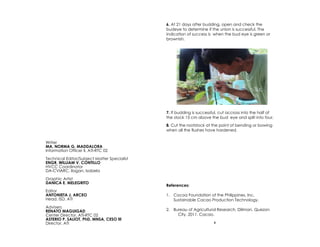
6. At 21 days after budding, open and check the
budeye to determine if the union is successful. The
indication of success is when the bud eye is green or
brownish.
7. If budding is successful, cut accross into the half of
the stock 15 cm above the bud eye and split into four.
8. Cut the rootstock at the point of bending or bowing
when all the flushes have hardened.
References:
1.	 Cocoa Foundation of the Philippines, Inc.
Sustainable Cacao Production Technology.
2.	 Bureau of Agricultural Research, Diliman, Quezon 	
City. 2011. Cacao.
5
General Considerations
1The budwoods to be used should be collected
from trees with the best yield capacities and
resistant to pests and diseases.Preferably those
varieties approved by the National Seed Industry
Council (NSIC).
2Germinated seedling top is used, as the rootstock
should have at least two pairs of mature leaves
before grafting operation.
3Budsticks (fan branch) selected from
recommended clones with matured leaves and
whose terminals are about to flush or emerge should
be gathered in the morning before 8:00am and
grafted immediately.
4Do not collect bud wood from trees that are
recovering from heavy cropping.
5Clean knives and other tools with alcohol before
and after grafting and budding to minimize
disease infection.
6Avoid grafting in very hot and very dry periods
and wet periods.
A
sexual propagation gives more advantage
in terms of reproduction of true-to-type trees,
more uniform growth, early to bear flowers,
and the clone perpetuates most if not all important
characters of the original seedling mother tree like
pod value, bean size, fruit wall thickness and others.
Major considerations in asexual propagation is
the use of the selected varieties that manifest the
characters mentioned above.
General ConsiderationsProcedures in Patch Budding
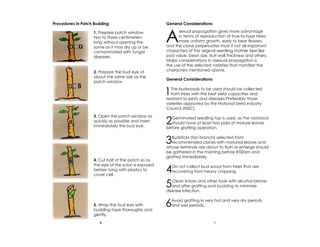
1. Prepare patch window
two to three centimeters
long without opening the
same as it may dry up or be
contaminated with fungal
diseases.
2. Prepare the bud eye of
about the same size as the
patch window.
3. Open the patch window as
quickly as possible and insert
immediately the bud eye.
4. Cut half of the patch so as
the eye of the scion is exposed
before tying with plastics to
cover cell.
5. Wrap the bud eye with
budding tape thoroughly and
gently.
14
Types of Asexual Propagation
Patch Budding - This is propagation of true-to-type
trees using buds from any of the NSIC approved
clones.
Conventional cleft grafting - This propagation
technique is similar to the procedure in grafting
mangoes. Scion of selected variety is attached to
rootstock with an inverted V shape cut and fastened
to each other using thin palstic strips.
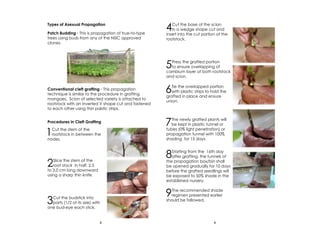
Procedures in Cleft Grafting
1Cut the stem of the
rootstock in between the
nodes.
2Slice the stem of the
root stock in half, 2.5
to 3.0 cm long downward
using a sharp thin knife.
3Cut the budstick into
parts (1/2 of its size) with
one bud-eye each stick.
4Cut the base of the scion
in a wedge shape cut and
insert into the cut portion of the
rootstock.
5Press the grafted portion
to ensure overlapping of
cambium layer of both rootstock
and scion.
6Tie the overlapped portion
with plastic strips to hold the
grafted in place and ensure
union.
8Starting from the 16th day
after grafting, the tunnels of
the propagation box/bin shall
be opened gradually for 10 days
before the grafted seedlings will
be exposed to 50% shade in the
established nursery.
9The recommended shade
regimen presented earlier
should be followed.
7The newly grafted plants will
be kept in plastic tunnel or
tubes (0% light penetration) or
propagation tunnel with 100%
shading for 15 days.
32

Cacao Asexual Propagation

  • 1.
  • 2.
    Writer MA. NORMA G.MADDALORA Information Officer II, ATI-RTC 02 Technical Editor/Subject Matter Specialist ENGR. WILLIAM V. CONTILLO HVCC Coordinator DA-CVIARC, Ilagan, Isabela Graphic Artist DANICA E. MELEGRITO Editor ANTONIETA J. ARCEO Head, ISD, ATI Advisers RENATO MAGUIGAD Center Director, ATI-RTC 02 ASTERIO P. SALIOT, PhD, MNSA, CESO III Director, ATI 6. At 21 days after budding, open and check the budeye to determine if the union is successful. The indication of success is when the bud eye is green or brownish. 7. If budding is successful, cut accross into the half of the stock 15 cm above the bud eye and split into four. 8. Cut the rootstock at the point of bending or bowing when all the flushes have hardened. References: 1. Cocoa Foundation of the Philippines, Inc. Sustainable Cacao Production Technology. 2. Bureau of Agricultural Research, Diliman, Quezon City. 2011. Cacao. 5
  • 3.
    General Considerations 1The budwoodsto be used should be collected from trees with the best yield capacities and resistant to pests and diseases.Preferably those varieties approved by the National Seed Industry Council (NSIC). 2Germinated seedling top is used, as the rootstock should have at least two pairs of mature leaves before grafting operation. 3Budsticks (fan branch) selected from recommended clones with matured leaves and whose terminals are about to flush or emerge should be gathered in the morning before 8:00am and grafted immediately. 4Do not collect bud wood from trees that are recovering from heavy cropping. 5Clean knives and other tools with alcohol before and after grafting and budding to minimize disease infection. 6Avoid grafting in very hot and very dry periods and wet periods. A sexual propagation gives more advantage in terms of reproduction of true-to-type trees, more uniform growth, early to bear flowers, and the clone perpetuates most if not all important characters of the original seedling mother tree like pod value, bean size, fruit wall thickness and others. Major considerations in asexual propagation is the use of the selected varieties that manifest the characters mentioned above. General ConsiderationsProcedures in Patch Budding 1. Prepare patch window two to three centimeters long without opening the same as it may dry up or be contaminated with fungal diseases. 2. Prepare the bud eye of about the same size as the patch window. 3. Open the patch window as quickly as possible and insert immediately the bud eye. 4. Cut half of the patch so as the eye of the scion is exposed before tying with plastics to cover cell. 5. Wrap the bud eye with budding tape thoroughly and gently. 14
  • 4.
    Types of AsexualPropagation Patch Budding - This is propagation of true-to-type trees using buds from any of the NSIC approved clones. Conventional cleft grafting - This propagation technique is similar to the procedure in grafting mangoes. Scion of selected variety is attached to rootstock with an inverted V shape cut and fastened to each other using thin palstic strips. Procedures in Cleft Grafting 1Cut the stem of the rootstock in between the nodes. 2Slice the stem of the root stock in half, 2.5 to 3.0 cm long downward using a sharp thin knife. 3Cut the budstick into parts (1/2 of its size) with one bud-eye each stick. 4Cut the base of the scion in a wedge shape cut and insert into the cut portion of the rootstock. 5Press the grafted portion to ensure overlapping of cambium layer of both rootstock and scion. 6Tie the overlapped portion with plastic strips to hold the grafted in place and ensure union. 8Starting from the 16th day after grafting, the tunnels of the propagation box/bin shall be opened gradually for 10 days before the grafted seedlings will be exposed to 50% shade in the established nursery. 9The recommended shade regimen presented earlier should be followed. 7The newly grafted plants will be kept in plastic tunnel or tubes (0% light penetration) or propagation tunnel with 100% shading for 15 days. 32