Learners with Difficulty in
Remembering and Concentrating
Training of Education Leaders on
Strategies and Accommodation
for Learners With Special
Educational Needs
@DepEd Ecotech Center, Lahug, Cebu City
June 25-28, 2024
After this session, participants are expected to:
1. Describe the characteristics of learners with difficulty
in remembering or concentrating based from a
screening device.
2. Explain how the proper use of instructional multi-
sensory materials support the learning of learners
with difficulty in remembering or concentrating
3. Craft a technical assistance plan for teachers to
accommodate learners with difficulty in
remembering and concentrating
4. Appreciate learners with difficulty in
remembering or concentrating through sharing of
insights.
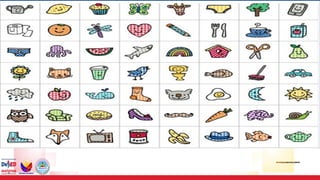
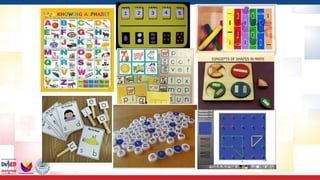
Activity #1. Remember Me
 For 10 seconds, look at the pictures on the slide
 Familiarize all that you can remember.
 No taking pictures.
 You will be called to share your list.
1. How many items do you remember?
Name them.
2. How do you find this activity?
Activity #2. Think of Me
1. Prepare the LDRC Screening Device.
2. Observe carefully the learner displaying difficulty
and using the tool, assess the learner who
manifests the following:
A)Physical and Motor Characteristics
B)Personal/Social Characteristics
C) Learning Characteristics
D)Spoken Language
Session Guide
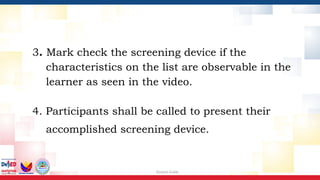
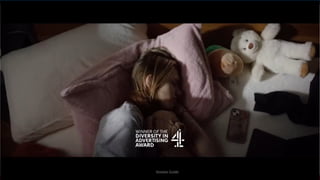
3. Mark check the screening device if the
characteristics on the list are observable in the
learner as seen in the video.
4. Participants shall be called to present their
accomplished screening device.
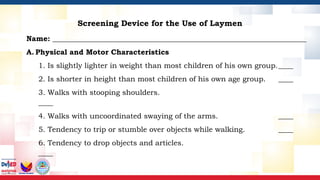
Screening Device for the Use of Laymen
Name: _____________________________________________________________________
A. Physical and Motor Characteristics
1. Is slightly lighter in weight than most children of his own group.____
2. Is shorter in height than most children of his own age group. ____
3. Walks with stooping shoulders.
____
4. Walks with uncoordinated swaying of the arms. ____
5. Tendency to trip or stumble over objects while walking. ____
6. Tendency to drop objects and articles.
____
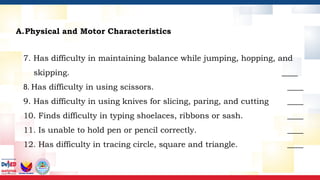
A.Physical and Motor Characteristics
7. Has difficulty in maintaining balance while jumping, hopping, and
skipping. ____
8. Has difficulty in using scissors. ____
9. Has difficulty in using knives for slicing, paring, and cutting ____
10. Finds difficulty in typing shoelaces, ribbons or sash. ____
11. Is unable to hold pen or pencil correctly. ____
12. Has difficulty in tracing circle, square and triangle. ____
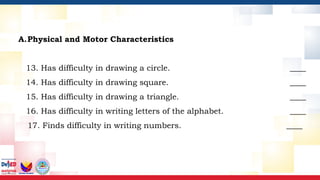
A.Physical and Motor Characteristics
13. Has difficulty in drawing a circle. ____
14. Has difficulty in drawing square. ____
15. Has difficulty in drawing a triangle. ____
16. Has difficulty in writing letters of the alphabet. ____
17. Finds difficulty in writing numbers. ____
A. Physical and Motor Characteristics
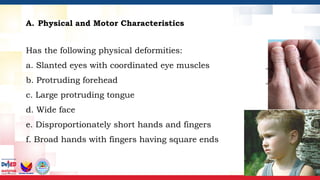
Has the following physical deformities: ____
a. Slanted eyes with coordinated eye muscles ____
b. Protruding forehead ____
c. Large protruding tongue ____
d. Wide face ____
e. Disproportionately short hands and fingers ____
f. Broad hands with fingers having square ends ____
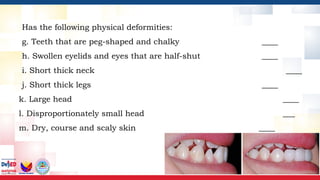
Has the following physical deformities:
g. Teeth that are peg-shaped and chalky ____
h. Swollen eyelids and eyes that are half-shut ____
i. Short thick neck ____
j. Short thick legs ____
k. Large head ____
l. Disproportionately small head ___
m. Dry, course and scaly skin ____
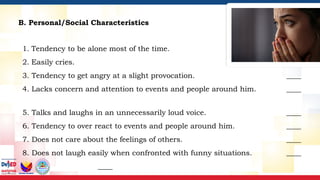
B. Personal/Social Characteristics
1. Tendency to be alone most of the time. ____
2. Easily cries. ____
3. Tendency to get angry at a slight provocation. ____
4. Lacks concern and attention to events and people around him. ____
5. Talks and laughs in an unnecessarily loud voice. ____
6. Tendency to over react to events and people around him. ____
7. Does not care about the feelings of others. ____
8. Does not laugh easily when confronted with funny situations. ____
____
C. Learning Characteristics
1. Has short attention span. ____
2. Has poor memory. ____
3. Has difficulty in comprehending situations in communication. ____
4. Is easily distracted around him. ____
5. Has difficulty in finishing work that has been started. ____
6. Perseverates or repeats unnecessary action. ____
7. Has reversals in written work. ____
8. Has difficulty in relating isolated facts into meaningful ideas. ____
Session Guide
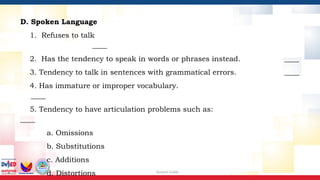
D. Spoken Language
1. Refuses to talk
____
2. Has the tendency to speak in words or phrases instead. ____
3. Tendency to talk in sentences with grammatical errors. ____
4. Has immature or improper vocabulary.
____
5. Tendency to have articulation problems such as:
____
a. Omissions
b. Substitutions
c. Additions
d. Distortions
Video
Session Guide
Session Guide
Timer 5 minutes
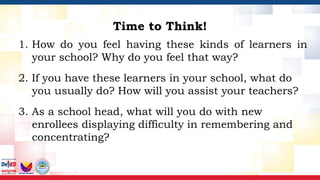
Time to Think!
1. How do you feel having these kinds of learners in
your school? Why do you feel that way?
2. If you have these learners in your school, what do
you usually do? How will you assist your teachers?
3. As a school head, what will you do with new
enrollees displaying difficulty in remembering and
concentrating?
Time to Intensify!
Difficulty in Remembering and
Concentrating
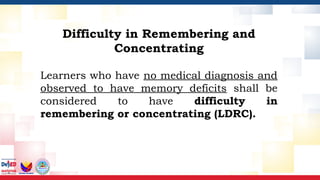
Learners who have no medical diagnosis and
observed to have memory deficits shall be
considered to have difficulty in
remembering or concentrating (LDRC).
Characteristics of Learners
with Difficulty in Remembering
or Concentrating
A. Physical and Motor Characteristics
1. Is slightly lighter in weight than most children of
his/her own group
2. Is shorter in height than most children of his/her
own age group
3. Walks with stooping shoulders
4. Walks with uncoordinated swaying of the arms
5. Tendency to trip or stumble over objects while
walking
6. Tendency to drop objects and articles
7. Has difficulty in maintaining balance while
jumping, hopping, and skipping
8. Has difficulty in using scissors
A. Physical and Motor Characteristics
9. Has difficulty in using knives for slicing, paring,
and cutting
10. Finds difficulty in tying shoelaces, ribbons or sash
11. Is unable to hold pen or pencil correctly
12. Has difficulty in tracing circle, square and triangle
A. Physical and Motor Characteristics
13. Has difficulty in drawing a circle, square and
triangle
14. Has difficulty in writing letters of the
alphabet
15. Finds difficulty in writing numbers
A. Physical and Motor Characteristics
18. Has the following physical deformities:
a. Slanted eyes with coordinated eye muscles
b. Protruding forehead
c. Large protruding tongue
d. Wide face
A. Physical and Motor Characteristics
e. Disproportionately short hands and fingers
f. Broad hands with fingers having square ends
g. Teeth that are peg shaped and chalky
h. Swollen eyelids and eyes that are half-shut
A. Physical and Motor Characteristics
i. Short thick neck
j. Short thick legs
k. Large head
l. Dry, coarse and scaly skin
A. Physical and Motor Characteristics
1. Tendency to be alone most of the time
2. Easily cries
3. Tendency to get angry at a slight provocation
4. Lacks concern and attention to events and
people around him
B. Personal and Social Characteristics
5. Talks and laughs in an unnecessarily loud
voice
6. Tendency to overreact to events and people
around him
B. Personal and Social Characteristics
7. Does not care about the feelings of others
8. Does not laugh easily when confronted
with funny situations
B. Personal and Social Characteristics
1. Has poor memory
2. Has short attention span
3. Has difficulty in comprehending situations in
communication
4. Is easily distracted around him/her
C. Learning Characteristics
5. Has difficulty in finishing work that has been
started
6. Perseverates or repeats unnecessary action
7. Has reversals in written work
8. Has difficulty in relating isolated facts into
meaningful ideas
C. Learning Characteristics
1. Refuses to talk
2. Has the tendency to speak in words or phrases
instead
3. Tendency to talk in sentences with grammatical
errors
4. Has immature or improper vocabulary
D. Spoken Language
5. Tendency to have articulation problems
such as:
a. omissions
b. substitutions
c. additions
d. distortions
6. Gropes for words to express himself
D. Spoken Language
How do you feel having these kinds of learners in
your school? Why do you feel that way?
If you have these learners in your school, what do
you usually do? How will you assist your teachers?
As a school head, what will you do with new
enrollees displaying difficulty in remembering and
concentrating?
Accommodations
to Support Learners
Instructional Accommodation
a. Give simplified instructions which are within
the level of the learner
b. Provide flexible time/schedule in doing
projects/ assignments
c. Multi-sensory activities should be provided for
the learners to remember concepts learned
d. Use visuals/pictures and mnemonics for
improving or strengthening memory
Instructional Accommodation
e. Brainstorm and offer better choices in doing
activities/tasks
f. Provide adaptive materials to cater different
learning styles
(e.g. use calculator in computing).
Instructional Accommodation
g. Use token economy system to reinforce
desirable cognitive behavior
h. Provide more assistance in doing tasks
Instructional Accommodation
i. Group them in small group discussion/
instruction.
j. Use chants or songs to recall or review
academic concepts in different core subjects.
Instructional Accommodation
k. Incorporate arts and crafts to motivate the
learners.
l. Involve them in extra- curricular activities
such as: sports, clubs, scouting, etc.
Instructional Accommodation
INSTRUCTIONAL STRATEGIES
Multi-Sensory Materials
 techniques used to help learners become
independent and strategic learners
 learners independently select the appropriate ones
and use them effectively to accomplish tasks or
meet goals
What are Instructional Strategies?
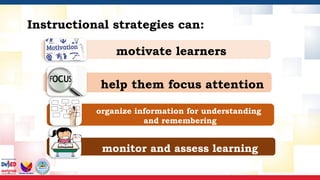
Instructional strategies can:
motivate learners
help them focus attention
organize information for understanding
and remembering
monitor and assess learning
 analyzes the thinking process involved in
performing a task
a. Instruction by another person
b. Overt self-instruction
c. Covert self-instruction
1. Cognitive Behavior Modification
 learners gain and practice appropriate
behaviors by observing and imitating
others
2. Modeling
 based on the premise that some learners learn
best when content is presented in several
modalities.
 also known as VAKT
(visual-auditory-kinesthetic-tactile)
3. Multisensory Method
a. Positive Reinforcement
 provides specific and immediate corrective
feedback by giving sensory stimulation to the
learners
example:
praise statement ; token
economy
4. Behavior Modification Technique
b. Fading
 gradually remove prompts/ reinforcers
to promote independence
4. Behavior Modification Technique
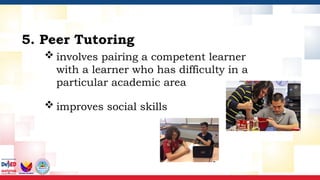
 involves pairing a competent learner
with a learner who has difficulty in a
particular academic area
5. Peer Tutoring
 improves social skills
 may be used by the teacher to encourage
students to project or express their feelings
and emotions
 Creative activities
 role playing
 puppetry
6. Projective Techniques
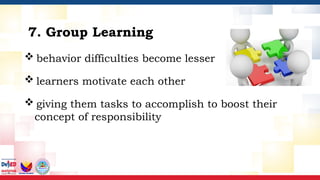
 behavior difficulties become lesser
 learners motivate each other
 giving them tasks to accomplish to boost their
concept of responsibility
7. Group Learning
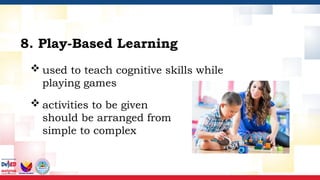
 used to teach cognitive skills while
playing games
8. Play-Based Learning
 activities to be given
should be arranged from
simple to complex
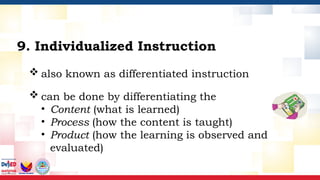
 also known as differentiated instruction
 can be done by differentiating the
• Content (what is learned)
• Process (how the content is taught)
• Product (how the learning is observed and
evaluated)
9. Individualized Instruction
 breaking down a complex task into simple
sub-tasks
 this will help frustration level down and
enable learning to take place.
10. Task Analysis
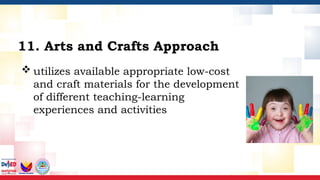
 utilizes available appropriate low-cost
and craft materials for the development
of different teaching-learning
experiences and activities
11. Arts and Crafts Approach
Are the strategies and materials that you
are using in the regular class the same
with the strategies presented?
In what way?
Multi-sensory Materials that support
the learning of LDRC
Multi-sensory Materials
that Support the
Learning of LDRC
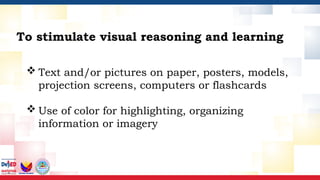
To stimulate visual reasoning and learning
 Text and/or pictures on paper, posters, models,
projection screens, computers or flashcards
 Use of color for highlighting, organizing
information or imagery
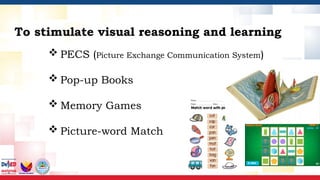
 PECS (Picture Exchange Communication System)
 Pop-up Books
 Memory Games
 Picture-word Match
To stimulate visual reasoning and learning
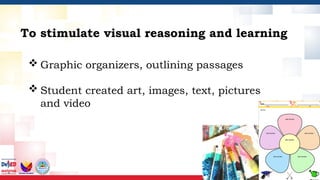
 Graphic organizers, outlining passages
 Student created art, images, text, pictures
and video
To stimulate visual reasoning and learning
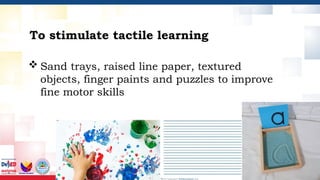
To stimulate tactile learning
 Sand trays, raised line paper, textured
objects, finger paints and puzzles to improve
fine motor skills
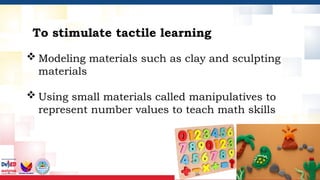
To stimulate tactile learning
 Modeling materials such as clay and sculpting
materials
 Using small materials called manipulatives to
represent number values to teach math skills
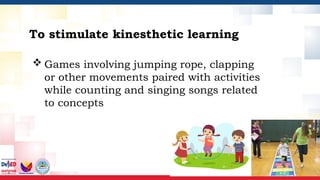
To stimulate kinesthetic learning
 Games involving jumping rope, clapping
or other movements paired with activities
while counting and singing songs related
to concepts
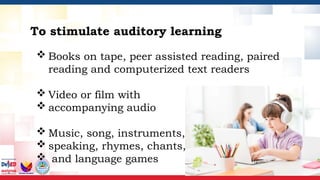
To stimulate auditory learning
 Books on tape, peer assisted reading, paired
reading and computerized text readers
 Video or film with
 accompanying audio
 Music, song, instruments,
 speaking, rhymes, chants,
 and language games
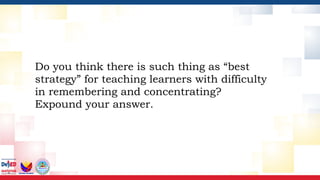
Do you think there is such thing as “best
strategy” for teaching learners with difficulty
in remembering and concentrating?
Expound your answer.
Session Guide
TIME TO PLAN!
Session Guide
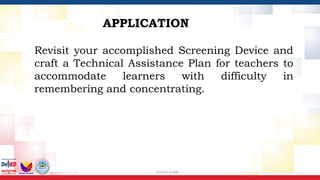
Revisit your accomplished Screening Device and
craft a Technical Assistance Plan for teachers to
accommodate learners with difficulty in
remembering and concentrating.
APPLICATION
Session Guide
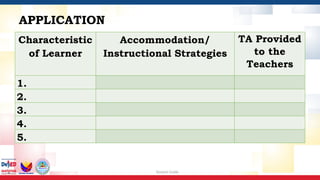
Characteristic
of Learner
Accommodation/
Instructional Strategies
TA Provided
to the
Teachers
1.
2.
3.
4.
5.
APPLICATION
Session Guide
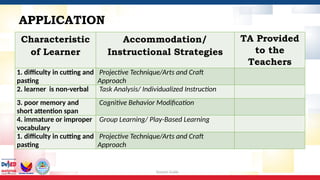
Characteristic
of Learner
Accommodation/
Instructional Strategies
TA Provided
to the
Teachers
1. difficulty in cutting and
pasting
Projective Technique/Arts and Craft
Approach
2. learner is non-verbal Task Analysis/ Individualized Instruction
3. poor memory and
short attention span
Cognitive Behavior Modification
4. immature or improper
vocabulary
Group Learning/ Play-Based Learning
1. difficulty in cutting and
pasting
Projective Technique/Arts and Craft
Approach
APPLICATION
Session Guide
APPLICATION
5 minute timer
Five participants shall be called to share
their accomplished Technical Assistance
Plan. Each presenter shall be given 2
minutes to discuss their plan.
“The Creed of Babies with Down Syndrome”
Image source: https://www.google.com.ph/search?q=down+syndrome&source=lnms&tbm=isch&sa=X&ved=0ahUKEwi0-
aHtq-XXAhVGgrwKHXSuAO8Q_AUICigB&biw=1366&bih=613#imgrc=nOmSGOI_afGEPM:
“The Creed of Babies with Down Syndrome”
Time to Ponder!
Share your insights based from our
session today
References
 Training Module on Inclusive Education Teaching Learners with
Difficulty in Remembering or Concentrating/Intellectual
Disability
 Handbook for Learners with Exceptionalities Difficulty in
Remembering/Concentrating
 https://www.youtube.com/watch?v=lTMLzXzgB_s
References:
https://www.disabled-world.com/disability/education/special/pecs.php
https://www.eduplace.com/ss/act/rules.html
https://education.alberta.ca/media/482311/is.pdf
Team up for Down Syndrome 2011 (www.teamupfordownsyndrome.org)
https://i.pinimg.com/236x/2b/60/7b/2b607b236b8af1b9df25f20a7f8d34cf.jpg
Images:

INSET presentation_Learners with special.pptx

  • 2.
    Learners with Difficultyin Remembering and Concentrating
  • 3.
    Training of EducationLeaders on Strategies and Accommodation for Learners With Special Educational Needs @DepEd Ecotech Center, Lahug, Cebu City June 25-28, 2024
  • 4.
    After this session,participants are expected to: 1. Describe the characteristics of learners with difficulty in remembering or concentrating based from a screening device. 2. Explain how the proper use of instructional multi- sensory materials support the learning of learners with difficulty in remembering or concentrating
  • 5.
    3. Craft atechnical assistance plan for teachers to accommodate learners with difficulty in remembering and concentrating 4. Appreciate learners with difficulty in remembering or concentrating through sharing of insights.
  • 6.
    Activity #1. RememberMe  For 10 seconds, look at the pictures on the slide  Familiarize all that you can remember.  No taking pictures.  You will be called to share your list.
  • 8.
    1. How manyitems do you remember? Name them. 2. How do you find this activity?
  • 9.
    Activity #2. Thinkof Me 1. Prepare the LDRC Screening Device. 2. Observe carefully the learner displaying difficulty and using the tool, assess the learner who manifests the following: A)Physical and Motor Characteristics B)Personal/Social Characteristics C) Learning Characteristics D)Spoken Language
  • 10.
    Session Guide 3. Markcheck the screening device if the characteristics on the list are observable in the learner as seen in the video. 4. Participants shall be called to present their accomplished screening device.
  • 11.
    Screening Device forthe Use of Laymen Name: _____________________________________________________________________ A. Physical and Motor Characteristics 1. Is slightly lighter in weight than most children of his own group.____ 2. Is shorter in height than most children of his own age group. ____ 3. Walks with stooping shoulders. ____ 4. Walks with uncoordinated swaying of the arms. ____ 5. Tendency to trip or stumble over objects while walking. ____ 6. Tendency to drop objects and articles. ____
  • 12.
    A.Physical and MotorCharacteristics 7. Has difficulty in maintaining balance while jumping, hopping, and skipping. ____ 8. Has difficulty in using scissors. ____ 9. Has difficulty in using knives for slicing, paring, and cutting ____ 10. Finds difficulty in typing shoelaces, ribbons or sash. ____ 11. Is unable to hold pen or pencil correctly. ____ 12. Has difficulty in tracing circle, square and triangle. ____
  • 13.
    A.Physical and MotorCharacteristics 13. Has difficulty in drawing a circle. ____ 14. Has difficulty in drawing square. ____ 15. Has difficulty in drawing a triangle. ____ 16. Has difficulty in writing letters of the alphabet. ____ 17. Finds difficulty in writing numbers. ____
  • 14.
    A. Physical andMotor Characteristics Has the following physical deformities: ____ a. Slanted eyes with coordinated eye muscles ____ b. Protruding forehead ____ c. Large protruding tongue ____ d. Wide face ____ e. Disproportionately short hands and fingers ____ f. Broad hands with fingers having square ends ____
  • 15.
    Has the followingphysical deformities: g. Teeth that are peg-shaped and chalky ____ h. Swollen eyelids and eyes that are half-shut ____ i. Short thick neck ____ j. Short thick legs ____ k. Large head ____ l. Disproportionately small head ___ m. Dry, course and scaly skin ____
  • 16.
    B. Personal/Social Characteristics 1.Tendency to be alone most of the time. ____ 2. Easily cries. ____ 3. Tendency to get angry at a slight provocation. ____ 4. Lacks concern and attention to events and people around him. ____ 5. Talks and laughs in an unnecessarily loud voice. ____ 6. Tendency to over react to events and people around him. ____ 7. Does not care about the feelings of others. ____ 8. Does not laugh easily when confronted with funny situations. ____ ____
  • 17.
    C. Learning Characteristics 1.Has short attention span. ____ 2. Has poor memory. ____ 3. Has difficulty in comprehending situations in communication. ____ 4. Is easily distracted around him. ____ 5. Has difficulty in finishing work that has been started. ____ 6. Perseverates or repeats unnecessary action. ____ 7. Has reversals in written work. ____ 8. Has difficulty in relating isolated facts into meaningful ideas. ____
  • 18.
    Session Guide D. SpokenLanguage 1. Refuses to talk ____ 2. Has the tendency to speak in words or phrases instead. ____ 3. Tendency to talk in sentences with grammatical errors. ____ 4. Has immature or improper vocabulary. ____ 5. Tendency to have articulation problems such as: ____ a. Omissions b. Substitutions c. Additions d. Distortions
  • 19.
  • 20.
  • 21.
    Time to Think! 1.How do you feel having these kinds of learners in your school? Why do you feel that way? 2. If you have these learners in your school, what do you usually do? How will you assist your teachers? 3. As a school head, what will you do with new enrollees displaying difficulty in remembering and concentrating?
  • 22.
  • 23.
    Difficulty in Rememberingand Concentrating Learners who have no medical diagnosis and observed to have memory deficits shall be considered to have difficulty in remembering or concentrating (LDRC).
  • 24.
    Characteristics of Learners withDifficulty in Remembering or Concentrating
  • 25.
    A. Physical andMotor Characteristics 1. Is slightly lighter in weight than most children of his/her own group 2. Is shorter in height than most children of his/her own age group 3. Walks with stooping shoulders 4. Walks with uncoordinated swaying of the arms
  • 26.
    5. Tendency totrip or stumble over objects while walking 6. Tendency to drop objects and articles 7. Has difficulty in maintaining balance while jumping, hopping, and skipping 8. Has difficulty in using scissors A. Physical and Motor Characteristics
  • 27.
    9. Has difficultyin using knives for slicing, paring, and cutting 10. Finds difficulty in tying shoelaces, ribbons or sash 11. Is unable to hold pen or pencil correctly 12. Has difficulty in tracing circle, square and triangle A. Physical and Motor Characteristics
  • 28.
    13. Has difficultyin drawing a circle, square and triangle 14. Has difficulty in writing letters of the alphabet 15. Finds difficulty in writing numbers A. Physical and Motor Characteristics
  • 29.
    18. Has thefollowing physical deformities: a. Slanted eyes with coordinated eye muscles b. Protruding forehead c. Large protruding tongue d. Wide face A. Physical and Motor Characteristics
  • 30.
    e. Disproportionately shorthands and fingers f. Broad hands with fingers having square ends g. Teeth that are peg shaped and chalky h. Swollen eyelids and eyes that are half-shut A. Physical and Motor Characteristics
  • 31.
    i. Short thickneck j. Short thick legs k. Large head l. Dry, coarse and scaly skin A. Physical and Motor Characteristics
  • 32.
    1. Tendency tobe alone most of the time 2. Easily cries 3. Tendency to get angry at a slight provocation 4. Lacks concern and attention to events and people around him B. Personal and Social Characteristics
  • 33.
    5. Talks andlaughs in an unnecessarily loud voice 6. Tendency to overreact to events and people around him B. Personal and Social Characteristics
  • 34.
    7. Does notcare about the feelings of others 8. Does not laugh easily when confronted with funny situations B. Personal and Social Characteristics
  • 35.
    1. Has poormemory 2. Has short attention span 3. Has difficulty in comprehending situations in communication 4. Is easily distracted around him/her C. Learning Characteristics
  • 36.
    5. Has difficultyin finishing work that has been started 6. Perseverates or repeats unnecessary action 7. Has reversals in written work 8. Has difficulty in relating isolated facts into meaningful ideas C. Learning Characteristics
  • 37.
    1. Refuses totalk 2. Has the tendency to speak in words or phrases instead 3. Tendency to talk in sentences with grammatical errors 4. Has immature or improper vocabulary D. Spoken Language
  • 38.
    5. Tendency tohave articulation problems such as: a. omissions b. substitutions c. additions d. distortions 6. Gropes for words to express himself D. Spoken Language
  • 39.
    How do youfeel having these kinds of learners in your school? Why do you feel that way? If you have these learners in your school, what do you usually do? How will you assist your teachers? As a school head, what will you do with new enrollees displaying difficulty in remembering and concentrating?
  • 41.
  • 42.
    Instructional Accommodation a. Givesimplified instructions which are within the level of the learner b. Provide flexible time/schedule in doing projects/ assignments
  • 43.
    c. Multi-sensory activitiesshould be provided for the learners to remember concepts learned d. Use visuals/pictures and mnemonics for improving or strengthening memory Instructional Accommodation
  • 44.
    e. Brainstorm andoffer better choices in doing activities/tasks f. Provide adaptive materials to cater different learning styles (e.g. use calculator in computing). Instructional Accommodation
  • 45.
    g. Use tokeneconomy system to reinforce desirable cognitive behavior h. Provide more assistance in doing tasks Instructional Accommodation
  • 46.
    i. Group themin small group discussion/ instruction. j. Use chants or songs to recall or review academic concepts in different core subjects. Instructional Accommodation
  • 47.
    k. Incorporate artsand crafts to motivate the learners. l. Involve them in extra- curricular activities such as: sports, clubs, scouting, etc. Instructional Accommodation
  • 49.
  • 50.
     techniques usedto help learners become independent and strategic learners  learners independently select the appropriate ones and use them effectively to accomplish tasks or meet goals What are Instructional Strategies?
  • 51.
    Instructional strategies can: motivatelearners help them focus attention organize information for understanding and remembering monitor and assess learning
  • 52.
     analyzes thethinking process involved in performing a task a. Instruction by another person b. Overt self-instruction c. Covert self-instruction 1. Cognitive Behavior Modification
  • 53.
     learners gainand practice appropriate behaviors by observing and imitating others 2. Modeling
  • 54.
     based onthe premise that some learners learn best when content is presented in several modalities.  also known as VAKT (visual-auditory-kinesthetic-tactile) 3. Multisensory Method
  • 55.
    a. Positive Reinforcement provides specific and immediate corrective feedback by giving sensory stimulation to the learners example: praise statement ; token economy 4. Behavior Modification Technique
  • 56.
    b. Fading  graduallyremove prompts/ reinforcers to promote independence 4. Behavior Modification Technique
  • 57.
     involves pairinga competent learner with a learner who has difficulty in a particular academic area 5. Peer Tutoring  improves social skills
  • 58.
     may beused by the teacher to encourage students to project or express their feelings and emotions  Creative activities  role playing  puppetry 6. Projective Techniques
  • 59.
     behavior difficultiesbecome lesser  learners motivate each other  giving them tasks to accomplish to boost their concept of responsibility 7. Group Learning
  • 60.
     used toteach cognitive skills while playing games 8. Play-Based Learning  activities to be given should be arranged from simple to complex
  • 61.
     also knownas differentiated instruction  can be done by differentiating the • Content (what is learned) • Process (how the content is taught) • Product (how the learning is observed and evaluated) 9. Individualized Instruction
  • 62.
     breaking downa complex task into simple sub-tasks  this will help frustration level down and enable learning to take place. 10. Task Analysis
  • 63.
     utilizes availableappropriate low-cost and craft materials for the development of different teaching-learning experiences and activities 11. Arts and Crafts Approach
  • 64.
    Are the strategiesand materials that you are using in the regular class the same with the strategies presented? In what way?
  • 65.
    Multi-sensory Materials thatsupport the learning of LDRC Multi-sensory Materials that Support the Learning of LDRC
  • 66.
    To stimulate visualreasoning and learning  Text and/or pictures on paper, posters, models, projection screens, computers or flashcards  Use of color for highlighting, organizing information or imagery
  • 67.
     PECS (PictureExchange Communication System)  Pop-up Books  Memory Games  Picture-word Match To stimulate visual reasoning and learning
  • 68.
     Graphic organizers,outlining passages  Student created art, images, text, pictures and video To stimulate visual reasoning and learning
  • 69.
    To stimulate tactilelearning  Sand trays, raised line paper, textured objects, finger paints and puzzles to improve fine motor skills
  • 70.
    To stimulate tactilelearning  Modeling materials such as clay and sculpting materials  Using small materials called manipulatives to represent number values to teach math skills
  • 71.
    To stimulate kinestheticlearning  Games involving jumping rope, clapping or other movements paired with activities while counting and singing songs related to concepts
  • 72.
    To stimulate auditorylearning  Books on tape, peer assisted reading, paired reading and computerized text readers  Video or film with  accompanying audio  Music, song, instruments,  speaking, rhymes, chants,  and language games
  • 73.
    Do you thinkthere is such thing as “best strategy” for teaching learners with difficulty in remembering and concentrating? Expound your answer.
  • 74.
  • 75.
    Session Guide Revisit youraccomplished Screening Device and craft a Technical Assistance Plan for teachers to accommodate learners with difficulty in remembering and concentrating. APPLICATION
  • 76.
    Session Guide Characteristic of Learner Accommodation/ InstructionalStrategies TA Provided to the Teachers 1. 2. 3. 4. 5. APPLICATION
  • 77.
    Session Guide Characteristic of Learner Accommodation/ InstructionalStrategies TA Provided to the Teachers 1. difficulty in cutting and pasting Projective Technique/Arts and Craft Approach 2. learner is non-verbal Task Analysis/ Individualized Instruction 3. poor memory and short attention span Cognitive Behavior Modification 4. immature or improper vocabulary Group Learning/ Play-Based Learning 1. difficulty in cutting and pasting Projective Technique/Arts and Craft Approach APPLICATION
  • 78.
  • 79.
    Five participants shallbe called to share their accomplished Technical Assistance Plan. Each presenter shall be given 2 minutes to discuss their plan.
  • 80.
    “The Creed ofBabies with Down Syndrome” Image source: https://www.google.com.ph/search?q=down+syndrome&source=lnms&tbm=isch&sa=X&ved=0ahUKEwi0- aHtq-XXAhVGgrwKHXSuAO8Q_AUICigB&biw=1366&bih=613#imgrc=nOmSGOI_afGEPM:
  • 81.
    “The Creed ofBabies with Down Syndrome”
  • 82.
    Time to Ponder! Shareyour insights based from our session today
  • 84.
    References  Training Moduleon Inclusive Education Teaching Learners with Difficulty in Remembering or Concentrating/Intellectual Disability  Handbook for Learners with Exceptionalities Difficulty in Remembering/Concentrating  https://www.youtube.com/watch?v=lTMLzXzgB_s
  • 85.
    References: https://www.disabled-world.com/disability/education/special/pecs.php https://www.eduplace.com/ss/act/rules.html https://education.alberta.ca/media/482311/is.pdf Team up forDown Syndrome 2011 (www.teamupfordownsyndrome.org) https://i.pinimg.com/236x/2b/60/7b/2b607b236b8af1b9df25f20a7f8d34cf.jpg Images:

Editor's Notes

  • #2 Good Morning! My topic is focusing to accommodate “Learners with Difficulty in Remembering and Concentrating”
  • #3 Before presenting to you the topic objectives I want to have volunteers to share their thoughts and experiences (Hello Games) Hello Love Again
  • #6 1 representative each table.
  • #8 Call 5 participants
  • #9 Say: Using the metacards, write down observable characteristics for each domain. Select a representative to present your output. LDRC – Learners with Difficulty in Remembering and Concentrating
  • #17 Was – saw, d and b.
  • #18 Omissions - Mistake: "He went school." Correction: "He went to school.“ Substitution – Substituting words is a common mistake children make while reading, where they replace the correct word with another word that may sound similar or fit into the context. Addition - Children often make mistakes by adding extra words when reading or speaking, which can change the meaning of what they intend to say.  The phrase "gropes for words to express himself" means that a person is having difficulty finding the right words to say what they want to communicate.
  • #25 The term “intellectual disability” is a medical term and can be used only to label learners who have completed medical diagnosis from a developmental pediatrician, but those learners with intellectual disability have memory deficits resulting to difficulty in remembering information and difficulty on self-regulations.
  • #29 Paring-trim something by cutting away its outer edges (pare fingernails, fruit, vegetables
  • #32 Peg shaped- smaller in size and pointed in appearance
  • #38 Perseverates-repeat or prolong an action ex. Sand papering a table until they’ve sanded through the wood, one who continuous talking about a topic when the conversation has moved on to other things, another person might be asked to draw a cat then several other objects, but continues to draw a cat each time. Has difficulty in relating isolated facts into meaningful ideas" means that a person struggles to connect separate pieces of information to form a bigger picture or understanding. 
  • #40 Distortion-the act of twisting or altering something out of its true, natural or original state.
  • #44 a. It should be brief and concise for better understanding or comprehension.
  • #45 It should be brief and concise for better understanding or comprehension. Multi-sensory activities refer to learning experiences that engage multiple senses simultaneously, such as sight, sound, touch, taste, and smell. This approach is based on the understanding that using more than one sense can enhance learning and retention of information.
  • #50 Learners should be seated in front close to the teacher. Peer tutors should also be seated with them.
  • #51 Materials should be within the reach of the learners to prevent them from roaming around the classroom that may disrupt their focus/ concentration.
  • #53 a. Give guided notes for the learners to recall important concepts of the lessons learned. b. Whenever possible, it is preferable for to use photocopied pages that the learners can write on. When giving oral assessment, repeat instructions or directions frequently and ask learners if further clarification is necessary.
  • #54 a. Give guided notes for the learners to recall important concepts of the lessons learned. b. Whenever possible, it is preferable for to use photocopied pages that the learners can write on. When giving oral assessment, repeat instructions or directions frequently and ask learners if further clarification is necessary.
  • #55 a. Give guided notes for the learners to recall important concepts of the lessons learned. b. Whenever possible, it is preferable for to use photocopied pages that the learners can write on. When giving oral assessment, repeat instructions or directions frequently and ask learners if further clarification is necessary.
  • #56 a. Give guided notes for the learners to recall important concepts of the lessons learned. b. Whenever possible, it is preferable for to use photocopied pages that the learners can write on. When giving oral assessment, repeat instructions or directions frequently and ask learners if further clarification is necessary.
  • #59 There are numerous teaching approaches, methods, and strategies that teachers can use to develop the functional academics of learners with difficulty in remembering/concentrating. Instructional Strategies are techniques used to help learners become independent and strategic learners. In addition, these strategies become learning strategies when they can independently select the appropriate ones and use them effectively to accomplish tasks or meet goals.
  • #60 motivate learners help them focus attention organize information for understanding and remembering monitor and assess learning
  • #61 Overt Self-instruction- This involves talking out loud to oneself while performing a task. Example: A student might say, "First, I need to solve this equation, then check my answer" as they work through a math problem. This method helps keep the student focused and organized. Covert self-instruction-This refers to internal self-talk that happens silently in one's mind, rather than being spoken out loud.  Instead of saying their thoughts aloud, a student might think, "I can do this step by step," while working on the same math problem. This type of self-instruction is more private and helps in maintaining concentration without disturbing others. This strategy analyzes the thinking process of the learners in performing a task. The learners will be able to give input about how they learn best, hence, helping them to be in control of their learning. The following are three ways on how to employ the thinking process: Instruction by another person – for example, an adult model (teacher) performs a task while talking out loud to himself/herself. Overt self-instruction – for example, while performing a task, the learner verbally instructs himself/herself or whispers instructions to himself/herself. Covert self-instruction – for example, the learner performs the task by guiding his/her performance through private speech.
  • #62 e.g. When the learners observe one of their peers being rewarded for desirable behavior, they tend to follow the example of the model. Thus they learn those behaviors which have positive consequences. Likewise, unacceptable behavior may be discouraged when they watches another receive punishment for such behavior. By continuous modeling of desirable behaviors, the learners will be able to recall and retain routines in the class such as sitting properly, passing of paper, raising of one’s hand to recite, paying attention, and transition from one task to another task.
  • #63 Multisensory learning involves the use of visual, auditory, and kinesthetic-tactile pathways simultaneously to enhance memory and learning of written language. For an instance, learners can grasp the concepts of the lesson when provided with musical or rhythmic associations, concrete visualization, and hands-on experiences. In all, the hand, body, and/or movement are used to support comprehension or production of language. Therefore, teachers who teach learning strategies teach the learners how to learn, rather than teaching them specific curriculum content or specific skills.
  • #64 This BMT provides specific and immediate corrective feedback. By giving sensory stimulation to the learners, they will be able to remember positive behavior more often. In addition, it is a great way to motivate the learners to learn a new skill, and perform or practice a known skill. Sensory stimulation may include lights, sounds, music, tastes, smells – preferred activities, favorite foods and drinks. Social reinforcers such as attention, approval, praise, and hugs are other ways in giving positive reinforcement. These internal and external reinforces are usually referred to as “Token Economies.”
  • #65 Positive reinforcement must not be stopped abruptly but gradually tailed off. Teachers should systematically fade prompts to promote independence. There are several ways to gradually remove prompts/reinforcers such as using behavior contracts, extinction (ignoring inappropriate behavior), and withholding reinforcers.
  • #66 Most of the time, the use of peer assistant/peer intervention worked better.
  • #67 Mas gamit siya sa highschool kay mas expressive ang highschool learners kaysa grade 1. Various projective techniques may be used by the teacher to encourage learners to project or express their feelings and emotions. Creative activities, such as role playing and puppetry, provide an opportunity for the learners to practice skills and express feelings.
  • #68 Learners often do better when they are in a group because behavior difficulties become lesser and learners motivate each other. Giving them tasks to accomplish boost their concept of responsibility. Make sure that the tasks given to them are the ones that they can perform efficiently.
  • #69 This is used to teach cognitive skills while playing games. Incorporating concepts and skills to be learned in play activities will help LDRC to retain and retrieve information based from the fun-learning experience they gained while playing. However, activities to be given should be arranged from simple to complex.
  • #70 Differentiating does not mean providing separate, unrelated activities for each learner but does mean providing interrelated activities that are based on learners’ needs for the purpose of ensuring that they come to a similar grasp of a skill or idea. This strategy can be done by differentiating the: Content (what is learned) Process (how the content is taught) Product (how the learning is observed and evaluated)   Learners with difficulty in remembering or concentrating who are non-verbal can be given Picture Exchange Communication (PECS). It involves using pictures with words to develop the skills for initiating communication with other people.
  • #71 In this strategy, it is necessary to breakdown a complex learning task into simple sub-tasks, then introduce each task one step at a time for mastery. This will help frustration level down and enable learning to take place.
  • #72 This is an approach that utilizes available appropriate low-cost and craft materials for the development of different teaching-learning experiences and activities. Example of Arts and Crafts is making a Pop-up Book.
  • #73 a. Give guided notes for the learners to recall important concepts of the lessons learned. b. Whenever possible, it is preferable for to use photocopied pages that the learners can write on. When giving oral assessment, repeat instructions or directions frequently and ask learners if further clarification is necessary.
  • #76 Picture exchange communication system
  • #80 Any large movement activity for learners involving dancing, bean bag tossing or other activities involving concepts, rhythmic recall and academic competition such as quizzes, flash card races, and other learning games
  • #84 List of instructional strategies and accommodations as discussed will be sent in chat box for easy reference.
  • #85 List of instructional strategies and accommodations as discussed will be sent in chat box for easy reference.
  • #86 List of instructional strategies and accommodations as discussed will be sent in chat box for easy reference.
  • #88 Note: The participants may be given the leeway as to the instructional strategies and may modify the materials to be used.