Excreta Disposal and
Sewage Treatment
Dr.D.Vanitha
Excreta Disposal - Problem
In India :
74 % living in rural area
Majority go to field for defecation
Polluting environment
In Urban:
Only 15 % have access to sewerage system.
Public health importance
 Excreta is a source of infection
 Necessary for safe disposal so that it is not a
threat to public health.
 Health Hazards :
1. Soil pollution
2. Water pollution
3. Contamination of foods
4. Propagation of flies and diseases
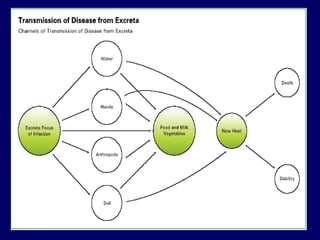
Oro fecal transmitted
Diseases
 Typhoid and Para typhoid
 Dysentery and diarrhoea
 Cholera
 Intestinal parasitic diseases :
1. Hookworm diseases
2. Ascariasis
 Viral hepatitis
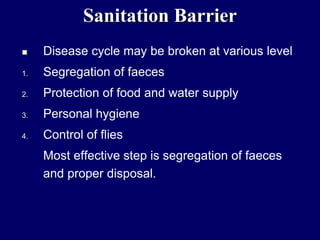
Sanitation Barrier
 Disease cycle may be broken at various level
1. Segregation of faeces
2. Protection of food and water supply
3. Personal hygiene
4. Control of flies
Most effective step is segregation of faeces
and proper disposal.
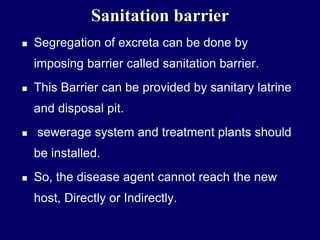
Sanitation barrier
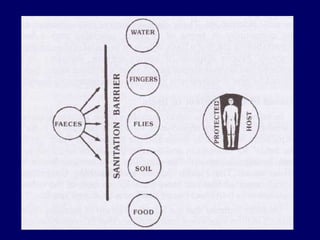
 Segregation of excreta can be done by
imposing barrier called sanitation barrier.
 This Barrier can be provided by sanitary latrine
and disposal pit.
 sewerage system and treatment plants should
be installed.
 So, the disease agent cannot reach the new
host, Directly or Indirectly.
Methods of Excreta disposal
Depends on availability of sewerage system.
 UNSEWERED AREA :
1. Service type
2. Non Service type
• Borehole Latrine
• Dug well Latrine
• Water seal type Latrine
P.R.A.I Type
R.C.A Type
Sulabh Shauchalaya
• Septic tank
• Aqua Privy
3. Latrines for Camps and Temporary use
Non Service type
 SANITARY LATRINE :
CRITERIA :
1. Excreta should not contaminate the ground or
surface water
2. Should not pollute the soil
3. Excreta should not be accessible to flies,
animals, Rodents
4. Should not create any type of nuisance in
terms of appearance and odour.
Types of Sanitary latrine
 Bore hole latrine:
Pit is dug for about 26 ft depth
 Special equipment for digging the ground -
AUGER is used
 When contents reach 50 cm from the ground
level, hole is closed with earth and a new hole is
dug out.
 Night soil undergoes anaerobic digestion.
 Suprastructure is built for privacy.
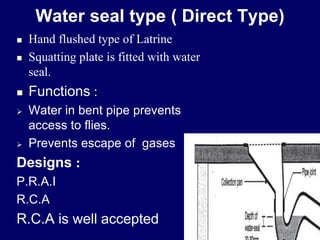
Water seal type ( Direct Type)
 Hand flushed type of Latrine
 Squatting plate is fitted with water
seal.
 Functions :
 Water in bent pipe prevents
access to flies.
 Prevents escape of gases
Designs :
P.R.A.I
R.C.A
R.C.A is well accepted
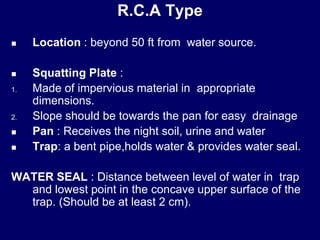
R.C.A Type
 Location : beyond 50 ft from water source.
 Squatting Plate :
1. Made of impervious material in appropriate
dimensions.
2. Slope should be towards the pan for easy drainage
 Pan : Receives the night soil, urine and water
 Trap: a bent pipe,holds water & provides water seal.
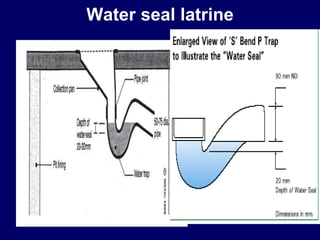
WATER SEAL : Distance between level of water in trap
and lowest point in the concave upper surface of the
trap. (Should be at least 2 cm).
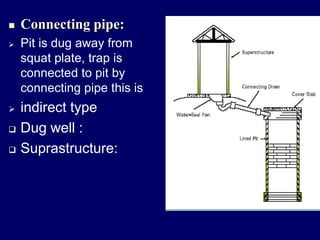
 Connecting pipe:
 Pit is dug away from
squat plate, trap is
connected to pit by
connecting pipe this is
 indirect type
 Dug well :
 Suprastructure:
Water seal latrine
Septic tank
 Water tight tank
 Places where no access to sewerage system
-- for disposal of excreta and liquid waste.
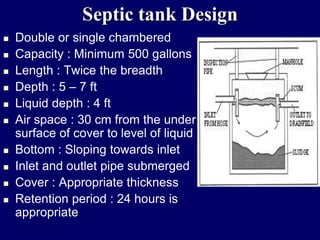
Septic tank Design
 Double or single chambered
 Capacity : Minimum 500 gallons
 Length : Twice the breadth
 Depth : 5 – 7 ft
 Liquid depth : 4 ft
 Air space : 30 cm from the under
surface of cover to level of liquid
 Bottom : Sloping towards inlet
 Inlet and outlet pipe submerged
 Cover : Appropriate thickness
 Retention period : 24 hours is
appropriate
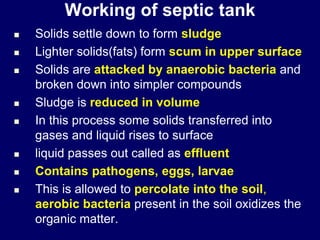
Working of septic tank
 Solids settle down to form sludge
 Lighter solids(fats) form scum in upper surface
 Solids are attacked by anaerobic bacteria and
broken down into simpler compounds
 Sludge is reduced in volume
 In this process some solids transferred into
gases and liquid rises to surface
 liquid passes out called as effluent
 Contains pathogens, eggs, larvae
 This is allowed to percolate into the soil,
aerobic bacteria present in the soil oxidizes the
organic matter.
Stages of purification
 Anaerobic digestion – Inside the septic tank
Aerobic Oxidation – Outside the septic tank
 Maintenance
 Soap and disinfectants not to be used
 Frequent desludging should be done
AQUA PRIVY :Similar to septic tank
SULABH SHAUCHALAYA :Community latrines
Water carriage system
 Sewerage system
 Collecting and transporting excreta, waste water
from residential, commercial, industrial areas to
site of disposal by pipes called sewers.
 Combined and separate sewer system
 Dry Weather flow – sewage flow in 24 hrs.
Sewage
 Waste water containing solid and liquid
excreta.
 Composition :
1. 99.9% Water
2. 0.1% Solids [ Organic and inorganic]
3. Numerous pathogens – Millions of E.coli, Cl.
Perfringes, Streptococci
Aim of Sewage treatment
 Inadequately treated sewage should not be
discharged into any water source since the
oxygen in the water is utilised by bacteria
present in the sewage
 Depletion of oxygen in water leads to death of
water flora
 Aim of sewage treatment is to stabilise the
organic matter for safe disposal of waste into
the land and water source.
Organic content
 indicator for organic content in the sewage is
biological oxygen demand test.
 Strength of sewage expressed by
1.Biological oxygen demand (B.O.D)
2.Chemical oxygen demand (C.O.D)
3.Suspended solids
Biological oxygen demand
 Amount of oxygen absorbed by a sample of
sewage during specified period of time and
temperature.
 Range from 1 mg/ litre – 300 mg/ litre
 > 300 mg/litre – sewage is strong
 < 100 mg/ litre – weak
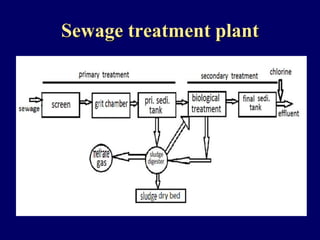
Sewage treatment
 Two stages
1.Primary treatment
2.Secondary treatment
Primary treatment
1. Solids from sewage is separated by screening
and sedimentation and subjected to anaerobic
digestion
Secondary treatment
1. Effluent resulting from primary treatment is
subjected to aerobic digestion
Sewage treatment plant
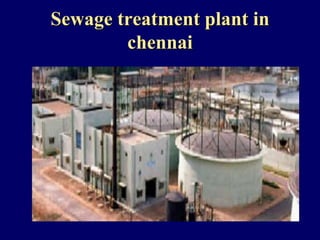
Sewage treatment plant in
chennai
Primary treatment
 Screening :
1.sewage at disposal site is passed through metal
screen which intercept large objects.
2.Screen has vertical or inclined bars can be either
fixed and moving type
 Grit chamber :
1. Long narrow chamber
2. Velocity of 1 foot / second
3. Settlement of heavier solids such as sand and
gravel and allows organic matter to flow.
4. Settled grit is periodically disposed
 Primary sedimentation
1. Sewage spends 6 – 8 hrs in the tank where
purification occurs by sedimentation of suspended
matter.
2. 50 – 70 % of solids is settled down by gravity and
reduction of coliform organisms is obtained.
3. Organic matter settled is called sludge and is
removed mechanically without disturbing the
operation
4. Biological action takes place - micro organisms
present in sewage attack the organic solids and
break down into simpler compounds
5. Certain amount of fat and grease rise to form
scum which is removed
Secondary treatment
 Effluent from primary sedimentation still contains
organic matter and micro organisms.
 Subjected to further treatment – aerobic
oxidation by
 Trickling filter method
 Or Activated sludge process
Trickling filter
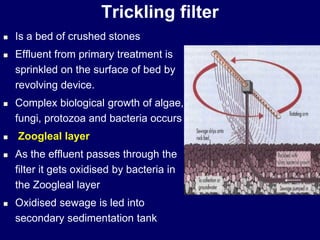
 Is a bed of crushed stones
 Effluent from primary treatment is
sprinkled on the surface of bed by
revolving device.
 Complex biological growth of algae,
fungi, protozoa and bacteria occurs
 Zoogleal layer
 As the effluent passes through the
filter it gets oxidised by bacteria in
the Zoogleal layer
 Oxidised sewage is led into
secondary sedimentation tank
Activated sludge process
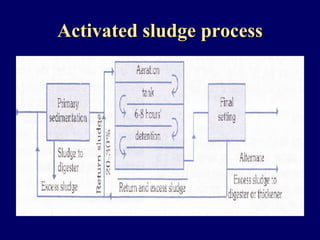
 Heart of activated sludge process is aeration tank
 Effluent from primary tank is mixed with sludge
drawn from final sedimentation tank
 effluent spend 6 – 8 hrs in this tank
- aeration is done by forcing compressed air.
 During this process organic matter gets oxidized
into co2, water, nitrates with the help of aerobic
bacteria.
 Typhoid and cholera organisms are destroyed
and coliform organism is reduced
Secondary sedimentation
 Oxidised sewage from aeration tank or trickling
filter is led into secondary sedimentation for 2-3
hrs .
 Sludge collected in sedimentation tank is called
aerated sludge or activated sludge
 Difference from sludge from primary treatment it
is inoffensive and no pathogens
 Part of activated sludge is pumped into sludge
digester for treatment and disposal
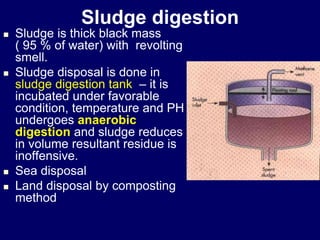
Sludge digestion
 Sludge is thick black mass
( 95 % of water) with revolting
smell.
 Sludge disposal is done in
sludge digestion tank – it is
incubated under favorable
condition, temperature and PH
undergoes anaerobic
digestion and sludge reduces
in volume resultant residue is
inoffensive.
 Sea disposal
 Land disposal by composting
method
Disposal of effluent
 Disposal by dilution – into water course
 Disposal by land for irrigation
Other methods :
 Sea outfall
 River outfall
 Land treatment (Sewage farming)
 Land is first laid into ridges and furrows, sewage
is fed into furrows intermittently and crops are
grown in ridges.
 Crops that are suitable, is that which does not
come in contact with sewage and likely to be
eaten raw.
 Sewage sickness – badly maintained farm.
Oxidation pond
 Cheap method of sewage treatment
 Other names – Redox pond, Waste
stabilisation pond.
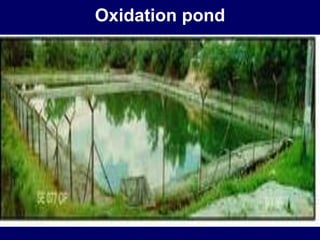
 Is a open, shallow pool with inlet and outlet
 To qualify for oxidation pond, it should contain –
Algae, certain types of bacteria which feed on
organic matter, and sunlight
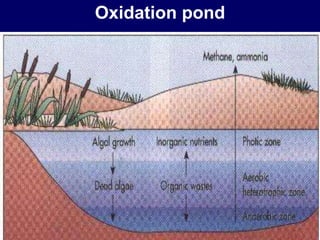
 Organic matter is oxidised by the bacteria into
co2, methane and ammonia, so called oxidation
pond.
 Algae with help of sunlight utilises the co2, water
for growth
 Sunlight is important factor for proper
functioning of oxidation pond
 Oxidation pond are predominantly aerobic
in day and some hours of night
 In night bottom layers of pond are
anaerobic
 Effluent produced are used for growing
crops or discharged into river
Oxidation pond
Oxidation pond
Thank you

PPT for Excreta disposal.ppt

  • 1.
    Excreta Disposal and SewageTreatment Dr.D.Vanitha
  • 2.
    Excreta Disposal -Problem In India : 74 % living in rural area Majority go to field for defecation Polluting environment In Urban: Only 15 % have access to sewerage system.
  • 3.
    Public health importance Excreta is a source of infection  Necessary for safe disposal so that it is not a threat to public health.  Health Hazards : 1. Soil pollution 2. Water pollution 3. Contamination of foods 4. Propagation of flies and diseases
  • 4.
    Oro fecal transmitted Diseases Typhoid and Para typhoid  Dysentery and diarrhoea  Cholera  Intestinal parasitic diseases : 1. Hookworm diseases 2. Ascariasis  Viral hepatitis
  • 6.
    Sanitation Barrier  Diseasecycle may be broken at various level 1. Segregation of faeces 2. Protection of food and water supply 3. Personal hygiene 4. Control of flies Most effective step is segregation of faeces and proper disposal.
  • 7.
    Sanitation barrier  Segregationof excreta can be done by imposing barrier called sanitation barrier.  This Barrier can be provided by sanitary latrine and disposal pit.  sewerage system and treatment plants should be installed.  So, the disease agent cannot reach the new host, Directly or Indirectly.
  • 9.
    Methods of Excretadisposal Depends on availability of sewerage system.  UNSEWERED AREA : 1. Service type 2. Non Service type • Borehole Latrine • Dug well Latrine • Water seal type Latrine P.R.A.I Type R.C.A Type Sulabh Shauchalaya • Septic tank • Aqua Privy 3. Latrines for Camps and Temporary use
  • 10.
    Non Service type SANITARY LATRINE : CRITERIA : 1. Excreta should not contaminate the ground or surface water 2. Should not pollute the soil 3. Excreta should not be accessible to flies, animals, Rodents 4. Should not create any type of nuisance in terms of appearance and odour.
  • 11.
    Types of Sanitarylatrine  Bore hole latrine: Pit is dug for about 26 ft depth  Special equipment for digging the ground - AUGER is used  When contents reach 50 cm from the ground level, hole is closed with earth and a new hole is dug out.  Night soil undergoes anaerobic digestion.  Suprastructure is built for privacy.
  • 12.
    Water seal type( Direct Type)  Hand flushed type of Latrine  Squatting plate is fitted with water seal.  Functions :  Water in bent pipe prevents access to flies.  Prevents escape of gases Designs : P.R.A.I R.C.A R.C.A is well accepted
  • 13.
    R.C.A Type  Location: beyond 50 ft from water source.  Squatting Plate : 1. Made of impervious material in appropriate dimensions. 2. Slope should be towards the pan for easy drainage  Pan : Receives the night soil, urine and water  Trap: a bent pipe,holds water & provides water seal. WATER SEAL : Distance between level of water in trap and lowest point in the concave upper surface of the trap. (Should be at least 2 cm).
  • 14.
     Connecting pipe: Pit is dug away from squat plate, trap is connected to pit by connecting pipe this is  indirect type  Dug well :  Suprastructure:
  • 15.
  • 16.
    Septic tank  Watertight tank  Places where no access to sewerage system -- for disposal of excreta and liquid waste.
  • 17.
    Septic tank Design Double or single chambered  Capacity : Minimum 500 gallons  Length : Twice the breadth  Depth : 5 – 7 ft  Liquid depth : 4 ft  Air space : 30 cm from the under surface of cover to level of liquid  Bottom : Sloping towards inlet  Inlet and outlet pipe submerged  Cover : Appropriate thickness  Retention period : 24 hours is appropriate
  • 18.
    Working of septictank  Solids settle down to form sludge  Lighter solids(fats) form scum in upper surface  Solids are attacked by anaerobic bacteria and broken down into simpler compounds  Sludge is reduced in volume  In this process some solids transferred into gases and liquid rises to surface  liquid passes out called as effluent  Contains pathogens, eggs, larvae  This is allowed to percolate into the soil, aerobic bacteria present in the soil oxidizes the organic matter.
  • 19.
    Stages of purification Anaerobic digestion – Inside the septic tank Aerobic Oxidation – Outside the septic tank  Maintenance  Soap and disinfectants not to be used  Frequent desludging should be done AQUA PRIVY :Similar to septic tank SULABH SHAUCHALAYA :Community latrines
  • 20.
    Water carriage system Sewerage system  Collecting and transporting excreta, waste water from residential, commercial, industrial areas to site of disposal by pipes called sewers.  Combined and separate sewer system  Dry Weather flow – sewage flow in 24 hrs.
  • 21.
    Sewage  Waste watercontaining solid and liquid excreta.  Composition : 1. 99.9% Water 2. 0.1% Solids [ Organic and inorganic] 3. Numerous pathogens – Millions of E.coli, Cl. Perfringes, Streptococci
  • 22.
    Aim of Sewagetreatment  Inadequately treated sewage should not be discharged into any water source since the oxygen in the water is utilised by bacteria present in the sewage  Depletion of oxygen in water leads to death of water flora  Aim of sewage treatment is to stabilise the organic matter for safe disposal of waste into the land and water source.
  • 23.
    Organic content  indicatorfor organic content in the sewage is biological oxygen demand test.  Strength of sewage expressed by 1.Biological oxygen demand (B.O.D) 2.Chemical oxygen demand (C.O.D) 3.Suspended solids
  • 24.
    Biological oxygen demand Amount of oxygen absorbed by a sample of sewage during specified period of time and temperature.  Range from 1 mg/ litre – 300 mg/ litre  > 300 mg/litre – sewage is strong  < 100 mg/ litre – weak
  • 25.
    Sewage treatment  Twostages 1.Primary treatment 2.Secondary treatment Primary treatment 1. Solids from sewage is separated by screening and sedimentation and subjected to anaerobic digestion Secondary treatment 1. Effluent resulting from primary treatment is subjected to aerobic digestion
  • 26.
  • 27.
  • 28.
    Primary treatment  Screening: 1.sewage at disposal site is passed through metal screen which intercept large objects. 2.Screen has vertical or inclined bars can be either fixed and moving type  Grit chamber : 1. Long narrow chamber 2. Velocity of 1 foot / second 3. Settlement of heavier solids such as sand and gravel and allows organic matter to flow. 4. Settled grit is periodically disposed
  • 29.
     Primary sedimentation 1.Sewage spends 6 – 8 hrs in the tank where purification occurs by sedimentation of suspended matter. 2. 50 – 70 % of solids is settled down by gravity and reduction of coliform organisms is obtained. 3. Organic matter settled is called sludge and is removed mechanically without disturbing the operation 4. Biological action takes place - micro organisms present in sewage attack the organic solids and break down into simpler compounds 5. Certain amount of fat and grease rise to form scum which is removed
  • 30.
    Secondary treatment  Effluentfrom primary sedimentation still contains organic matter and micro organisms.  Subjected to further treatment – aerobic oxidation by  Trickling filter method  Or Activated sludge process
  • 31.
    Trickling filter  Isa bed of crushed stones  Effluent from primary treatment is sprinkled on the surface of bed by revolving device.  Complex biological growth of algae, fungi, protozoa and bacteria occurs  Zoogleal layer  As the effluent passes through the filter it gets oxidised by bacteria in the Zoogleal layer  Oxidised sewage is led into secondary sedimentation tank
  • 32.
  • 33.
    Activated sludge process Heart of activated sludge process is aeration tank  Effluent from primary tank is mixed with sludge drawn from final sedimentation tank  effluent spend 6 – 8 hrs in this tank - aeration is done by forcing compressed air.  During this process organic matter gets oxidized into co2, water, nitrates with the help of aerobic bacteria.  Typhoid and cholera organisms are destroyed and coliform organism is reduced
  • 34.
    Secondary sedimentation  Oxidisedsewage from aeration tank or trickling filter is led into secondary sedimentation for 2-3 hrs .  Sludge collected in sedimentation tank is called aerated sludge or activated sludge  Difference from sludge from primary treatment it is inoffensive and no pathogens  Part of activated sludge is pumped into sludge digester for treatment and disposal
  • 35.
    Sludge digestion  Sludgeis thick black mass ( 95 % of water) with revolting smell.  Sludge disposal is done in sludge digestion tank – it is incubated under favorable condition, temperature and PH undergoes anaerobic digestion and sludge reduces in volume resultant residue is inoffensive.  Sea disposal  Land disposal by composting method
  • 36.
    Disposal of effluent Disposal by dilution – into water course  Disposal by land for irrigation Other methods :  Sea outfall  River outfall  Land treatment (Sewage farming)  Land is first laid into ridges and furrows, sewage is fed into furrows intermittently and crops are grown in ridges.  Crops that are suitable, is that which does not come in contact with sewage and likely to be eaten raw.  Sewage sickness – badly maintained farm.
  • 37.
    Oxidation pond  Cheapmethod of sewage treatment  Other names – Redox pond, Waste stabilisation pond.  Is a open, shallow pool with inlet and outlet  To qualify for oxidation pond, it should contain – Algae, certain types of bacteria which feed on organic matter, and sunlight  Organic matter is oxidised by the bacteria into co2, methane and ammonia, so called oxidation pond.  Algae with help of sunlight utilises the co2, water for growth
  • 38.
     Sunlight isimportant factor for proper functioning of oxidation pond  Oxidation pond are predominantly aerobic in day and some hours of night  In night bottom layers of pond are anaerobic  Effluent produced are used for growing crops or discharged into river
  • 39.
  • 40.
  • 41.