Municipal and Domestic Wastewater Treatment   The   Largest Biotechnology Industry in the World … … and the least understood?
Veolia Water    N° 1 worldwide  for water services;  revenue of €12.5 billion  for 2008;  providing drinking water and wastewater  treatment services to more than  139 million people  around the world;  93,433  employees;  Permanent operations in  64 countries ;  Managing close to 4,400 contracts around the world.
62,000 employees serving  68 million people worldwide with drinking water  44 million people for wastewater services  46 million people for waste collection service  Revenues of $18.4 billion in 2007  An R&D budget of $95 million for water research
Wastewater is the biggest waste by volume in New Zealand. Approximately 1.5 billion litres of domestic wastewater is discharged into the environment daily.
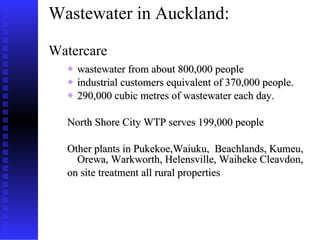
Wastewater in Auckland:  Watercare wastewater from about 800,000 people  industrial customers equivalent of 370,000 people.  290,000 cubic metres of wastewater each day. North Shore City WTP serves 199,000 people Other plants in Pukekoe,Waiuku,  Beachlands, Kumeu, Orewa, Warkworth, Helensville, Waiheke Cleavdon,  on site treatment all rural properties
What is wastewater? (aka Sewage) Water (99%) Organics Nutrients Toxic materials Infectious agents Plus??
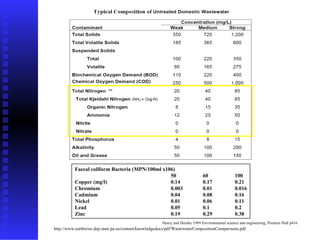
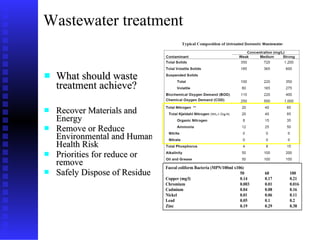
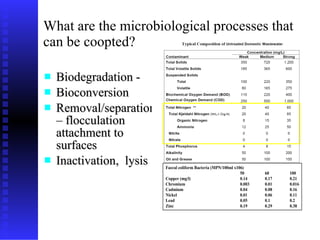
Henry and Heinke 1989 Environmental science and engineering, Prentice Hall p416 http://www.earthwise.dep.state.pa.us/content/knowledgedocs/pdf/WastewaterCompositionComparisons.pdf Faecal coliform   Bacteria (MPN/100ml x106) 50 60 100 Copper (mg/l) 0.14 0.17 0.21 Chromium  0.003 0.01 0.016 Cadmium 0.04 0.08 0.16 Nickel 0.01 0.06 0.11 Lead 0.05 0.1 0.2 Zinc 0.19 0.29 0.38
Waste product for treatment and disposal? or  Resource to recover and use? Discussion
What should waste treatment achieve? What are the microbiological processes that can be coopted? Control strategies to optimise the microbial function. Wastewater treatment
What should waste treatment achieve? Recover Materials and Energy Remove or Reduce Environmental and Human Health Risk  Priorities for reduce or remove Safely Dispose of Residue Wastewater treatment
What are the microbiological processes that can be coopted? Biodegradation -  Bioconversion Removal/separation – flocculation attachment to surfaces Inactivation,  lysis
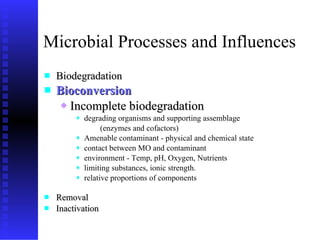
Microbial Processes and Influences Biodegradation   biomass + energy+ residual Biodegradation requires degrading organisms and  supporting  assemblage  (enzymes and cofactors) Amenable contaminant - physical and chemical state contact between MO and contaminant environment - Temp, pH,   Oxygen, Nutrients limiting substances, ionic strength. r elative proportions of components Bioconversion Removal  Inactivation
Microbial Processes and Influences Biodegradation Bioconversion Incomplete biodegradation degrading organisms and  supporting  assemblage  (enzymes and cofactors) Amenable contaminant - physical and chemical state contact between MO and contaminant environment - Temp, pH,   Oxygen, Nutrients limiting substances, ionic strength. r elative proportions of components Removal  Inactivation
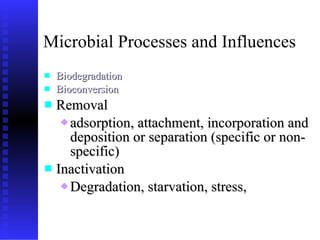
Microbial Processes and Influences Biodegradation Bioconversion Removal  adsorption, attachment, incorporation and deposition or separation (specific or non-specific) Inactivation Degradation, starvation, stress,
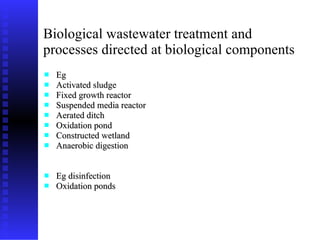
Biological wastewater treatment and processes directed at biological components Eg  Activated sludge Fixed growth reactor Suspended media reactor Aerated ditch Oxidation pond Constructed wetland Anaerobic digestion Eg disinfection Oxidation ponds
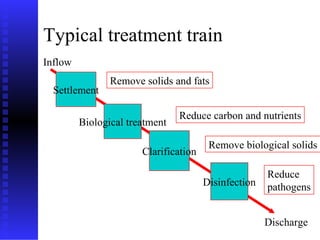
Typical treatment train Settlement Biological treatment Clarification Disinfection Discharge Inflow Remove solids and fats Reduce carbon and nutrients Remove biological solids Reduce  pathogens
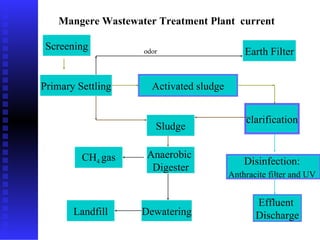
Mangere Wastewater Treatment Plant  current Screening Earth Filter clarification Activated sludge Sludge Primary Settling CH 4  gas Anaerobic  Digester Dewatering Landfill Effluent  Discharge Disinfection:  Anthracite filter and UV   odor
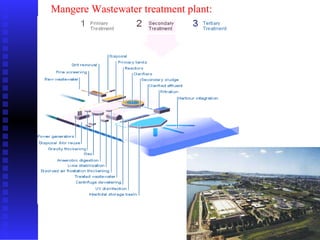
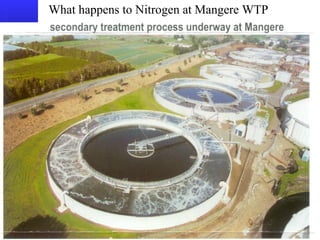
Mangere Wastewater treatment plant:
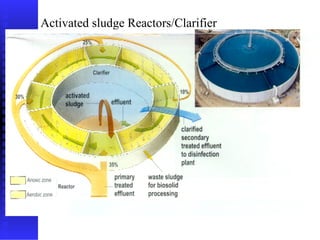
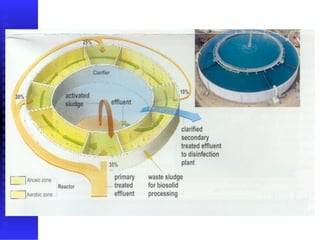
Activated sludge Reactors/Clarifier
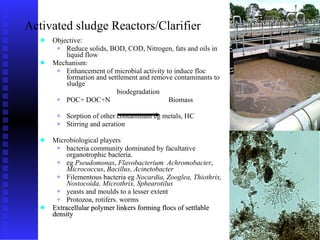
Activated sludge Reactors/Clarifier Objective:  Reduce solids, BOD, COD, Nitrogen, fats and oils in liquid flow Mechanism: Enhancement of microbial activity to induce floc formation and settlement and remove contaminants to sludge   biodegradation POC+ DOC+N  Biomass Sorption of other contaminant eg metals, HC Stirring and aeration Microbiological players bacteria community dominated by facultative organotrophic bacteria.  eg  Pseudomonas ,  F la v obacterium   Achromobacter ,  M icroco c cus ,  B acillus , Acinetobacter Filementous bacteria eg  Nocardia, Zooglea, Thiothrix, Nostocoida, Microthrix, Sphearotilus yeasts and moulds to a lesser extent  Protozoa, rotifers. worms   Extracellular polymer linkers forming flocs of settlable density
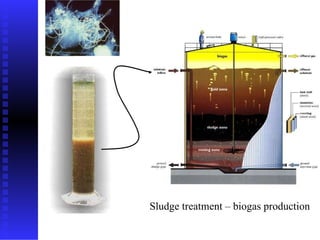
Sludge treatment – biogas production
Nitrogen removal Why remove nitrogen? Where does nitrogen come from? What is the form of nitrogen in wastewater?
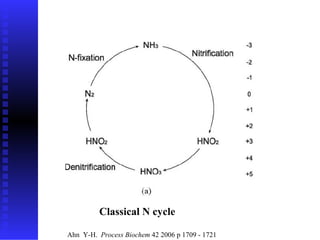
Classical N cycle   Ahn  Y-H.  Process Biochem  42 2006 p 1709 - 1721
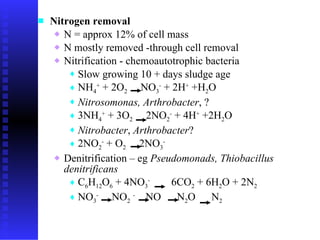
Nitrogen removal   N = approx 12 %  of cell mass  N mostly removed -through cell removal  Nitrification  -  chemoautotrophic bacteria  Slow growing 10 + days sludge age NH 4 +  + 2O 2   NO 3 -  + 2H +  +H 2 O Nitrosomonas, Arthrobacter , ?  3NH 4 +  + 3O 2   2NO 2 -  + 4H +  +2H 2 O  Nitrobacter ,  Arthrobacter ?  2NO 2 -  + O 2   2NO 3 - Denitrification – eg  Pseudomonads, Thiobacillus denitrificans C 6 H 12 O 6  + 4NO 3 -   6CO 2  + 6H 2 O + 2N 2 NO 3 -   NO 2   -   NO  N 2 O  N 2
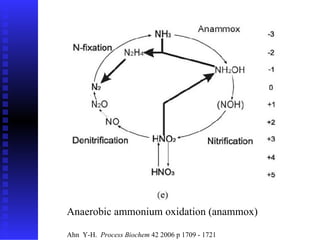
Anaerobic ammonium oxidation (anammox) Ahn  Y-H.  Process Biochem  42 2006 p 1709 - 1721
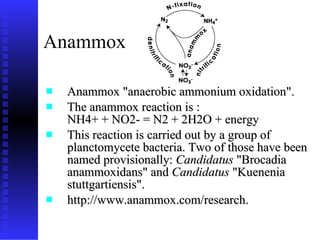
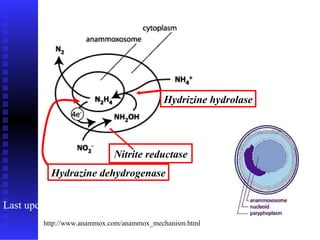
Anammox Anammox "anaerobic ammonium oxidation".  The anammox reaction is : NH4+ + NO2- = N2 + 2H2O + energy This reaction is carried out by a group of planctomycete bacteria. Two of those have been named provisionally:  Candidatus  "Brocadia anammoxidans" and  Candidatus  "Kuenenia stuttgartiensis".  http://www.anammox.com/research.
Nitrite reductase Hydrizine hydrolase Hydrazine dehydrogenase http://www.anammox.com/anammox_mechanism.html Last updated: March 9, 2004
Anommox Application http://www.anammox.com/application.html wastewater streams high in ammonium (>0.2 g/l) and low in organic carbon (C:N ratio lower than 0.15). The two processes proceed as follows: partial nitrification 2NH 4 +  + 1.5O 2 =NH 4 +  + NO 2 -  + H 2 O + 2H + anammox NH 4 +  + NO 2 - =N 2  + 2H 2 O  total 2NH 4 +  + 1.5O 2 =N 2  + 3H 2 O + 2H + Requires:  50% less  oxygen. May reduce operational costs by  90%,  decrease in CO 2  emissions of more than 100%
Nitrosomonas  aerobic denitrification   Ahn  Y-H.  Process Biochem  42 2006 p 1709 - 1721
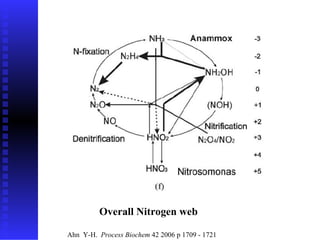
Overall Nitrogen web   Ahn  Y-H.  Process Biochem  42 2006 p 1709 - 1721
What happens to Nitrogen at Mangere WTP
 
Assignment: Mangere Complex adds NZ$1b to Auckland City Economy.   The just completed upgrade of the Mangere Materials Complex adds the final process to allow complete recovery of the materials from what was once called wastewater.  The wastewater also called sewage was collected at the plant and partly treated before being tipped into the Manukau harbour.  The cost of this treatment both in $ terms and in environmental cost was in excess on $50 m in 2010.  Recovery of the resources that was once waste and the industries linked to them are now worth over $1 b.  The most notable successes have been…. NZ Herald  May 12  2025
Assignment:  the to do.. Complete the next 10 paragraphs of the Newspaper Article (5%) plus 2 page document in point form that provides more information and some ideas on the approach to reclamation of resources (with references) (10%) Due date:  Monday  May  31st Submit to SRC by 4 pm  Value 15% of final mark
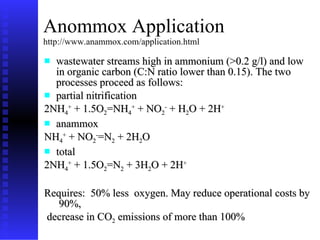
Field Visit : Wednesday 19 May  Mangere Wastewater treatment plant  Leave outside SBS  at 11.00 am sharp  Closed in shoes – no Sandals or Jandals Objectives  To understand the treatment process To  identify the strengths and weaknesses of the process and the main constraints on treatment and disposal of waste Identify the pressures on the process to perform effectively Identify areas where there is opportunity for improvement or benefit. Own Transport?
Older reviews: Ahn Y-H Sustainable nitrogen elimination biotechnologies: A Review.  Process Biochemistry 41, 2006, 1709 - 1721 Mendoza-Espinosa, Leopoldo Stephenson, Tom. A review of biological aerated filters (BAFs) for wastewater treatment  Environmental Engineering Science. 16(3). 1999. 201-216.   Stratful, I.; Brett, S. Scrimshaw, M. B.; Lester, J. N.. Biological phosphorus removal, its role in phosphorus recycling  Environmental Technology. 20(7). July, 1999. 681-695.   Grady, C. P. L., Jr. Filipe, C. D. M. . Ecological engineering of bioreactors for wastewater treatment  Water, Air, & Soil Pollution. 123(1-4). October, 2000. 117-132   de-Bashan, Luz E.; Bashan, Yoav Recent advances in removing phosphorus from wastewater and its future use as fertilizer (1997-2003)  Water Research. 38(19). November 2004. 4222-4246.   Mallick, Nirupama. Biotechnological potential of immobilized algae for wastewater N, P and metal removal: A review.  BioMetals. 15(4). December 2002. 377-390.   Low, Euan W.; Chase, Howard A.. Reducing production of excess biomass during wastewater treatment  Water Research. 33(5). April, 1999. 1119-1132.   Aksu, Zumriye. Application of biosorption for the removal of organic pollutants: A review  Process Biochemistry. 40(3-4). March 2005. 997-1026.   Lazarova, V. ; Savoye, P. Janex, M. L.; Blatchley, E. R., III Pommepuy, M. [Author]. Advanced wastewater disinfection technologies: State of the art and perspectives  Water Science & Technology. 40(4-5). Aug.-Sept., 1999. 203-213.   Chuichulcherm, S.. An integrated system for the bioremediation of wastewater containing xenobiotics and toxic metals  Engineering in Life Sciences. 4(4). August 2004. 354-357.   Books that contain helpful sections ( not on close reserve) Fry et al : 1992 Microbial control of pollution:  Society for General Microbiology.  Gray NF 2004 :Biology of  wastewater  treatment 2nd ed. Imperial College Press, London.  Gerardi M and Zimmerman M :2004 Wastewater Pathogens: Electronic reproduction Somerset, New Jersey : Wiley InterScience, [electronic resource]
Suggested Reading Ekama George A [a]; Wentzel Mark C [a]. Difficulties and developments in biological nutrient removal technology and modelling.  Water Science & Technology. 39(6). March, 1999. 1-11. ( try via science direct)  Fuerhacker M; Bauer H; Ellinger R; Sree U; Schmid H; Zibuschka F; Puxbaum H. Approach for a  novel  control strategy for simultaneous nitrification/ denitrification  in activated sludge reactors.  Water Research. 34(9). June, 2000. 2499-2506 Strous Marc; Van Gerven Eric; Zheng Ping; Kuenen J Gijs; Jetten Mike S M [a]. Ammonium removal from concentrated waste streams with the anaerobic ammonium oxidation (Anammox) process in different reactor configurations.  Water Research. 31(8). 1997. 1955-1962 Krumins Valdis; Hummerick Mary; Levine Lanfang; Strayer Richard; Adams Jennifer L; Bauer Jan. Effect of hydraulic retention time on inorganic nutrient recovery and biodegradable organics removal in a biofilm reactor treating plant biomass leachate.  Bioresource  Technology  85. December, 2002. 243-248.

Wastewater

  • 1.
    Municipal and DomesticWastewater Treatment The Largest Biotechnology Industry in the World … … and the least understood?
  • 2.
    Veolia Water   N° 1 worldwide for water services; revenue of €12.5 billion  for 2008; providing drinking water and wastewater treatment services to more than 139 million people around the world; 93,433 employees; Permanent operations in  64 countries ; Managing close to 4,400 contracts around the world.
  • 3.
    62,000 employees serving 68 million people worldwide with drinking water 44 million people for wastewater services 46 million people for waste collection service Revenues of $18.4 billion in 2007 An R&D budget of $95 million for water research
  • 4.
    Wastewater is thebiggest waste by volume in New Zealand. Approximately 1.5 billion litres of domestic wastewater is discharged into the environment daily.
  • 5.
    Wastewater in Auckland: Watercare wastewater from about 800,000 people industrial customers equivalent of 370,000 people. 290,000 cubic metres of wastewater each day. North Shore City WTP serves 199,000 people Other plants in Pukekoe,Waiuku, Beachlands, Kumeu, Orewa, Warkworth, Helensville, Waiheke Cleavdon, on site treatment all rural properties
  • 6.
    What is wastewater?(aka Sewage) Water (99%) Organics Nutrients Toxic materials Infectious agents Plus??
  • 7.
    Henry and Heinke1989 Environmental science and engineering, Prentice Hall p416 http://www.earthwise.dep.state.pa.us/content/knowledgedocs/pdf/WastewaterCompositionComparisons.pdf Faecal coliform Bacteria (MPN/100ml x106) 50 60 100 Copper (mg/l) 0.14 0.17 0.21 Chromium 0.003 0.01 0.016 Cadmium 0.04 0.08 0.16 Nickel 0.01 0.06 0.11 Lead 0.05 0.1 0.2 Zinc 0.19 0.29 0.38
  • 8.
    Waste product fortreatment and disposal? or Resource to recover and use? Discussion
  • 9.
    What should wastetreatment achieve? What are the microbiological processes that can be coopted? Control strategies to optimise the microbial function. Wastewater treatment
  • 10.
    What should wastetreatment achieve? Recover Materials and Energy Remove or Reduce Environmental and Human Health Risk Priorities for reduce or remove Safely Dispose of Residue Wastewater treatment
  • 11.
    What are themicrobiological processes that can be coopted? Biodegradation - Bioconversion Removal/separation – flocculation attachment to surfaces Inactivation, lysis
  • 12.
    Microbial Processes andInfluences Biodegradation biomass + energy+ residual Biodegradation requires degrading organisms and supporting assemblage (enzymes and cofactors) Amenable contaminant - physical and chemical state contact between MO and contaminant environment - Temp, pH, Oxygen, Nutrients limiting substances, ionic strength. r elative proportions of components Bioconversion Removal Inactivation
  • 13.
    Microbial Processes andInfluences Biodegradation Bioconversion Incomplete biodegradation degrading organisms and supporting assemblage (enzymes and cofactors) Amenable contaminant - physical and chemical state contact between MO and contaminant environment - Temp, pH, Oxygen, Nutrients limiting substances, ionic strength. r elative proportions of components Removal Inactivation
  • 14.
    Microbial Processes andInfluences Biodegradation Bioconversion Removal adsorption, attachment, incorporation and deposition or separation (specific or non-specific) Inactivation Degradation, starvation, stress,
  • 15.
    Biological wastewater treatmentand processes directed at biological components Eg Activated sludge Fixed growth reactor Suspended media reactor Aerated ditch Oxidation pond Constructed wetland Anaerobic digestion Eg disinfection Oxidation ponds
  • 16.
    Typical treatment trainSettlement Biological treatment Clarification Disinfection Discharge Inflow Remove solids and fats Reduce carbon and nutrients Remove biological solids Reduce pathogens
  • 17.
    Mangere Wastewater TreatmentPlant current Screening Earth Filter clarification Activated sludge Sludge Primary Settling CH 4 gas Anaerobic Digester Dewatering Landfill Effluent Discharge Disinfection: Anthracite filter and UV odor
  • 18.
  • 19.
  • 20.
    Activated sludge Reactors/ClarifierObjective: Reduce solids, BOD, COD, Nitrogen, fats and oils in liquid flow Mechanism: Enhancement of microbial activity to induce floc formation and settlement and remove contaminants to sludge biodegradation POC+ DOC+N Biomass Sorption of other contaminant eg metals, HC Stirring and aeration Microbiological players bacteria community dominated by facultative organotrophic bacteria. eg Pseudomonas , F la v obacterium Achromobacter , M icroco c cus , B acillus , Acinetobacter Filementous bacteria eg Nocardia, Zooglea, Thiothrix, Nostocoida, Microthrix, Sphearotilus yeasts and moulds to a lesser extent Protozoa, rotifers. worms Extracellular polymer linkers forming flocs of settlable density
  • 21.
    Sludge treatment –biogas production
  • 22.
    Nitrogen removal Whyremove nitrogen? Where does nitrogen come from? What is the form of nitrogen in wastewater?
  • 23.
    Classical N cycle Ahn Y-H. Process Biochem 42 2006 p 1709 - 1721
  • 24.
    Nitrogen removal N = approx 12 % of cell mass N mostly removed -through cell removal Nitrification - chemoautotrophic bacteria Slow growing 10 + days sludge age NH 4 + + 2O 2 NO 3 - + 2H + +H 2 O Nitrosomonas, Arthrobacter , ? 3NH 4 + + 3O 2 2NO 2 - + 4H + +2H 2 O Nitrobacter , Arthrobacter ? 2NO 2 - + O 2 2NO 3 - Denitrification – eg Pseudomonads, Thiobacillus denitrificans C 6 H 12 O 6 + 4NO 3 - 6CO 2 + 6H 2 O + 2N 2 NO 3 - NO 2 - NO N 2 O N 2
  • 25.
    Anaerobic ammonium oxidation(anammox) Ahn Y-H. Process Biochem 42 2006 p 1709 - 1721
  • 26.
    Anammox Anammox "anaerobicammonium oxidation". The anammox reaction is : NH4+ + NO2- = N2 + 2H2O + energy This reaction is carried out by a group of planctomycete bacteria. Two of those have been named provisionally: Candidatus "Brocadia anammoxidans" and Candidatus "Kuenenia stuttgartiensis". http://www.anammox.com/research.
  • 27.
    Nitrite reductase Hydrizinehydrolase Hydrazine dehydrogenase http://www.anammox.com/anammox_mechanism.html Last updated: March 9, 2004
  • 28.
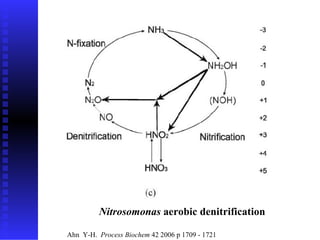
    Anommox Application http://www.anammox.com/application.htmlwastewater streams high in ammonium (>0.2 g/l) and low in organic carbon (C:N ratio lower than 0.15). The two processes proceed as follows: partial nitrification 2NH 4 + + 1.5O 2 =NH 4 + + NO 2 - + H 2 O + 2H + anammox NH 4 + + NO 2 - =N 2 + 2H 2 O total 2NH 4 + + 1.5O 2 =N 2 + 3H 2 O + 2H + Requires: 50% less oxygen. May reduce operational costs by 90%, decrease in CO 2 emissions of more than 100%
  • 29.
    Nitrosomonas aerobicdenitrification Ahn Y-H. Process Biochem 42 2006 p 1709 - 1721
  • 30.
    Overall Nitrogen web Ahn Y-H. Process Biochem 42 2006 p 1709 - 1721
  • 31.
    What happens toNitrogen at Mangere WTP
  • 32.
  • 33.
    Assignment: Mangere Complexadds NZ$1b to Auckland City Economy. The just completed upgrade of the Mangere Materials Complex adds the final process to allow complete recovery of the materials from what was once called wastewater. The wastewater also called sewage was collected at the plant and partly treated before being tipped into the Manukau harbour. The cost of this treatment both in $ terms and in environmental cost was in excess on $50 m in 2010. Recovery of the resources that was once waste and the industries linked to them are now worth over $1 b. The most notable successes have been…. NZ Herald May 12 2025
  • 34.
    Assignment: theto do.. Complete the next 10 paragraphs of the Newspaper Article (5%) plus 2 page document in point form that provides more information and some ideas on the approach to reclamation of resources (with references) (10%) Due date: Monday May 31st Submit to SRC by 4 pm Value 15% of final mark
  • 35.
    Field Visit :Wednesday 19 May Mangere Wastewater treatment plant Leave outside SBS at 11.00 am sharp Closed in shoes – no Sandals or Jandals Objectives To understand the treatment process To identify the strengths and weaknesses of the process and the main constraints on treatment and disposal of waste Identify the pressures on the process to perform effectively Identify areas where there is opportunity for improvement or benefit. Own Transport?
  • 36.
    Older reviews: AhnY-H Sustainable nitrogen elimination biotechnologies: A Review. Process Biochemistry 41, 2006, 1709 - 1721 Mendoza-Espinosa, Leopoldo Stephenson, Tom. A review of biological aerated filters (BAFs) for wastewater treatment Environmental Engineering Science. 16(3). 1999. 201-216. Stratful, I.; Brett, S. Scrimshaw, M. B.; Lester, J. N.. Biological phosphorus removal, its role in phosphorus recycling Environmental Technology. 20(7). July, 1999. 681-695. Grady, C. P. L., Jr. Filipe, C. D. M. . Ecological engineering of bioreactors for wastewater treatment Water, Air, & Soil Pollution. 123(1-4). October, 2000. 117-132 de-Bashan, Luz E.; Bashan, Yoav Recent advances in removing phosphorus from wastewater and its future use as fertilizer (1997-2003) Water Research. 38(19). November 2004. 4222-4246. Mallick, Nirupama. Biotechnological potential of immobilized algae for wastewater N, P and metal removal: A review. BioMetals. 15(4). December 2002. 377-390. Low, Euan W.; Chase, Howard A.. Reducing production of excess biomass during wastewater treatment Water Research. 33(5). April, 1999. 1119-1132. Aksu, Zumriye. Application of biosorption for the removal of organic pollutants: A review Process Biochemistry. 40(3-4). March 2005. 997-1026. Lazarova, V. ; Savoye, P. Janex, M. L.; Blatchley, E. R., III Pommepuy, M. [Author]. Advanced wastewater disinfection technologies: State of the art and perspectives Water Science & Technology. 40(4-5). Aug.-Sept., 1999. 203-213. Chuichulcherm, S.. An integrated system for the bioremediation of wastewater containing xenobiotics and toxic metals Engineering in Life Sciences. 4(4). August 2004. 354-357. Books that contain helpful sections ( not on close reserve) Fry et al : 1992 Microbial control of pollution: Society for General Microbiology. Gray NF 2004 :Biology of wastewater treatment 2nd ed. Imperial College Press, London. Gerardi M and Zimmerman M :2004 Wastewater Pathogens: Electronic reproduction Somerset, New Jersey : Wiley InterScience, [electronic resource]
  • 37.
    Suggested Reading EkamaGeorge A [a]; Wentzel Mark C [a]. Difficulties and developments in biological nutrient removal technology and modelling. Water Science & Technology. 39(6). March, 1999. 1-11. ( try via science direct) Fuerhacker M; Bauer H; Ellinger R; Sree U; Schmid H; Zibuschka F; Puxbaum H. Approach for a novel control strategy for simultaneous nitrification/ denitrification in activated sludge reactors. Water Research. 34(9). June, 2000. 2499-2506 Strous Marc; Van Gerven Eric; Zheng Ping; Kuenen J Gijs; Jetten Mike S M [a]. Ammonium removal from concentrated waste streams with the anaerobic ammonium oxidation (Anammox) process in different reactor configurations. Water Research. 31(8). 1997. 1955-1962 Krumins Valdis; Hummerick Mary; Levine Lanfang; Strayer Richard; Adams Jennifer L; Bauer Jan. Effect of hydraulic retention time on inorganic nutrient recovery and biodegradable organics removal in a biofilm reactor treating plant biomass leachate. Bioresource Technology 85. December, 2002. 243-248.