Submitted By,
SETHULEKSHMI K R
PHYSICAL SCIENCE
REG NO: 18214383019
Submitted To,
MRS.LINI MOL.K.S
Faculty in Physical science
department
SNTC Poochakkal
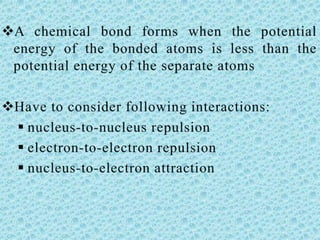
A chemical bond is an attraction between
atoms that allows the formation chemical
substances that contain two or more atoms .
The bond is caused by the electrostatic
force of attraction between opposite
charges, either between electrons and
nuclei, or as the result of a dipole attraction
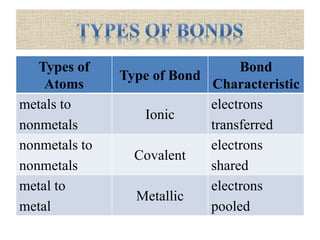
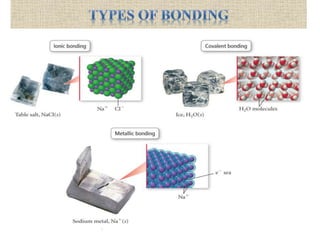
Types of
Atoms
Type of Bond
Bond
Characteristic
metals to
nonmetals
Ionic
electrons
transferred
nonmetals to
nonmetals
Covalent
electrons
shared
metal to
metal
Metallic
electrons
pooled
8
Tro, Chemistry: A Molecular Approach
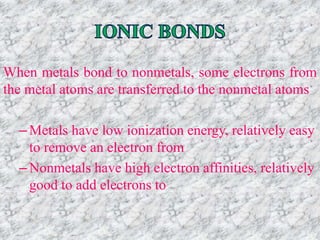
When metals bond to nonmetals, some electrons from
the metal atoms are transferred to the nonmetal atoms
–Metals have low ionization energy, relatively easy
to remove an electron from
–Nonmetals have high electron affinities, relatively
good to add electrons to
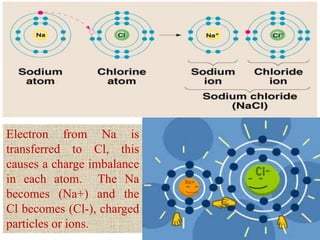
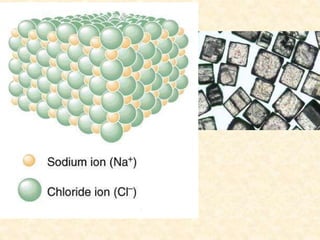
Electron from Na is
transferred to Cl, this
causes a charge imbalance
in each atom. The Na
becomes (Na+) and the
Cl becomes (Cl-), charged
particles or ions.
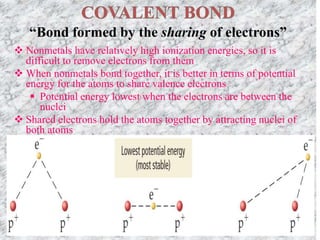
“Bond formed by the sharing of electrons”
Tro, Chemistry: A Molecular Approach 12
 Nonmetals have relatively high ionization energies, so it is
difficult to remove electrons from them
 When nonmetals bond together, it is better in terms of potential
energy for the atoms to share valence electrons
 Potential energy lowest when the electrons are between the
nuclei
 Shared electrons hold the atoms together by attracting nuclei of
both atoms
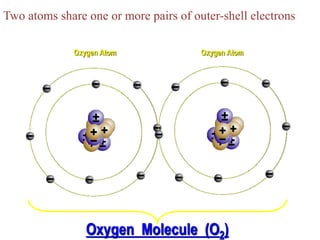
Two atoms share one or more pairs of outer-shell electrons
Oxygen Atom Oxygen Atom
Oxygen Molecule (O2)
Tro, Chemistry: A Molecular
Approach
14
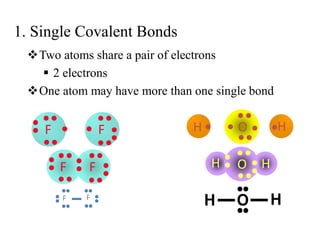
1. Single Covalent Bonds
Two atoms share a pair of electrons
 2 electrons
One atom may have more than one single bond
F
••
••
••
• F
••
••
•
••
F
••
••
••
••
••
F
••
••
HH O
••
••
••
••
H•H• O
••
•
•
••
F F
Tro, Chemistry: A Molecular
Approach
15
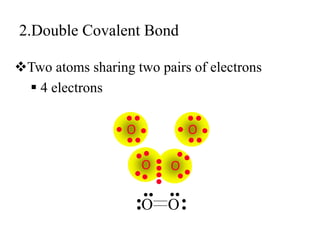
2.Double Covalent Bond
Two atoms sharing two pairs of electrons
 4 electrons
O O••••
O
••
• •••
O
••
•
•
••
O O····
·· ··
Tro, Chemistry: A Molecular
Approach
16
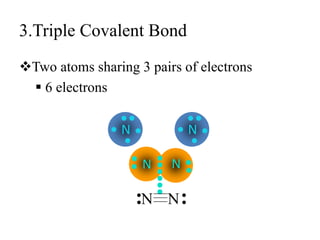
3.Triple Covalent Bond
Two atoms sharing 3 pairs of electrons
 6 electrons
N
••
• •
•
N
••
•
•
•
N ••••••
N
N N····
Sethu.ppt.

Sethu.ppt.

  • 3.
    Submitted By, SETHULEKSHMI KR PHYSICAL SCIENCE REG NO: 18214383019 Submitted To, MRS.LINI MOL.K.S Faculty in Physical science department SNTC Poochakkal
  • 5.
    A chemical bondis an attraction between atoms that allows the formation chemical substances that contain two or more atoms . The bond is caused by the electrostatic force of attraction between opposite charges, either between electrons and nuclei, or as the result of a dipole attraction
  • 7.
    Types of Atoms Type ofBond Bond Characteristic metals to nonmetals Ionic electrons transferred nonmetals to nonmetals Covalent electrons shared metal to metal Metallic electrons pooled
  • 8.
  • 9.
    Tro, Chemistry: AMolecular Approach When metals bond to nonmetals, some electrons from the metal atoms are transferred to the nonmetal atoms –Metals have low ionization energy, relatively easy to remove an electron from –Nonmetals have high electron affinities, relatively good to add electrons to
  • 10.
    Electron from Nais transferred to Cl, this causes a charge imbalance in each atom. The Na becomes (Na+) and the Cl becomes (Cl-), charged particles or ions.
  • 12.
    “Bond formed bythe sharing of electrons” Tro, Chemistry: A Molecular Approach 12  Nonmetals have relatively high ionization energies, so it is difficult to remove electrons from them  When nonmetals bond together, it is better in terms of potential energy for the atoms to share valence electrons  Potential energy lowest when the electrons are between the nuclei  Shared electrons hold the atoms together by attracting nuclei of both atoms
  • 13.
    Two atoms shareone or more pairs of outer-shell electrons Oxygen Atom Oxygen Atom Oxygen Molecule (O2)
  • 14.
    Tro, Chemistry: AMolecular Approach 14 1. Single Covalent Bonds Two atoms share a pair of electrons  2 electrons One atom may have more than one single bond F •• •• •• • F •• •• • •• F •• •• •• •• •• F •• •• HH O •• •• •• •• H•H• O •• • • •• F F
  • 15.
    Tro, Chemistry: AMolecular Approach 15 2.Double Covalent Bond Two atoms sharing two pairs of electrons  4 electrons O O•••• O •• • ••• O •• • • •• O O···· ·· ··
  • 16.
    Tro, Chemistry: AMolecular Approach 16 3.Triple Covalent Bond Two atoms sharing 3 pairs of electrons  6 electrons N •• • • • N •• • • • N •••••• N N N····