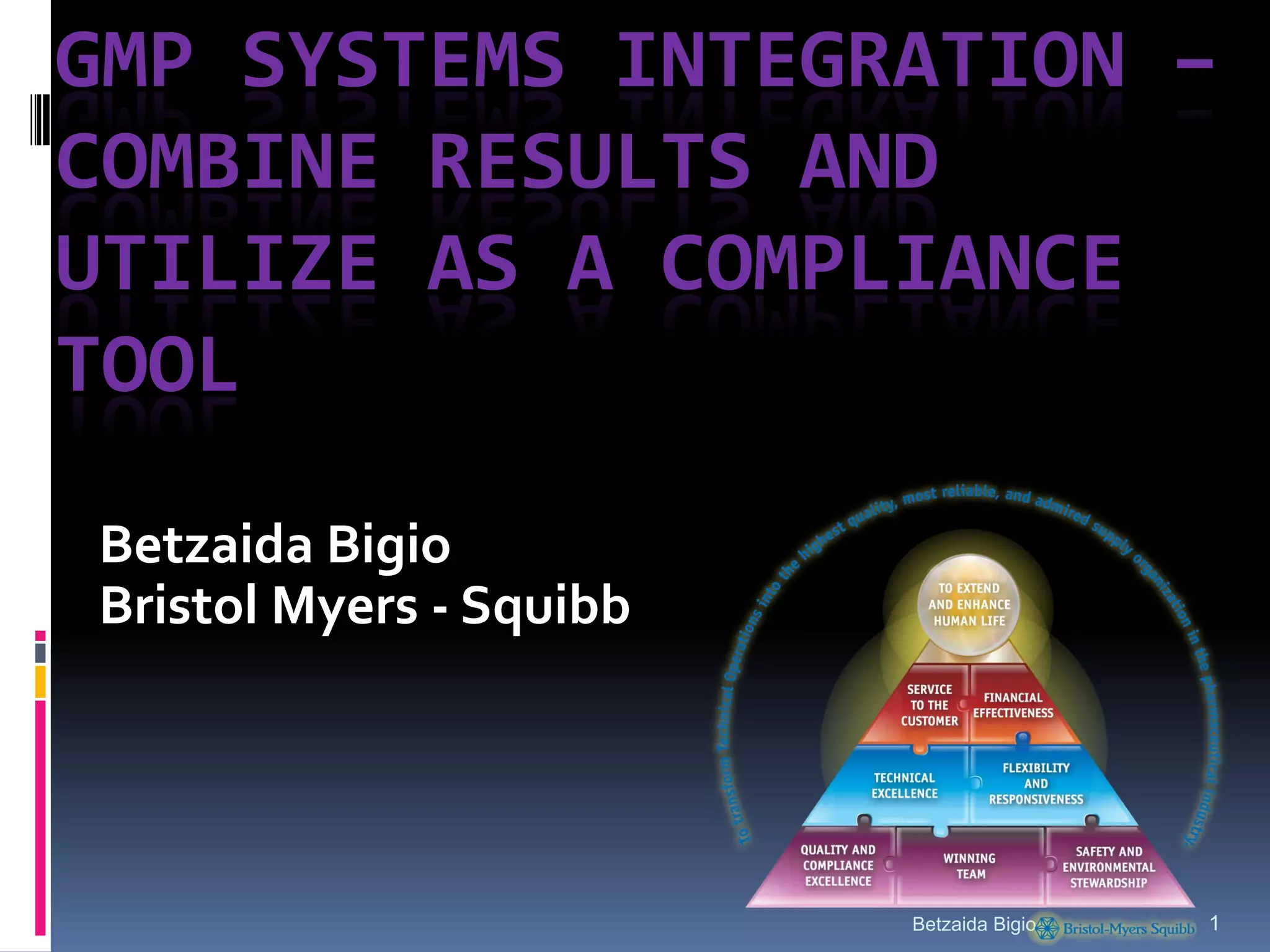
GMP SYSTEMS INTEGRATION –
COMBINE RESULTS AND
UTILIZE AS A COMPLIANCE
TOOL

Betzaida Bigio
Bristol Myers - Squibb


                         Betzaida Bigio   1
We will be Discussing

 GMP systems – no definitions
 How they interact
 Review of recent observations
 How they can be integrated to
  establish controls
 Interactive Exercise


                                  Betzaida Bigio   2
GMP Systems
      Annual Product Reviews (APR)
      Change Control
      Validations
      Equipment qualifications
      Vendor Qualifications
      Preventive Maintenance (PM’s)
      Audits (Internal & External)
      Suppliers audits
      Stability
      Customer complaints
      Suppliers complaints
      CAPA
      Investigations
                                       8/30/2012   3
Integration Between Systems

    Discussion of Recent observations
    Classification of observation
    Integration between systems based
    on each observation


                              8/30/2012   4
Recent Health Authorities
Findings
    Discussion of 2011- 2012 Warning letters
      Eighteen (18) Warning letters
      Focused on Pharmaceutical Industries
         cGMP for API (Active Pharmaceutical Ingredient)
         cGMP for Finished Pharmaceutical
         Location of inspected Sites:
              India
              China
              Germany
              Poland
              UK
              Canada
              Mexico
              Switzerland
              Israel
              Japan
              US

                                                    8/30/2012   5
Recent Observations - “Hot”
Topics
 Cleaning Validation
 Investigations
 Media Fill
 Laboratory Controls
 Test Methods
 Environmental Monitoring
 Microbiology Contamination Prevention
 Disinfectant qualification
 Visual Inspection Qualification
 Supplier Qualification
 Reduce testing
 APR, Record Retention
 Incoming testing of raw materials       8/30/2012   6
Cleaning Validation

 Use of two equipment parts for the production of
  multiple drug products without validating the process
    Process validation for six (6) products conducted
     only with one out of two parts
    Parts identical in construction but different internal
     configurations
    Failure to demonstrate are identical
 Not cleaned and maintained equipment at appropriate
  intervals – holding time

                                           8/30/2012      7
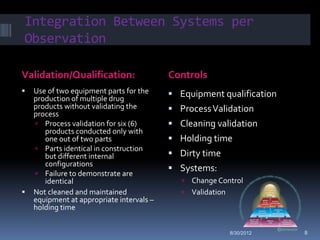
Integration Between Systems per
Observation

Validation/Qualification:                  Controls
   Use of two equipment parts for the      Equipment qualification
    production of multiple drug
    products without validating the         Process Validation
    process
     Process validation for six (6)        Cleaning validation
       products conducted only with
       one out of two parts                 Holding time
     Parts identical in construction
       but different internal               Dirty time
       configurations
                                            Systems:
     Failure to demonstrate are
       identical                               Change Control
   Not cleaned and maintained                 Validation
    equipment at appropriate intervals –
    holding time


                                                          8/30/2012    8
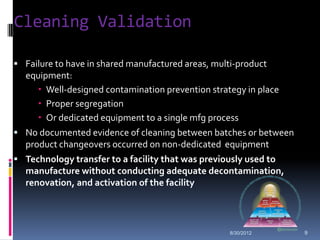
Cleaning Validation

 Failure to have in shared manufactured areas, multi-product
  equipment:
     Well-designed contamination prevention strategy in place
     Proper segregation
     Or dedicated equipment to a single mfg process
 No documented evidence of cleaning between batches or between
  product changeovers occurred on non-dedicated equipment
 Technology transfer to a facility that was previously used to
  manufacture without conducting adequate decontamination,
  renovation, and activation of the facility


                                                    8/30/2012     9
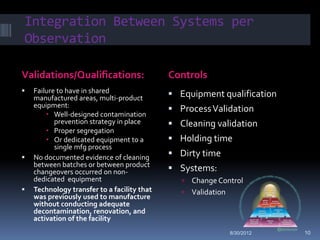
Integration Between Systems per
Observation

Validations/Qualifications:                  Controls
   Failure to have in shared
    manufactured areas, multi-product         Equipment qualification
    equipment:
                                              Process Validation
         Well-designed contamination
           prevention strategy in place       Cleaning validation
         Proper segregation
         Or dedicated equipment to a         Holding time
           single mfg process
   No documented evidence of cleaning        Dirty time
    between batches or between product
    changeovers occurred on non-              Systems:
    dedicated equipment                          Change Control
   Technology transfer to a facility that       Validation
    was previously used to manufacture
    without conducting adequate
    decontamination, renovation, and
    activation of the facility
                                                            8/30/2012    10
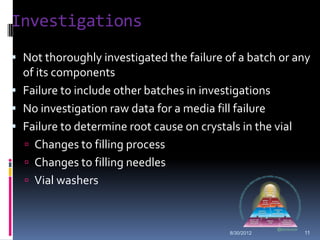
Investigations
 Not thoroughly investigated the failure of a batch or any
  of its components
 Failure to include other batches in investigations
 No investigation raw data for a media fill failure
 Failure to determine root cause on crystals in the vial
   Changes to filling process
   Changes to filling needles
   Vial washers


                                            8/30/2012       11
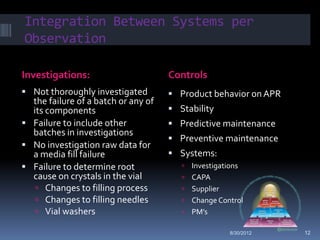
Integration Between Systems per
Observation

Investigations:                      Controls
 Not thoroughly investigated         Product behavior on APR
  the failure of a batch or any of
  its components                      Stability
 Failure to include other            Predictive maintenance
  batches in investigations
                                      Preventive maintenance
 No investigation raw data for
  a media fill failure                Systems:
 Failure to determine root                Investigations
  cause on crystals in the vial            CAPA
    Changes to filling process            Supplier
    Changes to filling needles            Change Control
    Vial washers                          PM’s

                                                      8/30/2012   12
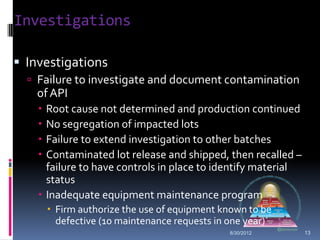
Investigations

 Investigations
   Failure to investigate and document contamination
   of API
     Root cause not determined and production continued
     No segregation of impacted lots
     Failure to extend investigation to other batches
     Contaminated lot release and shipped, then recalled –
      failure to have controls in place to identify material
      status
     Inadequate equipment maintenance program
         Firm authorize the use of equipment known to be
          defective (10 maintenance requests in one year)
                                               8/30/2012       13
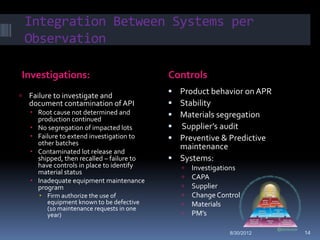
Integration Between Systems per
    Observation

Investigations:                             Controls
   Failure to investigate and
                                             Product behavior on APR
    document contamination of API            Stability
     Root cause not determined and          Materials segregation
      production continued
     No segregation of impacted lots        Supplier’s audit
     Failure to extend investigation to     Preventive & Predictive
      other batches
                                              maintenance
     Contaminated lot release and
      shipped, then recalled – failure to    Systems:
      have controls in place to identify           Investigations
      material status
                                                   CAPA
     Inadequate equipment maintenance
      program                                      Supplier
       Firm authorize the use of                  Change Control
        equipment known to be defective            Materials
        (10 maintenance requests in one
        year)                                      PM’s

                                                               8/30/2012   14
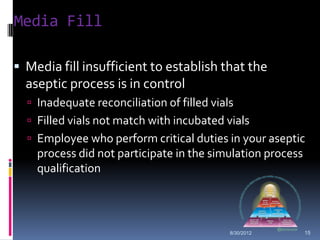
Media Fill

 Media fill insufficient to establish that the
  aseptic process is in control
   Inadequate reconciliation of filled vials
   Filled vials not match with incubated vials
   Employee who perform critical duties in your aseptic
    process did not participate in the simulation process
    qualification


                                            8/30/2012       15
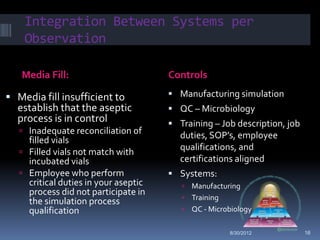
Integration Between Systems per
    Observation

   Media Fill:                         Controls

 Media fill insufficient to            Manufacturing simulation
  establish that the aseptic            QC – Microbiology
  process is in control                 Training – Job description, job
    Inadequate reconciliation of
                                          duties, SOP’s, employee
     filled vials
                                          qualifications, and
    Filled vials not match with
     incubated vials                      certifications aligned
    Employee who perform               Systems:
     critical duties in your aseptic       Manufacturing
     process did not participate in
                                           Training
     the simulation process
     qualification                         QC - Microbiology


                                                       8/30/2012           16
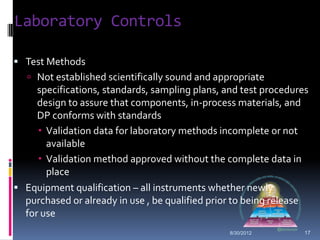
Laboratory Controls

 Test Methods
    Not established scientifically sound and appropriate
     specifications, standards, sampling plans, and test procedures
     design to assure that components, in-process materials, and
     DP conforms with standards
      Validation data for laboratory methods incomplete or not
       available
      Validation method approved without the complete data in
       place
 Equipment qualification – all instruments whether newly
  purchased or already in use , be qualified prior to being release
  for use
                                                 8/30/2012        17
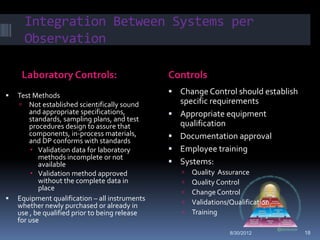
Integration Between Systems per
      Observation

     Laboratory Controls:                       Controls
   Test Methods                                 Change Control should establish
      Not established scientifically sound         specific requirements
        and appropriate specifications,            Appropriate equipment
        standards, sampling plans, and test
        procedures design to assure that            qualification
        components, in-process materials,          Documentation approval
        and DP conforms with standards
          Validation data for laboratory          Employee training
           methods incomplete or not
           available                               Systems:
          Validation method approved                  Quality Assurance
           without the complete data in                Quality Control
           place
                                                       Change Control
   Equipment qualification – all instruments
                                                       Validations/Qualification
    whether newly purchased or already in
    use , be qualified prior to being release          Training
    for use
                                                                    8/30/2012       18
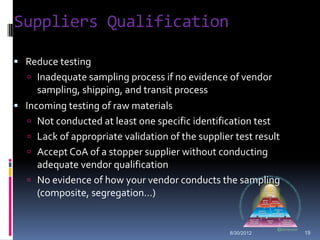
Suppliers Qualification

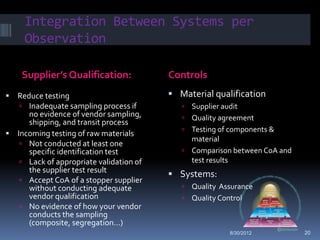
 Reduce testing
    Inadequate sampling process if no evidence of vendor
     sampling, shipping, and transit process
 Incoming testing of raw materials
    Not conducted at least one specific identification test
    Lack of appropriate validation of the supplier test result
    Accept CoA of a stopper supplier without conducting
     adequate vendor qualification
    No evidence of how your vendor conducts the sampling
     (composite, segregation…)


                                                   8/30/2012      19
Integration Between Systems per
     Observation

    Supplier’s Qualification:            Controls
 Reduce testing                          Material qualification
    Inadequate sampling process if          Supplier audit
     no evidence of vendor sampling,         Quality agreement
     shipping, and transit process
                                             Testing of components &
 Incoming testing of raw materials
                                              material
    Not conducted at least one
     specific identification test            Comparison between CoA and
    Lack of appropriate validation of        test results
     the supplier test result
                                          Systems:
    Accept CoA of a stopper supplier
     without conducting adequate             Quality Assurance
     vendor qualification                    Quality Control
    No evidence of how your vendor
     conducts the sampling
     (composite, segregation…)
                                                        8/30/2012          20
Shutdown/Start-up

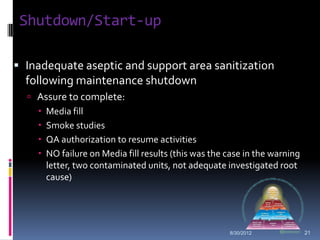
 Inadequate aseptic and support area sanitization
  following maintenance shutdown
   Assure to complete:
     Media fill
     Smoke studies
     QA authorization to resume activities
     NO failure on Media fill results (this was the case in the warning
      letter, two contaminated units, not adequate investigated root
      cause)


                                                      8/30/2012            21
Integration Between Systems per
   Observation

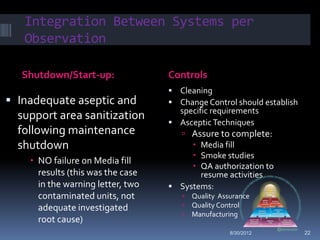
  Shutdown/Start-up:               Controls
                                    Cleaning
 Inadequate aseptic and            Change Control should establish
                                     specific requirements
  support area sanitization         Asceptic Techniques
  following maintenance               Assure to complete:
  shutdown                               Media fill
                                         Smoke studies
     NO failure on Media fill
                                         QA authorization to
      results (this was the case           resume activities
      in the warning letter, two    Systems:
      contaminated units, not            Quality Assurance
      adequate investigated              Quality Control
                                         Manufacturing
      root cause)
                                                     8/30/2012         22
Microbiology Contamination
Prevention
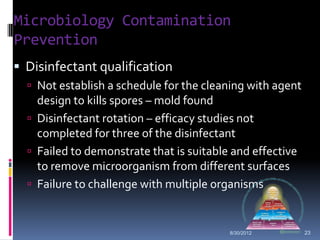
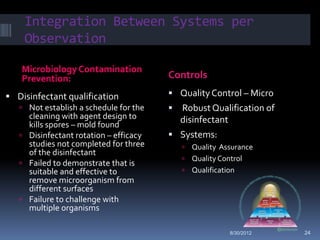
 Disinfectant qualification
   Not establish a schedule for the cleaning with agent
    design to kills spores – mold found
   Disinfectant rotation – efficacy studies not
    completed for three of the disinfectant
   Failed to demonstrate that is suitable and effective
    to remove microorganism from different surfaces
   Failure to challenge with multiple organisms


                                          8/30/2012        23
Integration Between Systems per
    Observation

    Microbiology Contamination
    Prevention:                        Controls
 Disinfectant qualification            Quality Control – Micro
   Not establish a schedule for the      Robust Qualification of
     cleaning with agent design to         disinfectant
     kills spores – mold found
   Disinfectant rotation – efficacy    Systems:
     studies not completed for three        Quality Assurance
     of the disinfectant
                                            Quality Control
   Failed to demonstrate that is
     suitable and effective to              Qualification
     remove microorganism from
     different surfaces
   Failure to challenge with
     multiple organisms

                                                       8/30/2012     24
Microbiology Contamination
Prevention
 Smoke studies
   No evidence of smoke studies
   Failure to demonstrate that appropriate design &
   controls are in place to prevent turbulence and
   stagnant air in critical areas


                                         8/30/2012     25
Integration Between Systems per
   Observation

  Microbiology Contamination
  Prevention:                  Controls
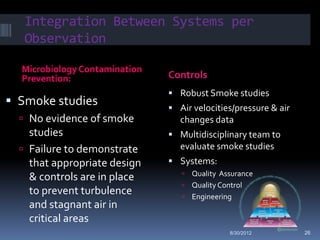
                                Robust Smoke studies
 Smoke studies                 Air velocities/pressure & air
   No evidence of smoke          changes data
    studies                     Multidisciplinary team to
   Failure to demonstrate        evaluate smoke studies
    that appropriate design     Systems:
                                   Quality Assurance
    & controls are in place
                                   Quality Control
    to prevent turbulence          Engineering
    and stagnant air in
    critical areas
                                              8/30/2012          26
Microbiology Contamination
Prevention
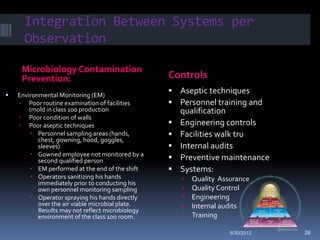
   Environmental Monitoring (EM)
     Poor routine examination of facilities (mold in class 100 production
     Poor condition of walls
     Poor aseptic techniques
        Personnel sampling areas (hands, chest, gowning, hood, goggles, sleeves)
        Gowned employee not monitored by a second qualified person
        EM performed at the end of the shift
        Operators sanitizing his hands immediately prior to conducting his own
          personnel monitoring sampling
        Operator spraying his hands directly over the air viable microbial plate. Results
          may not reflect microbiology environment of the class 100 room.


                                                                    8/30/2012                27
Integration Between Systems per
      Observation

     Microbiology Contamination
     Prevention:                                  Controls
   Environmental Monitoring (EM)
                                                   Aseptic techniques
     Poor routine examination of facilities       Personnel training and
        (mold in class 100 production                 qualification
     Poor condition of walls
     Poor aseptic techniques                        Engineering controls
         Personnel sampling areas (hands,           Facilities walk tru
           chest, gowning, hood, goggles,
           sleeves)                                  Internal audits
         Gowned employee not monitored by a
           second qualified person                   Preventive maintenance
         EM performed at the end of the shift       Systems:
         Operators sanitizing his hands                 Quality Assurance
           immediately prior to conducting his
           own personnel monitoring sampling             Quality Control
         Operator spraying his hands directly           Engineering
           over the air viable microbial plate.          Internal audits
           Results may not reflect microbiology
           environment of the class 100 room.            Training

                                                                     8/30/2012   28
Microbiology Contamination
Prevention
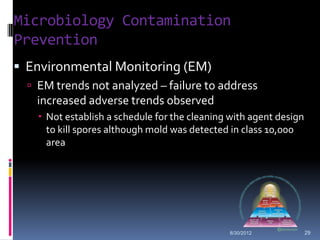
 Environmental Monitoring (EM)
   EM trends not analyzed – failure to address
   increased adverse trends observed
     Not establish a schedule for the cleaning with agent design
      to kill spores although mold was detected in class 10,000
      area


                                               8/30/2012            29
Integration Between Systems per
   Observation

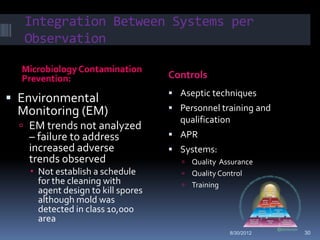
  Microbiology Contamination
  Prevention:                       Controls
                                     Aseptic techniques
 Environmental
 Monitoring (EM)                     Personnel training and
                                      qualification
   EM trends not analyzed
   – failure to address              APR
   increased adverse                 Systems:
   trends observed                      Quality Assurance
     Not establish a schedule          Quality Control
      for the cleaning with             Training
      agent design to kill spores
      although mold was
      detected in class 10,000
      area
                                                   8/30/2012   30
Visual Inspection
Qualification
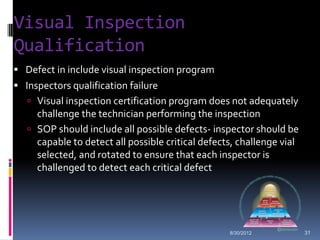
 Defect in include visual inspection program
 Inspectors qualification failure
    Visual inspection certification program does not adequately
     challenge the technician performing the inspection
    SOP should include all possible defects- inspector should be
     capable to detect all possible critical defects, challenge vial
     selected, and rotated to ensure that each inspector is
     challenged to detect each critical defect


                                                   8/30/2012           31
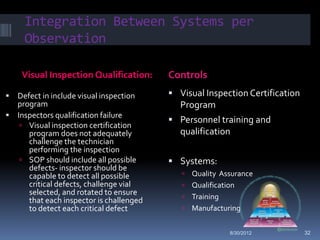
Integration Between Systems per
     Observation

    Visual Inspection Qualification:     Controls
 Defect in include visual inspection     Visual Inspection Certification
  program                                   Program
 Inspectors qualification failure
                                          Personnel training and
    Visual inspection certification
     program does not adequately            qualification
     challenge the technician
     performing the inspection
    SOP should include all possible      Systems:
     defects- inspector should be
     capable to detect all possible          Quality Assurance
     critical defects, challenge vial        Qualification
     selected, and rotated to ensure
                                             Training
     that each inspector is challenged
     to detect each critical defect          Manufacturing


                                                        8/30/2012            32
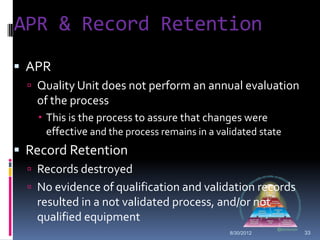
APR & Record Retention
 APR
   Quality Unit does not perform an annual evaluation
   of the process
     This is the process to assure that changes were
      effective and the process remains in a validated state
 Record Retention
   Records destroyed
   No evidence of qualification and validation records
   resulted in a not validated process, and/or not
   qualified equipment
                                                8/30/2012      33
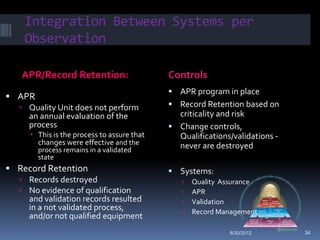
Integration Between Systems per
    Observation

    APR/Record Retention:                    Controls
                                              APR program in place
 APR
   Quality Unit does not perform             Record Retention based on
    an annual evaluation of the                criticality and risk
    process                                   Change controls,
       This is the process to assure that     Qualifications/validations -
        changes were effective and the         never are destroyed
        process remains in a validated
        state
 Record Retention                            Systems:
   Records destroyed                              Quality Assurance
   No evidence of qualification                   APR
    and validation records resulted                Validation
    in a not validated process,                    Record Management
    and/or not qualified equipment
                                                             8/30/2012        34
Interactive Exercise


               8/30/2012   35
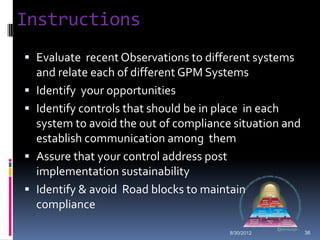
Instructions
 Evaluate recent Observations to different systems
    and relate each of different GPM Systems
   Identify your opportunities
   Identify controls that should be in place in each
    system to avoid the out of compliance situation and
    establish communication among them
   Assure that your control address post
    implementation sustainability
   Identify & avoid Road blocks to maintain
    compliance

                                         8/30/2012        36
3
8/30/2012   7
3
8/30/2012   8

GMP Systems Integration–Combine Results and Utilize as a Compliance Tool

  • 1.
    GMP SYSTEMS INTEGRATION– COMBINE RESULTS AND UTILIZE AS A COMPLIANCE TOOL Betzaida Bigio Bristol Myers - Squibb Betzaida Bigio 1
  • 2.
    We will beDiscussing  GMP systems – no definitions  How they interact  Review of recent observations  How they can be integrated to establish controls  Interactive Exercise Betzaida Bigio 2
  • 3.
    GMP Systems  Annual Product Reviews (APR)  Change Control  Validations  Equipment qualifications  Vendor Qualifications  Preventive Maintenance (PM’s)  Audits (Internal & External)  Suppliers audits  Stability  Customer complaints  Suppliers complaints  CAPA  Investigations 8/30/2012 3
  • 4.
    Integration Between Systems  Discussion of Recent observations  Classification of observation  Integration between systems based on each observation 8/30/2012 4
  • 5.
    Recent Health Authorities Findings  Discussion of 2011- 2012 Warning letters  Eighteen (18) Warning letters  Focused on Pharmaceutical Industries  cGMP for API (Active Pharmaceutical Ingredient)  cGMP for Finished Pharmaceutical  Location of inspected Sites:  India  China  Germany  Poland  UK  Canada  Mexico  Switzerland  Israel  Japan  US 8/30/2012 5
  • 6.
    Recent Observations -“Hot” Topics  Cleaning Validation  Investigations  Media Fill  Laboratory Controls  Test Methods  Environmental Monitoring  Microbiology Contamination Prevention  Disinfectant qualification  Visual Inspection Qualification  Supplier Qualification  Reduce testing  APR, Record Retention  Incoming testing of raw materials 8/30/2012 6
  • 7.
    Cleaning Validation  Useof two equipment parts for the production of multiple drug products without validating the process  Process validation for six (6) products conducted only with one out of two parts  Parts identical in construction but different internal configurations  Failure to demonstrate are identical  Not cleaned and maintained equipment at appropriate intervals – holding time 8/30/2012 7
  • 8.
    Integration Between Systemsper Observation Validation/Qualification: Controls  Use of two equipment parts for the  Equipment qualification production of multiple drug products without validating the  Process Validation process  Process validation for six (6)  Cleaning validation products conducted only with one out of two parts  Holding time  Parts identical in construction but different internal  Dirty time configurations  Systems:  Failure to demonstrate are identical  Change Control  Not cleaned and maintained  Validation equipment at appropriate intervals – holding time 8/30/2012 8
  • 9.
    Cleaning Validation  Failureto have in shared manufactured areas, multi-product equipment:  Well-designed contamination prevention strategy in place  Proper segregation  Or dedicated equipment to a single mfg process  No documented evidence of cleaning between batches or between product changeovers occurred on non-dedicated equipment  Technology transfer to a facility that was previously used to manufacture without conducting adequate decontamination, renovation, and activation of the facility 8/30/2012 9
  • 10.
    Integration Between Systemsper Observation Validations/Qualifications: Controls  Failure to have in shared manufactured areas, multi-product  Equipment qualification equipment:  Process Validation  Well-designed contamination prevention strategy in place  Cleaning validation  Proper segregation  Or dedicated equipment to a  Holding time single mfg process  No documented evidence of cleaning  Dirty time between batches or between product changeovers occurred on non-  Systems: dedicated equipment  Change Control  Technology transfer to a facility that  Validation was previously used to manufacture without conducting adequate decontamination, renovation, and activation of the facility 8/30/2012 10
  • 11.
    Investigations  Not thoroughlyinvestigated the failure of a batch or any of its components  Failure to include other batches in investigations  No investigation raw data for a media fill failure  Failure to determine root cause on crystals in the vial  Changes to filling process  Changes to filling needles  Vial washers 8/30/2012 11
  • 12.
    Integration Between Systemsper Observation Investigations: Controls  Not thoroughly investigated  Product behavior on APR the failure of a batch or any of its components  Stability  Failure to include other  Predictive maintenance batches in investigations  Preventive maintenance  No investigation raw data for a media fill failure  Systems:  Failure to determine root  Investigations cause on crystals in the vial  CAPA  Changes to filling process  Supplier  Changes to filling needles  Change Control  Vial washers  PM’s 8/30/2012 12
  • 13.
    Investigations  Investigations  Failure to investigate and document contamination of API  Root cause not determined and production continued  No segregation of impacted lots  Failure to extend investigation to other batches  Contaminated lot release and shipped, then recalled – failure to have controls in place to identify material status  Inadequate equipment maintenance program  Firm authorize the use of equipment known to be defective (10 maintenance requests in one year) 8/30/2012 13
  • 14.
    Integration Between Systemsper Observation Investigations: Controls  Failure to investigate and  Product behavior on APR document contamination of API  Stability  Root cause not determined and  Materials segregation production continued  No segregation of impacted lots  Supplier’s audit  Failure to extend investigation to  Preventive & Predictive other batches maintenance  Contaminated lot release and shipped, then recalled – failure to  Systems: have controls in place to identify  Investigations material status  CAPA  Inadequate equipment maintenance program  Supplier  Firm authorize the use of  Change Control equipment known to be defective  Materials (10 maintenance requests in one year)  PM’s 8/30/2012 14
  • 15.
    Media Fill  Mediafill insufficient to establish that the aseptic process is in control  Inadequate reconciliation of filled vials  Filled vials not match with incubated vials  Employee who perform critical duties in your aseptic process did not participate in the simulation process qualification 8/30/2012 15
  • 16.
    Integration Between Systemsper Observation Media Fill: Controls  Media fill insufficient to  Manufacturing simulation establish that the aseptic  QC – Microbiology process is in control  Training – Job description, job  Inadequate reconciliation of duties, SOP’s, employee filled vials qualifications, and  Filled vials not match with incubated vials certifications aligned  Employee who perform  Systems: critical duties in your aseptic  Manufacturing process did not participate in  Training the simulation process qualification  QC - Microbiology 8/30/2012 16
  • 17.
    Laboratory Controls  TestMethods  Not established scientifically sound and appropriate specifications, standards, sampling plans, and test procedures design to assure that components, in-process materials, and DP conforms with standards  Validation data for laboratory methods incomplete or not available  Validation method approved without the complete data in place  Equipment qualification – all instruments whether newly purchased or already in use , be qualified prior to being release for use 8/30/2012 17
  • 18.
    Integration Between Systemsper Observation Laboratory Controls: Controls  Test Methods  Change Control should establish  Not established scientifically sound specific requirements and appropriate specifications,  Appropriate equipment standards, sampling plans, and test procedures design to assure that qualification components, in-process materials,  Documentation approval and DP conforms with standards  Validation data for laboratory  Employee training methods incomplete or not available  Systems:  Validation method approved  Quality Assurance without the complete data in  Quality Control place  Change Control  Equipment qualification – all instruments  Validations/Qualification whether newly purchased or already in use , be qualified prior to being release  Training for use 8/30/2012 18
  • 19.
    Suppliers Qualification  Reducetesting  Inadequate sampling process if no evidence of vendor sampling, shipping, and transit process  Incoming testing of raw materials  Not conducted at least one specific identification test  Lack of appropriate validation of the supplier test result  Accept CoA of a stopper supplier without conducting adequate vendor qualification  No evidence of how your vendor conducts the sampling (composite, segregation…) 8/30/2012 19
  • 20.
    Integration Between Systemsper Observation Supplier’s Qualification: Controls  Reduce testing  Material qualification  Inadequate sampling process if  Supplier audit no evidence of vendor sampling,  Quality agreement shipping, and transit process  Testing of components &  Incoming testing of raw materials material  Not conducted at least one specific identification test  Comparison between CoA and  Lack of appropriate validation of test results the supplier test result  Systems:  Accept CoA of a stopper supplier without conducting adequate  Quality Assurance vendor qualification  Quality Control  No evidence of how your vendor conducts the sampling (composite, segregation…) 8/30/2012 20
  • 21.
    Shutdown/Start-up  Inadequate asepticand support area sanitization following maintenance shutdown  Assure to complete:  Media fill  Smoke studies  QA authorization to resume activities  NO failure on Media fill results (this was the case in the warning letter, two contaminated units, not adequate investigated root cause) 8/30/2012 21
  • 22.
    Integration Between Systemsper Observation Shutdown/Start-up: Controls  Cleaning  Inadequate aseptic and  Change Control should establish specific requirements support area sanitization  Asceptic Techniques following maintenance  Assure to complete: shutdown  Media fill  Smoke studies  NO failure on Media fill  QA authorization to results (this was the case resume activities in the warning letter, two  Systems: contaminated units, not  Quality Assurance adequate investigated  Quality Control  Manufacturing root cause) 8/30/2012 22
  • 23.
    Microbiology Contamination Prevention  Disinfectantqualification  Not establish a schedule for the cleaning with agent design to kills spores – mold found  Disinfectant rotation – efficacy studies not completed for three of the disinfectant  Failed to demonstrate that is suitable and effective to remove microorganism from different surfaces  Failure to challenge with multiple organisms 8/30/2012 23
  • 24.
    Integration Between Systemsper Observation Microbiology Contamination Prevention: Controls  Disinfectant qualification  Quality Control – Micro  Not establish a schedule for the  Robust Qualification of cleaning with agent design to disinfectant kills spores – mold found  Disinfectant rotation – efficacy  Systems: studies not completed for three  Quality Assurance of the disinfectant  Quality Control  Failed to demonstrate that is suitable and effective to  Qualification remove microorganism from different surfaces  Failure to challenge with multiple organisms 8/30/2012 24
  • 25.
    Microbiology Contamination Prevention  Smokestudies  No evidence of smoke studies  Failure to demonstrate that appropriate design & controls are in place to prevent turbulence and stagnant air in critical areas 8/30/2012 25
  • 26.
    Integration Between Systemsper Observation Microbiology Contamination Prevention: Controls  Robust Smoke studies  Smoke studies  Air velocities/pressure & air  No evidence of smoke changes data studies  Multidisciplinary team to  Failure to demonstrate evaluate smoke studies that appropriate design  Systems:  Quality Assurance & controls are in place  Quality Control to prevent turbulence  Engineering and stagnant air in critical areas 8/30/2012 26
  • 27.
    Microbiology Contamination Prevention  Environmental Monitoring (EM)  Poor routine examination of facilities (mold in class 100 production  Poor condition of walls  Poor aseptic techniques  Personnel sampling areas (hands, chest, gowning, hood, goggles, sleeves)  Gowned employee not monitored by a second qualified person  EM performed at the end of the shift  Operators sanitizing his hands immediately prior to conducting his own personnel monitoring sampling  Operator spraying his hands directly over the air viable microbial plate. Results may not reflect microbiology environment of the class 100 room. 8/30/2012 27
  • 28.
    Integration Between Systemsper Observation Microbiology Contamination Prevention: Controls  Environmental Monitoring (EM)  Aseptic techniques  Poor routine examination of facilities  Personnel training and (mold in class 100 production qualification  Poor condition of walls  Poor aseptic techniques  Engineering controls  Personnel sampling areas (hands,  Facilities walk tru chest, gowning, hood, goggles, sleeves)  Internal audits  Gowned employee not monitored by a second qualified person  Preventive maintenance  EM performed at the end of the shift  Systems:  Operators sanitizing his hands  Quality Assurance immediately prior to conducting his own personnel monitoring sampling  Quality Control  Operator spraying his hands directly  Engineering over the air viable microbial plate.  Internal audits Results may not reflect microbiology environment of the class 100 room.  Training 8/30/2012 28
  • 29.
    Microbiology Contamination Prevention  EnvironmentalMonitoring (EM)  EM trends not analyzed – failure to address increased adverse trends observed  Not establish a schedule for the cleaning with agent design to kill spores although mold was detected in class 10,000 area 8/30/2012 29
  • 30.
    Integration Between Systemsper Observation Microbiology Contamination Prevention: Controls  Aseptic techniques  Environmental Monitoring (EM)  Personnel training and qualification  EM trends not analyzed – failure to address  APR increased adverse  Systems: trends observed  Quality Assurance  Not establish a schedule  Quality Control for the cleaning with  Training agent design to kill spores although mold was detected in class 10,000 area 8/30/2012 30
  • 31.
    Visual Inspection Qualification  Defectin include visual inspection program  Inspectors qualification failure  Visual inspection certification program does not adequately challenge the technician performing the inspection  SOP should include all possible defects- inspector should be capable to detect all possible critical defects, challenge vial selected, and rotated to ensure that each inspector is challenged to detect each critical defect 8/30/2012 31
  • 32.
    Integration Between Systemsper Observation Visual Inspection Qualification: Controls  Defect in include visual inspection  Visual Inspection Certification program Program  Inspectors qualification failure  Personnel training and  Visual inspection certification program does not adequately qualification challenge the technician performing the inspection  SOP should include all possible  Systems: defects- inspector should be capable to detect all possible  Quality Assurance critical defects, challenge vial  Qualification selected, and rotated to ensure  Training that each inspector is challenged to detect each critical defect  Manufacturing 8/30/2012 32
  • 33.
    APR & RecordRetention  APR  Quality Unit does not perform an annual evaluation of the process  This is the process to assure that changes were effective and the process remains in a validated state  Record Retention  Records destroyed  No evidence of qualification and validation records resulted in a not validated process, and/or not qualified equipment 8/30/2012 33
  • 34.
    Integration Between Systemsper Observation APR/Record Retention: Controls  APR program in place  APR  Quality Unit does not perform  Record Retention based on an annual evaluation of the criticality and risk process  Change controls,  This is the process to assure that Qualifications/validations - changes were effective and the never are destroyed process remains in a validated state  Record Retention  Systems:  Records destroyed  Quality Assurance  No evidence of qualification  APR and validation records resulted  Validation in a not validated process,  Record Management and/or not qualified equipment 8/30/2012 34
  • 35.
  • 36.
    Instructions  Evaluate recentObservations to different systems and relate each of different GPM Systems  Identify your opportunities  Identify controls that should be in place in each system to avoid the out of compliance situation and establish communication among them  Assure that your control address post implementation sustainability  Identify & avoid Road blocks to maintain compliance 8/30/2012 36
  • 37.
  • 38.