QUALITY ASSURANCE
1. Quality?
 FIT FOR USE
 The word “Quality” represents the
properties of products & services that are
valued by the consumer.
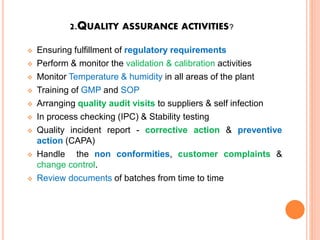
2.QUALITY ASSURANCE ACTIVITIES?
 Ensuring fulfillment of regulatory requirements
 Perform & monitor the validation & calibration activities
 Monitor Temperature & humidity in all areas of the plant
 Training of GMP and SOP
 Arranging quality audit visits to suppliers & self infection
 In process checking (IPC) & Stability testing
 Quality incident report - corrective action & preventive
action (CAPA)
 Handle the non conformities, customer complaints &
change control.
 Review documents of batches from time to time
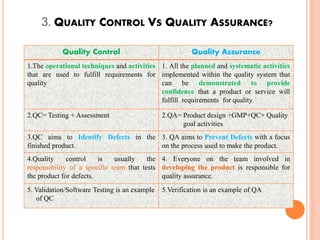
3. QUALITY CONTROL VS QUALITY ASSURANCE?
Quality Control Quality Assurance
1.The operational techniques and activities
that are used to fulfill requirements for
quality
1. All the planned and systematic activities
implemented within the quality system that
can be demonstrated to provide
confidence that a product or service will
fulfill requirements for quality.
2.QC= Testing + Assessment 2.QA= Product design +GMP+QC+ Quality
goal activities
3.QC aims to Identify Defects in the
finished product.
3. QA aims to Prevent Defects with a focus
on the process used to make the product.
4.Quality control is usually the
responsibility of a specific team that tests
the product for defects.
4. Everyone on the team involved in
developing the product is responsible for
quality assurance.
5. Validation/Software Testing is an example
of QC
5.Verification is an example of QA
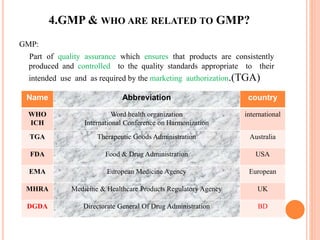
4.GMP & WHO ARE RELATED TO GMP?
GMP:
Part of quality assurance which ensures that products are consistently
produced and controlled to the quality standards appropriate to their
intended use and as required by the marketing authorization.(TGA)
Name Abbreviation country
WHO
ICH
Word health organization
International Conference on Harmonization
international
TGA Therapeutic Goods Administration Australia
FDA Food & Drug Administration USA
EMA European Medicine Agency European
MHRA Medicine & Healthcare Products Regulatory Agency UK
DGDA Directorate General Of Drug Administration BD
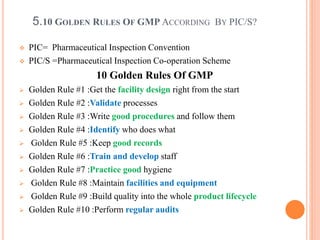
5.10 GOLDEN RULES OF GMP ACCORDING BY PIC/S?
 PIC= Pharmaceutical Inspection Convention
 PIC/S =Pharmaceutical Inspection Co-operation Scheme
10 Golden Rules Of GMP
 Golden Rule #1 :Get the facility design right from the start
 Golden Rule #2 :Validate processes
 Golden Rule #3 :Write good procedures and follow them
 Golden Rule #4 :Identify who does what
 Golden Rule #5 :Keep good records
 Golden Rule #6 :Train and develop staff
 Golden Rule #7 :Practice good hygiene
 Golden Rule #8 :Maintain facilities and equipment
 Golden Rule #9 :Build quality into the whole product lifecycle
 Golden Rule #10 :Perform regular audits
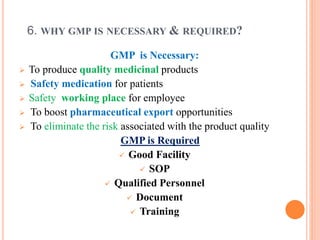
6. WHY GMP IS NECESSARY & REQUIRED?
GMP is Necessary:
 To produce quality medicinal products
 Safety medication for patients
 Safety working place for employee
 To boost pharmaceutical export opportunities
 To eliminate the risk associated with the product quality
GMP is Required
 Good Facility
 SOP
 Qualified Personnel
 Document
 Training
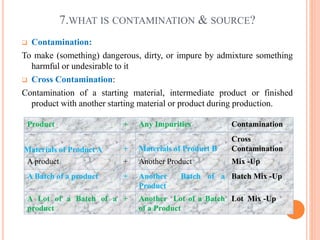
7.WHAT IS CONTAMINATION & SOURCE?
 Contamination:
To make (something) dangerous, dirty, or impure by admixture something
harmful or undesirable to it
 Cross Contamination:
Contamination of a starting material, intermediate product or finished
product with another starting material or product during production.
Product + Any Impurities Contamination
Materials of Product A + Materials of Product B
Cross
Contamination
A product + Another Product Mix -Up
A Batch of a product + Another Batch of a
Product
Batch Mix -Up
A Lot of a Batch of a
product
+ Another Lot of a Batch
of a Product
Lot Mix -Up
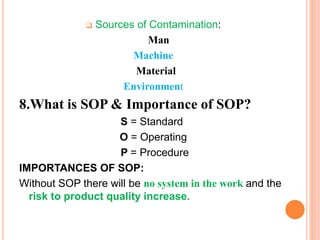
 Sources of Contamination:
Man
Machine
Material
Environment
8.What is SOP & Importance of SOP?
S = Standard
O = Operating
P = Procedure
IMPORTANCES OF SOP:
Without SOP there will be no system in the work and the
risk to product quality increase.
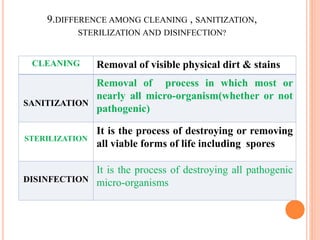
9.DIFFERENCE AMONG CLEANING , SANITIZATION,
STERILIZATION AND DISINFECTION?
CLEANING Removal of visible physical dirt & stains
SANITIZATION
Removal of process in which most or
nearly all micro-organism(whether or not
pathogenic)
STERILIZATION
It is the process of destroying or removing
all viable forms of life including spores
DISINFECTION
It is the process of destroying all pathogenic
micro-organisms
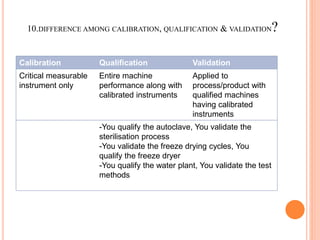
10.DIFFERENCE AMONG CALIBRATION, QUALIFICATION & VALIDATION?
Calibration Qualification Validation
Critical measurable
instrument only
Entire machine
performance along with
calibrated instruments
Applied to
process/product with
qualified machines
having calibrated
instruments
-You qualify the autoclave, You validate the
sterilisation process
-You validate the freeze drying cycles, You
qualify the freeze dryer
-You qualify the water plant, You validate the test
methods
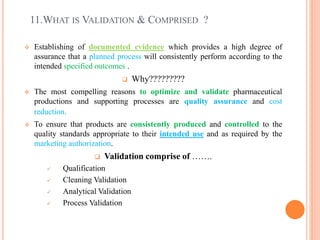
11.WHAT IS VALIDATION & COMPRISED ?
 Establishing of documented evidence which provides a high degree of
assurance that a planned process will consistently perform according to the
intended specified outcomes .
 Why?????????
 The most compelling reasons to optimize and validate pharmaceutical
productions and supporting processes are quality assurance and cost
reduction.
 To ensure that products are consistently produced and controlled to the
quality standards appropriate to their intended use and as required by the
marketing authorization.
 Validation comprise of …….
 Qualification
 Cleaning Validation
 Analytical Validation
 Process Validation
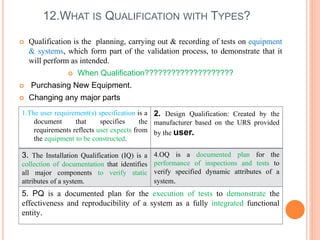
12.WHAT IS QUALIFICATION WITH TYPES?
 Qualification is the planning, carrying out & recording of tests on equipment
& systems, which form part of the validation process, to demonstrate that it
will perform as intended.
 When Qualification????????????????????
 Purchasing New Equipment.
 Changing any major parts
1.The user requirement(s) specification is a
document that specifies the
requirements reflects user expects from
the equipment to be constructed.
2. Design Qualification: Created by the
manufacturer based on the URS provided
by the user.
3. The Installation Qualification (IQ) is a
collection of documentation that identifies
all major components to verify static
attributes of a system.
4.OQ is a documented plan for the
performance of inspections and tests to
verify specified dynamic attributes of a
system.
5. PQ is a documented plan for the execution of tests to demonstrate the
effectiveness and reproducibility of a system as a fully integrated functional
entity.
11.WHAT IS PROCESS VALIDATION & TERMINOLOGY
 Establishing of documented evidence which provides a high degree of
assurance that a specific process will consistently produce a product
meeting its pre-determined specification & quality characteristics.
 Terminology….
1. Prospective validation
2. Concurrent validation
3. Retrospective validation
14.WHAT IS VALIDATION MASTER PLAN
 A Validation Master Plan (VMP) is an integral part
of a well organized validation project.
 It documents the company's approach to complex
validation projects.
 It clarifies responsibilities, general objectives,
procedures to be followed for validation, and it
prioritizes multiple validation tasks.
 It requires collaboration of experts, miticulous
planning and budget
15.WHAT IS CLEANING VALIDATION & WHY?
 The process of removing contaminants from process equipment and
monitoring the condition of equipment such that the equipment can be
safely used for subsequent product manufacturing
 Three criteria :
 It should be scientifically justifiable.
 Practical & achievable.
 Methodically verifiable.
o Why?????????????
o Protect product integrity and to avoid cross contamination for internal
control and compliance.
o To reuse the equipments and make the process more cost effective.
o To combat the regulatory authorities (FDA, USFDA, cGMP).
 To increase Equipment Utilization.
 For multiproduct Equipments.

Quality assurance

  • 1.
    QUALITY ASSURANCE 1. Quality? FIT FOR USE  The word “Quality” represents the properties of products & services that are valued by the consumer.
  • 2.
    2.QUALITY ASSURANCE ACTIVITIES? Ensuring fulfillment of regulatory requirements  Perform & monitor the validation & calibration activities  Monitor Temperature & humidity in all areas of the plant  Training of GMP and SOP  Arranging quality audit visits to suppliers & self infection  In process checking (IPC) & Stability testing  Quality incident report - corrective action & preventive action (CAPA)  Handle the non conformities, customer complaints & change control.  Review documents of batches from time to time
  • 3.
    3. QUALITY CONTROLVS QUALITY ASSURANCE? Quality Control Quality Assurance 1.The operational techniques and activities that are used to fulfill requirements for quality 1. All the planned and systematic activities implemented within the quality system that can be demonstrated to provide confidence that a product or service will fulfill requirements for quality. 2.QC= Testing + Assessment 2.QA= Product design +GMP+QC+ Quality goal activities 3.QC aims to Identify Defects in the finished product. 3. QA aims to Prevent Defects with a focus on the process used to make the product. 4.Quality control is usually the responsibility of a specific team that tests the product for defects. 4. Everyone on the team involved in developing the product is responsible for quality assurance. 5. Validation/Software Testing is an example of QC 5.Verification is an example of QA
  • 4.
    4.GMP & WHOARE RELATED TO GMP? GMP: Part of quality assurance which ensures that products are consistently produced and controlled to the quality standards appropriate to their intended use and as required by the marketing authorization.(TGA) Name Abbreviation country WHO ICH Word health organization International Conference on Harmonization international TGA Therapeutic Goods Administration Australia FDA Food & Drug Administration USA EMA European Medicine Agency European MHRA Medicine & Healthcare Products Regulatory Agency UK DGDA Directorate General Of Drug Administration BD
  • 5.
    5.10 GOLDEN RULESOF GMP ACCORDING BY PIC/S?  PIC= Pharmaceutical Inspection Convention  PIC/S =Pharmaceutical Inspection Co-operation Scheme 10 Golden Rules Of GMP  Golden Rule #1 :Get the facility design right from the start  Golden Rule #2 :Validate processes  Golden Rule #3 :Write good procedures and follow them  Golden Rule #4 :Identify who does what  Golden Rule #5 :Keep good records  Golden Rule #6 :Train and develop staff  Golden Rule #7 :Practice good hygiene  Golden Rule #8 :Maintain facilities and equipment  Golden Rule #9 :Build quality into the whole product lifecycle  Golden Rule #10 :Perform regular audits
  • 6.
    6. WHY GMPIS NECESSARY & REQUIRED? GMP is Necessary:  To produce quality medicinal products  Safety medication for patients  Safety working place for employee  To boost pharmaceutical export opportunities  To eliminate the risk associated with the product quality GMP is Required  Good Facility  SOP  Qualified Personnel  Document  Training
  • 7.
    7.WHAT IS CONTAMINATION& SOURCE?  Contamination: To make (something) dangerous, dirty, or impure by admixture something harmful or undesirable to it  Cross Contamination: Contamination of a starting material, intermediate product or finished product with another starting material or product during production. Product + Any Impurities Contamination Materials of Product A + Materials of Product B Cross Contamination A product + Another Product Mix -Up A Batch of a product + Another Batch of a Product Batch Mix -Up A Lot of a Batch of a product + Another Lot of a Batch of a Product Lot Mix -Up
  • 8.
     Sources ofContamination: Man Machine Material Environment 8.What is SOP & Importance of SOP? S = Standard O = Operating P = Procedure IMPORTANCES OF SOP: Without SOP there will be no system in the work and the risk to product quality increase.
  • 9.
    9.DIFFERENCE AMONG CLEANING, SANITIZATION, STERILIZATION AND DISINFECTION? CLEANING Removal of visible physical dirt & stains SANITIZATION Removal of process in which most or nearly all micro-organism(whether or not pathogenic) STERILIZATION It is the process of destroying or removing all viable forms of life including spores DISINFECTION It is the process of destroying all pathogenic micro-organisms
  • 10.
    10.DIFFERENCE AMONG CALIBRATION,QUALIFICATION & VALIDATION? Calibration Qualification Validation Critical measurable instrument only Entire machine performance along with calibrated instruments Applied to process/product with qualified machines having calibrated instruments -You qualify the autoclave, You validate the sterilisation process -You validate the freeze drying cycles, You qualify the freeze dryer -You qualify the water plant, You validate the test methods
  • 11.
    11.WHAT IS VALIDATION& COMPRISED ?  Establishing of documented evidence which provides a high degree of assurance that a planned process will consistently perform according to the intended specified outcomes .  Why?????????  The most compelling reasons to optimize and validate pharmaceutical productions and supporting processes are quality assurance and cost reduction.  To ensure that products are consistently produced and controlled to the quality standards appropriate to their intended use and as required by the marketing authorization.  Validation comprise of …….  Qualification  Cleaning Validation  Analytical Validation  Process Validation
  • 12.
    12.WHAT IS QUALIFICATIONWITH TYPES?  Qualification is the planning, carrying out & recording of tests on equipment & systems, which form part of the validation process, to demonstrate that it will perform as intended.  When Qualification????????????????????  Purchasing New Equipment.  Changing any major parts 1.The user requirement(s) specification is a document that specifies the requirements reflects user expects from the equipment to be constructed. 2. Design Qualification: Created by the manufacturer based on the URS provided by the user. 3. The Installation Qualification (IQ) is a collection of documentation that identifies all major components to verify static attributes of a system. 4.OQ is a documented plan for the performance of inspections and tests to verify specified dynamic attributes of a system. 5. PQ is a documented plan for the execution of tests to demonstrate the effectiveness and reproducibility of a system as a fully integrated functional entity.
  • 13.
    11.WHAT IS PROCESSVALIDATION & TERMINOLOGY  Establishing of documented evidence which provides a high degree of assurance that a specific process will consistently produce a product meeting its pre-determined specification & quality characteristics.  Terminology…. 1. Prospective validation 2. Concurrent validation 3. Retrospective validation
  • 14.
    14.WHAT IS VALIDATIONMASTER PLAN  A Validation Master Plan (VMP) is an integral part of a well organized validation project.  It documents the company's approach to complex validation projects.  It clarifies responsibilities, general objectives, procedures to be followed for validation, and it prioritizes multiple validation tasks.  It requires collaboration of experts, miticulous planning and budget
  • 15.
    15.WHAT IS CLEANINGVALIDATION & WHY?  The process of removing contaminants from process equipment and monitoring the condition of equipment such that the equipment can be safely used for subsequent product manufacturing  Three criteria :  It should be scientifically justifiable.  Practical & achievable.  Methodically verifiable. o Why????????????? o Protect product integrity and to avoid cross contamination for internal control and compliance. o To reuse the equipments and make the process more cost effective. o To combat the regulatory authorities (FDA, USFDA, cGMP).  To increase Equipment Utilization.  For multiproduct Equipments.