Regulatory Considerations for Use of 
Regulatory Considerations for Use of
Cloud Computing and SaaS Environments
Institute of Validation Technology Conference
Qualifying and Validating Cloud and Virtualized IT Infrastructure  
Philadelphia PA 
Philadelphia PA
21‐August‐2012

Chris Wubbolt, BS, MS
Chris Wubbolt BS MS


John Patterson, MSE
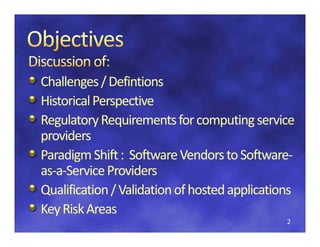
Challenges / Defintions
 h ll       / fi i
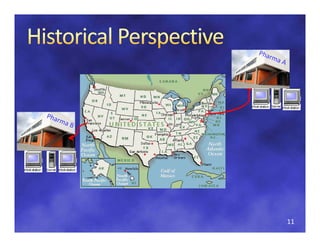
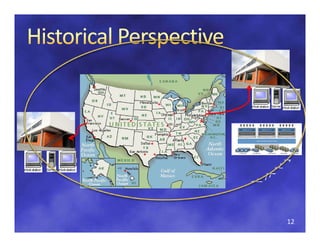
Historical Perspective
Regulatory Requirements for computing service 
providers
Paradigm Shift :  Software Vendors to Software‐
as‐ Service Providers
as‐a‐Service Providers
Qualification / Validation of hosted applications
Key Risk Areas
                                               2
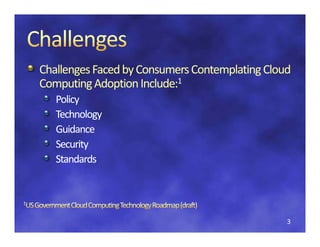
Challenges Faced by Consumers Contemplating Cloud 
Challenges Faced by Consumers Contemplating C
Computing Adoption Include:1
 omputing A
   Policy
   Technology
   Guidance
   Security
   Standards


                                                3
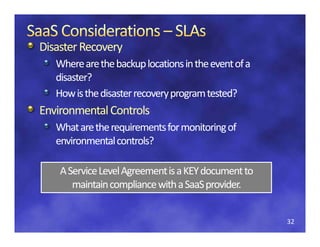
Cloud computing is still in an early deployment stage, 
and standards are crucial to increased adoption. 
Urgency is driven by rapid deployment of cloud 
computing in response to financial incentives. 
Strategically, there is a need to augment standards 
and to establish additional security, interoperability, 
and portability standards :
   to ensure cost‐
   to ensure cost‐effective and easy migration, 
   to ensure that mission‐
   to ensure that mission‐critical requirements can be met, 
   and to reduce the risk that sizable investments may 
   and to reduce the risk that sizable investments may 
      d     d      h kh             bl
   become prematurely technologically obsolete.                4
Cloud Computing2
Virtual Machines3
Infrastructure as a Service (IaaS)2
Infrastructure as a Service 
Infrastructure as a Service (IaaS)
Platform as a Service (PaaS) 2
Platform as a Service (PaaS)
Software as a Service (SaaS)2
Software as a Service (SaaS)


                                      5
Public Cloud 2‐ The cloud infrastructure is made available to
Public Cloud 
Public Cloud  The cloud infrastructure is made available to 
the general public or a large industry group and is owned 
by an organization selling cloud services.

Private Cloud 2‐ The cloud infrastructure is operated solely 
for an organization.  It may be managed by the organization 
for an organization It may be managed by the organization
or a third party and may exist on premise or off premise.


                                                           6
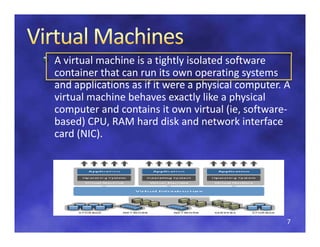
A virtual machine is a tightly isolated software 
container that can run its own operating systems 
                                   p      g y
and applications as if it were a physical computer. A 
virtual machine behaves exactly like a physical 
computer and contains it own virtual (ie, software‐
computer and contains it own virtual (ie software
based) CPU, RAM hard disk and network interface 
card (NIC).
     ( )


                                                    7
The capability provided to the consumer is to 
p
provision processing, storage, networks, and other 
          p        g,      g ,         ,
fundamental computing resources where the 
consumer is able to deploy and run software, which 
can include operating systems and applications. 
can include operating systems and applications

The consumer does not manage or control the
The consumer does not manage or control the 
underlying cloud infrastructure but has control over 
operating systems, storage, and deployed 
applications; and possibly limited control of select 
networking components (e.g., host firewalls). 

                                                   8
The capability provided to the consumer is to 
deploy onto the cloud infrastructure consumer‐
   p y
created or acquired applications created using 
programming languages, libraries, services, and 
tools supported by the provider.
tools supported by the provider

 The consumer does not manage or control the
 The consumer does not manage or control the 
underlying cloud infrastructure including network, 
servers, operating systems, or storage, but has 
control over the deployed applications and possibly 
configuration settings for the application‐hosting 
environment
environment.
                                                   9
The capability provided to the consumer is to use the 
provider s appls running on a cloud infrastructure. 
provider’s appls running on a cloud infrastructure

The apps are accessible from various client devices 
The apps are accessible from various client devices
through either a thin client interface, such as a web 
browser (e.g., web‐based email), or program interface.

The consumer does not manage or control the 
underlying cloud infrastructure including network, 
   d l i     l di f t t          i l di       t   k
servers, operating systems, storage, or even individual 
application capabilities, with the possible exception of 
  pp          p         ,          p            p
limited user‐specific application configuration settings. 
                                                       1
                                                       0
11
12
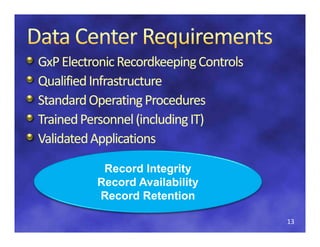
GxP Electronic Recordkeeping Controls
Qualified Infrastructure
Q lifi d I f
Standard Operating Procedures
Trained Personnel (including IT)
Validated Applications
Validated Applications

           Record Integrity
          Record Availability
          Record Retention

                                        13
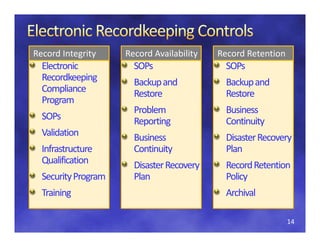
Record Integrity     Record Availability    Record Retention
  Electronic           SOPs                   SOPs
  Recordkeeping 
  Recordkeeping        Backup and             Backup and 
  Compliance           Restore                Restore
  Program
                       Problem 
                       P bl                   Business 
                                              B i
  SOPs                 Reporting              Continuity
  Validation           Business 
                       Business               Disaster Recovery 
                                              Disaster Recovery
  Infrastructure       Continuity             Plan
  Qualification        Disaster Recovery      Record Retention 
  Security Program     Plan                   Policy
  Training                                    Archival

                                                               14
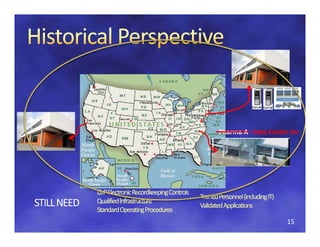
Pharma A Data Center Inc


             GxPElectronic Recordkeeping Controls
             GxP Electronic Recordkeeping Controls
                                                     Trained Personnel (including IT)
STILL NEED
STILL NEED   Qualified Infrastructure
             QualifiedInfrastructure
                                                     Validated Applications
             Standard Operating Procedures
             Standard Operating Procedures
                                                                                        15
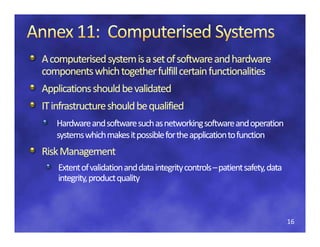
A computerised
A computerised system is a set of software and hardware 
components which together fulfill certain functionalities
Applications should be validated
IT infrastructure should be qualified
IT infrastructure should be qualified
   Hardware and software such as networking software and operation 
   systems which makes it possible for the application to function
   systems which makes it possible for the application to function
    y                     p                 pp
Risk Management 
Risk Management 
    Extent of validation and data integrity controls  patient safety, data 
    Extent ofvalidationand dataintegritycontrols – patient safety, data
                              dataintegritycontrols–
    integrity, product quality
    integrity, product quality


                                                                              16
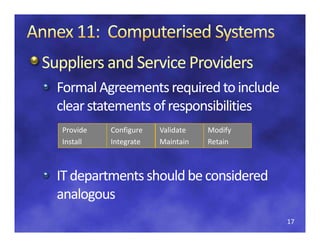
Suppliers and Service Providers
  Formal Agreements required to include 
  clear statements of responsibilities
  clear statements of 
  clear statements of responsibilities
  Provide   Configure   Validate   Modify
  Install
       ll   Integrate   Maintain
                            i i    Retain
                                       i


  IT departments should be considered 
  IT d
     departments should be considered 
                  h ld b        d d
  analogous
        g
                                            17
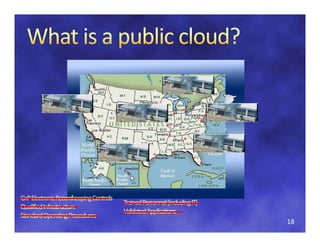
GxPElectronic Recordkeeping Controls
GxP Electronic Recordkeeping Controls
                         p g
                                        TrainedPersonnel(includingIT)
                                        Trained Personnel (including IT)
Qualified Infrastructure
                                        Validated Applications
Standard Operating Procedures
                                                                           18
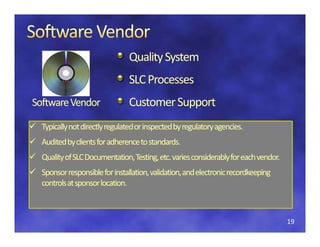
Quality System
                               SLC Processes 
                               SLC P
Software Vendor                Customer Support
                                          pp
  Typically not directly regulated or inspected by regulatory agencies.
  Typically not directly regulated or inspected by regulatory agencies.
  Audited by clients for adherence to standards.
  Audited by clients for adherence to standards.
  A di db li         f dh                 d d
  Quality of SLC Documentation, Testing, etc. varies considerably for each vendor.
  Quality of SLC Documentation, Testing, etc. varies considerably for each vendor.
  S
  Sponsor responsible for installation, validation, and electronic recordkeeping 
                   ibl f i t ll ti        lid ti      d l t i           dk i
  controls at sponsor location.


                                                                                     19
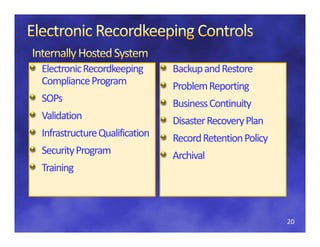
Electronic Recordkeeping       Backup and Restore
Compliance Program
      l                        Problem Reporting
                               Problem Reporting
SOPs                           Business Continuity
                                                 y
Validation                     Disaster Recovery Plan
Infrastructure Qualification   Record Retention Policy
                               Record Retention Policy
Security Program               Archival
Training


                                                         20
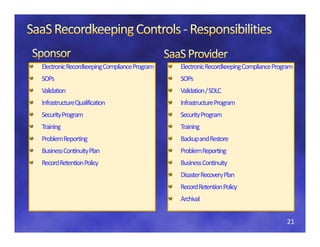
Electronic Recordkeeping Compliance Program   Electronic Recordkeeping Compliance Program
SOPs
SOP                                           SOPs
                                              SOP
Validation                                    Validation / SDLC
Infrastructure Qualification                  Infrastructure Program
Security Program                              Security Program
Training                                      Training
Problem Reporting
ProblemReporting                              Backup and Restore
                                              Backup and Restore
                                              BackupandRestore
                                              Backup andRestore
Business Continuity Plan                      Problem Reporting
                                              Problem Reporting
Record Retention Policy                       Business Continuity
                                              Disaster Recovery Plan
                                              Record Retention Policy
                                              Archival


                                                                                      21
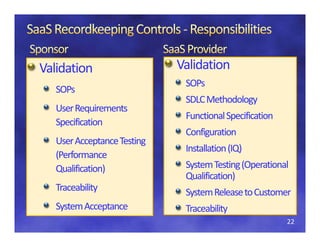
Validation                    Validation
                               SOPs
   SOPs
                               SDLC Methodology
   User Requirements 
   User Requirements
                               Functional Specification
   Specification
                               Configuration
   User Acceptance Testing 
   U A         t   T ti
                               Installation (IQ)
   (Performance 
   Qualification)              System Testing (Operational 
                               Qualification)
   Traceability                System Release to Customer
   System Acceptance           Traceability
                                                          22
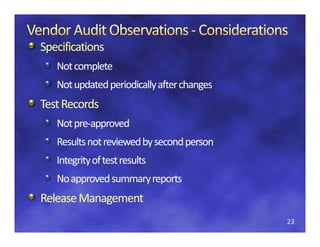
Specifications
   Not complete
   Not updated periodically after changes
Test Records
Test Records
   Not pre‐
   Not pre‐approved
   Results not reviewed by second person
   R lt t i d b                 d
   Integrity of test results
   No approved summary reports
Release Management
Release Management
                                            23
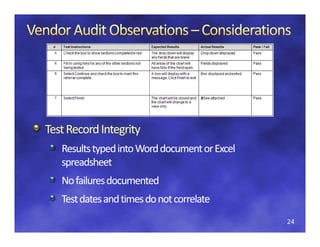
Test Record Integrity
   Results typed into Word document or Excel 
   spreadsheet
   No failures documented
   Test dates and times do not correlate
   Test dates and times do not correlate 
                                                24
Quality System
                              Quality System
                            SLC Processes 
                             SLC Processes 
                             SLC P
                            Customer Support                 Hosted Environment
Software Vendor              Customer Support
                            Validation  pp
                            Record Keeping Controls
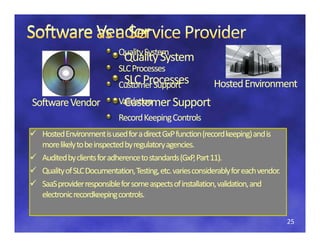
  Hosted Environment is used for a direct GxP function (record keeping) and is 
  Typically not directly regulated or inspected by regulatory agencies.
  Hosted Environment is used for a direct GxPfunction (record keeping) and is 
  Typically not directly regulated or inspected by regulatory agencies.
  more likely to be inspected by regulatory agencies.
  Audited by clients for adherence to standards.
  Audited by clients for adherence to standards.
  Audited by clients for adherence to standards (GxP, Part 11).
  Audited by clients for adherence to standards (GxP, Part 11).
  Quality of SLC Documentation, Testing, etc. varies considerably for each vendor.
  Quality of SLC Documentation, Testing, etc. varies considerably for each vendor.
  QualityofSLCDocumentation Testing etc variesconsiderably foreachvendor
  Quality of SLC Documentation, Testing, etc. varies considerably for each vendor.
  Quality of SLC Documentation, Testing, etc. varies considerablyforeach vendor
                                                varies considerably for each vendor.
  Sponsor responsible for installation, validation, and electronic recordkeeping 
  SaaSprovider responsible for some aspects of installation, validation, and 
  SaaS provider responsible for some aspects of installation, validation, and 
  controls at sponsor location.
  electronic recordkeeping controls.
  electronic recordkeeping controls.

                                                                                       25
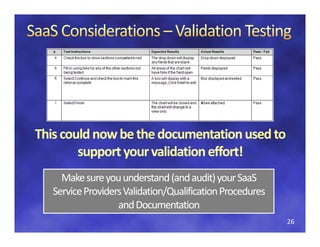
This could now be the documentation used to 
        support your validation effort!
     Make sure you understand (and audit) your SaaS
     Make sure you understand (and audit) your SaaS
   Service Providers Validation/Qualification Procedures 
                   and Documentation
                      dD            i
                                                            26
SAS 70  / SSAE‐
SAS 70  / SSAE‐16
   Internationally recognized financial auditing standard
    nternationally recognized financial auditing standard 
    nternationally recognized financial auditing standard 
   developed by the AICPA
   developed by the AICPA
   SAS 70 was replaced by SSAE
   SAS 70 was replaced by SSAE 16 in June 2011
   SAS 70 was replaced by SSAE‐16 in June 2011
                              SSAE‐
   There is no SAS 70 / SSAE‐16 certification 
   There is no SAS 70 / SSAE‐
   There is no list of published SAS 70 / SSAE 16 
   There is no list of published SAS 70 / SSAE‐16
                                          SSAE‐
   standards


                                                             27
SAS 70  / SSAE‐
SAS 70  / SSAE‐16
   Requires a description of controls and attestation of 
   Requires a description of controls and attestation of 
   Requires a description of controls and attestation of
   controls by management
   CPA firms issue Type I (design) and Type II (design 
   CPA firms issue Type I (design) and Type II (design
   and effectiveness) reports
   Neither SAS 70 or SSAE‐
   Neither SAS 70 or SSAE‐16 discuss qualification or 
                                       q
   validation of network infrastructure


                                                            28
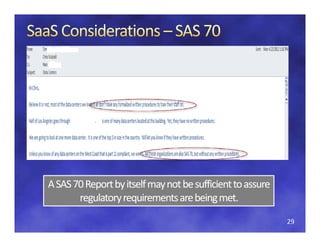
A SAS 70 Report by itself may not be sufficient to assure 
       regulatory requirements are being met.
          g     y q                       g

                                                             29
System Unavailable
   System Down
   Connection Problems
   Data Center Disaster
   Legal / Contractual Disputes

      Make sure your Business Continuity Plans are 
                     established.

   Be sure your legal contracts are carefully constructed 
                       and reviewed.
                       and reviewed
                                                             30
Change
Change Control
Change Control
   In a shared environment with multiple customers, 
   how are hardware or software platform changes 
   how are hardware or software platform changes
   communicated or approved?
   How are application upgrades handled?
   How are application upgrades handled?
Backups
   What is the frequency of the backup?
   What is the freq enc of the back p?
   What happens if a backup fails?
Security
S    i
   Who has access to the computing environment 
   (logically or physically)?
   (l i ll        h i ll )?
                                                       31
Disaster Recovery
Disaster Recovery 
   Where are the backup locations in the event of a 
   disaster?
   How is the disaster recovery program tested?
Environmental Controls
E i       t lC t l
   What are the requirements for monitoring of 
   environmental controls?
   en ironmental controls?

    A Service Level Agreement is a KEY document to 
    A Service Level Agreement is a KEY document to
       maintain compliance with a SaaS provider.
       maintain compliance with a SaaS


                                                       32
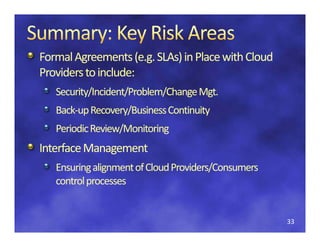
Formal Agreements (e.g. SLAs) in Place with Cloud 
Providers to include:
   Security/Incident/Problem/Change Mgt.
   Back‐up Recovery/Business Continuity
   Back‐ R
   B k             /B i      C ti it
   Periodic Review/Monitoring
Interface Management
   Ensuring alignment of Cloud Providers/Consumers 
   Ensuring alignment of Cloud Providers/Consumers
   control processes


                                                      33
34
1. NIST Special Publication 500‐293, US Government Cloud 
   NIST Special Publication 500‐
   Computing Technology Roadmap , Volume I, Release 1.0 
   (draft) ,  High‐Priority Requirements to Further USG Agency 
   (draft) ,  
   ( f ) High‐Priority Requirements to Further USG Agency 
   Cloud Computing Adoption,  November 2011 
   Cloud Computing Adoption,  November 2011 
2. NIST Special Publication 800 145, The NIST Definition of Cloud 
2 NIST Special Publication 800‐145 The NIST Definition of Cloud
   NIST Special Publication 800‐
   Computing,   September 2011
   Computing,   September 2011
3. VMWare (http://www.vmware.com/virtualization/virtual‐machine.html)
                  p //              /           /                   )
4. Federal Cloud Computing Strategy, The White House, 
   February 8, 2011


                                                                   35
Chris Wubbolt, BS, MS     www.QACVConsulting.com
Principal Consultant      3242 Regal Road
QACV Consulting, LLC
QACV Consulting LLC       Bethlehem, PA 18020 USA
                          Bethlehem, PA 18020 USA
                             hl h

                          Telephone:  610‐442‐
                          Telephone:  610‐442‐2250
                          E‐mail:  chris.wubbolt@QACVConsulting.com
                            mail:  chris.wubbolt@QACVConsulting.com


John Patterson, MSE       1 Merck Drive
Executive  Director –     Whitehouse Station NJ  08889
Compliance; 
Manufacturing , Supply 
      f     i         l
Chain IT; Merck & Co.     Telephone:  908‐423‐5675
                          Telephone:  908‐423‐
                          E‐mail:  john.patterson@merck.com


                                                                      36

Regulatory Considerations for use of Cloud Computing and SaaS Environments

  • 1.
    Regulatory Considerations for Use of  Regulatory Considerations forUse of Cloud Computing and SaaS Environments Institute of Validation Technology Conference Qualifying and Validating Cloud and Virtualized IT Infrastructure   Philadelphia PA  Philadelphia PA 21‐August‐2012 Chris Wubbolt, BS, MS Chris Wubbolt BS MS John Patterson, MSE
  • 2.
    Challenges / Defintions Challenges / Defintions h ll / fi i Historical Perspective Regulatory Requirements for computing service  providers Paradigm Shift :  Software Vendors to Software‐ Paradigm Shift :  Software Vendors to Software‐ as‐ Service Providers as‐a‐Service Providers Qualification / Validation of hosted applications Key Risk Areas 2
  • 3.
  • 4.
    Cloud computing is still in an early deployment stage,  Cloud computing is still in an early deployment stage,  and standards are crucial to increased adoption.  Urgency is driven by rapid deployment of cloud  Urgency is driven by rapid deployment of cloud  computing in response to financial incentives.  Strategically, there is a need to augment standards  and to establish additional security, interoperability,  and portability standards : to ensure cost‐ to ensure cost‐effective and easy migration,  to ensure that mission‐ to ensure that mission‐critical requirements can be met,  and to reduce the risk that sizable investments may  and to reduce the risk that sizable investments may  d d h kh bl become prematurely technologically obsolete.  4
  • 5.
    Cloud Computing2 Virtual Machines3 Infrastructure as aService (IaaS)2 Infrastructure as a Service  Infrastructure as a Service (IaaS) Platform as a Service (PaaS) 2 Platform as a Service (PaaS) Software as a Service (SaaS)2 Software as a Service (SaaS) 5
  • 6.
    Public Cloud 2‐The cloud infrastructure is made available to Public Cloud  Public Cloud  The cloud infrastructure is made available to  the general public or a large industry group and is owned  by an organization selling cloud services. by an organization selling cloud services. Private Cloud 2‐ The cloud infrastructure is operated solely  for an organization.  It may be managed by the organization  for an organization It may be managed by the organization or a third party and may exist on premise or off premise. 6
  • 7.
    A virtual machine is a tightly isolated software  container that can run its own operating systems  p g y and applications as if it were a physical computer. A  virtual machine behaves exactly like a physical  computer and contains it own virtual (ie, software‐ computer and contains it own virtual (ie software based) CPU, RAM hard disk and network interface  card (NIC). ( ) 7
  • 8.
    The capability provided to the consumer is to  p provision processing, storage, networks, and other  p g, g , , fundamental computing resources where the  consumer is able to deploy and run software, which  can include operating systems and applications.  can include operating systems and applications The consumer does not manage or control the The consumer does not manage or control the  underlying cloud infrastructure but has control over  operating systems, storage, and deployed  applications; and possibly limited control of select  networking components (e.g., host firewalls).  8
  • 9.
    The capability provided to the consumer is to  deploy onto the cloud infrastructure consumer‐ p y created or acquired applications created using  programming languages, libraries, services, and  tools supported by the provider. tools supported by the provider The consumer does not manage or control the The consumer does not manage or control the  underlying cloud infrastructure including network,  servers, operating systems, or storage, but has  control over the deployed applications and possibly  configuration settings for the application‐hosting  environment environment. 9
  • 10.
    The capability provided to the consumer is to use the  provider s appls running on a cloud infrastructure.  provider’sappls running on a cloud infrastructure The apps are accessible from various client devices  The apps are accessible from various client devices through either a thin client interface, such as a web  browser (e.g., web‐based email), or program interface. The consumer does not manage or control the  underlying cloud infrastructure including network,  d l i l di f t t i l di t k servers, operating systems, storage, or even individual  application capabilities, with the possible exception of  pp p , p p limited user‐specific application configuration settings.  1 0
  • 11.
  • 12.
  • 13.
    GxP Electronic Recordkeeping Controls Qualified Infrastructure Q lifid I f Standard Operating Procedures Trained Personnel (including IT) Validated Applications Validated Applications Record Integrity Record Availability Record Retention 13
  • 14.
    Record Integrity Record Availability Record Retention Electronic  SOPs SOPs Recordkeeping  Recordkeeping Backup and  Backup and  Compliance  Restore Restore Program Problem  P bl Business  B i SOPs Reporting Continuity Validation Business  Business Disaster Recovery  Disaster Recovery Infrastructure  Continuity Plan Qualification Disaster Recovery  Record Retention  Security Program Plan Policy Training Archival 14
  • 15.
    Pharma A Data Center Inc GxPElectronic Recordkeeping Controls GxP Electronic Recordkeeping Controls Trained Personnel (including IT) STILL NEED STILL NEED Qualified Infrastructure QualifiedInfrastructure Validated Applications Standard Operating Procedures Standard Operating Procedures 15
  • 16.
    A computerised A computerised system is a set of software and hardware  components which together fulfill certain functionalities Applications should be validated IT infrastructure should be qualified IT infrastructureshould be qualified Hardware and software such as networking software and operation  systems which makes it possible for the application to function systems which makes it possible for the application to function y p pp Risk Management  Risk Management  Extent of validation and data integrity controls  patient safety, data  Extent ofvalidationand dataintegritycontrols – patient safety, data dataintegritycontrols– integrity, product quality integrity, product quality 16
  • 17.
    Suppliers and Service Providers Suppliers and Service Providers Formal Agreements required to include  clear statements of responsibilities clear statements of  clear statements of responsibilities Provide Configure Validate Modify Install ll Integrate Maintain i i Retain i IT departments should be considered  IT d departments should be considered  h ld b d d analogous g 17
  • 18.
    GxPElectronic Recordkeeping Controls GxP Electronic Recordkeeping Controls p g TrainedPersonnel(includingIT) Trained Personnel (including IT) Qualified Infrastructure Validated Applications Standard Operating Procedures Standard Operating Procedures 18
  • 19.
    Quality System SLC Processes  SLC P Software Vendor  Customer Support pp Typically not directly regulated or inspected by regulatory agencies. Typically not directly regulated or inspected by regulatory agencies. Audited by clients for adherence to standards. Audited by clients for adherence to standards. A di db li f dh d d Quality of SLC Documentation, Testing, etc. varies considerably for each vendor. Quality of SLC Documentation, Testing, etc. varies considerably for each vendor. S Sponsor responsible for installation, validation, and electronic recordkeeping  ibl f i t ll ti lid ti d l t i dk i controls at sponsor location. 19
  • 20.
    Electronic Recordkeeping  Backup and Restore Compliance Program l Problem Reporting Problem Reporting SOPs Business Continuity y Validation Disaster Recovery Plan Infrastructure Qualification Record Retention Policy Record Retention Policy Security Program Archival Training 20
  • 21.
    Electronic Recordkeeping Compliance Program Electronic Recordkeeping Compliance Program SOPs SOP SOPs SOP Validation Validation / SDLC Infrastructure Qualification Infrastructure Program Security Program Security Program Training Training Problem Reporting ProblemReporting Backup and Restore Backup and Restore BackupandRestore Backup andRestore Business Continuity Plan Problem Reporting Problem Reporting Record Retention Policy  Business Continuity Disaster Recovery Plan Record Retention Policy Archival 21
  • 22.
    Validation Validation SOPs SOPs SDLC Methodology User Requirements  User Requirements Functional Specification Specification Configuration User Acceptance Testing  U A t T ti Installation (IQ) (Performance  Qualification) System Testing (Operational  Qualification) Traceability System Release to Customer System Acceptance Traceability 22
  • 23.
    Specifications Not complete Not updated periodically after changes Test Records Test Records Not pre‐ Not pre‐approved Results not reviewed by second person R lt t i d b d Integrity of test results No approved summary reports Release Management Release Management 23
  • 24.
    Test Record Integrity Results typed into Word document or Excel  spreadsheet No failures documented Test dates and times do not correlate Test dates and times do not correlate  24
  • 25.
    Quality System Quality System SLC Processes  SLC Processes  SLC P Customer Support Hosted Environment Software Vendor  Customer Support Validation pp Record Keeping Controls Hosted Environment is used for a direct GxP function (record keeping) and is  Typically not directly regulated or inspected by regulatory agencies. Hosted Environment is used for a direct GxPfunction (record keeping) and is  Typically not directly regulated or inspected by regulatory agencies. more likely to be inspected by regulatory agencies. Audited by clients for adherence to standards. Audited by clients for adherence to standards. Audited by clients for adherence to standards (GxP, Part 11). Audited by clients for adherence to standards (GxP, Part 11). Quality of SLC Documentation, Testing, etc. varies considerably for each vendor. Quality of SLC Documentation, Testing, etc. varies considerably for each vendor. QualityofSLCDocumentation Testing etc variesconsiderably foreachvendor Quality of SLC Documentation, Testing, etc. varies considerably for each vendor. Quality of SLC Documentation, Testing, etc. varies considerablyforeach vendor varies considerably for each vendor. Sponsor responsible for installation, validation, and electronic recordkeeping  SaaSprovider responsible for some aspects of installation, validation, and  SaaS provider responsible for some aspects of installation, validation, and  controls at sponsor location. electronic recordkeeping controls. electronic recordkeeping controls. 25
  • 26.
    This could now be the documentation used to  This could now be the documentation used to  support your validation effort! Make sure you understand (and audit) your SaaS Make sure you understand (and audit) your SaaS Service Providers Validation/Qualification Procedures  and Documentation dD i 26
  • 27.
    SAS 70  / SSAE‐ SAS 70  / SSAE‐16 Internationally recognized financial auditing standard nternationally recognized financial auditing standard  nternationally recognized financial auditing standard  developed by the AICPA developed by the AICPA SAS 70 was replaced by SSAE SAS 70 was replaced by SSAE 16 in June 2011 SAS 70 was replaced by SSAE‐16 in June 2011 SSAE‐ There is no SAS 70 / SSAE‐16 certification  There is no SAS 70 / SSAE‐ There is no list of published SAS 70 / SSAE 16  There is no list of published SAS 70 / SSAE‐16 SSAE‐ standards 27
  • 28.
    SAS 70  / SSAE‐ SAS 70  / SSAE‐16 Requires a description of controls and attestation of  Requires a description of controls and attestation of  Requires a description of controls and attestation of controls by management CPA firms issue Type I (design) and Type II (design  CPA firms issue Type I (design) and Type II (design and effectiveness) reports Neither SAS 70 or SSAE‐ Neither SAS 70 or SSAE‐16 discuss qualification or  q validation of network infrastructure 28
  • 29.
    A SAS 70 Report by itself may not be sufficient to assure  regulatory requirements are being met. g y q g 29
  • 30.
    System Unavailable System Down Connection Problems Data Center Disaster Legal / Contractual Disputes Make sure your Business Continuity Plans are  established. Be sure your legal contracts are carefully constructed  and reviewed. and reviewed 30
  • 31.
    Change Change Control Change Control In a shared environment with multiple customers,  how are hardware or software platform changes  how are hardware or software platform changes communicated or approved? How are application upgrades handled? How are application upgrades handled? Backups What is the frequency of the backup? What is the freq enc of the back p? What happens if a backup fails? Security S i Who has access to the computing environment  (logically or physically)? (l i ll h i ll )? 31
  • 32.
    Disaster Recovery Disaster Recovery  Where are the backup locations in the event of a  disaster? How is the disaster recovery program tested? Environmental Controls E i t lC t l What are the requirements for monitoring of  environmental controls? en ironmental controls? A Service Level Agreement is a KEY document to  A Service Level Agreement is a KEY document to maintain compliance with a SaaS provider. maintain compliance with a SaaS 32
  • 33.
    Formal Agreements (e.g. SLAs) in Place with Cloud  Providers to include: Security/Incident/Problem/Change Mgt. Back‐up Recovery/Business Continuity Back‐ R B k /B i C ti it Periodic Review/Monitoring Interface Management Ensuring alignment of Cloud Providers/Consumers  Ensuring alignment of Cloud Providers/Consumers control processes 33
  • 34.
  • 35.
    1. NIST Special Publication 500‐293, US Government Cloud  NIST Special Publication 500‐ Computing Technology Roadmap , Volume I, Release 1.0  (draft) ,  High‐Priority Requirements to Further USG Agency  (draft) ,   ( f ) High‐Priority Requirements to Further USG Agency  Cloud Computing Adoption,  November 2011  Cloud Computing Adoption,  November 2011  2. NIST Special Publication 800 145, The NIST Definition of Cloud  2 NIST Special Publication 800‐145 The NIST Definition of Cloud NIST Special Publication 800‐ Computing,   September 2011 Computing,   September 2011 3. VMWare (http://www.vmware.com/virtualization/virtual‐machine.html) p // / / ) 4. Federal Cloud Computing Strategy, The White House,  February 8, 2011 35
  • 36.
    Chris Wubbolt, BS, MS www.QACVConsulting.com Principal Consultant 3242 Regal Road QACV Consulting, LLC QACV Consulting LLC Bethlehem, PA 18020 USA Bethlehem, PA 18020 USA hl h Telephone:  610‐442‐ Telephone:  610‐442‐2250 E‐mail:  chris.wubbolt@QACVConsulting.com mail:  chris.wubbolt@QACVConsulting.com John Patterson, MSE 1 Merck Drive Executive  Director – Whitehouse Station NJ  08889 Compliance;  Manufacturing , Supply  f i l Chain IT; Merck & Co. Telephone:  908‐423‐5675 Telephone:  908‐423‐ E‐mail:  john.patterson@merck.com 36