LIFECYCLE APPROACHC C O C
TO CLEANING VALIDATION
Paul L. Pluta, PhD
Validation Week EU, 2013
1
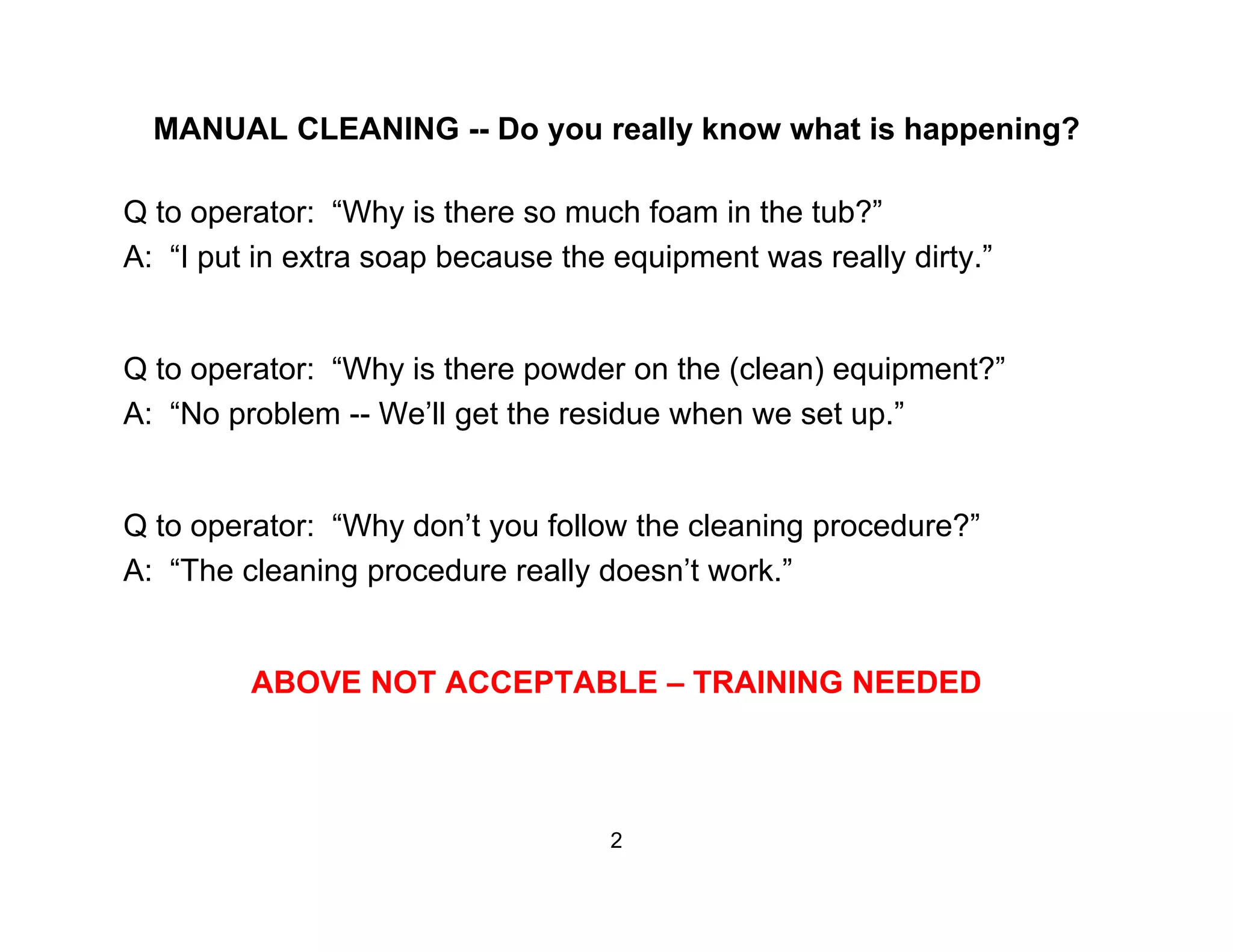
MANUAL CLEANING -- Do you really know what is happening?
Q to operator: “Why is there so much foam in the tub?”
A: “I put in extra soap because the equipment was really dirty.”
Q to operator: “Why is there powder on the (clean) equipment?”
A: “No problem -- We’ll get the residue when we set up ”A: No problem -- We ll get the residue when we set up.
Q to operator: “Why don’t you follow the cleaning procedure?”Q to operator: Why don t you follow the cleaning procedure?
A: “The cleaning procedure really doesn’t work.”
ABOVE NOT ACCEPTABLE – TRAINING NEEDED
2
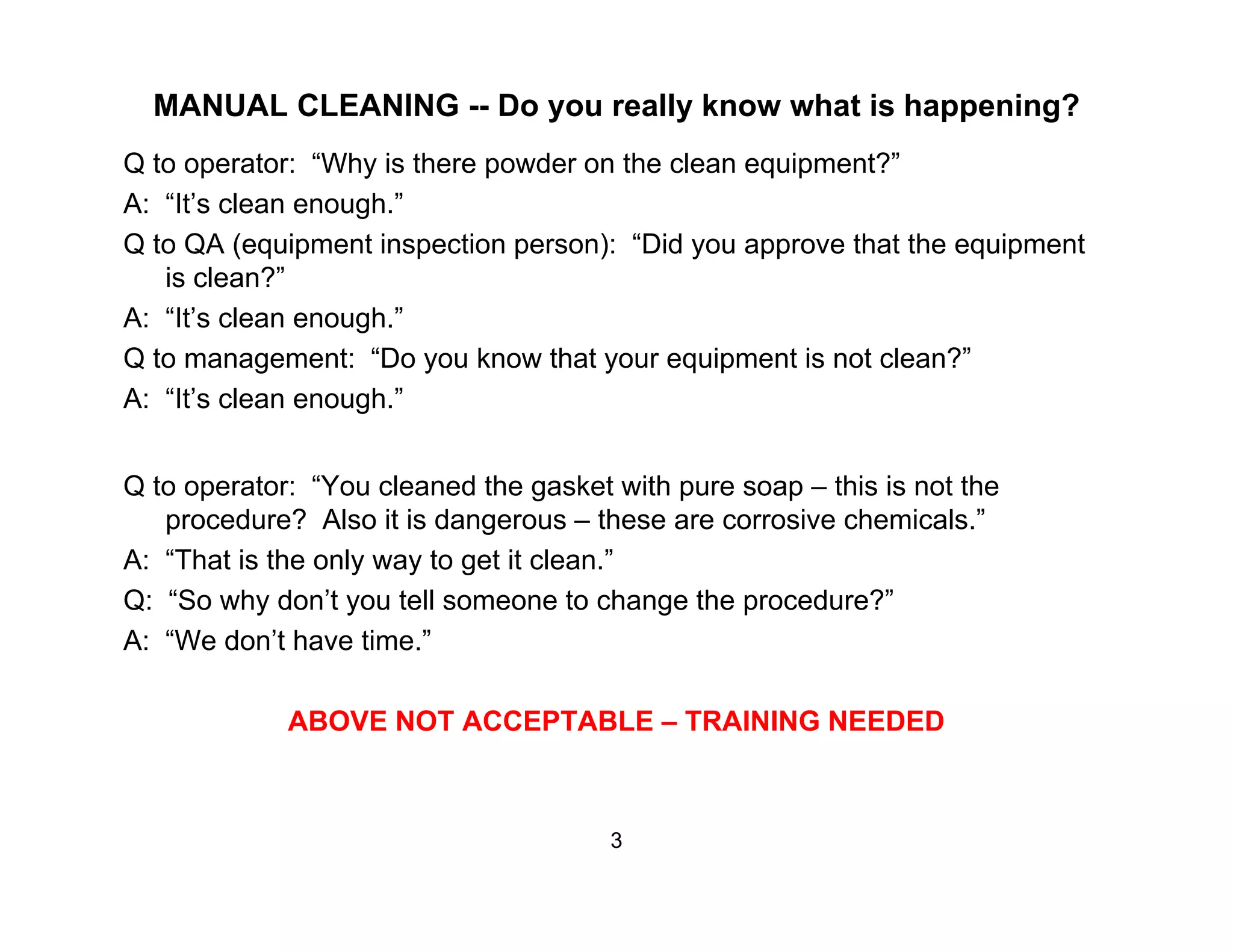
MANUAL CLEANING -- Do you really know what is happening?
Q to operator: “Why is there powder on the clean equipment?”p y p q p
A: “It’s clean enough.”
Q to QA (equipment inspection person): “Did you approve that the equipment
is clean?”
A: “It’s clean enough.”
Q to management: “Do you know that your equipment is not clean?”
A: “It’s clean enough.”
Q to operator: “You cleaned the gasket with pure soap – this is not the
procedure? Also it is dangerous – these are corrosive chemicals.”
A: “That is the only way to get it clean.”
Q: “So why don’t you tell someone to change the procedure?”
A: “We don’t have time.”
ABOVE NOT ACCEPTABLE – TRAINING NEEDED
3
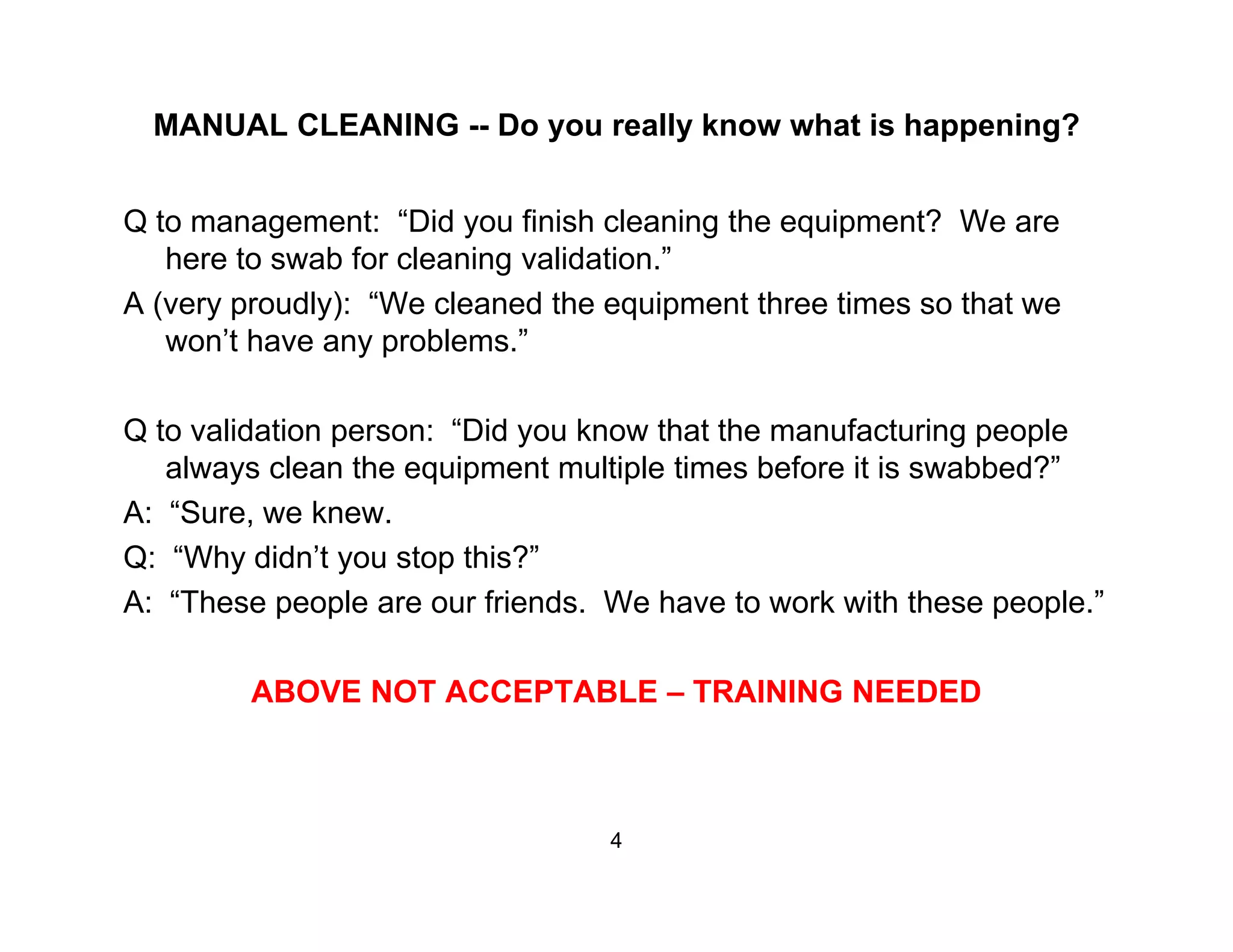
MANUAL CLEANING -- Do you really know what is happening?
Q to management: “Did you finish cleaning the equipment? We are
here to swab for cleaning validation.”
A ( dl ) “W l d th i t th ti th tA (very proudly): “We cleaned the equipment three times so that we
won’t have any problems.”
Q to validation person: “Did you know that the manufacturing people
always clean the equipment multiple times before it is swabbed?”
A: “Sure, we knew.
Q: “Why didn’t you stop this?”
A: “These people are our friends. We have to work with these people.”
ABOVE NOT ACCEPTABLE – TRAINING NEEDED
4
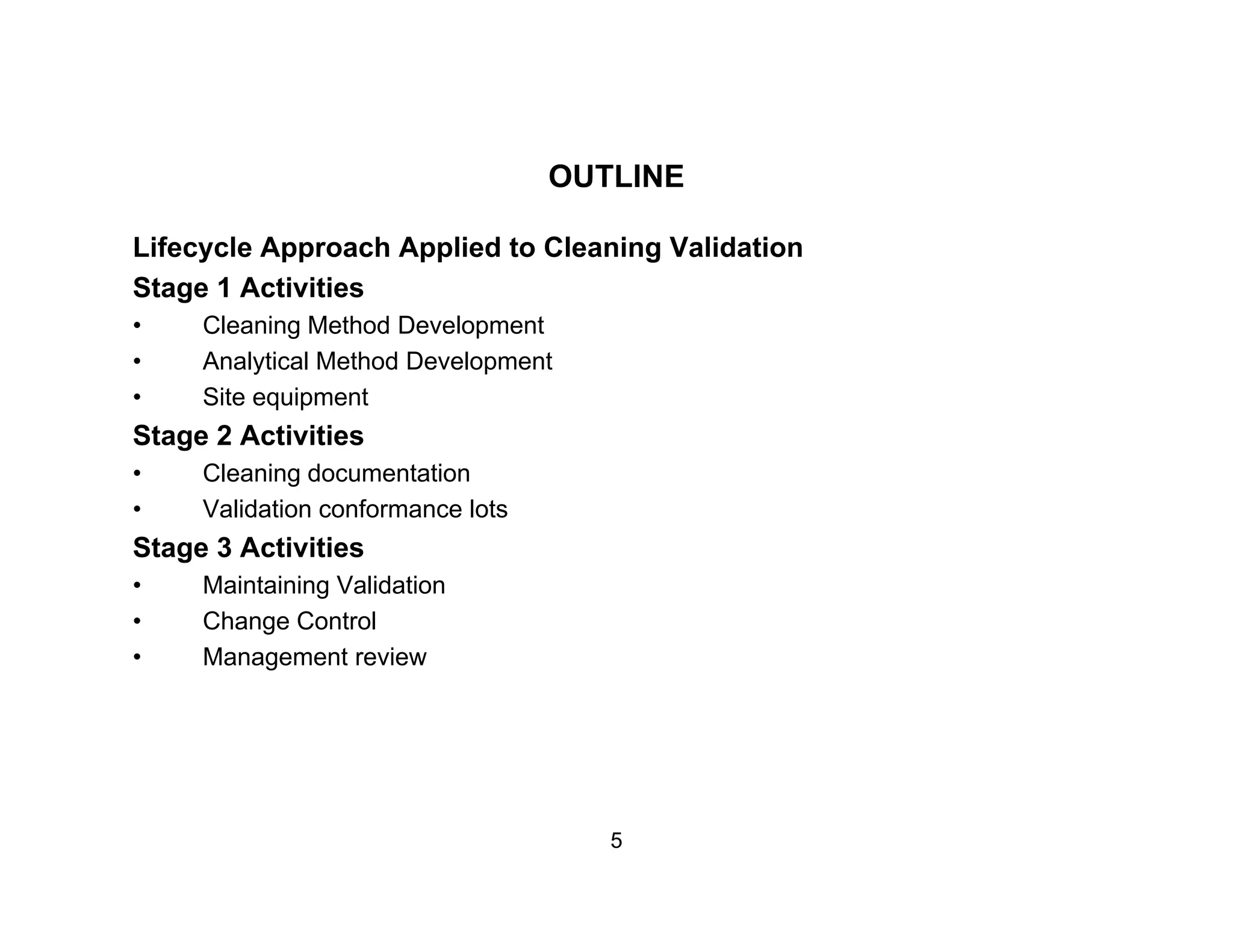
OUTLINEOUTLINE
Lifecycle Approach Applied to Cleaning Validation
Stage 1 ActivitiesStage 1 Activities
• Cleaning Method Development
• Analytical Method Development
• Site equipment
Stage 2 Activities
• Cleaning documentation
• Validation conformance lots
Stage 3 Activities
• Maintaining Validation
• Change Control
• Management review• Management review
5
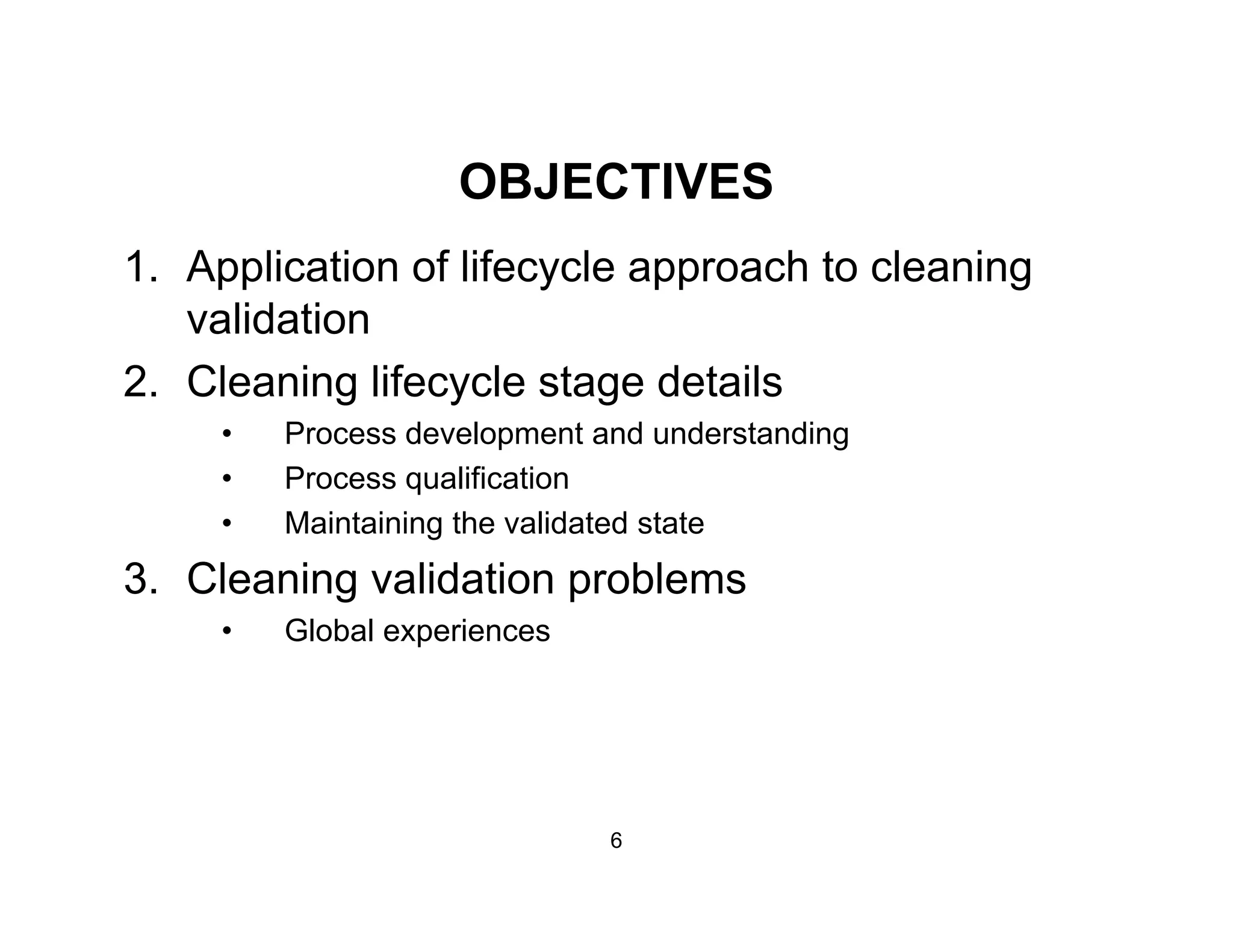
OBJECTIVESOBJECTIVES
1. Application of lifecycle approach to cleaning
validation
2. Cleaning lifecycle stage details
• Process development and understanding
• Process qualification
• Maintaining the validated stateg
3. Cleaning validation problems
• Global experiences
6
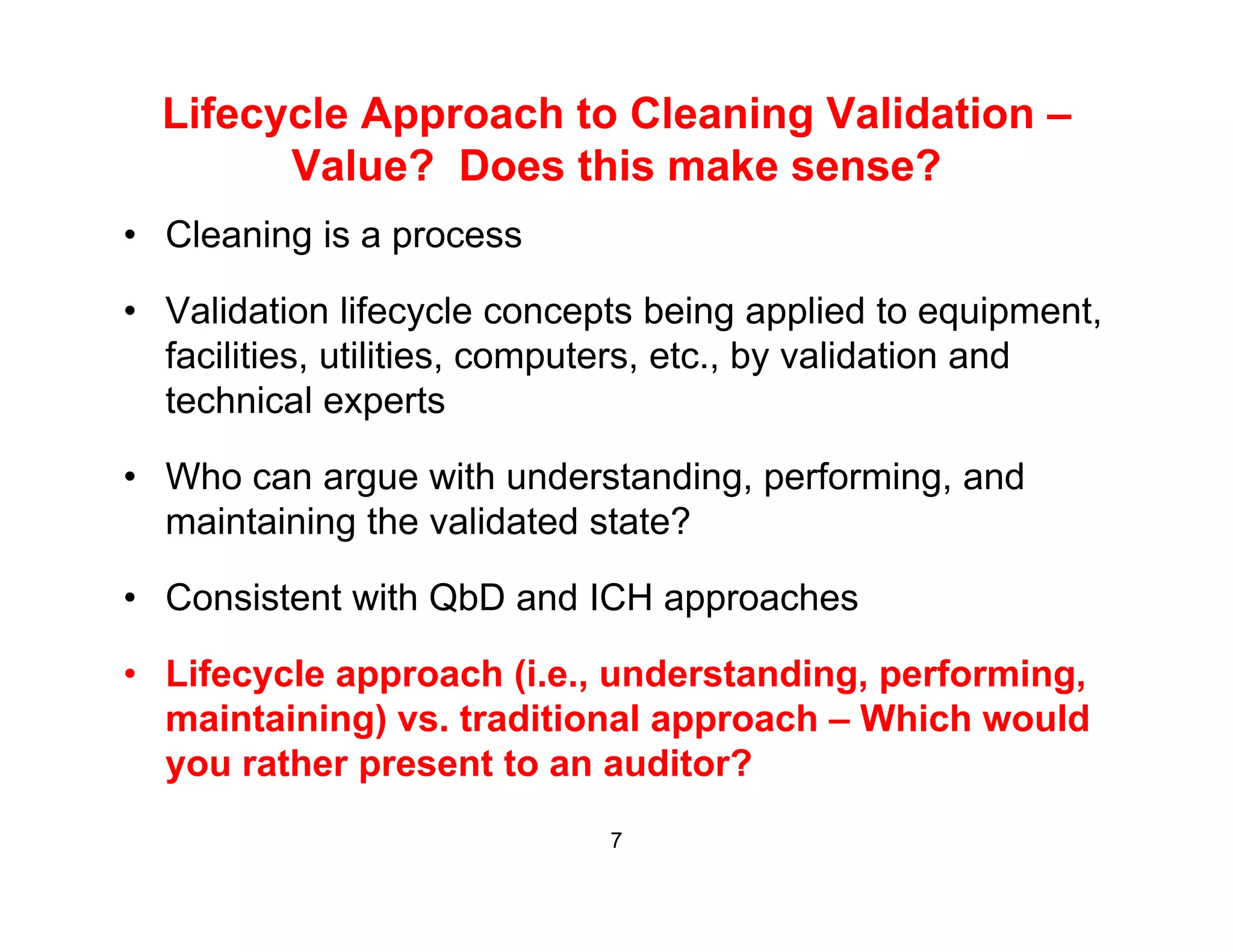
Lifecycle Approach to Cleaning Validation –
Value? Does this make sense?Value? Does this make sense?
• Cleaning is a process
• Validation lifecycle concepts being applied to equipment,
facilities, utilities, computers, etc., by validation and
technical expertsp
• Who can argue with understanding, performing, and
maintaining the validated state?g
• Consistent with QbD and ICH approaches
• Lifecycle approach (i.e., understanding, performing,
maintaining) vs. traditional approach – Which would
you rather present to an auditor?you rather present to an auditor?
7
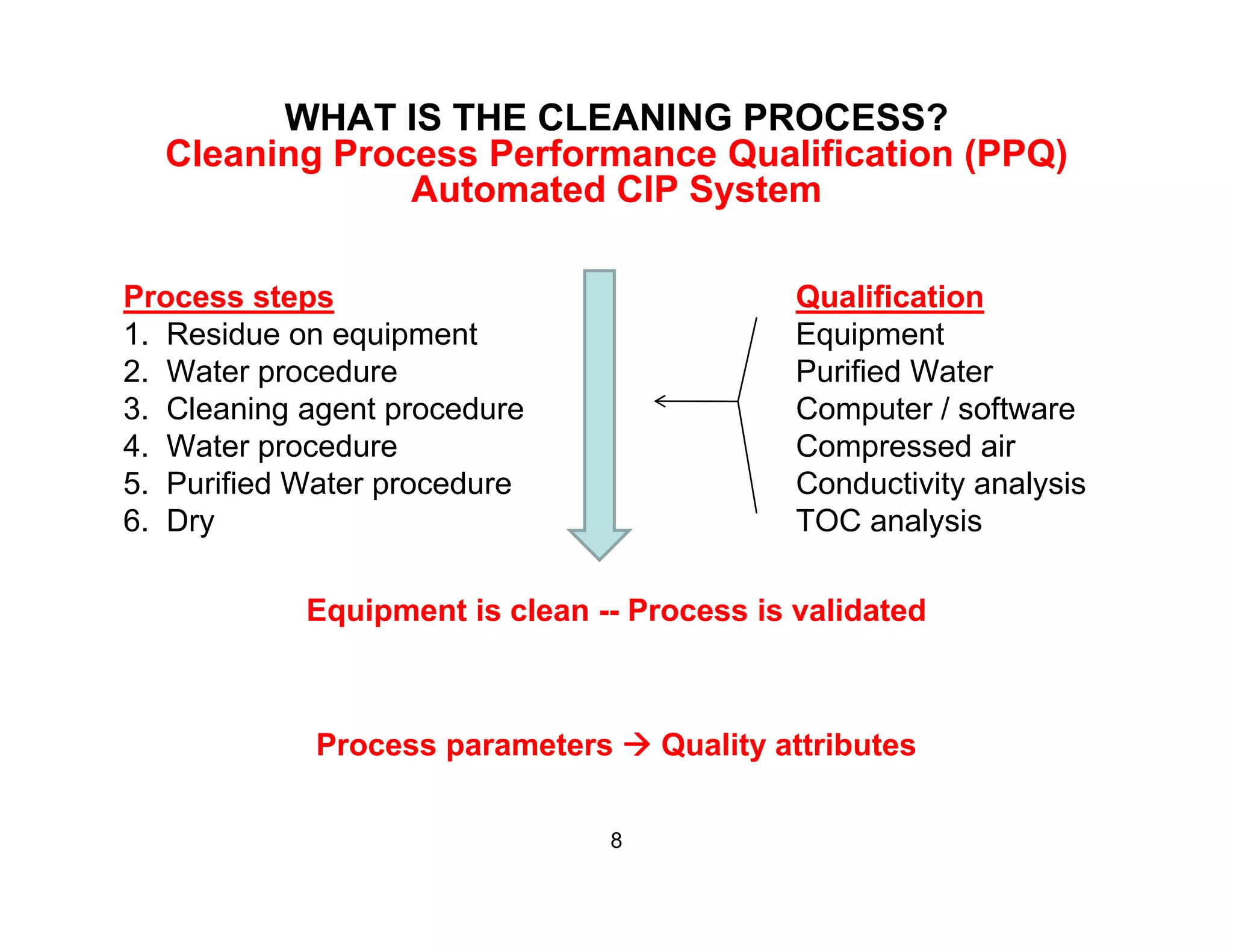
WHAT IS THE CLEANING PROCESS?
Cleaning Process Performance Qualification (PPQ)
A t t d CIP S tAutomated CIP System
Process steps QualificationProcess steps Qualification
1. Residue on equipment Equipment
2. Water procedure Purified Water
3 Cleaning agent procedure Computer / software3. Cleaning agent procedure Computer / software
4. Water procedure Compressed air
5. Purified Water procedure Conductivity analysis
6. Dry TOC analysisy y
Equipment is clean -- Process is validated
Process parameters Quality attributes
8
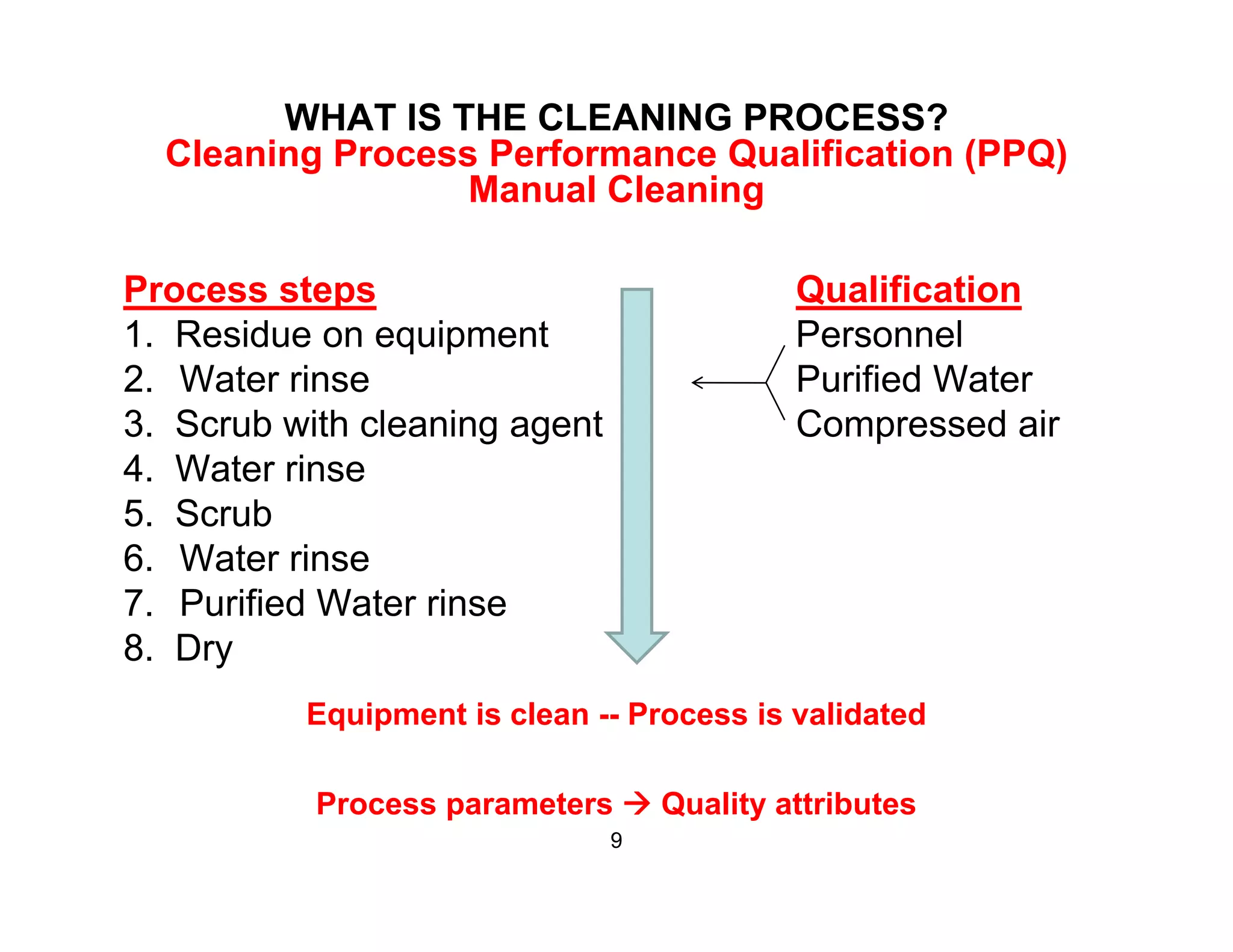
WHAT IS THE CLEANING PROCESS?
Cleaning Process Performance Qualification (PPQ)
M l Cl iManual Cleaning
Process steps QualificationProcess steps Qualification
1. Residue on equipment Personnel
2. Water rinse Purified Water
3 S b ith l i t C d i3. Scrub with cleaning agent Compressed air
4. Water rinse
5. Scrub
6. Water rinse
7. Purified Water rinse
8 Dry8. Dry
Equipment is clean -- Process is validated
Process parameters Quality attributes
9
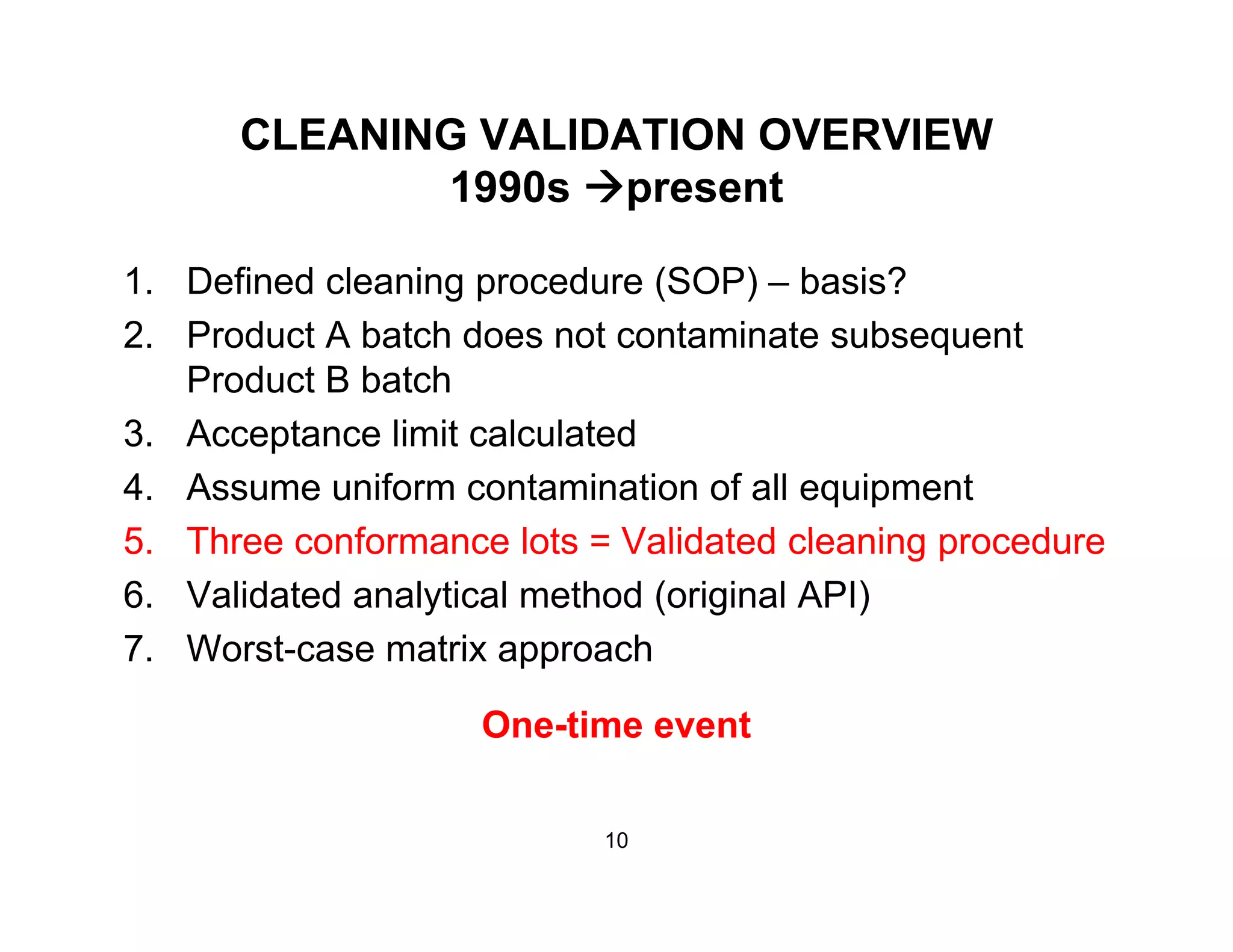
CLEANING VALIDATION OVERVIEW
1990 t1990s present
1. Defined cleaning procedure (SOP) – basis?g p ( )
2. Product A batch does not contaminate subsequent
Product B batch
3. Acceptance limit calculated
4. Assume uniform contamination of all equipment
5 Three conformance lots = Validated cleaning procedure5. Three conformance lots = Validated cleaning procedure
6. Validated analytical method (original API)
7 Worst-case matrix approach7. Worst case matrix approach
One-time event
10
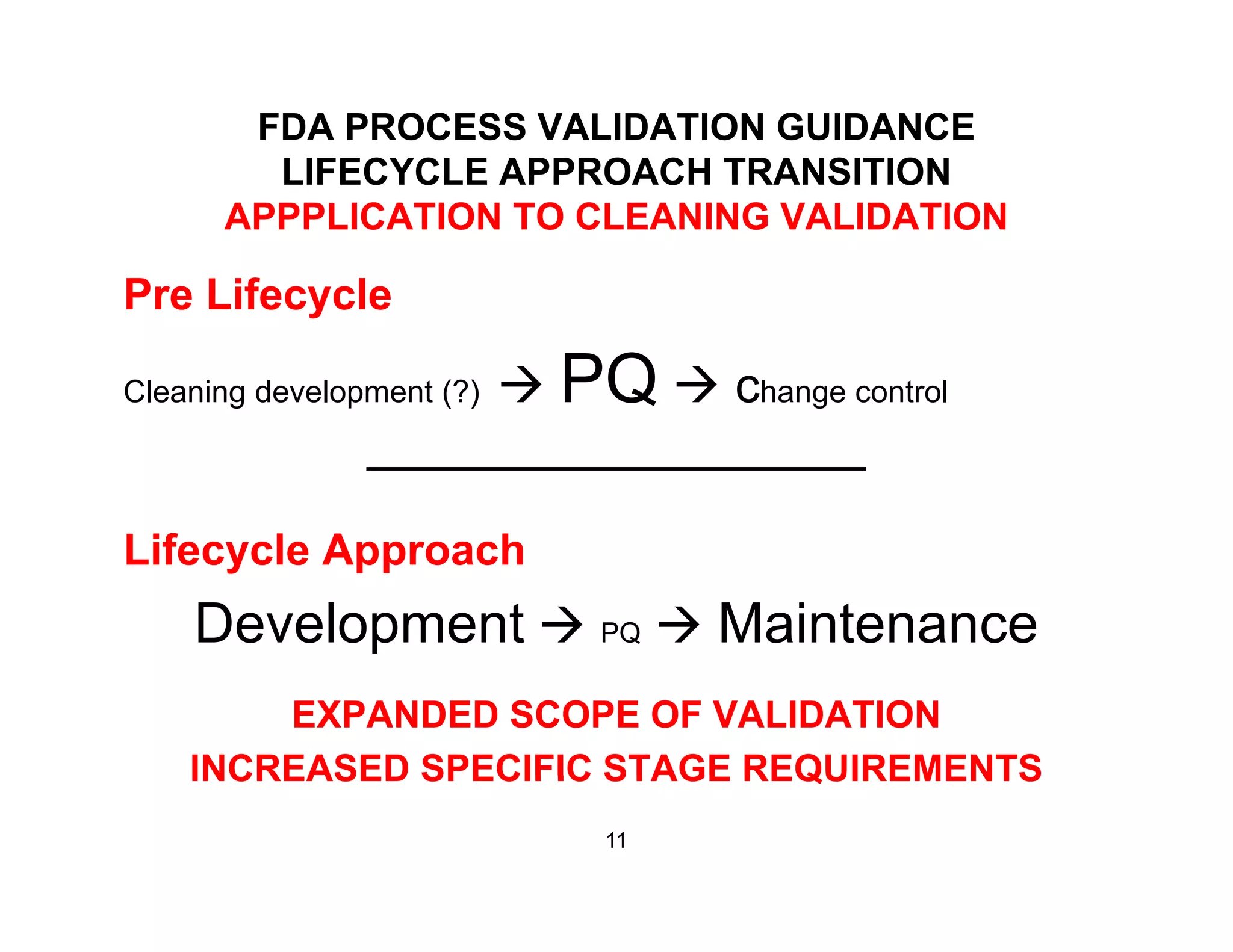
FDA PROCESS VALIDATION GUIDANCE
LIFECYCLE APPROACH TRANSITIONLIFECYCLE APPROACH TRANSITION
APPPLICATION TO CLEANING VALIDATION
Pre LifecyclePre Lifecycle
Cleaning development (?) PQ change control
________________________
Lif l A hLifecycle Approach
Development PQ Maintenance
EXPANDED SCOPE OF VALIDATION
INCREASED SPECIFIC STAGE REQUIREMENTSINCREASED SPECIFIC STAGE REQUIREMENTS
11
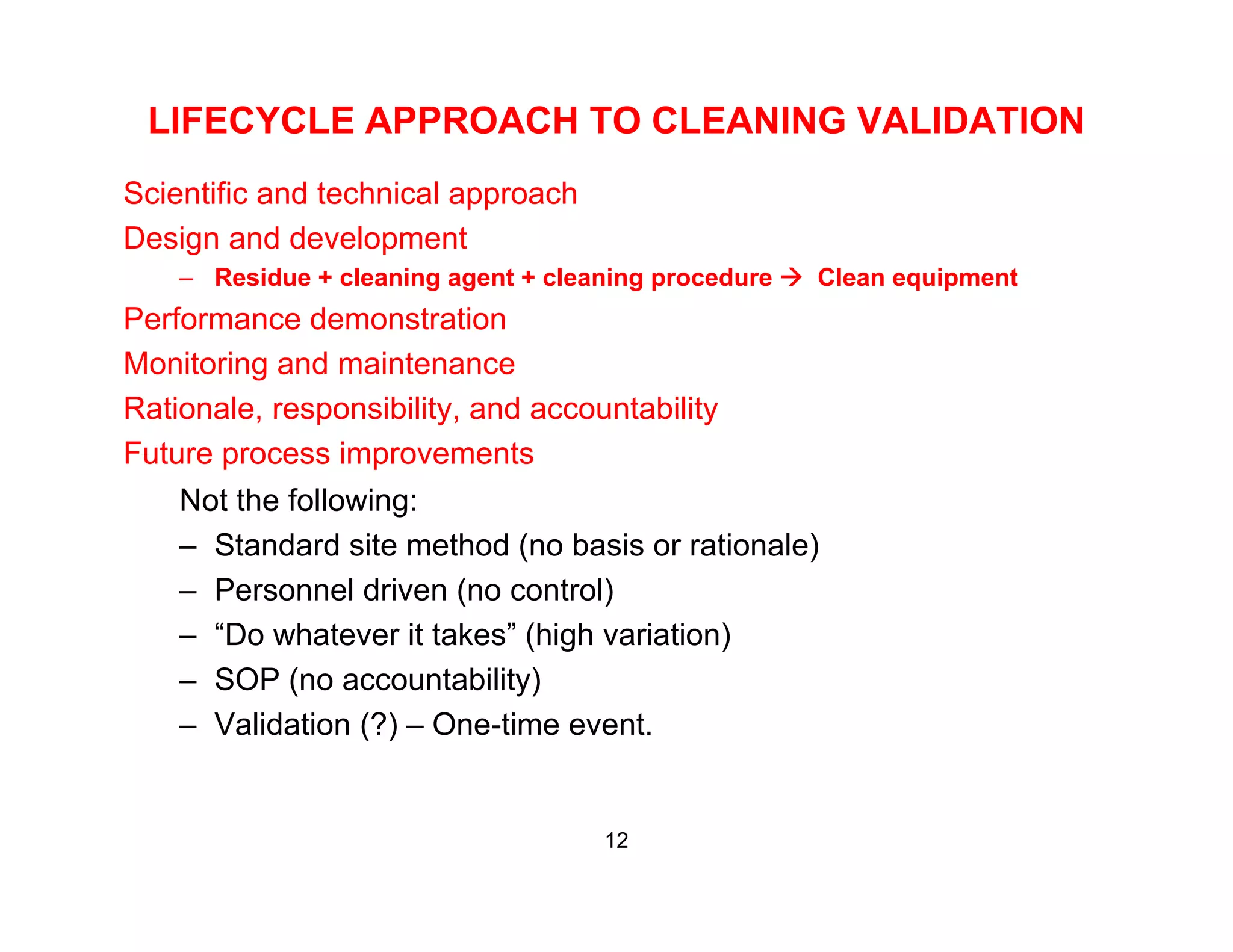
LIFECYCLE APPROACH TO CLEANING VALIDATION
Scientific and technical approach
Design and development
– Residue + cleaning agent + cleaning procedure Clean equipment
Performance demonstration
Monitoring and maintenance
Rationale, responsibility, and accountabilityRationale, responsibility, and accountability
Future process improvements
Not the following:
St d d it th d ( b i ti l )– Standard site method (no basis or rationale)
– Personnel driven (no control)
– “Do whatever it takes” (high variation)
– SOP (no accountability)
– Validation (?) – One-time event.
12
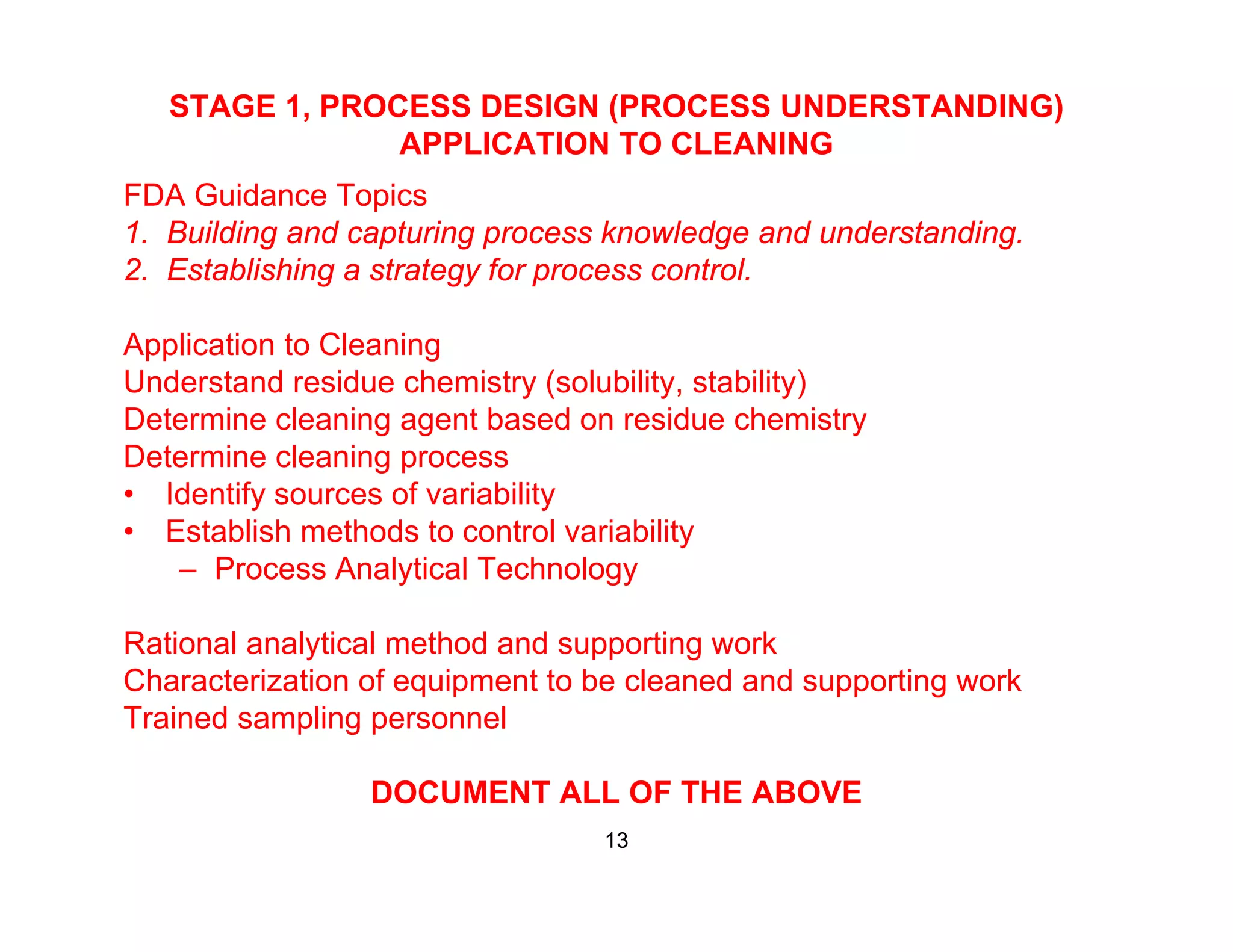
STAGE 1, PROCESS DESIGN (PROCESS UNDERSTANDING)
APPLICATION TO CLEANING
FDA Guidance Topics
1. Building and capturing process knowledge and understanding.
2. Establishing a strategy for process control.
Application to Cleaning
Understand residue chemistry (solubility, stability)
Determine cleaning agent based on residue chemistryDetermine cleaning agent based on residue chemistry
Determine cleaning process
• Identify sources of variability
• Establish methods to control variabilityEstablish methods to control variability
– Process Analytical Technology
Rational analytical method and supporting worky pp g
Characterization of equipment to be cleaned and supporting work
Trained sampling personnel
DOCUMENT ALL OF THE ABOVE
13
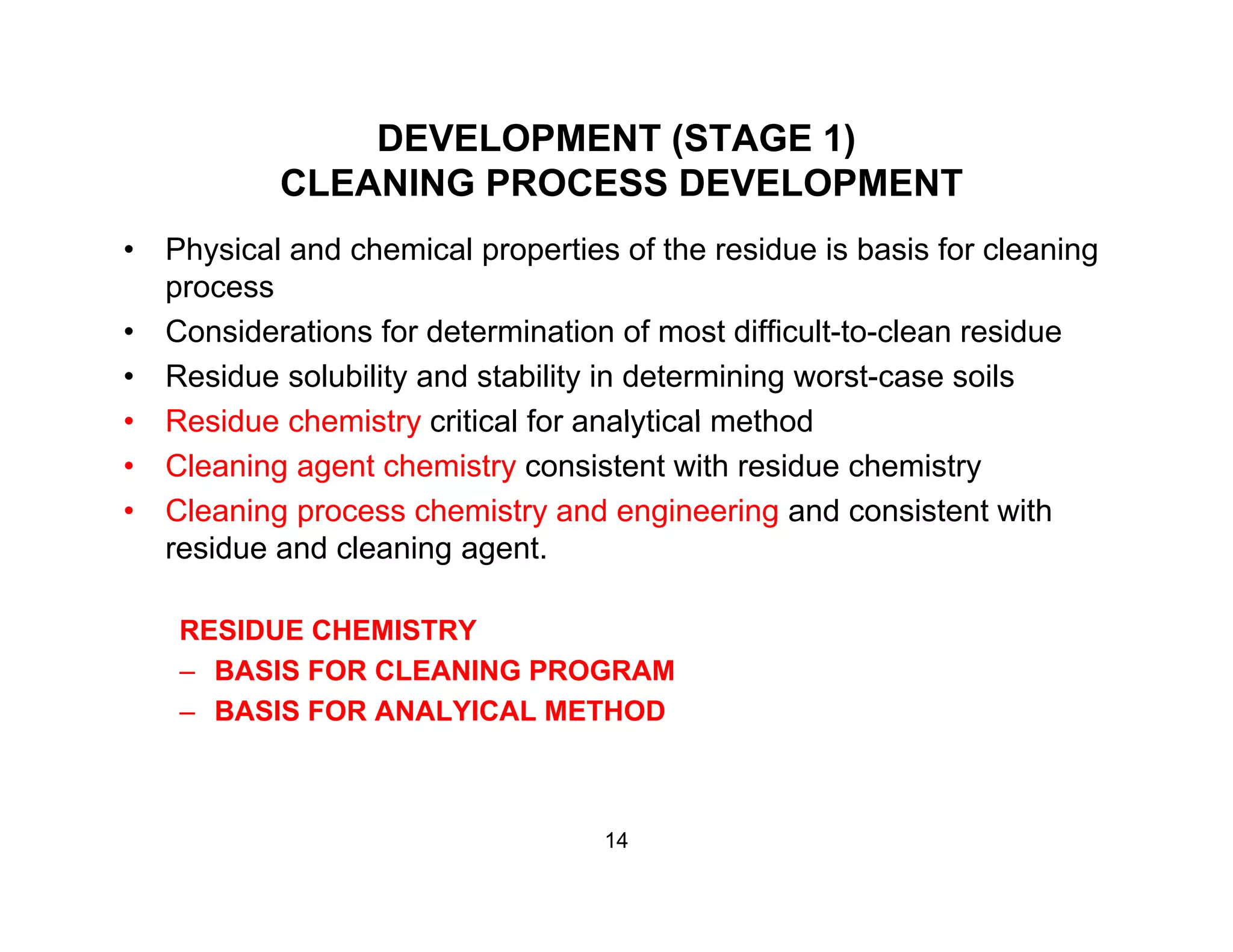
DEVELOPMENT (STAGE 1)
CLEANING PROCESS DEVELOPMENTCLEANING PROCESS DEVELOPMENT
• Physical and chemical properties of the residue is basis for cleaning
processprocess
• Considerations for determination of most difficult-to-clean residue
• Residue solubility and stability in determining worst-case soils
Residue chemistry critical for analytical method• Residue chemistry critical for analytical method
• Cleaning agent chemistry consistent with residue chemistry
• Cleaning process chemistry and engineering and consistent with
residue and cleaning agent.
RESIDUE CHEMISTRY
– BASIS FOR CLEANING PROGRAM
– BASIS FOR ANALYICAL METHOD
14
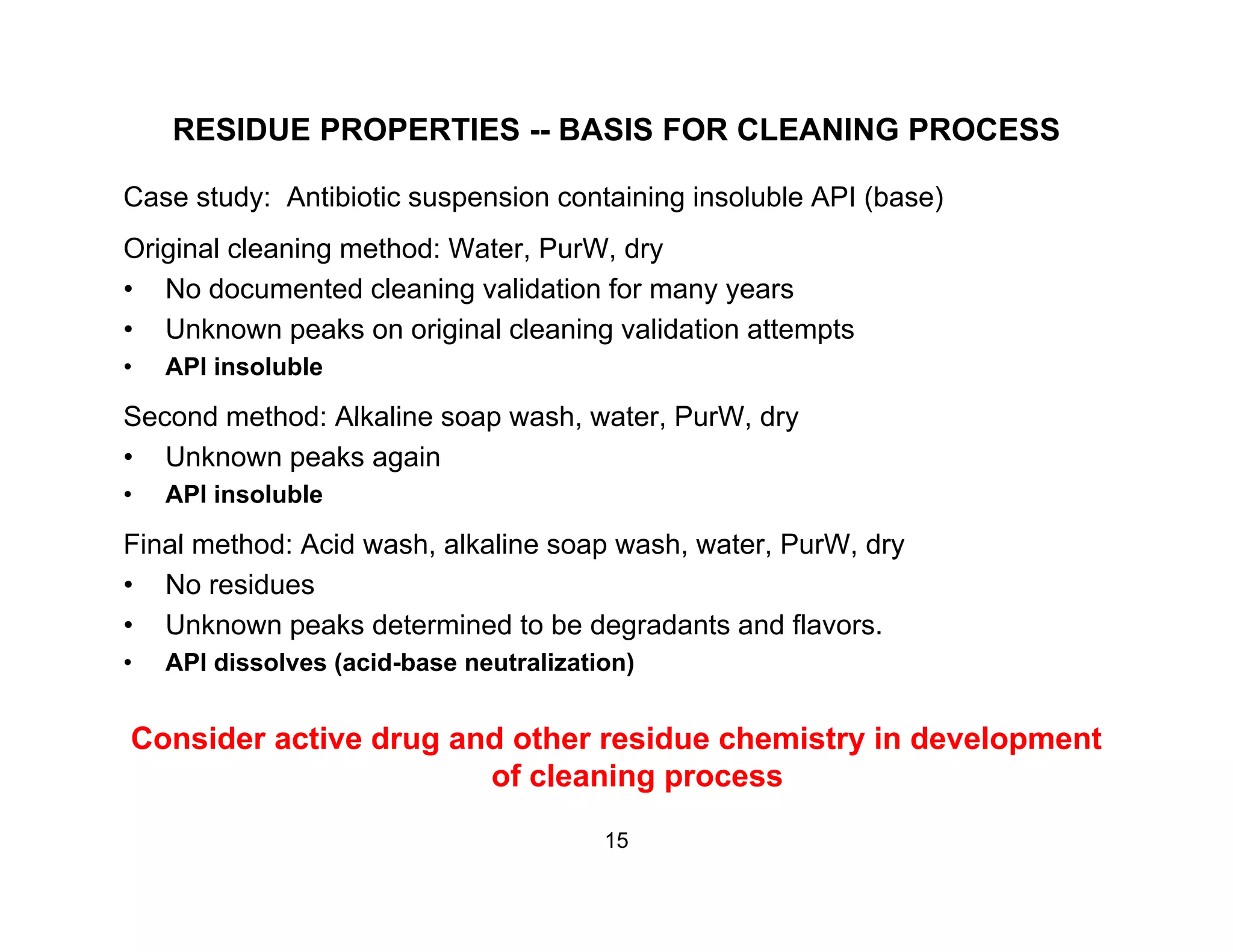
RESIDUE PROPERTIES -- BASIS FOR CLEANING PROCESS
Case study: Antibiotic suspension containing insoluble API (base)
Original cleaning method: Water, PurW, dry
• No documented cleaning validation for many yearsNo documented cleaning validation for many years
• Unknown peaks on original cleaning validation attempts
• API insoluble
Second method: Alkaline soap wash water PurW drySecond method: Alkaline soap wash, water, PurW, dry
• Unknown peaks again
• API insoluble
Fi l th d A id h lk li h t P W dFinal method: Acid wash, alkaline soap wash, water, PurW, dry
• No residues
• Unknown peaks determined to be degradants and flavors.
API di l ( id b t li ti )• API dissolves (acid-base neutralization)
Consider active drug and other residue chemistry in development
of cleaning processof cleaning process
15
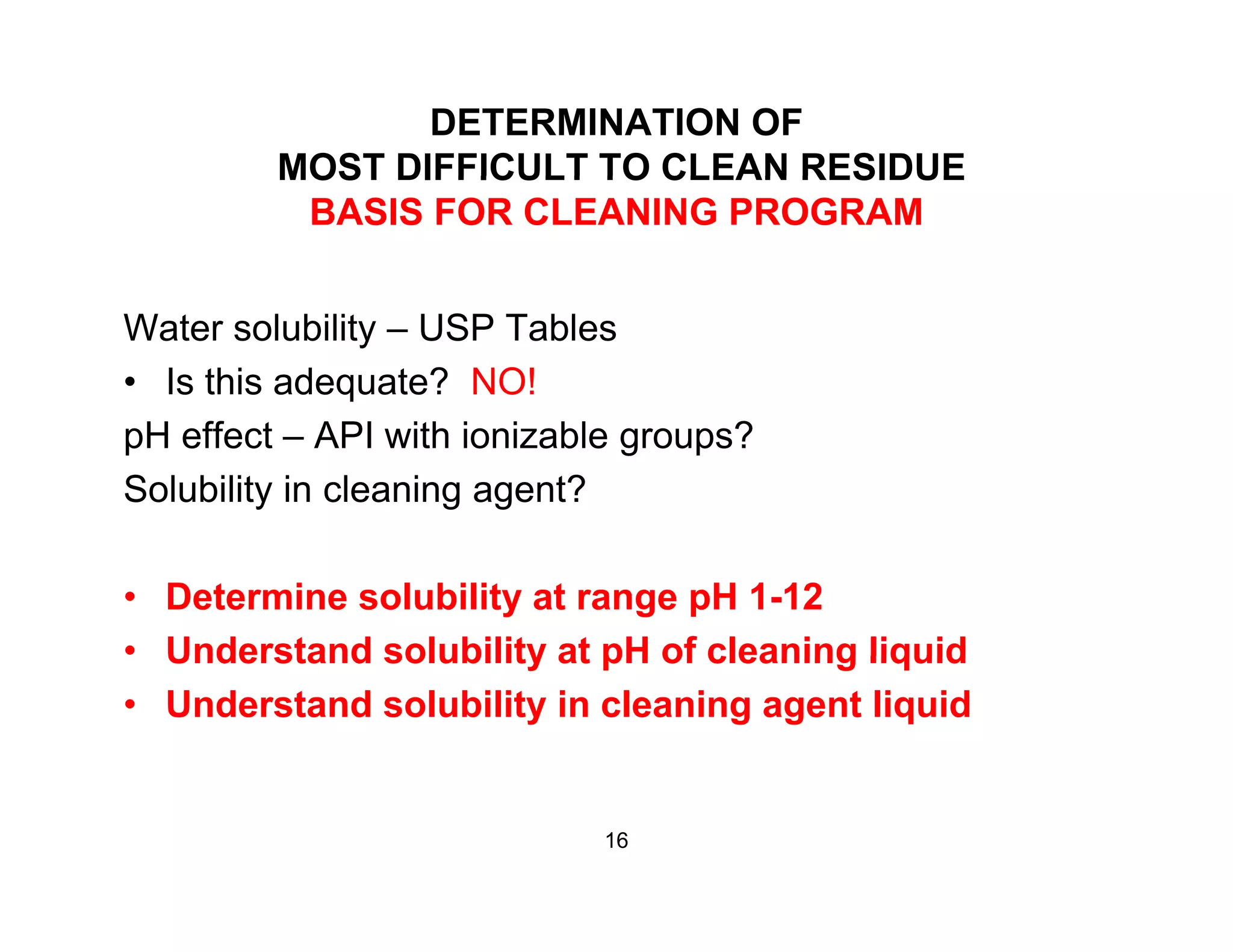
DETERMINATION OF
MOST DIFFICULT TO CLEAN RESIDUEMOST DIFFICULT TO CLEAN RESIDUE
BASIS FOR CLEANING PROGRAM
Water solubility – USP Tables
• Is this adequate? NO!
pH effect – API with ionizable groups?
Solubility in cleaning agent?
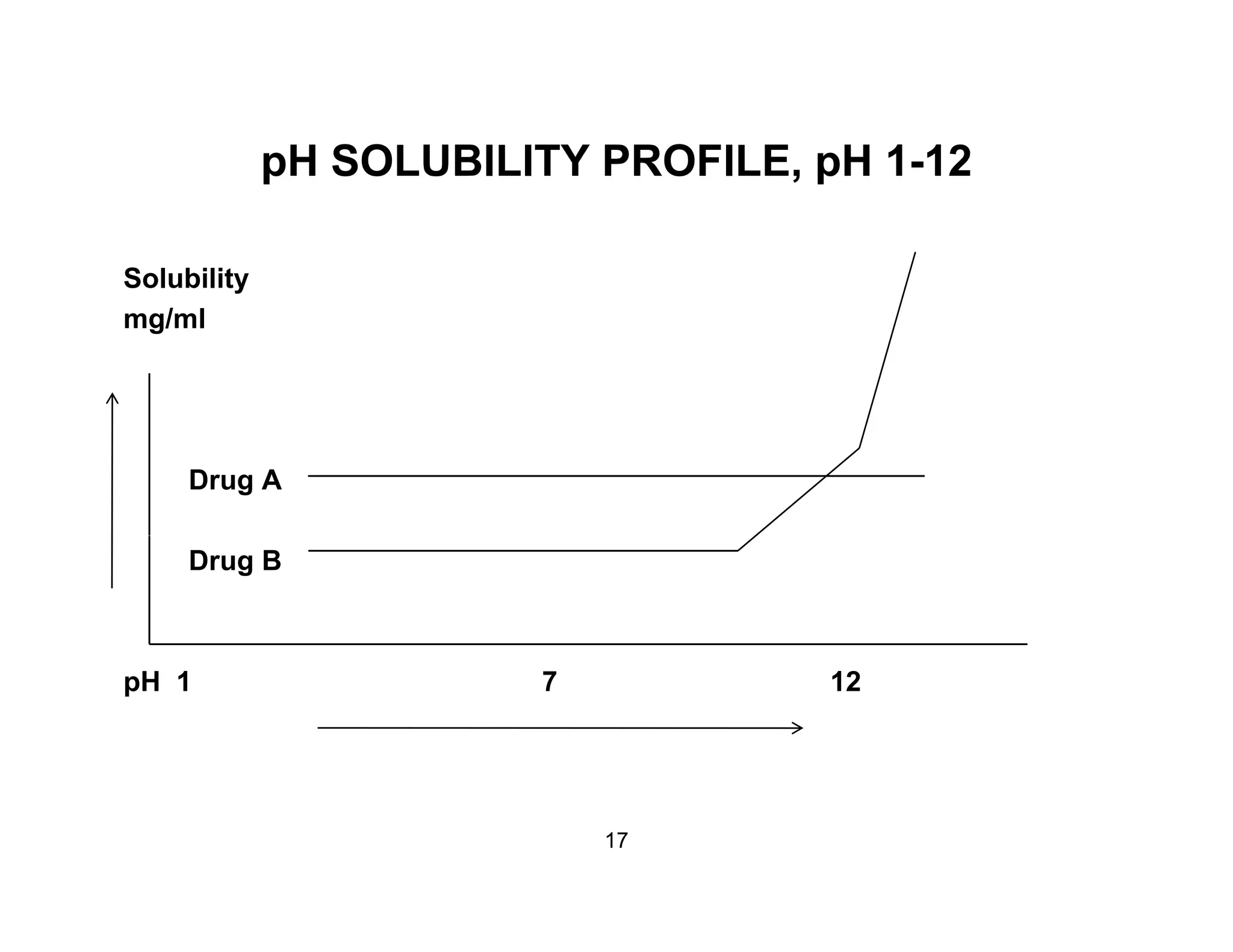
• Determine solubility at range pH 1-12
• Understand solubility at pH of cleaning liquidUnderstand solubility at pH of cleaning liquid
• Understand solubility in cleaning agent liquid
16
pH SOLUBILITY PROFILE, pH 1-12p SO U O , p
Solubility
mg/ml
Drug A
Drug B
pH 1 7 12
17
RESIDUE SOLUBILITY AND STABILITY FOR
DETERMINING WORST CASE SOILSDETERMINING WORST-CASE SOILS
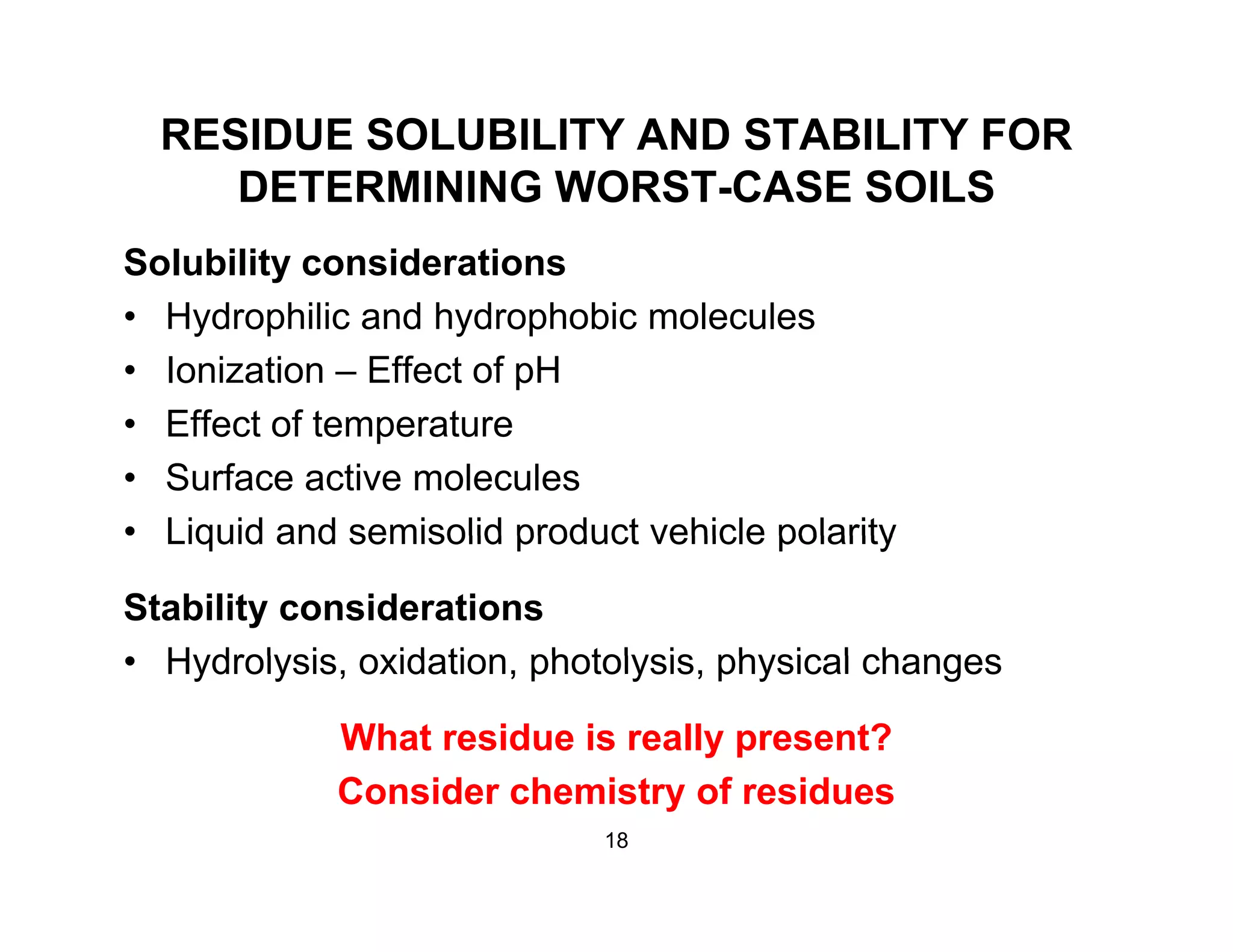
Solubility considerations
• Hydrophilic and hydrophobic molecules
• Ionization – Effect of pH
Eff t f t t• Effect of temperature
• Surface active molecules
• Liquid and semisolid product vehicle polarityLiquid and semisolid product vehicle polarity
Stability considerations
Hydrolysis oxidation photolysis physical changes• Hydrolysis, oxidation, photolysis, physical changes
What residue is really present?
Consider chemistry of residues
18
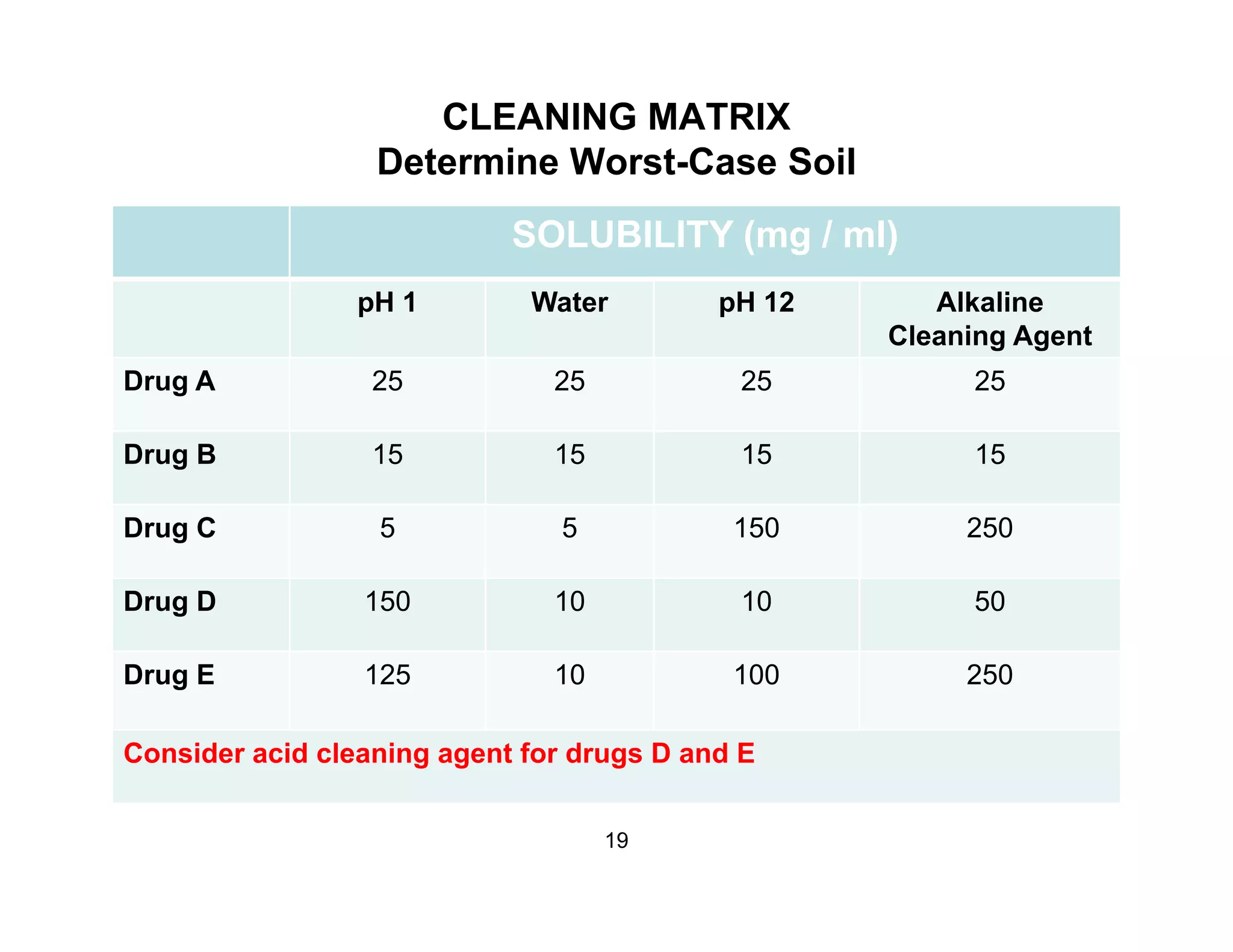
CLEANING MATRIX
Determine Worst-Case Soil
SOLUBILITY (mg / ml)
H 1 W t H 12 Alk lipH 1 Water pH 12 Alkaline
Cleaning Agent
Drug A 25 25 25 25
Drug B 15 15 15 15
Drug C 5 5 150 250Drug C 5 5 150 250
Drug D 150 10 10 50
Drug E 125 10 100 250
Consider acid cleaning agent for drugs D and E
19
WORST CASE CLEANING
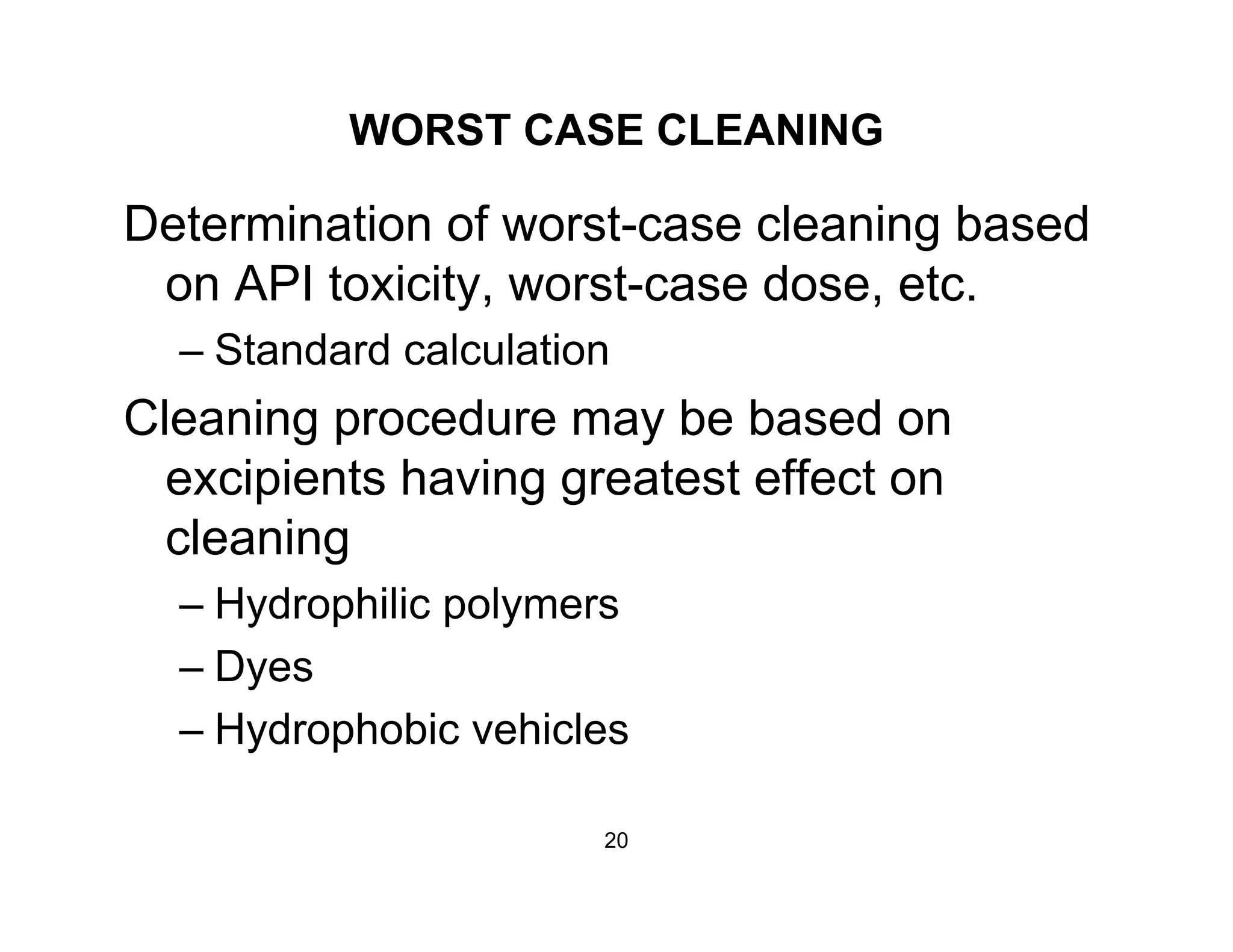
Determination of worst-case cleaning based
on API toxicity, worst-case dose, etc.on API toxicity, worst case dose, etc.
– Standard calculation
Cleaning procedure may be based onCleaning procedure may be based on
excipients having greatest effect on
cleaningcleaning
– Hydrophilic polymers
D– Dyes
– Hydrophobic vehicles
20
BIOTECH CLEANING CHEMISTRY -- API
Protein molecules degrade in alkaline conditions
Degradation rate is milder in acidic conditionsg
Degradation rate increases with temperature
API residues typically consist of protein fragments and
aggregates
Analytical method: Non-specific analysis
Reference: Kendrick, Canhuto, and Kreuze. Analysis of
Degradation Products of Biopharmaceutical API Causedg p
by Cleaning Agents and Temperature. Journal of
Validation Technology, V15, #3, Summer 2009.
21
BIOTECH CLEANING CHEMISTRY – GROWTH MEDIUM
Medium Composition
• Acids or bases
• Monovalent salts• Monovalent salts
• Polyvalent salts
• Amino acids
• Proteins (polypeptides)
• Carbohydrates
• Aqueous soluble organicsq g
• Non-aqueous soluble organics
Consider medium composition at end of cycle.
Reference: Azadan and Canhoto. A Scientific Approach to the Selection of
Cleaning Validation Worst-Case Soils for Biopharmaceutical manufacturing.
Cleaning and Cleaning Validation, Volume 1. 2011.Cleaning and Cleaning Validation, Volume 1. 2011.
22
CLEANING CHEMISTRY MECHANISMS
• Wetting
• Emulsification
• Dispersion
• Solubilityy
• Chelation
• OxidationOxidation
• Hydrolysis
23
CLEANING AGENT OPTIONS
• Water
• Commodity alkalis and acidsy
• Organic solvents
• Surfactants
– Anionic
– Cationic
– Amphoteric
– Nonionic
• Formulated detergents
24
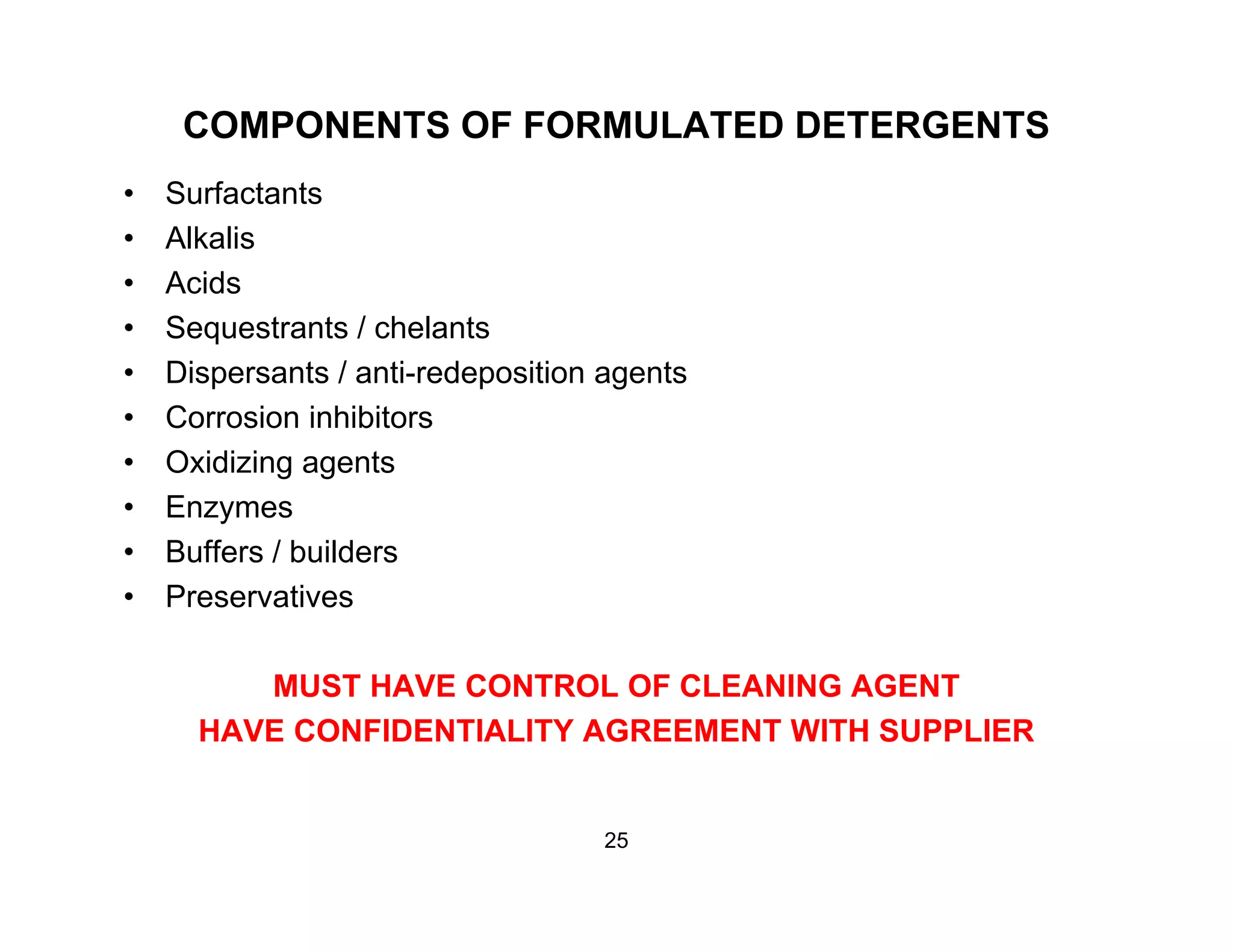
COMPONENTS OF FORMULATED DETERGENTS
• Surfactants
• Alkalis
• Acids
• Sequestrants / chelants
• Dispersants / anti-redeposition agents
• Corrosion inhibitors• Corrosion inhibitors
• Oxidizing agents
• Enzymes
• Buffers / builders
• Preservatives
MUST HAVE CONTROL OF CLEANING AGENT
HAVE CONFIDENTIALITY AGREEMENT WITH SUPPLIER
25
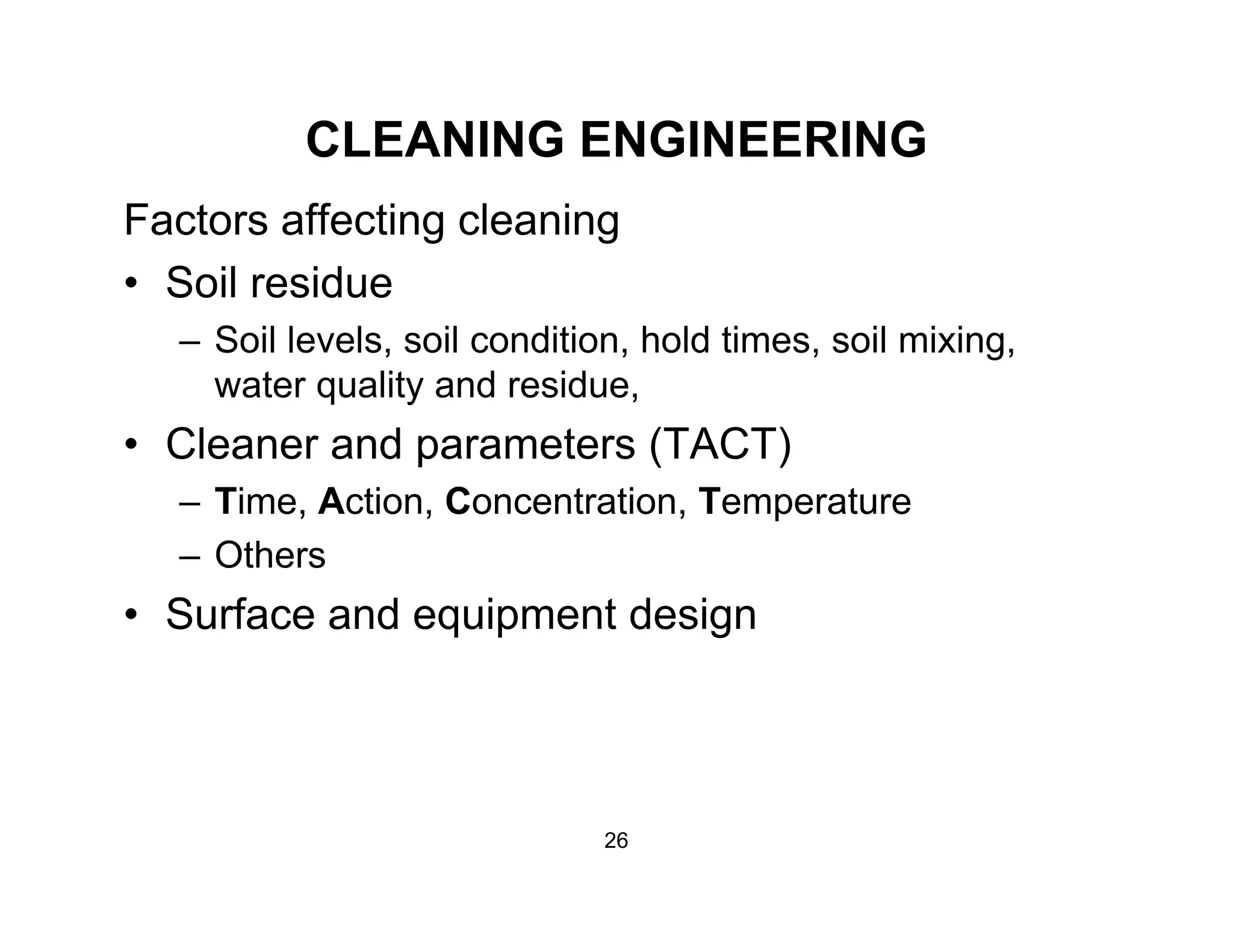
CLEANING ENGINEERING
Factors affecting cleaning
• Soil residueSoil residue
– Soil levels, soil condition, hold times, soil mixing,
water quality and residue,
• Cleaner and parameters (TACT)
– Time, Action, Concentration, Temperature
– Others
• Surface and equipment design
26
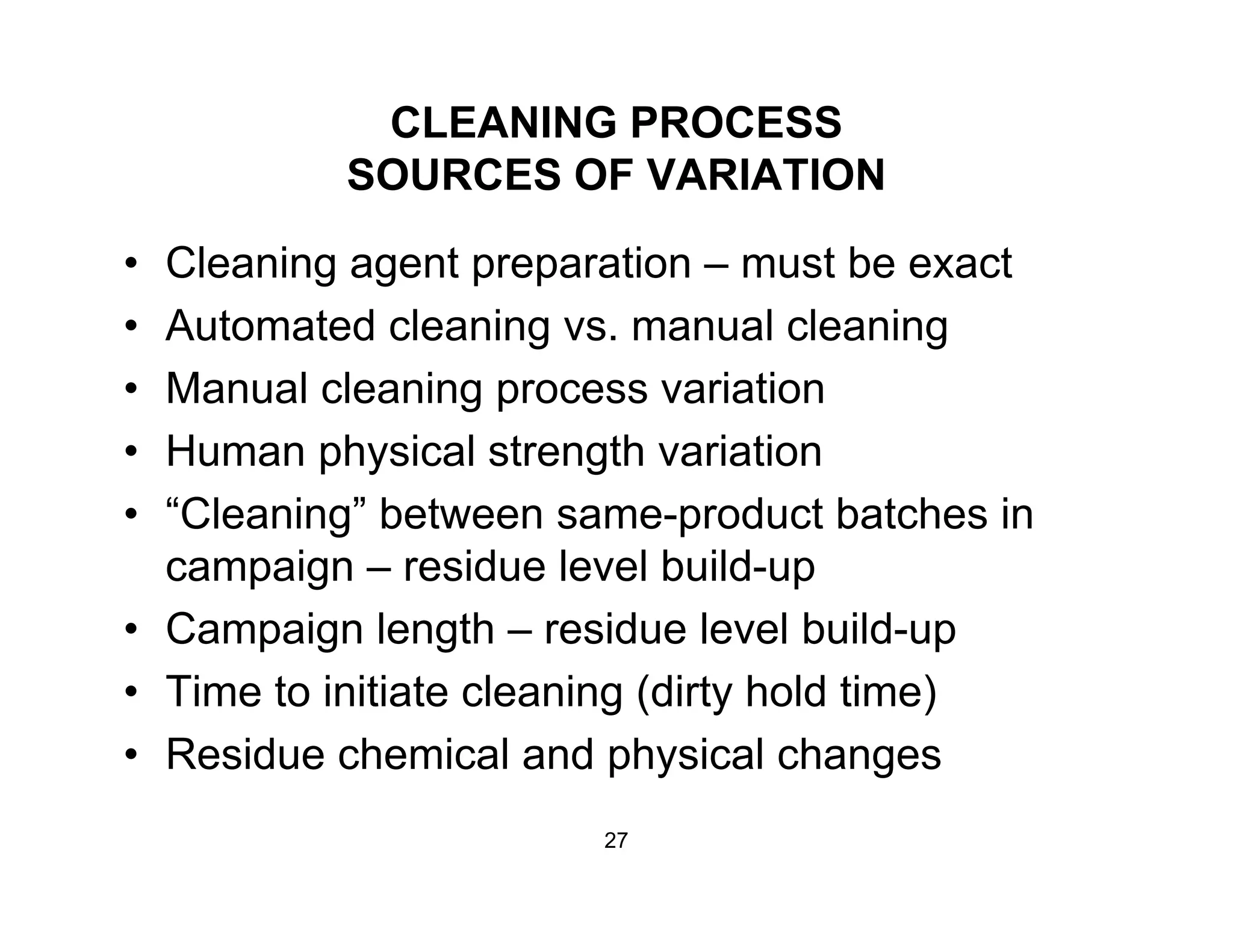
CLEANING PROCESS
SOURCES OF VARIATIONSOURCES OF VARIATION
• Cleaning agent preparation – must be exact
• Automated cleaning vs. manual cleaning
• Manual cleaning process variation
• Human physical strength variation
• “Cleaning” between same-product batches ing p
campaign – residue level build-up
• Campaign length – residue level build-up
• Time to initiate cleaning (dirty hold time)
• Residue chemical and physical changesp y g
27
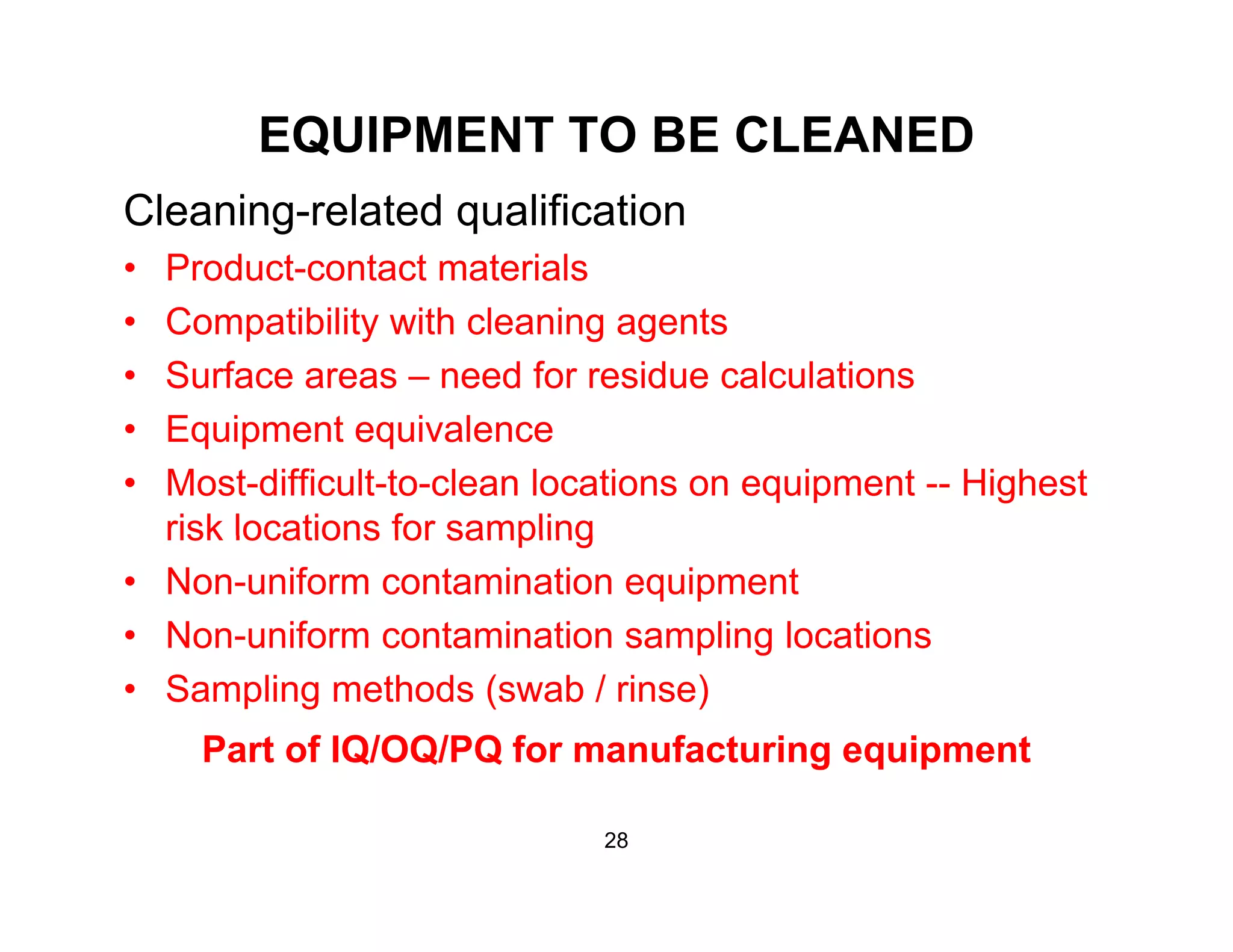
EQUIPMENT TO BE CLEANED
Cleaning-related qualification
• Product-contact materials
• Compatibility with cleaning agents
• Surface areas – need for residue calculations
E i t i l• Equipment equivalence
• Most-difficult-to-clean locations on equipment -- Highest
risk locations for samplingrisk locations for sampling
• Non-uniform contamination equipment
• Non-uniform contamination sampling locationsg
• Sampling methods (swab / rinse)
Part of IQ/OQ/PQ for manufacturing equipment
28
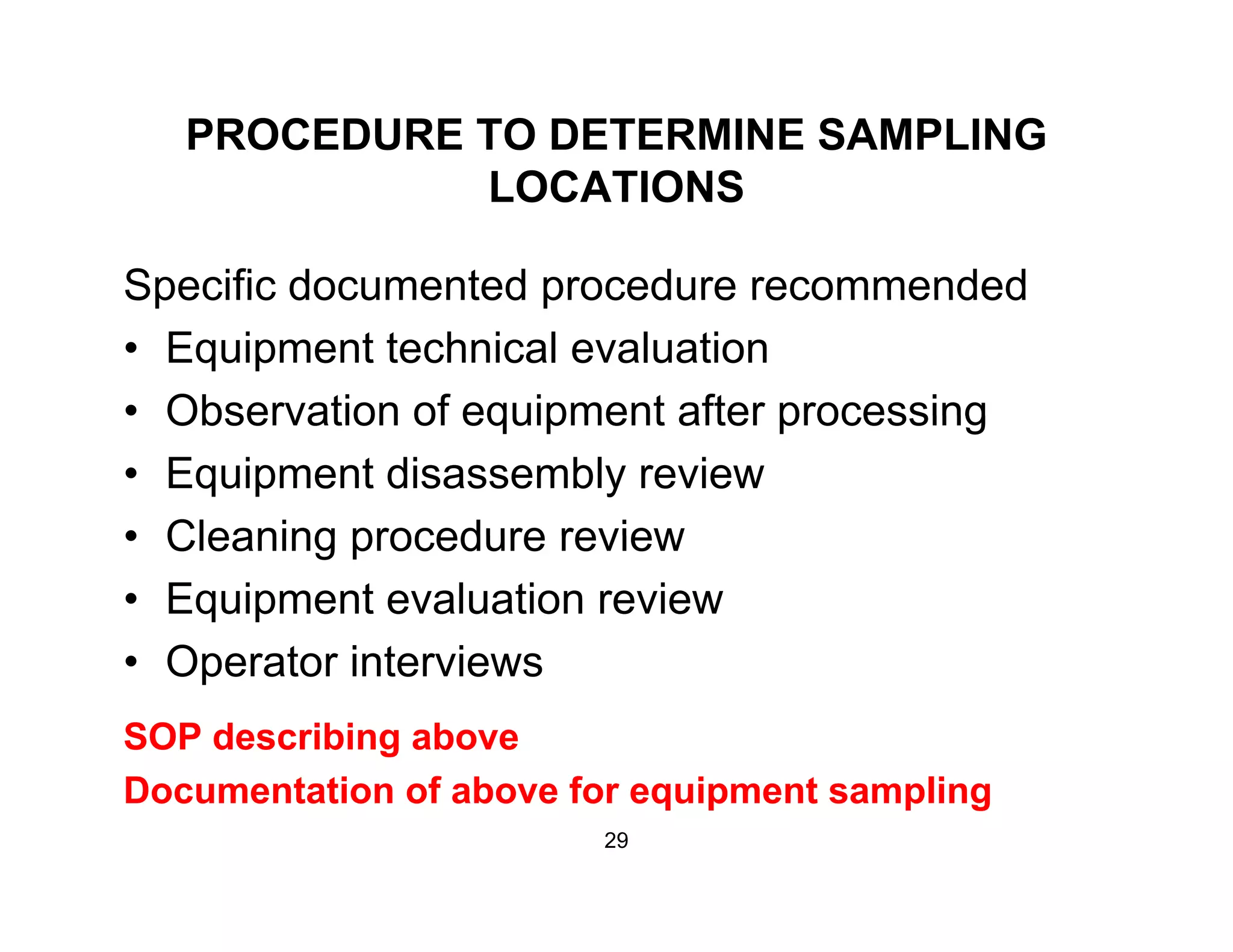
PROCEDURE TO DETERMINE SAMPLING
LOCATIONSLOCATIONS
Specific documented procedure recommendedSpecific documented procedure recommended
• Equipment technical evaluation
• Observation of equipment after processingObservation of equipment after processing
• Equipment disassembly review
• Cleaning procedure review• Cleaning procedure review
• Equipment evaluation review
• Operator interviews• Operator interviews
SOP describing above
Documentation of above for equipment sampling
29
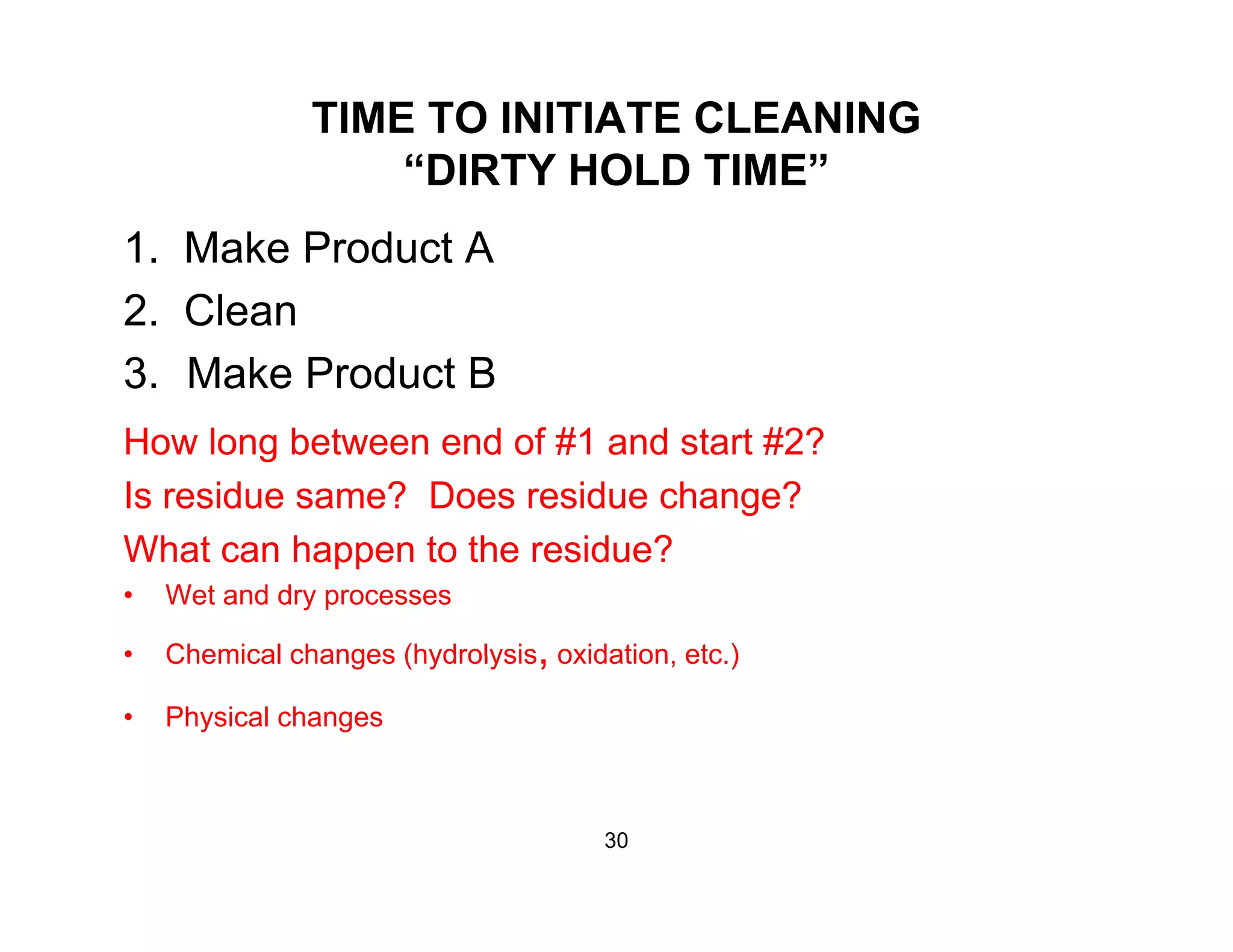
TIME TO INITIATE CLEANING
“DIRTY HOLD TIME”DIRTY HOLD TIME
1. Make Product A
2 Cl2. Clean
3. Make Product B
How long between end of #1 and start #2?
Is residue same? Does residue change?
Wh h h id ?What can happen to the residue?
• Wet and dry processes
• Chemical changes (hydrolysis oxidation etc )• Chemical changes (hydrolysis, oxidation, etc.)
• Physical changes
30
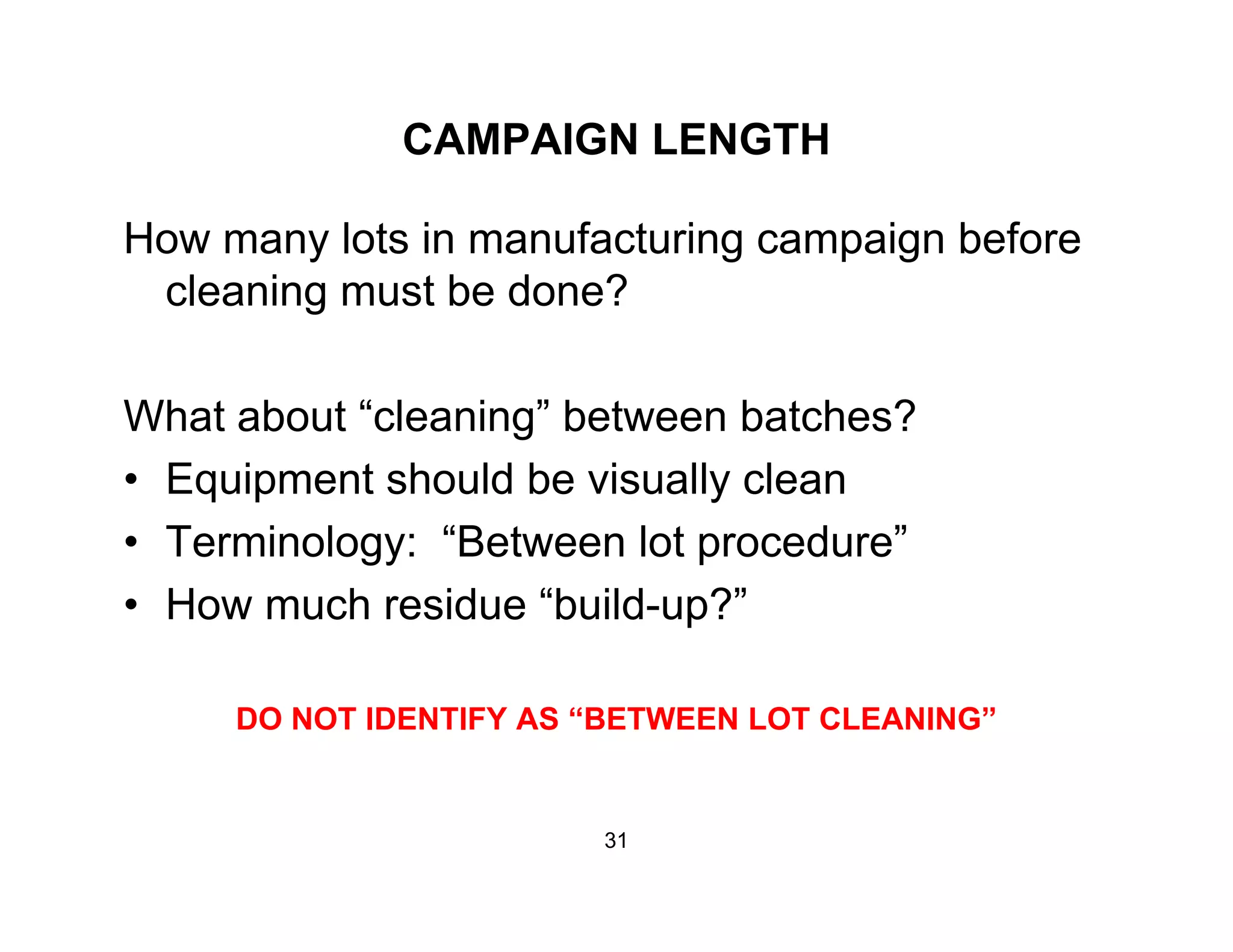
CAMPAIGN LENGTH
How many lots in manufacturing campaign before
cleaning must be done?cleaning must be done?
What about “cleaning” between batches?What about cleaning between batches?
• Equipment should be visually clean
Terminology: “Between lot procedure”• Terminology: Between lot procedure
• How much residue “build-up?”
DO NOT IDENTIFY AS “BETWEEN LOT CLEANING”
31
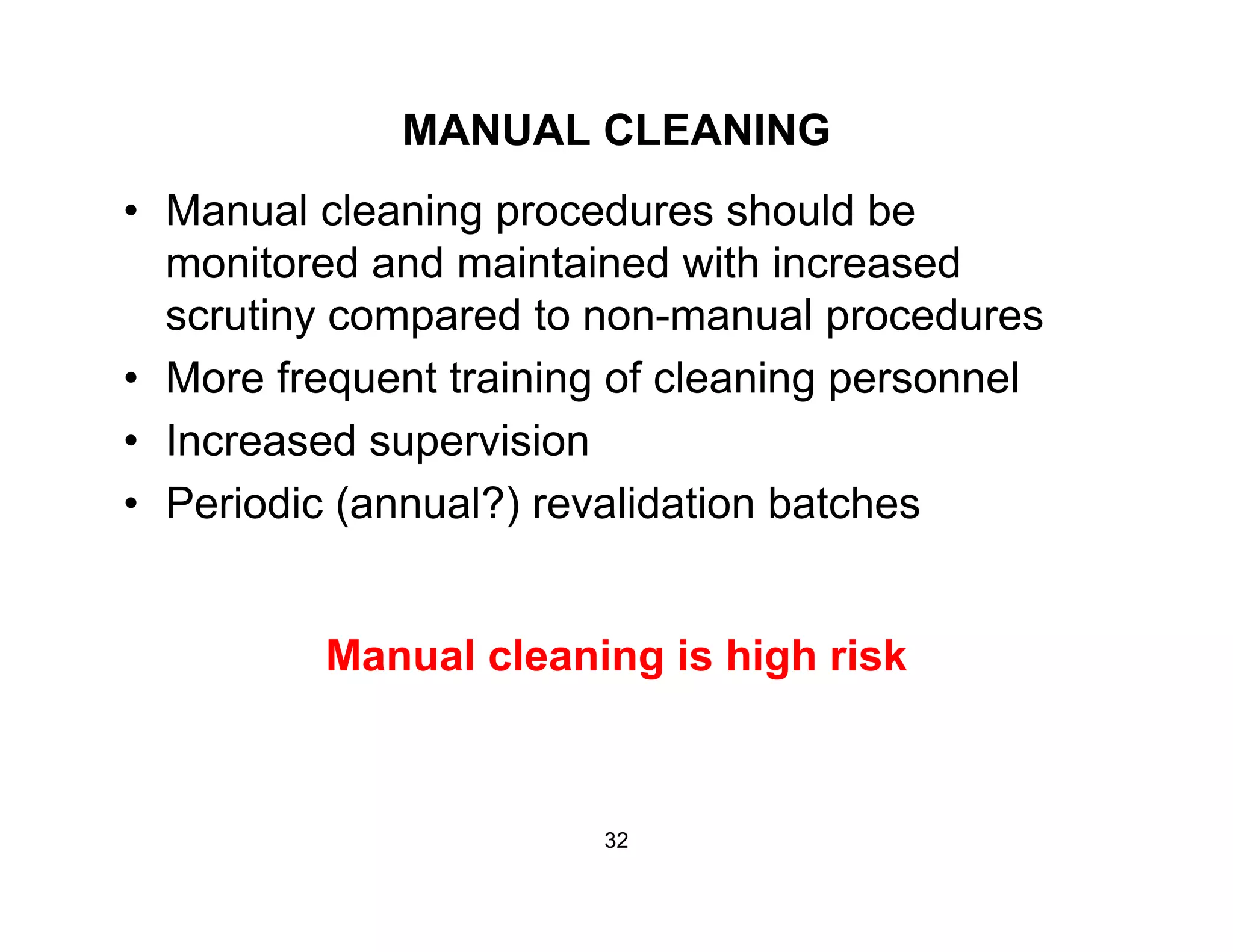
MANUAL CLEANING
• Manual cleaning procedures should be
monitored and maintained with increased
scrutiny compared to non-manual procedures
• More frequent training of cleaning personnel
• Increased supervision
• Periodic (annual?) revalidation batches
Manual cleaning is high riskManual cleaning is high risk
32
ANALYTICAL METHOD DEVELOPMENT
Early stage 1 (development) analysis –
validation not required but must be soundvalidation not required but must be sound
Validated method when used for Stage 2
cleaning validation and post validationcleaning validation and post-validation
testing (change control)
All methods and data (including stage 1) subject to
regulatory auditregulatory audit
33
ANALYTICAL METHOD DEVELOPMENT
Analytical method must measure actual residue –
what residue is actually present on equipment
surfaces?
• Small molecules
– API
– API degraded – specific or non-specific method
Bi t h l l• Biotech molecules
– API degraded – non-specific method
UNDERSTAND RESIDUE CHEMISTRY
34
ANALYTICAL METHOD DEVELOPMENT
Cleaning agent residue
• Analytical method to determine residual cleaning
agent.
• Information from cleaning agent vendor
35
ANALYTICAL METHOD DEVELOPMENT
R t diRecovery studies
Can sampling procedure adequately recover residue
from equipment surfaces?from equipment surfaces?
• Product contact materials
• High % of total surface area
• Obtain representative coupons from equipment
fabricators
Hi h ( 80%) t it i• High (e.g., >80%) acceptance criteria
• Factor may be used in calculation
– Multiple approachesMultiple approaches
– Factor every calculation?
All sampled surfaces must have recovery dataAll sampled surfaces must have recovery data
36
SAMPLING
Sampling methodsSampling methods
• Sampling (swab) critical activity
• Training programTraining program
• Trained sampling personnel
– Demonstrated acceptable performance
• Documented training and retraining
• Worst case compounds / procedures in training
– Volatile solvents (importance of rapid technique)– Volatile solvents (importance of rapid technique)
• Worst case sampling equipment
– Extension poles
• Retraining considerations
– Who does sampling? Personnel skills
37
SAMPLING TRAINING
Sampling is extremely critical to cleaning
validation programvalidation program
Inadequate sampling = false negative
Insufficient pressure on surface– Insufficient pressure on surface
– Swab solvent evaporation
I ffi i t l d– Insufficient area sampled
Auditors routinely ask for sampling program training
methods and training records
38
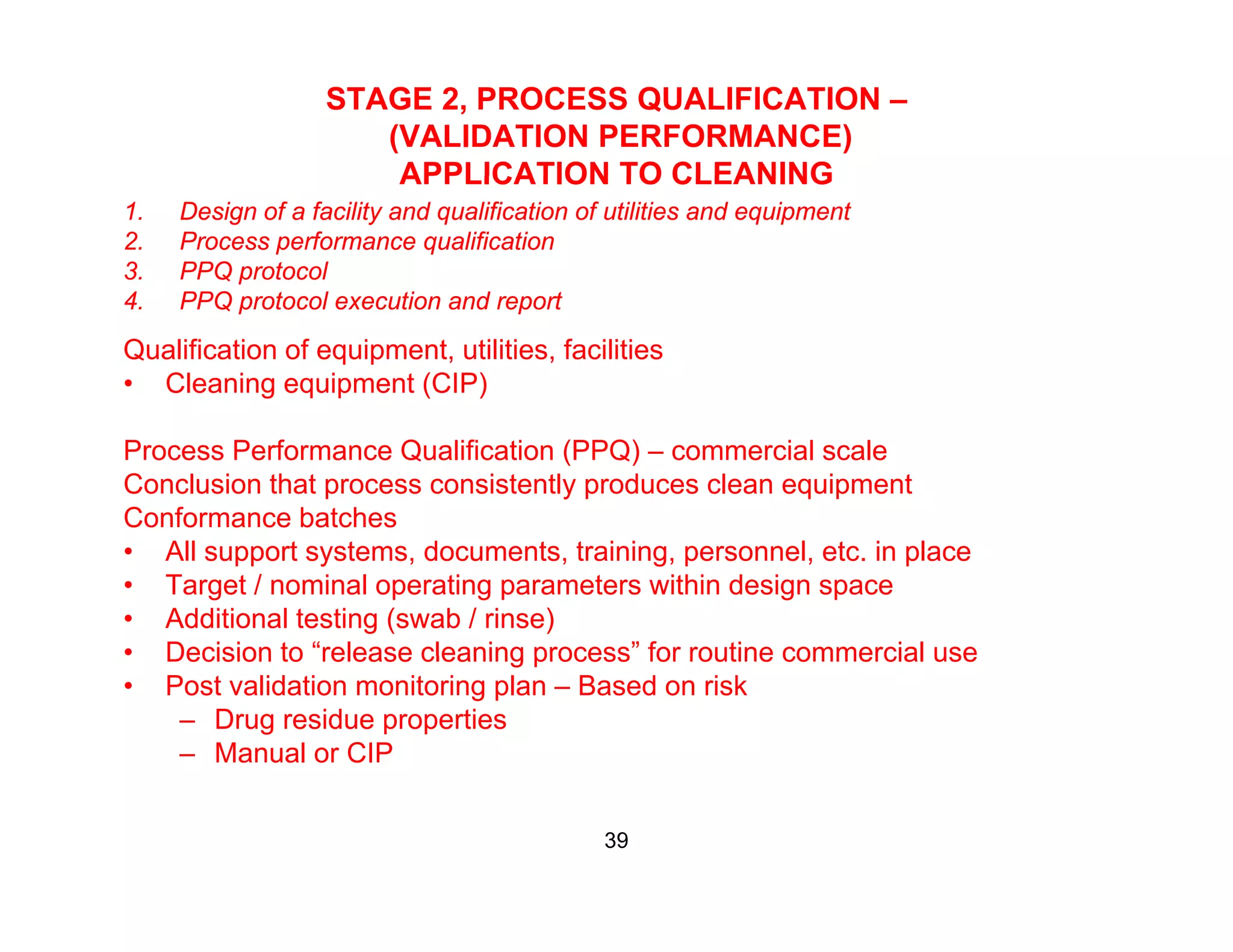
STAGE 2, PROCESS QUALIFICATION –
(VALIDATION PERFORMANCE)
APPLICATION TO CLEANINGAPPLICATION TO CLEANING
1. Design of a facility and qualification of utilities and equipment
2. Process performance qualification
3. PPQ protocol
4 PPQ t l ti d t4. PPQ protocol execution and report
Qualification of equipment, utilities, facilities
• Cleaning equipment (CIP)
Process Performance Qualification (PPQ) – commercial scale
Conclusion that process consistently produces clean equipment
Conformance batches
• All support systems, documents, training, personnel, etc. in place
• Target / nominal operating parameters within design space
• Additional testing (swab / rinse)
• Decision to “release cleaning process” for routine commercial useDecision to release cleaning process for routine commercial use
• Post validation monitoring plan – Based on risk
– Drug residue properties
– Manual or CIP
39
CLEANING EQUIPMENTCLEANING EQUIPMENT
CIP system must be qualified (IQ/OQ/PQ or ASTMCIP system must be qualified (IQ/OQ/PQ or ASTM
E2500)
Riboflavin (or other) coverage testing( ) g g
Temperature controls
Flow rates etcFlow rates, etc.
PAT inline systems
– Drug disappearance – spectrophotometry, other methodsg pp p p y
– Cleaning agent rinse -- conductivity
40
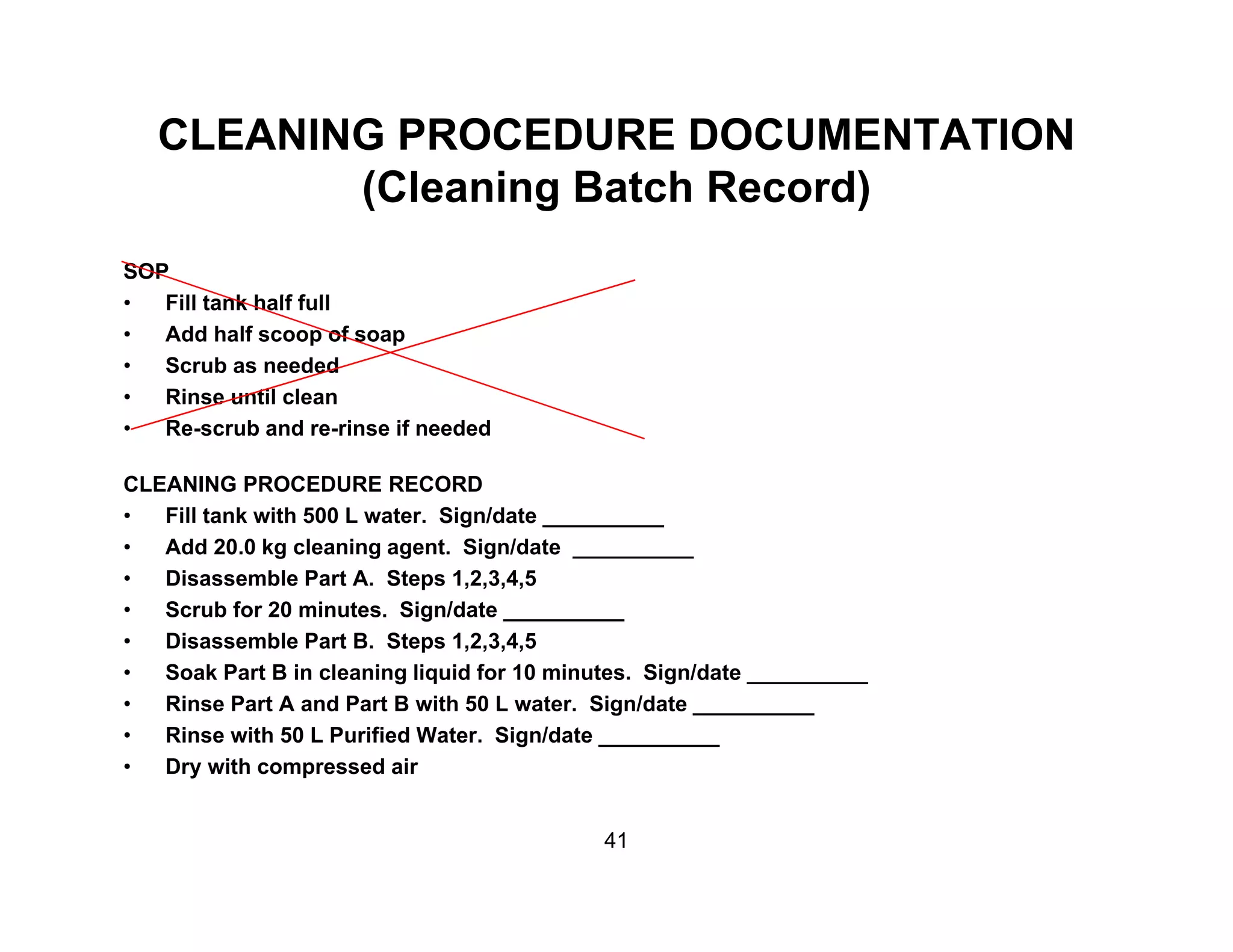
CLEANING PROCEDURE DOCUMENTATION
(Cl i B t h R d)(Cleaning Batch Record)
SOP
Fill t k h lf f ll• Fill tank half full
• Add half scoop of soap
• Scrub as needed
• Rinse until clean
• Re-scrub and re-rinse if needed
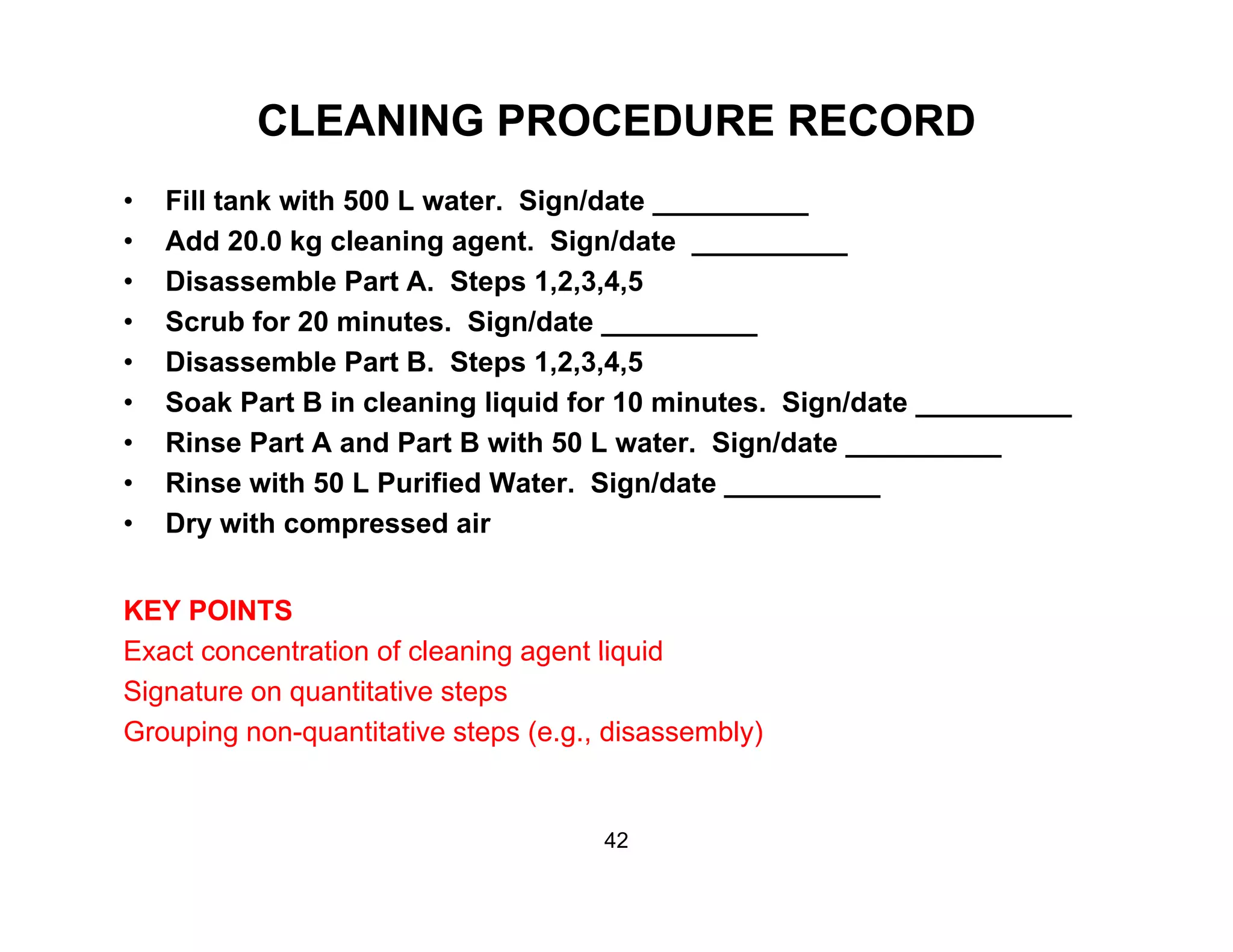
CLEANING PROCEDURE RECORD
• Fill tank with 500 L water. Sign/date __________
• Add 20.0 kg cleaning agent. Sign/date __________
• Disassemble Part A. Steps 1,2,3,4,5
• Scrub for 20 minutes. Sign/date __________
• Disassemble Part B. Steps 1,2,3,4,5
• Soak Part B in cleaning liquid for 10 minutes. Sign/date __________
• Rinse Part A and Part B with 50 L water. Sign/date __________
• Rinse with 50 L Purified Water. Sign/date __________
• Dry with compressed airy p
41
CLEANING PROCEDURE RECORD
• Fill tank with 500 L water. Sign/date __________
• Add 20.0 kg cleaning agent. Sign/date __________
• Disassemble Part A. Steps 1,2,3,4,5p
• Scrub for 20 minutes. Sign/date __________
• Disassemble Part B. Steps 1,2,3,4,5
• Soak Part B in cleaning liquid for 10 minutes. Sign/date __________g q g __________
• Rinse Part A and Part B with 50 L water. Sign/date __________
• Rinse with 50 L Purified Water. Sign/date __________
• Dry with compressed airy p
KEY POINTS
Exact concentration of cleaning agent liquidExact concentration of cleaning agent liquid
Signature on quantitative steps
Grouping non-quantitative steps (e.g., disassembly)
42
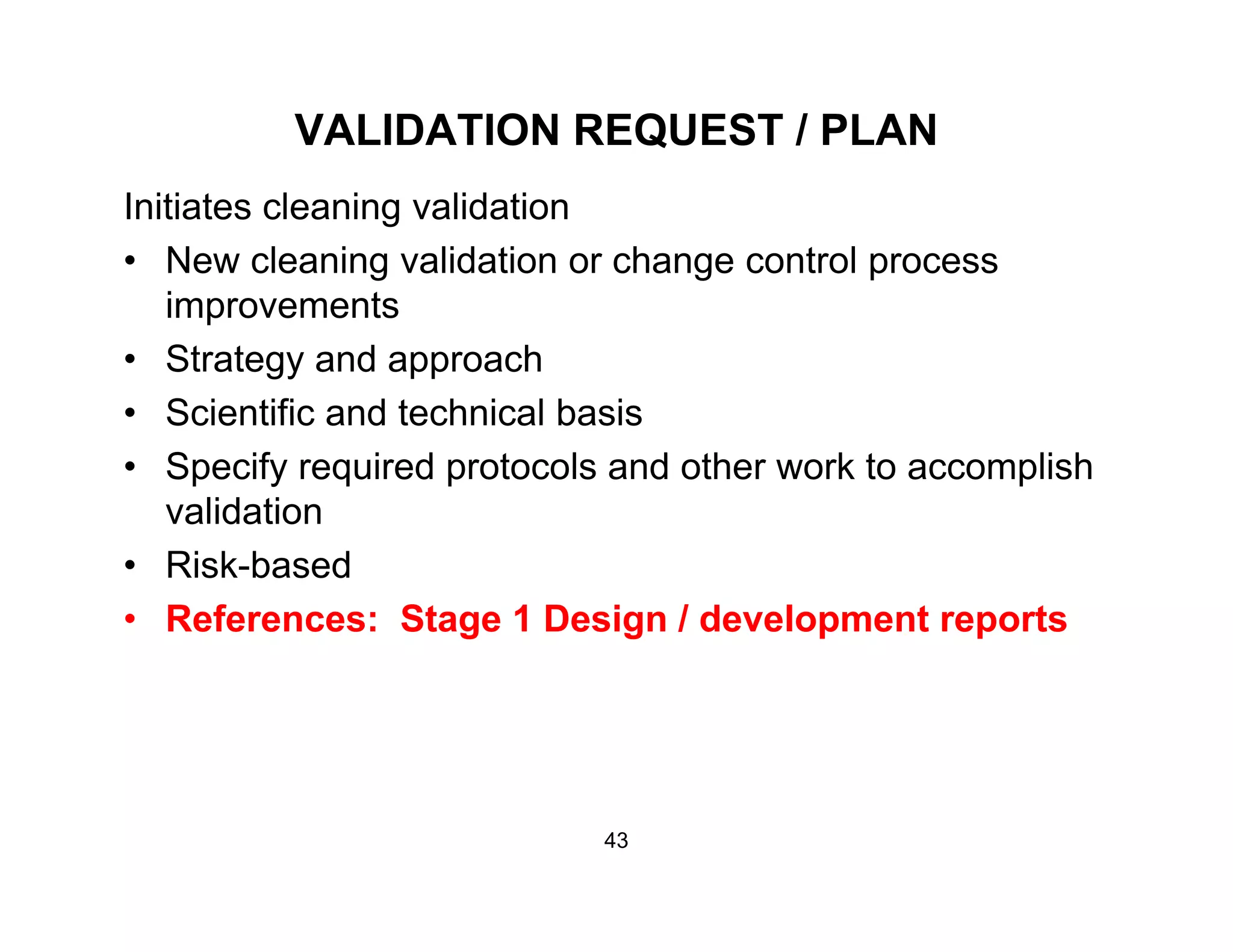
VALIDATION REQUEST / PLAN
Initiates cleaning validation
• New cleaning validation or change control process
i timprovements
• Strategy and approach
• Scientific and technical basis• Scientific and technical basis
• Specify required protocols and other work to accomplish
validation
• Risk-based
• References: Stage 1 Design / development reports
43
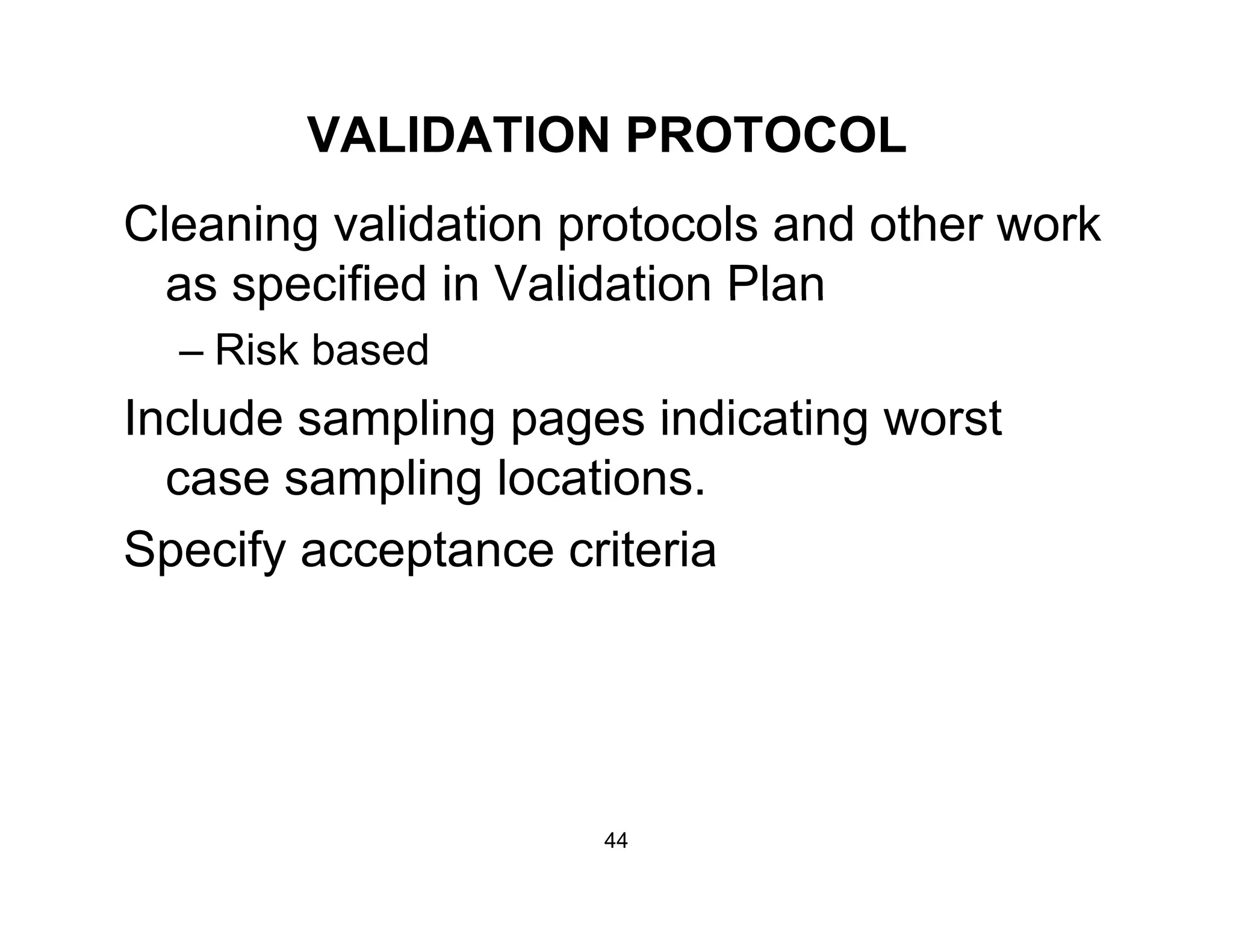
VALIDATION PROTOCOL
Cleaning validation protocols and other work
as specified in Validation Planas specified in Validation Plan
– Risk based
Include sampling pages indicating worstInclude sampling pages indicating worst
case sampling locations.
S if t it iSpecify acceptance criteria
44
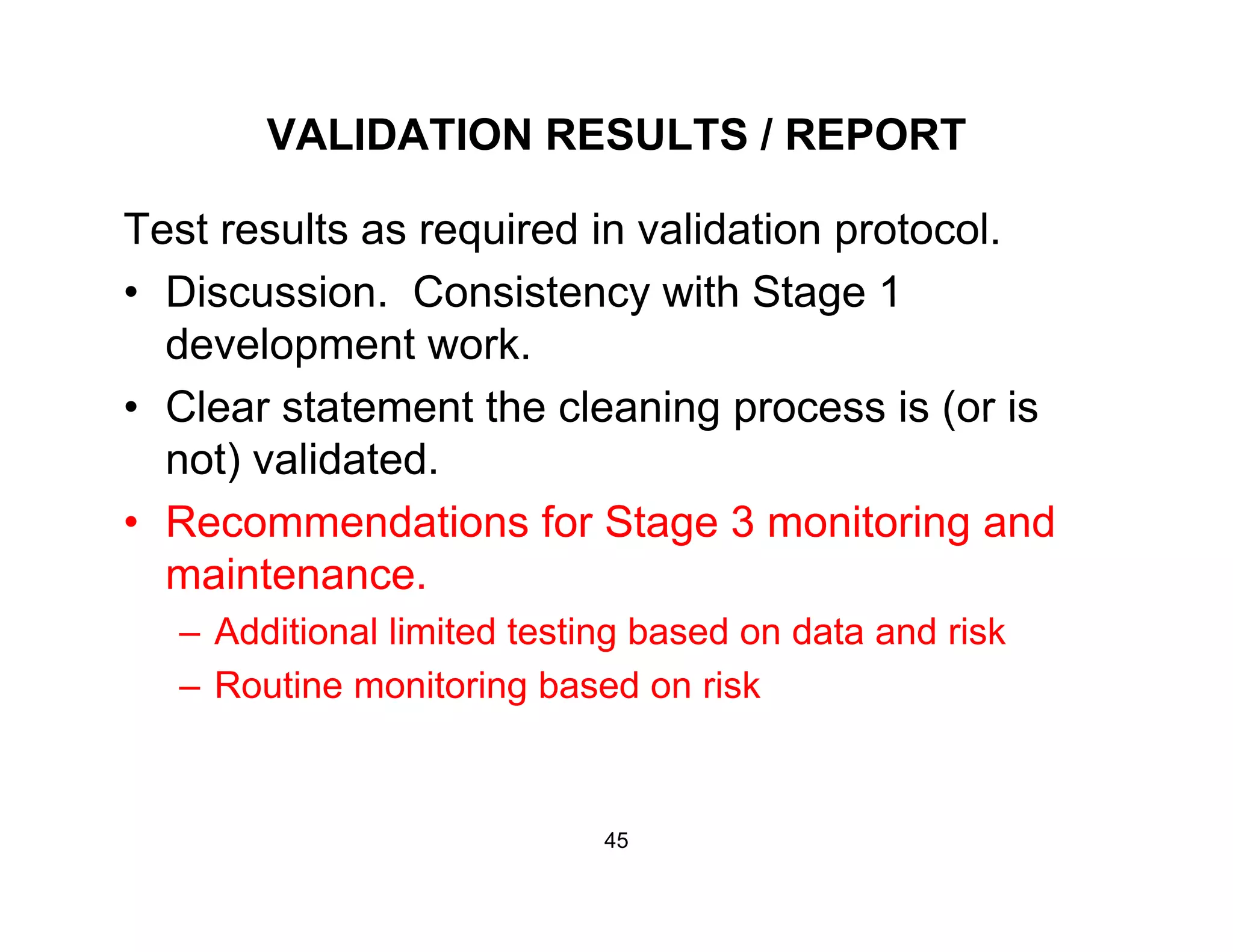
VALIDATION RESULTS / REPORT
Test results as required in validation protocol.
• Discussion Consistency with Stage 1• Discussion. Consistency with Stage 1
development work.
• Clear statement the cleaning process is (or isClear statement the cleaning process is (or is
not) validated.
• Recommendations for Stage 3 monitoring andRecommendations for Stage 3 monitoring and
maintenance.
– Additional limited testing based on data and risk
– Routine monitoring based on risk
45
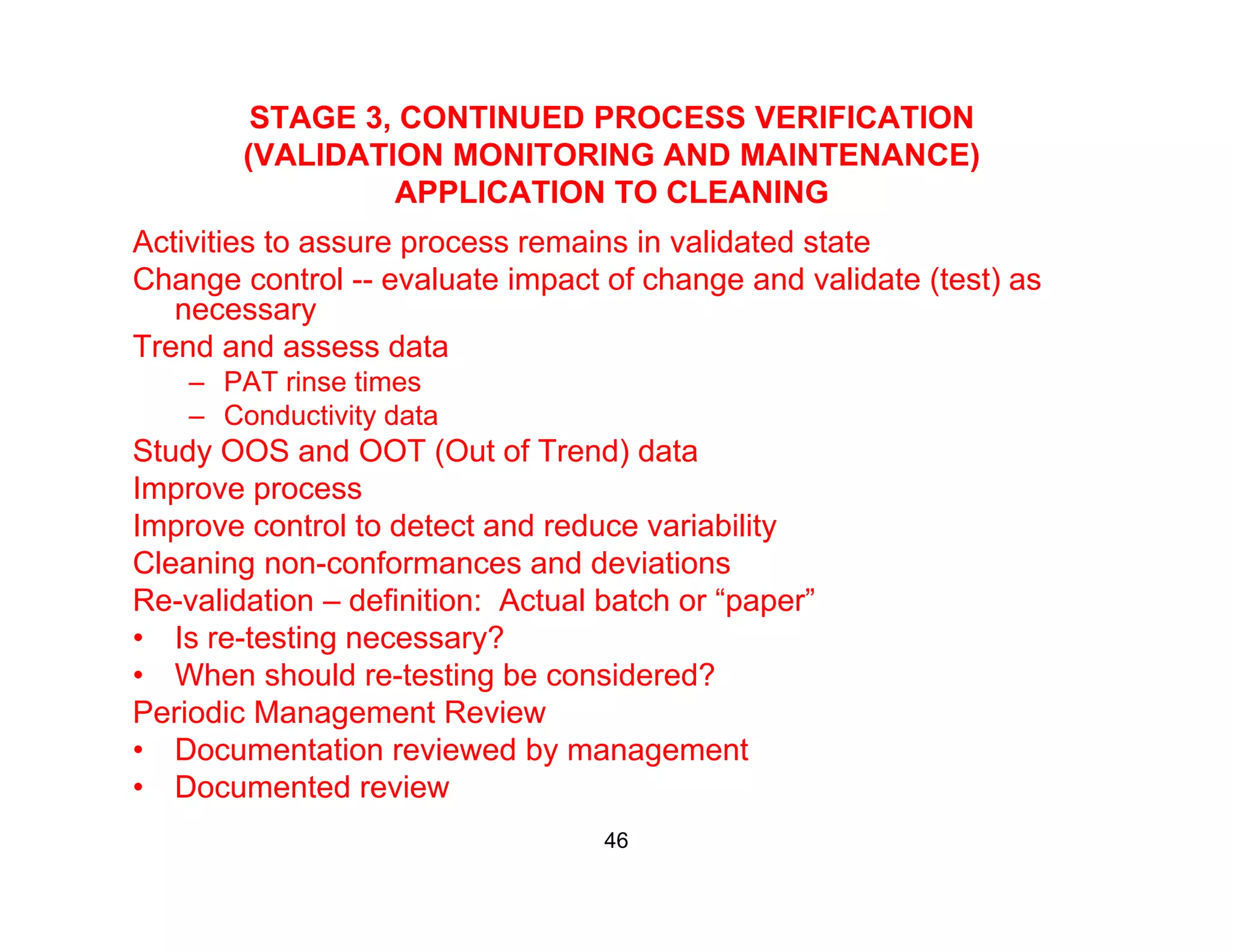
STAGE 3, CONTINUED PROCESS VERIFICATION
(VALIDATION MONITORING AND MAINTENANCE)
APPLICATION TO CLEANING
Activities to assure process remains in validated state
Change control -- evaluate impact of change and validate (test) asg p g ( )
necessary
Trend and assess data
– PAT rinse times
Conductivity data– Conductivity data
Study OOS and OOT (Out of Trend) data
Improve process
Improve control to detect and reduce variabilityImprove control to detect and reduce variability
Cleaning non-conformances and deviations
Re-validation – definition: Actual batch or “paper”
• Is re-testing necessary?
• When should re-testing be considered?
Periodic Management Review
• Documentation reviewed by management
D d i
46
• Documented review
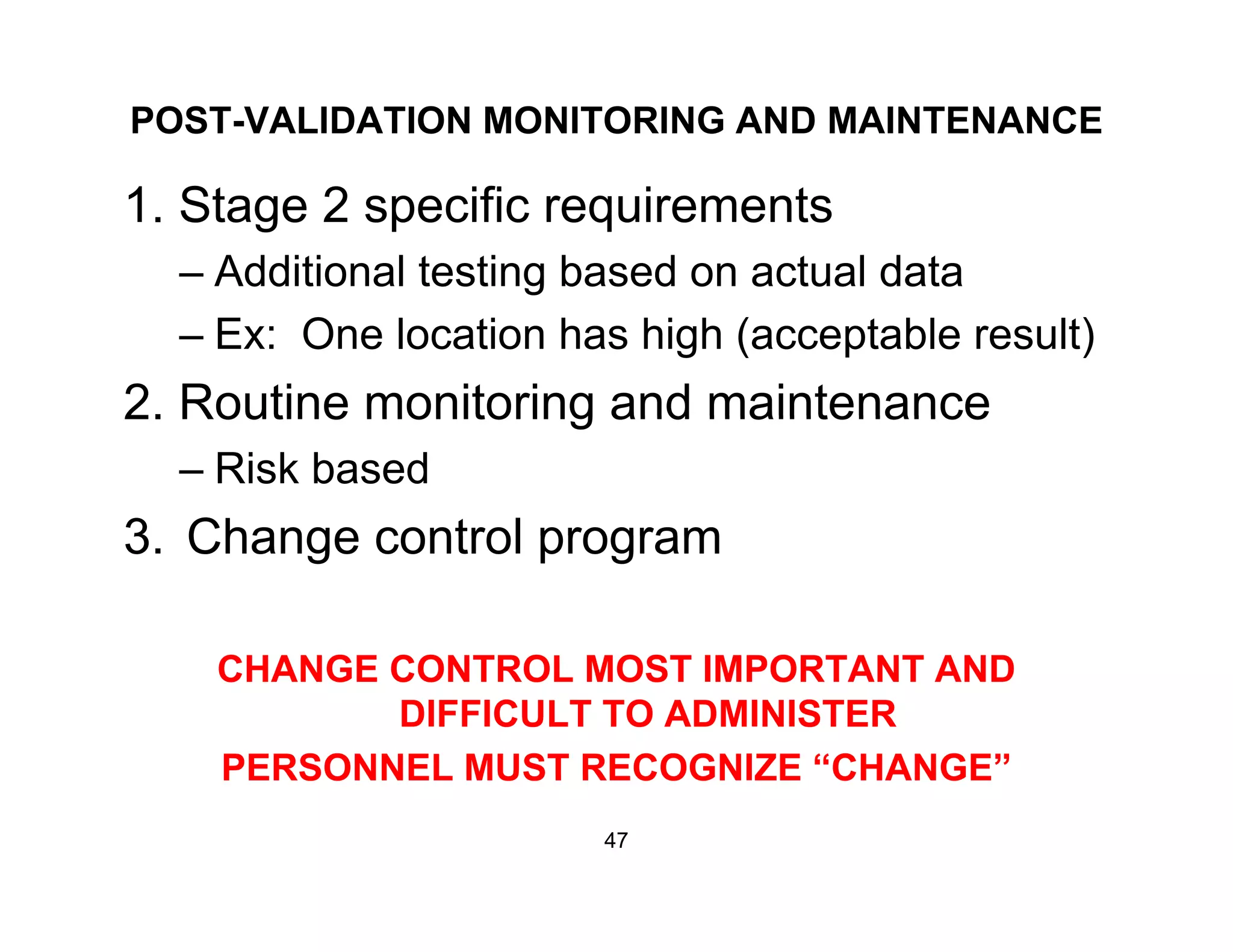
POST-VALIDATION MONITORING AND MAINTENANCE
1. Stage 2 specific requirements
– Additional testing based on actual data
– Ex: One location has high (acceptable result)
2. Routine monitoring and maintenance2. Routine monitoring and maintenance
– Risk based
3 Change control program3. Change control program
CHANGE CONTROL MOST IMPORTANT ANDCHANGE CONTROL MOST IMPORTANT AND
DIFFICULT TO ADMINISTER
PERSONNEL MUST RECOGNIZE “CHANGE”PERSONNEL MUST RECOGNIZE CHANGE
47
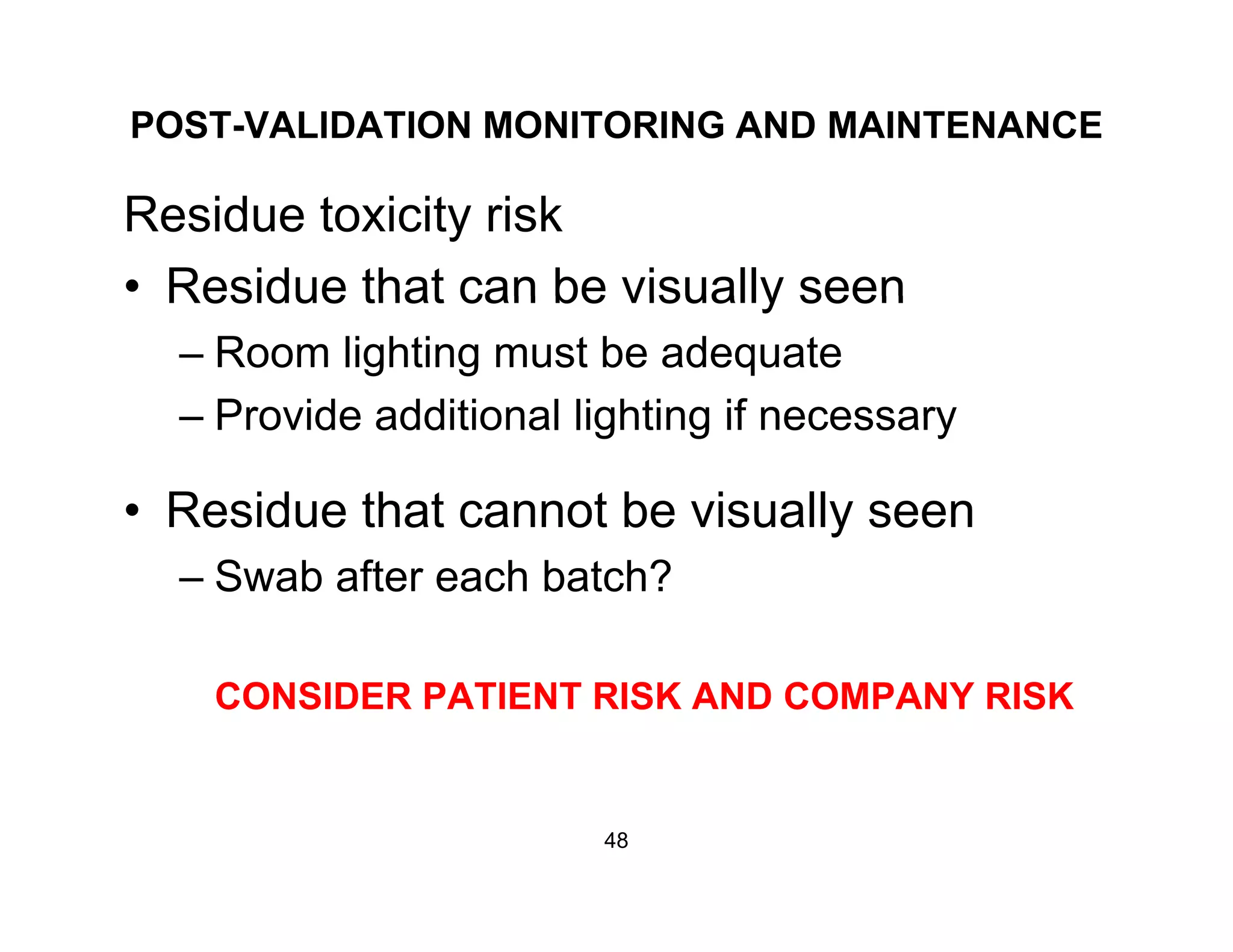
POST-VALIDATION MONITORING AND MAINTENANCE
Residue toxicity risk
• Residue that can be visually seenResidue that can be visually seen
– Room lighting must be adequate
Provide additional lighting if necessary– Provide additional lighting if necessary
• Residue that cannot be visually seeny
– Swab after each batch?
CONSIDER PATIENT RISK AND COMPANY RISK
48
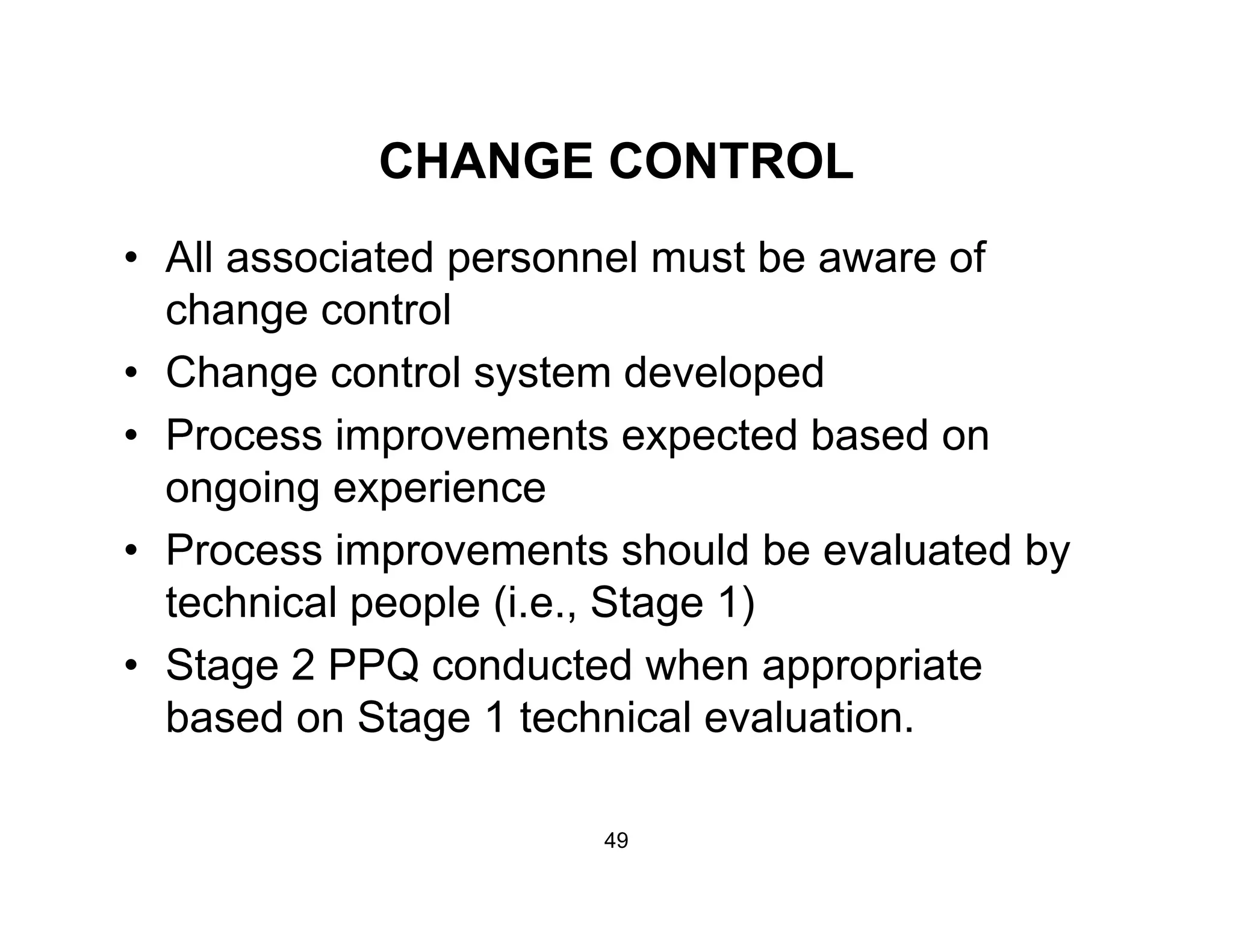
CHANGE CONTROLCHANGE CONTROL
• All associated personnel must be aware of
h t lchange control
• Change control system developed
• Process improvements expected based on
ongoing experience
P i t h ld b l t d b• Process improvements should be evaluated by
technical people (i.e., Stage 1)
St 2 PPQ d t d h i t• Stage 2 PPQ conducted when appropriate
based on Stage 1 technical evaluation.
49
POST-VALIDATION MONITORING
Periodic review of cleaning performance
• Deviations• Deviations
• Non-conformances (dirty equipment)
R l i• Re-cleaning
• Change control
O h i i (CIP d )• Other monitoring (CIP data)
• Product APR data
• Statistical Process Control data treatment
• Management review -- documented
50
CLEANING DOCUMENTATION
• High level documents
• Specific cleaning validation documents
– Design/Development, performance, monitoring/maintenance
• Specific cleaning validation support documents (equipment
qualifications)
• Cleaning validation approach documents (Worst case matrix,g pp ( ,
calculations, sampling locations, etc.)
• Production documents (Cleaning Procedure Records)
– Production cleaning policiesg p
• Management review documents
• Associated documents
– Personnel training in direct and associated areasPersonnel training in direct and associated areas
– HR records
51
CLEANING DOCUMENTATION
High level documents
• Corporate policy
• VMP (Cleaning VMP)
Stage 1 documents
Cl i d l t t• Cleaning process development report
• Analytical method development report
• Supporting equipment documents (materials, surface areas, equivalent equipment,
sampling, etc.)p g, )
Stage 2 documents
• Validation PPQ request, protocol, results
• Cleaning equipment qualification
• Cleaning procedure record
Stage 3 documents
• Change control documents
• Process monitoring• Process monitoring
• Management review
CONSISTENT LIFECYCLE STRATEGY AND APPROACHCONSISTENT LIFECYCLE STRATEGY AND APPROACH
52
SUMMARY
STAGE 1 DESIGN AND DEVELOPMENTSTAGE 1 -- DESIGN AND DEVELOPMENT
INCLUDING COMMON PROBLEMS
Understanding cleaning process
• Residue properties
– Residue degradationResidue degradation
• Rational cleaning process based on residue
• Scientific and technical cleaning matrix
U d t d d t l f i tiUnderstand and control sources of variation
• Dirty hold time
• Campaigns
Rational analytical method based on residue properties
Equipment to be cleaned characterized
• Worst case samplingWorst case sampling
53
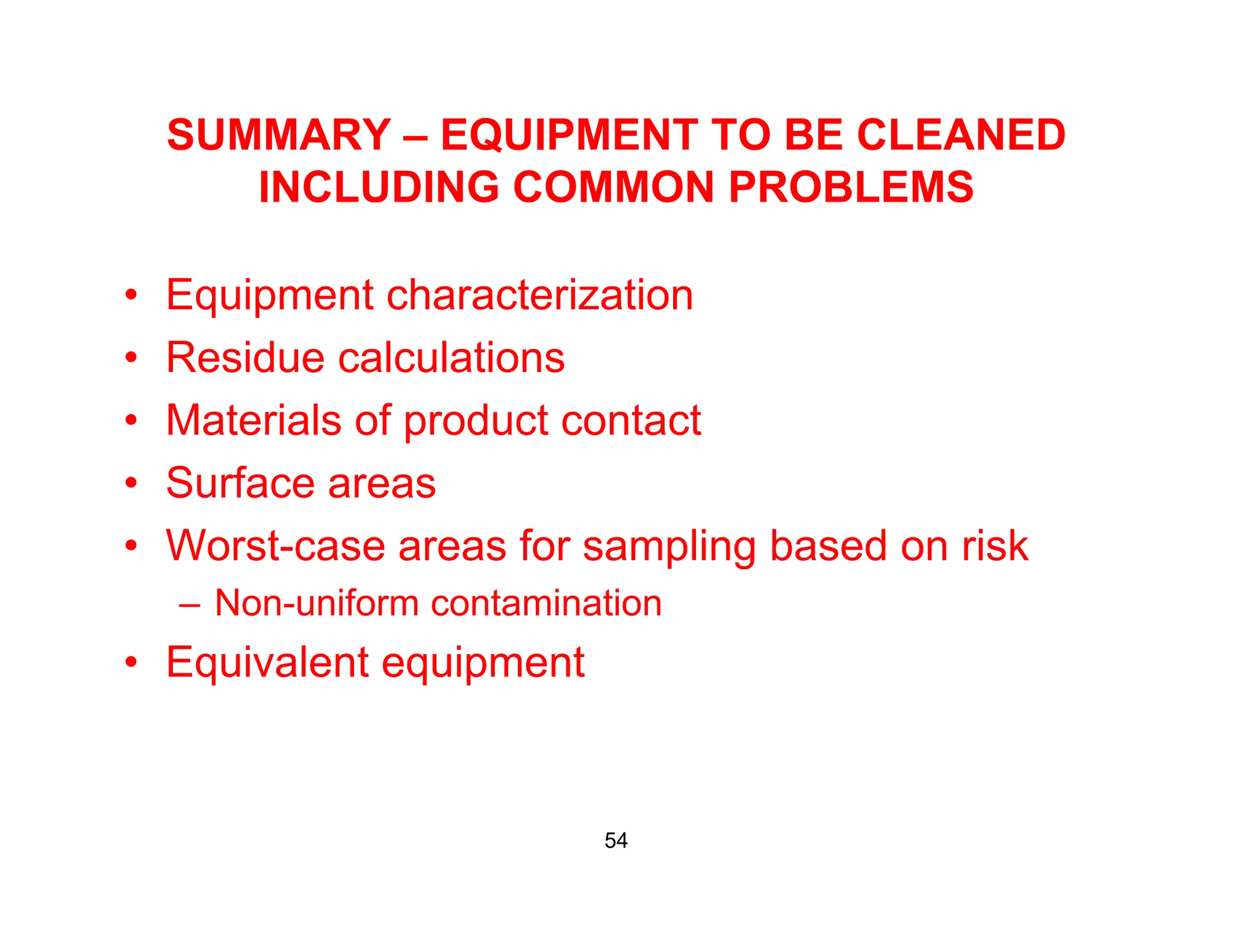
SUMMARY – EQUIPMENT TO BE CLEANED
INCLUDING COMMON PROBLEMSINCLUDING COMMON PROBLEMS
• Equipment characterization• Equipment characterization
• Residue calculations
• Materials of product contact• Materials of product contact
• Surface areas
W t f li b d i k• Worst-case areas for sampling based on risk
– Non-uniform contamination
Equivalent equipment• Equivalent equipment
54
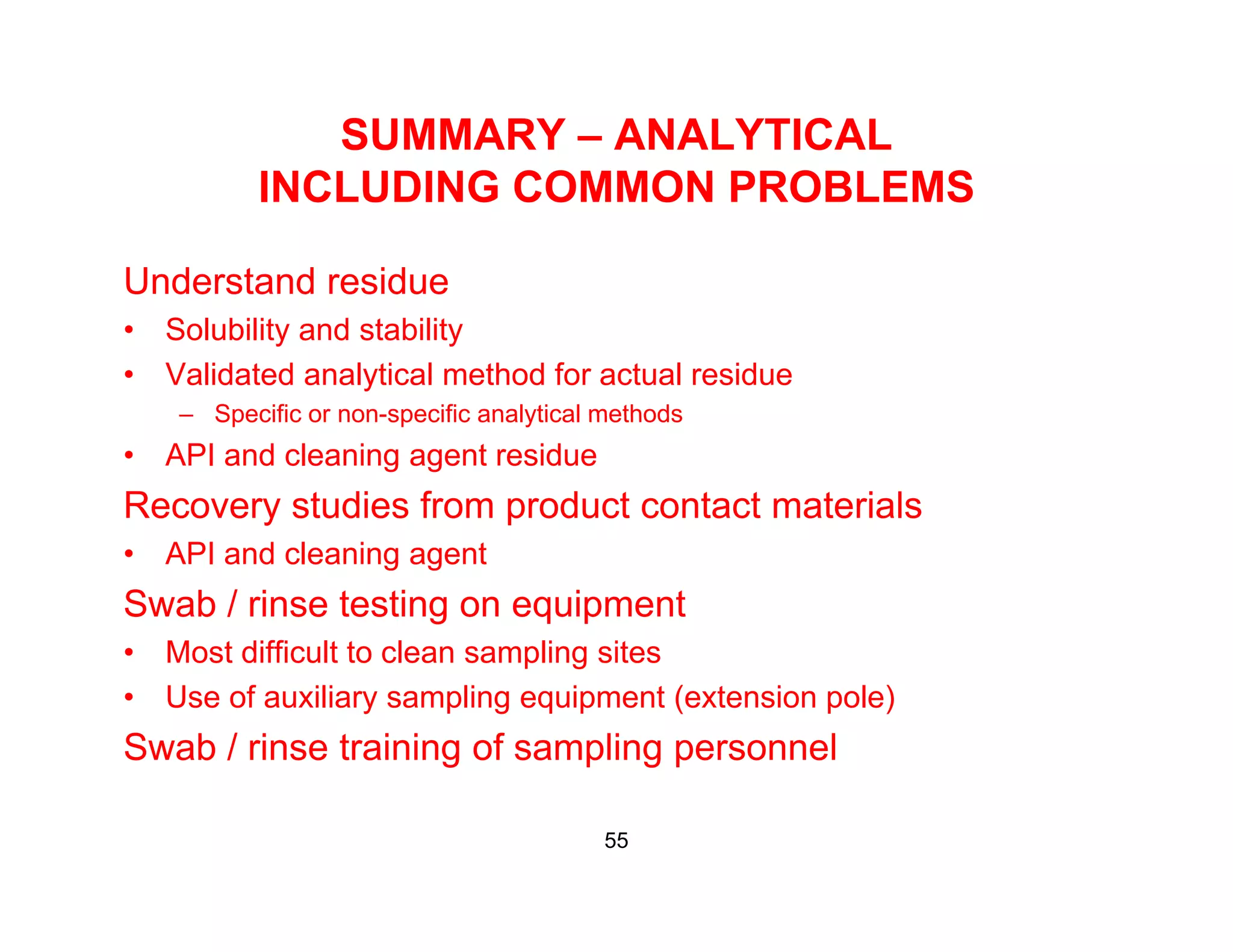
SUMMARY – ANALYTICAL
INCLUDING COMMON PROBLEMSINCLUDING COMMON PROBLEMS
Understand residue
• Solubility and stability
• Validated analytical method for actual residue
– Specific or non-specific analytical methods– Specific or non-specific analytical methods
• API and cleaning agent residue
Recovery studies from product contact materials
• API and cleaning agent
Swab / rinse testing on equipment
• Most difficult to clean sampling sitesMost difficult to clean sampling sites
• Use of auxiliary sampling equipment (extension pole)
Swab / rinse training of sampling personnel
55
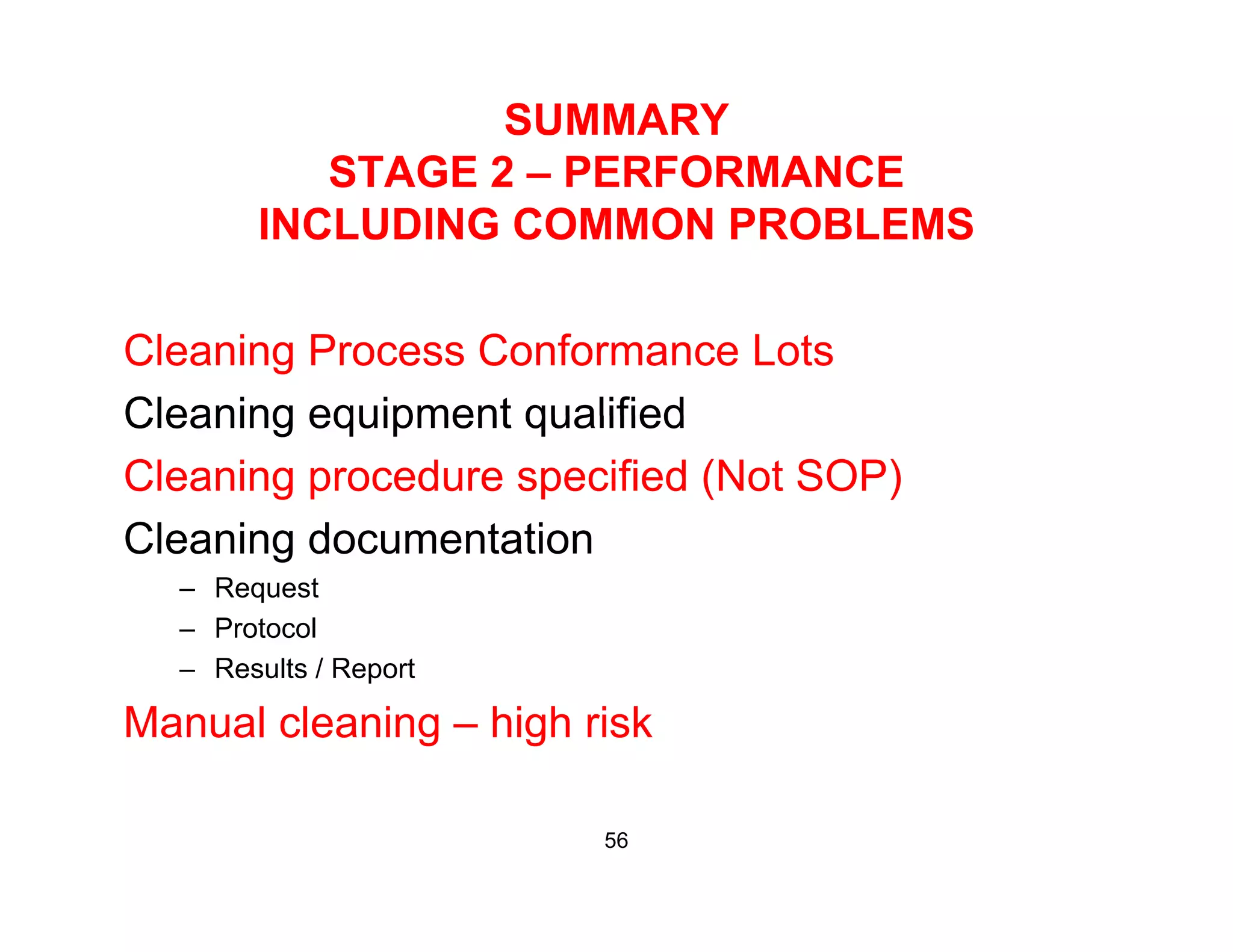
SUMMARY
STAGE 2 – PERFORMANCESTAGE 2 – PERFORMANCE
INCLUDING COMMON PROBLEMS
Cleaning Process Conformance Lots
Cleaning equipment qualifiedCleaning equipment qualified
Cleaning procedure specified (Not SOP)
Cleaning documentationCleaning documentation
– Request
– Protocol
– Results / Report
Manual cleaning – high risk
56
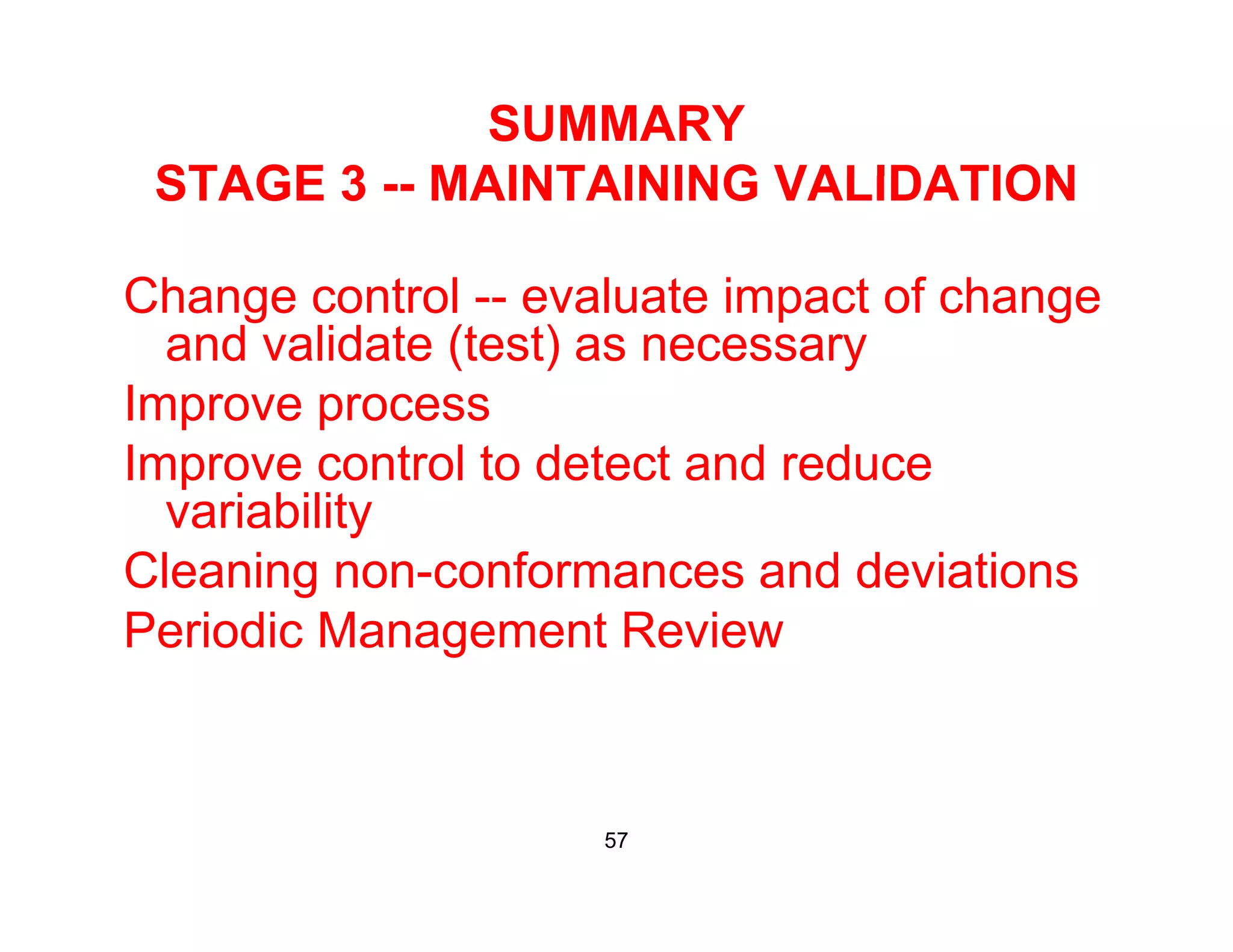
SUMMARY
STAGE 3 MAINTAINING VALIDATIONSTAGE 3 -- MAINTAINING VALIDATION
Change control evaluate impact of changeChange control -- evaluate impact of change
and validate (test) as necessary
Improve processImprove process
Improve control to detect and reduce
variabilityy
Cleaning non-conformances and deviations
Periodic Management Reviewg
57
CLEANING AND CLEANING VALIDATIONCLEANING AND CLEANING VALIDATION
For the Pharmaceutical and Medical Device
I d t iIndustries
V1 Basics Expectations and PrinciplesV1. Basics, Expectations, and Principles
V2. Applications of Basics and Principles
V3 Lifecycle Approach to Cleaning ValidationV3. Lifecycle Approach to Cleaning Validation
(Expected end 2013)
Paul L. Pluta, PhD, editor
58
PAUL L PLUTA PhDPAUL L. PLUTA, PhD
Editor-in-Chief
Jo rnal of Validation TechnologJournal of Validation Technology
Journal of GXP Compliance
Advanstar Communications
Adjunct Associate Professor
University of Illinois at Chicago (UIC) College of Pharmacy
Chicago, IL, USA
Pharmaceutical industry experiencey p
Contact: paul.pluta@comcast.net
59

Lifecycle Approach to Cleaning Validation

  • 1.
    LIFECYCLE APPROACHC CO C TO CLEANING VALIDATION Paul L. Pluta, PhD Validation Week EU, 2013 1
  • 2.
    MANUAL CLEANING --Do you really know what is happening? Q to operator: “Why is there so much foam in the tub?” A: “I put in extra soap because the equipment was really dirty.” Q to operator: “Why is there powder on the (clean) equipment?” A: “No problem -- We’ll get the residue when we set up ”A: No problem -- We ll get the residue when we set up. Q to operator: “Why don’t you follow the cleaning procedure?”Q to operator: Why don t you follow the cleaning procedure? A: “The cleaning procedure really doesn’t work.” ABOVE NOT ACCEPTABLE – TRAINING NEEDED 2
  • 3.
    MANUAL CLEANING --Do you really know what is happening? Q to operator: “Why is there powder on the clean equipment?”p y p q p A: “It’s clean enough.” Q to QA (equipment inspection person): “Did you approve that the equipment is clean?” A: “It’s clean enough.” Q to management: “Do you know that your equipment is not clean?” A: “It’s clean enough.” Q to operator: “You cleaned the gasket with pure soap – this is not the procedure? Also it is dangerous – these are corrosive chemicals.” A: “That is the only way to get it clean.” Q: “So why don’t you tell someone to change the procedure?” A: “We don’t have time.” ABOVE NOT ACCEPTABLE – TRAINING NEEDED 3
  • 4.
    MANUAL CLEANING --Do you really know what is happening? Q to management: “Did you finish cleaning the equipment? We are here to swab for cleaning validation.” A ( dl ) “W l d th i t th ti th tA (very proudly): “We cleaned the equipment three times so that we won’t have any problems.” Q to validation person: “Did you know that the manufacturing people always clean the equipment multiple times before it is swabbed?” A: “Sure, we knew. Q: “Why didn’t you stop this?” A: “These people are our friends. We have to work with these people.” ABOVE NOT ACCEPTABLE – TRAINING NEEDED 4
  • 5.
    OUTLINEOUTLINE Lifecycle Approach Appliedto Cleaning Validation Stage 1 ActivitiesStage 1 Activities • Cleaning Method Development • Analytical Method Development • Site equipment Stage 2 Activities • Cleaning documentation • Validation conformance lots Stage 3 Activities • Maintaining Validation • Change Control • Management review• Management review 5
  • 6.
    OBJECTIVESOBJECTIVES 1. Application oflifecycle approach to cleaning validation 2. Cleaning lifecycle stage details • Process development and understanding • Process qualification • Maintaining the validated stateg 3. Cleaning validation problems • Global experiences 6
  • 7.
    Lifecycle Approach toCleaning Validation – Value? Does this make sense?Value? Does this make sense? • Cleaning is a process • Validation lifecycle concepts being applied to equipment, facilities, utilities, computers, etc., by validation and technical expertsp • Who can argue with understanding, performing, and maintaining the validated state?g • Consistent with QbD and ICH approaches • Lifecycle approach (i.e., understanding, performing, maintaining) vs. traditional approach – Which would you rather present to an auditor?you rather present to an auditor? 7
  • 8.
    WHAT IS THECLEANING PROCESS? Cleaning Process Performance Qualification (PPQ) A t t d CIP S tAutomated CIP System Process steps QualificationProcess steps Qualification 1. Residue on equipment Equipment 2. Water procedure Purified Water 3 Cleaning agent procedure Computer / software3. Cleaning agent procedure Computer / software 4. Water procedure Compressed air 5. Purified Water procedure Conductivity analysis 6. Dry TOC analysisy y Equipment is clean -- Process is validated Process parameters Quality attributes 8
  • 9.
    WHAT IS THECLEANING PROCESS? Cleaning Process Performance Qualification (PPQ) M l Cl iManual Cleaning Process steps QualificationProcess steps Qualification 1. Residue on equipment Personnel 2. Water rinse Purified Water 3 S b ith l i t C d i3. Scrub with cleaning agent Compressed air 4. Water rinse 5. Scrub 6. Water rinse 7. Purified Water rinse 8 Dry8. Dry Equipment is clean -- Process is validated Process parameters Quality attributes 9
  • 10.
    CLEANING VALIDATION OVERVIEW 1990t1990s present 1. Defined cleaning procedure (SOP) – basis?g p ( ) 2. Product A batch does not contaminate subsequent Product B batch 3. Acceptance limit calculated 4. Assume uniform contamination of all equipment 5 Three conformance lots = Validated cleaning procedure5. Three conformance lots = Validated cleaning procedure 6. Validated analytical method (original API) 7 Worst-case matrix approach7. Worst case matrix approach One-time event 10
  • 11.
    FDA PROCESS VALIDATIONGUIDANCE LIFECYCLE APPROACH TRANSITIONLIFECYCLE APPROACH TRANSITION APPPLICATION TO CLEANING VALIDATION Pre LifecyclePre Lifecycle Cleaning development (?) PQ change control ________________________ Lif l A hLifecycle Approach Development PQ Maintenance EXPANDED SCOPE OF VALIDATION INCREASED SPECIFIC STAGE REQUIREMENTSINCREASED SPECIFIC STAGE REQUIREMENTS 11
  • 12.
    LIFECYCLE APPROACH TOCLEANING VALIDATION Scientific and technical approach Design and development – Residue + cleaning agent + cleaning procedure Clean equipment Performance demonstration Monitoring and maintenance Rationale, responsibility, and accountabilityRationale, responsibility, and accountability Future process improvements Not the following: St d d it th d ( b i ti l )– Standard site method (no basis or rationale) – Personnel driven (no control) – “Do whatever it takes” (high variation) – SOP (no accountability) – Validation (?) – One-time event. 12
  • 13.
    STAGE 1, PROCESSDESIGN (PROCESS UNDERSTANDING) APPLICATION TO CLEANING FDA Guidance Topics 1. Building and capturing process knowledge and understanding. 2. Establishing a strategy for process control. Application to Cleaning Understand residue chemistry (solubility, stability) Determine cleaning agent based on residue chemistryDetermine cleaning agent based on residue chemistry Determine cleaning process • Identify sources of variability • Establish methods to control variabilityEstablish methods to control variability – Process Analytical Technology Rational analytical method and supporting worky pp g Characterization of equipment to be cleaned and supporting work Trained sampling personnel DOCUMENT ALL OF THE ABOVE 13
  • 14.
    DEVELOPMENT (STAGE 1) CLEANINGPROCESS DEVELOPMENTCLEANING PROCESS DEVELOPMENT • Physical and chemical properties of the residue is basis for cleaning processprocess • Considerations for determination of most difficult-to-clean residue • Residue solubility and stability in determining worst-case soils Residue chemistry critical for analytical method• Residue chemistry critical for analytical method • Cleaning agent chemistry consistent with residue chemistry • Cleaning process chemistry and engineering and consistent with residue and cleaning agent. RESIDUE CHEMISTRY – BASIS FOR CLEANING PROGRAM – BASIS FOR ANALYICAL METHOD 14
  • 15.
    RESIDUE PROPERTIES --BASIS FOR CLEANING PROCESS Case study: Antibiotic suspension containing insoluble API (base) Original cleaning method: Water, PurW, dry • No documented cleaning validation for many yearsNo documented cleaning validation for many years • Unknown peaks on original cleaning validation attempts • API insoluble Second method: Alkaline soap wash water PurW drySecond method: Alkaline soap wash, water, PurW, dry • Unknown peaks again • API insoluble Fi l th d A id h lk li h t P W dFinal method: Acid wash, alkaline soap wash, water, PurW, dry • No residues • Unknown peaks determined to be degradants and flavors. API di l ( id b t li ti )• API dissolves (acid-base neutralization) Consider active drug and other residue chemistry in development of cleaning processof cleaning process 15
  • 16.
    DETERMINATION OF MOST DIFFICULTTO CLEAN RESIDUEMOST DIFFICULT TO CLEAN RESIDUE BASIS FOR CLEANING PROGRAM Water solubility – USP Tables • Is this adequate? NO! pH effect – API with ionizable groups? Solubility in cleaning agent? • Determine solubility at range pH 1-12 • Understand solubility at pH of cleaning liquidUnderstand solubility at pH of cleaning liquid • Understand solubility in cleaning agent liquid 16
  • 17.
    pH SOLUBILITY PROFILE,pH 1-12p SO U O , p Solubility mg/ml Drug A Drug B pH 1 7 12 17
  • 18.
    RESIDUE SOLUBILITY ANDSTABILITY FOR DETERMINING WORST CASE SOILSDETERMINING WORST-CASE SOILS Solubility considerations • Hydrophilic and hydrophobic molecules • Ionization – Effect of pH Eff t f t t• Effect of temperature • Surface active molecules • Liquid and semisolid product vehicle polarityLiquid and semisolid product vehicle polarity Stability considerations Hydrolysis oxidation photolysis physical changes• Hydrolysis, oxidation, photolysis, physical changes What residue is really present? Consider chemistry of residues 18
  • 19.
    CLEANING MATRIX Determine Worst-CaseSoil SOLUBILITY (mg / ml) H 1 W t H 12 Alk lipH 1 Water pH 12 Alkaline Cleaning Agent Drug A 25 25 25 25 Drug B 15 15 15 15 Drug C 5 5 150 250Drug C 5 5 150 250 Drug D 150 10 10 50 Drug E 125 10 100 250 Consider acid cleaning agent for drugs D and E 19
  • 20.
    WORST CASE CLEANING Determinationof worst-case cleaning based on API toxicity, worst-case dose, etc.on API toxicity, worst case dose, etc. – Standard calculation Cleaning procedure may be based onCleaning procedure may be based on excipients having greatest effect on cleaningcleaning – Hydrophilic polymers D– Dyes – Hydrophobic vehicles 20
  • 21.
    BIOTECH CLEANING CHEMISTRY-- API Protein molecules degrade in alkaline conditions Degradation rate is milder in acidic conditionsg Degradation rate increases with temperature API residues typically consist of protein fragments and aggregates Analytical method: Non-specific analysis Reference: Kendrick, Canhuto, and Kreuze. Analysis of Degradation Products of Biopharmaceutical API Causedg p by Cleaning Agents and Temperature. Journal of Validation Technology, V15, #3, Summer 2009. 21
  • 22.
    BIOTECH CLEANING CHEMISTRY– GROWTH MEDIUM Medium Composition • Acids or bases • Monovalent salts• Monovalent salts • Polyvalent salts • Amino acids • Proteins (polypeptides) • Carbohydrates • Aqueous soluble organicsq g • Non-aqueous soluble organics Consider medium composition at end of cycle. Reference: Azadan and Canhoto. A Scientific Approach to the Selection of Cleaning Validation Worst-Case Soils for Biopharmaceutical manufacturing. Cleaning and Cleaning Validation, Volume 1. 2011.Cleaning and Cleaning Validation, Volume 1. 2011. 22
  • 23.
    CLEANING CHEMISTRY MECHANISMS •Wetting • Emulsification • Dispersion • Solubilityy • Chelation • OxidationOxidation • Hydrolysis 23
  • 24.
    CLEANING AGENT OPTIONS •Water • Commodity alkalis and acidsy • Organic solvents • Surfactants – Anionic – Cationic – Amphoteric – Nonionic • Formulated detergents 24
  • 25.
    COMPONENTS OF FORMULATEDDETERGENTS • Surfactants • Alkalis • Acids • Sequestrants / chelants • Dispersants / anti-redeposition agents • Corrosion inhibitors• Corrosion inhibitors • Oxidizing agents • Enzymes • Buffers / builders • Preservatives MUST HAVE CONTROL OF CLEANING AGENT HAVE CONFIDENTIALITY AGREEMENT WITH SUPPLIER 25
  • 26.
    CLEANING ENGINEERING Factors affectingcleaning • Soil residueSoil residue – Soil levels, soil condition, hold times, soil mixing, water quality and residue, • Cleaner and parameters (TACT) – Time, Action, Concentration, Temperature – Others • Surface and equipment design 26
  • 27.
    CLEANING PROCESS SOURCES OFVARIATIONSOURCES OF VARIATION • Cleaning agent preparation – must be exact • Automated cleaning vs. manual cleaning • Manual cleaning process variation • Human physical strength variation • “Cleaning” between same-product batches ing p campaign – residue level build-up • Campaign length – residue level build-up • Time to initiate cleaning (dirty hold time) • Residue chemical and physical changesp y g 27
  • 28.
    EQUIPMENT TO BECLEANED Cleaning-related qualification • Product-contact materials • Compatibility with cleaning agents • Surface areas – need for residue calculations E i t i l• Equipment equivalence • Most-difficult-to-clean locations on equipment -- Highest risk locations for samplingrisk locations for sampling • Non-uniform contamination equipment • Non-uniform contamination sampling locationsg • Sampling methods (swab / rinse) Part of IQ/OQ/PQ for manufacturing equipment 28
  • 29.
    PROCEDURE TO DETERMINESAMPLING LOCATIONSLOCATIONS Specific documented procedure recommendedSpecific documented procedure recommended • Equipment technical evaluation • Observation of equipment after processingObservation of equipment after processing • Equipment disassembly review • Cleaning procedure review• Cleaning procedure review • Equipment evaluation review • Operator interviews• Operator interviews SOP describing above Documentation of above for equipment sampling 29
  • 30.
    TIME TO INITIATECLEANING “DIRTY HOLD TIME”DIRTY HOLD TIME 1. Make Product A 2 Cl2. Clean 3. Make Product B How long between end of #1 and start #2? Is residue same? Does residue change? Wh h h id ?What can happen to the residue? • Wet and dry processes • Chemical changes (hydrolysis oxidation etc )• Chemical changes (hydrolysis, oxidation, etc.) • Physical changes 30
  • 31.
    CAMPAIGN LENGTH How manylots in manufacturing campaign before cleaning must be done?cleaning must be done? What about “cleaning” between batches?What about cleaning between batches? • Equipment should be visually clean Terminology: “Between lot procedure”• Terminology: Between lot procedure • How much residue “build-up?” DO NOT IDENTIFY AS “BETWEEN LOT CLEANING” 31
  • 32.
    MANUAL CLEANING • Manualcleaning procedures should be monitored and maintained with increased scrutiny compared to non-manual procedures • More frequent training of cleaning personnel • Increased supervision • Periodic (annual?) revalidation batches Manual cleaning is high riskManual cleaning is high risk 32
  • 33.
    ANALYTICAL METHOD DEVELOPMENT Earlystage 1 (development) analysis – validation not required but must be soundvalidation not required but must be sound Validated method when used for Stage 2 cleaning validation and post validationcleaning validation and post-validation testing (change control) All methods and data (including stage 1) subject to regulatory auditregulatory audit 33
  • 34.
    ANALYTICAL METHOD DEVELOPMENT Analyticalmethod must measure actual residue – what residue is actually present on equipment surfaces? • Small molecules – API – API degraded – specific or non-specific method Bi t h l l• Biotech molecules – API degraded – non-specific method UNDERSTAND RESIDUE CHEMISTRY 34
  • 35.
    ANALYTICAL METHOD DEVELOPMENT Cleaningagent residue • Analytical method to determine residual cleaning agent. • Information from cleaning agent vendor 35
  • 36.
    ANALYTICAL METHOD DEVELOPMENT Rt diRecovery studies Can sampling procedure adequately recover residue from equipment surfaces?from equipment surfaces? • Product contact materials • High % of total surface area • Obtain representative coupons from equipment fabricators Hi h ( 80%) t it i• High (e.g., >80%) acceptance criteria • Factor may be used in calculation – Multiple approachesMultiple approaches – Factor every calculation? All sampled surfaces must have recovery dataAll sampled surfaces must have recovery data 36
  • 37.
    SAMPLING Sampling methodsSampling methods •Sampling (swab) critical activity • Training programTraining program • Trained sampling personnel – Demonstrated acceptable performance • Documented training and retraining • Worst case compounds / procedures in training – Volatile solvents (importance of rapid technique)– Volatile solvents (importance of rapid technique) • Worst case sampling equipment – Extension poles • Retraining considerations – Who does sampling? Personnel skills 37
  • 38.
    SAMPLING TRAINING Sampling isextremely critical to cleaning validation programvalidation program Inadequate sampling = false negative Insufficient pressure on surface– Insufficient pressure on surface – Swab solvent evaporation I ffi i t l d– Insufficient area sampled Auditors routinely ask for sampling program training methods and training records 38
  • 39.
    STAGE 2, PROCESSQUALIFICATION – (VALIDATION PERFORMANCE) APPLICATION TO CLEANINGAPPLICATION TO CLEANING 1. Design of a facility and qualification of utilities and equipment 2. Process performance qualification 3. PPQ protocol 4 PPQ t l ti d t4. PPQ protocol execution and report Qualification of equipment, utilities, facilities • Cleaning equipment (CIP) Process Performance Qualification (PPQ) – commercial scale Conclusion that process consistently produces clean equipment Conformance batches • All support systems, documents, training, personnel, etc. in place • Target / nominal operating parameters within design space • Additional testing (swab / rinse) • Decision to “release cleaning process” for routine commercial useDecision to release cleaning process for routine commercial use • Post validation monitoring plan – Based on risk – Drug residue properties – Manual or CIP 39
  • 40.
    CLEANING EQUIPMENTCLEANING EQUIPMENT CIPsystem must be qualified (IQ/OQ/PQ or ASTMCIP system must be qualified (IQ/OQ/PQ or ASTM E2500) Riboflavin (or other) coverage testing( ) g g Temperature controls Flow rates etcFlow rates, etc. PAT inline systems – Drug disappearance – spectrophotometry, other methodsg pp p p y – Cleaning agent rinse -- conductivity 40
  • 41.
    CLEANING PROCEDURE DOCUMENTATION (Cli B t h R d)(Cleaning Batch Record) SOP Fill t k h lf f ll• Fill tank half full • Add half scoop of soap • Scrub as needed • Rinse until clean • Re-scrub and re-rinse if needed CLEANING PROCEDURE RECORD • Fill tank with 500 L water. Sign/date __________ • Add 20.0 kg cleaning agent. Sign/date __________ • Disassemble Part A. Steps 1,2,3,4,5 • Scrub for 20 minutes. Sign/date __________ • Disassemble Part B. Steps 1,2,3,4,5 • Soak Part B in cleaning liquid for 10 minutes. Sign/date __________ • Rinse Part A and Part B with 50 L water. Sign/date __________ • Rinse with 50 L Purified Water. Sign/date __________ • Dry with compressed airy p 41
  • 42.
    CLEANING PROCEDURE RECORD •Fill tank with 500 L water. Sign/date __________ • Add 20.0 kg cleaning agent. Sign/date __________ • Disassemble Part A. Steps 1,2,3,4,5p • Scrub for 20 minutes. Sign/date __________ • Disassemble Part B. Steps 1,2,3,4,5 • Soak Part B in cleaning liquid for 10 minutes. Sign/date __________g q g __________ • Rinse Part A and Part B with 50 L water. Sign/date __________ • Rinse with 50 L Purified Water. Sign/date __________ • Dry with compressed airy p KEY POINTS Exact concentration of cleaning agent liquidExact concentration of cleaning agent liquid Signature on quantitative steps Grouping non-quantitative steps (e.g., disassembly) 42
  • 43.
    VALIDATION REQUEST /PLAN Initiates cleaning validation • New cleaning validation or change control process i timprovements • Strategy and approach • Scientific and technical basis• Scientific and technical basis • Specify required protocols and other work to accomplish validation • Risk-based • References: Stage 1 Design / development reports 43
  • 44.
    VALIDATION PROTOCOL Cleaning validationprotocols and other work as specified in Validation Planas specified in Validation Plan – Risk based Include sampling pages indicating worstInclude sampling pages indicating worst case sampling locations. S if t it iSpecify acceptance criteria 44
  • 45.
    VALIDATION RESULTS /REPORT Test results as required in validation protocol. • Discussion Consistency with Stage 1• Discussion. Consistency with Stage 1 development work. • Clear statement the cleaning process is (or isClear statement the cleaning process is (or is not) validated. • Recommendations for Stage 3 monitoring andRecommendations for Stage 3 monitoring and maintenance. – Additional limited testing based on data and risk – Routine monitoring based on risk 45
  • 46.
    STAGE 3, CONTINUEDPROCESS VERIFICATION (VALIDATION MONITORING AND MAINTENANCE) APPLICATION TO CLEANING Activities to assure process remains in validated state Change control -- evaluate impact of change and validate (test) asg p g ( ) necessary Trend and assess data – PAT rinse times Conductivity data– Conductivity data Study OOS and OOT (Out of Trend) data Improve process Improve control to detect and reduce variabilityImprove control to detect and reduce variability Cleaning non-conformances and deviations Re-validation – definition: Actual batch or “paper” • Is re-testing necessary? • When should re-testing be considered? Periodic Management Review • Documentation reviewed by management D d i 46 • Documented review
  • 47.
    POST-VALIDATION MONITORING ANDMAINTENANCE 1. Stage 2 specific requirements – Additional testing based on actual data – Ex: One location has high (acceptable result) 2. Routine monitoring and maintenance2. Routine monitoring and maintenance – Risk based 3 Change control program3. Change control program CHANGE CONTROL MOST IMPORTANT ANDCHANGE CONTROL MOST IMPORTANT AND DIFFICULT TO ADMINISTER PERSONNEL MUST RECOGNIZE “CHANGE”PERSONNEL MUST RECOGNIZE CHANGE 47
  • 48.
    POST-VALIDATION MONITORING ANDMAINTENANCE Residue toxicity risk • Residue that can be visually seenResidue that can be visually seen – Room lighting must be adequate Provide additional lighting if necessary– Provide additional lighting if necessary • Residue that cannot be visually seeny – Swab after each batch? CONSIDER PATIENT RISK AND COMPANY RISK 48
  • 49.
    CHANGE CONTROLCHANGE CONTROL •All associated personnel must be aware of h t lchange control • Change control system developed • Process improvements expected based on ongoing experience P i t h ld b l t d b• Process improvements should be evaluated by technical people (i.e., Stage 1) St 2 PPQ d t d h i t• Stage 2 PPQ conducted when appropriate based on Stage 1 technical evaluation. 49
  • 50.
    POST-VALIDATION MONITORING Periodic reviewof cleaning performance • Deviations• Deviations • Non-conformances (dirty equipment) R l i• Re-cleaning • Change control O h i i (CIP d )• Other monitoring (CIP data) • Product APR data • Statistical Process Control data treatment • Management review -- documented 50
  • 51.
    CLEANING DOCUMENTATION • Highlevel documents • Specific cleaning validation documents – Design/Development, performance, monitoring/maintenance • Specific cleaning validation support documents (equipment qualifications) • Cleaning validation approach documents (Worst case matrix,g pp ( , calculations, sampling locations, etc.) • Production documents (Cleaning Procedure Records) – Production cleaning policiesg p • Management review documents • Associated documents – Personnel training in direct and associated areasPersonnel training in direct and associated areas – HR records 51
  • 52.
    CLEANING DOCUMENTATION High leveldocuments • Corporate policy • VMP (Cleaning VMP) Stage 1 documents Cl i d l t t• Cleaning process development report • Analytical method development report • Supporting equipment documents (materials, surface areas, equivalent equipment, sampling, etc.)p g, ) Stage 2 documents • Validation PPQ request, protocol, results • Cleaning equipment qualification • Cleaning procedure record Stage 3 documents • Change control documents • Process monitoring• Process monitoring • Management review CONSISTENT LIFECYCLE STRATEGY AND APPROACHCONSISTENT LIFECYCLE STRATEGY AND APPROACH 52
  • 53.
    SUMMARY STAGE 1 DESIGNAND DEVELOPMENTSTAGE 1 -- DESIGN AND DEVELOPMENT INCLUDING COMMON PROBLEMS Understanding cleaning process • Residue properties – Residue degradationResidue degradation • Rational cleaning process based on residue • Scientific and technical cleaning matrix U d t d d t l f i tiUnderstand and control sources of variation • Dirty hold time • Campaigns Rational analytical method based on residue properties Equipment to be cleaned characterized • Worst case samplingWorst case sampling 53
  • 54.
    SUMMARY – EQUIPMENTTO BE CLEANED INCLUDING COMMON PROBLEMSINCLUDING COMMON PROBLEMS • Equipment characterization• Equipment characterization • Residue calculations • Materials of product contact• Materials of product contact • Surface areas W t f li b d i k• Worst-case areas for sampling based on risk – Non-uniform contamination Equivalent equipment• Equivalent equipment 54
  • 55.
    SUMMARY – ANALYTICAL INCLUDINGCOMMON PROBLEMSINCLUDING COMMON PROBLEMS Understand residue • Solubility and stability • Validated analytical method for actual residue – Specific or non-specific analytical methods– Specific or non-specific analytical methods • API and cleaning agent residue Recovery studies from product contact materials • API and cleaning agent Swab / rinse testing on equipment • Most difficult to clean sampling sitesMost difficult to clean sampling sites • Use of auxiliary sampling equipment (extension pole) Swab / rinse training of sampling personnel 55
  • 56.
    SUMMARY STAGE 2 –PERFORMANCESTAGE 2 – PERFORMANCE INCLUDING COMMON PROBLEMS Cleaning Process Conformance Lots Cleaning equipment qualifiedCleaning equipment qualified Cleaning procedure specified (Not SOP) Cleaning documentationCleaning documentation – Request – Protocol – Results / Report Manual cleaning – high risk 56
  • 57.
    SUMMARY STAGE 3 MAINTAININGVALIDATIONSTAGE 3 -- MAINTAINING VALIDATION Change control evaluate impact of changeChange control -- evaluate impact of change and validate (test) as necessary Improve processImprove process Improve control to detect and reduce variabilityy Cleaning non-conformances and deviations Periodic Management Reviewg 57
  • 58.
    CLEANING AND CLEANINGVALIDATIONCLEANING AND CLEANING VALIDATION For the Pharmaceutical and Medical Device I d t iIndustries V1 Basics Expectations and PrinciplesV1. Basics, Expectations, and Principles V2. Applications of Basics and Principles V3 Lifecycle Approach to Cleaning ValidationV3. Lifecycle Approach to Cleaning Validation (Expected end 2013) Paul L. Pluta, PhD, editor 58
  • 59.
    PAUL L PLUTAPhDPAUL L. PLUTA, PhD Editor-in-Chief Jo rnal of Validation TechnologJournal of Validation Technology Journal of GXP Compliance Advanstar Communications Adjunct Associate Professor University of Illinois at Chicago (UIC) College of Pharmacy Chicago, IL, USA Pharmaceutical industry experiencey p Contact: paul.pluta@comcast.net 59