Ultrasonics inspections and confocal
microscopy to evaluate fatigue damage in
  fiber reinforced polymer composites
V.G. García, J. Sala, L. Crispí, J.M. Cabrera, A. Istúriz, A. Sàez,
                  M. Millán, C. Comes, D. Trias


Composites
1. Introduction: Outline

2. Experimental Procedure:
       Materials inspected and tested
       Ultrasound equipment
       Ultrasound visualization software
       4-Point bending fatigue tests
3. Results:
      Wöhler plot
      Ultrasound scans at N=4,000 cycles
      Ultrasound scans in at N=26,079 cycles
      Confocal microscopy in a GFRP at N=26,079 cycles
      Confocal microscopy in a CFRP at N=20,000 cycles

4. Conclusions


                                                         2/20
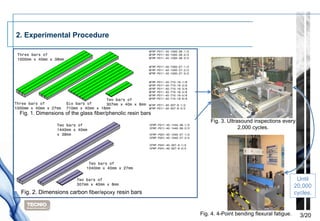
2. Experimental Procedure


 Fig. 1. Dimensions of the glass fiber/phenolic resin bars
                                                                 Fig. 3. Ultrasound inspections every
                                                                              2,000 cycles.


                                                                                                          Until
                                                                                                         20,000
 Fig. 2. Dimensions carbon fiber/epoxy resin bars                                                        cycles.


                                                             Fig. 4. 4-Point bending flexural fatigue.     3/20
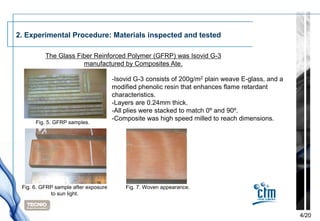
2. Experimental Procedure: Materials inspected and tested

          The Glass Fiber Reinforced Polymer (GFRP) was Isovid G-3
                      manufactured by Composites Ate.

                                      -Isovid G-3 consists of 200g/m2 plain weave E-glass, and a
                                      modified phenolic resin that enhances flame retardant
                                      characteristics.
                                      -Layers are 0.24mm thick.
                                      -All plies were stacked to match 0º and 90º.
                                      -Composite was high speed milled to reach dimensions.
      Fig. 5. GFRP samples.


 Fig. 6. GFRP sample after exposure       Fig. 7. Woven appearance.
            to sun light.


                                                                                                   4/20
2. Experimental Procedure: Materials inspected and tested

   The Carbon Fiber Reinforced Polymer (CFRP) was manufactured using Hexcel
     8552/32%/134/IM7(12K) at the INTA Materials and Structures Department.


                                        -The 8552/32%/134/IM7(12K) pre-impregnated carbon fiber
                                        plies consisted of tows of 12,000 individual fibers of IM7
                                        intermediate modulus carbon.
                                        -The pre-preg contained 32% of 8552, an amine cured,
      Fig. 8. CFRP samples.             toughened epoxy resin system.
                                        -The nominal ply thickness was 134µm.
                                        -Measured ply thickness was 129µm to 134µm.


                                     Table 1. Stacking sequences and percentages of layers oriented 90º, 0º or ±45º.
                                                                                  %      %       %       %          #
                                     Specimens             Stacking sequence
                                                                                 90º     0º     45º     -45º     layers
                                                        [(0/±45/02/±45/02/90) /
                                     CFRP-P011                                   8.8    54.4 18.4       18.4      283
                                                      ( 02/±45/02/±45/02/ )12]S
                                                                           90
                                                                 [(0/90) /
                                     CFRP-P021                                   9.5    54.7 17.9       17.9      201
                                                       ( 02/±45/02/±45/0290)9]S
                                                                           /
      Fig. 9. Smooth, rough, and                          [(0/90/0/±45/02/90) /
      machined surfaces of CFRP      CFRP-P041                                  11.9 54.2 16.9          16.9       59
                                                       ( 02/±45/02/±45/0290)2]S
                                                                           /
               samples.


                                                                                                                   5/20
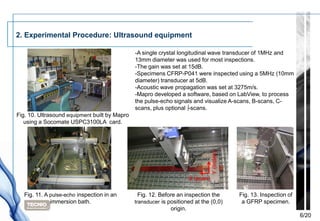
2. Experimental Procedure: Ultrasound equipment

                                               -A single crystal longitudinal wave transducer of 1MHz and
                                               13mm diameter was used for most inspections.
                                               -The gain was set at 15dB.
                                               -Specimens CFRP-P041 were inspected using a 5MHz (10mm
                                               diameter) transducer at 5dB.
                                               -Acoustic wave propagation was set at 3275m/s.
                                               -Mapro developed a software, based on LabView, to process
                                               the pulse-echo signals and visualize A-scans, B-scans, C-
                                               scans, plus optional ∫-scans.
Fig. 10. Ultrasound equipment built by Mapro
   using a Socomate USPC3100LA card.


                                                                                Y (Index)
                                                                     X (scan)

  Fig. 11. A pulse-echo inspection in an         Fig. 12. Before an inspection the          Fig. 13. Inspection of
             immersion bath.                   transducer is positioned at the (0,0)         a GFRP specimen.
                                                              origin.
                                                                                                                     6/20
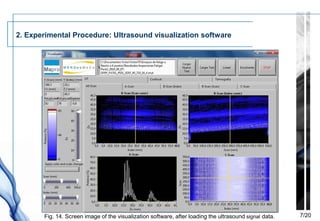
2. Experimental Procedure: Ultrasound visualization software


       Fig. 14. Screen image of the visualization software, after loading the ultrasound signal data.   7/20
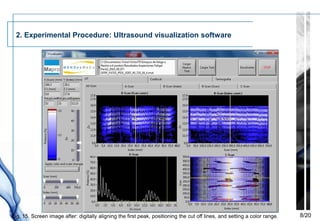
2. Experimental Procedure: Ultrasound visualization software


Fig. 15. Screen image after: digitally aligning the first peak, positioning the cut off lines, and setting a color range.   8/20
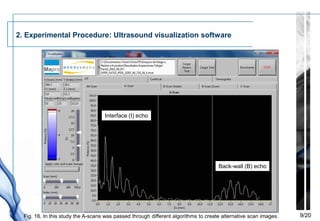
2. Experimental Procedure: Ultrasound visualization software


                                    Interface (I) echo


                                                                                     Back-wall (B) echo


  Fig. 16. In this study the A-scans was passed through different algorithms to create alternative scan images.   9/20
2. Experimental Procedure: Ultrasound visualization software


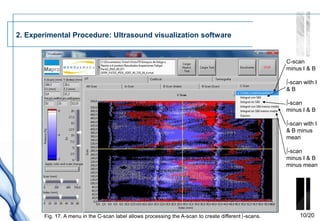
                                                                                                       C-scan
                                                                                                       minus I & B

                                                                                                       ∫-scan with I
                                                                                                       &B

                                                                                                       ∫-scan
                                                                                                       minus I & B

                                                                                                       ∫-scan with I
                                                                                                       & B minus
                                                                                                       mean

                                                                                                       ∫-scan
                                                                                                       minus I & B
                                                                                                       minus mean


       Fig. 17. A menu in the C-scan label allows processing the A-scan to create different ∫-scans.        10/20
2. Experimental Procedure: 4-Point bending fatigue tests

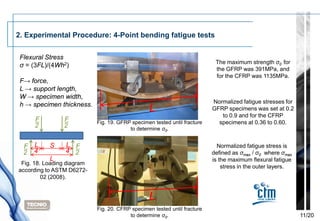
 Flexural Stress
                                                                            The maximum strength σ0 for
 σ = (3FL)/(4Wh2)
                                                                            the GFRP was 391MPa, and
                                                                            for the CFRP was 1135MPa.
 F→ force,
 L → support length,
 W → specimen width,
                                                                           Normalized fatigue stresses for
 h → specimen thickness.
                                                 L                         GFRP specimens was set at 0.2
                                                                              to 0.9 and for the CFRP
     F          F           Fig. 19. GFRP specimen tested until fracture     specimens at 0.36 to 0.60.
     2          2                        to determine σ0.


  F L      S     L F                                                         Normalized fatigue stress is
  2 4            4 2                                                       defined as σmax / σ0 where σmax
           L                                                               is the maximum flexural fatigue
 Fig. 18. Loading diagram
                                                                               stress in the outer layers.
according to ASTM D6272-
         02 (2008).


                                                 L
                            Fig. 20. CFRP specimen tested until fracture
                                         to determine σ0.                                                    11/20
3. Results: Wöhler plot

                              600                                                                                                                      400
 Maximum stress, σmax (MPa)


                                                                                                                                                                      GFRP-P011-40-1000-38_1/3   GFRP-P031-40-710-16_2/6
                                                          CFRP-P011-40-1440-38_1/2


                                                                                                                          Maximum stress, σmax (MPa)
                              400                         CFRP-P011-40-1440-38_2/2                                                                     300            GFRP-P011-40-1000-38_2/3
                                                                                                                                                                      GFRP-P011-40-1000-38_3/3
                                                                                                                                                                                                 GFRP-P031-40-710-16_3/6
                                                                                                                                                                                                 GFRP-P031-40-710-16_4/6
                                                          CFRP-PO21-40-1040-27_1/2                                                                                    GFRP-P021-40-1000-27_1/3   GFRP-P031-40-710-16_5/6
                                                                                                                                                       200            GFRP-P021-40-1000-27_2/3   GFRP-P031-40-710-16_6/6
                              200       f = 0,8 Hz        CFRP-P021-40-1040-27_2/2                                                                                    GFRP-P021-40-1000-27_3/3   GFRP-P041-40-307-8_1/2
                                        R=0,1             CFRP-P041-40-307-8_2/2                                                                       100            GFRP-P031-40-710-16_1/6    GFRP-P041-40-307-8_2/2

                               0
                                    0     2   4      6   8   10 12 14 16 18 20                                                                          0 0   2   4   6     8    10 12 14 16 18 20
                                                                                                                                                                                      Number of cycles (x1000)
                        -200                                   Number of cycles (x1000)
                                                                                                                                                   -100
                                    4-point bending tests
                        -400                                                                                                                       -200

                        -600
                                                                                                                                                   -300               4-point bending tests
                                                                                                                                                                                 f = 0,8 Hz
                                                                                                                                                   -400                          R = 0,1
                        -800
       Fig. 21. Maximum stresses during fatigue every                                                                           Fig. 22. Maximum stresses during fatigue every
            2,000 cycles for the CFRP specimens.                                                                                     2,000 cycles for the GFRP specimens.
                                                                                              400
                                                                     Maximum stress, σmax (MPa)


                                                                                              350
                                                                                              300 4-point
                                                                                                  bending
                                                                                              250
                                                                                                  fatigue tests,                                                                235 MPa
                                                                                              200 R=0,1
                                                                                              150 f=0,8Hz                                                                       13,344 cycles
                                                                                              100      Isovid G-3:
                                                                                                  50
                                                                                                       Plain weave 200g/m2 fiber glass
                                                                                                       with flame retardant phenolic resin
                                                                                                  0
                                                                                101    102    103  100  104  105
                                                                              Number of cycles to failure, N
                                                         Fig. 23. Maximum stresses versus cycles to failure of Isovid G-3 GFRP.                                                                                            12/20
3. Results: Ultrasound scans a GFRP at N=4,000 cycles


                        Y (Index)
                                    X (scan)
                 (a)                X (scan)


                        Y (Index)
                                                                                     C-scan of the B echo
                 (b)
                                                                                     ∫-scan with I & B
                 (c)
                                                                                     ∫-scan minus I & B
                 (d)
                                                                                     ∫-scan with I & B minus mean
                 (e)
                                                                                     ∫-scan minus I & B minus mean

                 (f)
                 Fig. 24. In (a) specimen GFRP-P031-40-710-16_5/6 that broke at
                 N=4001 cycles is shown. Images (b) to (f) show different types of
                                     scans performed at N=4000.

                                                                                                             13/20
3. Results: Ultrasound scans in a GFRP at N=26,079 cycles
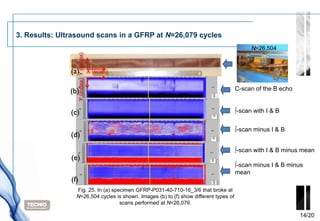
                                                                                             N=26,504


                     Y (Index) Y (Index)
               (a)                         X (scan)


               (b)                                                                     C-scan of the B echo


               (c)                                                                     ∫-scan with I & B


                                                                                       ∫-scan minus I & B
               (d)
                                                                                       ∫-scan with I & B minus mean
               (e)
                                                                                       ∫-scan minus I & B minus
                                                                                       mean
               (f)
                 Fig. 25. In (a) specimen GFRP-P031-40-710-16_3/6 that broke at
                 N=26,504 cycles is shown. Images (b) to (f) show different types of
                                    scans performed at N=26,079.

                                                                                                              14/20
3. Results: Ultrasound scans in a GFRP at N=26,079 cycles
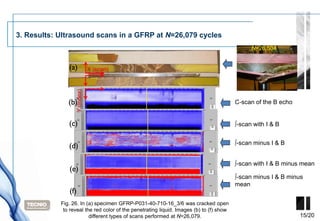
                                                                                               N=26,504


               (a)               X (scan)
                     Y (Index)


               (b)                                                                       C-scan of the B echo


               (c)                                                                       ∫-scan with I & B


                                                                                         ∫-scan minus I & B
               (d)

                                                                                         ∫-scan with I & B minus mean
               (e)
                                                                                         ∫-scan minus I & B minus
                                                                                         mean
               (f)
            Fig. 26. In (a) specimen GFRP-P031-40-710-16_3/6 was cracked open
             to reveal the red color of the penetrating liquid. Images (b) to (f) show
                         different types of scans performed at N=26,079.                                        15/20
3. Results: Confocal microscopy in a GFRP at N=26,079 cycles


                                                        (b)
(a)


                                                        (c)


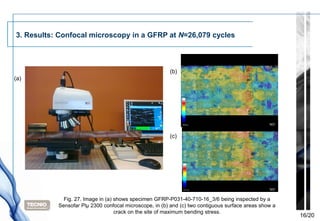
             Fig. 27. Image in (a) shows specimen GFRP-P031-40-710-16_3/6 being inspected by a
           Sensofar Plμ 2300 confocal microscope, in (b) and (c) two contiguous surface areas show a
                                   crack on the site of maximum bending stress.
                                                                                                       16/20
3. Results: Confocal microscopy in a CFRP at N=20,000 cycles
                  X (scan)
(a)
      Y (Index)


                                                                                            (d)
(b)

                  X (scan)
(c)
      Y (Index)


                             (e)                                     (f)


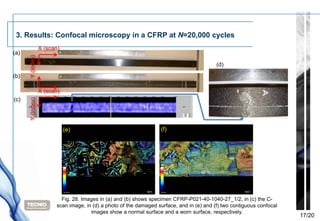
                           Fig. 28. Images in (a) and (b) shows specimen CFRP-P021-40-1040-27_1/2, in (c) the C-
                         scan image, in (d) a photo of the damaged surface, and in (e) and (f) two contiguous confocal
                                       images show a normal surface and a worn surface, respectively.
                                                                                                                         17/20
3. Results: Confocal microscopy in a CFRP at N=20,000 cycles


             (e)                                       (f)


             Fig. 28. Images in (a) and (b) shows specimen CFRP-P021-40-1040-27_1/2, in (c) the C-
           scan image, in (d) a photo of the damaged surface, and in (e) and (f) two contiguous confocal
                         images show a normal surface and a worn surface, respectively.
                                                                                                           18/20
3. Results: Confocal microscopy in a CFRP at N=20,000 cycles

                                                        (f)


        (g)                                       (h)


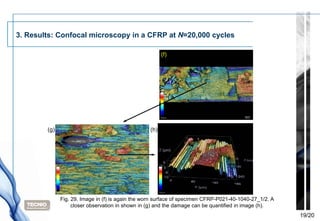
              Fig. 29. Image in (f) is again the worn surface of specimen CFRP-P021-40-1040-27_1/2. A
                   closer observation in shown in (g) and the damage can be quantified in image (h).
                                                                                                        19/20
4. Conclusions


   -The additional information (i. e. newer spots) provided by the ∫-scans still require
   further corroboration with the actual internal damage.

   -However, the observations of this study seem to point to the ∫-scan without the I &
   B echoes, as the image that can combine the most information both from internal
   and superficial damage.

   -Ultrasound inspections in the GFRP specimens of this study helped locate
   possible surface damage, and confocal microscopy was capable of noticing cracks
   on that surface.

   -In CFRP specimens the damage was visually evident, but confocal images helped
   quantify the depth and type of damage.


                                                                                           20/20
Thank you for your attention.

Ultrasonics inspections and confocal microscopy to evaluate fatigue damage in fiber reinforced polymer composites V. G. García

  • 1.
    Ultrasonics inspections andconfocal microscopy to evaluate fatigue damage in fiber reinforced polymer composites V.G. García, J. Sala, L. Crispí, J.M. Cabrera, A. Istúriz, A. Sàez, M. Millán, C. Comes, D. Trias Composites
  • 2.
    1. Introduction: Outline 2.Experimental Procedure: Materials inspected and tested Ultrasound equipment Ultrasound visualization software 4-Point bending fatigue tests 3. Results: Wöhler plot Ultrasound scans at N=4,000 cycles Ultrasound scans in at N=26,079 cycles Confocal microscopy in a GFRP at N=26,079 cycles Confocal microscopy in a CFRP at N=20,000 cycles 4. Conclusions 2/20
  • 3.
    2. Experimental Procedure Fig. 1. Dimensions of the glass fiber/phenolic resin bars Fig. 3. Ultrasound inspections every 2,000 cycles. Until 20,000 Fig. 2. Dimensions carbon fiber/epoxy resin bars cycles. Fig. 4. 4-Point bending flexural fatigue. 3/20
  • 4.
    2. Experimental Procedure:Materials inspected and tested The Glass Fiber Reinforced Polymer (GFRP) was Isovid G-3 manufactured by Composites Ate. -Isovid G-3 consists of 200g/m2 plain weave E-glass, and a modified phenolic resin that enhances flame retardant characteristics. -Layers are 0.24mm thick. -All plies were stacked to match 0º and 90º. -Composite was high speed milled to reach dimensions. Fig. 5. GFRP samples. Fig. 6. GFRP sample after exposure Fig. 7. Woven appearance. to sun light. 4/20
  • 5.
    2. Experimental Procedure:Materials inspected and tested The Carbon Fiber Reinforced Polymer (CFRP) was manufactured using Hexcel 8552/32%/134/IM7(12K) at the INTA Materials and Structures Department. -The 8552/32%/134/IM7(12K) pre-impregnated carbon fiber plies consisted of tows of 12,000 individual fibers of IM7 intermediate modulus carbon. -The pre-preg contained 32% of 8552, an amine cured, Fig. 8. CFRP samples. toughened epoxy resin system. -The nominal ply thickness was 134µm. -Measured ply thickness was 129µm to 134µm. Table 1. Stacking sequences and percentages of layers oriented 90º, 0º or ±45º. % % % % # Specimens Stacking sequence 90º 0º 45º -45º layers [(0/±45/02/±45/02/90) / CFRP-P011 8.8 54.4 18.4 18.4 283 ( 02/±45/02/±45/02/ )12]S 90 [(0/90) / CFRP-P021 9.5 54.7 17.9 17.9 201 ( 02/±45/02/±45/0290)9]S / Fig. 9. Smooth, rough, and [(0/90/0/±45/02/90) / machined surfaces of CFRP CFRP-P041 11.9 54.2 16.9 16.9 59 ( 02/±45/02/±45/0290)2]S / samples. 5/20
  • 6.
    2. Experimental Procedure:Ultrasound equipment -A single crystal longitudinal wave transducer of 1MHz and 13mm diameter was used for most inspections. -The gain was set at 15dB. -Specimens CFRP-P041 were inspected using a 5MHz (10mm diameter) transducer at 5dB. -Acoustic wave propagation was set at 3275m/s. -Mapro developed a software, based on LabView, to process the pulse-echo signals and visualize A-scans, B-scans, C- scans, plus optional ∫-scans. Fig. 10. Ultrasound equipment built by Mapro using a Socomate USPC3100LA card. Y (Index) X (scan) Fig. 11. A pulse-echo inspection in an Fig. 12. Before an inspection the Fig. 13. Inspection of immersion bath. transducer is positioned at the (0,0) a GFRP specimen. origin. 6/20
  • 7.
    2. Experimental Procedure:Ultrasound visualization software Fig. 14. Screen image of the visualization software, after loading the ultrasound signal data. 7/20
  • 8.
    2. Experimental Procedure:Ultrasound visualization software Fig. 15. Screen image after: digitally aligning the first peak, positioning the cut off lines, and setting a color range. 8/20
  • 9.
    2. Experimental Procedure:Ultrasound visualization software Interface (I) echo Back-wall (B) echo Fig. 16. In this study the A-scans was passed through different algorithms to create alternative scan images. 9/20
  • 10.
    2. Experimental Procedure:Ultrasound visualization software C-scan minus I & B ∫-scan with I &B ∫-scan minus I & B ∫-scan with I & B minus mean ∫-scan minus I & B minus mean Fig. 17. A menu in the C-scan label allows processing the A-scan to create different ∫-scans. 10/20
  • 11.
    2. Experimental Procedure:4-Point bending fatigue tests Flexural Stress The maximum strength σ0 for σ = (3FL)/(4Wh2) the GFRP was 391MPa, and for the CFRP was 1135MPa. F→ force, L → support length, W → specimen width, Normalized fatigue stresses for h → specimen thickness. L GFRP specimens was set at 0.2 to 0.9 and for the CFRP F F Fig. 19. GFRP specimen tested until fracture specimens at 0.36 to 0.60. 2 2 to determine σ0. F L S L F Normalized fatigue stress is 2 4 4 2 defined as σmax / σ0 where σmax L is the maximum flexural fatigue Fig. 18. Loading diagram stress in the outer layers. according to ASTM D6272- 02 (2008). L Fig. 20. CFRP specimen tested until fracture to determine σ0. 11/20
  • 12.
    3. Results: Wöhlerplot 600 400 Maximum stress, σmax (MPa) GFRP-P011-40-1000-38_1/3 GFRP-P031-40-710-16_2/6 CFRP-P011-40-1440-38_1/2 Maximum stress, σmax (MPa) 400 CFRP-P011-40-1440-38_2/2 300 GFRP-P011-40-1000-38_2/3 GFRP-P011-40-1000-38_3/3 GFRP-P031-40-710-16_3/6 GFRP-P031-40-710-16_4/6 CFRP-PO21-40-1040-27_1/2 GFRP-P021-40-1000-27_1/3 GFRP-P031-40-710-16_5/6 200 GFRP-P021-40-1000-27_2/3 GFRP-P031-40-710-16_6/6 200 f = 0,8 Hz CFRP-P021-40-1040-27_2/2 GFRP-P021-40-1000-27_3/3 GFRP-P041-40-307-8_1/2 R=0,1 CFRP-P041-40-307-8_2/2 100 GFRP-P031-40-710-16_1/6 GFRP-P041-40-307-8_2/2 0 0 2 4 6 8 10 12 14 16 18 20 0 0 2 4 6 8 10 12 14 16 18 20 Number of cycles (x1000) -200 Number of cycles (x1000) -100 4-point bending tests -400 -200 -600 -300 4-point bending tests f = 0,8 Hz -400 R = 0,1 -800 Fig. 21. Maximum stresses during fatigue every Fig. 22. Maximum stresses during fatigue every 2,000 cycles for the CFRP specimens. 2,000 cycles for the GFRP specimens. 400 Maximum stress, σmax (MPa) 350 300 4-point bending 250 fatigue tests, 235 MPa 200 R=0,1 150 f=0,8Hz 13,344 cycles 100 Isovid G-3: 50 Plain weave 200g/m2 fiber glass with flame retardant phenolic resin 0 101 102 103 100 104 105 Number of cycles to failure, N Fig. 23. Maximum stresses versus cycles to failure of Isovid G-3 GFRP. 12/20
  • 13.
    3. Results: Ultrasoundscans a GFRP at N=4,000 cycles Y (Index) X (scan) (a) X (scan) Y (Index) C-scan of the B echo (b) ∫-scan with I & B (c) ∫-scan minus I & B (d) ∫-scan with I & B minus mean (e) ∫-scan minus I & B minus mean (f) Fig. 24. In (a) specimen GFRP-P031-40-710-16_5/6 that broke at N=4001 cycles is shown. Images (b) to (f) show different types of scans performed at N=4000. 13/20
  • 14.
    3. Results: Ultrasoundscans in a GFRP at N=26,079 cycles N=26,504 Y (Index) Y (Index) (a) X (scan) (b) C-scan of the B echo (c) ∫-scan with I & B ∫-scan minus I & B (d) ∫-scan with I & B minus mean (e) ∫-scan minus I & B minus mean (f) Fig. 25. In (a) specimen GFRP-P031-40-710-16_3/6 that broke at N=26,504 cycles is shown. Images (b) to (f) show different types of scans performed at N=26,079. 14/20
  • 15.
    3. Results: Ultrasoundscans in a GFRP at N=26,079 cycles N=26,504 (a) X (scan) Y (Index) (b) C-scan of the B echo (c) ∫-scan with I & B ∫-scan minus I & B (d) ∫-scan with I & B minus mean (e) ∫-scan minus I & B minus mean (f) Fig. 26. In (a) specimen GFRP-P031-40-710-16_3/6 was cracked open to reveal the red color of the penetrating liquid. Images (b) to (f) show different types of scans performed at N=26,079. 15/20
  • 16.
    3. Results: Confocalmicroscopy in a GFRP at N=26,079 cycles (b) (a) (c) Fig. 27. Image in (a) shows specimen GFRP-P031-40-710-16_3/6 being inspected by a Sensofar Plμ 2300 confocal microscope, in (b) and (c) two contiguous surface areas show a crack on the site of maximum bending stress. 16/20
  • 17.
    3. Results: Confocalmicroscopy in a CFRP at N=20,000 cycles X (scan) (a) Y (Index) (d) (b) X (scan) (c) Y (Index) (e) (f) Fig. 28. Images in (a) and (b) shows specimen CFRP-P021-40-1040-27_1/2, in (c) the C- scan image, in (d) a photo of the damaged surface, and in (e) and (f) two contiguous confocal images show a normal surface and a worn surface, respectively. 17/20
  • 18.
    3. Results: Confocalmicroscopy in a CFRP at N=20,000 cycles (e) (f) Fig. 28. Images in (a) and (b) shows specimen CFRP-P021-40-1040-27_1/2, in (c) the C- scan image, in (d) a photo of the damaged surface, and in (e) and (f) two contiguous confocal images show a normal surface and a worn surface, respectively. 18/20
  • 19.
    3. Results: Confocalmicroscopy in a CFRP at N=20,000 cycles (f) (g) (h) Fig. 29. Image in (f) is again the worn surface of specimen CFRP-P021-40-1040-27_1/2. A closer observation in shown in (g) and the damage can be quantified in image (h). 19/20
  • 20.
    4. Conclusions -The additional information (i. e. newer spots) provided by the ∫-scans still require further corroboration with the actual internal damage. -However, the observations of this study seem to point to the ∫-scan without the I & B echoes, as the image that can combine the most information both from internal and superficial damage. -Ultrasound inspections in the GFRP specimens of this study helped locate possible surface damage, and confocal microscopy was capable of noticing cracks on that surface. -In CFRP specimens the damage was visually evident, but confocal images helped quantify the depth and type of damage. 20/20
  • 21.
    Thank you foryour attention.