Slide 1.1
Johnson, Whittington, Scholes, Angwin and Regnér, Exploring Strategy Powerpoints on the Web, 10th edition ©Pearson Education Limited 2014
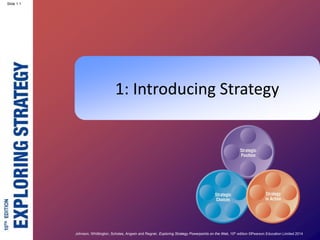
1: Introducing Strategy
Slide 1.2
Based on Johnson, Whittington, Scholes, Angwin and Regnér, Exploring Strategy Powerpoints on the Web, 10th edition ©Pearson Education Limited 2014
Learning outcomes
• Summarise the strategy of an organisation in a ‘strategy
statement’.
• Distinguish between corporate, business and operational
strategies.
• Identify key issues for an organisation’s strategy according to the
Exploring Strategy model.
• Understand different people’s roles in strategy work.
• Appreciate the importance of different organisational contexts,
academic disciplines and theoretical lenses to practical
strategy analysis.
Slide 1.3
Based on Johnson, Whittington, Scholes, Angwin and Regnér, Exploring Strategy Powerpoints on the Web, 10th edition ©Pearson Education Limited 2014
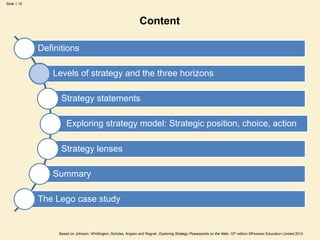
Content
Definitions
Levels of strategy and the three horizons
Strategy statements
Exploring strategy model: Strategic position, choice, action
Strategy lenses
Summary
The Lego case study
Slide 1.4
Based on Johnson, Whittington, Scholes, Angwin and Regnér, Exploring Strategy Powerpoints on the Web, 10th edition ©Pearson Education Limited 2014
Strategy definition
What is strategy? Michael Porter explains…
https://www.youtube.com/watch?v=3Hd88eBgkw0
Slide 1.5
Based on Johnson, Whittington, Scholes, Angwin and Regnér, Exploring Strategy Powerpoints on the Web, 10th edition ©Pearson Education Limited 2014
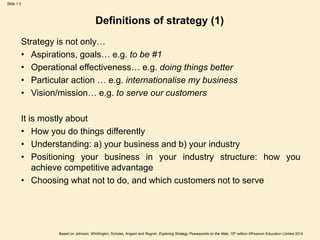
Strategy is not only…
• Aspirations, goals… e.g. to be #1
• Operational effectiveness… e.g. doing things better
• Particular action … e.g. internationalise my business
• Vision/mission… e.g. to serve our customers
It is mostly about
• How you do things differently
• Understanding: a) your business and b) your industry
• Positioning your business in your industry structure: how you
achieve competitive advantage
• Choosing what not to do, and which customers not to serve
Definitions of strategy (1)
Slide 1.6
Based on Johnson, Whittington, Scholes, Angwin and Regnér, Exploring Strategy Powerpoints on the Web, 10th edition ©Pearson Education Limited 2014
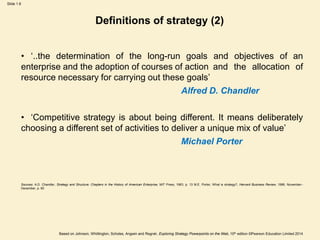
Definitions of strategy (2)
• ‘..the determination of the long-run goals and objectives of an
enterprise and the adoption of courses of action and the allocation of
resource necessary for carrying out these goals’
Alfred D. Chandler
• ‘Competitive strategy is about being different. It means deliberately
choosing a different set of activities to deliver a unique mix of value’
Michael Porter
Sources: A.D. Chandler, Strategy and Structure: Chapters in the History of American Enterprise, MIT Press, 1963, p. 13 M.E. Porter, What is strategy?, Harvard Business Review, 1996, November–
December, p. 60
Slide 1.7
Based on Johnson, Whittington, Scholes, Angwin and Regnér, Exploring Strategy Powerpoints on the Web, 10th edition ©Pearson Education Limited 2014
Definitions of strategy (3)
• ‘..a pattern in a stream of decisions’
Henry Mintzberg
• ‘..the long-term direction of an organisation’
Exploring Strategy
Sources: H. Mintzberg, Tracking Strategy: Towards a General Theory, Oxford University Press, 2007, p. 3
Slide 1.8
Based on Johnson, Whittington, Scholes, Angwin and Regnér, Exploring Strategy Powerpoints on the Web, 10th edition ©Pearson Education Limited 2014
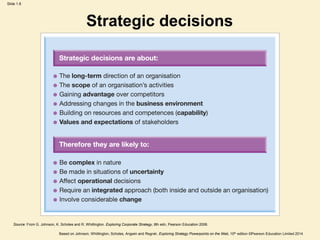
Strategic decisions
Source: From G. Johnson, K. Scholes and R. Whittington. Exploring Corporate Strategy, 8th edn, Pearson Education 2008.
Slide 1.9
Based on Johnson, Whittington, Scholes, Angwin and Regnér, Exploring Strategy Powerpoints on the Web, 10th edition ©Pearson Education Limited 2014
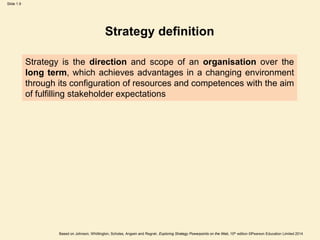
Strategy definition
Strategy is the direction and scope of an organisation over the
long term, which achieves advantages in a changing environment
through its configuration of resources and competences with the aim
of fulfilling stakeholder expectations
Slide 1.10
Based on Johnson, Whittington, Scholes, Angwin and Regnér, Exploring Strategy Powerpoints on the Web, 10th edition ©Pearson Education Limited 2014
Content
Definitions
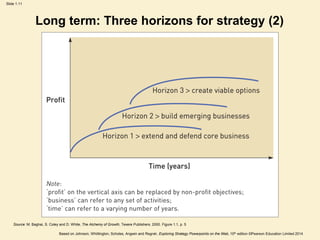
Levels of strategy and the three horizons
Strategy statements
Exploring strategy model: Strategic position, choice, action
Strategy lenses
Summary
The Lego case study
Slide 1.11
Based on Johnson, Whittington, Scholes, Angwin and Regnér, Exploring Strategy Powerpoints on the Web, 10th edition ©Pearson Education Limited 2014
Long term: Three horizons for strategy (2)
Source: M. Baghai, S. Coley and D. White, The Alchemy of Growth, Texere Publishers, 2000. Figure 1.1, p. 5
Slide 1.12
Based on Johnson, Whittington, Scholes, Angwin and Regnér, Exploring Strategy Powerpoints on the Web, 10th edition ©Pearson Education Limited 2014
Organisation:
Internal and External Stakeholders
Stakeholders are those individuals or groups that
depend on an organisation to fulfil their own goals and
on whom, in turn, the organisation depends.
Slide 1.13
Based on Johnson, Whittington, Scholes, Angwin and Regnér, Exploring Strategy Powerpoints on the Web, 10th edition ©Pearson Education Limited 2014
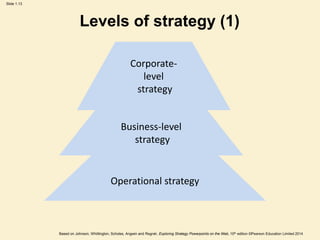
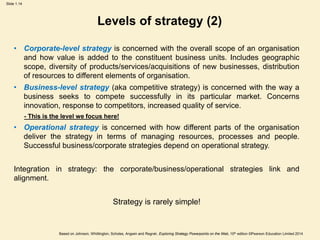
Levels of strategy (1)
Operational strategy
Business-level
strategy
Corporate-
level
strategy
Slide 1.14
Based on Johnson, Whittington, Scholes, Angwin and Regnér, Exploring Strategy Powerpoints on the Web, 10th edition ©Pearson Education Limited 2014
Levels of strategy (2)
• Corporate-level strategy is concerned with the overall scope of an organisation
and how value is added to the constituent business units. Includes geographic
scope, diversity of products/services/acquisitions of new businesses, distribution
of resources to different elements of organisation.
• Business-level strategy (aka competitive strategy) is concerned with the way a
business seeks to compete successfully in its particular market. Concerns
innovation, response to competitors, increased quality of service.
- This is the level we focus here!
• Operational strategy is concerned with how different parts of the organisation
deliver the strategy in terms of managing resources, processes and people.
Successful business/corporate strategies depend on operational strategy.
Integration in strategy: the corporate/business/operational strategies link and
alignment.
Strategy is rarely simple!
Slide 1.15
Based on Johnson, Whittington, Scholes, Angwin and Regnér, Exploring Strategy Powerpoints on the Web, 10th edition ©Pearson Education Limited 2014
Content
Definitions
Levels of strategy and the three horizons
Strategy statements
Exploring strategy model: Strategic position, choice, action
Strategy lenses
Summary
The Lego case study
Slide 1.16
Based on Johnson, Whittington, Scholes, Angwin and Regnér, Exploring Strategy Powerpoints on the Web, 10th edition ©Pearson Education Limited 2014
Strategy statements
All entrepreneurs and managers should be able to summarise
their organisation’s strategy with a “strategy statement”.
There are different types of “strategy statements” and there is
also confusion in their definitions.
Slide 1.17
Based on Johnson, Whittington, Scholes, Angwin and Regnér, Exploring Strategy Powerpoints on the Web, 10th edition ©Pearson Education Limited 2014
Strategy statements
• Vision:
– Definitions:
• a concise and inspirational statement implicitly relating an organization's purpose
to its values, thus motivating its actions toward a future state it strives to achieve
(StratML);
• Desired future state of the organisation (what do we want to achieve/be)
• An aspirational description of what an organization would like to achieve or
accomplish in the mid-term or long-term future. It is intended to serves as a clear
guide for choosing current and future courses of action.
http://www.businessdictionary.com/definition/vision-statement.html
– Examples
• Toyota trucks: to become the most successful and respected lift truck company in
Europe
• Samsung Electronics, Inspire the World, Create the Future.
• Oxfam: A just world without poverty
• Make-A-Wish: Our vision is that people everywhere will share the power of a wish
• Save the Children: A world in which every child attains the right to survival,
protection, development and participation.
Slide 1.18
Based on Johnson, Whittington, Scholes, Angwin and Regnér, Exploring Strategy Powerpoints on the Web, 10th edition ©Pearson Education Limited 2014
Strategy statements
• Mission:
– Definition
• A brief description of the basic purpose/reason of the organization (StratML), why
we exist, what we want to do.
• A written declaration of an organization's core purpose and focus that normally
remains unchanged over time. Properly crafted mission statements (1) serve as
filters to separate what is important from what is not, (2) clearly state which
markets will be served and how, and (3) communicate a sense of intended
direction to the entire organization.
http://www.businessdictionary.com/definition/mission-statement.html
– Examples:
• TED: Spreading Ideas.
• Oxfam: To create lasting solutions to poverty, hunger, and social injustice
• Save the Children: To inspire breakthroughs in the way the world treats children
and to achieve immediate and lasting change in their lives.
• New York Public Library: To inspire lifelong learning, advance knowledge, and
strengthen our communities.
• Amazon's: To be Earth’s most customer-centric company, where customers can
find and discover anything they might want to buy online, and endeavors to offer its
customers the lowest possible prices
Slide 1.19
Based on Johnson, Whittington, Scholes, Angwin and Regnér, Exploring Strategy Powerpoints on the Web, 10th edition ©Pearson Education Limited 2014
Strategy statements
What's the Difference Between Mission and Vision?
A mission is different from a vision in that the former is the cause and the
latter is the effect; a mission is something to be accomplished whereas a
vision is something to be pursued for that accomplishment.
http://www.businessdictionary.com/definition/mission-statement.html
https://www.youtube.com/watch?v=b2MyaR0gMo0
Slide 1.20
Based on Johnson, Whittington, Scholes, Angwin and Regnér, Exploring Strategy Powerpoints on the Web, 10th edition ©Pearson Education Limited 2014
Strategy statements
– Objectives:
• Performance Goal Strategy: A target level of results expressed in units
against which achievement is to be measured within a single resource
allocation and performance execution cycle (StratML)
• More precise and ideally quantifiable statements of the organisation
goals over some period of time (what do we want to achieve in the
coming period)
– Values:
• A principle that is important and helps to define the essential character
of the organization (StratML)
Slide 1.21
Based on Johnson, Whittington, Scholes, Angwin and Regnér, Exploring Strategy Powerpoints on the Web, 10th edition ©Pearson Education Limited 2014
Strategy statements
• IKEA’s mission and vision are the same statements: “At IKEA our vision is to
create a better everyday life for the many people. Our business idea supports this
vision by offering a wide range of well-designed, functional home furnishing
products at prices so low that as many people as possible will be able to afford
them.”
• IBM has hardly a well-formulated vision or mission statement, but rather the
following focuses on values:
– IBMers value...
• Dedication to every client’s success.
• Innovation that matters—for our company and the world.
• Trust and personal responsibility in all relationships.
Slide 1.22
Based on Johnson, Whittington, Scholes, Angwin and Regnér, Exploring Strategy Powerpoints on the Web, 10th edition ©Pearson Education Limited 2014
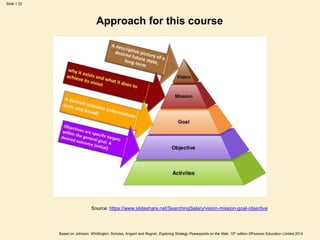
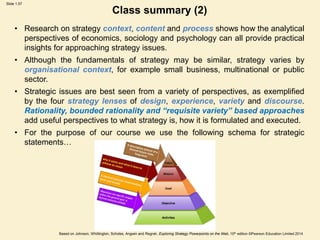
Approach for this course
Source: https://www.slideshare.net/SearchingSalary/vision-mission-goal-objective
Slide 1.23
Based on Johnson, Whittington, Scholes, Angwin and Regnér, Exploring Strategy Powerpoints on the Web, 10th edition ©Pearson Education Limited 2014
Approach for this course
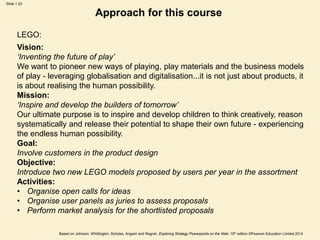
LEGO:
Vision:
‘Inventing the future of play’
We want to pioneer new ways of playing, play materials and the business models
of play - leveraging globalisation and digitalisation...it is not just about products, it
is about realising the human possibility.
Mission:
‘Inspire and develop the builders of tomorrow’
Our ultimate purpose is to inspire and develop children to think creatively, reason
systematically and release their potential to shape their own future - experiencing
the endless human possibility.
Goal:
Involve customers in the product design
Objective:
Introduce two new LEGO models proposed by users per year in the assortment
Activities:
• Organise open calls for ideas
• Organise user panels as juries to assess proposals
• Perform market analysis for the shortlisted proposals
Slide 1.24
Based on Johnson, Whittington, Scholes, Angwin and Regnér, Exploring Strategy Powerpoints on the Web, 10th edition ©Pearson Education Limited 2014
In-class activity
In groups of
Define an example of
Vision - Mission - Goal - Objective - Activity
for one organisation
15’
Slide 1.25
Based on Johnson, Whittington, Scholes, Angwin and Regnér, Exploring Strategy Powerpoints on the Web, 10th edition ©Pearson Education Limited 2014
Content
Definitions
Levels of strategy and the three horizons
Strategy statements
Exploring strategy model: Strategic position, choice, action
Strategy lenses
Summary
The Lego case study
Slide 1.26
Based on Johnson, Whittington, Scholes, Angwin and Regnér, Exploring Strategy Powerpoints on the Web, 10th edition ©Pearson Education Limited 2014
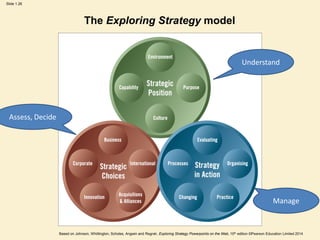
The Exploring Strategy model
Understand
Assess, Decide
Manage
Slide 1.27
Based on Johnson, Whittington, Scholes, Angwin and Regnér, Exploring Strategy Powerpoints on the Web, 10th edition ©Pearson Education Limited 2014
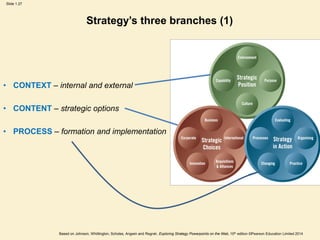
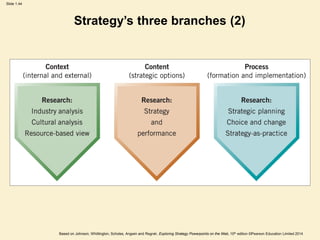
Strategy’s three branches (1)
• CONTEXT – internal and external
• CONTENT – strategic options
• PROCESS – formation and implementation
Slide 1.28
Based on Johnson, Whittington, Scholes, Angwin and Regnér, Exploring Strategy Powerpoints on the Web, 10th edition ©Pearson Education Limited 2014
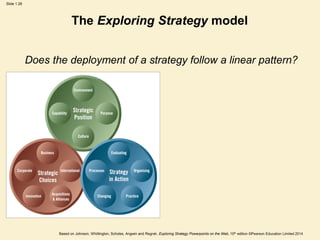
The Exploring Strategy model
Does the deployment of a strategy follow a linear pattern?
Slide 1.29
Based on Johnson, Whittington, Scholes, Angwin and Regnér, Exploring Strategy Powerpoints on the Web, 10th edition ©Pearson Education Limited 2014
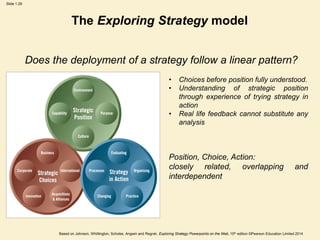
The Exploring Strategy model
Does the deployment of a strategy follow a linear pattern?
• Choices before position fully understood.
• Understanding of strategic position
through experience of trying strategy in
action
• Real life feedback cannot substitute any
analysis
Position, Choice, Action:
closely related, overlapping and
interdependent
Slide 1.30
Based on Johnson, Whittington, Scholes, Angwin and Regnér, Exploring Strategy Powerpoints on the Web, 10th edition ©Pearson Education Limited 2014
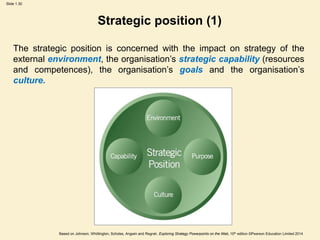
Strategic position (1)
The strategic position is concerned with the impact on strategy of the
external environment, the organisation’s strategic capability (resources
and competences), the organisation’s goals and the organisation’s
culture.
Slide 1.31
Based on Johnson, Whittington, Scholes, Angwin and Regnér, Exploring Strategy Powerpoints on the Web, 10th edition ©Pearson Education Limited 2014
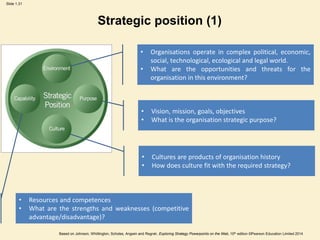
Strategic position (1)
• Organisations operate in complex political, economic,
social, technological, ecological and legal world.
• What are the opportunities and threats for the
organisation in this environment?
• Resources and competences
• What are the strengths and weaknesses (competitive
advantage/disadvantage)?
• Vision, mission, goals, objectives
• What is the organisation strategic purpose?
• Cultures are products of organisation history
• How does culture fit with the required strategy?
Slide 1.32
Based on Johnson, Whittington, Scholes, Angwin and Regnér, Exploring Strategy Powerpoints on the Web, 10th edition ©Pearson Education Limited 2014
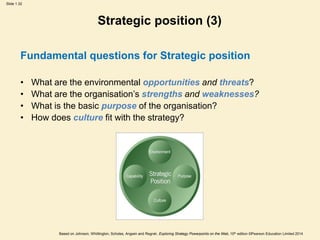
Strategic position (3)
Fundamental questions for Strategic position
• What are the environmental opportunities and threats?
• What are the organisation’s strengths and weaknesses?
• What is the basic purpose of the organisation?
• How does culture fit with the strategy?
Slide 1.33
Based on Johnson, Whittington, Scholes, Angwin and Regnér, Exploring Strategy Powerpoints on the Web, 10th edition ©Pearson Education Limited 2014
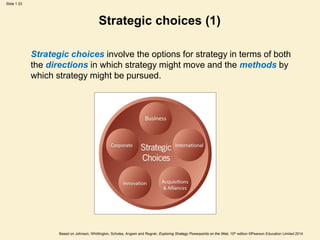
Strategic choices (1)
Strategic choices involve the options for strategy in terms of both
the directions in which strategy might move and the methods by
which strategy might be pursued.
Slide 1.34
Based on Johnson, Whittington, Scholes, Angwin and Regnér, Exploring Strategy Powerpoints on the Web, 10th edition ©Pearson Education Limited 2014
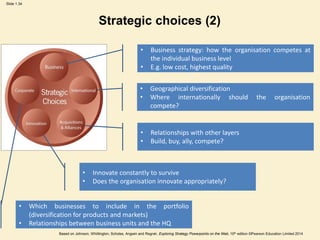
Strategic choices (2)
• Business strategy: how the organisation competes at
the individual business level
• E.g. low cost, highest quality
• Which businesses to include in the portfolio
(diversification for products and markets)
• Relationships between business units and the HQ
• Geographical diversification
• Where internationally should the organisation
compete?
• Innovate constantly to survive
• Does the organisation innovate appropriately?
• Relationships with other layers
• Build, buy, ally, compete?
Slide 1.35
Based on Johnson, Whittington, Scholes, Angwin and Regnér, Exploring Strategy Powerpoints on the Web, 10th edition ©Pearson Education Limited 2014
https://www.youtube.com/watch?v=_tStxIF4qNA
CNN: Why did Microsoft buy Skype?
Slide 1.36
Based on Johnson, Whittington, Scholes, Angwin and Regnér, Exploring Strategy Powerpoints on the Web, 10th edition ©Pearson Education Limited 2014
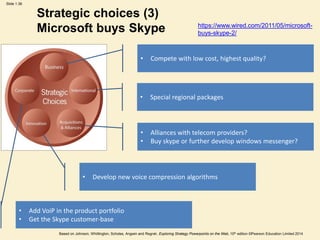
Strategic choices (3)
Microsoft buys Skype
• Compete with low cost, highest quality?
• Add VoiP in the product portfolio
• Get the Skype customer-base
• Special regional packages
• Develop new voice compression algorithms
• Alliances with telecom providers?
• Buy skype or further develop windows messenger?
https://www.wired.com/2011/05/microsoft-
buys-skype-2/
Slide 1.37
Based on Johnson, Whittington, Scholes, Angwin and Regnér, Exploring Strategy Powerpoints on the Web, 10th edition ©Pearson Education Limited 2014
Strategic choices (4)
Fundamental questions for Strategic choice
• How should individual business units compete?
• Which businesses (products/services) to include in the portfolio?
• Where should the organisation compete internationally?
• Is the organisation innovating appropriately?
• Should the organisation buy other companies, form alliances or go it
alone?
Slide 1.38
Based on Johnson, Whittington, Scholes, Angwin and Regnér, Exploring Strategy Powerpoints on the Web, 10th edition ©Pearson Education Limited 2014
Strategy in action (1)
Strategy in action is about how strategies are formed and how they
are implemented.
The emphasis is on the practicalities of managing.
Slide 1.39
Based on Johnson, Whittington, Scholes, Angwin and Regnér, Exploring Strategy Powerpoints on the Web, 10th edition ©Pearson Education Limited 2014
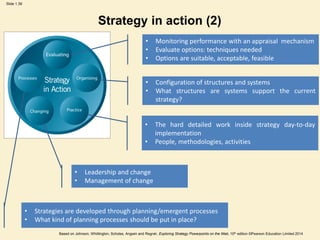
Strategy in action (2)
• Monitoring performance with an appraisal mechanism
• Evaluate options: techniques needed
• Options are suitable, acceptable, feasible
• Strategies are developed through planning/emergent processes
• What kind of planning processes should be put in place?
• Configuration of structures and systems
• What structures are systems support the current
strategy?
• Leadership and change
• Management of change
• The hard detailed work inside strategy day-to-day
implementation
• People, methodologies, activities
Slide 1.40
Based on Johnson, Whittington, Scholes, Angwin and Regnér, Exploring Strategy Powerpoints on the Web, 10th edition ©Pearson Education Limited 2014
Strategy in action (3)
Fundamental questions for Strategy in action
• Which strategies are suitable, acceptable and feasible?
• What kind of strategy-making processes are needed?
• What are the required organisation structures and systems?
• How should the organisation manage the change needed?
• Who should do what in the strategy process? Which people and what
activities.
Slide 1.41
Based on Johnson, Whittington, Scholes, Angwin and Regnér, Exploring Strategy Powerpoints on the Web, 10th edition ©Pearson Education Limited 2014
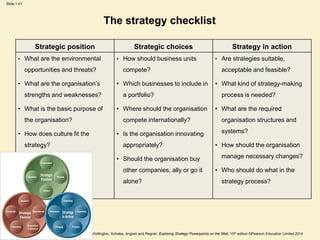
The strategy checklist
Strategic position Strategic choices Strategy in action
• What are the environmental
opportunities and threats?
• What are the organisation’s
strengths and weaknesses?
• What is the basic purpose of
the organisation?
• How does culture fit the
strategy?
• How should business units
compete?
• Which businesses to include in
a portfolio?
• Where should the organisation
compete internationally?
• Is the organisation innovating
appropriately?
• Should the organisation buy
other companies, ally or go it
alone?
• Are strategies suitable,
acceptable and feasible?
• What kind of strategy-making
process is needed?
• What are the required
organisation structures and
systems?
• How should the organisation
manage necessary changes?
• Who should do what in the
strategy process?
Slide 1.42
Based on Johnson, Whittington, Scholes, Angwin and Regnér, Exploring Strategy Powerpoints on the Web, 10th edition ©Pearson Education Limited 2014
Working with strategy (1)
All managers are concerned with strategy:
• Top managers frequently formulate and control strategy but may also
involve others in the process.
• Middle and lower level managers have to meet strategic objectives and
deal with constraints.
• All managers have to communicate strategy to their teams.
• All managers can contribute to the formation of strategy through ideas and
feedback.
Slide 1.43
Based on Johnson, Whittington, Scholes, Angwin and Regnér, Exploring Strategy Powerpoints on the Web, 10th edition ©Pearson Education Limited 2014
Working with strategy (2)
Organisations may also use strategy specialists:
• Many large organisations have in-house strategic planning or
analyst roles.
• Strategy consultants can be engaged from management consulting
firms (e.g. Accenture, IBM Consulting, PwC).
• There are a growing number of specialist strategy consulting
firms (e.g. McKinsey & Co, The Boston Consulting Group).
Slide 1.44
Based on Johnson, Whittington, Scholes, Angwin and Regnér, Exploring Strategy Powerpoints on the Web, 10th edition ©Pearson Education Limited 2014
Strategy’s three branches (2)
Slide 1.45
Based on Johnson, Whittington, Scholes, Angwin and Regnér, Exploring Strategy Powerpoints on the Web, 10th edition ©Pearson Education Limited 2014
Exploring strategy in different contexts
The Exploring Strategy Model can be applied in many contexts.
In each context the balance of strategic issues differs:
• Small businesses (e.g. strategic purpose, growth issues and retaining
independence)
• Multinational corporations (e.g. geographical scope; cultural issues and
structure/control issues)
• Public sector organisations (e.g. service/quality and managing change
issues)
• Not for profit organisations (e.g. purpose and funding issues)
Slide 1.46
Based on Johnson, Whittington, Scholes, Angwin and Regnér, Exploring Strategy Powerpoints on the Web, 10th edition ©Pearson Education Limited 2014
Content
Definitions
Levels of strategy and the three horizons
Strategy statements
Exploring strategy model: Strategic position, choice, action
Strategy lenses
Summary
The Lego case study
Slide 1.47
Based on Johnson, Whittington, Scholes, Angwin and Regnér, Exploring Strategy Powerpoints on the Web, 10th edition ©Pearson Education Limited 2014
The strategy lenses (1)
The strategy lenses are ways of looking at strategy issues
differently in order to generate additional insights.
Looking at problems in different ways will raise new issues and new
solutions.
Slide 1.48
Based on Johnson, Whittington, Scholes, Angwin and Regnér, Exploring Strategy Powerpoints on the Web, 10th edition ©Pearson Education Limited 2014
The strategy lenses (2)
Strategy can be seen as:
• Design
• Experience
• Variety
• Discourse
Slide 1.49
Based on Johnson, Whittington, Scholes, Angwin and Regnér, Exploring Strategy Powerpoints on the Web, 10th edition ©Pearson Education Limited 2014
The strategy lenses (3)
Strategy as design
• Strategy can be designed in advance and a detailed plan conceived
by strategists.
• This approach is rational and objective.
• Little attention is paid to cultural, political or unpredictable aspects of
strategy.
• The design lens is systematic, analytical and logical.
Slide 1.50
Based on Johnson, Whittington, Scholes, Angwin and Regnér, Exploring Strategy Powerpoints on the Web, 10th edition ©Pearson Education Limited 2014
The strategy lenses (4)
Strategy as experience
• Strategy is influenced by the experience of managers.
• The organisation’s culture and the taken-for-granted assumptions
and ways of doing things are key drivers of strategy.
• Strategy is likely to build on and continue what has gone before.
Slide 1.51
Based on Johnson, Whittington, Scholes, Angwin and Regnér, Exploring Strategy Powerpoints on the Web, 10th edition ©Pearson Education Limited 2014
The strategy lenses (5)
Strategy as variety
• Strategy ‘emerges’ from an uncertain and changing environment.
• Strategy comes from a variety of initiatives.
• New ideas ‘bubble up’ from unpredictable sources and not just the
top.
• Organisations need to encourage diversity and look for initiatives at
the bottom or the periphery of the organisation.
Slide 1.52
Based on Johnson, Whittington, Scholes, Angwin and Regnér, Exploring Strategy Powerpoints on the Web, 10th edition ©Pearson Education Limited 2014
The strategy lenses (6)
Strategy as discourse
• Attention is focused on the way managers use language to frame
strategic problems, make strategy proposals, debate issues and
communicate strategic decisions.
• The way managers ‘talk’ about strategy matters – it influences
decisions.
• The discourse lens helps to uncover the personal interests and
‘politicking’ of managers.
Slide 1.53
Based on Johnson, Whittington, Scholes, Angwin and Regnér, Exploring Strategy Powerpoints on the Web, 10th edition ©Pearson Education Limited 2014
The strategy lenses (2)
Strategy can be seen as:
• Design
• Experience
• Variety
• Discourse
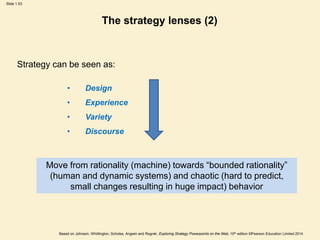
Move from rationality (machine) towards “bounded rationality”
(human and dynamic systems) and chaotic (hard to predict,
small changes resulting in huge impact) behavior
Slide 1.54
Based on Johnson, Whittington, Scholes, Angwin and Regnér, Exploring Strategy Powerpoints on the Web, 10th edition ©Pearson Education Limited 2014
The strategy lenses (1)
https://www.youtube.com/watch?v=Xt_1qCHH_Qk
Images of Organisations…
Slide 1.55
Based on Johnson, Whittington, Scholes, Angwin and Regnér, Exploring Strategy Powerpoints on the Web, 10th edition ©Pearson Education Limited 2014
Content
Definitions
Levels of strategy and the three horizons
Strategy statements
Exploring strategy model: Strategic position, choice, action
Strategy lenses
Summary
The Lego case study
Slide 1.56
Based on Johnson, Whittington, Scholes, Angwin and Regnér, Exploring Strategy Powerpoints on the Web, 10th edition ©Pearson Education Limited 2014
Class summary (1)
• Strategy is the long-term direction of an organisation. A strategy statement
should cover the goals of an organisation, the scope of the organisation’s
activities and the advantages or capabilities the organisation brings to these
goals and activities.
• Corporate-level strategy is concerned with an organisation’s overall scope;
business-level strategy is concerned with how to compete; and operational
strategy is concerned with how corporate- and business-level strategies are
actually delivered.
• The Exploring Strategy Model has three major elements: understanding the
strategic position, making strategic choices for the future and managing
strategy in action.
• Strategy work is done by managers throughout an organisation, as well as
specialist strategic planners and strategy consultants.
Slide 1.57
Based on Johnson, Whittington, Scholes, Angwin and Regnér, Exploring Strategy Powerpoints on the Web, 10th edition ©Pearson Education Limited 2014
Class summary (2)
• Research on strategy context, content and process shows how the analytical
perspectives of economics, sociology and psychology can all provide practical
insights for approaching strategy issues.
• Although the fundamentals of strategy may be similar, strategy varies by
organisational context, for example small business, multinational or public
sector.
• Strategic issues are best seen from a variety of perspectives, as exemplified
by the four strategy lenses of design, experience, variety and discourse.
Rationality, bounded rationality and “requisite variety” based approaches
add useful perspectives to what strategy is, how it is formulated and executed.
• For the purpose of our course we use the following schema for strategic
statements…
Slide 1.58
Based on Johnson, Whittington, Scholes, Angwin and Regnér, Exploring Strategy Powerpoints on the Web, 10th edition ©Pearson Education Limited 2014
Content
Definitions
Levels of strategy and the three horizons
Strategy statements
Exploring strategy model: Strategic position, choice, action
Strategy lenses
Summary
The Lego case study
Slide 1.59
Based on Johnson, Whittington, Scholes, Angwin and Regnér, Exploring Strategy Powerpoints on the Web, 10th edition ©Pearson Education Limited 2014
Case Study I:
The Lego Group adopting a strategic approach
Slide 1.60
Based on Johnson, Whittington, Scholes, Angwin and Regnér, Exploring Strategy Powerpoints on the Web, 10th edition ©Pearson Education Limited 2014
1. Discuss how the development of strategy at the LEGO Group reflects the
key characteristics of strategic management discussed in slide #8
2. What features of the external environment have influenced strategy
development at the LEGO Group?
3. What resources and competences of the LEGO Group have enabled them
to regain their successful position in the global toy market?
4. What alternative strategies were open to the LEGO Group in 2004? Why
do you think the group chose the course they did?
5. Looking at the LEGO Group today how would you approach strategy
development to ensure success for the company in the future?
Case Study I:
The Lego Group adopting a strategic approach

Business strategy 1.pdf

  • 1.
    Slide 1.1 Johnson, Whittington,Scholes, Angwin and Regnér, Exploring Strategy Powerpoints on the Web, 10th edition ©Pearson Education Limited 2014 1: Introducing Strategy
  • 2.
    Slide 1.2 Based onJohnson, Whittington, Scholes, Angwin and Regnér, Exploring Strategy Powerpoints on the Web, 10th edition ©Pearson Education Limited 2014 Learning outcomes • Summarise the strategy of an organisation in a ‘strategy statement’. • Distinguish between corporate, business and operational strategies. • Identify key issues for an organisation’s strategy according to the Exploring Strategy model. • Understand different people’s roles in strategy work. • Appreciate the importance of different organisational contexts, academic disciplines and theoretical lenses to practical strategy analysis.
  • 3.
    Slide 1.3 Based onJohnson, Whittington, Scholes, Angwin and Regnér, Exploring Strategy Powerpoints on the Web, 10th edition ©Pearson Education Limited 2014 Content Definitions Levels of strategy and the three horizons Strategy statements Exploring strategy model: Strategic position, choice, action Strategy lenses Summary The Lego case study
  • 4.
    Slide 1.4 Based onJohnson, Whittington, Scholes, Angwin and Regnér, Exploring Strategy Powerpoints on the Web, 10th edition ©Pearson Education Limited 2014 Strategy definition What is strategy? Michael Porter explains… https://www.youtube.com/watch?v=3Hd88eBgkw0
  • 5.
    Slide 1.5 Based onJohnson, Whittington, Scholes, Angwin and Regnér, Exploring Strategy Powerpoints on the Web, 10th edition ©Pearson Education Limited 2014 Strategy is not only… • Aspirations, goals… e.g. to be #1 • Operational effectiveness… e.g. doing things better • Particular action … e.g. internationalise my business • Vision/mission… e.g. to serve our customers It is mostly about • How you do things differently • Understanding: a) your business and b) your industry • Positioning your business in your industry structure: how you achieve competitive advantage • Choosing what not to do, and which customers not to serve Definitions of strategy (1)
  • 6.
    Slide 1.6 Based onJohnson, Whittington, Scholes, Angwin and Regnér, Exploring Strategy Powerpoints on the Web, 10th edition ©Pearson Education Limited 2014 Definitions of strategy (2) • ‘..the determination of the long-run goals and objectives of an enterprise and the adoption of courses of action and the allocation of resource necessary for carrying out these goals’ Alfred D. Chandler • ‘Competitive strategy is about being different. It means deliberately choosing a different set of activities to deliver a unique mix of value’ Michael Porter Sources: A.D. Chandler, Strategy and Structure: Chapters in the History of American Enterprise, MIT Press, 1963, p. 13 M.E. Porter, What is strategy?, Harvard Business Review, 1996, November– December, p. 60
  • 7.
    Slide 1.7 Based onJohnson, Whittington, Scholes, Angwin and Regnér, Exploring Strategy Powerpoints on the Web, 10th edition ©Pearson Education Limited 2014 Definitions of strategy (3) • ‘..a pattern in a stream of decisions’ Henry Mintzberg • ‘..the long-term direction of an organisation’ Exploring Strategy Sources: H. Mintzberg, Tracking Strategy: Towards a General Theory, Oxford University Press, 2007, p. 3
  • 8.
    Slide 1.8 Based onJohnson, Whittington, Scholes, Angwin and Regnér, Exploring Strategy Powerpoints on the Web, 10th edition ©Pearson Education Limited 2014 Strategic decisions Source: From G. Johnson, K. Scholes and R. Whittington. Exploring Corporate Strategy, 8th edn, Pearson Education 2008.
  • 9.
    Slide 1.9 Based onJohnson, Whittington, Scholes, Angwin and Regnér, Exploring Strategy Powerpoints on the Web, 10th edition ©Pearson Education Limited 2014 Strategy definition Strategy is the direction and scope of an organisation over the long term, which achieves advantages in a changing environment through its configuration of resources and competences with the aim of fulfilling stakeholder expectations
  • 10.
    Slide 1.10 Based onJohnson, Whittington, Scholes, Angwin and Regnér, Exploring Strategy Powerpoints on the Web, 10th edition ©Pearson Education Limited 2014 Content Definitions Levels of strategy and the three horizons Strategy statements Exploring strategy model: Strategic position, choice, action Strategy lenses Summary The Lego case study
  • 11.
    Slide 1.11 Based onJohnson, Whittington, Scholes, Angwin and Regnér, Exploring Strategy Powerpoints on the Web, 10th edition ©Pearson Education Limited 2014 Long term: Three horizons for strategy (2) Source: M. Baghai, S. Coley and D. White, The Alchemy of Growth, Texere Publishers, 2000. Figure 1.1, p. 5
  • 12.
    Slide 1.12 Based onJohnson, Whittington, Scholes, Angwin and Regnér, Exploring Strategy Powerpoints on the Web, 10th edition ©Pearson Education Limited 2014 Organisation: Internal and External Stakeholders Stakeholders are those individuals or groups that depend on an organisation to fulfil their own goals and on whom, in turn, the organisation depends.
  • 13.
    Slide 1.13 Based onJohnson, Whittington, Scholes, Angwin and Regnér, Exploring Strategy Powerpoints on the Web, 10th edition ©Pearson Education Limited 2014 Levels of strategy (1) Operational strategy Business-level strategy Corporate- level strategy
  • 14.
    Slide 1.14 Based onJohnson, Whittington, Scholes, Angwin and Regnér, Exploring Strategy Powerpoints on the Web, 10th edition ©Pearson Education Limited 2014 Levels of strategy (2) • Corporate-level strategy is concerned with the overall scope of an organisation and how value is added to the constituent business units. Includes geographic scope, diversity of products/services/acquisitions of new businesses, distribution of resources to different elements of organisation. • Business-level strategy (aka competitive strategy) is concerned with the way a business seeks to compete successfully in its particular market. Concerns innovation, response to competitors, increased quality of service. - This is the level we focus here! • Operational strategy is concerned with how different parts of the organisation deliver the strategy in terms of managing resources, processes and people. Successful business/corporate strategies depend on operational strategy. Integration in strategy: the corporate/business/operational strategies link and alignment. Strategy is rarely simple!
  • 15.
    Slide 1.15 Based onJohnson, Whittington, Scholes, Angwin and Regnér, Exploring Strategy Powerpoints on the Web, 10th edition ©Pearson Education Limited 2014 Content Definitions Levels of strategy and the three horizons Strategy statements Exploring strategy model: Strategic position, choice, action Strategy lenses Summary The Lego case study
  • 16.
    Slide 1.16 Based onJohnson, Whittington, Scholes, Angwin and Regnér, Exploring Strategy Powerpoints on the Web, 10th edition ©Pearson Education Limited 2014 Strategy statements All entrepreneurs and managers should be able to summarise their organisation’s strategy with a “strategy statement”. There are different types of “strategy statements” and there is also confusion in their definitions.
  • 17.
    Slide 1.17 Based onJohnson, Whittington, Scholes, Angwin and Regnér, Exploring Strategy Powerpoints on the Web, 10th edition ©Pearson Education Limited 2014 Strategy statements • Vision: – Definitions: • a concise and inspirational statement implicitly relating an organization's purpose to its values, thus motivating its actions toward a future state it strives to achieve (StratML); • Desired future state of the organisation (what do we want to achieve/be) • An aspirational description of what an organization would like to achieve or accomplish in the mid-term or long-term future. It is intended to serves as a clear guide for choosing current and future courses of action. http://www.businessdictionary.com/definition/vision-statement.html – Examples • Toyota trucks: to become the most successful and respected lift truck company in Europe • Samsung Electronics, Inspire the World, Create the Future. • Oxfam: A just world without poverty • Make-A-Wish: Our vision is that people everywhere will share the power of a wish • Save the Children: A world in which every child attains the right to survival, protection, development and participation.
  • 18.
    Slide 1.18 Based onJohnson, Whittington, Scholes, Angwin and Regnér, Exploring Strategy Powerpoints on the Web, 10th edition ©Pearson Education Limited 2014 Strategy statements • Mission: – Definition • A brief description of the basic purpose/reason of the organization (StratML), why we exist, what we want to do. • A written declaration of an organization's core purpose and focus that normally remains unchanged over time. Properly crafted mission statements (1) serve as filters to separate what is important from what is not, (2) clearly state which markets will be served and how, and (3) communicate a sense of intended direction to the entire organization. http://www.businessdictionary.com/definition/mission-statement.html – Examples: • TED: Spreading Ideas. • Oxfam: To create lasting solutions to poverty, hunger, and social injustice • Save the Children: To inspire breakthroughs in the way the world treats children and to achieve immediate and lasting change in their lives. • New York Public Library: To inspire lifelong learning, advance knowledge, and strengthen our communities. • Amazon's: To be Earth’s most customer-centric company, where customers can find and discover anything they might want to buy online, and endeavors to offer its customers the lowest possible prices
  • 19.
    Slide 1.19 Based onJohnson, Whittington, Scholes, Angwin and Regnér, Exploring Strategy Powerpoints on the Web, 10th edition ©Pearson Education Limited 2014 Strategy statements What's the Difference Between Mission and Vision? A mission is different from a vision in that the former is the cause and the latter is the effect; a mission is something to be accomplished whereas a vision is something to be pursued for that accomplishment. http://www.businessdictionary.com/definition/mission-statement.html https://www.youtube.com/watch?v=b2MyaR0gMo0
  • 20.
    Slide 1.20 Based onJohnson, Whittington, Scholes, Angwin and Regnér, Exploring Strategy Powerpoints on the Web, 10th edition ©Pearson Education Limited 2014 Strategy statements – Objectives: • Performance Goal Strategy: A target level of results expressed in units against which achievement is to be measured within a single resource allocation and performance execution cycle (StratML) • More precise and ideally quantifiable statements of the organisation goals over some period of time (what do we want to achieve in the coming period) – Values: • A principle that is important and helps to define the essential character of the organization (StratML)
  • 21.
    Slide 1.21 Based onJohnson, Whittington, Scholes, Angwin and Regnér, Exploring Strategy Powerpoints on the Web, 10th edition ©Pearson Education Limited 2014 Strategy statements • IKEA’s mission and vision are the same statements: “At IKEA our vision is to create a better everyday life for the many people. Our business idea supports this vision by offering a wide range of well-designed, functional home furnishing products at prices so low that as many people as possible will be able to afford them.” • IBM has hardly a well-formulated vision or mission statement, but rather the following focuses on values: – IBMers value... • Dedication to every client’s success. • Innovation that matters—for our company and the world. • Trust and personal responsibility in all relationships.
  • 22.
    Slide 1.22 Based onJohnson, Whittington, Scholes, Angwin and Regnér, Exploring Strategy Powerpoints on the Web, 10th edition ©Pearson Education Limited 2014 Approach for this course Source: https://www.slideshare.net/SearchingSalary/vision-mission-goal-objective
  • 23.
    Slide 1.23 Based onJohnson, Whittington, Scholes, Angwin and Regnér, Exploring Strategy Powerpoints on the Web, 10th edition ©Pearson Education Limited 2014 Approach for this course LEGO: Vision: ‘Inventing the future of play’ We want to pioneer new ways of playing, play materials and the business models of play - leveraging globalisation and digitalisation...it is not just about products, it is about realising the human possibility. Mission: ‘Inspire and develop the builders of tomorrow’ Our ultimate purpose is to inspire and develop children to think creatively, reason systematically and release their potential to shape their own future - experiencing the endless human possibility. Goal: Involve customers in the product design Objective: Introduce two new LEGO models proposed by users per year in the assortment Activities: • Organise open calls for ideas • Organise user panels as juries to assess proposals • Perform market analysis for the shortlisted proposals
  • 24.
    Slide 1.24 Based onJohnson, Whittington, Scholes, Angwin and Regnér, Exploring Strategy Powerpoints on the Web, 10th edition ©Pearson Education Limited 2014 In-class activity In groups of Define an example of Vision - Mission - Goal - Objective - Activity for one organisation 15’
  • 25.
    Slide 1.25 Based onJohnson, Whittington, Scholes, Angwin and Regnér, Exploring Strategy Powerpoints on the Web, 10th edition ©Pearson Education Limited 2014 Content Definitions Levels of strategy and the three horizons Strategy statements Exploring strategy model: Strategic position, choice, action Strategy lenses Summary The Lego case study
  • 26.
    Slide 1.26 Based onJohnson, Whittington, Scholes, Angwin and Regnér, Exploring Strategy Powerpoints on the Web, 10th edition ©Pearson Education Limited 2014 The Exploring Strategy model Understand Assess, Decide Manage
  • 27.
    Slide 1.27 Based onJohnson, Whittington, Scholes, Angwin and Regnér, Exploring Strategy Powerpoints on the Web, 10th edition ©Pearson Education Limited 2014 Strategy’s three branches (1) • CONTEXT – internal and external • CONTENT – strategic options • PROCESS – formation and implementation
  • 28.
    Slide 1.28 Based onJohnson, Whittington, Scholes, Angwin and Regnér, Exploring Strategy Powerpoints on the Web, 10th edition ©Pearson Education Limited 2014 The Exploring Strategy model Does the deployment of a strategy follow a linear pattern?
  • 29.
    Slide 1.29 Based onJohnson, Whittington, Scholes, Angwin and Regnér, Exploring Strategy Powerpoints on the Web, 10th edition ©Pearson Education Limited 2014 The Exploring Strategy model Does the deployment of a strategy follow a linear pattern? • Choices before position fully understood. • Understanding of strategic position through experience of trying strategy in action • Real life feedback cannot substitute any analysis Position, Choice, Action: closely related, overlapping and interdependent
  • 30.
    Slide 1.30 Based onJohnson, Whittington, Scholes, Angwin and Regnér, Exploring Strategy Powerpoints on the Web, 10th edition ©Pearson Education Limited 2014 Strategic position (1) The strategic position is concerned with the impact on strategy of the external environment, the organisation’s strategic capability (resources and competences), the organisation’s goals and the organisation’s culture.
  • 31.
    Slide 1.31 Based onJohnson, Whittington, Scholes, Angwin and Regnér, Exploring Strategy Powerpoints on the Web, 10th edition ©Pearson Education Limited 2014 Strategic position (1) • Organisations operate in complex political, economic, social, technological, ecological and legal world. • What are the opportunities and threats for the organisation in this environment? • Resources and competences • What are the strengths and weaknesses (competitive advantage/disadvantage)? • Vision, mission, goals, objectives • What is the organisation strategic purpose? • Cultures are products of organisation history • How does culture fit with the required strategy?
  • 32.
    Slide 1.32 Based onJohnson, Whittington, Scholes, Angwin and Regnér, Exploring Strategy Powerpoints on the Web, 10th edition ©Pearson Education Limited 2014 Strategic position (3) Fundamental questions for Strategic position • What are the environmental opportunities and threats? • What are the organisation’s strengths and weaknesses? • What is the basic purpose of the organisation? • How does culture fit with the strategy?
  • 33.
    Slide 1.33 Based onJohnson, Whittington, Scholes, Angwin and Regnér, Exploring Strategy Powerpoints on the Web, 10th edition ©Pearson Education Limited 2014 Strategic choices (1) Strategic choices involve the options for strategy in terms of both the directions in which strategy might move and the methods by which strategy might be pursued.
  • 34.
    Slide 1.34 Based onJohnson, Whittington, Scholes, Angwin and Regnér, Exploring Strategy Powerpoints on the Web, 10th edition ©Pearson Education Limited 2014 Strategic choices (2) • Business strategy: how the organisation competes at the individual business level • E.g. low cost, highest quality • Which businesses to include in the portfolio (diversification for products and markets) • Relationships between business units and the HQ • Geographical diversification • Where internationally should the organisation compete? • Innovate constantly to survive • Does the organisation innovate appropriately? • Relationships with other layers • Build, buy, ally, compete?
  • 35.
    Slide 1.35 Based onJohnson, Whittington, Scholes, Angwin and Regnér, Exploring Strategy Powerpoints on the Web, 10th edition ©Pearson Education Limited 2014 https://www.youtube.com/watch?v=_tStxIF4qNA CNN: Why did Microsoft buy Skype?
  • 36.
    Slide 1.36 Based onJohnson, Whittington, Scholes, Angwin and Regnér, Exploring Strategy Powerpoints on the Web, 10th edition ©Pearson Education Limited 2014 Strategic choices (3) Microsoft buys Skype • Compete with low cost, highest quality? • Add VoiP in the product portfolio • Get the Skype customer-base • Special regional packages • Develop new voice compression algorithms • Alliances with telecom providers? • Buy skype or further develop windows messenger? https://www.wired.com/2011/05/microsoft- buys-skype-2/
  • 37.
    Slide 1.37 Based onJohnson, Whittington, Scholes, Angwin and Regnér, Exploring Strategy Powerpoints on the Web, 10th edition ©Pearson Education Limited 2014 Strategic choices (4) Fundamental questions for Strategic choice • How should individual business units compete? • Which businesses (products/services) to include in the portfolio? • Where should the organisation compete internationally? • Is the organisation innovating appropriately? • Should the organisation buy other companies, form alliances or go it alone?
  • 38.
    Slide 1.38 Based onJohnson, Whittington, Scholes, Angwin and Regnér, Exploring Strategy Powerpoints on the Web, 10th edition ©Pearson Education Limited 2014 Strategy in action (1) Strategy in action is about how strategies are formed and how they are implemented. The emphasis is on the practicalities of managing.
  • 39.
    Slide 1.39 Based onJohnson, Whittington, Scholes, Angwin and Regnér, Exploring Strategy Powerpoints on the Web, 10th edition ©Pearson Education Limited 2014 Strategy in action (2) • Monitoring performance with an appraisal mechanism • Evaluate options: techniques needed • Options are suitable, acceptable, feasible • Strategies are developed through planning/emergent processes • What kind of planning processes should be put in place? • Configuration of structures and systems • What structures are systems support the current strategy? • Leadership and change • Management of change • The hard detailed work inside strategy day-to-day implementation • People, methodologies, activities
  • 40.
    Slide 1.40 Based onJohnson, Whittington, Scholes, Angwin and Regnér, Exploring Strategy Powerpoints on the Web, 10th edition ©Pearson Education Limited 2014 Strategy in action (3) Fundamental questions for Strategy in action • Which strategies are suitable, acceptable and feasible? • What kind of strategy-making processes are needed? • What are the required organisation structures and systems? • How should the organisation manage the change needed? • Who should do what in the strategy process? Which people and what activities.
  • 41.
    Slide 1.41 Based onJohnson, Whittington, Scholes, Angwin and Regnér, Exploring Strategy Powerpoints on the Web, 10th edition ©Pearson Education Limited 2014 The strategy checklist Strategic position Strategic choices Strategy in action • What are the environmental opportunities and threats? • What are the organisation’s strengths and weaknesses? • What is the basic purpose of the organisation? • How does culture fit the strategy? • How should business units compete? • Which businesses to include in a portfolio? • Where should the organisation compete internationally? • Is the organisation innovating appropriately? • Should the organisation buy other companies, ally or go it alone? • Are strategies suitable, acceptable and feasible? • What kind of strategy-making process is needed? • What are the required organisation structures and systems? • How should the organisation manage necessary changes? • Who should do what in the strategy process?
  • 42.
    Slide 1.42 Based onJohnson, Whittington, Scholes, Angwin and Regnér, Exploring Strategy Powerpoints on the Web, 10th edition ©Pearson Education Limited 2014 Working with strategy (1) All managers are concerned with strategy: • Top managers frequently formulate and control strategy but may also involve others in the process. • Middle and lower level managers have to meet strategic objectives and deal with constraints. • All managers have to communicate strategy to their teams. • All managers can contribute to the formation of strategy through ideas and feedback.
  • 43.
    Slide 1.43 Based onJohnson, Whittington, Scholes, Angwin and Regnér, Exploring Strategy Powerpoints on the Web, 10th edition ©Pearson Education Limited 2014 Working with strategy (2) Organisations may also use strategy specialists: • Many large organisations have in-house strategic planning or analyst roles. • Strategy consultants can be engaged from management consulting firms (e.g. Accenture, IBM Consulting, PwC). • There are a growing number of specialist strategy consulting firms (e.g. McKinsey & Co, The Boston Consulting Group).
  • 44.
    Slide 1.44 Based onJohnson, Whittington, Scholes, Angwin and Regnér, Exploring Strategy Powerpoints on the Web, 10th edition ©Pearson Education Limited 2014 Strategy’s three branches (2)
  • 45.
    Slide 1.45 Based onJohnson, Whittington, Scholes, Angwin and Regnér, Exploring Strategy Powerpoints on the Web, 10th edition ©Pearson Education Limited 2014 Exploring strategy in different contexts The Exploring Strategy Model can be applied in many contexts. In each context the balance of strategic issues differs: • Small businesses (e.g. strategic purpose, growth issues and retaining independence) • Multinational corporations (e.g. geographical scope; cultural issues and structure/control issues) • Public sector organisations (e.g. service/quality and managing change issues) • Not for profit organisations (e.g. purpose and funding issues)
  • 46.
    Slide 1.46 Based onJohnson, Whittington, Scholes, Angwin and Regnér, Exploring Strategy Powerpoints on the Web, 10th edition ©Pearson Education Limited 2014 Content Definitions Levels of strategy and the three horizons Strategy statements Exploring strategy model: Strategic position, choice, action Strategy lenses Summary The Lego case study
  • 47.
    Slide 1.47 Based onJohnson, Whittington, Scholes, Angwin and Regnér, Exploring Strategy Powerpoints on the Web, 10th edition ©Pearson Education Limited 2014 The strategy lenses (1) The strategy lenses are ways of looking at strategy issues differently in order to generate additional insights. Looking at problems in different ways will raise new issues and new solutions.
  • 48.
    Slide 1.48 Based onJohnson, Whittington, Scholes, Angwin and Regnér, Exploring Strategy Powerpoints on the Web, 10th edition ©Pearson Education Limited 2014 The strategy lenses (2) Strategy can be seen as: • Design • Experience • Variety • Discourse
  • 49.
    Slide 1.49 Based onJohnson, Whittington, Scholes, Angwin and Regnér, Exploring Strategy Powerpoints on the Web, 10th edition ©Pearson Education Limited 2014 The strategy lenses (3) Strategy as design • Strategy can be designed in advance and a detailed plan conceived by strategists. • This approach is rational and objective. • Little attention is paid to cultural, political or unpredictable aspects of strategy. • The design lens is systematic, analytical and logical.
  • 50.
    Slide 1.50 Based onJohnson, Whittington, Scholes, Angwin and Regnér, Exploring Strategy Powerpoints on the Web, 10th edition ©Pearson Education Limited 2014 The strategy lenses (4) Strategy as experience • Strategy is influenced by the experience of managers. • The organisation’s culture and the taken-for-granted assumptions and ways of doing things are key drivers of strategy. • Strategy is likely to build on and continue what has gone before.
  • 51.
    Slide 1.51 Based onJohnson, Whittington, Scholes, Angwin and Regnér, Exploring Strategy Powerpoints on the Web, 10th edition ©Pearson Education Limited 2014 The strategy lenses (5) Strategy as variety • Strategy ‘emerges’ from an uncertain and changing environment. • Strategy comes from a variety of initiatives. • New ideas ‘bubble up’ from unpredictable sources and not just the top. • Organisations need to encourage diversity and look for initiatives at the bottom or the periphery of the organisation.
  • 52.
    Slide 1.52 Based onJohnson, Whittington, Scholes, Angwin and Regnér, Exploring Strategy Powerpoints on the Web, 10th edition ©Pearson Education Limited 2014 The strategy lenses (6) Strategy as discourse • Attention is focused on the way managers use language to frame strategic problems, make strategy proposals, debate issues and communicate strategic decisions. • The way managers ‘talk’ about strategy matters – it influences decisions. • The discourse lens helps to uncover the personal interests and ‘politicking’ of managers.
  • 53.
    Slide 1.53 Based onJohnson, Whittington, Scholes, Angwin and Regnér, Exploring Strategy Powerpoints on the Web, 10th edition ©Pearson Education Limited 2014 The strategy lenses (2) Strategy can be seen as: • Design • Experience • Variety • Discourse Move from rationality (machine) towards “bounded rationality” (human and dynamic systems) and chaotic (hard to predict, small changes resulting in huge impact) behavior
  • 54.
    Slide 1.54 Based onJohnson, Whittington, Scholes, Angwin and Regnér, Exploring Strategy Powerpoints on the Web, 10th edition ©Pearson Education Limited 2014 The strategy lenses (1) https://www.youtube.com/watch?v=Xt_1qCHH_Qk Images of Organisations…
  • 55.
    Slide 1.55 Based onJohnson, Whittington, Scholes, Angwin and Regnér, Exploring Strategy Powerpoints on the Web, 10th edition ©Pearson Education Limited 2014 Content Definitions Levels of strategy and the three horizons Strategy statements Exploring strategy model: Strategic position, choice, action Strategy lenses Summary The Lego case study
  • 56.
    Slide 1.56 Based onJohnson, Whittington, Scholes, Angwin and Regnér, Exploring Strategy Powerpoints on the Web, 10th edition ©Pearson Education Limited 2014 Class summary (1) • Strategy is the long-term direction of an organisation. A strategy statement should cover the goals of an organisation, the scope of the organisation’s activities and the advantages or capabilities the organisation brings to these goals and activities. • Corporate-level strategy is concerned with an organisation’s overall scope; business-level strategy is concerned with how to compete; and operational strategy is concerned with how corporate- and business-level strategies are actually delivered. • The Exploring Strategy Model has three major elements: understanding the strategic position, making strategic choices for the future and managing strategy in action. • Strategy work is done by managers throughout an organisation, as well as specialist strategic planners and strategy consultants.
  • 57.
    Slide 1.57 Based onJohnson, Whittington, Scholes, Angwin and Regnér, Exploring Strategy Powerpoints on the Web, 10th edition ©Pearson Education Limited 2014 Class summary (2) • Research on strategy context, content and process shows how the analytical perspectives of economics, sociology and psychology can all provide practical insights for approaching strategy issues. • Although the fundamentals of strategy may be similar, strategy varies by organisational context, for example small business, multinational or public sector. • Strategic issues are best seen from a variety of perspectives, as exemplified by the four strategy lenses of design, experience, variety and discourse. Rationality, bounded rationality and “requisite variety” based approaches add useful perspectives to what strategy is, how it is formulated and executed. • For the purpose of our course we use the following schema for strategic statements…
  • 58.
    Slide 1.58 Based onJohnson, Whittington, Scholes, Angwin and Regnér, Exploring Strategy Powerpoints on the Web, 10th edition ©Pearson Education Limited 2014 Content Definitions Levels of strategy and the three horizons Strategy statements Exploring strategy model: Strategic position, choice, action Strategy lenses Summary The Lego case study
  • 59.
    Slide 1.59 Based onJohnson, Whittington, Scholes, Angwin and Regnér, Exploring Strategy Powerpoints on the Web, 10th edition ©Pearson Education Limited 2014 Case Study I: The Lego Group adopting a strategic approach
  • 60.
    Slide 1.60 Based onJohnson, Whittington, Scholes, Angwin and Regnér, Exploring Strategy Powerpoints on the Web, 10th edition ©Pearson Education Limited 2014 1. Discuss how the development of strategy at the LEGO Group reflects the key characteristics of strategic management discussed in slide #8 2. What features of the external environment have influenced strategy development at the LEGO Group? 3. What resources and competences of the LEGO Group have enabled them to regain their successful position in the global toy market? 4. What alternative strategies were open to the LEGO Group in 2004? Why do you think the group chose the course they did? 5. Looking at the LEGO Group today how would you approach strategy development to ensure success for the company in the future? Case Study I: The Lego Group adopting a strategic approach