Slide 6.1
Johnson, Whittington, Scholes, Angwin and Regnér, Exploring Strategy Powerpoints on the Web, 10th edition ©Pearson Education Limited 2014
Strategic Choices
6: Business Strategy
Slide 6.2
Johnson, Whittington, Scholes, Angwin and Regnér, Exploring Strategy Powerpoints on the Web, 10th edition ©Pearson Education Limited 2014
Generic strategies
‘Generic strategy’: basic types of competitive strategy that hold
across many kinds of business situations.
A company can have:
• lower costs than its competitors.
• products or services that are differentiated:
– From competitors’ products or services in ways that are so valued by
customers that it can charge higher prices that cover the additional
costs of the differentiation.
– Different scope of customers. Businesses can choose to focus on
narrow customer segments, for example a particular demographic group
such as the youth market. Alternatively, they can adopt a broad scope,
targeting customers across a range of characteristics such as age,
wealth or geography.
Slide 6.3
Johnson, Whittington, Scholes, Angwin and Regnér, Exploring Strategy Powerpoints on the Web, 10th edition ©Pearson Education Limited 2014
Three generic strategies
Source: Adapted with the permission of The Free Press, a Division of Simon & Schuster, Inc., from Competitive Advantage: Creating and Sustaining Superior Performance by
Michael E. Porter. Copyright © 1985, 1998 by Michael E. Porter. All rights reserved.
Lidl
iPhone
Tesla
Zara
Mass/Radical
personalisation
Slide 6.4
Johnson, Whittington, Scholes, Angwin and Regnér, Exploring Strategy Powerpoints on the Web, 10th edition ©Pearson Education Limited 2014
Cost-leadership
Cost-leadership strategy involves becoming the lowest-cost organisation in a
domain of activity.
Four key cost drivers that can help deliver cost leadership:
• Lower input costs, e.g. labour or raw materials
• Economies of scale, increasing scale usually reduces the average costs of
operation over a particular time period, perhaps a month or a year. Economies of
scale are important wherever there are high fixed costs
Note, though, that diseconomies of scale
are possible. Large volumes of output that
require special overtime payments to
workers or involve the neglect of equipment
maintenance can soon become very
expensive.
Slide 6.5
Johnson, Whittington, Scholes, Angwin and Regnér, Exploring Strategy Powerpoints on the Web, 10th edition ©Pearson Education Limited 2014
Cost-leadership
…continued:
• Experience
– The learning curve implies that the cumulative experience gained by
an organisation with each unit of output leads to reductions in unit
costs
– Εntry timing into a market is important:
• Εarly entrants into a market will have experience that late entrants do not
yet have and so will gain a cost advantage.
• Ιt is important to gain and hold market share, as companies with higher
market share have more ‘cumulative experience’ simply because of their
greater volumes.
• Αlthough the gains from experience are typically greatest at the start,
improvements normally continue over time
• Product/process design
– engineers can choose to build a product from cheap standard components,
to interact with customers exclusively through cheap web-based methods
Slide 6.6
Johnson, Whittington, Scholes, Angwin and Regnér, Exploring Strategy Powerpoints on the Web, 10th edition ©Pearson Education Limited 2014
Costs, prices and profits for generic strategies
Low cost should not be pursued in total disregard for quality
• What is the difference between parity and proximity strategies?
• Where are more requirements for high quality, in parity or proximity strategy?
Slide 6.7
Johnson, Whittington, Scholes, Angwin and Regnér, Exploring Strategy Powerpoints on the Web, 10th edition ©Pearson Education Limited 2014
Differentiation strategies
Differentiation involves uniqueness along some dimension that is
sufficiently valued by customers to allow a price premium.
• Relevant points of differentiation vary between markets. E.g. even at
the same top end of the car market, BMW and Mercedes differentiate
in different ways, the first typically with a sportier image, the second
with more conservative values.
Three differentiation drivers :
• Product and service attributes with better or unique features than
comparable products or services
• Customer relationships, customer services (e.g. Zalando) and
responsiveness (e.g. Amazon), customisation (e.g. SAP), marketing
and reputation (e.g. Starbucks)
• Complements, a way of bundling products and services together to
increase the value for the customer (Apple/iTunes/App Store)
Slide 6.8
Johnson, Whittington, Scholes, Angwin and Regnér, Exploring Strategy Powerpoints on the Web, 10th edition ©Pearson Education Limited 2014
Differentiation in the US airline industry
Source: Simplified from Figure 1, in D. Gursoy, M. Chen and H. Kim (2005) ‘The US airlines relative positioning’, Tourism Management, 26, 5, 57–67: p. 62.
Slide 6.9
Johnson, Whittington, Scholes, Angwin and Regnér, Exploring Strategy Powerpoints on the Web, 10th edition ©Pearson Education Limited 2014
Critical issue for differentiation strategy
Source: Simplified from Figure 1, in D. Gursoy, M. Chen and H. Kim (2005) ‘The US airlines relative positioning’, Tourism Management, 26, 5, 57–67: p. 62.
• The differentiator needs to ensure that the additional costs of
differentiation do not exceed the gains in price.
• The historic failures under British ownership of the luxury car
companies Rolls-Royce and Bentley against top-end Mercedes cars
are partly attributable to the expensive crafting of wood and leather
interiors, the full cost of which even wealthy customers were not
prepared to pay for.
• Just as cost-leaders should not neglect quality, so should
differentiators attend closely to costs, especially in areas irrelevant to
their sources of differentiation.
Do you see a difference in the top class cars versus mobiles industries?
Slide 6.10
Johnson, Whittington, Scholes, Angwin and Regnér, Exploring Strategy Powerpoints on the Web, 10th edition ©Pearson Education Limited 2014
Focus strategies (1)
A focus strategy targets a narrow segment or domain of activity and
tailors its products or services to the needs of that specific segment to the
exclusion of others.
Two types of focus strategy:
• Cost-focus strategy (e.g. Zara)
• Differentiation focus strategy (e.g. ARM Holdings dominates the
world market for mobile phone chips, despite being only a fraction of the
size of the leading microprocessor manufacturers, AMD and Intel, which
also make chips for a wide range of computers).
Slide 6.11
Johnson, Whittington, Scholes, Angwin and Regnér, Exploring Strategy Powerpoints on the Web, 10th edition ©Pearson Education Limited 2014
Focus strategies (2)
Successful focus strategies depend on at least one of three key factors:
• Distinct segment needs, e.g. Tesla Motors currently targets a narrow
segment with its expensive premium electric vehicles
• Distinct segment value chains, e.g. Focus strategies are
strengthened if they have distinctive value chains that will be difficult or
costly for rivals to construct. In detergents, Procter & Gamble cannot
easily respond to the Belgian ecologically friendly cleaning products
company Ecover because achieving the same environmental soundness
would involve transforming its purchasing and production processes.
• Viable segment economics. Segments can easily become too small
to serve economically as demand or supply conditions change
Slide 6.12
Johnson, Whittington, Scholes, Angwin and Regnér, Exploring Strategy Powerpoints on the Web, 10th edition ©Pearson Education Limited 2014
‘Stuck in the middle’?
Porter argues:
• It is best to choose which generic strategy to adopt and then stick
rigorously to it.
• Failure to do this leads to a danger of being ‘stuck in the middle’ –
doing no strategy well.
• The argument for pure generic strategies is controversial. Porter
acknowledges that the strategies can be combined (e.g. if being
unique costs nothing).
Slide 6.13
Johnson, Whittington, Scholes, Angwin and Regnér, Exploring Strategy Powerpoints on the Web, 10th edition ©Pearson Education Limited 2014
Combining generic strategies (hybrid)
• A company can create separate strategic business units each
pursuing different generic strategies and with different cost structures,
e.g. Lexus/Toyota, Lufthansa/German Wings.
• Technological or managerial innovations where both cost
efficiency and quality are improved.
• Competitive failures – if rivals are similarly ‘stuck in the middle’ or if
there is no significant competition then ‘middle’ strategies may be OK.
Slide 6.14
Johnson, Whittington, Scholes, Angwin and Regnér, Exploring Strategy Powerpoints on the Web, 10th edition ©Pearson Education Limited 2014
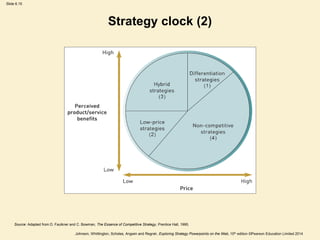
Strategy clock (1)
The strategy clock provides an alternative approach to generic
strategy which gives more scope for hybrid strategies.
It has two distinct features:
– It is focused on the prices to customers rather than the costs to
organisations.
– The circular design allows for incremental adjustments in strategy rather
than stark choices.
Slide 6.15
Johnson, Whittington, Scholes, Angwin and Regnér, Exploring Strategy Powerpoints on the Web, 10th edition ©Pearson Education Limited 2014
Strategy clock (2)
Source: Adapted from D. Faulkner and C. Bowman, The Essence of Competitive Strategy, Prentice Hall, 1995.
Slide 6.16
Johnson, Whittington, Scholes, Angwin and Regnér, Exploring Strategy Powerpoints on the Web, 10th edition ©Pearson Education Limited 2014
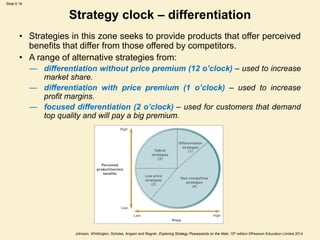
Strategy clock – differentiation
• Strategies in this zone seeks to provide products that offer perceived
benefits that differ from those offered by competitors.
• A range of alternative strategies from:
― differentiation without price premium (12 o’clock) – used to increase
market share.
― differentiation with price premium (1 o’clock) – used to increase
profit margins.
― focused differentiation (2 o’clock) – used for customers that demand
top quality and will pay a big premium.
Slide 6.17
Johnson, Whittington, Scholes, Angwin and Regnér, Exploring Strategy Powerpoints on the Web, 10th edition ©Pearson Education Limited 2014
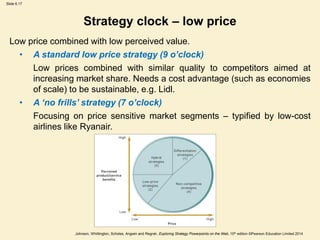
Strategy clock – low price
Low price combined with low perceived value.
• A standard low price strategy (9 o’clock)
Low prices combined with similar quality to competitors aimed at
increasing market share. Needs a cost advantage (such as economies
of scale) to be sustainable, e.g. Lidl.
• A ‘no frills’ strategy (7 o’clock)
Focusing on price sensitive market segments – typified by low-cost
airlines like Ryanair.
Slide 6.18
Johnson, Whittington, Scholes, Angwin and Regnér, Exploring Strategy Powerpoints on the Web, 10th edition ©Pearson Education Limited 2014
Strategy clock – hybrid
Seeks to simultaneously achieve higher benefits and lower prices
relative to those of competitors.
Hybrid strategies can be used:
• to enter markets and build position quickly
• as an aggressive attempt to win market share
• to build volume sales and gain from mass production.
IKEA is a classic example which uses scale advantages to combine
relatively low prices with differentiated Swedish design.
Slide 6.19
Johnson, Whittington, Scholes, Angwin and Regnér, Exploring Strategy Powerpoints on the Web, 10th edition ©Pearson Education Limited 2014
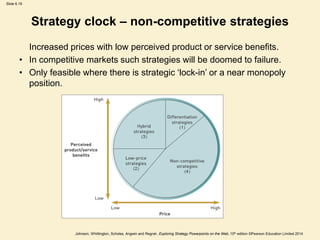
Strategy clock – non-competitive strategies
Increased prices with low perceived product or service benefits.
• In competitive markets such strategies will be doomed to failure.
• Only feasible where there is strategic ‘lock-in’ or a near monopoly
position.
Slide 6.20
Johnson, Whittington, Scholes, Angwin and Regnér, Exploring Strategy Powerpoints on the Web, 10th edition ©Pearson Education Limited 2014
Strategic lock-in
Strategic lock-in is where users become dependent on a supplier
and are unable to use another supplier without substantial switching
costs.
Lock-in can be achieved in two main ways:
• Controlling complementary products or services. An example
is razors that only work with one type of blade.
• Creating a proprietary industry standard. Microsoft with its
Windows operating system.
Slide 6.21
Johnson, Whittington, Scholes, Angwin and Regnér, Exploring Strategy Powerpoints on the Web, 10th edition ©Pearson Education Limited 2014
Interactive strategies
• Business strategy choices depend on what competitors do
(they are interactive).
• If everybody else is chasing after cost leadership, then a
differentiation strategy might be sensible.
Slide 6.22
Johnson, Whittington, Scholes, Angwin and Regnér, Exploring Strategy Powerpoints on the Web, 10th edition ©Pearson Education Limited 2014
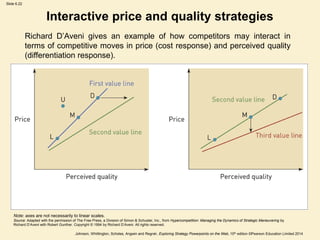
Interactive price and quality strategies
Note: axes are not necessarily to linear scales.
Source: Adapted with the permission of The Free Press, a Division of Simon & Schuster, Inc., from Hypercompetition: Managing the Dynamics of Strategic Maneuvering by
Richard D’Aveni with Robert Gunther. Copyright © 1994 by Richard D’Aveni. All rights reserved.
Richard D’Aveni gives an example of how competitors may interact in
terms of competitive moves in price (cost response) and perceived quality
(differentiation response).
Slide 6.23
Johnson, Whittington, Scholes, Angwin and Regnér, Exploring Strategy Powerpoints on the Web, 10th edition ©Pearson Education Limited 2014
Interactive price and quality strategies
Note: axes are not necessarily to linear scales.
Source: Adapted with the permission of The Free Press, a Division of Simon & Schuster, Inc., from Hypercompetition: Managing the Dynamics of Strategic Maneuvering by
Richard D’Aveni with Robert Gunther. Copyright © 1994 by Richard D’Aveni. All rights reserved.
Richard D’Aveni gives an example of how competitors may interact in
terms of competitive moves in price (cost response) and perceived quality
(differentiation response).
Slide 6.24
Johnson, Whittington, Scholes, Angwin and Regnér, Exploring Strategy Powerpoints on the Web, 10th edition ©Pearson Education Limited 2014
Hypercompetition
Hypercompetition describes markets with continuous disequilibrium
and change, e.g. popular music or consumer electronics.
– It may be impossible to plan for long-term sustainable competitive
advantage.
– Planning may actually destroy competitive advantage by slowing down
responses.
– Successful hypercompetition demands speed and initiative rather than
defensiveness.
Slide 6.25
Johnson, Whittington, Scholes, Angwin and Regnér, Exploring Strategy Powerpoints on the Web, 10th edition ©Pearson Education Limited 2014
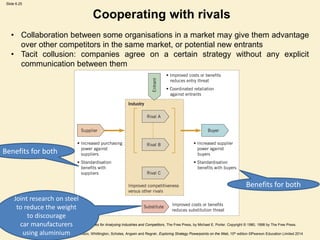
Cooperating with rivals
Source: Adapted from Competitive Strategy: Techniques for Analysing Industries and Competitors, The Free Press, by Michael E. Porter. Copyright © 1980, 1998 by The Free Press.
All rights reserved.
• Collaboration between some organisations in a market may give them advantage
over other competitors in the same market, or potential new entrants
• Tacit collusion: companies agree on a certain strategy without any explicit
communication between them
Benefits for both
Benefits for both
Joint research on steel
to reduce the weight
to discourage
car manufacturers
using aluminium
Slide 6.26
Johnson, Whittington, Scholes, Angwin and Regnér, Exploring Strategy Powerpoints on the Web, 10th edition ©Pearson Education Limited 2014
Game theory
Game theory encourages an organisation to consider competitors’ likely
moves and the implications of these moves for its own strategy.
• Game theory is particularly important where competitors are
interdependent.
– Interdependence exists where the outcome of choices made by one competitor
is dependent on the choices made by other competitors. For example, the
success of price cuts by a retailer depends on the responses of its rivals: if
rivals do not match the price cuts, then the price-cutter gains market share; but
if rivals follow the price cuts, nobody gains market share and all players suffer
from the lower prices.
• In these circumstances it is important to:
– get in the mind of competitors
– think forwards and reason backwards.
• Think forwards to what competitors might do in the future, and then reason
backwards to what would be sensible to do in the light of this now.
Slide 6.27
Johnson, Whittington, Scholes, Angwin and Regnér, Exploring Strategy Powerpoints on the Web, 10th edition ©Pearson Education Limited 2014
Prisoner’s dilemma
The most attractive strategy for Airbus and Boeing jointly is for them both to hold
their prices, yet in practice they are likely to cut prices because they must expect
the other to do so anyway.
Slide 6.28
Johnson, Whittington, Scholes, Angwin and Regnér, Exploring Strategy Powerpoints on the Web, 10th edition ©Pearson Education Limited 2014
Lessons from game theory
• Game theory frequently highlights the value of a more cooperative
approach to competitor interaction, rather than aggressive competition.
• It encourages managers to consider how a ‘game’ can be transformed
from lose–lose competition to win–win cooperation.
Slide 6.29
Johnson, Whittington, Scholes, Angwin and Regnér, Exploring Strategy Powerpoints on the Web, 10th edition ©Pearson Education Limited 2014
Business Strategy tools:
McKinsey 7-Ss, BCG Martix, Business Model Canvas
Slide 6.30
Johnson, Whittington, Scholes, Angwin and Regnér, Exploring Strategy Powerpoints on the Web, 10th edition ©Pearson Education Limited 2014
McKinsey 7s
Slide 6.31
Johnson, Whittington, Scholes, Angwin and Regnér, Exploring Strategy Powerpoints on the Web, 10th edition ©Pearson Education Limited 2014
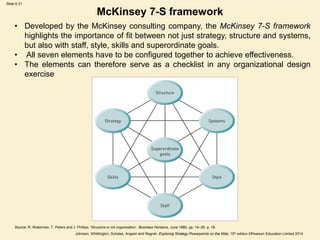
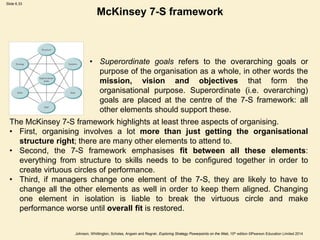
McKinsey 7-S framework
Source: R. Waterman, T. Peters and J. Phillips, ‘Structure is not organisation’, Business Horizons, June 1980, pp. 14–26: p. 18.
• Developed by the McKinsey consulting company, the McKinsey 7-S framework
highlights the importance of fit between not just strategy, structure and systems,
but also with staff, style, skills and superordinate goals.
• All seven elements have to be configured together to achieve effectiveness.
• The elements can therefore serve as a checklist in any organizational design
exercise
Slide 6.32
Johnson, Whittington, Scholes, Angwin and Regnér, Exploring Strategy Powerpoints on the Web, 10th edition ©Pearson Education Limited 2014
McKinsey 7-S framework
• Style refers to the leadership style of top managers in
an organisation. Leadership styles may be
collaborative, participative, directive or coercive.
Managers’ behavioral style influences the culture of the
whole organisation. Style should fit other aspects of the
framework: a highly directive or coercive style is not
likely to fit a matrix organisation structure.
• Staff is about the kinds of people in the organisation and how they are
developed. This relates to systems of selection, socialisation and reward. A
key criterion for the feasibility of any strategy is: does the organisation have the
people to match? A common constraint on structural change is the availability
of the right people to head new departments and divisions.
• Skills relates to staff, but here refers more broadly to capabilities in general,
how these skills are embedded in and captured by the organisation as a whole.
For example, how training schemes, information technology and reward
systems transform the talents of individuals into organisational capabilities
required.
Slide 6.33
Johnson, Whittington, Scholes, Angwin and Regnér, Exploring Strategy Powerpoints on the Web, 10th edition ©Pearson Education Limited 2014
McKinsey 7-S framework
• Superordinate goals refers to the overarching goals or
purpose of the organisation as a whole, in other words the
mission, vision and objectives that form the
organisational purpose. Superordinate (i.e. overarching)
goals are placed at the centre of the 7-S framework: all
other elements should support these.
The McKinsey 7-S framework highlights at least three aspects of organising.
• First, organising involves a lot more than just getting the organisational
structure right; there are many other elements to attend to.
• Second, the 7-S framework emphasises fit between all these elements:
everything from structure to skills needs to be configured together in order to
create virtuous circles of performance.
• Third, if managers change one element of the 7-S, they are likely to have to
change all the other elements as well in order to keep them aligned. Changing
one element in isolation is liable to break the virtuous circle and make
performance worse until overall fit is restored.
Slide 6.34
Johnson, Whittington, Scholes, Angwin and Regnér, Exploring Strategy Powerpoints on the Web, 10th edition ©Pearson Education Limited 2014
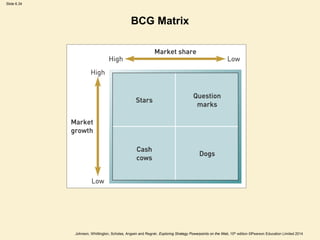
BCG Matrix
Slide 6.35
Johnson, Whittington, Scholes, Angwin and Regnér, Exploring Strategy Powerpoints on the Web, 10th edition ©Pearson Education Limited 2014
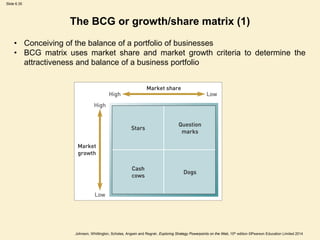
The BCG or growth/share matrix (1)
• Conceiving of the balance of a portfolio of businesses
• BCG matrix uses market share and market growth criteria to determine the
attractiveness and balance of a business portfolio
Slide 6.36
Johnson, Whittington, Scholes, Angwin and Regnér, Exploring Strategy Powerpoints on the Web, 10th edition ©Pearson Education Limited 2014
The BCG or growth/share matrix (2)
• A question mark (or problem child) is a business unit in a growing market,
without high market share. Developing question marks into stars, takes heavy
investment. Many question marks fail to develop some develop into stars.
• A cash cow is a business unit that has a high market share in a mature
market. As growth is low, investment needs are less, while the business unit is
profitable.
• A dog is a business unit that has a low market share in a static or declining
market. They may be a cash drain and use up a disproportionate amount of
managerial time and company resources. The BCG usually recommends
divestment or closure.
• A star is a business unit which has a high market share in a
growing market. The business unit may be spending heavily
to keep up with growth, but high market share should yield
sufficient profits to make it more or less self-sufficient in terms
of investment needs. Existing stars eventually become
cash cows and cash cows may decline into dogs.
Slide 6.37
Johnson, Whittington, Scholes, Angwin and Regnér, Exploring Strategy Powerpoints on the Web, 10th edition ©Pearson Education Limited 2014
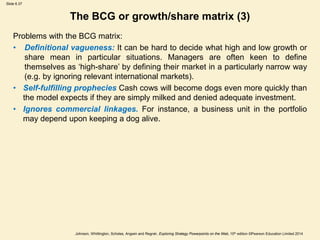
Problems with the BCG matrix:
• Definitional vagueness: It can be hard to decide what high and low growth or
share mean in particular situations. Managers are often keen to define
themselves as ‘high-share’ by defining their market in a particularly narrow way
(e.g. by ignoring relevant international markets).
• Self-fulfilling prophecies Cash cows will become dogs even more quickly than
the model expects if they are simply milked and denied adequate investment.
• Ignores commercial linkages. For instance, a business unit in the portfolio
may depend upon keeping a dog alive.
The BCG or growth/share matrix (3)
Slide 6.38
Johnson, Whittington, Scholes, Angwin and Regnér, Exploring Strategy Powerpoints on the Web, 10th edition ©Pearson Education Limited 2014
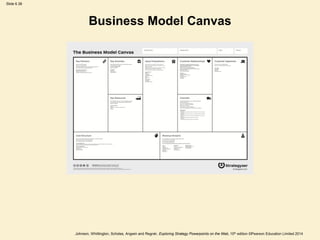
Business Model Canvas
Slide 6.39
Johnson, Whittington, Scholes, Angwin and Regnér, Exploring Strategy Powerpoints on the Web, 10th edition ©Pearson Education Limited 2014
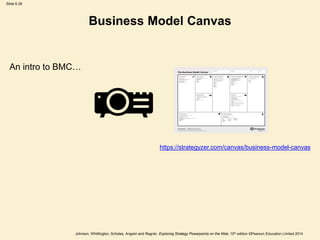
Business Model Canvas
An intro to BMC…
https://strategyzer.com/canvas/business-model-canvas
Slide 6.40
Johnson, Whittington, Scholes, Angwin and Regnér, Exploring Strategy Powerpoints on the Web, 10th edition ©Pearson Education Limited 2014
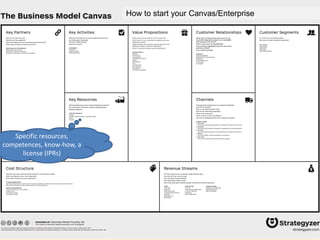
Specific resources,
competences, know-how, a
license (IPRs)
How to start your Canvas/Enterprise
Slide 6.41
Johnson, Whittington, Scholes, Angwin and Regnér, Exploring Strategy Powerpoints on the Web, 10th edition ©Pearson Education Limited 2014
A specific Value Proposition … a well-
defined offer : you have a solution
looking for a problem to solve, or a
customer to satisfy.
How to start your Canvas/Enterprise
Slide 6.42
Johnson, Whittington, Scholes, Angwin and Regnér, Exploring Strategy Powerpoints on the Web, 10th edition ©Pearson Education Limited 2014
A well-defined segment of
customer having a problem
you intend to satisfy
How to start your Canvas/Enterprise
Slide 6.43
Johnson, Whittington, Scholes, Angwin and Regnér, Exploring Strategy Powerpoints on the Web, 10th edition ©Pearson Education Limited 2014
Reducing costs can increase
the profit margin or the price
How to start your Canvas/Enterprise
Slide 6.44
Johnson, Whittington, Scholes, Angwin and Regnér, Exploring Strategy Powerpoints on the Web, 10th edition ©Pearson Education Limited 2014
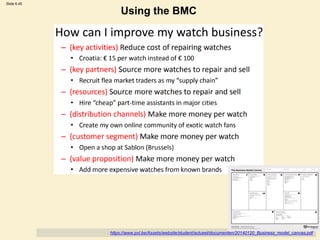
https://www.pxl.be/Assets/website/student/actueel/documenten/20140120_Business_model_canvas.pdf
Using the BMC
Slide 6.45
Johnson, Whittington, Scholes, Angwin and Regnér, Exploring Strategy Powerpoints on the Web, 10th edition ©Pearson Education Limited 2014
https://www.pxl.be/Assets/website/student/actueel/documenten/20140120_Business_model_canvas.pdf
Using the BMC
Slide 6.46
Johnson, Whittington, Scholes, Angwin and Regnér, Exploring Strategy Powerpoints on the Web, 10th edition ©Pearson Education Limited 2014
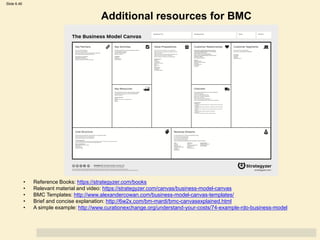
Additional resources for BMC
• Reference Books: https://strategyzer.com/books
• Relevant material and video: https://strategyzer.com/canvas/business-model-canvas
• BMC Templates: http://www.alexandercowan.com/business-model-canvas-templates/
• Brief and concise explanation: http://6w2x.com/bm-mardi/bmc-canvasexplained.html
• A simple example: http://www.curationexchange.org/understand-your-costs/74-example-rdo-business-model
Slide 6.47
Johnson, Whittington, Scholes, Angwin and Regnér, Exploring Strategy Powerpoints on the Web, 10th edition ©Pearson Education Limited 2014
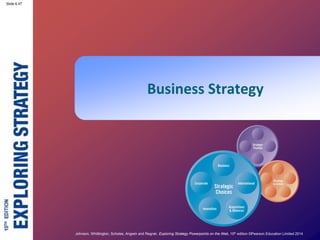
Business Strategy

Business strategy 4.pdf

  • 1.
    Slide 6.1 Johnson, Whittington,Scholes, Angwin and Regnér, Exploring Strategy Powerpoints on the Web, 10th edition ©Pearson Education Limited 2014 Strategic Choices 6: Business Strategy
  • 2.
    Slide 6.2 Johnson, Whittington,Scholes, Angwin and Regnér, Exploring Strategy Powerpoints on the Web, 10th edition ©Pearson Education Limited 2014 Generic strategies ‘Generic strategy’: basic types of competitive strategy that hold across many kinds of business situations. A company can have: • lower costs than its competitors. • products or services that are differentiated: – From competitors’ products or services in ways that are so valued by customers that it can charge higher prices that cover the additional costs of the differentiation. – Different scope of customers. Businesses can choose to focus on narrow customer segments, for example a particular demographic group such as the youth market. Alternatively, they can adopt a broad scope, targeting customers across a range of characteristics such as age, wealth or geography.
  • 3.
    Slide 6.3 Johnson, Whittington,Scholes, Angwin and Regnér, Exploring Strategy Powerpoints on the Web, 10th edition ©Pearson Education Limited 2014 Three generic strategies Source: Adapted with the permission of The Free Press, a Division of Simon & Schuster, Inc., from Competitive Advantage: Creating and Sustaining Superior Performance by Michael E. Porter. Copyright © 1985, 1998 by Michael E. Porter. All rights reserved. Lidl iPhone Tesla Zara Mass/Radical personalisation
  • 4.
    Slide 6.4 Johnson, Whittington,Scholes, Angwin and Regnér, Exploring Strategy Powerpoints on the Web, 10th edition ©Pearson Education Limited 2014 Cost-leadership Cost-leadership strategy involves becoming the lowest-cost organisation in a domain of activity. Four key cost drivers that can help deliver cost leadership: • Lower input costs, e.g. labour or raw materials • Economies of scale, increasing scale usually reduces the average costs of operation over a particular time period, perhaps a month or a year. Economies of scale are important wherever there are high fixed costs Note, though, that diseconomies of scale are possible. Large volumes of output that require special overtime payments to workers or involve the neglect of equipment maintenance can soon become very expensive.
  • 5.
    Slide 6.5 Johnson, Whittington,Scholes, Angwin and Regnér, Exploring Strategy Powerpoints on the Web, 10th edition ©Pearson Education Limited 2014 Cost-leadership …continued: • Experience – The learning curve implies that the cumulative experience gained by an organisation with each unit of output leads to reductions in unit costs – Εntry timing into a market is important: • Εarly entrants into a market will have experience that late entrants do not yet have and so will gain a cost advantage. • Ιt is important to gain and hold market share, as companies with higher market share have more ‘cumulative experience’ simply because of their greater volumes. • Αlthough the gains from experience are typically greatest at the start, improvements normally continue over time • Product/process design – engineers can choose to build a product from cheap standard components, to interact with customers exclusively through cheap web-based methods
  • 6.
    Slide 6.6 Johnson, Whittington,Scholes, Angwin and Regnér, Exploring Strategy Powerpoints on the Web, 10th edition ©Pearson Education Limited 2014 Costs, prices and profits for generic strategies Low cost should not be pursued in total disregard for quality • What is the difference between parity and proximity strategies? • Where are more requirements for high quality, in parity or proximity strategy?
  • 7.
    Slide 6.7 Johnson, Whittington,Scholes, Angwin and Regnér, Exploring Strategy Powerpoints on the Web, 10th edition ©Pearson Education Limited 2014 Differentiation strategies Differentiation involves uniqueness along some dimension that is sufficiently valued by customers to allow a price premium. • Relevant points of differentiation vary between markets. E.g. even at the same top end of the car market, BMW and Mercedes differentiate in different ways, the first typically with a sportier image, the second with more conservative values. Three differentiation drivers : • Product and service attributes with better or unique features than comparable products or services • Customer relationships, customer services (e.g. Zalando) and responsiveness (e.g. Amazon), customisation (e.g. SAP), marketing and reputation (e.g. Starbucks) • Complements, a way of bundling products and services together to increase the value for the customer (Apple/iTunes/App Store)
  • 8.
    Slide 6.8 Johnson, Whittington,Scholes, Angwin and Regnér, Exploring Strategy Powerpoints on the Web, 10th edition ©Pearson Education Limited 2014 Differentiation in the US airline industry Source: Simplified from Figure 1, in D. Gursoy, M. Chen and H. Kim (2005) ‘The US airlines relative positioning’, Tourism Management, 26, 5, 57–67: p. 62.
  • 9.
    Slide 6.9 Johnson, Whittington,Scholes, Angwin and Regnér, Exploring Strategy Powerpoints on the Web, 10th edition ©Pearson Education Limited 2014 Critical issue for differentiation strategy Source: Simplified from Figure 1, in D. Gursoy, M. Chen and H. Kim (2005) ‘The US airlines relative positioning’, Tourism Management, 26, 5, 57–67: p. 62. • The differentiator needs to ensure that the additional costs of differentiation do not exceed the gains in price. • The historic failures under British ownership of the luxury car companies Rolls-Royce and Bentley against top-end Mercedes cars are partly attributable to the expensive crafting of wood and leather interiors, the full cost of which even wealthy customers were not prepared to pay for. • Just as cost-leaders should not neglect quality, so should differentiators attend closely to costs, especially in areas irrelevant to their sources of differentiation. Do you see a difference in the top class cars versus mobiles industries?
  • 10.
    Slide 6.10 Johnson, Whittington,Scholes, Angwin and Regnér, Exploring Strategy Powerpoints on the Web, 10th edition ©Pearson Education Limited 2014 Focus strategies (1) A focus strategy targets a narrow segment or domain of activity and tailors its products or services to the needs of that specific segment to the exclusion of others. Two types of focus strategy: • Cost-focus strategy (e.g. Zara) • Differentiation focus strategy (e.g. ARM Holdings dominates the world market for mobile phone chips, despite being only a fraction of the size of the leading microprocessor manufacturers, AMD and Intel, which also make chips for a wide range of computers).
  • 11.
    Slide 6.11 Johnson, Whittington,Scholes, Angwin and Regnér, Exploring Strategy Powerpoints on the Web, 10th edition ©Pearson Education Limited 2014 Focus strategies (2) Successful focus strategies depend on at least one of three key factors: • Distinct segment needs, e.g. Tesla Motors currently targets a narrow segment with its expensive premium electric vehicles • Distinct segment value chains, e.g. Focus strategies are strengthened if they have distinctive value chains that will be difficult or costly for rivals to construct. In detergents, Procter & Gamble cannot easily respond to the Belgian ecologically friendly cleaning products company Ecover because achieving the same environmental soundness would involve transforming its purchasing and production processes. • Viable segment economics. Segments can easily become too small to serve economically as demand or supply conditions change
  • 12.
    Slide 6.12 Johnson, Whittington,Scholes, Angwin and Regnér, Exploring Strategy Powerpoints on the Web, 10th edition ©Pearson Education Limited 2014 ‘Stuck in the middle’? Porter argues: • It is best to choose which generic strategy to adopt and then stick rigorously to it. • Failure to do this leads to a danger of being ‘stuck in the middle’ – doing no strategy well. • The argument for pure generic strategies is controversial. Porter acknowledges that the strategies can be combined (e.g. if being unique costs nothing).
  • 13.
    Slide 6.13 Johnson, Whittington,Scholes, Angwin and Regnér, Exploring Strategy Powerpoints on the Web, 10th edition ©Pearson Education Limited 2014 Combining generic strategies (hybrid) • A company can create separate strategic business units each pursuing different generic strategies and with different cost structures, e.g. Lexus/Toyota, Lufthansa/German Wings. • Technological or managerial innovations where both cost efficiency and quality are improved. • Competitive failures – if rivals are similarly ‘stuck in the middle’ or if there is no significant competition then ‘middle’ strategies may be OK.
  • 14.
    Slide 6.14 Johnson, Whittington,Scholes, Angwin and Regnér, Exploring Strategy Powerpoints on the Web, 10th edition ©Pearson Education Limited 2014 Strategy clock (1) The strategy clock provides an alternative approach to generic strategy which gives more scope for hybrid strategies. It has two distinct features: – It is focused on the prices to customers rather than the costs to organisations. – The circular design allows for incremental adjustments in strategy rather than stark choices.
  • 15.
    Slide 6.15 Johnson, Whittington,Scholes, Angwin and Regnér, Exploring Strategy Powerpoints on the Web, 10th edition ©Pearson Education Limited 2014 Strategy clock (2) Source: Adapted from D. Faulkner and C. Bowman, The Essence of Competitive Strategy, Prentice Hall, 1995.
  • 16.
    Slide 6.16 Johnson, Whittington,Scholes, Angwin and Regnér, Exploring Strategy Powerpoints on the Web, 10th edition ©Pearson Education Limited 2014 Strategy clock – differentiation • Strategies in this zone seeks to provide products that offer perceived benefits that differ from those offered by competitors. • A range of alternative strategies from: ― differentiation without price premium (12 o’clock) – used to increase market share. ― differentiation with price premium (1 o’clock) – used to increase profit margins. ― focused differentiation (2 o’clock) – used for customers that demand top quality and will pay a big premium.
  • 17.
    Slide 6.17 Johnson, Whittington,Scholes, Angwin and Regnér, Exploring Strategy Powerpoints on the Web, 10th edition ©Pearson Education Limited 2014 Strategy clock – low price Low price combined with low perceived value. • A standard low price strategy (9 o’clock) Low prices combined with similar quality to competitors aimed at increasing market share. Needs a cost advantage (such as economies of scale) to be sustainable, e.g. Lidl. • A ‘no frills’ strategy (7 o’clock) Focusing on price sensitive market segments – typified by low-cost airlines like Ryanair.
  • 18.
    Slide 6.18 Johnson, Whittington,Scholes, Angwin and Regnér, Exploring Strategy Powerpoints on the Web, 10th edition ©Pearson Education Limited 2014 Strategy clock – hybrid Seeks to simultaneously achieve higher benefits and lower prices relative to those of competitors. Hybrid strategies can be used: • to enter markets and build position quickly • as an aggressive attempt to win market share • to build volume sales and gain from mass production. IKEA is a classic example which uses scale advantages to combine relatively low prices with differentiated Swedish design.
  • 19.
    Slide 6.19 Johnson, Whittington,Scholes, Angwin and Regnér, Exploring Strategy Powerpoints on the Web, 10th edition ©Pearson Education Limited 2014 Strategy clock – non-competitive strategies Increased prices with low perceived product or service benefits. • In competitive markets such strategies will be doomed to failure. • Only feasible where there is strategic ‘lock-in’ or a near monopoly position.
  • 20.
    Slide 6.20 Johnson, Whittington,Scholes, Angwin and Regnér, Exploring Strategy Powerpoints on the Web, 10th edition ©Pearson Education Limited 2014 Strategic lock-in Strategic lock-in is where users become dependent on a supplier and are unable to use another supplier without substantial switching costs. Lock-in can be achieved in two main ways: • Controlling complementary products or services. An example is razors that only work with one type of blade. • Creating a proprietary industry standard. Microsoft with its Windows operating system.
  • 21.
    Slide 6.21 Johnson, Whittington,Scholes, Angwin and Regnér, Exploring Strategy Powerpoints on the Web, 10th edition ©Pearson Education Limited 2014 Interactive strategies • Business strategy choices depend on what competitors do (they are interactive). • If everybody else is chasing after cost leadership, then a differentiation strategy might be sensible.
  • 22.
    Slide 6.22 Johnson, Whittington,Scholes, Angwin and Regnér, Exploring Strategy Powerpoints on the Web, 10th edition ©Pearson Education Limited 2014 Interactive price and quality strategies Note: axes are not necessarily to linear scales. Source: Adapted with the permission of The Free Press, a Division of Simon & Schuster, Inc., from Hypercompetition: Managing the Dynamics of Strategic Maneuvering by Richard D’Aveni with Robert Gunther. Copyright © 1994 by Richard D’Aveni. All rights reserved. Richard D’Aveni gives an example of how competitors may interact in terms of competitive moves in price (cost response) and perceived quality (differentiation response).
  • 23.
    Slide 6.23 Johnson, Whittington,Scholes, Angwin and Regnér, Exploring Strategy Powerpoints on the Web, 10th edition ©Pearson Education Limited 2014 Interactive price and quality strategies Note: axes are not necessarily to linear scales. Source: Adapted with the permission of The Free Press, a Division of Simon & Schuster, Inc., from Hypercompetition: Managing the Dynamics of Strategic Maneuvering by Richard D’Aveni with Robert Gunther. Copyright © 1994 by Richard D’Aveni. All rights reserved. Richard D’Aveni gives an example of how competitors may interact in terms of competitive moves in price (cost response) and perceived quality (differentiation response).
  • 24.
    Slide 6.24 Johnson, Whittington,Scholes, Angwin and Regnér, Exploring Strategy Powerpoints on the Web, 10th edition ©Pearson Education Limited 2014 Hypercompetition Hypercompetition describes markets with continuous disequilibrium and change, e.g. popular music or consumer electronics. – It may be impossible to plan for long-term sustainable competitive advantage. – Planning may actually destroy competitive advantage by slowing down responses. – Successful hypercompetition demands speed and initiative rather than defensiveness.
  • 25.
    Slide 6.25 Johnson, Whittington,Scholes, Angwin and Regnér, Exploring Strategy Powerpoints on the Web, 10th edition ©Pearson Education Limited 2014 Cooperating with rivals Source: Adapted from Competitive Strategy: Techniques for Analysing Industries and Competitors, The Free Press, by Michael E. Porter. Copyright © 1980, 1998 by The Free Press. All rights reserved. • Collaboration between some organisations in a market may give them advantage over other competitors in the same market, or potential new entrants • Tacit collusion: companies agree on a certain strategy without any explicit communication between them Benefits for both Benefits for both Joint research on steel to reduce the weight to discourage car manufacturers using aluminium
  • 26.
    Slide 6.26 Johnson, Whittington,Scholes, Angwin and Regnér, Exploring Strategy Powerpoints on the Web, 10th edition ©Pearson Education Limited 2014 Game theory Game theory encourages an organisation to consider competitors’ likely moves and the implications of these moves for its own strategy. • Game theory is particularly important where competitors are interdependent. – Interdependence exists where the outcome of choices made by one competitor is dependent on the choices made by other competitors. For example, the success of price cuts by a retailer depends on the responses of its rivals: if rivals do not match the price cuts, then the price-cutter gains market share; but if rivals follow the price cuts, nobody gains market share and all players suffer from the lower prices. • In these circumstances it is important to: – get in the mind of competitors – think forwards and reason backwards. • Think forwards to what competitors might do in the future, and then reason backwards to what would be sensible to do in the light of this now.
  • 27.
    Slide 6.27 Johnson, Whittington,Scholes, Angwin and Regnér, Exploring Strategy Powerpoints on the Web, 10th edition ©Pearson Education Limited 2014 Prisoner’s dilemma The most attractive strategy for Airbus and Boeing jointly is for them both to hold their prices, yet in practice they are likely to cut prices because they must expect the other to do so anyway.
  • 28.
    Slide 6.28 Johnson, Whittington,Scholes, Angwin and Regnér, Exploring Strategy Powerpoints on the Web, 10th edition ©Pearson Education Limited 2014 Lessons from game theory • Game theory frequently highlights the value of a more cooperative approach to competitor interaction, rather than aggressive competition. • It encourages managers to consider how a ‘game’ can be transformed from lose–lose competition to win–win cooperation.
  • 29.
    Slide 6.29 Johnson, Whittington,Scholes, Angwin and Regnér, Exploring Strategy Powerpoints on the Web, 10th edition ©Pearson Education Limited 2014 Business Strategy tools: McKinsey 7-Ss, BCG Martix, Business Model Canvas
  • 30.
    Slide 6.30 Johnson, Whittington,Scholes, Angwin and Regnér, Exploring Strategy Powerpoints on the Web, 10th edition ©Pearson Education Limited 2014 McKinsey 7s
  • 31.
    Slide 6.31 Johnson, Whittington,Scholes, Angwin and Regnér, Exploring Strategy Powerpoints on the Web, 10th edition ©Pearson Education Limited 2014 McKinsey 7-S framework Source: R. Waterman, T. Peters and J. Phillips, ‘Structure is not organisation’, Business Horizons, June 1980, pp. 14–26: p. 18. • Developed by the McKinsey consulting company, the McKinsey 7-S framework highlights the importance of fit between not just strategy, structure and systems, but also with staff, style, skills and superordinate goals. • All seven elements have to be configured together to achieve effectiveness. • The elements can therefore serve as a checklist in any organizational design exercise
  • 32.
    Slide 6.32 Johnson, Whittington,Scholes, Angwin and Regnér, Exploring Strategy Powerpoints on the Web, 10th edition ©Pearson Education Limited 2014 McKinsey 7-S framework • Style refers to the leadership style of top managers in an organisation. Leadership styles may be collaborative, participative, directive or coercive. Managers’ behavioral style influences the culture of the whole organisation. Style should fit other aspects of the framework: a highly directive or coercive style is not likely to fit a matrix organisation structure. • Staff is about the kinds of people in the organisation and how they are developed. This relates to systems of selection, socialisation and reward. A key criterion for the feasibility of any strategy is: does the organisation have the people to match? A common constraint on structural change is the availability of the right people to head new departments and divisions. • Skills relates to staff, but here refers more broadly to capabilities in general, how these skills are embedded in and captured by the organisation as a whole. For example, how training schemes, information technology and reward systems transform the talents of individuals into organisational capabilities required.
  • 33.
    Slide 6.33 Johnson, Whittington,Scholes, Angwin and Regnér, Exploring Strategy Powerpoints on the Web, 10th edition ©Pearson Education Limited 2014 McKinsey 7-S framework • Superordinate goals refers to the overarching goals or purpose of the organisation as a whole, in other words the mission, vision and objectives that form the organisational purpose. Superordinate (i.e. overarching) goals are placed at the centre of the 7-S framework: all other elements should support these. The McKinsey 7-S framework highlights at least three aspects of organising. • First, organising involves a lot more than just getting the organisational structure right; there are many other elements to attend to. • Second, the 7-S framework emphasises fit between all these elements: everything from structure to skills needs to be configured together in order to create virtuous circles of performance. • Third, if managers change one element of the 7-S, they are likely to have to change all the other elements as well in order to keep them aligned. Changing one element in isolation is liable to break the virtuous circle and make performance worse until overall fit is restored.
  • 34.
    Slide 6.34 Johnson, Whittington,Scholes, Angwin and Regnér, Exploring Strategy Powerpoints on the Web, 10th edition ©Pearson Education Limited 2014 BCG Matrix
  • 35.
    Slide 6.35 Johnson, Whittington,Scholes, Angwin and Regnér, Exploring Strategy Powerpoints on the Web, 10th edition ©Pearson Education Limited 2014 The BCG or growth/share matrix (1) • Conceiving of the balance of a portfolio of businesses • BCG matrix uses market share and market growth criteria to determine the attractiveness and balance of a business portfolio
  • 36.
    Slide 6.36 Johnson, Whittington,Scholes, Angwin and Regnér, Exploring Strategy Powerpoints on the Web, 10th edition ©Pearson Education Limited 2014 The BCG or growth/share matrix (2) • A question mark (or problem child) is a business unit in a growing market, without high market share. Developing question marks into stars, takes heavy investment. Many question marks fail to develop some develop into stars. • A cash cow is a business unit that has a high market share in a mature market. As growth is low, investment needs are less, while the business unit is profitable. • A dog is a business unit that has a low market share in a static or declining market. They may be a cash drain and use up a disproportionate amount of managerial time and company resources. The BCG usually recommends divestment or closure. • A star is a business unit which has a high market share in a growing market. The business unit may be spending heavily to keep up with growth, but high market share should yield sufficient profits to make it more or less self-sufficient in terms of investment needs. Existing stars eventually become cash cows and cash cows may decline into dogs.
  • 37.
    Slide 6.37 Johnson, Whittington,Scholes, Angwin and Regnér, Exploring Strategy Powerpoints on the Web, 10th edition ©Pearson Education Limited 2014 Problems with the BCG matrix: • Definitional vagueness: It can be hard to decide what high and low growth or share mean in particular situations. Managers are often keen to define themselves as ‘high-share’ by defining their market in a particularly narrow way (e.g. by ignoring relevant international markets). • Self-fulfilling prophecies Cash cows will become dogs even more quickly than the model expects if they are simply milked and denied adequate investment. • Ignores commercial linkages. For instance, a business unit in the portfolio may depend upon keeping a dog alive. The BCG or growth/share matrix (3)
  • 38.
    Slide 6.38 Johnson, Whittington,Scholes, Angwin and Regnér, Exploring Strategy Powerpoints on the Web, 10th edition ©Pearson Education Limited 2014 Business Model Canvas
  • 39.
    Slide 6.39 Johnson, Whittington,Scholes, Angwin and Regnér, Exploring Strategy Powerpoints on the Web, 10th edition ©Pearson Education Limited 2014 Business Model Canvas An intro to BMC… https://strategyzer.com/canvas/business-model-canvas
  • 40.
    Slide 6.40 Johnson, Whittington,Scholes, Angwin and Regnér, Exploring Strategy Powerpoints on the Web, 10th edition ©Pearson Education Limited 2014 Specific resources, competences, know-how, a license (IPRs) How to start your Canvas/Enterprise
  • 41.
    Slide 6.41 Johnson, Whittington,Scholes, Angwin and Regnér, Exploring Strategy Powerpoints on the Web, 10th edition ©Pearson Education Limited 2014 A specific Value Proposition … a well- defined offer : you have a solution looking for a problem to solve, or a customer to satisfy. How to start your Canvas/Enterprise
  • 42.
    Slide 6.42 Johnson, Whittington,Scholes, Angwin and Regnér, Exploring Strategy Powerpoints on the Web, 10th edition ©Pearson Education Limited 2014 A well-defined segment of customer having a problem you intend to satisfy How to start your Canvas/Enterprise
  • 43.
    Slide 6.43 Johnson, Whittington,Scholes, Angwin and Regnér, Exploring Strategy Powerpoints on the Web, 10th edition ©Pearson Education Limited 2014 Reducing costs can increase the profit margin or the price How to start your Canvas/Enterprise
  • 44.
    Slide 6.44 Johnson, Whittington,Scholes, Angwin and Regnér, Exploring Strategy Powerpoints on the Web, 10th edition ©Pearson Education Limited 2014 https://www.pxl.be/Assets/website/student/actueel/documenten/20140120_Business_model_canvas.pdf Using the BMC
  • 45.
    Slide 6.45 Johnson, Whittington,Scholes, Angwin and Regnér, Exploring Strategy Powerpoints on the Web, 10th edition ©Pearson Education Limited 2014 https://www.pxl.be/Assets/website/student/actueel/documenten/20140120_Business_model_canvas.pdf Using the BMC
  • 46.
    Slide 6.46 Johnson, Whittington,Scholes, Angwin and Regnér, Exploring Strategy Powerpoints on the Web, 10th edition ©Pearson Education Limited 2014 Additional resources for BMC • Reference Books: https://strategyzer.com/books • Relevant material and video: https://strategyzer.com/canvas/business-model-canvas • BMC Templates: http://www.alexandercowan.com/business-model-canvas-templates/ • Brief and concise explanation: http://6w2x.com/bm-mardi/bmc-canvasexplained.html • A simple example: http://www.curationexchange.org/understand-your-costs/74-example-rdo-business-model
  • 47.
    Slide 6.47 Johnson, Whittington,Scholes, Angwin and Regnér, Exploring Strategy Powerpoints on the Web, 10th edition ©Pearson Education Limited 2014 Business Strategy