Slide 2.1
      6.1


            Part II:
            Strategic Choices


                  Johnson, Whittington and Scholes, Exploring Strategy, 9th Edition, © Pearson Education Limited 2011
Slide 6.2


                   The focus of part 2:
                    strategic choices
        • How organisations relate to competitors in terms
          of their competitive business strategies.
        • How broad and diverse organisations should be in
          terms of their corporate portfolios.
        • How far organisations should extend themselves
          internationally.
        • How organisations are creative and innovative.
        • How organisations pursue strategies through
          organic development, acquisitions or strategic
          alliances.

                              Johnson, Whittington and Scholes, Exploring Strategy, 9th Edition, © Pearson Education Limited 2011
Slide 6.3


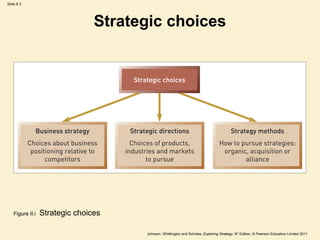
                                 Strategic choices


    Figure II.i   Strategic choices

                                       Johnson, Whittington and Scholes, Exploring Strategy, 9th Edition, © Pearson Education Limited 2011
Slide 6.4


            Strategic Choices
                 6: Business Strategy


                     Johnson, Whittington and Scholes, Exploring Strategy, 9th Edition, © Pearson Education Limited 2011
Slide 6.5


                  Learning outcomes

        • Identify strategic business units (SBUs) in
          organisations.
        • Assess business strategy in terms of the
          generic strategies of cost leadership,
          differentiation and focus.
        • Identify business strategies suited to
          hypercompetitive conditions.
        • Assess the benefits of cooperation in
          business strategy.
        • Apply principles of game theory to business
          strategy.
                            Johnson, Whittington and Scholes, Exploring Strategy, 9th Edition, © Pearson Education Limited 2011
Slide 6.6


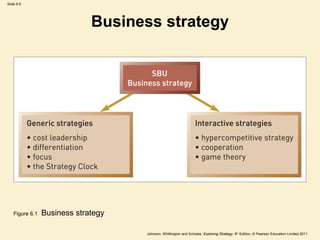
                              Business strategy


    Figure 6.1   Business strategy

                                     Johnson, Whittington and Scholes, Exploring Strategy, 9th Edition, © Pearson Education Limited 2011
Slide 6.7


              Strategic business units (SBUs)

            A strategic business unit (SBU) supplies
            goods or services for a distinct domain of activity.
            • A small business has just one SBU.
            • A large diversified corporation is made up of
              multiple businesses (SBUs).
            • SBUs can be called ‘divisions’ or ‘profit centres’
            • SBUs can be identified by:
             – Market based criteria (similar customers,
               channels and competitors).
             – Capability based criteria (similar strategic
               capabilities).
                                   Johnson, Whittington and Scholes, Exploring Strategy, 9th Edition, © Pearson Education Limited 2011
Slide 6.8


                  The purpose of SBUs

        • To decentralise initiative to smaller units within
          the corporation so SBUs can pursue their own
          distinct strategy.
        • To allow large corporations to vary their
          business strategies according to the different
          needs of external markets.
        • To encourage accountability – each SBU can
          be held responsible for its own costs, revenues
          and profits.

                              Johnson, Whittington and Scholes, Exploring Strategy, 9th Edition, © Pearson Education Limited 2011
Slide 6.9


                   Generic strategies

        • Porter introduced the term ‘Generic Strategy’
          to mean basic types of competitive strategy
          that hold across many kinds of business
          situations.
        • Competitive strategy is concerned with how a
          strategic business unit achieves competitive
          advantage in its domain of activity.
        • Competitive advantage is about how an SBU
          creates value for its users both greater than the
          costs of supplying them and superior to that of
          rival SBUs.
                              Johnson, Whittington and Scholes, Exploring Strategy, 9th Edition, © Pearson Education Limited 2011
Slide 6.10


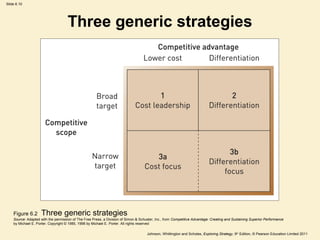
                                     Three generic strategies


    Figure 6.2      Three generic strategies
    Source: Adapted with the permission of The Free Press, a Division of Simon & Schuster, Inc., from Competitive Advantage: Creating and Sustaining Superior Performance
    by Michael E. Porter. Copyright © 1985, 1998 by Michael E. Porter. All rights reserved

                                                                                     Johnson, Whittington and Scholes, Exploring Strategy, 9th Edition, © Pearson Education Limited 2011
Slide 6.11


                      Cost-leadership

         Cost-leadership strategy involves becoming
         the lowest-cost organisation in a domain of
         activity.
         Four key cost drivers that can help deliver cost
         leadership:
         • Lower input costs.
         • Economies of scale.
         • Experience.
         • Product process and design.

                               Johnson, Whittington and Scholes, Exploring Strategy, 9th Edition, © Pearson Education Limited 2011
Slide 6.12


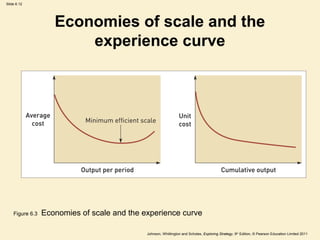
                    Economies of scale and the
                        experience curve


    Figure 6.3   Economies of scale and the experience curve

                                             Johnson, Whittington and Scholes, Exploring Strategy, 9th Edition, © Pearson Education Limited 2011
Slide 6.13


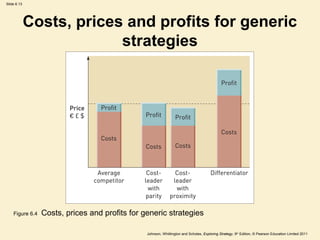
             Costs, prices and profits for generic
                          strategies


    Figure 6.4   Costs, prices and profits for generic strategies

                                                Johnson, Whittington and Scholes, Exploring Strategy, 9th Edition, © Pearson Education Limited 2011
Slide 6.14


                Differentiation strategies

         Differentiation involves uniqueness along some
         dimension that is sufficiently valued by
         customers to allow a price premium.

         Two key issues:
         • The strategic customer on whose needs the
         differentiation is based.
         • Key competitors – who are the rivals and who
         may become a rival.


                             Johnson, Whittington and Scholes, Exploring Strategy, 9th Edition, © Pearson Education Limited 2011
Slide 6.15


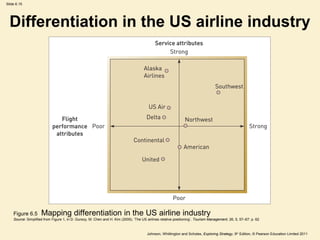
  Differentiation in the US airline industry


    Figure 6.5       Mapping differentiation in the US airline industry
    Source: Simplified from Figure 1, in D. Gursoy, M. Chen and H. Kim (2005), ‘The US airlines relative positioning’, Tourism Management, 26, 5, 57–67: p. 62


                                                                                       Johnson, Whittington and Scholes, Exploring Strategy, 9th Edition, © Pearson Education Limited 2011
Slide 6.16


                   Focus strategies (1)

         A focus strategy targets a narrow segment of
         domain of an activity and tailors its products or
         services to the needs of that specific segment to
         the exclusion of others.
         Two types of focus strategy:
         • cost-focus strategy (e.g. Ryanair).
         • differentiation focus strategy (e.g. Ecover).


                              Johnson, Whittington and Scholes, Exploring Strategy, 9th Edition, © Pearson Education Limited 2011
Slide 6.17


                   Focus strategies (2)

         Successful focus strategies depend on at least
         one of three key factors:

         • Distinct segment needs.
         • Distinct segment value chains.
         • Viable segment economics.


                              Johnson, Whittington and Scholes, Exploring Strategy, 9th Edition, © Pearson Education Limited 2011
Slide 6.18


                   ‘Stuck in the middle’?

         Porter’s argues:
         • It is best to choose which generic strategy to
           adopt and then stick rigorously to it.
         • Failure to do this leads to a danger of being
           ‘stuck in the middle’ i.e. doing no strategy well.
         • The argument for pure generic strategies is
           controversial. Even Porter acknowledges that
           the strategies can be combined (e.g. if being
           unique costs nothing).

                                Johnson, Whittington and Scholes, Exploring Strategy, 9th Edition, © Pearson Education Limited 2011
Slide 6.19


             Combining generic strategies

         • A company can create separate strategic
           business units each pursuing different generic
           strategies and with different cost structures.
         • Technological or managerial innovations where
           both cost efficiency and quality are improved.
         • Competitive failures – if rivals are similarly
           ‘stuck in the middle’ or if there is no significant
           competition then ‘middle’ strategies may be
           OK.

                                Johnson, Whittington and Scholes, Exploring Strategy, 9th Edition, © Pearson Education Limited 2011
Slide 6.20


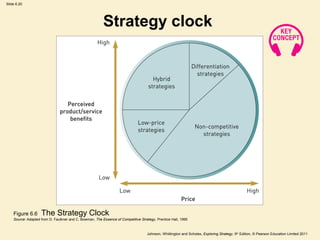
                                                         Strategy clock


    Figure 6.6      The Strategy Clock
    Source: Adapted from D. Faulkner and C. Bowman, The Essence of Competitive Strategy, Prentice Hall, 1995


                                                                                   Johnson, Whittington and Scholes, Exploring Strategy, 9th Edition, © Pearson Education Limited 2011
Slide 6.21


               Strategy clock - differentiation

         • Strategies in this zone seeks to provide
           products that offer benefits that differ from
           those offered by competitors.
         • A range of alternative strategies from:
              differentiation without price premium (12
               o’clock) – used to increase market share.
              differentiation with price premium (1 o’clock) –
               used to increase profit margins.
              focused differentiation (2 o’clock) – used for
               customers that demand top quality and will pay
               a big premium.
                                  Johnson, Whittington and Scholes, Exploring Strategy, 9th Edition, © Pearson Education Limited 2011
Slide 6.22


                  Strategy clock – low price

         Low price combined with:
              low perceived product benefits focusing on
               price sensitive market segments – a ‘no frills’
               strategy typified by low cost airlines like
               Ryanair.
              lower price than competitors while offering
               similar product benefits – aimed at
               increasing market share typified by Asda
               /Walmart in grocery retailing.

                                 Johnson, Whittington and Scholes, Exploring Strategy, 9th Edition, © Pearson Education Limited 2011
Slide 6.23


                    Strategy clock - hybrid

         • Seeks to simultaneously achieve
           differentiation and low price relative to
           competitors.
         • Hybrid strategies can be used:
              to enter markets and build position quickly.
              as an aggressive attempt to win market share.
              to build volume sales and gain from mass
              production.


                                 Johnson, Whittington and Scholes, Exploring Strategy, 9th Edition, © Pearson Education Limited 2011
Slide 6.24


             Strategy clock – non-competitive

         • Increased prices without increasing
           service/product benefits.
         • In competitive markets such strategies will be
           doomed to failure.
         • Only feasible where there is strategic ‘lock-in’
           or a near monopoly position.


                               Johnson, Whittington and Scholes, Exploring Strategy, 9th Edition, © Pearson Education Limited 2011
Slide 6.25


                        Strategic lock-in

         • Strategic lock-in is where users become
           dependent on a supplier and are unable to use
           another supplier without substantial switching
           costs.
         • Lock-in can be achieved in two main ways:
              Controlling complementary products or
               services. E.g. Cheap razors that only work with
               one type of blade.
              Creating a proprietary industry standard. E.g.
               Microsoft with its Windows operating system.
                                 Johnson, Whittington and Scholes, Exploring Strategy, 9th Edition, © Pearson Education Limited 2011
Slide 6.26


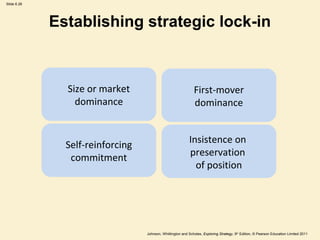
             Establishing strategic lock-in


               Size or market                                 First-mover
                 dominance                                    dominance


                                                           Insistence on
               Self-reinforcing
                                                           preservation
                commitment
                                                             of position


                                  Johnson, Whittington and Scholes, Exploring Strategy, 9th Edition, © Pearson Education Limited 2011
Slide 6.27


                   Hypercompetition

         • Hypercompetition describes markets with
           continuous disequilibrium and change e.g.
           popular music or consumer electronics.
         • Successful hypercompetition demands speed
           and initiative rather than defensiveness.


                            Johnson, Whittington and Scholes, Exploring Strategy, 9th Edition, © Pearson Education Limited 2011
Slide 6.28


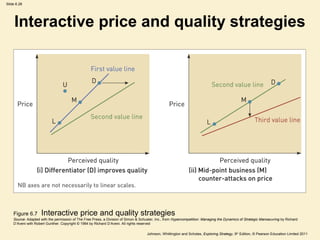
     Interactive price and quality strategies


    Figure 6.7      Interactive price and quality strategies
    Source: Adapted with the permission of The Free Press, a Division of Simon & Schuster, Inc., from Hypercompetition: Managing the Dynamics of Strategic Manoeuvring by Richard
    D’Aveni with Robert Gunther. Copyright © 1994 by Richard D’Aveni. All rights reserved

                                                                                     Johnson, Whittington and Scholes, Exploring Strategy, 9th Edition, © Pearson Education Limited 2011
Slide 6.29


                    Interactive strategies in
                       hypercompetition
         • Four key principles:
              Cannibalise bases of success.
              A series of small moves rather than big moves.
              Be unpredictable.
              Mislead the competition.


                                  Johnson, Whittington and Scholes, Exploring Strategy, 9th Edition, © Pearson Education Limited 2011
Slide 6.30


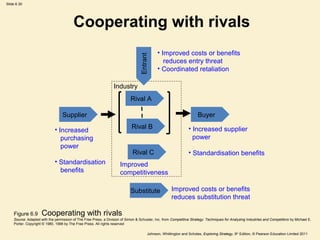
                                        Cooperating with rivals
                                                                                              • Improved costs or benefits


                                                                                  Entrant
                                                                                                 reduces entry threat
                                                                                              • Coordinated retaliation

                                                                 Industry
                                                                            Rival A

                                  Supplier                                                                             Buyer

                             • Increased                                    Rival B                              • Increased supplier
                                purchasing                                                                         power
                                power
                                                                             Rival C                             • Standardisation benefits
                             • Standardisation                       Improved
                               benefits                              competitiveness

                                                                            Substitute                 Improved costs or benefits
                                                                                                       reduces substitution threat

    Figure 6.9       Cooperating with rivals
    Source: Adapted with the permission of The Free Press, a Division of Simon & Schuster, Inc. from Competitive Strategy: Techniques for Analyzing Industries and Competitors by Michael E.
    Porter. Copyright © 1980, 1998 by The Free Press. All rights reserved

                                                                                        Johnson, Whittington and Scholes, Exploring Strategy, 9th Edition, © Pearson Education Limited 2011
Slide 6.31


                         Game theory

             Game theory encourages an organisation to
             consider competitors’ likely moves and the
             implications of these moves for its own
             strategy.


                               Johnson, Whittington and Scholes, Exploring Strategy, 9th Edition, © Pearson Education Limited 2011
Slide 6.32


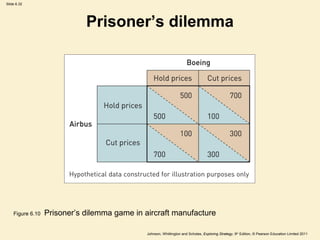
                             Prisoner’s dilemma


    Figure 6.10   Prisoner’s dilemma game in aircraft manufacture

                                              Johnson, Whittington and Scholes, Exploring Strategy, 9th Edition, © Pearson Education Limited 2011
Slide 6.33


               Lessons from game theory

         • Game theory encourages managers to
           consider how a ‘game’ can be transformed
           from ‘lose–lose’ competition to ‘win–win’
           cooperation.
         • Four principles:
            Ensure repetition.
            Signalling.
            Deterrence.
            Commitment.


                             Johnson, Whittington and Scholes, Exploring Strategy, 9th Edition, © Pearson Education Limited 2011
Slide 6.34


                          Summary (1)

         • Business strategy is concerned with seeking
           competitive advantage in markets at the business
           rather than corporate level.
         • Business strategy needs to be considered and
           defined in terms of strategic business units
           (SBUs).
         • Different generic strategies can be defined in
           terms of cost-leadership, differentiation and focus.
         • Managers need to consider how business
           strategies can be sustained through strategic
           capabilities and/or the ability to achieve a ‘lock-in’
           position with buyers.
                                 Johnson, Whittington and Scholes, Exploring Strategy, 9th Edition, © Pearson Education Limited 2011
Slide 6.35


                        Summary (2)

         • In hypercompetitive conditions sustainable
           competitive advantage is difficult to achieve.
           Competitors need to be able to cannibalise,
           make small moves, be unpredictable and
           mislead their rivals.
         • Cooperative strategies may offer alternatives to
           competitive strategies or may run in parallel.
         • Game theory encourages managers to get in
           the mind of competitors and think forwards and
           reason backwards.
                              Johnson, Whittington and Scholes, Exploring Strategy, 9th Edition, © Pearson Education Limited 2011

Business strategy

  • 1.
    Slide 2.1 6.1 Part II: Strategic Choices Johnson, Whittington and Scholes, Exploring Strategy, 9th Edition, © Pearson Education Limited 2011
  • 2.
    Slide 6.2 The focus of part 2: strategic choices • How organisations relate to competitors in terms of their competitive business strategies. • How broad and diverse organisations should be in terms of their corporate portfolios. • How far organisations should extend themselves internationally. • How organisations are creative and innovative. • How organisations pursue strategies through organic development, acquisitions or strategic alliances. Johnson, Whittington and Scholes, Exploring Strategy, 9th Edition, © Pearson Education Limited 2011
  • 3.
    Slide 6.3 Strategic choices Figure II.i Strategic choices Johnson, Whittington and Scholes, Exploring Strategy, 9th Edition, © Pearson Education Limited 2011
  • 4.
    Slide 6.4 Strategic Choices 6: Business Strategy Johnson, Whittington and Scholes, Exploring Strategy, 9th Edition, © Pearson Education Limited 2011
  • 5.
    Slide 6.5 Learning outcomes • Identify strategic business units (SBUs) in organisations. • Assess business strategy in terms of the generic strategies of cost leadership, differentiation and focus. • Identify business strategies suited to hypercompetitive conditions. • Assess the benefits of cooperation in business strategy. • Apply principles of game theory to business strategy. Johnson, Whittington and Scholes, Exploring Strategy, 9th Edition, © Pearson Education Limited 2011
  • 6.
    Slide 6.6 Business strategy Figure 6.1 Business strategy Johnson, Whittington and Scholes, Exploring Strategy, 9th Edition, © Pearson Education Limited 2011
  • 7.
    Slide 6.7 Strategic business units (SBUs) A strategic business unit (SBU) supplies goods or services for a distinct domain of activity. • A small business has just one SBU. • A large diversified corporation is made up of multiple businesses (SBUs). • SBUs can be called ‘divisions’ or ‘profit centres’ • SBUs can be identified by: – Market based criteria (similar customers, channels and competitors). – Capability based criteria (similar strategic capabilities). Johnson, Whittington and Scholes, Exploring Strategy, 9th Edition, © Pearson Education Limited 2011
  • 8.
    Slide 6.8 The purpose of SBUs • To decentralise initiative to smaller units within the corporation so SBUs can pursue their own distinct strategy. • To allow large corporations to vary their business strategies according to the different needs of external markets. • To encourage accountability – each SBU can be held responsible for its own costs, revenues and profits. Johnson, Whittington and Scholes, Exploring Strategy, 9th Edition, © Pearson Education Limited 2011
  • 9.
    Slide 6.9 Generic strategies • Porter introduced the term ‘Generic Strategy’ to mean basic types of competitive strategy that hold across many kinds of business situations. • Competitive strategy is concerned with how a strategic business unit achieves competitive advantage in its domain of activity. • Competitive advantage is about how an SBU creates value for its users both greater than the costs of supplying them and superior to that of rival SBUs. Johnson, Whittington and Scholes, Exploring Strategy, 9th Edition, © Pearson Education Limited 2011
  • 10.
    Slide 6.10 Three generic strategies Figure 6.2 Three generic strategies Source: Adapted with the permission of The Free Press, a Division of Simon & Schuster, Inc., from Competitive Advantage: Creating and Sustaining Superior Performance by Michael E. Porter. Copyright © 1985, 1998 by Michael E. Porter. All rights reserved Johnson, Whittington and Scholes, Exploring Strategy, 9th Edition, © Pearson Education Limited 2011
  • 11.
    Slide 6.11 Cost-leadership Cost-leadership strategy involves becoming the lowest-cost organisation in a domain of activity. Four key cost drivers that can help deliver cost leadership: • Lower input costs. • Economies of scale. • Experience. • Product process and design. Johnson, Whittington and Scholes, Exploring Strategy, 9th Edition, © Pearson Education Limited 2011
  • 12.
    Slide 6.12 Economies of scale and the experience curve Figure 6.3 Economies of scale and the experience curve Johnson, Whittington and Scholes, Exploring Strategy, 9th Edition, © Pearson Education Limited 2011
  • 13.
    Slide 6.13 Costs, prices and profits for generic strategies Figure 6.4 Costs, prices and profits for generic strategies Johnson, Whittington and Scholes, Exploring Strategy, 9th Edition, © Pearson Education Limited 2011
  • 14.
    Slide 6.14 Differentiation strategies Differentiation involves uniqueness along some dimension that is sufficiently valued by customers to allow a price premium. Two key issues: • The strategic customer on whose needs the differentiation is based. • Key competitors – who are the rivals and who may become a rival. Johnson, Whittington and Scholes, Exploring Strategy, 9th Edition, © Pearson Education Limited 2011
  • 15.
    Slide 6.15 Differentiation in the US airline industry Figure 6.5 Mapping differentiation in the US airline industry Source: Simplified from Figure 1, in D. Gursoy, M. Chen and H. Kim (2005), ‘The US airlines relative positioning’, Tourism Management, 26, 5, 57–67: p. 62 Johnson, Whittington and Scholes, Exploring Strategy, 9th Edition, © Pearson Education Limited 2011
  • 16.
    Slide 6.16 Focus strategies (1) A focus strategy targets a narrow segment of domain of an activity and tailors its products or services to the needs of that specific segment to the exclusion of others. Two types of focus strategy: • cost-focus strategy (e.g. Ryanair). • differentiation focus strategy (e.g. Ecover). Johnson, Whittington and Scholes, Exploring Strategy, 9th Edition, © Pearson Education Limited 2011
  • 17.
    Slide 6.17 Focus strategies (2) Successful focus strategies depend on at least one of three key factors: • Distinct segment needs. • Distinct segment value chains. • Viable segment economics. Johnson, Whittington and Scholes, Exploring Strategy, 9th Edition, © Pearson Education Limited 2011
  • 18.
    Slide 6.18 ‘Stuck in the middle’? Porter’s argues: • It is best to choose which generic strategy to adopt and then stick rigorously to it. • Failure to do this leads to a danger of being ‘stuck in the middle’ i.e. doing no strategy well. • The argument for pure generic strategies is controversial. Even Porter acknowledges that the strategies can be combined (e.g. if being unique costs nothing). Johnson, Whittington and Scholes, Exploring Strategy, 9th Edition, © Pearson Education Limited 2011
  • 19.
    Slide 6.19 Combining generic strategies • A company can create separate strategic business units each pursuing different generic strategies and with different cost structures. • Technological or managerial innovations where both cost efficiency and quality are improved. • Competitive failures – if rivals are similarly ‘stuck in the middle’ or if there is no significant competition then ‘middle’ strategies may be OK. Johnson, Whittington and Scholes, Exploring Strategy, 9th Edition, © Pearson Education Limited 2011
  • 20.
    Slide 6.20 Strategy clock Figure 6.6 The Strategy Clock Source: Adapted from D. Faulkner and C. Bowman, The Essence of Competitive Strategy, Prentice Hall, 1995 Johnson, Whittington and Scholes, Exploring Strategy, 9th Edition, © Pearson Education Limited 2011
  • 21.
    Slide 6.21 Strategy clock - differentiation • Strategies in this zone seeks to provide products that offer benefits that differ from those offered by competitors. • A range of alternative strategies from:  differentiation without price premium (12 o’clock) – used to increase market share.  differentiation with price premium (1 o’clock) – used to increase profit margins.  focused differentiation (2 o’clock) – used for customers that demand top quality and will pay a big premium. Johnson, Whittington and Scholes, Exploring Strategy, 9th Edition, © Pearson Education Limited 2011
  • 22.
    Slide 6.22 Strategy clock – low price Low price combined with:  low perceived product benefits focusing on price sensitive market segments – a ‘no frills’ strategy typified by low cost airlines like Ryanair.  lower price than competitors while offering similar product benefits – aimed at increasing market share typified by Asda /Walmart in grocery retailing. Johnson, Whittington and Scholes, Exploring Strategy, 9th Edition, © Pearson Education Limited 2011
  • 23.
    Slide 6.23 Strategy clock - hybrid • Seeks to simultaneously achieve differentiation and low price relative to competitors. • Hybrid strategies can be used:  to enter markets and build position quickly.  as an aggressive attempt to win market share.  to build volume sales and gain from mass production. Johnson, Whittington and Scholes, Exploring Strategy, 9th Edition, © Pearson Education Limited 2011
  • 24.
    Slide 6.24 Strategy clock – non-competitive • Increased prices without increasing service/product benefits. • In competitive markets such strategies will be doomed to failure. • Only feasible where there is strategic ‘lock-in’ or a near monopoly position. Johnson, Whittington and Scholes, Exploring Strategy, 9th Edition, © Pearson Education Limited 2011
  • 25.
    Slide 6.25 Strategic lock-in • Strategic lock-in is where users become dependent on a supplier and are unable to use another supplier without substantial switching costs. • Lock-in can be achieved in two main ways:  Controlling complementary products or services. E.g. Cheap razors that only work with one type of blade.  Creating a proprietary industry standard. E.g. Microsoft with its Windows operating system. Johnson, Whittington and Scholes, Exploring Strategy, 9th Edition, © Pearson Education Limited 2011
  • 26.
    Slide 6.26 Establishing strategic lock-in Size or market First-mover dominance dominance Insistence on Self-reinforcing preservation commitment of position Johnson, Whittington and Scholes, Exploring Strategy, 9th Edition, © Pearson Education Limited 2011
  • 27.
    Slide 6.27 Hypercompetition • Hypercompetition describes markets with continuous disequilibrium and change e.g. popular music or consumer electronics. • Successful hypercompetition demands speed and initiative rather than defensiveness. Johnson, Whittington and Scholes, Exploring Strategy, 9th Edition, © Pearson Education Limited 2011
  • 28.
    Slide 6.28 Interactive price and quality strategies Figure 6.7 Interactive price and quality strategies Source: Adapted with the permission of The Free Press, a Division of Simon & Schuster, Inc., from Hypercompetition: Managing the Dynamics of Strategic Manoeuvring by Richard D’Aveni with Robert Gunther. Copyright © 1994 by Richard D’Aveni. All rights reserved Johnson, Whittington and Scholes, Exploring Strategy, 9th Edition, © Pearson Education Limited 2011
  • 29.
    Slide 6.29 Interactive strategies in hypercompetition • Four key principles:  Cannibalise bases of success.  A series of small moves rather than big moves.  Be unpredictable.  Mislead the competition. Johnson, Whittington and Scholes, Exploring Strategy, 9th Edition, © Pearson Education Limited 2011
  • 30.
    Slide 6.30 Cooperating with rivals • Improved costs or benefits Entrant reduces entry threat • Coordinated retaliation Industry Rival A Supplier Buyer • Increased Rival B • Increased supplier purchasing power power Rival C • Standardisation benefits • Standardisation Improved benefits competitiveness Substitute Improved costs or benefits reduces substitution threat Figure 6.9 Cooperating with rivals Source: Adapted with the permission of The Free Press, a Division of Simon & Schuster, Inc. from Competitive Strategy: Techniques for Analyzing Industries and Competitors by Michael E. Porter. Copyright © 1980, 1998 by The Free Press. All rights reserved Johnson, Whittington and Scholes, Exploring Strategy, 9th Edition, © Pearson Education Limited 2011
  • 31.
    Slide 6.31 Game theory Game theory encourages an organisation to consider competitors’ likely moves and the implications of these moves for its own strategy. Johnson, Whittington and Scholes, Exploring Strategy, 9th Edition, © Pearson Education Limited 2011
  • 32.
    Slide 6.32 Prisoner’s dilemma Figure 6.10 Prisoner’s dilemma game in aircraft manufacture Johnson, Whittington and Scholes, Exploring Strategy, 9th Edition, © Pearson Education Limited 2011
  • 33.
    Slide 6.33 Lessons from game theory • Game theory encourages managers to consider how a ‘game’ can be transformed from ‘lose–lose’ competition to ‘win–win’ cooperation. • Four principles:  Ensure repetition.  Signalling.  Deterrence.  Commitment. Johnson, Whittington and Scholes, Exploring Strategy, 9th Edition, © Pearson Education Limited 2011
  • 34.
    Slide 6.34 Summary (1) • Business strategy is concerned with seeking competitive advantage in markets at the business rather than corporate level. • Business strategy needs to be considered and defined in terms of strategic business units (SBUs). • Different generic strategies can be defined in terms of cost-leadership, differentiation and focus. • Managers need to consider how business strategies can be sustained through strategic capabilities and/or the ability to achieve a ‘lock-in’ position with buyers. Johnson, Whittington and Scholes, Exploring Strategy, 9th Edition, © Pearson Education Limited 2011
  • 35.
    Slide 6.35 Summary (2) • In hypercompetitive conditions sustainable competitive advantage is difficult to achieve. Competitors need to be able to cannibalise, make small moves, be unpredictable and mislead their rivals. • Cooperative strategies may offer alternatives to competitive strategies or may run in parallel. • Game theory encourages managers to get in the mind of competitors and think forwards and reason backwards. Johnson, Whittington and Scholes, Exploring Strategy, 9th Edition, © Pearson Education Limited 2011

Editor's Notes

  • #5 Update – 9 th edition and new title (Exploring Strategy) and chapter title (Business Strategy)