Industrial Automation
Training
Session 09 – Control Systems
Basics
Page 1Classification: Restricted
Different types of control system
Loops & Controls
Agenda
Page 2Classification: Restricted
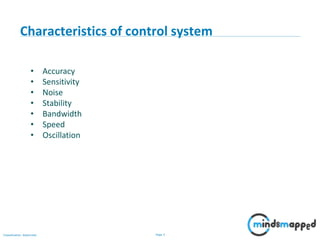
• Accuracy
• Sensitivity
• Noise
• Stability
• Bandwidth
• Speed
• Oscillation
Characteristics of control system
Page 3Classification: Restricted
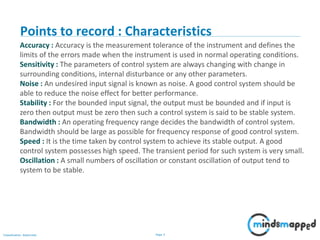
Accuracy : Accuracy is the measurement tolerance of the instrument and defines the
limits of the errors made when the instrument is used in normal operating conditions.
Sensitivity : The parameters of control system are always changing with change in
surrounding conditions, internal disturbance or any other parameters.
Noise : An undesired input signal is known as noise. A good control system should be
able to reduce the noise effect for better performance.
Stability : For the bounded input signal, the output must be bounded and if input is
zero then output must be zero then such a control system is said to be stable system.
Bandwidth : An operating frequency range decides the bandwidth of control system.
Bandwidth should be large as possible for frequency response of good control system.
Speed : It is the time taken by control system to achieve its stable output. A good
control system possesses high speed. The transient period for such system is very small.
Oscillation : A small numbers of oscillation or constant oscillation of output tend to
system to be stable.
Points to record : Characteristics
Page 4Classification: Restricted
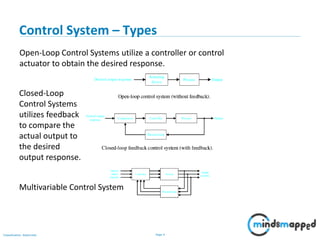
Multivariable Control System
Open-Loop Control Systems utilize a controller or control
actuator to obtain the desired response.
Closed-Loop
Control Systems
utilizes feedback
to compare the
actual output to
the desired
output response.
Control System – Types
Page 5Classification: Restricted
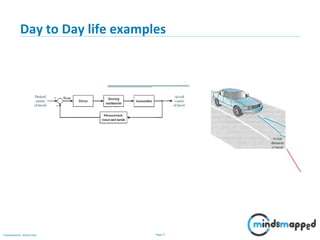
Day to Day life examples
Page 6Classification: Restricted
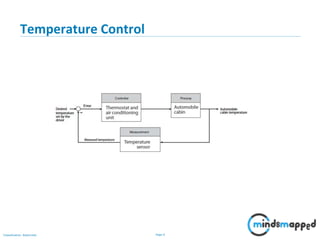
Temperature Control
Page 7Classification: Restricted
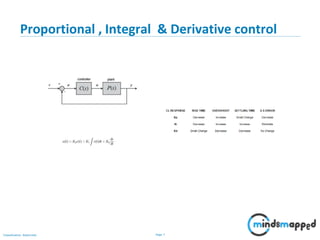
Proportional , Integral & Derivative control
Page 8Classification: Restricted
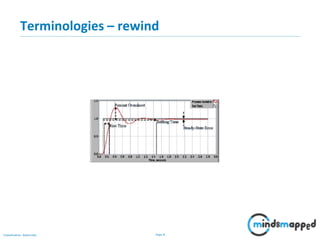
Terminologies – rewind
Page 9Classification: Restricted
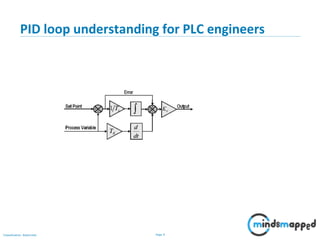
PID loop understanding for PLC engineers
Page 10Classification: Restricted
http://www.wikihow.com/Use-Cruise-Control-on-a-Car
An accurate positioning motor, with power amplifier (we’ll see how to make these
later in the course) that accepts a low-power (almost no current) voltage signal, and
moves the accelerator pedal in a manner proportional to the voltage signal.
• The engine, which produces a torque that is related to the position of the
accelerator pedal (current and past values).
• The drivetrain of the car, which transmits this torque to the ground through the
driven wheels.
• A vehicle, which gets accelerated due to the forces (road/tire interface,
aerodynamic) which act on it. • Changes in the slope of the highway, which act as a
disturbance force on the car. We do not assume that the car has a sensor which can
measure this slope.
• A speedometer, which converts the speed (in miles/hour, say), into a voltage signal
for feedback purposes.
CRUISE CONTROL – A simple case study
Page 11Classification: Restricted
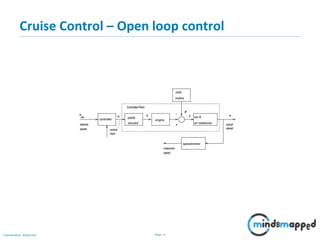
Cruise Control – Open loop control
Page 12Classification: Restricted
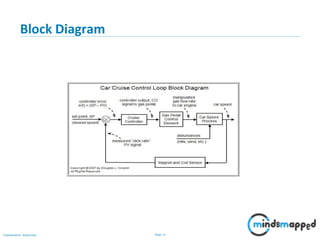
Block Diagram
Page 13Classification: Restricted
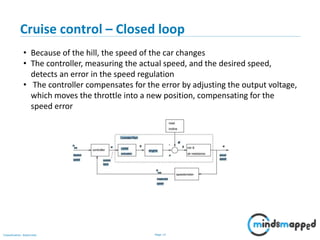
Cruise control – Closed loop
• Because of the hill, the speed of the car changes
• The controller, measuring the actual speed, and the desired speed,
detects an error in the speed regulation
• The controller compensates for the error by adjusting the output voltage,
which moves the throttle into a new position, compensating for the
speed error
Page 14Classification: Restricted
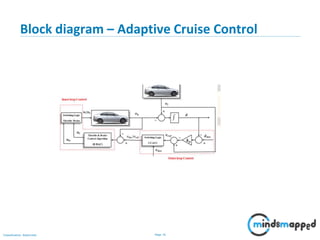
Adaptive Cruise control – Closed loop
• Adaptive cruise control (ACC) is an intelligent form of cruise control that
slows down and speeds up automatically to keep pace with the car in
front of you.
• The driver sets the maximum speed
• Then a radar sensor watches for traffic ahead, locks on to the car in a
lane, and instructs the car to stay 2, 3, or 4 seconds behind the person car
ahead of it (the driver sets the follow distance, within reason).
• ACC is now almost always paired with a pre-crash system that alerts you
and often begins braking
Page 15Classification: Restricted
• To use adaptive cruise control, you start the same as you would with
standard cruise control.
• The driver turns ACC on, accelerates to the desired speed, then presses
the “Set” button.
• It’s then possible to tweak the “+” and “-” buttons to raise or lower the
speed, typically by in 1 or 5 mph increments.
• Lastly, the driver can set the desired gap behind the next car, most
commonly by pressing a button to cycle among short, medium, and long
following distances.
• Some automakers show icons with 1, 2 or 3 distance bars between two
vehicle icons.
• An indicator in the instrument panel or head-up display shows a car icon
and often what looks like converging-at-infinity lines, indicating the
roadway. When radar detects a car ahead, a second car icon appears or
the lone car icon changes color.
Page 16Classification: Restricted
Block diagram – Adaptive Cruise Control
Page 17Classification: Restricted
Topics to be covered in next session
•Advanced Control Systems
Page 18Classification: Restricted
Thank you!

Session 09 - Control System Basics - Slides

  • 1.
  • 2.
    Page 1Classification: Restricted Differenttypes of control system Loops & Controls Agenda
  • 3.
    Page 2Classification: Restricted •Accuracy • Sensitivity • Noise • Stability • Bandwidth • Speed • Oscillation Characteristics of control system
  • 4.
    Page 3Classification: Restricted Accuracy: Accuracy is the measurement tolerance of the instrument and defines the limits of the errors made when the instrument is used in normal operating conditions. Sensitivity : The parameters of control system are always changing with change in surrounding conditions, internal disturbance or any other parameters. Noise : An undesired input signal is known as noise. A good control system should be able to reduce the noise effect for better performance. Stability : For the bounded input signal, the output must be bounded and if input is zero then output must be zero then such a control system is said to be stable system. Bandwidth : An operating frequency range decides the bandwidth of control system. Bandwidth should be large as possible for frequency response of good control system. Speed : It is the time taken by control system to achieve its stable output. A good control system possesses high speed. The transient period for such system is very small. Oscillation : A small numbers of oscillation or constant oscillation of output tend to system to be stable. Points to record : Characteristics
  • 5.
    Page 4Classification: Restricted MultivariableControl System Open-Loop Control Systems utilize a controller or control actuator to obtain the desired response. Closed-Loop Control Systems utilizes feedback to compare the actual output to the desired output response. Control System – Types
  • 6.
  • 7.
  • 8.
    Page 7Classification: Restricted Proportional, Integral & Derivative control
  • 9.
  • 10.
    Page 9Classification: Restricted PIDloop understanding for PLC engineers
  • 11.
    Page 10Classification: Restricted http://www.wikihow.com/Use-Cruise-Control-on-a-Car Anaccurate positioning motor, with power amplifier (we’ll see how to make these later in the course) that accepts a low-power (almost no current) voltage signal, and moves the accelerator pedal in a manner proportional to the voltage signal. • The engine, which produces a torque that is related to the position of the accelerator pedal (current and past values). • The drivetrain of the car, which transmits this torque to the ground through the driven wheels. • A vehicle, which gets accelerated due to the forces (road/tire interface, aerodynamic) which act on it. • Changes in the slope of the highway, which act as a disturbance force on the car. We do not assume that the car has a sensor which can measure this slope. • A speedometer, which converts the speed (in miles/hour, say), into a voltage signal for feedback purposes. CRUISE CONTROL – A simple case study
  • 12.
    Page 11Classification: Restricted CruiseControl – Open loop control
  • 13.
  • 14.
    Page 13Classification: Restricted Cruisecontrol – Closed loop • Because of the hill, the speed of the car changes • The controller, measuring the actual speed, and the desired speed, detects an error in the speed regulation • The controller compensates for the error by adjusting the output voltage, which moves the throttle into a new position, compensating for the speed error
  • 15.
    Page 14Classification: Restricted AdaptiveCruise control – Closed loop • Adaptive cruise control (ACC) is an intelligent form of cruise control that slows down and speeds up automatically to keep pace with the car in front of you. • The driver sets the maximum speed • Then a radar sensor watches for traffic ahead, locks on to the car in a lane, and instructs the car to stay 2, 3, or 4 seconds behind the person car ahead of it (the driver sets the follow distance, within reason). • ACC is now almost always paired with a pre-crash system that alerts you and often begins braking
  • 16.
    Page 15Classification: Restricted •To use adaptive cruise control, you start the same as you would with standard cruise control. • The driver turns ACC on, accelerates to the desired speed, then presses the “Set” button. • It’s then possible to tweak the “+” and “-” buttons to raise or lower the speed, typically by in 1 or 5 mph increments. • Lastly, the driver can set the desired gap behind the next car, most commonly by pressing a button to cycle among short, medium, and long following distances. • Some automakers show icons with 1, 2 or 3 distance bars between two vehicle icons. • An indicator in the instrument panel or head-up display shows a car icon and often what looks like converging-at-infinity lines, indicating the roadway. When radar detects a car ahead, a second car icon appears or the lone car icon changes color.
  • 17.
    Page 16Classification: Restricted Blockdiagram – Adaptive Cruise Control
  • 18.
    Page 17Classification: Restricted Topicsto be covered in next session •Advanced Control Systems
  • 19.