SeminarForWeb Ontology Language (OWL)	 Prepared by:	 	Hussein Ali Ahmad Ghanim6/19/201121WEB ONTOLOGY LANGUAGE (OWL)
Web Ontology Language: OWLWeb Ontology Language Definition.OverviewRequirements for ontology languagesOWL Languages	- OWL, RDF, RDF(s), XMLReferences6/19/201122WEB ONTOLOGY LANGUAGE (OWL)
Web Ontology LanguageThe Web Ontology Language (OWL) is a family of knowledge representation languages for authoring ontologies.The languages are characterised by formal semantics and RDF/XML-based serializations for the Semantic Web. Semantic Web led to requirement for a “web ontology language”6/19/201123WEB ONTOLOGY LANGUAGE (OWL)
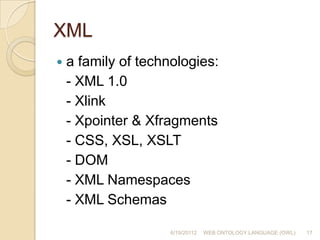
OverviewFrom the overview of OWL1: The OWL Web Ontology Language is designed for use by applications that need to process the content of information instead of just presenting information to humans. OWL facilitates greater machine interpretability of Web content than that supported by XML, RDF, and RDF Schema (RDF-S) by providing additional vocabulary along with a formal semantics. OWL has three increasingly-expressive sublanguages: OWL Lite, OWL DL, and OWL Full.6/19/201124WEB ONTOLOGY LANGUAGE (OWL)
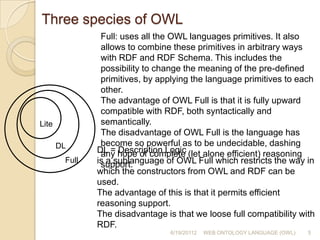
LiteDLFullThree species of OWLFull: uses all the OWL languages primitives. It also allows to combine these primitives in arbitrary ways with RDF and RDF Schema. This includes the possibility to change the meaning of the pre-defined primitives, by applying the language primitives to each other.The advantage of OWL Full is that it is fully upward compatible with RDF, both syntactically and semantically.The disadvantage of OWL Full is the language has become so powerful as to be undecidable, dashing any hope of complete (let alone efficient) reasoning support.DL = Description Logicis a sublanguage of OWL Full which restricts the way in which the constructors from OWL and RDF can be used.The advantage of this is that it permits efficient reasoning support.The disadvantage is that we loose full compatibility with RDF.6/19/201125WEB ONTOLOGY LANGUAGE (OWL)
Three species of OWLLite: - An ever further restriction limits OWL DL to a subset of the language constructors. For example, OWL Lite excludes enumerated classes, disjointness statements and arbitrary cardinality (among others).- The advantage of this is a language that is both easier to grasp (for users) and easier to implement (for tool builders).- The disadvantage is of course a restricted expressivity.6/19/201126WEB ONTOLOGY LANGUAGE (OWL)
Requirements for ontology languagesOntology languages allow users to write explicit, formal conceptualizations of domains models. The main requirements are:1. a well-defined syntax2. a well-defined semantics3. efficient reasoning support4. sufficient expressive power5. convenience of expression.6/19/201127WEB ONTOLOGY LANGUAGE (OWL)
What is OWL?W3C Recommendation, February 2004.web standard Web Ontology Language built on top of RDFRDF: the Resource Description Framework is an XML-based language to describe resources. for processing information on the web designed to be interpreted by computers, not for being read by people OWL is written in XML 6/19/201128WEB ONTOLOGY LANGUAGE (OWL)
Why OWL?OWL is a part of the "Semantic Web Vision" - a future where:Web information has exact meaning Web information can be processed by computers Computers can integrate information from the webOWL was designed to provide a common way to process the content of web information (instead of displaying it).be read by computer applications (instead of humans). 6/19/201129WEB ONTOLOGY LANGUAGE (OWL)
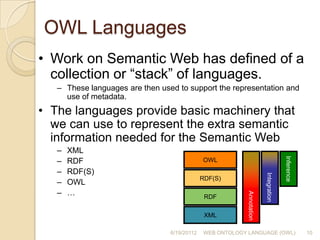
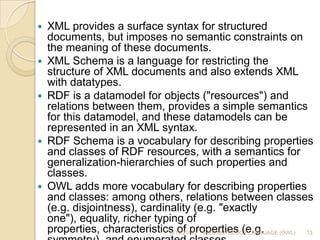
OWLInferenceRDF(S)IntegrationIntegrationRDFAnnotationXML OWL LanguagesWork on Semantic Web has defined of a collection or “stack” of languages.
These languages are then used to support the representation and use of metadata.
The languages provide basic machinery that we can use to represent the extra semantic information needed for the Semantic Web
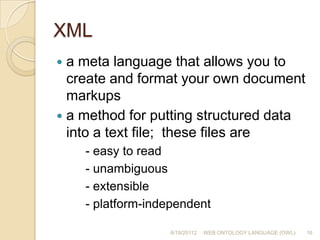
XML
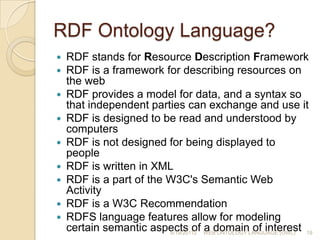
RDF
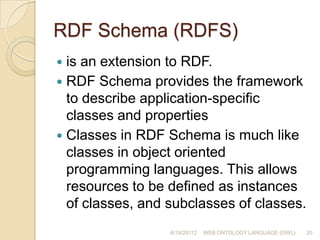
RDF(S)
OWL
…6/19/2011210WEB ONTOLOGY LANGUAGE (OWL)
OWL OWL: the language that is aimed to be the	standardised and broadly accepted ontology language of the Semantic Web. OWL: is an ontology language designed for the Semantic Web
It provides a rich collection of operators for forming concept descriptions
It is a W3C standard, promoting interoperation and sharing between applications
It has been designed to be compatible with existing web standards6/19/2011211WEB ONTOLOGY LANGUAGE (OWL)
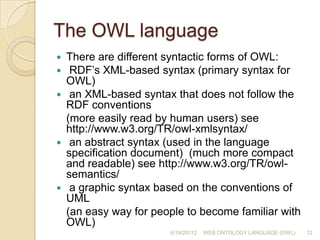
The OWL languageThere are different syntactic forms of OWL: RDF’s XML-based syntax (primary syntax for OWL) an XML-based syntax that does not follow the RDF conventions	(more easily read by human users) see http://www.w3.org/TR/owl-xmlsyntax/ an abstract syntax (used in the language specification document)  (much more compact and readable) see http://www.w3.org/TR/owl-semantics/ a graphic syntax based on the conventions of UML	(an easy way for people to become familiar with OWL)6/19/2011212WEB ONTOLOGY LANGUAGE (OWL)

Owl web ontology language

  • 1.
    SeminarForWeb Ontology Language(OWL) Prepared by: Hussein Ali Ahmad Ghanim6/19/201121WEB ONTOLOGY LANGUAGE (OWL)
  • 2.
    Web Ontology Language:OWLWeb Ontology Language Definition.OverviewRequirements for ontology languagesOWL Languages - OWL, RDF, RDF(s), XMLReferences6/19/201122WEB ONTOLOGY LANGUAGE (OWL)
  • 3.
    Web Ontology LanguageTheWeb Ontology Language (OWL) is a family of knowledge representation languages for authoring ontologies.The languages are characterised by formal semantics and RDF/XML-based serializations for the Semantic Web. Semantic Web led to requirement for a “web ontology language”6/19/201123WEB ONTOLOGY LANGUAGE (OWL)
  • 4.
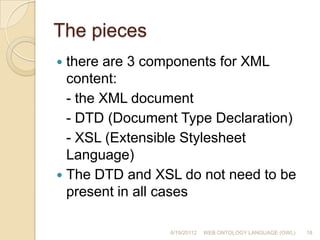
    OverviewFrom the overviewof OWL1: The OWL Web Ontology Language is designed for use by applications that need to process the content of information instead of just presenting information to humans. OWL facilitates greater machine interpretability of Web content than that supported by XML, RDF, and RDF Schema (RDF-S) by providing additional vocabulary along with a formal semantics. OWL has three increasingly-expressive sublanguages: OWL Lite, OWL DL, and OWL Full.6/19/201124WEB ONTOLOGY LANGUAGE (OWL)
  • 5.
    LiteDLFullThree species ofOWLFull: uses all the OWL languages primitives. It also allows to combine these primitives in arbitrary ways with RDF and RDF Schema. This includes the possibility to change the meaning of the pre-defined primitives, by applying the language primitives to each other.The advantage of OWL Full is that it is fully upward compatible with RDF, both syntactically and semantically.The disadvantage of OWL Full is the language has become so powerful as to be undecidable, dashing any hope of complete (let alone efficient) reasoning support.DL = Description Logicis a sublanguage of OWL Full which restricts the way in which the constructors from OWL and RDF can be used.The advantage of this is that it permits efficient reasoning support.The disadvantage is that we loose full compatibility with RDF.6/19/201125WEB ONTOLOGY LANGUAGE (OWL)
  • 6.
    Three species ofOWLLite: - An ever further restriction limits OWL DL to a subset of the language constructors. For example, OWL Lite excludes enumerated classes, disjointness statements and arbitrary cardinality (among others).- The advantage of this is a language that is both easier to grasp (for users) and easier to implement (for tool builders).- The disadvantage is of course a restricted expressivity.6/19/201126WEB ONTOLOGY LANGUAGE (OWL)
  • 7.
    Requirements for ontologylanguagesOntology languages allow users to write explicit, formal conceptualizations of domains models. The main requirements are:1. a well-defined syntax2. a well-defined semantics3. efficient reasoning support4. sufficient expressive power5. convenience of expression.6/19/201127WEB ONTOLOGY LANGUAGE (OWL)
  • 8.
    What is OWL?W3CRecommendation, February 2004.web standard Web Ontology Language built on top of RDFRDF: the Resource Description Framework is an XML-based language to describe resources. for processing information on the web designed to be interpreted by computers, not for being read by people OWL is written in XML 6/19/201128WEB ONTOLOGY LANGUAGE (OWL)
  • 9.
    Why OWL?OWL isa part of the "Semantic Web Vision" - a future where:Web information has exact meaning Web information can be processed by computers Computers can integrate information from the webOWL was designed to provide a common way to process the content of web information (instead of displaying it).be read by computer applications (instead of humans). 6/19/201129WEB ONTOLOGY LANGUAGE (OWL)
  • 10.
    OWLInferenceRDF(S)IntegrationIntegrationRDFAnnotationXML OWL LanguagesWorkon Semantic Web has defined of a collection or “stack” of languages.
  • 11.
    These languages arethen used to support the representation and use of metadata.
  • 12.
    The languages providebasic machinery that we can use to represent the extra semantic information needed for the Semantic Web
  • 13.
  • 14.
  • 15.
  • 16.
  • 17.
  • 18.
    OWL OWL: thelanguage that is aimed to be the standardised and broadly accepted ontology language of the Semantic Web. OWL: is an ontology language designed for the Semantic Web
  • 19.
    It provides arich collection of operators for forming concept descriptions
  • 20.
    It is aW3C standard, promoting interoperation and sharing between applications
  • 21.
    It has beendesigned to be compatible with existing web standards6/19/2011211WEB ONTOLOGY LANGUAGE (OWL)
  • 22.
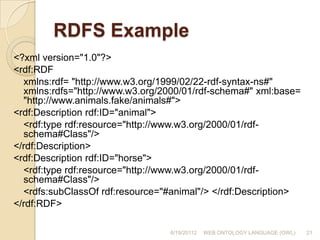
    The OWL languageThereare different syntactic forms of OWL: RDF’s XML-based syntax (primary syntax for OWL) an XML-based syntax that does not follow the RDF conventions (more easily read by human users) see http://www.w3.org/TR/owl-xmlsyntax/ an abstract syntax (used in the language specification document) (much more compact and readable) see http://www.w3.org/TR/owl-semantics/ a graphic syntax based on the conventions of UML (an easy way for people to become familiar with OWL)6/19/2011212WEB ONTOLOGY LANGUAGE (OWL)

Editor's Notes

  • #6 For example, in OWL Full we could impose a cardinality constraint on the class of all classes, essentially limiting the number of classes that can be described in any ontology.any legal RDF document is also a legal OWL Full document, and any valid RDF/RDF Schema conclusion is also a valid OWL Full conclusion. an RDF document will in general have to be extended in some ways and restricted in others before it is a legal OWL DL document. Conversely, every legalOWL DL document is still a legal RDF document.
  • #9 OWL became a W3C (World Wide Web Consortium) Recommendation in February 2004.A W3C Recommendation is understood by the industry and the web community as a web standard. A W3C Recommendation is a stable specification developed by a W3C Working Group and reviewed by the W3C Membership.Q. What does the acronym "OWL" stand for?A. Actually, OWL is not a real acronym. The language started out as the "Web Ontology Language" but the Working Group disliked the acronym "WOL." They decided to call it OWL. The Working Group became more comfortable with this decision when one of the members pointed out the following justification for this decision from the noted ontologist A.A. Milne who, in his influential book "Winnie the Pooh" stated of the wise character OWL:"He could spell his own name WOL, and he could spell Tuesday so that you knew it wasn't Wednesday...“See for more: http://www.w3.org/2003/08/owlfaq.html.en