Connected Data London / 16 Nov 17
RDF vs Property Graph
Is your Graph Semantic?
Dr. Jesús Barrasa - Neo4j
Connected Data London / 16 Nov 17
Quick refresher on LPG & RDF
Connected Data London / 16 Nov 17
RDF Resource
Description
Framework
W3C recommendation model for
information exchange. Feb‘99
Connected Data London / 16 Nov 17
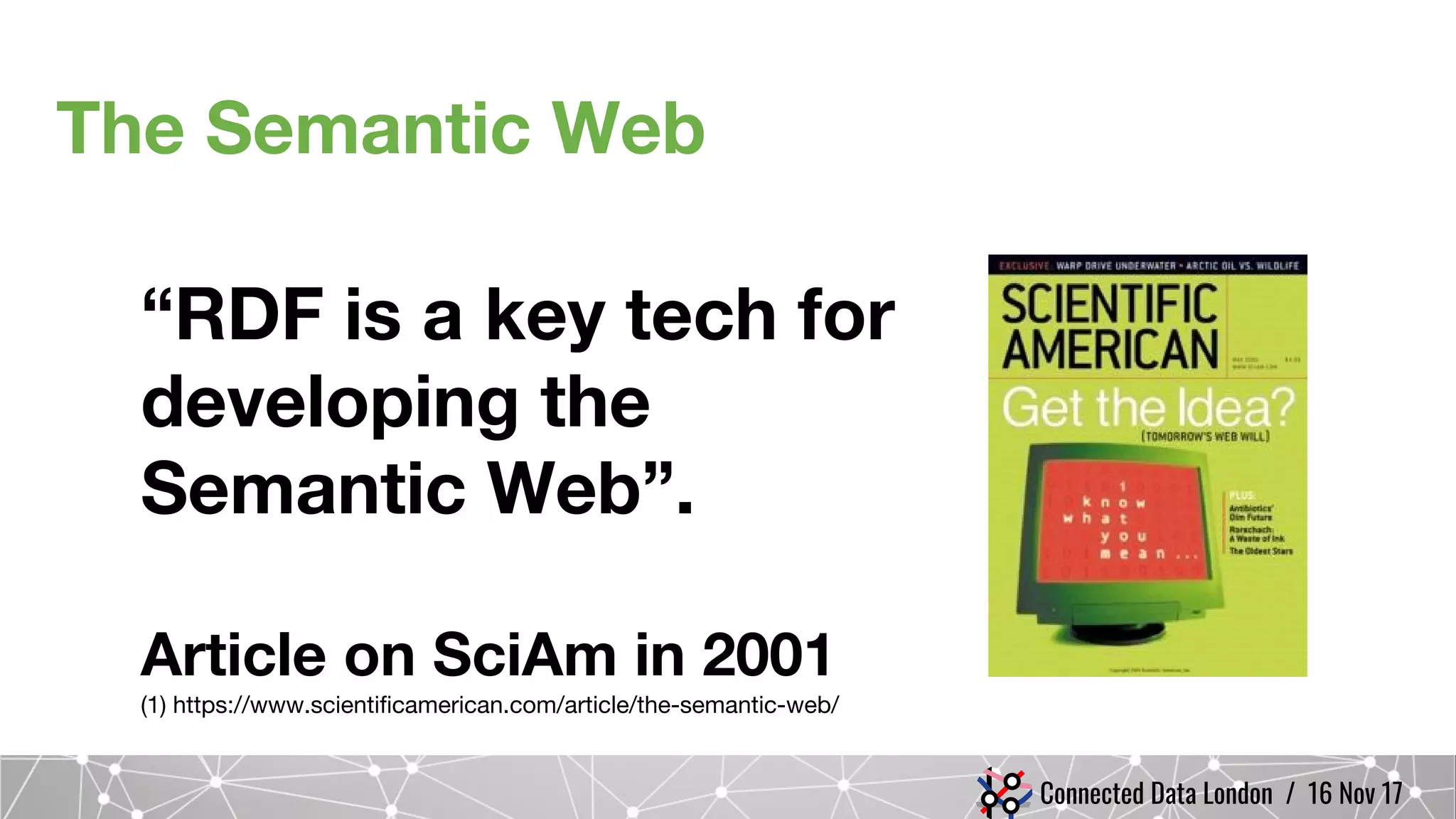
The Semantic Web
“RDF is a key tech for
developing the
Semantic Web”.
Article on SciAm in 2001
(1) https://www.scientificamerican.com/article/the-semantic-web/
Connected Data London / 16 Nov 17
Persisted RDF
Specialized RDF stores
(triple/quad stores)
Semantic Graph Databases
Connected Data London / 16 Nov 17
LPG
Sweden (2000 - 2007)
efficient (graph native) storage
fast query and traversal
humane model: close to the way we humans
understand and reason about the world
Connected Data London / 16 Nov 17
A look at the models
Connected Data London / 16 Nov 17
GRAPH = VERTICES + EDGES
Connected Data London / 16 Nov 17
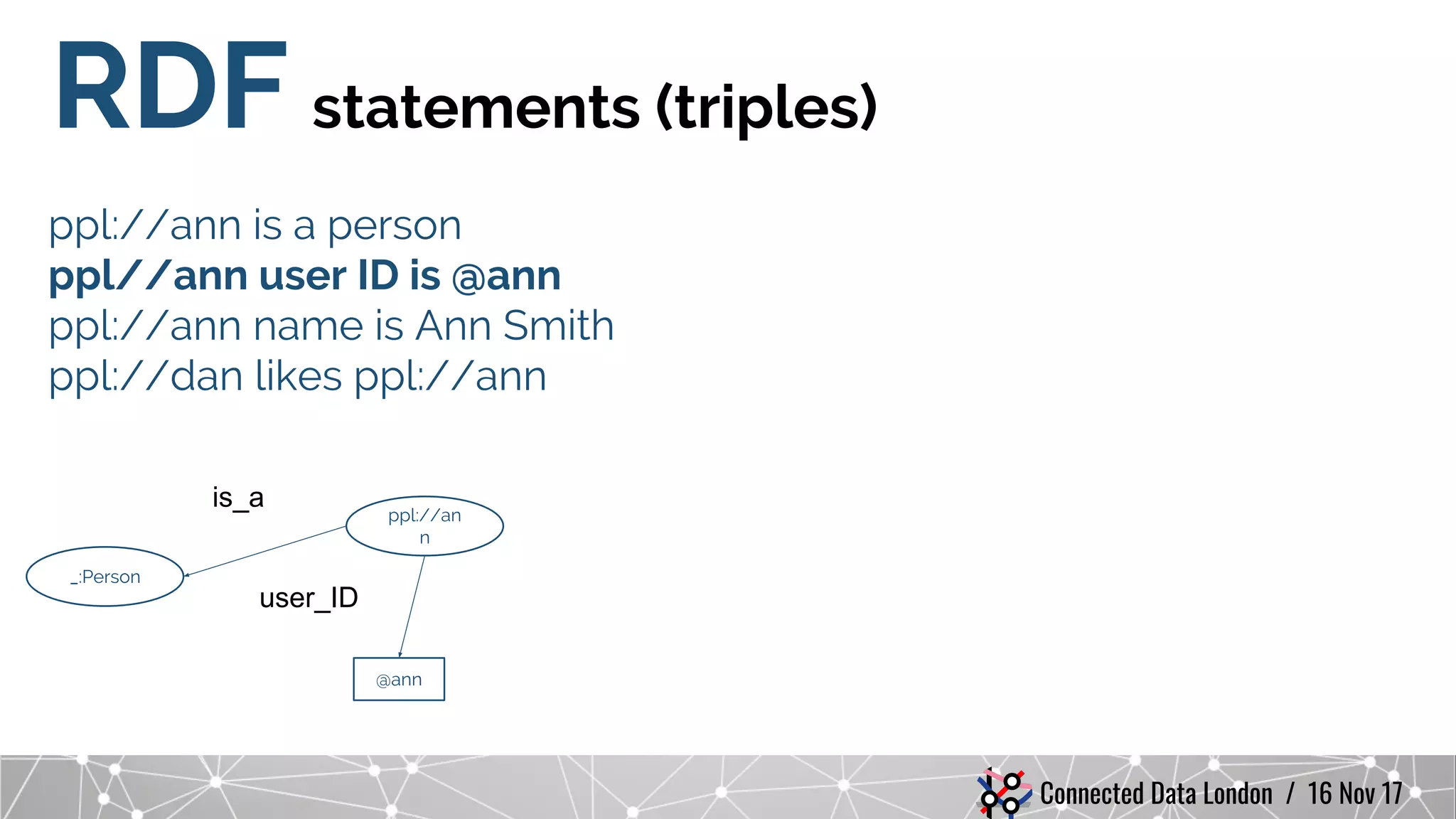
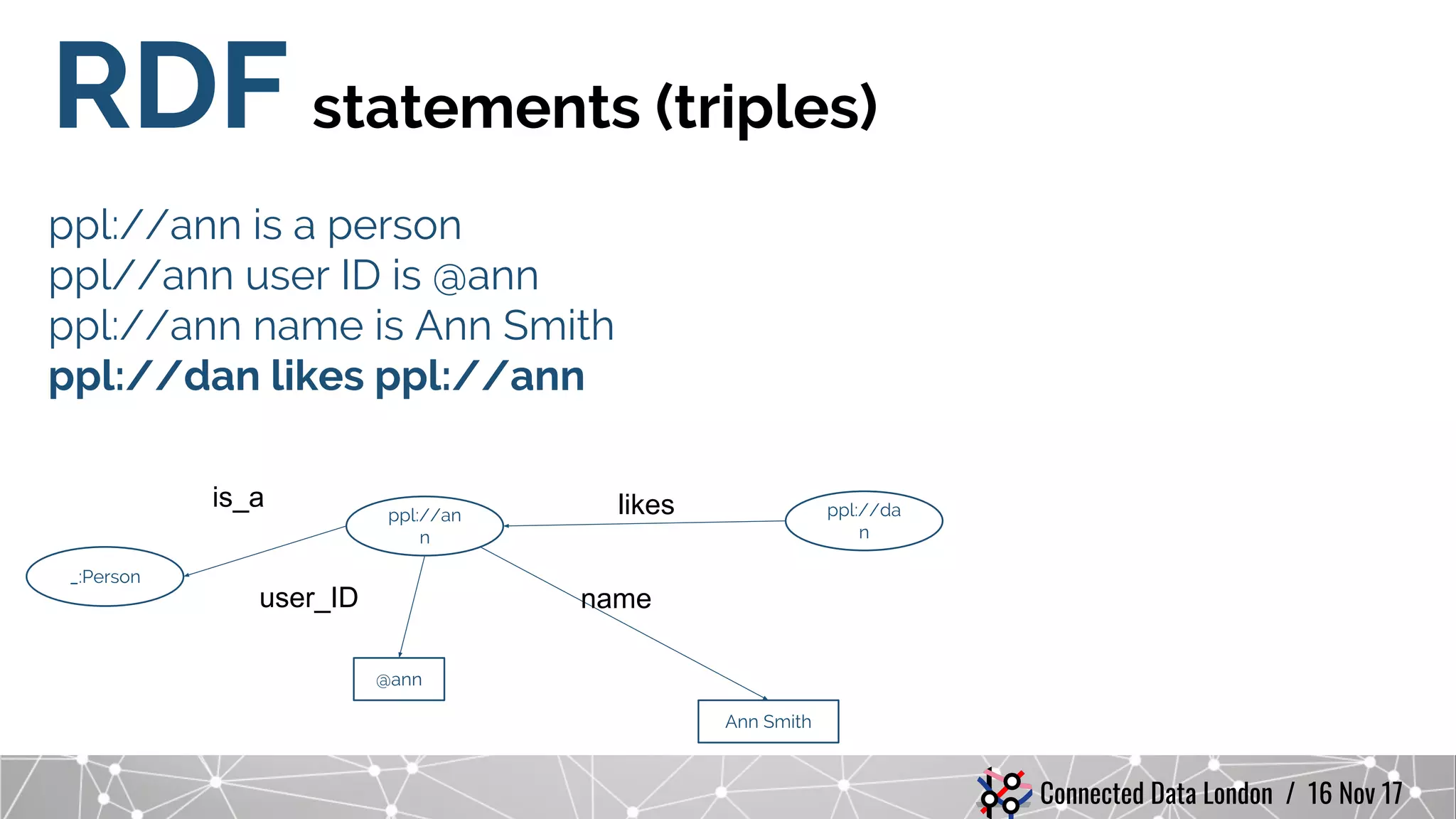
ppl://ann is a person
ppl//ann user ID is @ann
ppl://ann name is Ann Smith
ppl://dan likes ppl://ann
RDF statements (triples)
Connected Data London / 16 Nov 17
ppl://ann is a person
ppl//ann user ID is @ann
ppl://ann name is Ann Smith
ppl://dan likes ppl://ann
RDF statements (triples)
ppl://an
n
is_a
_:Person
Connected Data London / 16 Nov 17
ppl://ann is a person
ppl//ann user ID is @ann
ppl://ann name is Ann Smith
ppl://dan likes ppl://ann
RDF statements (triples)
ppl://an
n
@ann
is_a
user_ID
_:Person
Connected Data London / 16 Nov 17
ppl://ann is a person
ppl//ann user ID is @ann
ppl://ann name is Ann Smith
ppl://dan likes ppl://ann
RDF statements (triples)
ppl://an
n
@ann
Ann Smith
is_a
name
_:Person
user_ID
Connected Data London / 16 Nov 17
ppl://ann is a person
ppl//ann user ID is @ann
ppl://ann name is Ann Smith
ppl://dan likes ppl://ann
RDF statements (triples)
ppl://an
n
ppl://da
n
@ann
Ann Smith
is_a
name
_:Person
likes
user_ID
Connected Data London / 16 Nov 17
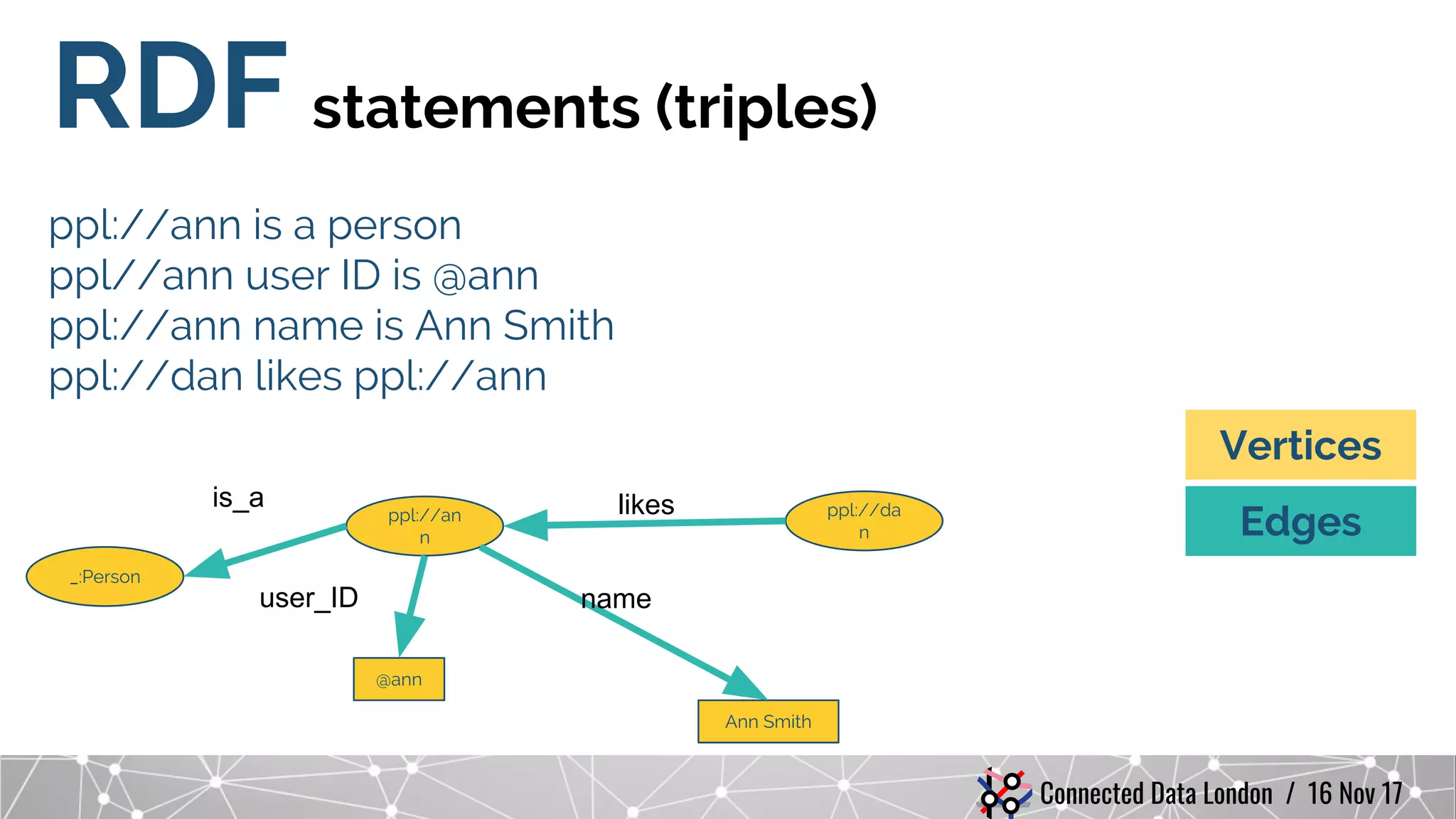
ppl://ann is a person
ppl//ann user ID is @ann
ppl://ann name is Ann Smith
ppl://dan likes ppl://ann
RDF statements (triples)
ppl://an
n
ppl://da
n
@ann
Ann Smith
is_a
name
_:Person
likes
Vertices
Edges
user_ID
Connected Data London / 16 Nov 17
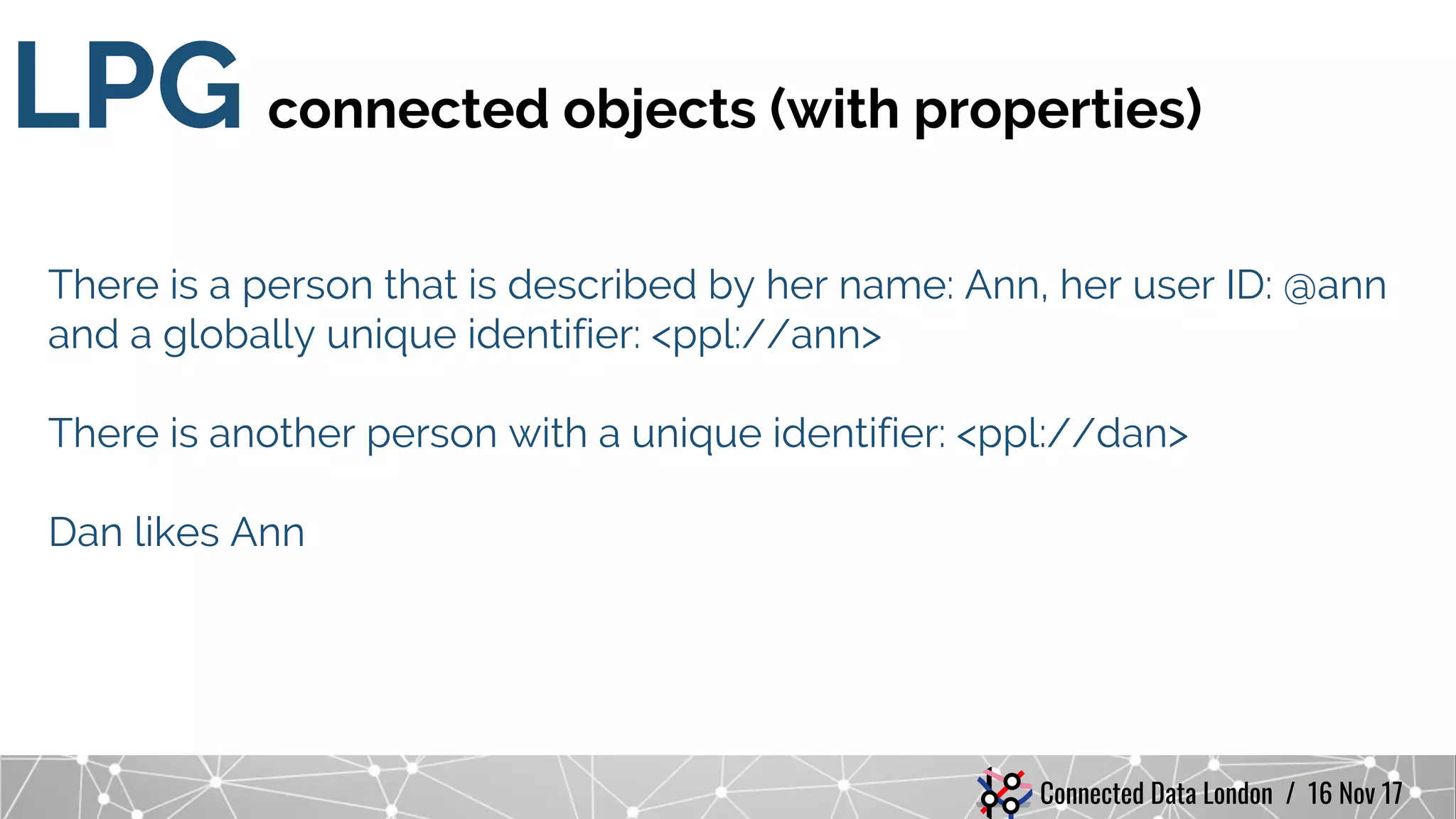
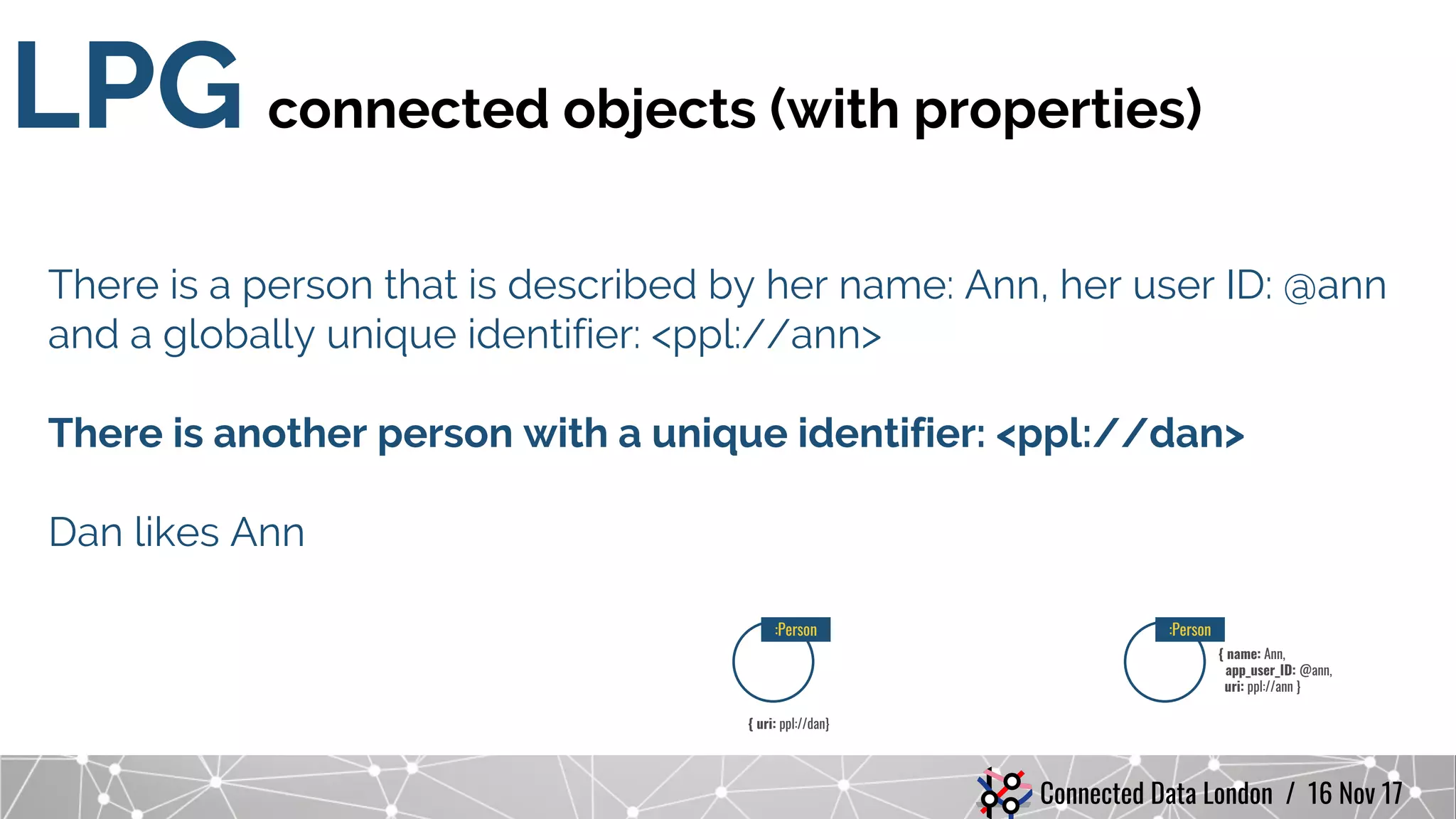
There is a person that is described by her name: Ann, her user ID: @ann
and a globally unique identifier: <ppl://ann>
There is another person with a unique identifier: <ppl://dan>
Dan likes Ann
LPG connected objects (with properties)
Connected Data London / 16 Nov 17
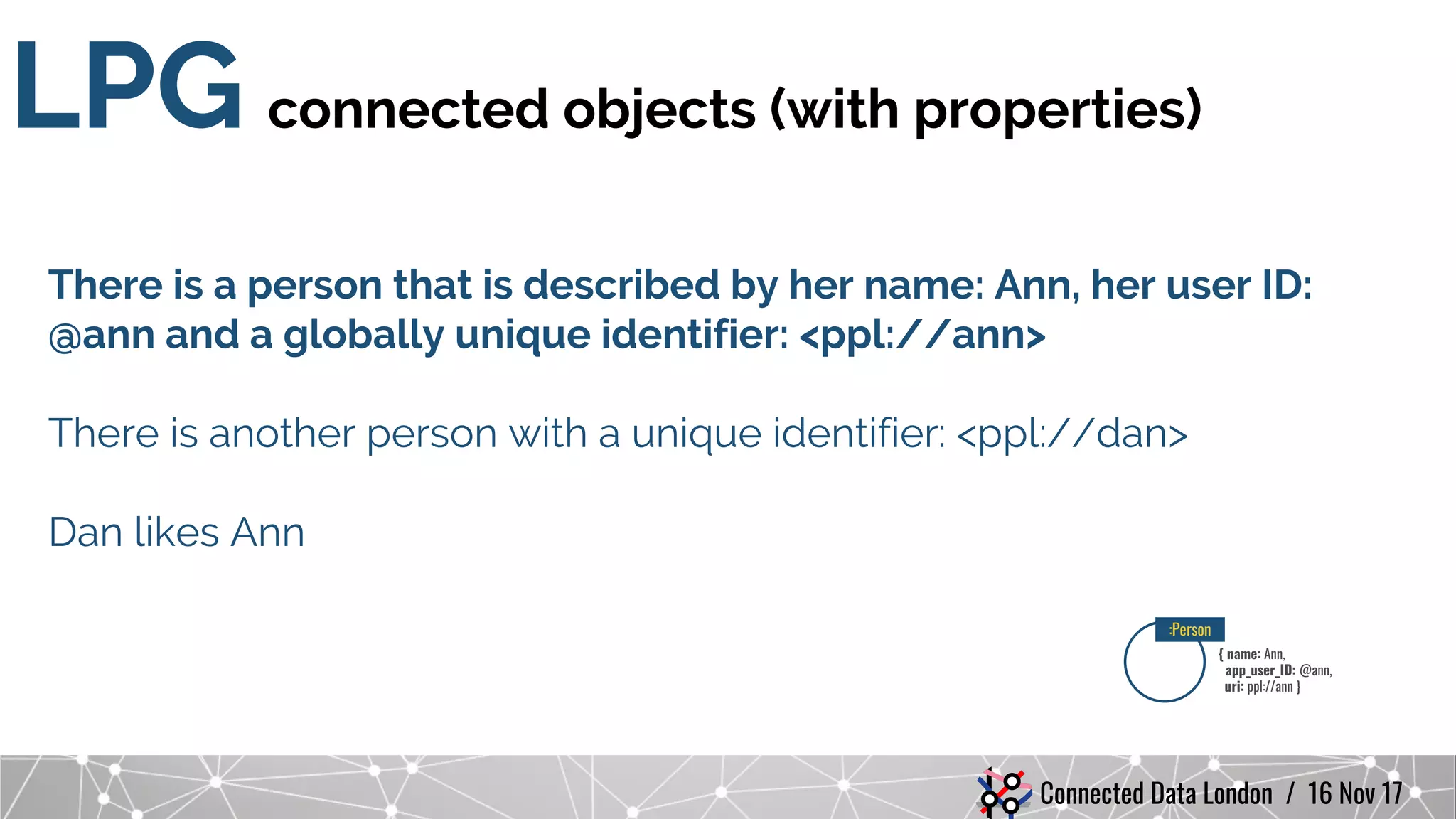
There is a person that is described by her name: Ann, her user ID:
@ann and a globally unique identifier: <ppl://ann>
There is another person with a unique identifier: <ppl://dan>
Dan likes Ann
LPG connected objects (with properties)
{ name: Ann,
app_user_ID: @ann,
uri: ppl://ann }
:Person
Connected Data London / 16 Nov 17
There is a person that is described by her name: Ann, her user ID: @ann
and a globally unique identifier: <ppl://ann>
There is another person with a unique identifier: <ppl://dan>
Dan likes Ann
LPG connected objects (with properties)
{ uri: ppl://dan}
{ name: Ann,
app_user_ID: @ann,
uri: ppl://ann }
:Person:Person
Connected Data London / 16 Nov 17
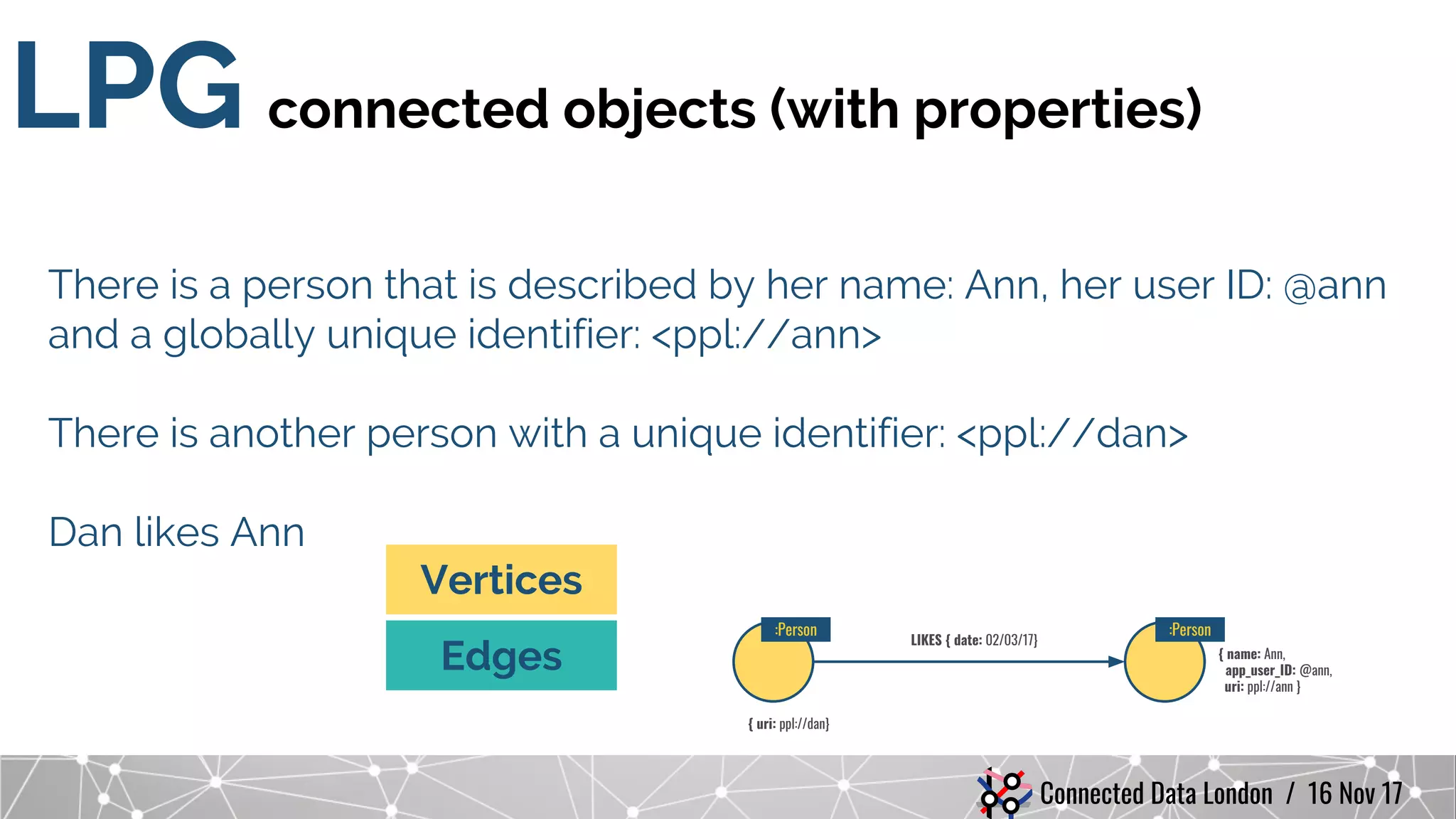
There is a person that is described by her name: Ann, her user ID: @ann
and a globally unique identifier: <ppl://ann>
There is another person with a unique identifier: <ppl://dan>
Dan likes Ann
LPG connected objects (with properties)
LIKES { date: 02/03/17}
{ uri: ppl://dan}
{ name: Ann,
app_user_ID: @ann,
uri: ppl://ann }
:Person:Person
Connected Data London / 16 Nov 17
There is a person that is described by her name: Ann, her user ID: @ann
and a globally unique identifier: <ppl://ann>
There is another person with a unique identifier: <ppl://dan>
Dan likes Ann
LPG connected objects (with properties)
LIKES { date: 02/03/17}
{ uri: ppl://dan}
{ name: Ann,
app_user_ID: @ann,
uri: ppl://ann }
Vertices
Edges
:Person:Person
Connected Data London / 16 Nov 17
RDF Graph
Vertices
Every statement produces two vertices in the graph.
Some are uniquely identified by URIs: Resources
Some are property values: Literals
Edges
Every statement produces an edge.
Uniquely identified by URIs
Vertices or Edges have NO
internal structure
Connected Data London / 16 Nov 17
RDF Graph
Vertices
Every statement produces two vertices in the graph.
Some are uniquely identified by URIs: Resources
Some are property values: Literals
Edges
Every statement produces an edge.
Uniquely identified by URIs
Vertices or Edges have NO
internal structure
Property Graph
Vertices
Unique Id + set of key-value pairs
Edges
Unique Id + set of key-value pairs
Vertices and Edges have
internal structure
Connected Data London / 16 Nov 17
The query languages
Connected Data London / 16 Nov 17
Query: Who likes this person named Ann?
Cypher
MATCH (who)-[:LIKES]->(a:Person)
WHERE a.name CONTAINS ‘Ann’
RETURN who
SPARQL
prefix ms: <http://myschma.me/>
prefix rdf: <http://www[...]#>
SELECT ?who
{
?a rdf:type ms:Person .
?a ms:name ?asName .
FILTER regex(?asName,’Ann’)
?who ms:likes ?a .
}
Connected Data London / 16 Nov 17
End of refresher
Connected Data London / 16 Nov 17
Modelling differences
Connected Data London / 16 Nov 17
#1 RDF does not uniquely identify
instances of relationships: No two
relationships of the same type between
a pair of nodes
Dan cannot like Ann three times. Just once :(
Connected Data London / 16 Nov 17
RDF
Dan has liked Ann three times
prefix sc: <http://schema.org/>
INSERT DATA {
<http://dan> sc:name "Dan" .
<http://ann> sc:name "Ann" .
<http://dan> sc:likes <http://ann> .
}
PREFIX sc: <http://schema.org/>
SELECT (COUNT(?p) AS ?count)
where {
<http://dan> ?p <http://ann>
FILTER(?p = sc:likes)
}
╒════════╕
│COUNT(l)│
╞════════╡
│1 │
└────────┘
Connected Data London / 16 Nov 17
LPG in Neo4j
Dan has liked Ann three times
CREATE (d {name: "Dan"})-[:LIKES]->(a {name: "Ann"})
CREATE (d)-[:LIKES]->(a)
MATCH (d {name: "Dan"})-[l:LIKES]->(a {name:
"Ann"})
RETURN COUNT(l)
╒════════╕
│COUNT(l)│
╞════════╡
│3 │
└────────┘
{ name: Dan }
{ name: Ann }
Connected Data London / 16 Nov 17
#2 In RDF you cannot qualify
individual relationships: no
attributes on predicates
...
Connected Data London / 16 Nov 17
LPG in Neo4j
Connection NYC-SFO is $300 and 4100Km
CREATE ( {name: "NYC"})-[:CONNECTION { distanceKm : 4100, costUSD: 300}]->( {name: "SFO"})
MATCH ( {name: "NYC"})-[c:CONNECTION]->( {name: "SFO"})
RETURN c.costUSD, c.distanceKm
╒═════════╤════════════╕
│c.costUSD│c.distanceKm│
╞═════════╪════════════╡
│300 │4100 │
└─────────┴────────────┘
{ name: NYC }
{ name: SFO }
{ distanceKm: 4100,
costUSD: 300 }
Connected Data London / 16 Nov 17
RDF
Connection NYC-SFO is $300 and 4100Km
prefix sc: <http://schema.org/>
INSERT DATA {
<http://nyc> sc:name "NYC" .
<http://sfo> sc:name "SFO" .
<http://nyc> sc:connection <http://sfo> .
sc:connection sc:distanceKm 4100
}
Connected Data London / 16 Nov 17
Alternatives in RDF (?)
Modeling workarounds (intermediate nodes)
Reification (1)
Singleton Property (2)
(1) https://www.w3.org/TR/2004/REC-rdf-primer-20040210/#reification
(2) http://dl.acm.org/citation.cfm?id=2567973
Connected Data London / 16 Nov 17
Modeling workaround
Connection between NYC and SF: 300 USD / 4100 in Km.
LPG (Neo4j) RDF
Connected Data London / 16 Nov 17
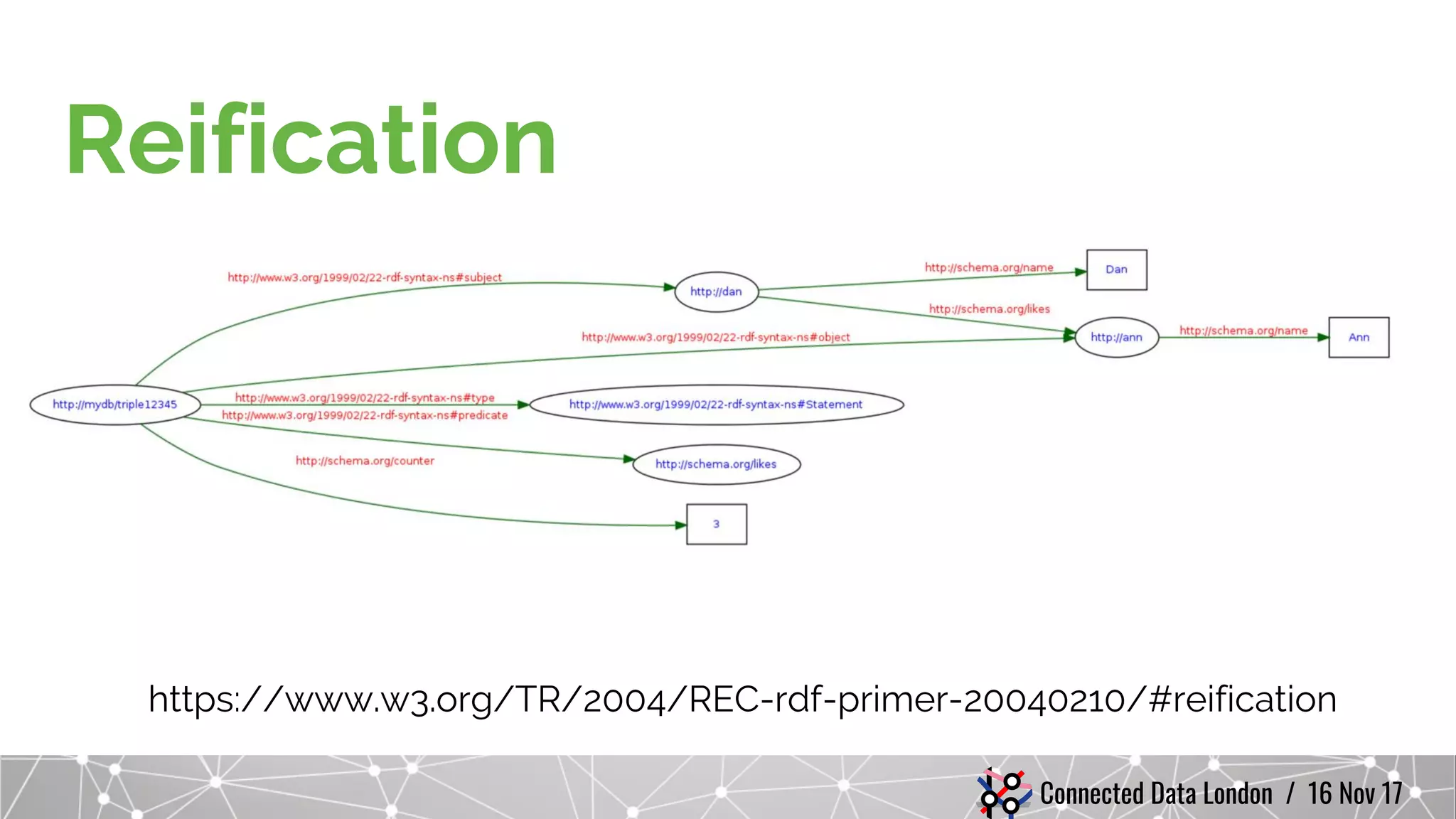
Reification
https://www.w3.org/TR/2004/REC-rdf-primer-20040210/#reification
Connected Data London / 16 Nov 17
Singleton property
(2) http://dl.acm.org/citation.cfm?id=2567973
Connected Data London / 16 Nov 17
#3 RDF can have
multivalued properties, in
the LPG you use Arrays.
Arrays in LPG
Connected Data London / 16 Nov 17
Example
The genre of this album is Jazz, or
more precisely Orchestral Jazz.
prefix schema: <http://schema.org/>
INSERT DATA {
<http://g.co/kg/m/0567wt>
schema:name "Sketches of Spain" ;
schema:genre "Jazz", "Orchestral Jazz" . }
}
CREATE (s:Album { name: "Sketches of Spain",
genre: [ "Jazz","Orchestral Jazz" ] } )
{ name: Sketches of Spain
genre: [ Jazz, Orchestral Jazz ] }
CypherSPARQL
Connected Data London / 16 Nov 17
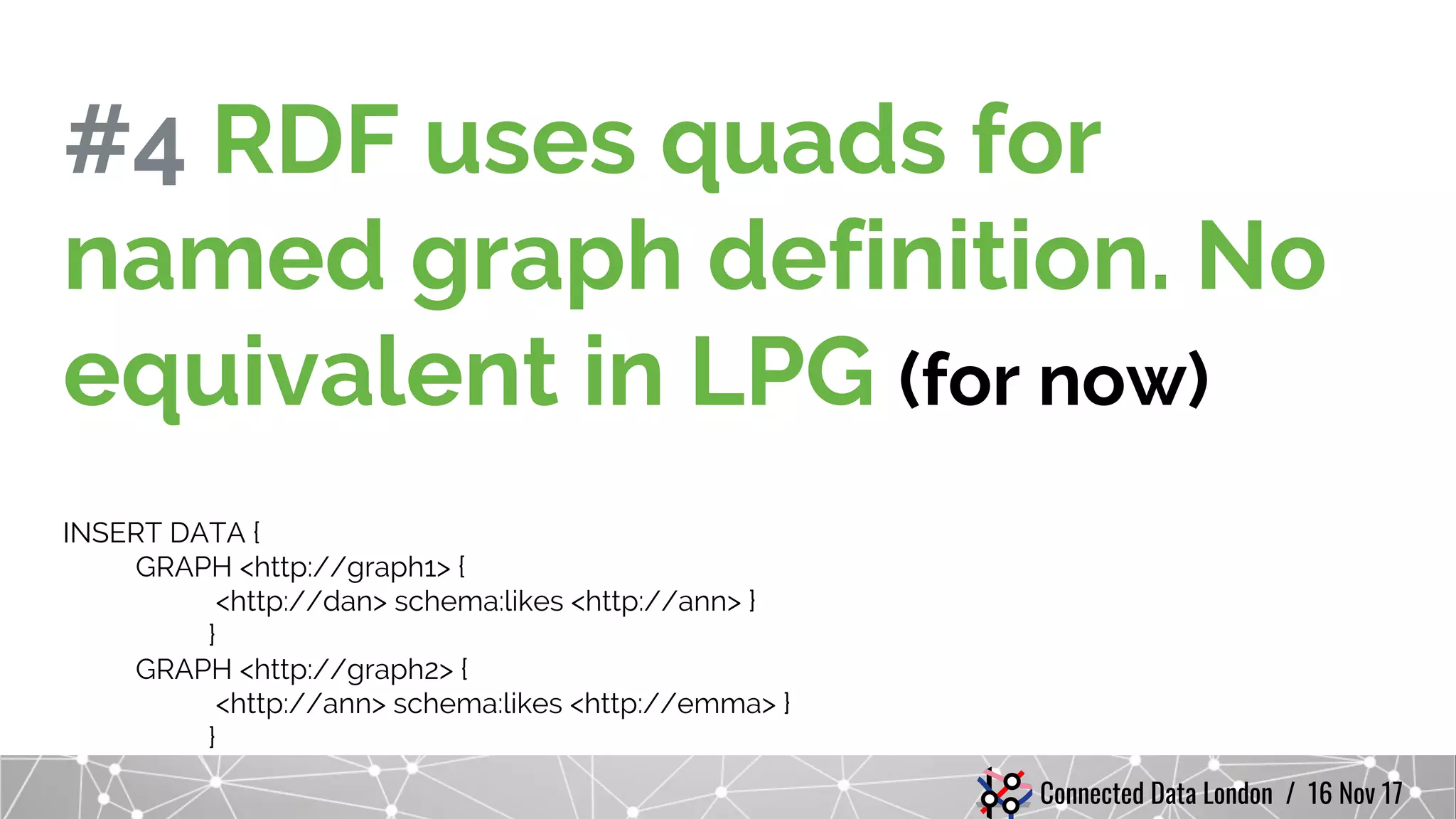
#4 RDF uses quads for
named graph definition. No
equivalent in LPG (for now)
INSERT DATA {
GRAPH <http://graph1> {
<http://dan> schema:likes <http://ann> }
}
GRAPH <http://graph2> {
<http://ann> schema:likes <http://emma> }
}
Connected Data London / 16 Nov 17
#1 RDF vs Graph DBs. Apples to apples
#2 the semantics of semantics
Connected Data London / 16 Nov 17
#1 RDF vs Graph DBs. Apples to apples
What are we comparing? Is it models or is it stores?
“RDF vs Graph DBs…”
RDF Stores Native Graph DB (Neo4j)
❏ Very strongly index based (some
graph DBs are also strongly index
based!! Graph as a feature)
❏ RDF used on mostly additive, typically
slow changing if not immutable data
sets
❏ Neo4j is Graph native
❏ Neo4j excels with highly dynamic
datasets & transactional UC where
data Integrity is key
Connected Data London / 16 Nov 17
#1 RDF vs Graph DBs. Apples to apples
Separating the model from the storage
○ RDF does not impose any particular type of data storage
○ Micro-demo: A Turing test of RDFness(*)
“RDF vs Graph DBs…”
(*) https://jesusbarrasa.wordpress.com/2016/11/17/neo4j-is-your-rdf-store-part-1/
Connected Data London / 16 Nov 17
#1 Demo
Connected Data London / 16 Nov 17
#1 Demo
<RDF>
=
Connected Data London / 16 Nov 17
#2 The semantics of semantics
“suppose you entered the details ‘Philip owns a Mercedes’
where ‘Philip’ and ‘Mercedes’ are both entities and ‘owns’
is a relationship. An inference engine can deduce that
Mercedes in this instance is a car whereas in ‘Juan is
married to Mercedes’ it would deduce that Mercedes is a
person
[...]
contrast this with the inability of a database to understand
anything it isn’t explicitly told then you should be able to
see the potential advantages”
Connected Data London / 16 Nov 17
#2 The semantics of semantics
“suppose you entered the details ‘Philip owns a Mercedes’
where ‘Philip’ and ‘Mercedes’ are both entities and ‘owns’
is a relationship. An inference engine can deduce that
Mercedes in this instance is a car whereas in ‘Juan is
married to Mercedes’ it would deduce that Mercedes is a
person
[...]
contrast this with the inability of a database to understand
anything it isn’t explicitly told then you should be able to
see the potential advantages”
WRONG!!
Connected Data London / 16 Nov 17
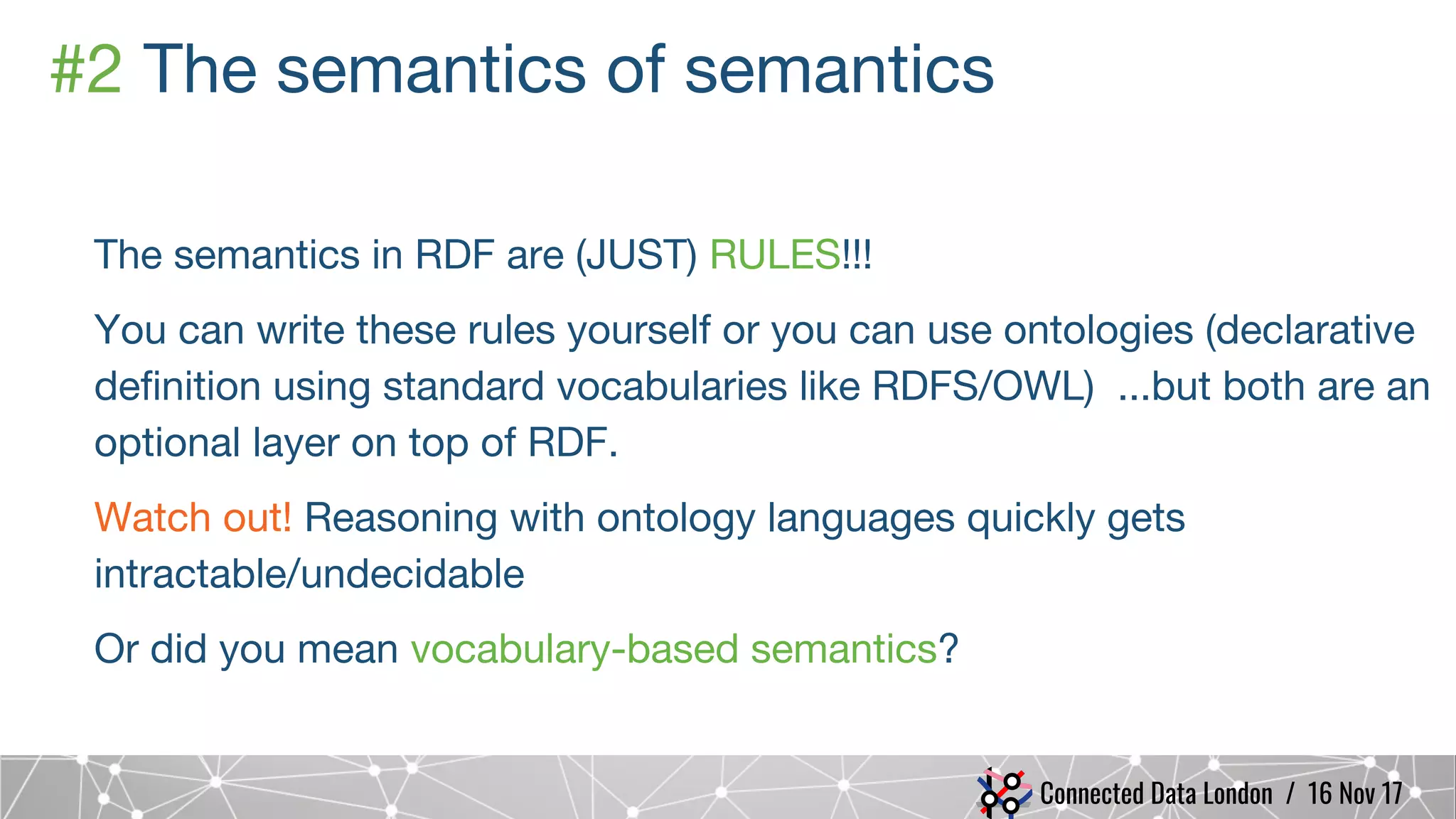
#2 The semantics of semantics
The semantics in RDF are (JUST) RULES!!!
You can write these rules yourself or you can use ontologies (declarative
definition using standard vocabularies like RDFS/OWL) ...but both are an
optional layer on top of RDF.
Watch out! Reasoning with ontology languages quickly gets
intractable/undecidable
Or did you mean vocabulary-based semantics?
Connected Data London / 16 Nov 17
#2 The semantics of semantics
Yes, inference is expensive. When considering
it, you should:
1) run it over as small a dataset as possible
2) use only the rules you need
3) consider alternatives to inference
Thanks for the tip, vendor of “the world’s only Enterprise Triple Store” ;-)
Connected Data London / 16 Nov 17
Thank You!

Jesús Barrasa

  • 1.
    Connected Data London/ 16 Nov 17 RDF vs Property Graph Is your Graph Semantic? Dr. Jesús Barrasa - Neo4j
  • 2.
    Connected Data London/ 16 Nov 17 Quick refresher on LPG & RDF
  • 3.
    Connected Data London/ 16 Nov 17 RDF Resource Description Framework W3C recommendation model for information exchange. Feb‘99
  • 4.
    Connected Data London/ 16 Nov 17 The Semantic Web “RDF is a key tech for developing the Semantic Web”. Article on SciAm in 2001 (1) https://www.scientificamerican.com/article/the-semantic-web/
  • 5.
    Connected Data London/ 16 Nov 17 Persisted RDF Specialized RDF stores (triple/quad stores) Semantic Graph Databases
  • 6.
    Connected Data London/ 16 Nov 17 LPG Sweden (2000 - 2007) efficient (graph native) storage fast query and traversal humane model: close to the way we humans understand and reason about the world
  • 7.
  • 8.
    Connected Data London/ 16 Nov 17 A look at the models
  • 9.
    Connected Data London/ 16 Nov 17 GRAPH = VERTICES + EDGES
  • 10.
    Connected Data London/ 16 Nov 17 ppl://ann is a person ppl//ann user ID is @ann ppl://ann name is Ann Smith ppl://dan likes ppl://ann RDF statements (triples)
  • 11.
    Connected Data London/ 16 Nov 17 ppl://ann is a person ppl//ann user ID is @ann ppl://ann name is Ann Smith ppl://dan likes ppl://ann RDF statements (triples) ppl://an n is_a _:Person
  • 12.
    Connected Data London/ 16 Nov 17 ppl://ann is a person ppl//ann user ID is @ann ppl://ann name is Ann Smith ppl://dan likes ppl://ann RDF statements (triples) ppl://an n @ann is_a user_ID _:Person
  • 13.
    Connected Data London/ 16 Nov 17 ppl://ann is a person ppl//ann user ID is @ann ppl://ann name is Ann Smith ppl://dan likes ppl://ann RDF statements (triples) ppl://an n @ann Ann Smith is_a name _:Person user_ID
  • 14.
    Connected Data London/ 16 Nov 17 ppl://ann is a person ppl//ann user ID is @ann ppl://ann name is Ann Smith ppl://dan likes ppl://ann RDF statements (triples) ppl://an n ppl://da n @ann Ann Smith is_a name _:Person likes user_ID
  • 15.
    Connected Data London/ 16 Nov 17 ppl://ann is a person ppl//ann user ID is @ann ppl://ann name is Ann Smith ppl://dan likes ppl://ann RDF statements (triples) ppl://an n ppl://da n @ann Ann Smith is_a name _:Person likes Vertices Edges user_ID
  • 16.
    Connected Data London/ 16 Nov 17 There is a person that is described by her name: Ann, her user ID: @ann and a globally unique identifier: <ppl://ann> There is another person with a unique identifier: <ppl://dan> Dan likes Ann LPG connected objects (with properties)
  • 17.
    Connected Data London/ 16 Nov 17 There is a person that is described by her name: Ann, her user ID: @ann and a globally unique identifier: <ppl://ann> There is another person with a unique identifier: <ppl://dan> Dan likes Ann LPG connected objects (with properties) { name: Ann, app_user_ID: @ann, uri: ppl://ann } :Person
  • 18.
    Connected Data London/ 16 Nov 17 There is a person that is described by her name: Ann, her user ID: @ann and a globally unique identifier: <ppl://ann> There is another person with a unique identifier: <ppl://dan> Dan likes Ann LPG connected objects (with properties) { uri: ppl://dan} { name: Ann, app_user_ID: @ann, uri: ppl://ann } :Person:Person
  • 19.
    Connected Data London/ 16 Nov 17 There is a person that is described by her name: Ann, her user ID: @ann and a globally unique identifier: <ppl://ann> There is another person with a unique identifier: <ppl://dan> Dan likes Ann LPG connected objects (with properties) LIKES { date: 02/03/17} { uri: ppl://dan} { name: Ann, app_user_ID: @ann, uri: ppl://ann } :Person:Person
  • 20.
    Connected Data London/ 16 Nov 17 There is a person that is described by her name: Ann, her user ID: @ann and a globally unique identifier: <ppl://ann> There is another person with a unique identifier: <ppl://dan> Dan likes Ann LPG connected objects (with properties) LIKES { date: 02/03/17} { uri: ppl://dan} { name: Ann, app_user_ID: @ann, uri: ppl://ann } Vertices Edges :Person:Person
  • 21.
    Connected Data London/ 16 Nov 17 RDF Graph Vertices Every statement produces two vertices in the graph. Some are uniquely identified by URIs: Resources Some are property values: Literals Edges Every statement produces an edge. Uniquely identified by URIs Vertices or Edges have NO internal structure
  • 22.
    Connected Data London/ 16 Nov 17 RDF Graph Vertices Every statement produces two vertices in the graph. Some are uniquely identified by URIs: Resources Some are property values: Literals Edges Every statement produces an edge. Uniquely identified by URIs Vertices or Edges have NO internal structure Property Graph Vertices Unique Id + set of key-value pairs Edges Unique Id + set of key-value pairs Vertices and Edges have internal structure
  • 23.
    Connected Data London/ 16 Nov 17 The query languages
  • 24.
    Connected Data London/ 16 Nov 17 Query: Who likes this person named Ann? Cypher MATCH (who)-[:LIKES]->(a:Person) WHERE a.name CONTAINS ‘Ann’ RETURN who SPARQL prefix ms: <http://myschma.me/> prefix rdf: <http://www[...]#> SELECT ?who { ?a rdf:type ms:Person . ?a ms:name ?asName . FILTER regex(?asName,’Ann’) ?who ms:likes ?a . }
  • 25.
    Connected Data London/ 16 Nov 17 End of refresher
  • 26.
    Connected Data London/ 16 Nov 17 Modelling differences
  • 27.
    Connected Data London/ 16 Nov 17 #1 RDF does not uniquely identify instances of relationships: No two relationships of the same type between a pair of nodes Dan cannot like Ann three times. Just once :(
  • 28.
    Connected Data London/ 16 Nov 17 RDF Dan has liked Ann three times prefix sc: <http://schema.org/> INSERT DATA { <http://dan> sc:name "Dan" . <http://ann> sc:name "Ann" . <http://dan> sc:likes <http://ann> . <http://dan> sc:likes <http://ann> . <http://dan> sc:likes <http://ann> . } PREFIX sc: <http://schema.org/> SELECT (COUNT(?p) AS ?count) where { <http://dan> ?p <http://ann> FILTER(?p = sc:likes) } ╒════════╕ │COUNT(l)│ ╞════════╡ │1 │ └────────┘
  • 29.
    Connected Data London/ 16 Nov 17 LPG in Neo4j Dan has liked Ann three times CREATE (d {name: "Dan"})-[:LIKES]->(a {name: "Ann"}) CREATE (d)-[:LIKES]->(a) CREATE (d)-[:LIKES]->(a) MATCH (d {name: "Dan"})-[l:LIKES]->(a {name: "Ann"}) RETURN COUNT(l) ╒════════╕ │COUNT(l)│ ╞════════╡ │3 │ └────────┘ { name: Dan } { name: Ann }
  • 30.
    Connected Data London/ 16 Nov 17 #2 In RDF you cannot qualify individual relationships: no attributes on predicates ...
  • 31.
    Connected Data London/ 16 Nov 17 LPG in Neo4j Connection NYC-SFO is $300 and 4100Km CREATE ( {name: "NYC"})-[:CONNECTION { distanceKm : 4100, costUSD: 300}]->( {name: "SFO"}) MATCH ( {name: "NYC"})-[c:CONNECTION]->( {name: "SFO"}) RETURN c.costUSD, c.distanceKm ╒═════════╤════════════╕ │c.costUSD│c.distanceKm│ ╞═════════╪════════════╡ │300 │4100 │ └─────────┴────────────┘ { name: NYC } { name: SFO } { distanceKm: 4100, costUSD: 300 }
  • 32.
    Connected Data London/ 16 Nov 17 RDF Connection NYC-SFO is $300 and 4100Km prefix sc: <http://schema.org/> INSERT DATA { <http://nyc> sc:name "NYC" . <http://sfo> sc:name "SFO" . <http://nyc> sc:connection <http://sfo> . sc:connection sc:distanceKm 4100 }
  • 33.
    Connected Data London/ 16 Nov 17 Alternatives in RDF (?) Modeling workarounds (intermediate nodes) Reification (1) Singleton Property (2) (1) https://www.w3.org/TR/2004/REC-rdf-primer-20040210/#reification (2) http://dl.acm.org/citation.cfm?id=2567973
  • 34.
    Connected Data London/ 16 Nov 17 Modeling workaround Connection between NYC and SF: 300 USD / 4100 in Km. LPG (Neo4j) RDF
  • 35.
    Connected Data London/ 16 Nov 17 Reification https://www.w3.org/TR/2004/REC-rdf-primer-20040210/#reification
  • 36.
    Connected Data London/ 16 Nov 17 Singleton property (2) http://dl.acm.org/citation.cfm?id=2567973
  • 37.
    Connected Data London/ 16 Nov 17 #3 RDF can have multivalued properties, in the LPG you use Arrays. Arrays in LPG
  • 38.
    Connected Data London/ 16 Nov 17 Example The genre of this album is Jazz, or more precisely Orchestral Jazz. prefix schema: <http://schema.org/> INSERT DATA { <http://g.co/kg/m/0567wt> schema:name "Sketches of Spain" ; schema:genre "Jazz", "Orchestral Jazz" . } } CREATE (s:Album { name: "Sketches of Spain", genre: [ "Jazz","Orchestral Jazz" ] } ) { name: Sketches of Spain genre: [ Jazz, Orchestral Jazz ] } CypherSPARQL
  • 39.
    Connected Data London/ 16 Nov 17 #4 RDF uses quads for named graph definition. No equivalent in LPG (for now) INSERT DATA { GRAPH <http://graph1> { <http://dan> schema:likes <http://ann> } } GRAPH <http://graph2> { <http://ann> schema:likes <http://emma> } }
  • 40.
    Connected Data London/ 16 Nov 17 #1 RDF vs Graph DBs. Apples to apples #2 the semantics of semantics
  • 41.
    Connected Data London/ 16 Nov 17 #1 RDF vs Graph DBs. Apples to apples What are we comparing? Is it models or is it stores? “RDF vs Graph DBs…” RDF Stores Native Graph DB (Neo4j) ❏ Very strongly index based (some graph DBs are also strongly index based!! Graph as a feature) ❏ RDF used on mostly additive, typically slow changing if not immutable data sets ❏ Neo4j is Graph native ❏ Neo4j excels with highly dynamic datasets & transactional UC where data Integrity is key
  • 42.
    Connected Data London/ 16 Nov 17 #1 RDF vs Graph DBs. Apples to apples Separating the model from the storage ○ RDF does not impose any particular type of data storage ○ Micro-demo: A Turing test of RDFness(*) “RDF vs Graph DBs…” (*) https://jesusbarrasa.wordpress.com/2016/11/17/neo4j-is-your-rdf-store-part-1/
  • 43.
    Connected Data London/ 16 Nov 17 #1 Demo
  • 44.
    Connected Data London/ 16 Nov 17 #1 Demo <RDF> =
  • 45.
    Connected Data London/ 16 Nov 17 #2 The semantics of semantics “suppose you entered the details ‘Philip owns a Mercedes’ where ‘Philip’ and ‘Mercedes’ are both entities and ‘owns’ is a relationship. An inference engine can deduce that Mercedes in this instance is a car whereas in ‘Juan is married to Mercedes’ it would deduce that Mercedes is a person [...] contrast this with the inability of a database to understand anything it isn’t explicitly told then you should be able to see the potential advantages”
  • 46.
    Connected Data London/ 16 Nov 17 #2 The semantics of semantics “suppose you entered the details ‘Philip owns a Mercedes’ where ‘Philip’ and ‘Mercedes’ are both entities and ‘owns’ is a relationship. An inference engine can deduce that Mercedes in this instance is a car whereas in ‘Juan is married to Mercedes’ it would deduce that Mercedes is a person [...] contrast this with the inability of a database to understand anything it isn’t explicitly told then you should be able to see the potential advantages” WRONG!!
  • 47.
    Connected Data London/ 16 Nov 17 #2 The semantics of semantics The semantics in RDF are (JUST) RULES!!! You can write these rules yourself or you can use ontologies (declarative definition using standard vocabularies like RDFS/OWL) ...but both are an optional layer on top of RDF. Watch out! Reasoning with ontology languages quickly gets intractable/undecidable Or did you mean vocabulary-based semantics?
  • 48.
    Connected Data London/ 16 Nov 17 #2 The semantics of semantics Yes, inference is expensive. When considering it, you should: 1) run it over as small a dataset as possible 2) use only the rules you need 3) consider alternatives to inference Thanks for the tip, vendor of “the world’s only Enterprise Triple Store” ;-)
  • 49.
    Connected Data London/ 16 Nov 17 Thank You!