Working on Clinical Trials
Introduction to clinical trials (what are they; how do they work; who is
implied)
Types of documents used in clinical trials (medical [specialist facing/
patient facing]; legal; marketing, etc.)
Types of audiences (doctors/investigators/healthcare providers; patients/
other laymen such as healthy subjects/ partners/ legal representatives/
parents, etc.; ECs; CROs…)
What skills do linguists need to work in this field?
How to acquire that knowledge?
 Where to find glossaries/ templates/ further information
 MOOCs to take to get you started
 Books and articles you should have read
 Other handy resources
Introduction to Clinical Trials
http://web.chem.ucla.edu/~harding/IGOC/C/clinical_trial.html
Legal Basics:
• clinical trials have to comply with strict regulations
• Declaration of Helsinki
• International Conference on Harmonization of Technical Requirements for the
Registration of Pharmaceuticals for Human Use (ICH) > Good Clinical Practice
(GCP)
• national/ EU guidelines (AMG, EU Clinical Trials Directive)
• national/ EU regulatory authorities (BfArM, PEI, EMA)
Introduction to Clinical Trials
http://web.chem.ucla.edu/~harding/IGOC/C/clinical_trial.html
Important for linguists:
different conditions and medical specializations
different types of documentation
many texts have to be handed in for approval > have to adapt to
certain specifications
Introduction to Clinical Trials
• Prospective biomedical or behavioral research study of
human subjects
• Designed to answer specific questions about biomedical or
behavioral interventions e.g.:
• vaccines,
• drugs,
• treatments,
• devices,
• new ways of using known drugs, treatments, or devices
• Used to determine whether new biomedical or behavioral
interventions are safe, efficacious, and effective
• Include behavioral human subjects research involving an
intervention to modify behavior
• increasing the use of an intervention
• willingness to pay for an intervention, etc.
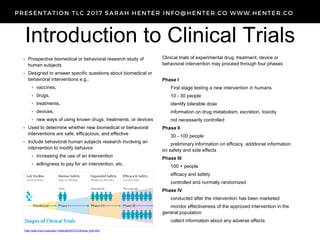
Clinical trials of experimental drug, treatment, device or
behavioral intervention may proceed through four phases
Phase I
First stage testing a new intervention in humans
10 - 30 people
identify tolerable dose
information on drug metabolism, excretion, toxicity
not necessarily controlled
Phase II
30 - 100 people
preliminary information on efficacy, additional information
on safety and side effects
Phase III
100 + people
efficacy and safety
controlled and normally randomized
Phase IV
conducted after the intervention has been marketed
monitor effectiveness of the approved intervention in the
general population
collect information about any adverse effects
http://web.chem.ucla.edu/~harding/IGOC/C/clinical_trial.html
Types of documents used in
Clinical TrialsAccording to Good Clinical Practice (GCP), all information and
processes of clinical trials must be recorded and stored so that
they can be correctly reported, interpreted and authenticated.
Many different types of documents are created, processed and
filed in the process of clinical studies.
As per ICH GCP E6 Section 8, essential documents are those
which:
(…) individually and collectively permit evaluation of the conduct
of a trial and the quality of the data produced. These documents
serve to demonstrate the compliance of the investigator,
sponsor and monitor with the standards of Good Clinical
Practice and with all applicable regulatory requirements.
Other important uses and objectives of essential documents
are:
• correct management of the trial in question by investigators,
sponsors and monitors;
• audits;
• inspections by regulatory authorities.
There are mainly three stages in which essential documents are
generated and handled, namely:
1 Before the start of the clinical phase of the trial
2 During the clinical phase of the trial
3 After the clinical phase of the trial
All documentation needs to be described and it must be
defined whether they are stored in the files of either the
study site (investigator or institution), the sponsor, or both.
See the European Commission’s Detailed Guidance on the
Content of a Trial Master File and Archiving for more
information on Trial Master Files. In some cases, documents
may be combined if all essential parts are still clear and can
be easily identified.
Very few clinical trials are conducted only in one country;
many are available in a variety of different sites in different
places, so the translation and linguistic adaptation for
different target cultures and languages becomes more
important. However, requirements as to which types of
documents need to be translated differ from country to
country. Whereas in some states all documents need to
be available in the local language, others assume that
specialist-facing text will be understood in English, and
only texts that are not directly addressing the study
staff involved in the trial need to be translated, such as:
• Packaging and labeling
• Patient diaries
• Patient information sheets
• Informed consent forms
• Patient questionnaires
• Patient-reported outcomes
Types of documents used in
Clinical Trials
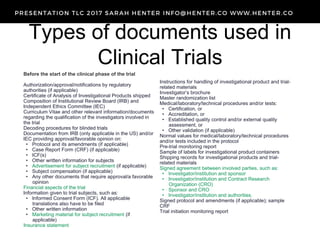
Before the start of the clinical phase of the trial
Authorization/approval/notifications by regulatory
authorities (if applicable)
Certificate of Analysis of Investigational Products shipped
Composition of Institutional Review Board (IRB) and
Independent Ethics Committee (IEC)
Curriculum Vitae and other relevant information/documents
regarding the qualification of the investigators involved in
the trial
Decoding procedures for blinded trials
Documentation from IRB (only applicable in the US) and/or
IEC providing approval/favorable opinion on:
• Protocol and its amendments (if applicable)
• Case Report Form (CRF) (if applicable)
• ICF(s)
• Other written information for subjects
• Advertisement for subject recruitment (if applicable)
• Subject compensation (if applicable)
• Any other documents that require approval/a favorable
opinion
Financial aspects of the trial
Information given to trial subjects, such as:
• Informed Consent Form (ICF). All applicable
translations also have to be filed
• Other written information
• Marketing material for subject recruitment (if
applicable)
Insurance statement
Instructions for handling of investigational product and trial-
related materials
Investigator’s brochure
Master randomization list
Medical/laboratory/technical procedures and/or tests:
• Certification, or
• Accreditation, or
• Established quality control and/or external quality
assessment, or
• Other validation (if applicable)
Normal values for medical/laboratory/technical procedures
and/or tests included in the protocol
Pre-trial monitoring report
Sample of labels for investigational product containers
Shipping records for investigational products and trial-
related materials
Signed agreement between involved parties, such as:
• Investigator/institution and sponsor
• Investigator/institution and Contract Research
Organization (CRO)
• Sponsor and CRO
• Investigator/institution and authorities.
Signed protocol and amendments (if applicable); sample
CRF
Trial initiation monitoring report
Types of documents used in
Clinical Trials
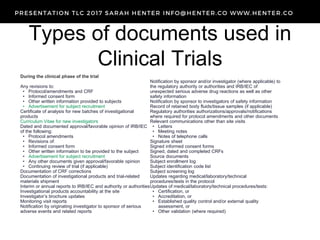
During the clinical phase of the trial
Any revisions to:
• Protocol/amendments and CRF
• Informed consent form
• Other written information provided to subjects
• Advertisement for subject recruitment
Certificate of analysis for new batches of investigational
products
Curriculum Vitae for new investigators
Dated and documented approval/favorable opinion of IRB/IEC
of the following:
• Protocol amendments
• Revisions of:
• Informed consent form
• Other written information to be provided to the subject
• Advertisement for subject recruitment
• Any other documents given approval/favorable opinion
• Continuing review of trial (if applicable)
Documentation of CRF corrections
Documentation of investigational products and trial-related
materials shipment
Interim or annual reports to IRB/IEC and authority or authorities
Investigational products accountability at the site
Investigator’s brochure updates
Monitoring visit reports
Notification by originating investigator to sponsor of serious
adverse events and related reports
Notification by sponsor and/or investigator (where applicable) to
the regulatory authority or authorities and IRB/IEC of
unexpected serious adverse drug reactions as well as other
safety information
Notification by sponsor to investigators of safety information
Record of retained body fluids/tissue samples (if applicable)
Regulatory authorities authorizations/approvals/notifications
where required for protocol amendments and other documents
Relevant communications other than site visits
• Letters
• Meeting notes
• Notes of telephone calls
Signature sheet
Signed informed consent forms
Signed, dated and completed CRFs
Source documents
Subject enrollment log
Subject identification code list
Subject screening log
Updates regarding medical/laboratory/technical
procedures/tests in the protocol
Updates of medical/laboratory/technical procedures/tests:
• Certification, or
• Accreditation, or
• Established quality control and/or external quality
assessment, or
• Other validation (where required)
Types of documents used in
Clinical Trials
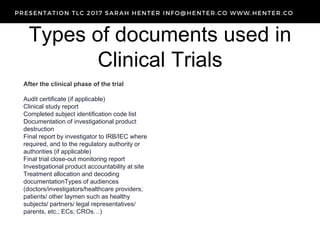
After the clinical phase of the trial
Audit certificate (if applicable)
Clinical study report
Completed subject identification code list
Documentation of investigational product
destruction
Final report by investigator to IRB/IEC where
required, and to the regulatory authority or
authorities (if applicable)
Final trial close-out monitoring report
Investigational product accountability at site
Treatment allocation and decoding
documentationTypes of audiences
(doctors/investigators/healthcare providers;
patients/ other laymen such as healthy
subjects/ partners/ legal representatives/
parents, etc.; ECs; CROs…)
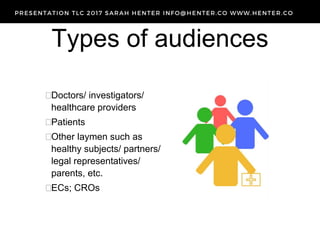
Types of audiences
Doctors/ investigators/
healthcare providers
Patients
Other laymen such as
healthy subjects/ partners/
legal representatives/
parents, etc.
ECs; CROs
What skills do linguists need
to work in this field?
Basic knowledge about the functioning of
clinical trials
Specific terminology
Adapt texts for different audiences
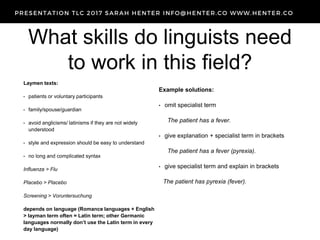
What skills do linguists need
to work in this field?
Laymen texts:
• patients or voluntary participants
• family/spouse/guardian
• avoid anglicisms/ latinisms if they are not widely
understood
• style and expression should be easy to understand
• no long and complicated syntax
Influenza > Flu
Placebo > Placebo
Screening > Voruntersuchung
depends on language (Romance languages + English
> layman term often = Latin term; other Germanic
languages normally don’t use the Latin term in every
day language)
Example solutions:
• omit specialist term
The patient has a fever.
• give explanation + specialist term in brackets
The patient has a fever (pyrexia).
• give specialist term and explain in brackets
The patient has pyrexia (fever).
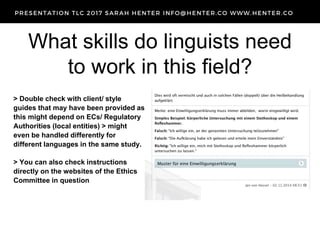
What skills do linguists need
to work in this field?
> Double check with client/ style
guides that may have been provided as
this might depend on ECs/ Regulatory
Authorities (local entities) > might
even be handled differently for
different languages in the same study.
> You can also check instructions
directly on the websites of the Ethics
Committee in question
How to acquire that
knowledge?
• Where to find glossaries/ templates/ further
information
• MOOCs to take to get you started
• Books and articles you should have read
• Other handy resources
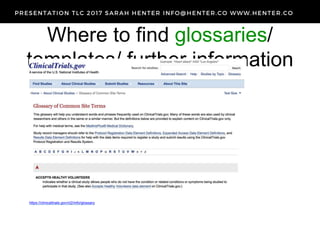
Where to find glossaries/
templates/ further information
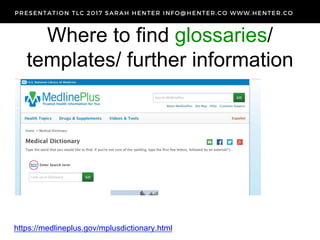
https://clinicaltrials.gov/ct2/info/glossary
Where to find glossaries/
templates/ further information
https://medlineplus.gov/mplusdictionary.html
Where to find glossaries/
templates/ further information
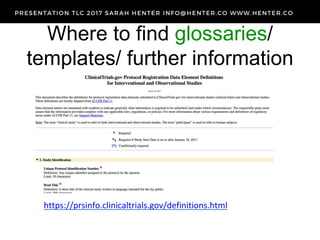
https://prsinfo.clinicaltrials.gov/definitions.html
Where to find glossaries/
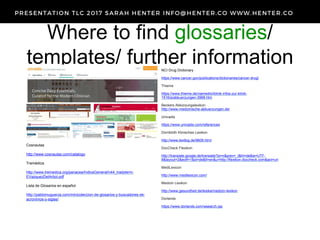
templates/ further informationNCI Drug Dictionary
https://www.cancer.gov/publications/dictionaries/cancer-drug/
Thieme
https://www.thieme.de/viamedici/klinik-infos-zur-klinik-
1516/a/abkuerzungen-3968.htm
Beckers Abkürzungslexikon
http://www.medizinische-abkuerzungen.de/
Univadis
https://www.univadis.com/references
Dornblüth Klinisches Lexikon
http://www.textlog.de/9609.html
DocCheck Flexikon
http://translate.google.de/translate?js=n&prev=_t&hl=de&ie=UTF-
8&layout=2&eotf=1&sl=de&tl=en&u=http://flexikon.doccheck.com&act=url
MediLexicon
http://www.medilexicon.com/
Medizin Lexikon
http://www.gesundheit.de/lexika/medizin-lexikon
Dorlands
https://www.dorlands.com/wsearch.jsp
Cosnautas
http://www.cosnautas.com/catalogo
Tremédica
http://www.tremedica.org/panacea/IndiceGeneral/n44_tradyterm-
EVazquezDelArbol.pdf
Lista de Glosarios en español
http://pablomuguerza.com/minicoleccion-de-glosarios-y-buscadores-de-
acronimos-y-siglas/
Where to find glossaries/
templates/ further information
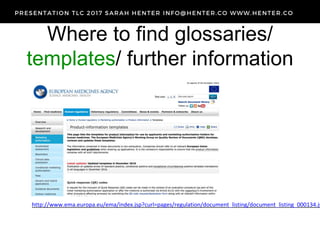
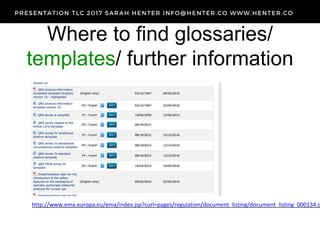
http://www.ema.europa.eu/ema/index.jsp?curl=pages/regulation/document_listing/document_listing_000134.js
Where to find glossaries/
templates/ further information
http://www.ema.europa.eu/ema/index.jsp?curl=pages/regulation/document_listing/document_listing_000134.js
Where to find glossaries/
templates/ further information
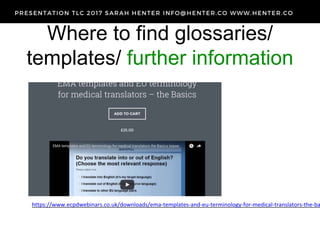
https://www.ecpdwebinars.co.uk/downloads/ema-templates-and-eu-terminology-for-medical-translators-the-ba
Where to find glossaries/
templates/ further information
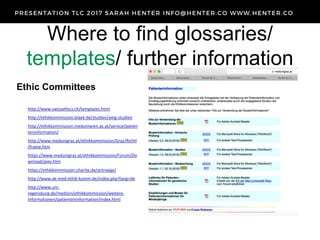
Ethic Committees
http://www.swissethics.ch/templates.html
http://ethikkommission.blaek.de/studien/amg-studien
http://ethikkommission.meduniwien.ac.at/service/patien
teninformation/
http://www.medunigraz.at/ethikkommission/Graz/Richtl
/frame.htm
https://www.medunigraz.at/ethikkommission/Forum/Do
wnload/piev.htm
https://ethikkommission.charite.de/antraege/
http://www.ak-med-ethik-komm.de/index.php?lang=de
http://www.uni-
regensburg.de/medizin/ethikkommission/weitere-
informationen/patienteninformation/index.html
MOOCs to take to get you
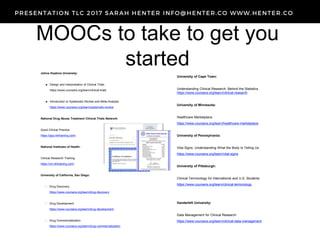
startedJohns Hopkins University:
 Design and Interpretation of Clinical Trials
https://www.coursera.org/learn/clinical-trials
 Introduction to Systematic Review and Meta-Analysis
https://www.coursera.org/learn/systematic-review
National Drug Abuse Treatment Clinical Trials Network:
Good Clinical Practice
https://gcp.nihtraining.com/
National Institutes of Health:
Clinical Research Training
https://crt.nihtraining.com/
University of California, San Diego:
 Drug Discovery
https://www.coursera.org/learn/drug-discovery
 Drug Development
https://www.coursera.org/learn/drug-development
 Drug Commercialization
https://www.coursera.org/learn/drug-commercialization
University of Cape Town:
Understanding Clinical Research: Behind the Statistics
https://www.coursera.org/learn/clinical-research
University of Minnesota:
Healthcare Marketplace
https://www.coursera.org/learn/healthcare-marketplace
University of Pennsylvania:
Vital Signs: Understanding What the Body Is Telling Us
https://www.coursera.org/learn/vital-signs
University of Pittsburgh:
Clinical Terminology for International and U.S. Students
https://www.coursera.org/learn/clinical-terminology
Vanderbilt University:
Data Management for Clinical Research
https://www.coursera.org/learn/clinical-data-management
Books and articles
• Daniela Penn: Ein Überblick über klinische
Studien und das Übersetzen von
Studiendokumenten
• http://www.bdue-
fachverlag.de/fachverlag/detail_book/110
• Shayne Cox Gad: Clinical Trials
handbookhttps://books.google.es/books?id=
d8GxG0d9rpgC&pg=PA118&redir_esc=y#v=on
epage&q&f=false
•
• S. D. MathiasS. K. FiferD. L. Patrick:Rapid
translation of quality of life measures for
international clinical trials: avoiding errors
in the minimalist approach
• http://link.springer.com/article/10.1007/BF
00435392
• Dictionaries for your language combination
Other handy resources
NIH Toolkit for Clinical Researchers
 https://www.nidcr.nih.gov/research/toolkit/#start
up2
UBC Webinars
 http://www.ubc.com/library/archived-webinars
USC Information about Clinical Trials
 https://research.usc.edu/clinical-trials-at-usc/
NCI's Clinical Trials Programs and Initiatives
 https://www.cancer.gov/research/areas/clinical-
trials
My blog
 http://www.henter.co/documents-used-in-
clinical-trials/
 http://www.henter.co/specialization-courses-for-
medical-translators-and-interpreters/
Presentation working on clinical trials

Presentation working on clinical trials

  • 2.
    Working on ClinicalTrials Introduction to clinical trials (what are they; how do they work; who is implied) Types of documents used in clinical trials (medical [specialist facing/ patient facing]; legal; marketing, etc.) Types of audiences (doctors/investigators/healthcare providers; patients/ other laymen such as healthy subjects/ partners/ legal representatives/ parents, etc.; ECs; CROs…) What skills do linguists need to work in this field? How to acquire that knowledge?  Where to find glossaries/ templates/ further information  MOOCs to take to get you started  Books and articles you should have read  Other handy resources
  • 3.
    Introduction to ClinicalTrials http://web.chem.ucla.edu/~harding/IGOC/C/clinical_trial.html Legal Basics: • clinical trials have to comply with strict regulations • Declaration of Helsinki • International Conference on Harmonization of Technical Requirements for the Registration of Pharmaceuticals for Human Use (ICH) > Good Clinical Practice (GCP) • national/ EU guidelines (AMG, EU Clinical Trials Directive) • national/ EU regulatory authorities (BfArM, PEI, EMA)
  • 4.
    Introduction to ClinicalTrials http://web.chem.ucla.edu/~harding/IGOC/C/clinical_trial.html Important for linguists: different conditions and medical specializations different types of documentation many texts have to be handed in for approval > have to adapt to certain specifications
  • 5.
    Introduction to ClinicalTrials • Prospective biomedical or behavioral research study of human subjects • Designed to answer specific questions about biomedical or behavioral interventions e.g.: • vaccines, • drugs, • treatments, • devices, • new ways of using known drugs, treatments, or devices • Used to determine whether new biomedical or behavioral interventions are safe, efficacious, and effective • Include behavioral human subjects research involving an intervention to modify behavior • increasing the use of an intervention • willingness to pay for an intervention, etc. Clinical trials of experimental drug, treatment, device or behavioral intervention may proceed through four phases Phase I First stage testing a new intervention in humans 10 - 30 people identify tolerable dose information on drug metabolism, excretion, toxicity not necessarily controlled Phase II 30 - 100 people preliminary information on efficacy, additional information on safety and side effects Phase III 100 + people efficacy and safety controlled and normally randomized Phase IV conducted after the intervention has been marketed monitor effectiveness of the approved intervention in the general population collect information about any adverse effects http://web.chem.ucla.edu/~harding/IGOC/C/clinical_trial.html
  • 6.
    Types of documentsused in Clinical TrialsAccording to Good Clinical Practice (GCP), all information and processes of clinical trials must be recorded and stored so that they can be correctly reported, interpreted and authenticated. Many different types of documents are created, processed and filed in the process of clinical studies. As per ICH GCP E6 Section 8, essential documents are those which: (…) individually and collectively permit evaluation of the conduct of a trial and the quality of the data produced. These documents serve to demonstrate the compliance of the investigator, sponsor and monitor with the standards of Good Clinical Practice and with all applicable regulatory requirements. Other important uses and objectives of essential documents are: • correct management of the trial in question by investigators, sponsors and monitors; • audits; • inspections by regulatory authorities. There are mainly three stages in which essential documents are generated and handled, namely: 1 Before the start of the clinical phase of the trial 2 During the clinical phase of the trial 3 After the clinical phase of the trial All documentation needs to be described and it must be defined whether they are stored in the files of either the study site (investigator or institution), the sponsor, or both. See the European Commission’s Detailed Guidance on the Content of a Trial Master File and Archiving for more information on Trial Master Files. In some cases, documents may be combined if all essential parts are still clear and can be easily identified. Very few clinical trials are conducted only in one country; many are available in a variety of different sites in different places, so the translation and linguistic adaptation for different target cultures and languages becomes more important. However, requirements as to which types of documents need to be translated differ from country to country. Whereas in some states all documents need to be available in the local language, others assume that specialist-facing text will be understood in English, and only texts that are not directly addressing the study staff involved in the trial need to be translated, such as: • Packaging and labeling • Patient diaries • Patient information sheets • Informed consent forms • Patient questionnaires • Patient-reported outcomes
  • 7.
    Types of documentsused in Clinical Trials Before the start of the clinical phase of the trial Authorization/approval/notifications by regulatory authorities (if applicable) Certificate of Analysis of Investigational Products shipped Composition of Institutional Review Board (IRB) and Independent Ethics Committee (IEC) Curriculum Vitae and other relevant information/documents regarding the qualification of the investigators involved in the trial Decoding procedures for blinded trials Documentation from IRB (only applicable in the US) and/or IEC providing approval/favorable opinion on: • Protocol and its amendments (if applicable) • Case Report Form (CRF) (if applicable) • ICF(s) • Other written information for subjects • Advertisement for subject recruitment (if applicable) • Subject compensation (if applicable) • Any other documents that require approval/a favorable opinion Financial aspects of the trial Information given to trial subjects, such as: • Informed Consent Form (ICF). All applicable translations also have to be filed • Other written information • Marketing material for subject recruitment (if applicable) Insurance statement Instructions for handling of investigational product and trial- related materials Investigator’s brochure Master randomization list Medical/laboratory/technical procedures and/or tests: • Certification, or • Accreditation, or • Established quality control and/or external quality assessment, or • Other validation (if applicable) Normal values for medical/laboratory/technical procedures and/or tests included in the protocol Pre-trial monitoring report Sample of labels for investigational product containers Shipping records for investigational products and trial- related materials Signed agreement between involved parties, such as: • Investigator/institution and sponsor • Investigator/institution and Contract Research Organization (CRO) • Sponsor and CRO • Investigator/institution and authorities. Signed protocol and amendments (if applicable); sample CRF Trial initiation monitoring report
  • 8.
    Types of documentsused in Clinical Trials During the clinical phase of the trial Any revisions to: • Protocol/amendments and CRF • Informed consent form • Other written information provided to subjects • Advertisement for subject recruitment Certificate of analysis for new batches of investigational products Curriculum Vitae for new investigators Dated and documented approval/favorable opinion of IRB/IEC of the following: • Protocol amendments • Revisions of: • Informed consent form • Other written information to be provided to the subject • Advertisement for subject recruitment • Any other documents given approval/favorable opinion • Continuing review of trial (if applicable) Documentation of CRF corrections Documentation of investigational products and trial-related materials shipment Interim or annual reports to IRB/IEC and authority or authorities Investigational products accountability at the site Investigator’s brochure updates Monitoring visit reports Notification by originating investigator to sponsor of serious adverse events and related reports Notification by sponsor and/or investigator (where applicable) to the regulatory authority or authorities and IRB/IEC of unexpected serious adverse drug reactions as well as other safety information Notification by sponsor to investigators of safety information Record of retained body fluids/tissue samples (if applicable) Regulatory authorities authorizations/approvals/notifications where required for protocol amendments and other documents Relevant communications other than site visits • Letters • Meeting notes • Notes of telephone calls Signature sheet Signed informed consent forms Signed, dated and completed CRFs Source documents Subject enrollment log Subject identification code list Subject screening log Updates regarding medical/laboratory/technical procedures/tests in the protocol Updates of medical/laboratory/technical procedures/tests: • Certification, or • Accreditation, or • Established quality control and/or external quality assessment, or • Other validation (where required)
  • 9.
    Types of documentsused in Clinical Trials After the clinical phase of the trial Audit certificate (if applicable) Clinical study report Completed subject identification code list Documentation of investigational product destruction Final report by investigator to IRB/IEC where required, and to the regulatory authority or authorities (if applicable) Final trial close-out monitoring report Investigational product accountability at site Treatment allocation and decoding documentationTypes of audiences (doctors/investigators/healthcare providers; patients/ other laymen such as healthy subjects/ partners/ legal representatives/ parents, etc.; ECs; CROs…)
  • 10.
    Types of audiences Doctors/investigators/ healthcare providers Patients Other laymen such as healthy subjects/ partners/ legal representatives/ parents, etc. ECs; CROs
  • 11.
    What skills dolinguists need to work in this field? Basic knowledge about the functioning of clinical trials Specific terminology Adapt texts for different audiences
  • 12.
    What skills dolinguists need to work in this field? Laymen texts: • patients or voluntary participants • family/spouse/guardian • avoid anglicisms/ latinisms if they are not widely understood • style and expression should be easy to understand • no long and complicated syntax Influenza > Flu Placebo > Placebo Screening > Voruntersuchung depends on language (Romance languages + English > layman term often = Latin term; other Germanic languages normally don’t use the Latin term in every day language) Example solutions: • omit specialist term The patient has a fever. • give explanation + specialist term in brackets The patient has a fever (pyrexia). • give specialist term and explain in brackets The patient has pyrexia (fever).
  • 13.
    What skills dolinguists need to work in this field? > Double check with client/ style guides that may have been provided as this might depend on ECs/ Regulatory Authorities (local entities) > might even be handled differently for different languages in the same study. > You can also check instructions directly on the websites of the Ethics Committee in question
  • 14.
    How to acquirethat knowledge? • Where to find glossaries/ templates/ further information • MOOCs to take to get you started • Books and articles you should have read • Other handy resources
  • 15.
    Where to findglossaries/ templates/ further information https://clinicaltrials.gov/ct2/info/glossary
  • 16.
    Where to findglossaries/ templates/ further information https://medlineplus.gov/mplusdictionary.html
  • 17.
    Where to findglossaries/ templates/ further information https://prsinfo.clinicaltrials.gov/definitions.html
  • 18.
    Where to findglossaries/ templates/ further informationNCI Drug Dictionary https://www.cancer.gov/publications/dictionaries/cancer-drug/ Thieme https://www.thieme.de/viamedici/klinik-infos-zur-klinik- 1516/a/abkuerzungen-3968.htm Beckers Abkürzungslexikon http://www.medizinische-abkuerzungen.de/ Univadis https://www.univadis.com/references Dornblüth Klinisches Lexikon http://www.textlog.de/9609.html DocCheck Flexikon http://translate.google.de/translate?js=n&prev=_t&hl=de&ie=UTF- 8&layout=2&eotf=1&sl=de&tl=en&u=http://flexikon.doccheck.com&act=url MediLexicon http://www.medilexicon.com/ Medizin Lexikon http://www.gesundheit.de/lexika/medizin-lexikon Dorlands https://www.dorlands.com/wsearch.jsp Cosnautas http://www.cosnautas.com/catalogo Tremédica http://www.tremedica.org/panacea/IndiceGeneral/n44_tradyterm- EVazquezDelArbol.pdf Lista de Glosarios en español http://pablomuguerza.com/minicoleccion-de-glosarios-y-buscadores-de- acronimos-y-siglas/
  • 19.
    Where to findglossaries/ templates/ further information http://www.ema.europa.eu/ema/index.jsp?curl=pages/regulation/document_listing/document_listing_000134.js
  • 20.
    Where to findglossaries/ templates/ further information http://www.ema.europa.eu/ema/index.jsp?curl=pages/regulation/document_listing/document_listing_000134.js
  • 21.
    Where to findglossaries/ templates/ further information https://www.ecpdwebinars.co.uk/downloads/ema-templates-and-eu-terminology-for-medical-translators-the-ba
  • 22.
    Where to findglossaries/ templates/ further information Ethic Committees http://www.swissethics.ch/templates.html http://ethikkommission.blaek.de/studien/amg-studien http://ethikkommission.meduniwien.ac.at/service/patien teninformation/ http://www.medunigraz.at/ethikkommission/Graz/Richtl /frame.htm https://www.medunigraz.at/ethikkommission/Forum/Do wnload/piev.htm https://ethikkommission.charite.de/antraege/ http://www.ak-med-ethik-komm.de/index.php?lang=de http://www.uni- regensburg.de/medizin/ethikkommission/weitere- informationen/patienteninformation/index.html
  • 23.
    MOOCs to taketo get you startedJohns Hopkins University:  Design and Interpretation of Clinical Trials https://www.coursera.org/learn/clinical-trials  Introduction to Systematic Review and Meta-Analysis https://www.coursera.org/learn/systematic-review National Drug Abuse Treatment Clinical Trials Network: Good Clinical Practice https://gcp.nihtraining.com/ National Institutes of Health: Clinical Research Training https://crt.nihtraining.com/ University of California, San Diego:  Drug Discovery https://www.coursera.org/learn/drug-discovery  Drug Development https://www.coursera.org/learn/drug-development  Drug Commercialization https://www.coursera.org/learn/drug-commercialization University of Cape Town: Understanding Clinical Research: Behind the Statistics https://www.coursera.org/learn/clinical-research University of Minnesota: Healthcare Marketplace https://www.coursera.org/learn/healthcare-marketplace University of Pennsylvania: Vital Signs: Understanding What the Body Is Telling Us https://www.coursera.org/learn/vital-signs University of Pittsburgh: Clinical Terminology for International and U.S. Students https://www.coursera.org/learn/clinical-terminology Vanderbilt University: Data Management for Clinical Research https://www.coursera.org/learn/clinical-data-management
  • 24.
    Books and articles •Daniela Penn: Ein Überblick über klinische Studien und das Übersetzen von Studiendokumenten • http://www.bdue- fachverlag.de/fachverlag/detail_book/110 • Shayne Cox Gad: Clinical Trials handbookhttps://books.google.es/books?id= d8GxG0d9rpgC&pg=PA118&redir_esc=y#v=on epage&q&f=false • • S. D. MathiasS. K. FiferD. L. Patrick:Rapid translation of quality of life measures for international clinical trials: avoiding errors in the minimalist approach • http://link.springer.com/article/10.1007/BF 00435392 • Dictionaries for your language combination
  • 25.
    Other handy resources NIHToolkit for Clinical Researchers  https://www.nidcr.nih.gov/research/toolkit/#start up2 UBC Webinars  http://www.ubc.com/library/archived-webinars USC Information about Clinical Trials  https://research.usc.edu/clinical-trials-at-usc/ NCI's Clinical Trials Programs and Initiatives  https://www.cancer.gov/research/areas/clinical- trials My blog  http://www.henter.co/documents-used-in- clinical-trials/  http://www.henter.co/specialization-courses-for- medical-translators-and-interpreters/