Overview of Documentum
Agenda What is Documentum ? Brief History of Documentum Architecture Kernel  Application Services Experiences Tools How and What EMC Documentum delivers Summary
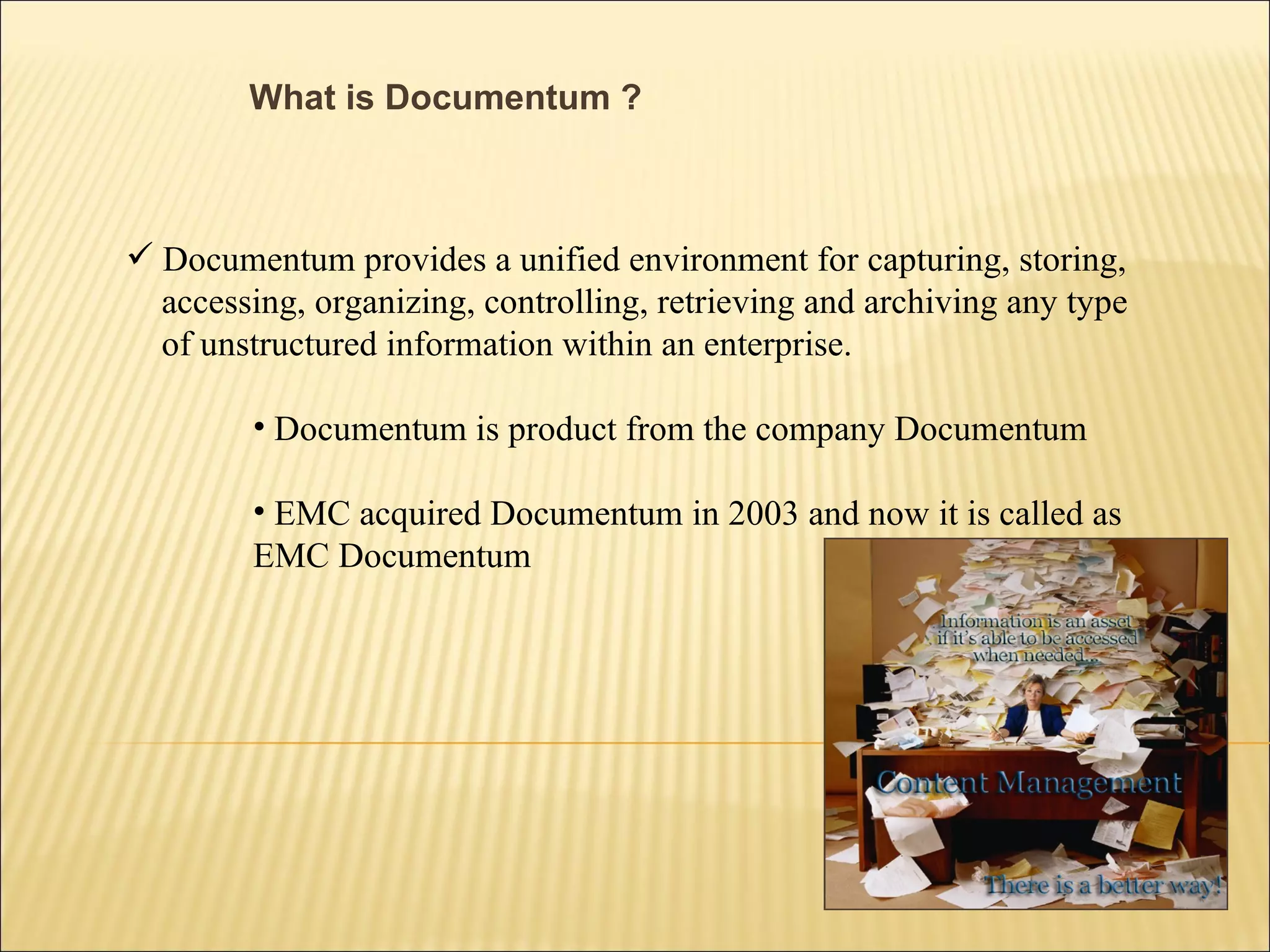
What is Documentum ? Documentum provides a unified environment for capturing, storing,  accessing, organizing, controlling, retrieving and archiving any type of unstructured information within an enterprise. Documentum is product from the company Documentum EMC acquired Documentum in 2003 and now it is called as  EMC Documentum
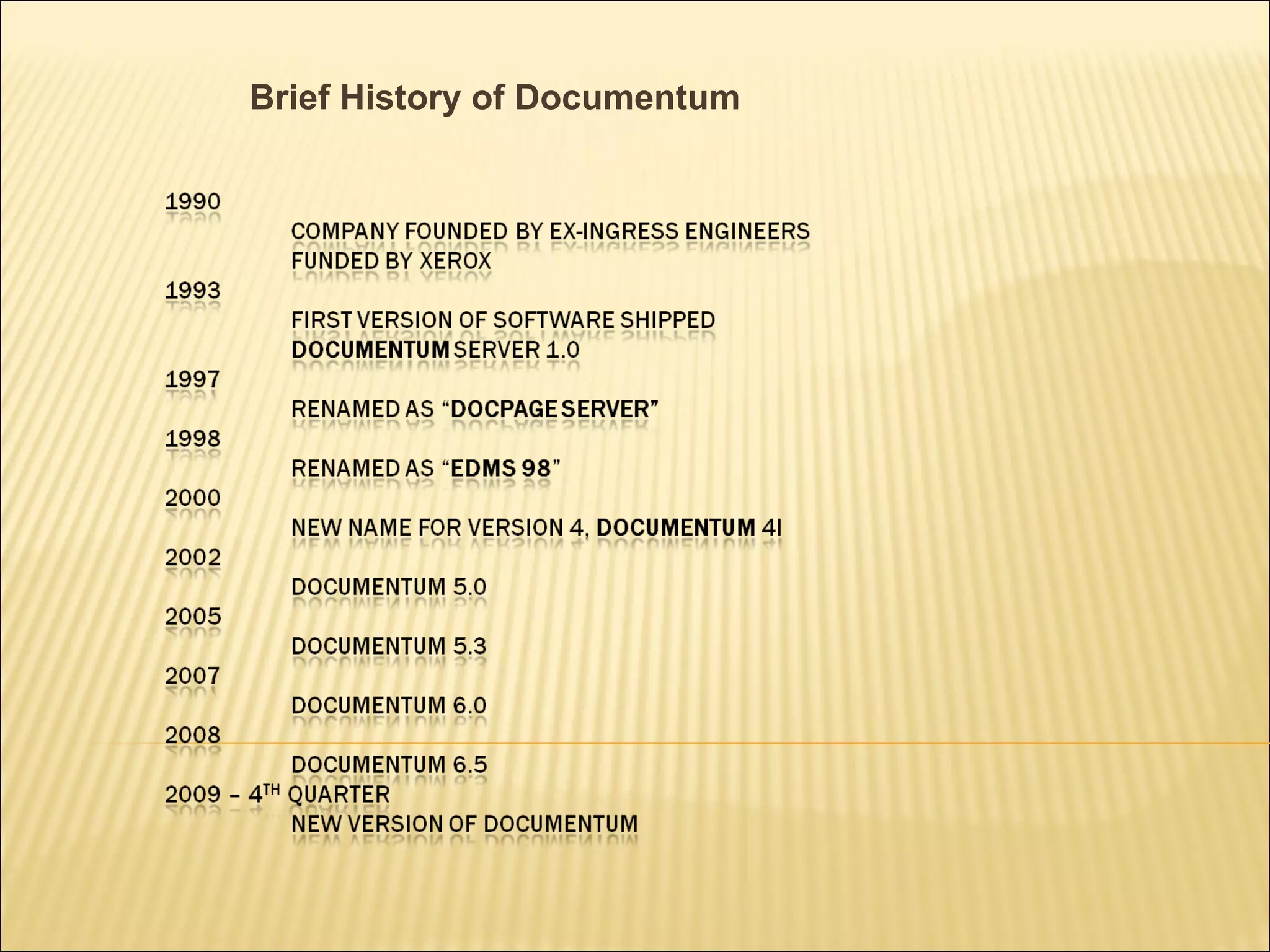
Brief History of Documentum
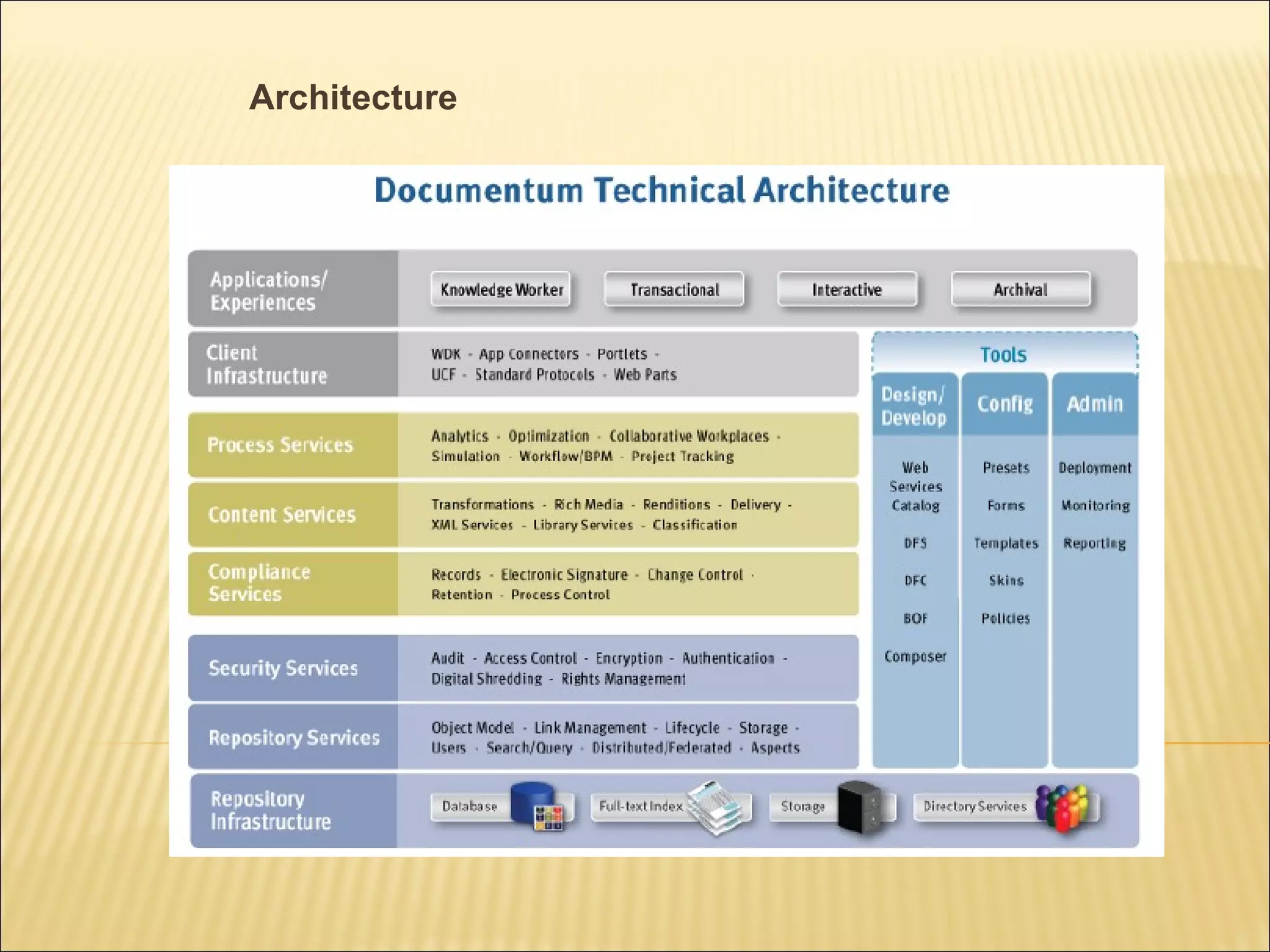
Architecture
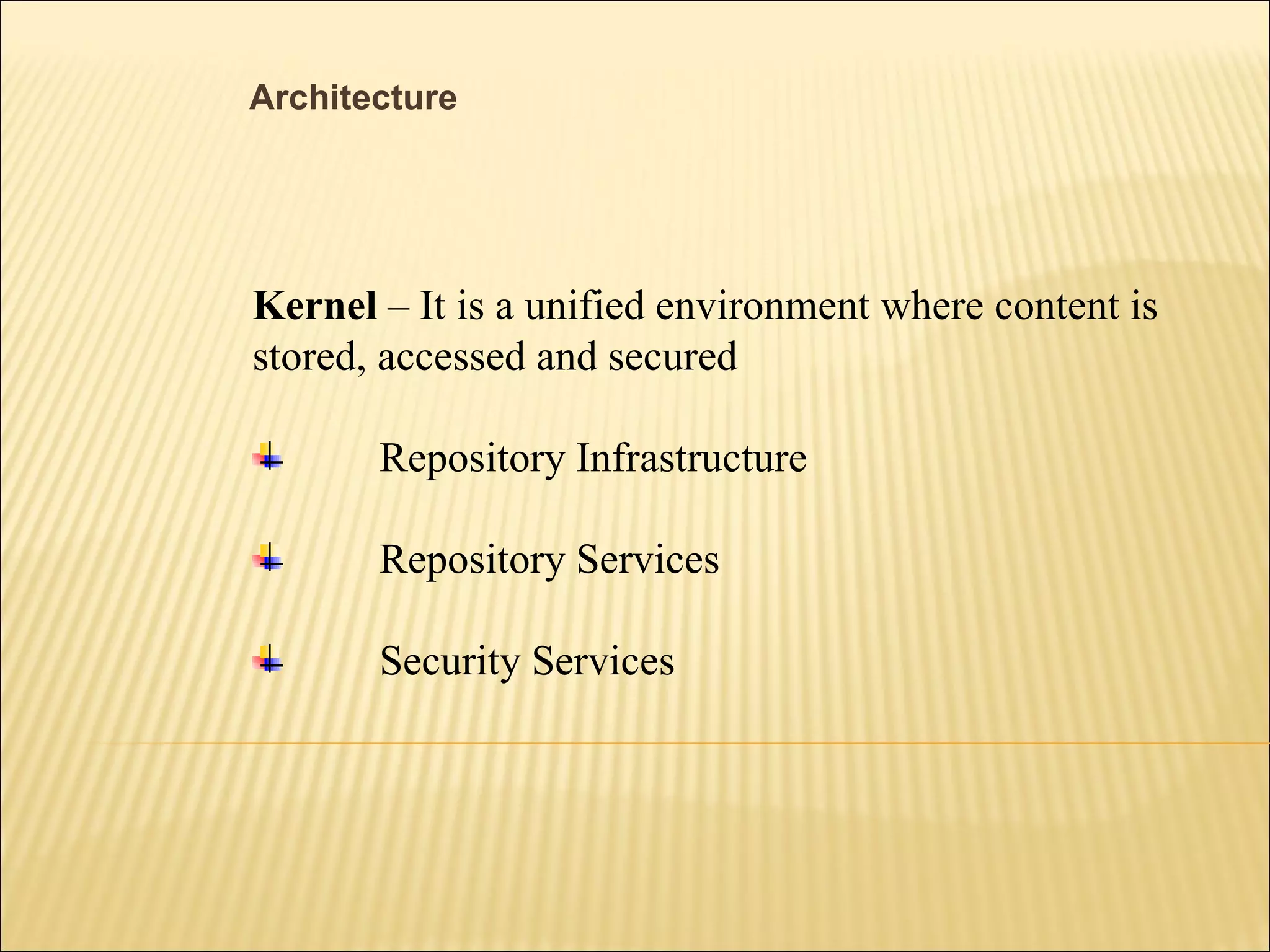
Architecture Kernel  – It is a unified environment where content is stored, accessed and secured Repository Infrastructure Repository Services Security Services
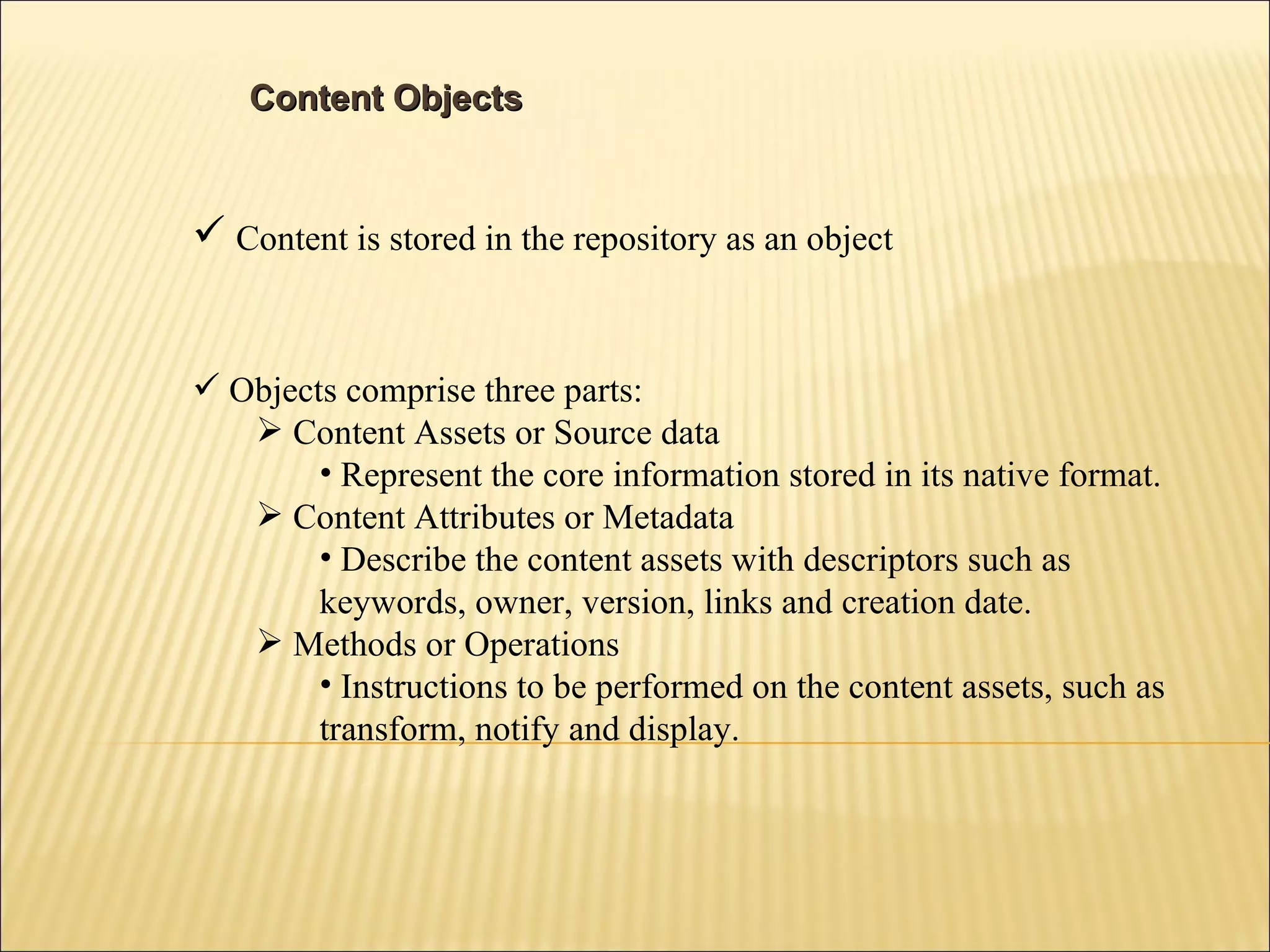
Content Objects Content is stored in the repository as an object Objects comprise three parts: Content Assets or Source data Represent the core information stored in its native format. Content Attributes or Metadata Describe the content assets with descriptors such as keywords, owner, version, links and creation date. Methods or Operations Instructions to be performed on the content assets, such as transform, notify and display.
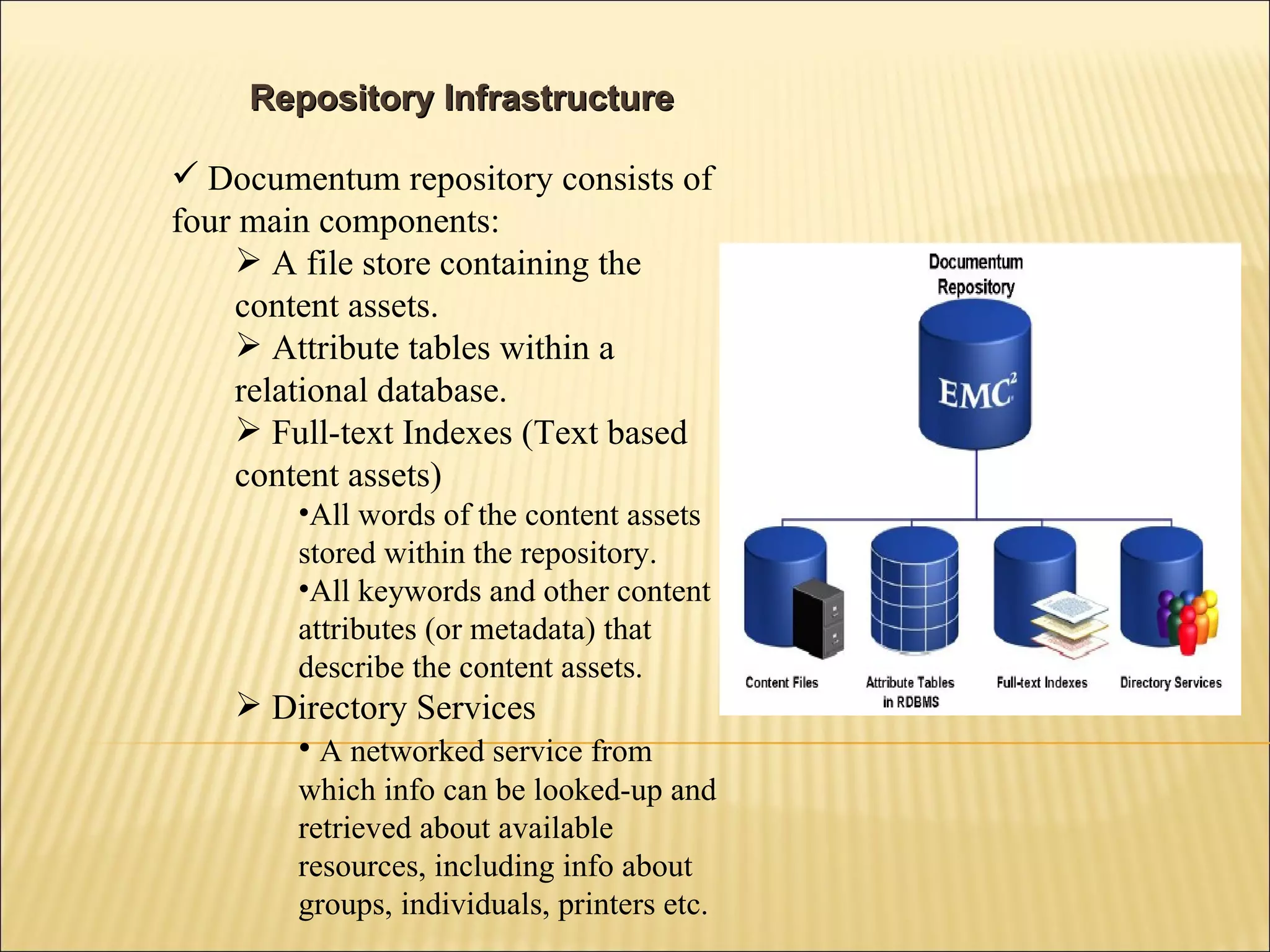
Repository Infrastructure Documentum repository consists of four main components: A file store containing the content assets. Attribute tables within a relational database. Full-text Indexes (Text based content assets) All words of the content assets stored within the repository. All keywords and other content attributes (or metadata) that describe the content assets. Directory Services A networked service from which info can be looked-up and retrieved about available resources, including info about groups, individuals, printers etc.
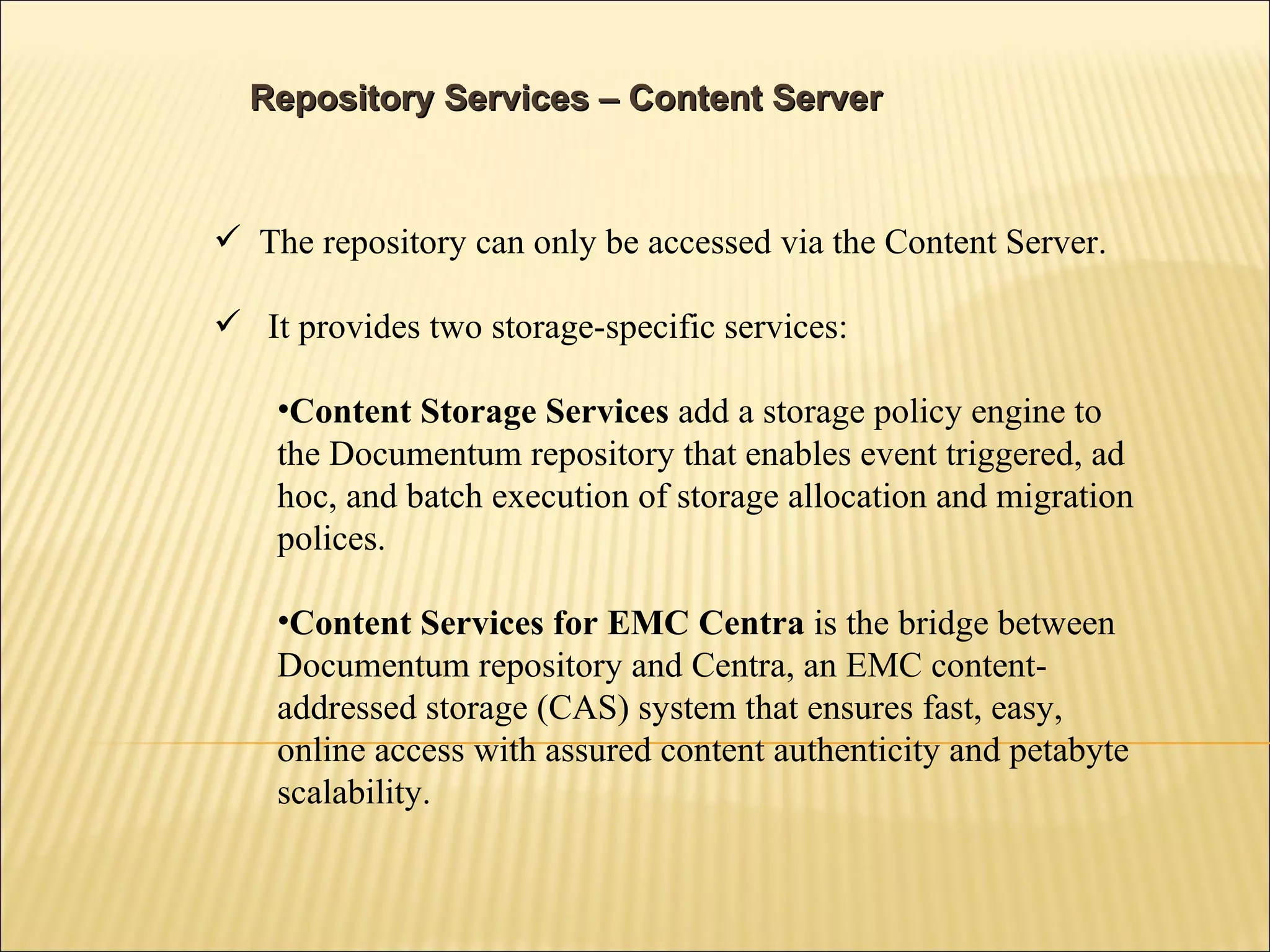
Repository Services – Content Server The repository can only be accessed via the Content Server. It provides two storage-specific services:  Content Storage Services  add a storage policy engine to the Documentum repository that enables event triggered, ad hoc, and batch execution of storage allocation and migration polices. Content Services for EMC Centra  is the bridge between Documentum repository and Centra, an EMC content-addressed storage (CAS) system that ensures fast, easy, online access with assured content authenticity and petabyte scalability.
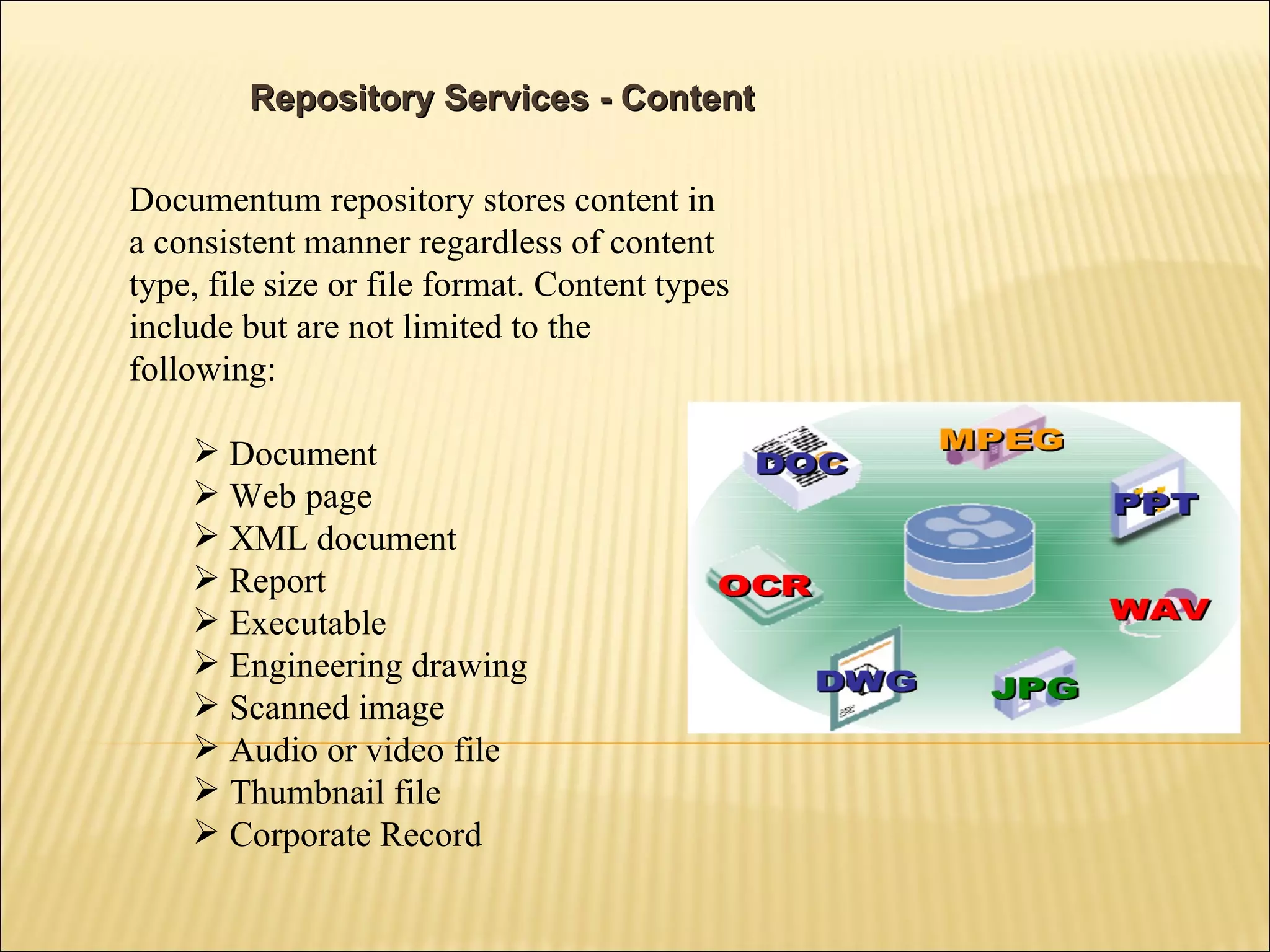
Repository Services - Content Documentum repository stores content in a consistent manner regardless of content type, file size or file format. Content types include but are not limited to the following: Document Web page XML document Report Executable Engineering drawing Scanned image Audio or video file Thumbnail file Corporate Record
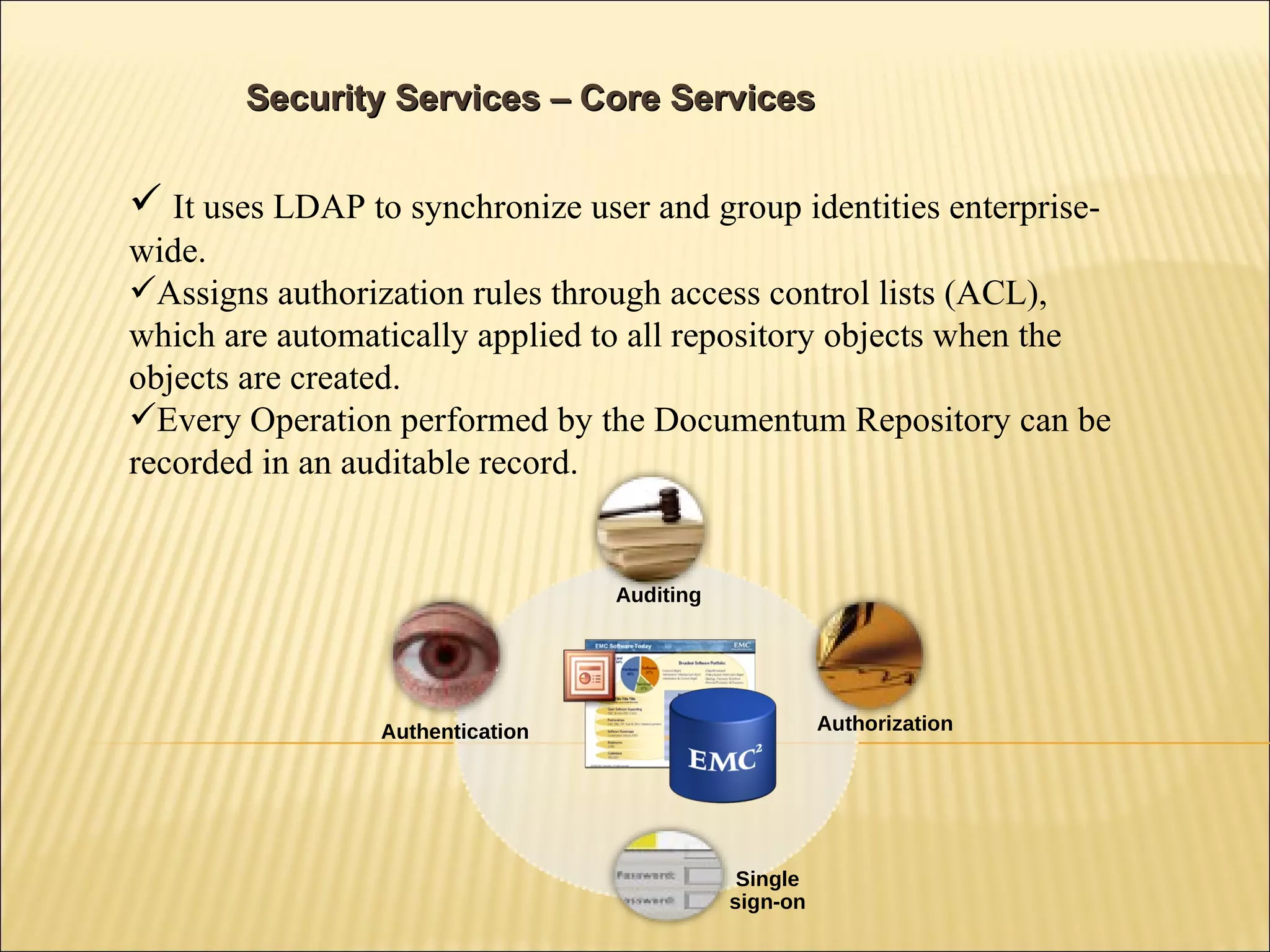
It uses LDAP to synchronize user and group identities enterprise-wide.  Assigns authorization rules through access control lists (ACL), which are automatically applied to all repository objects when the objects are created. Every Operation performed by the Documentum Repository can be recorded in an auditable record. Security Services – Core Services Auditing Authentication Authorization Single sign-on
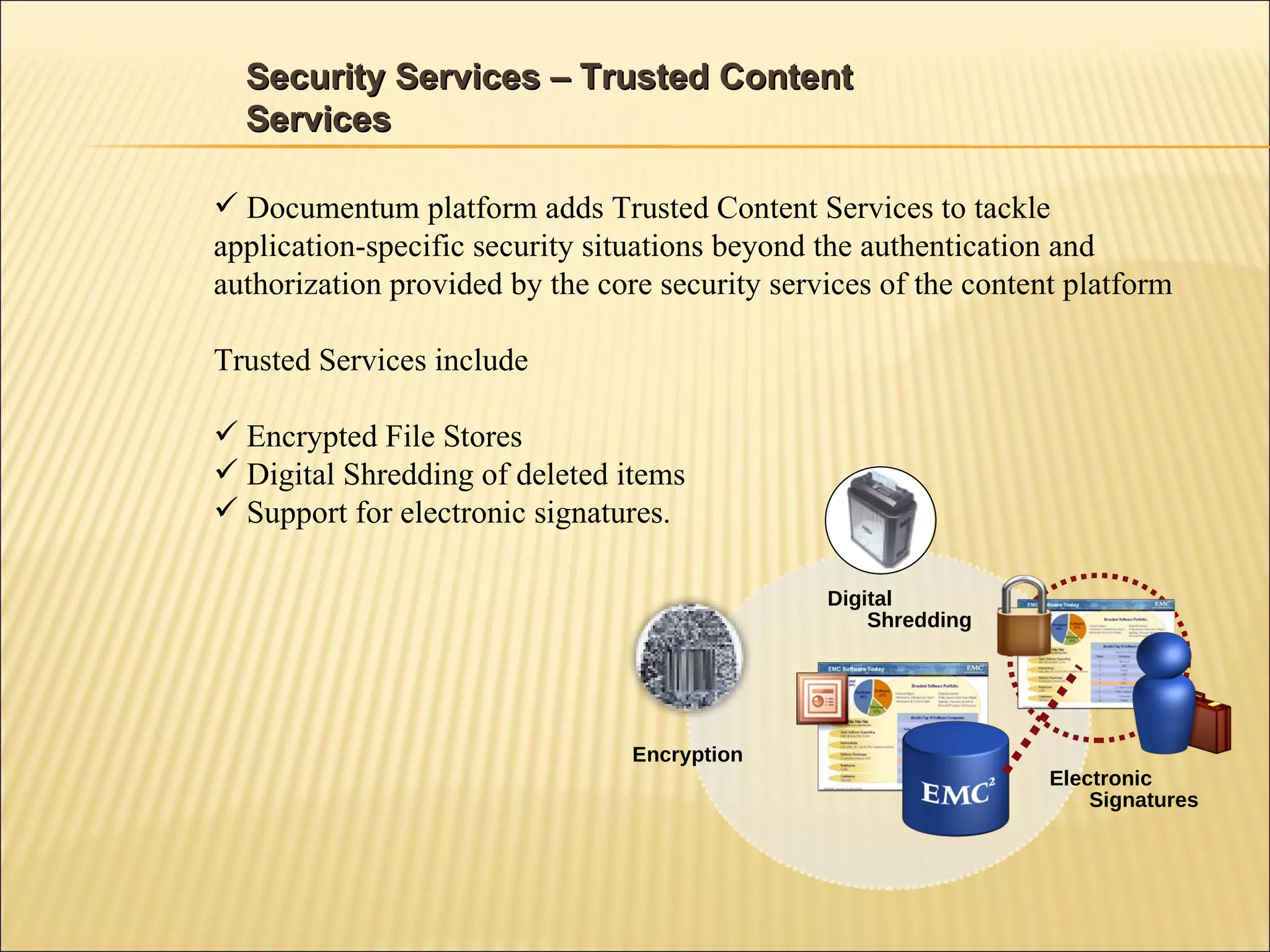
Security Services – Trusted Content Services Documentum platform adds Trusted Content Services to tackle application-specific security situations beyond the authentication and authorization provided by the core security services of the content platform Trusted Services include Encrypted File Stores Digital Shredding of deleted items Support for electronic signatures.  Digital Shredding Encryption Electronic Signatures
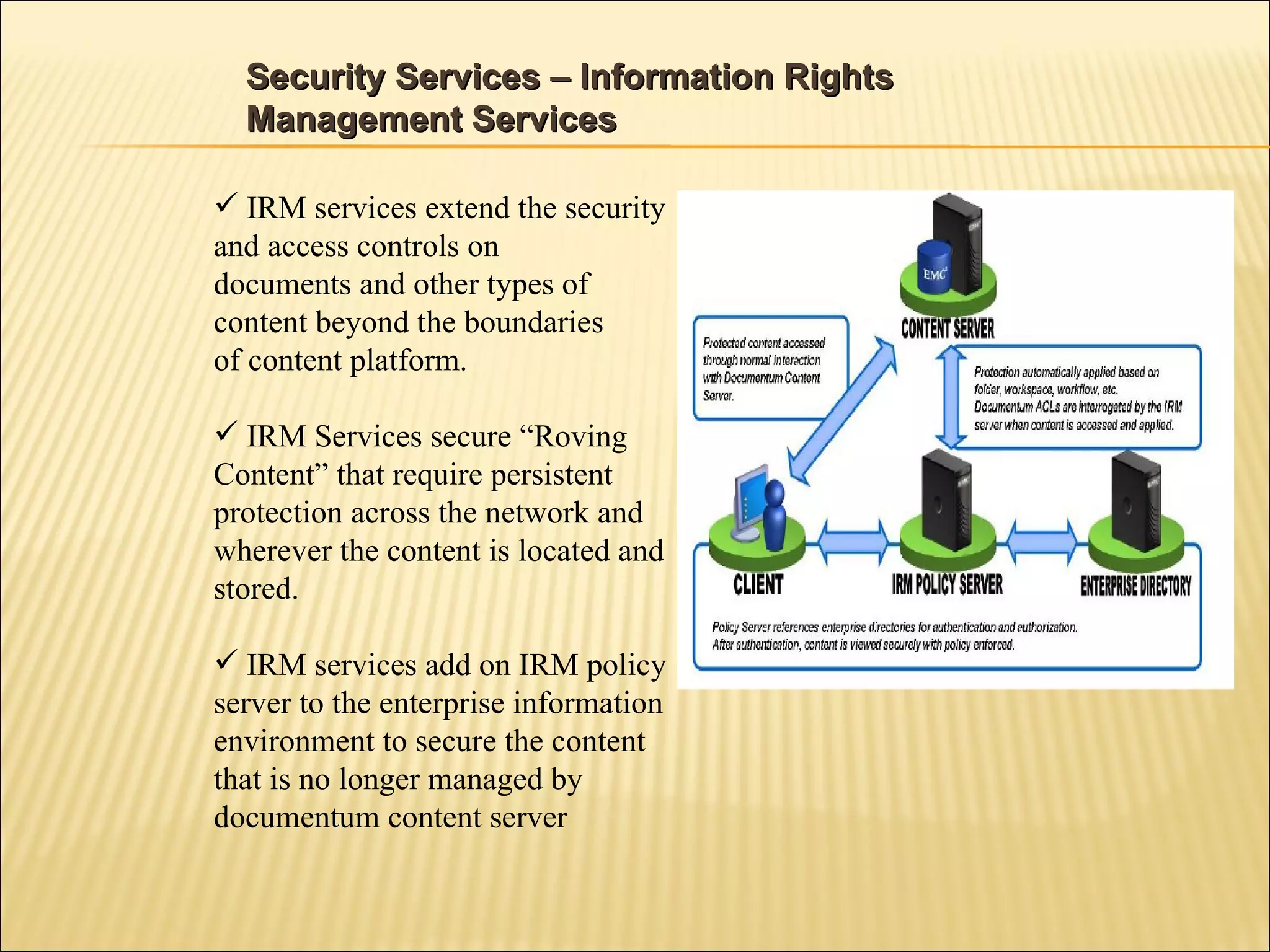
Security Services – Information Rights Management Services IRM services extend the security and access controls on documents and other types of content beyond the boundaries of content platform. IRM Services secure “Roving Content” that require persistent protection across the network and wherever the content is located and stored. IRM services add on IRM policy server to the enterprise information environment to secure the content that is no longer managed by documentum content server
Architecture Application Services Group  – Provides various application- level services for organizing, controlling, sequencing and  delivering content to, and from the repository. Compliance Services Content Services Process Services
Compliance Services – Retention Policy Services Compliance Services provide capabilities for retaining content and managing content as records. These are  Retention Policy Services Records Manager RPS specify and enforce the retention of objects in the documentum repository by attaching one or more retention policies to the objects. The objects cannot be changed or deleted for the duration of the retention policy.  RPS enhances the standard documentum controls along three important dimensions: Notifications Auditing Reporting
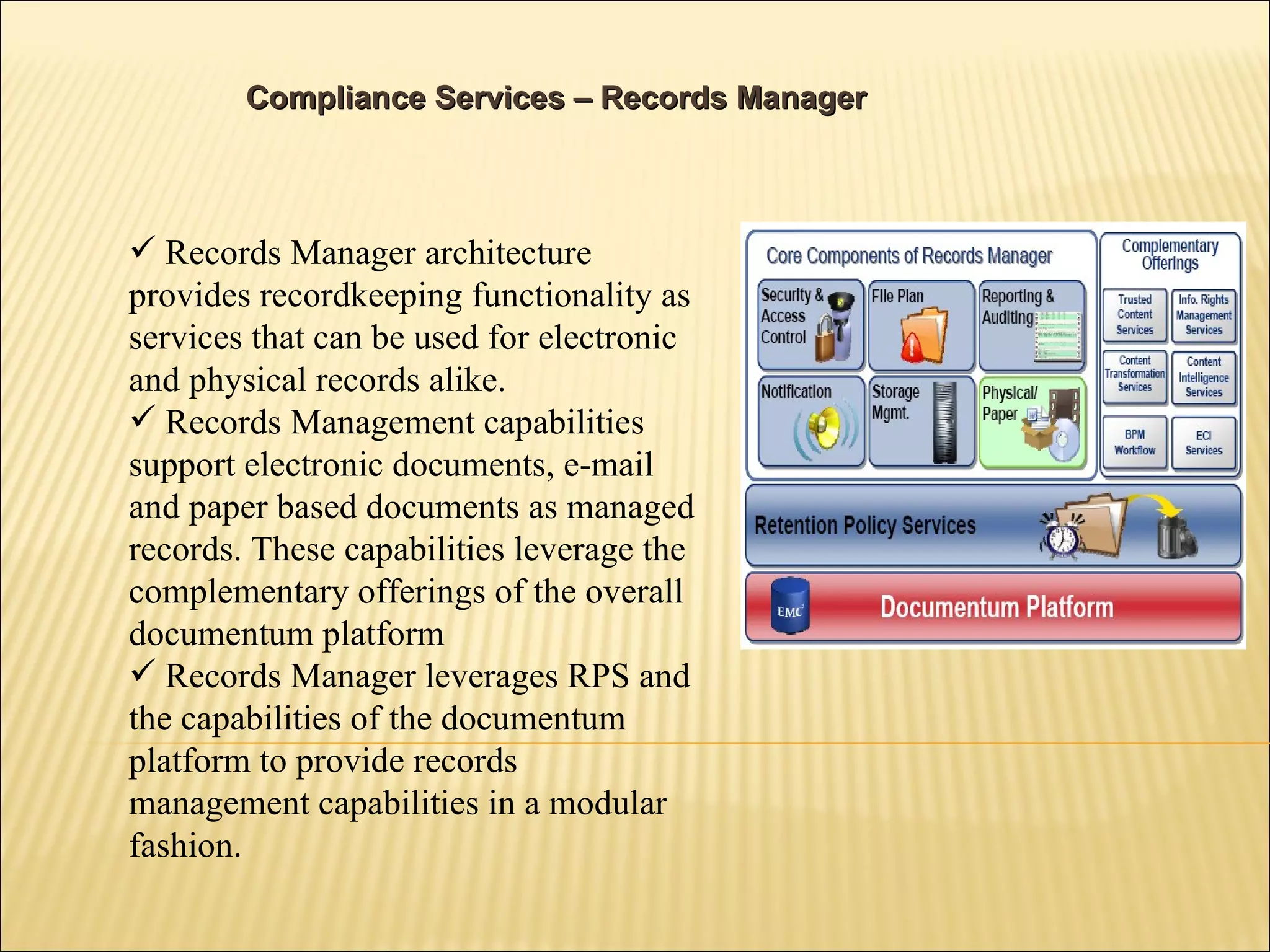
Compliance Services – Records Manager Records Manager architecture provides recordkeeping functionality as services that can be used for electronic and physical records alike. Records Management capabilities support electronic documents, e-mail and paper based documents as managed records. These capabilities leverage the complementary offerings of the overall documentum platform Records Manager leverages RPS and the capabilities of the documentum platform to provide records management capabilities in a modular fashion.
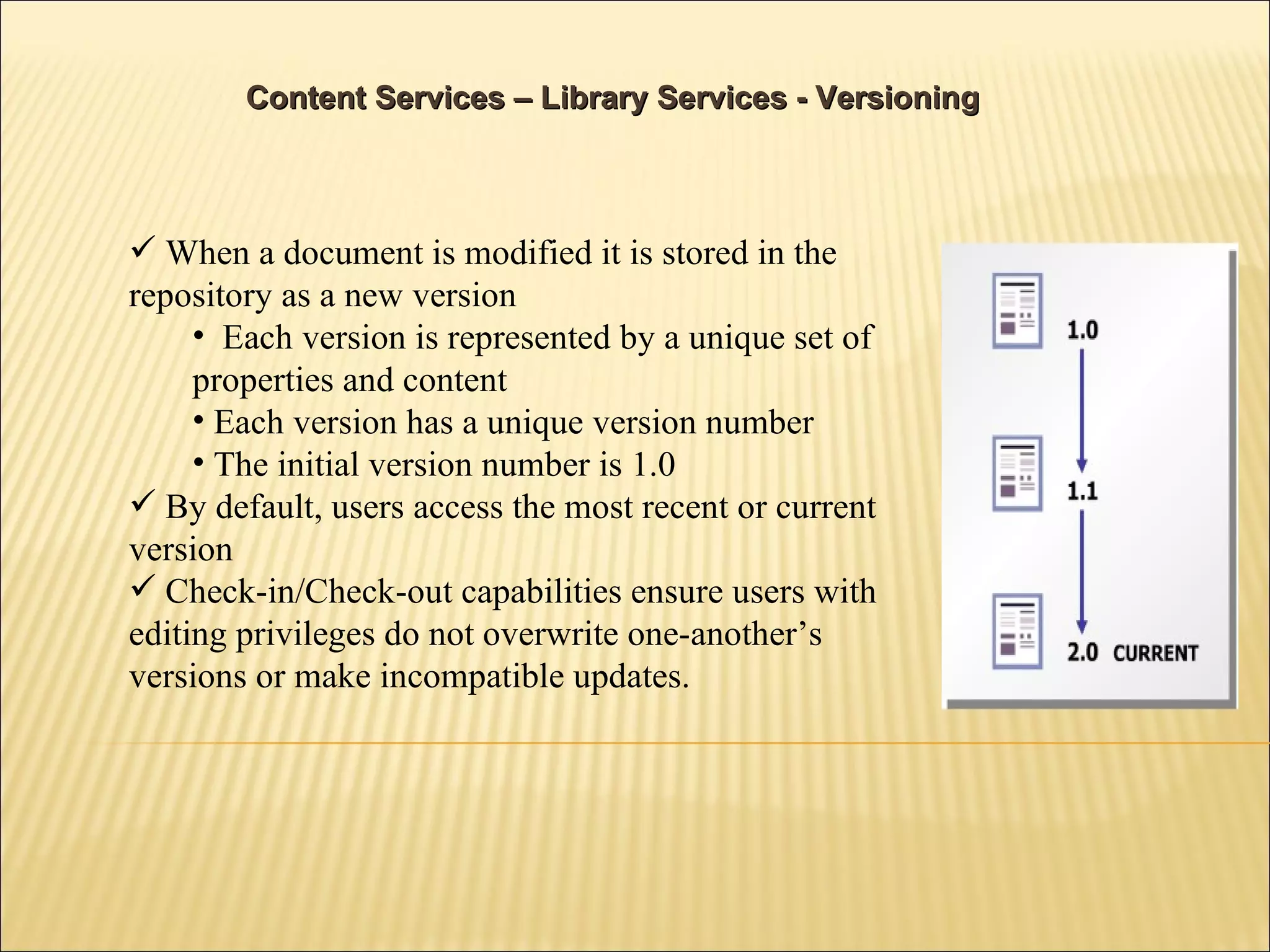
Content Services – Library Services - Versioning When a document is modified it is stored in the repository as a new version Each version is represented by a unique set of properties and content Each version has a unique version number The initial version number is 1.0 By default, users access the most recent or current version Check-in/Check-out capabilities ensure users with editing privileges do not overwrite one-another’s versions or make incompatible updates.
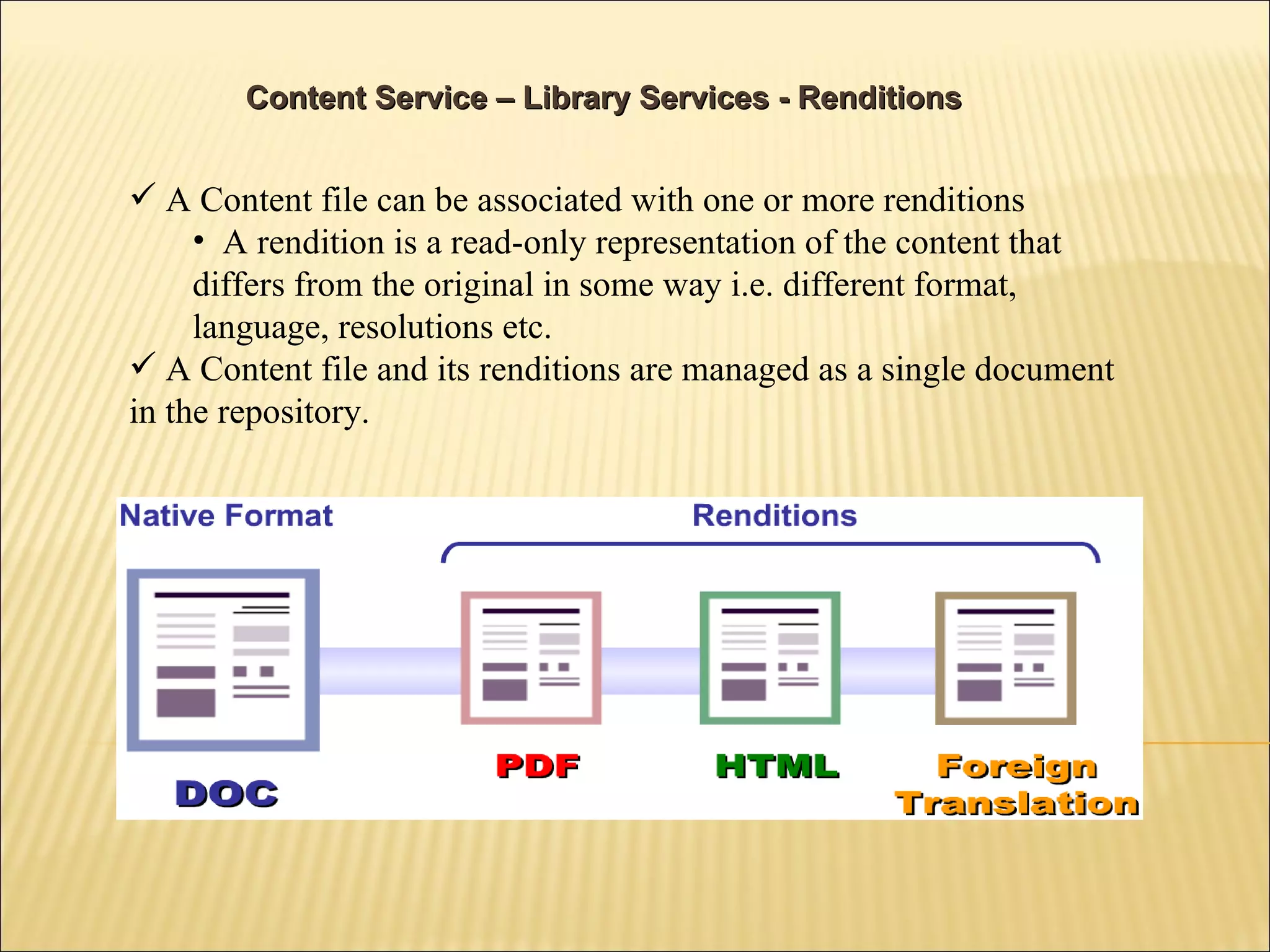
A Content file can be associated with one or more renditions A rendition is a read-only representation of the content that differs from the original in some way i.e. different format, language, resolutions etc. A Content file and its renditions are managed as a single document in the repository. Content Service – Library Services - Renditions
Content Services – Workflow Services Documentum workflow automates business activities and policies for repository content. A workflow is defined by a model, the sequence of steps that comprise the process, and the actions that must occur at each step. A workflow can be serial with activities occurring one after another, or parallel, with all activities occurring simultaneously
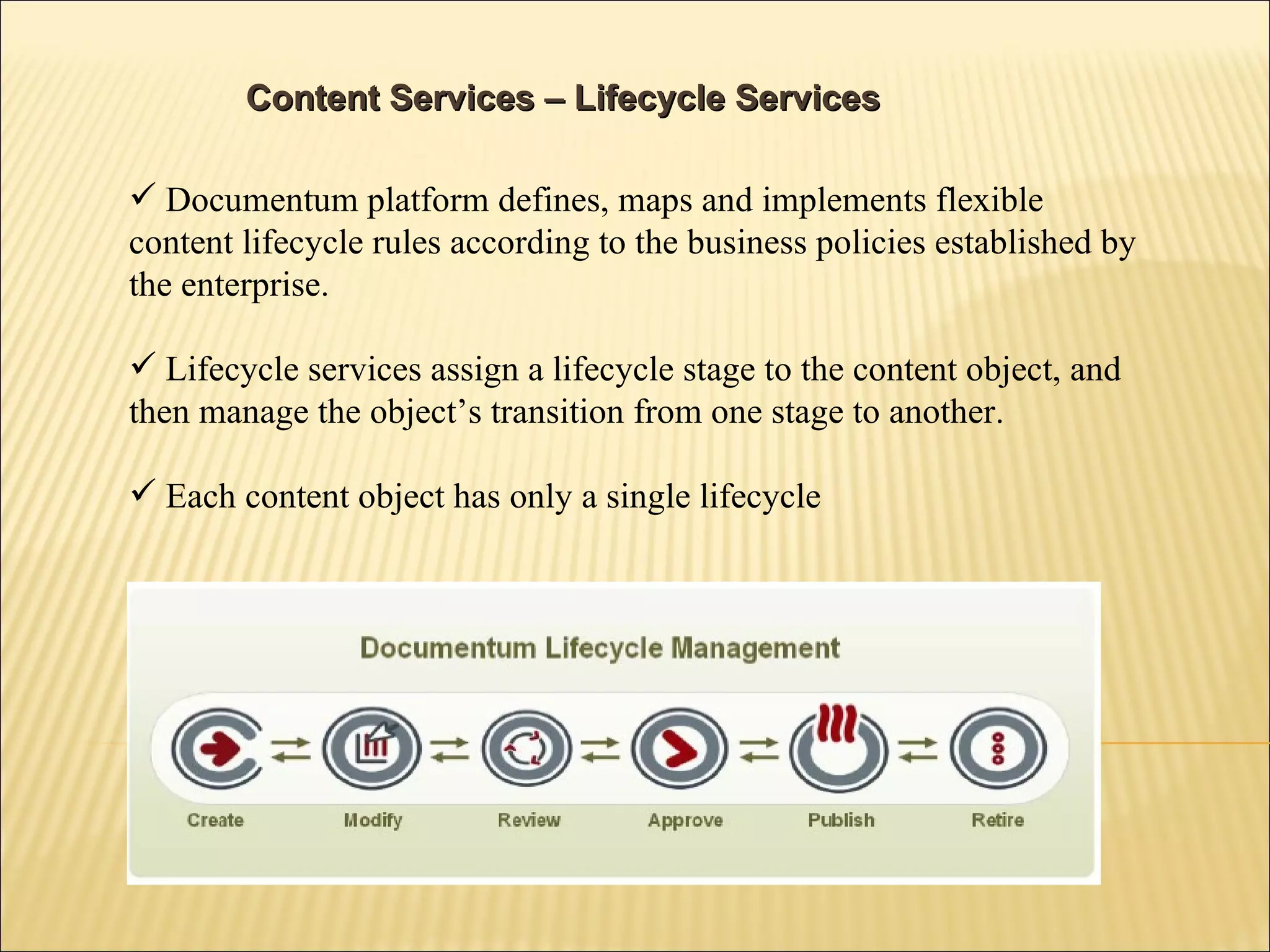
Content Services – Lifecycle Services Documentum platform defines, maps and implements flexible content lifecycle rules according to the business policies established by the enterprise. Lifecycle services assign a lifecycle stage to the content object, and then manage the object’s transition from one stage to another. Each content object has only a single lifecycle
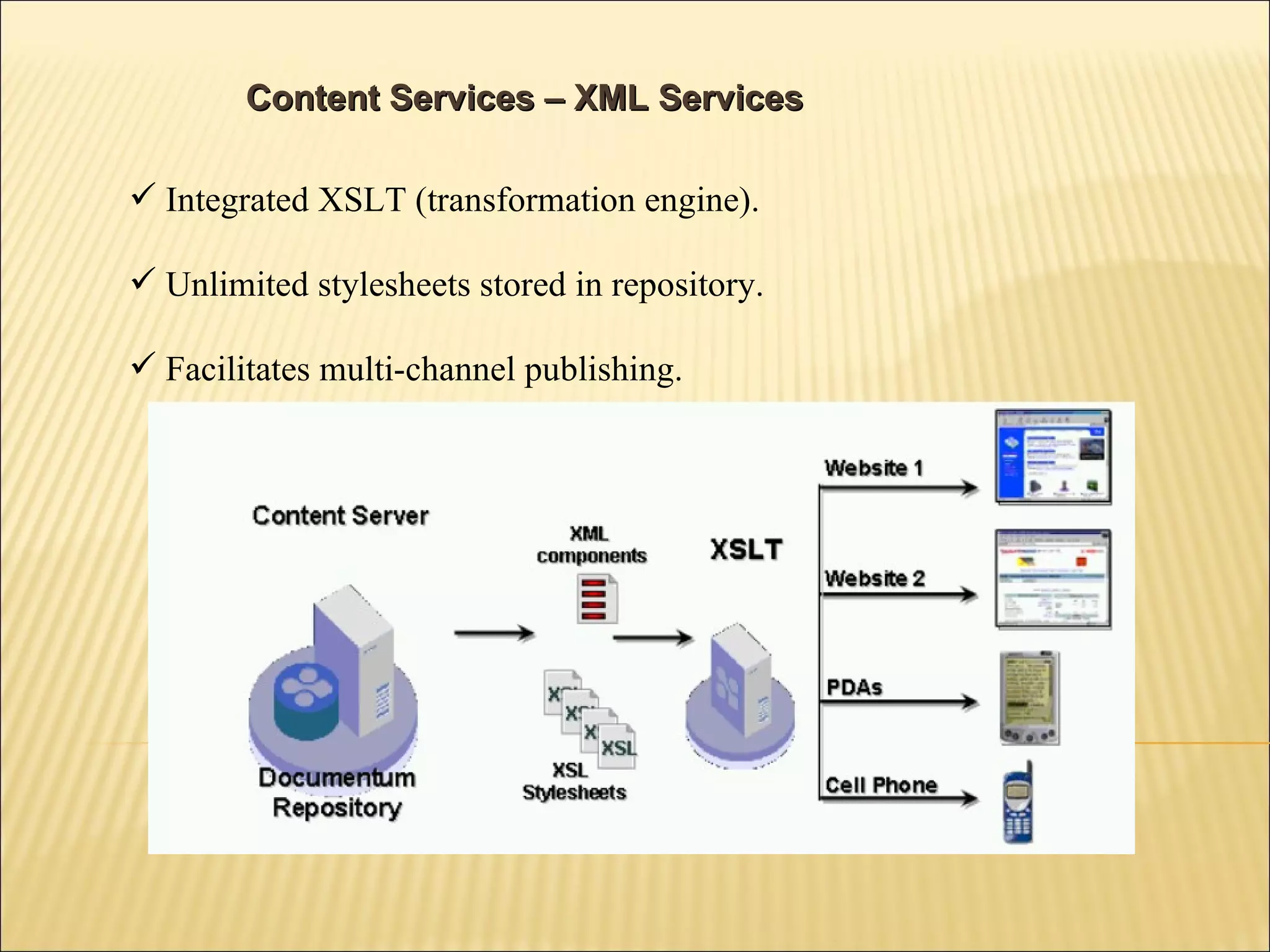
Content Services – XML Services Integrated XSLT (transformation engine). Unlimited stylesheets stored in repository. Facilitates multi-channel publishing.
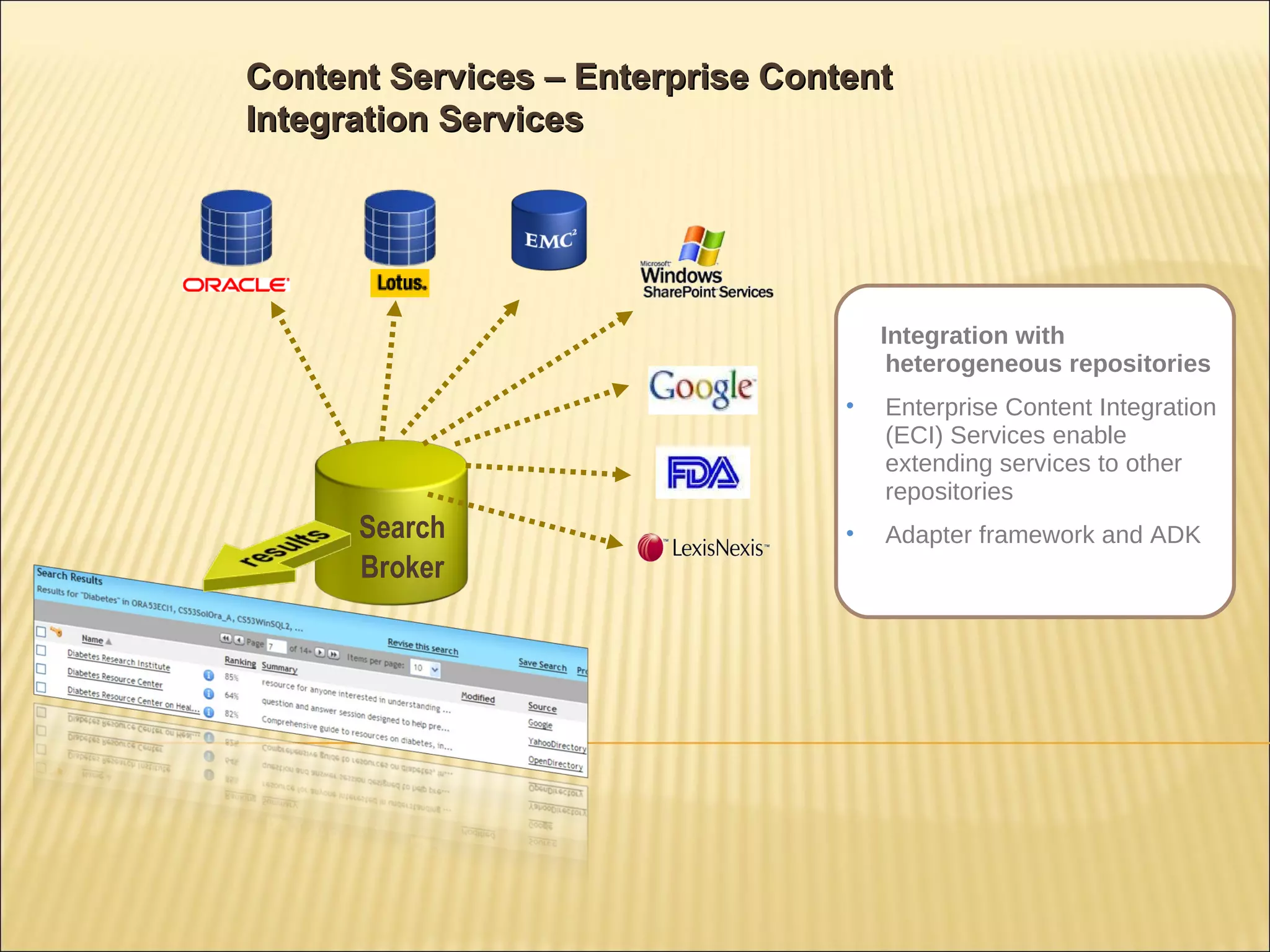
Content Services – Enterprise Content Integration Services Integration with heterogeneous repositories  Enterprise Content Integration (ECI) Services enable extending services to other repositories  Adapter framework and ADK Search Broker
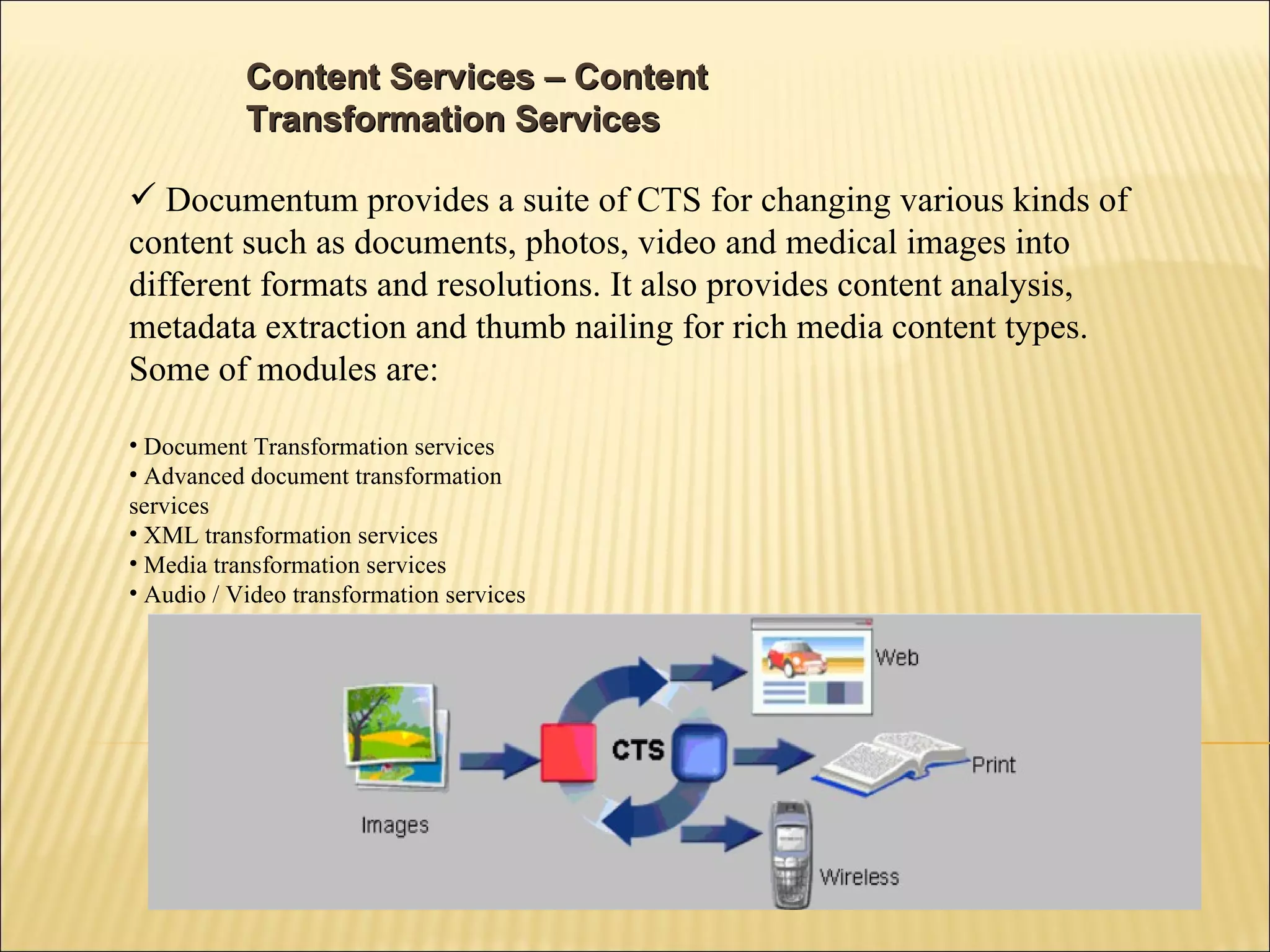
Content Services – Content Transformation Services  Documentum provides a suite of CTS for changing various kinds of content such as documents, photos, video and medical images into different formats and resolutions. It also provides content analysis, metadata extraction and thumb nailing for rich media content types. Some of modules are: Document Transformation services Advanced document transformation  services XML transformation services Media transformation services Audio / Video transformation services
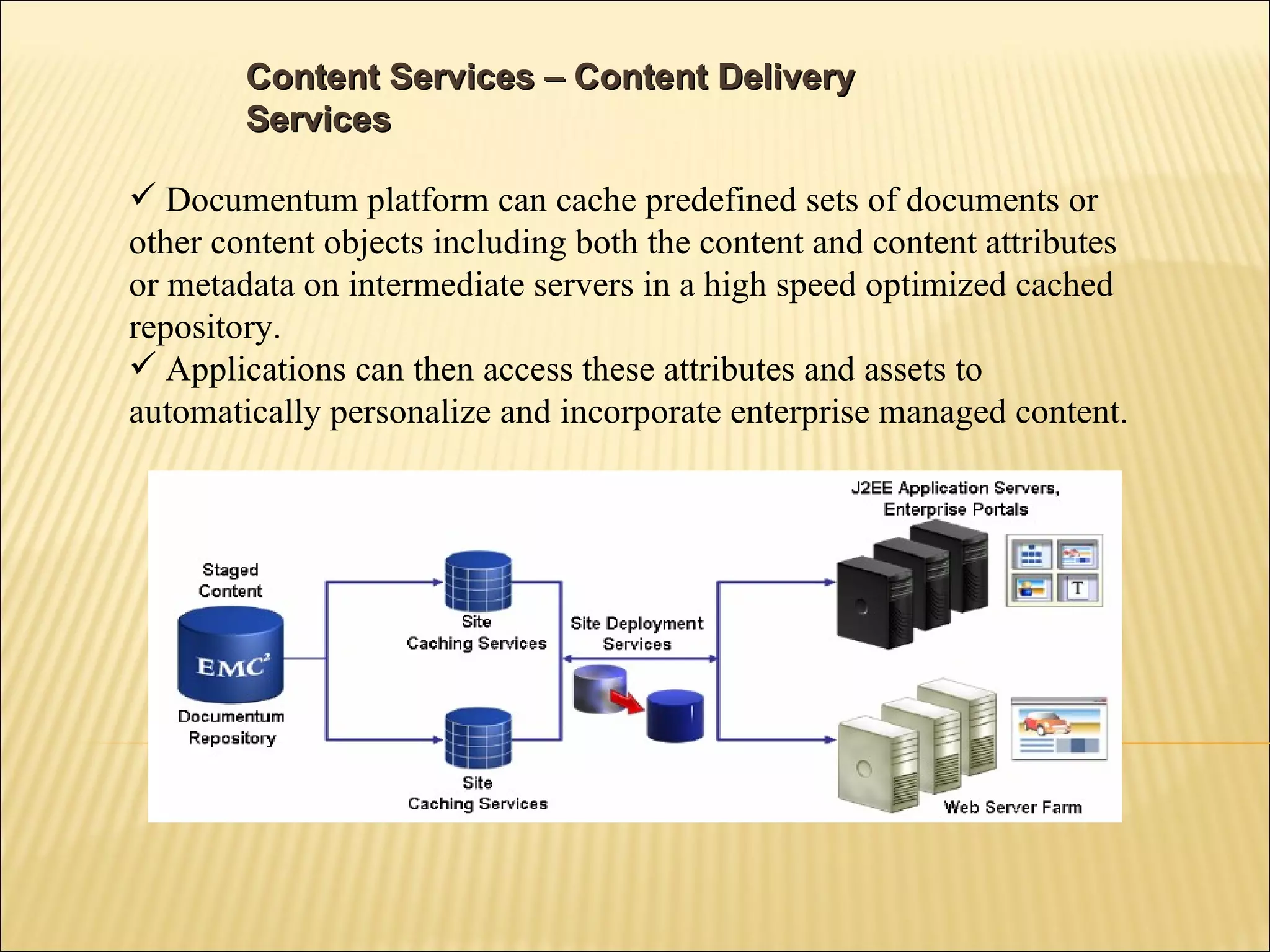
Content Services – Content Delivery Services  Documentum platform provides sophisticated content deployment and delivery services to supply content to web server farms, enterprise portals and servers. Documentum platform can be integrated with a wide variety of network accessible application, personalization, portal and e-commerce servers from enterprise vendors such as BEA, IBM, MS, Oracle. Site Caching Services It adds flexibility for distributing content to disparate delivery environments. Site Deployment Services It complements site caching services by automatically delivering content to multiple external web servers. If the content cannot be delivered as scheduled, these services also support rollback with self-repair.
Content Services – Content Delivery Services  Documentum platform can cache predefined sets of documents or other content objects including both the content and content attributes or metadata on intermediate servers in a high speed optimized cached repository. Applications can then access these attributes and assets to automatically personalize and incorporate enterprise managed content.
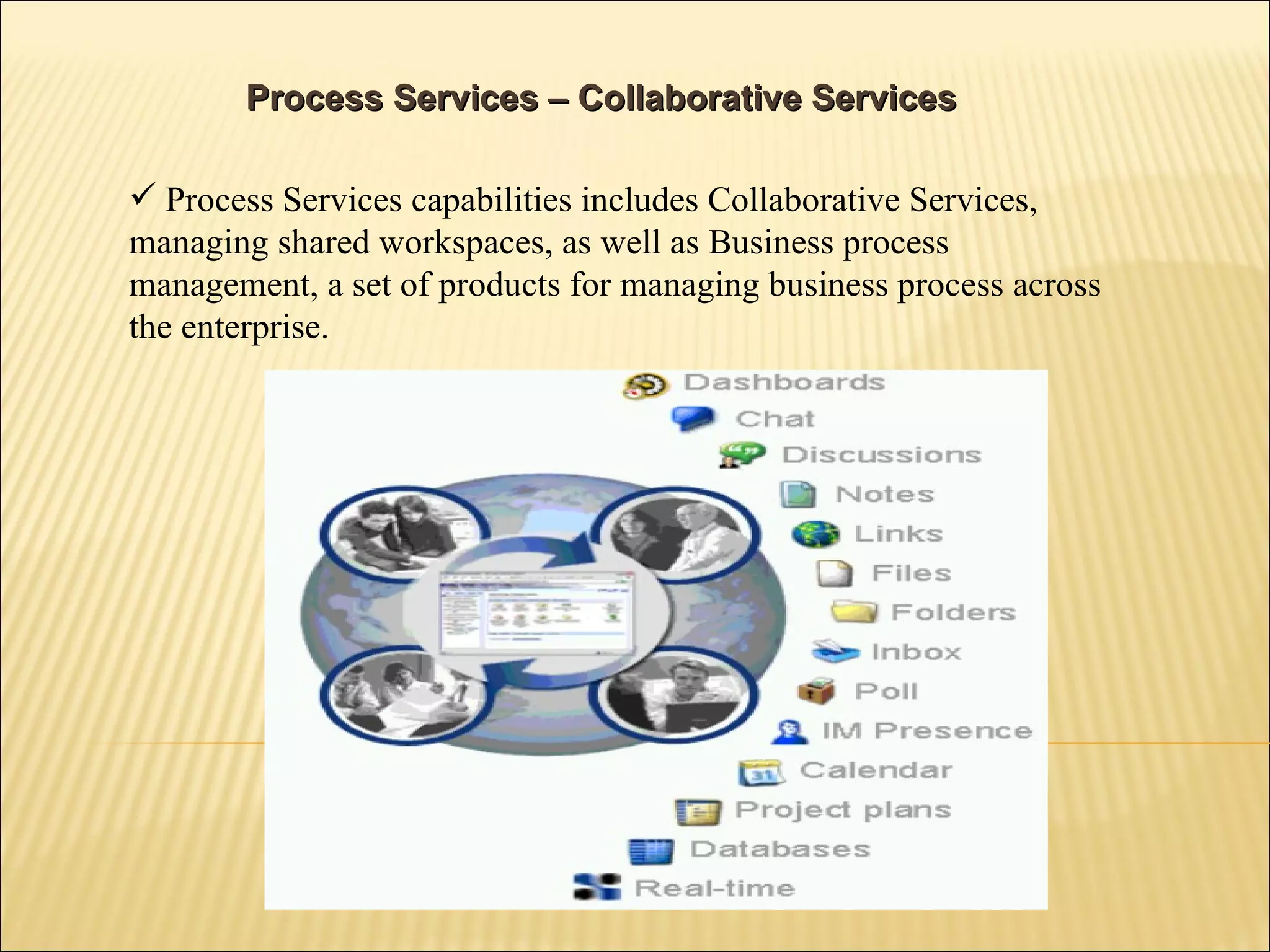
Process Services – Collaborative Services  Process Services capabilities includes Collaborative Services, managing shared workspaces, as well as Business process management, a set of products for managing business process across the enterprise.
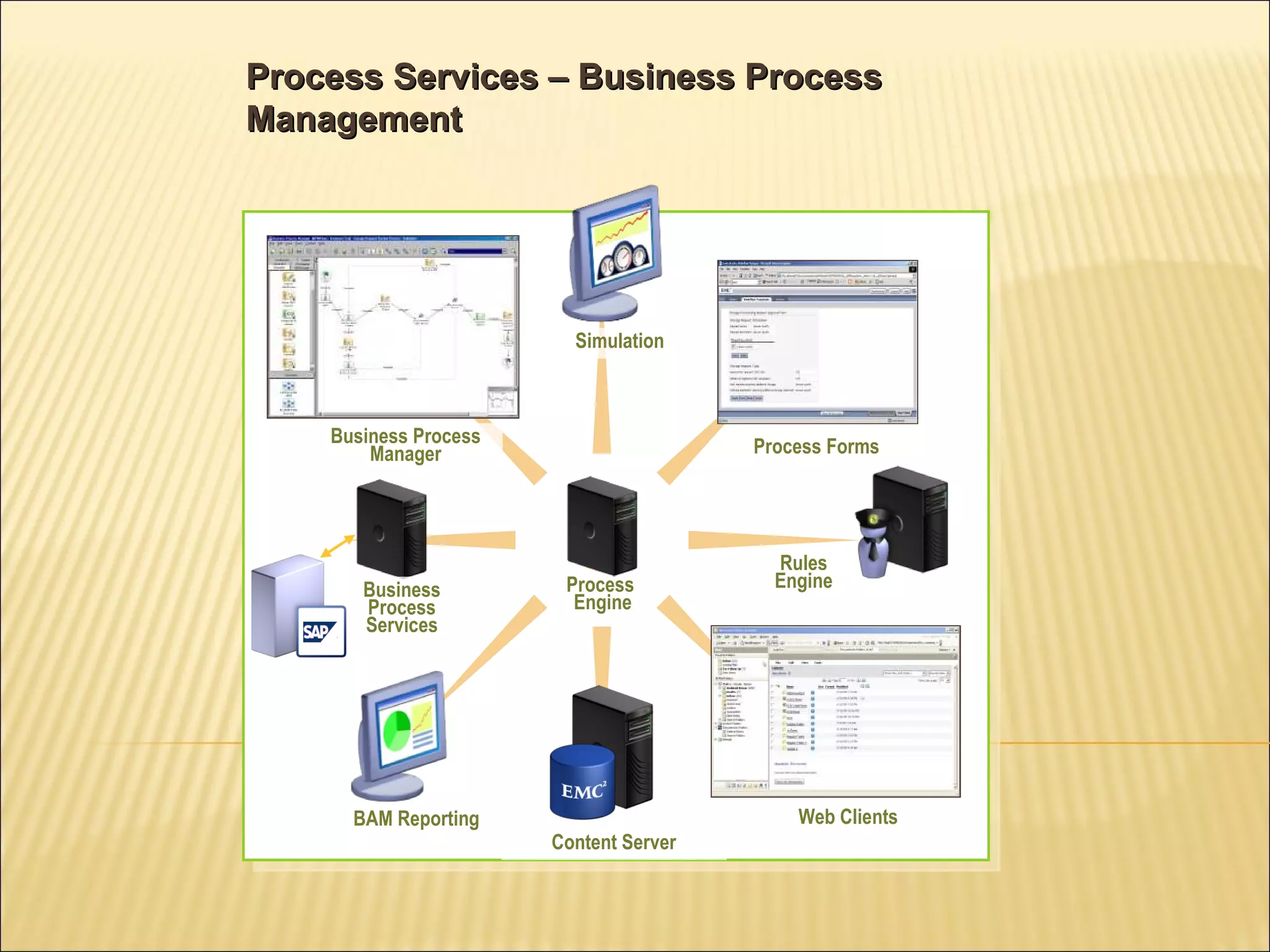
Process Services – Business Process Management  Documentum provides a complete suite of BPM products that manages the complete lifecycle of business processes across the enterprise. Business Activity Monitoring (BAM) engine monitors critical aspects of the business processes and provides up-to-date reports. Business Process Engine runs and manages the end-to-end processes and integrates with external applications through a SOA framework. All of content is stored and managed with the repository.
Process Services – Business Process Management  Process  Engine Business Process Manager Business Process Services BAM Reporting Simulation Process Forms Rules Engine Web Clients Content Server
Tools Group  – Provides capabilities for developing and deploying content applications. It also provides web services for integrating Content related objects with external enterprise applications.   Architecture
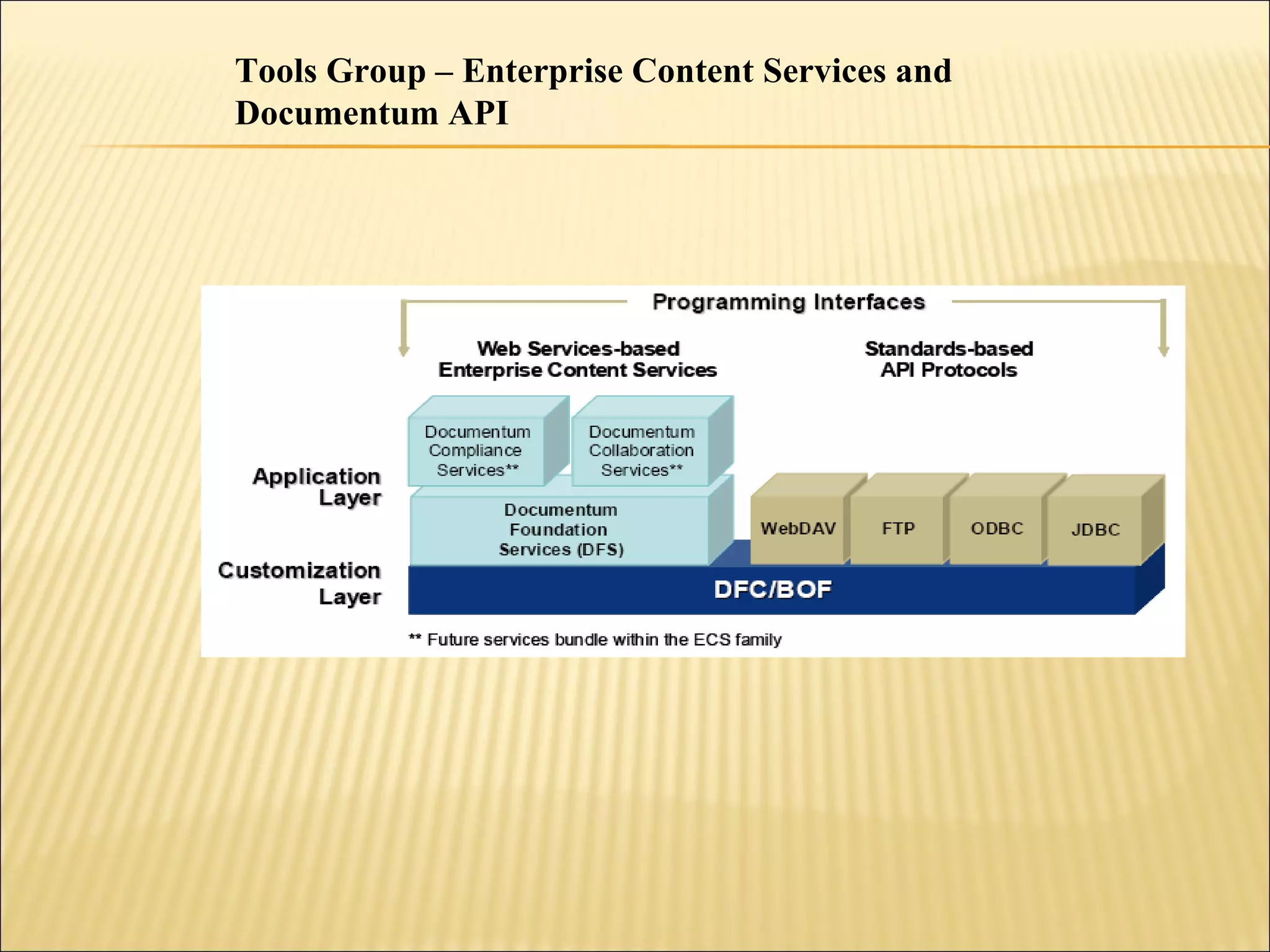
Tools Group – Enterprise Content Services and  Documentum API Documentum Foundation Classes (DFC) is the published and supported programming interface for accessing the functionality of the documentum Platform. It provides Java and COM class libraries that expose the functions that drive the documentum platform. Documentum Foundation Services (DFS) are an SOA development framework and API. They are based on web services, and designed to support interoperable machine-to-machine interaction over a network. Documentum Platform also includes Business Framework Object (BOF). BOF provides a framework and a methodology to develop reusable business logic components called Business Objects. This framework is built into DFC and accessible from applications written using DFC. It can implement business logic in reusable business object components that can be plugged into middle-tier or client applications.
Tools Group – Enterprise Content Services and  Documentum API
Experiences Group  – Provide the framework and interfaces enabling  users to process and use content management functionality in desktop or Browser based applications. Architecture
Experiences Group – WDK Framework Documentum platform includes a Web Development Kit (WDK), an application development framework for developing web based clients and user applications. WDK is used to provide a series of application connectors for  integrating documentum functionality within Word, Excel, PowerPoint and documentum client for outlook as well as portlets for exposing documentum functionality from within a portal. WDK framework provides a set of WDK services that run locally on a client-side device either within a browser or a desktop applications and interact with server-side business objects.
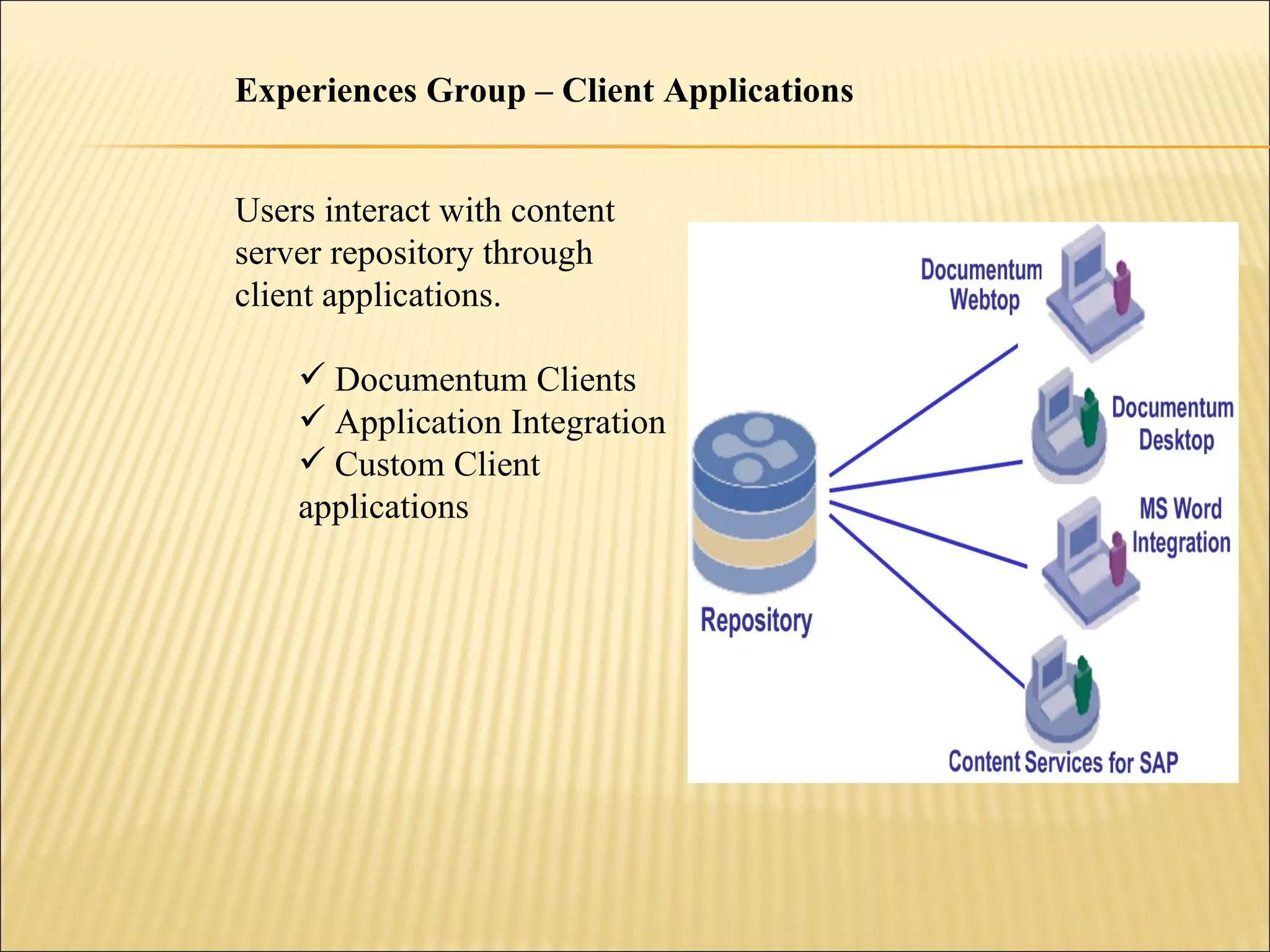
Experiences Group – Client Applications Users interact with content server repository through client applications. Documentum Clients Application Integration Custom Client applications
How EMC Documentum delivers
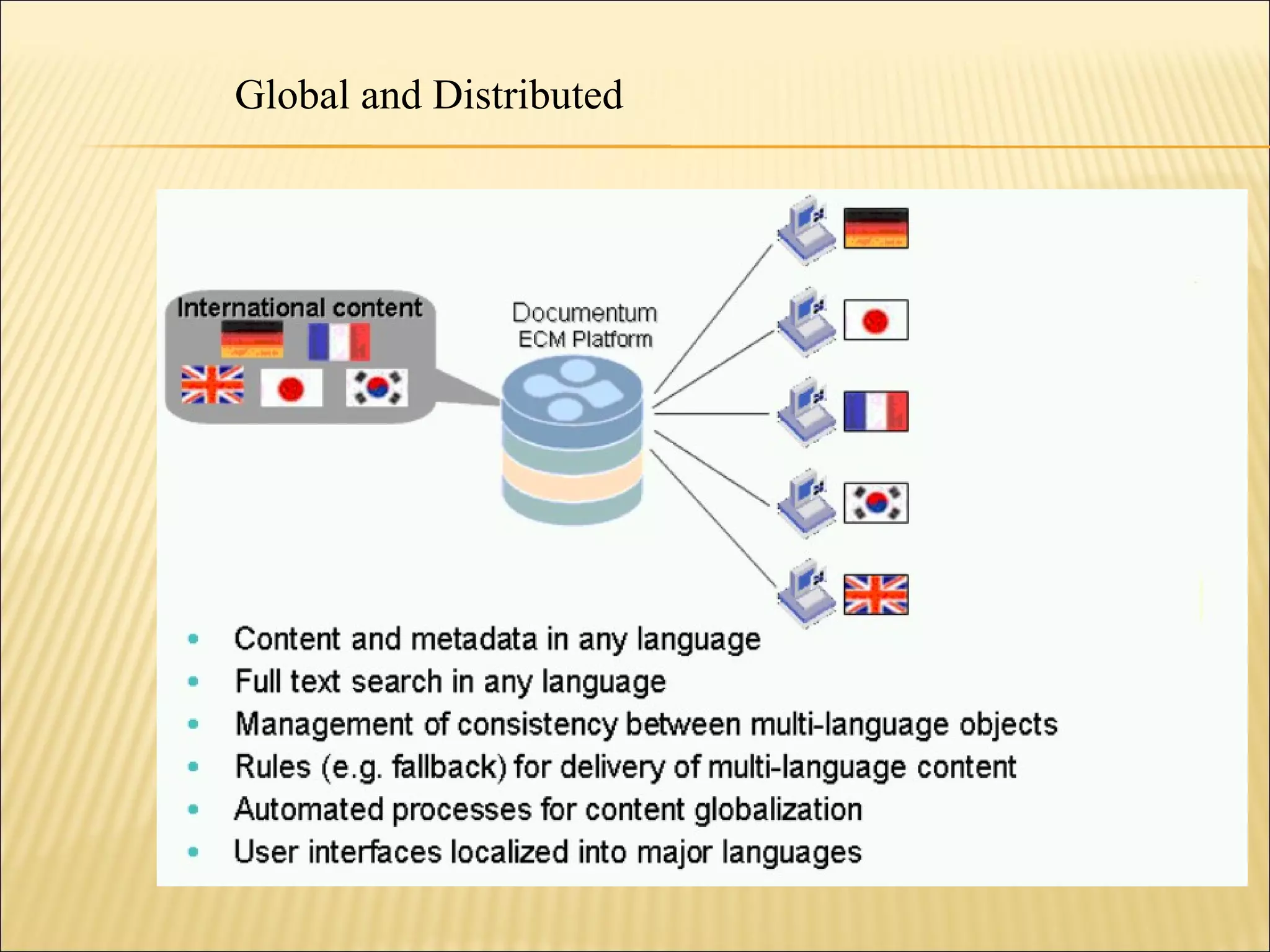
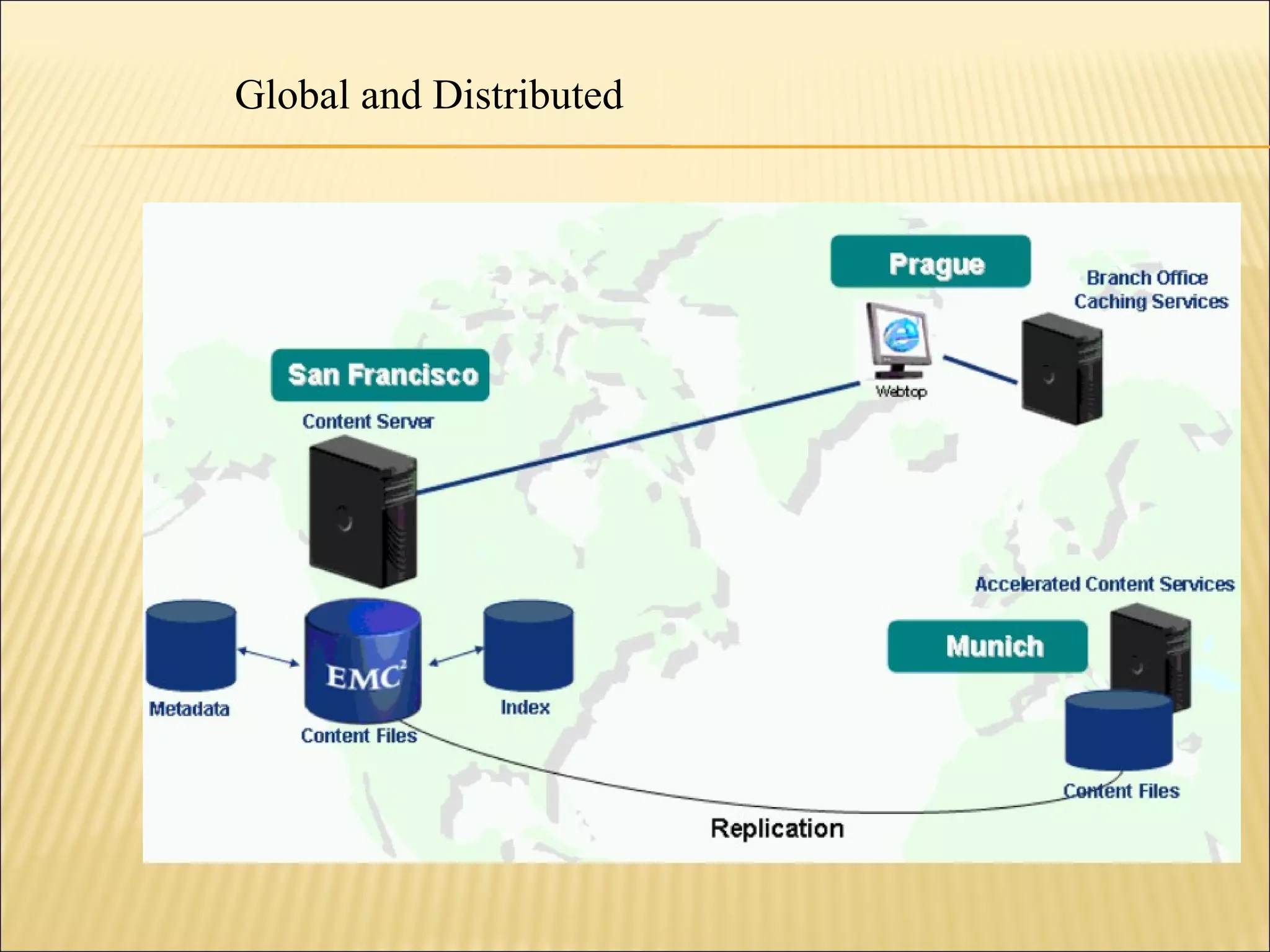
Global and Distributed
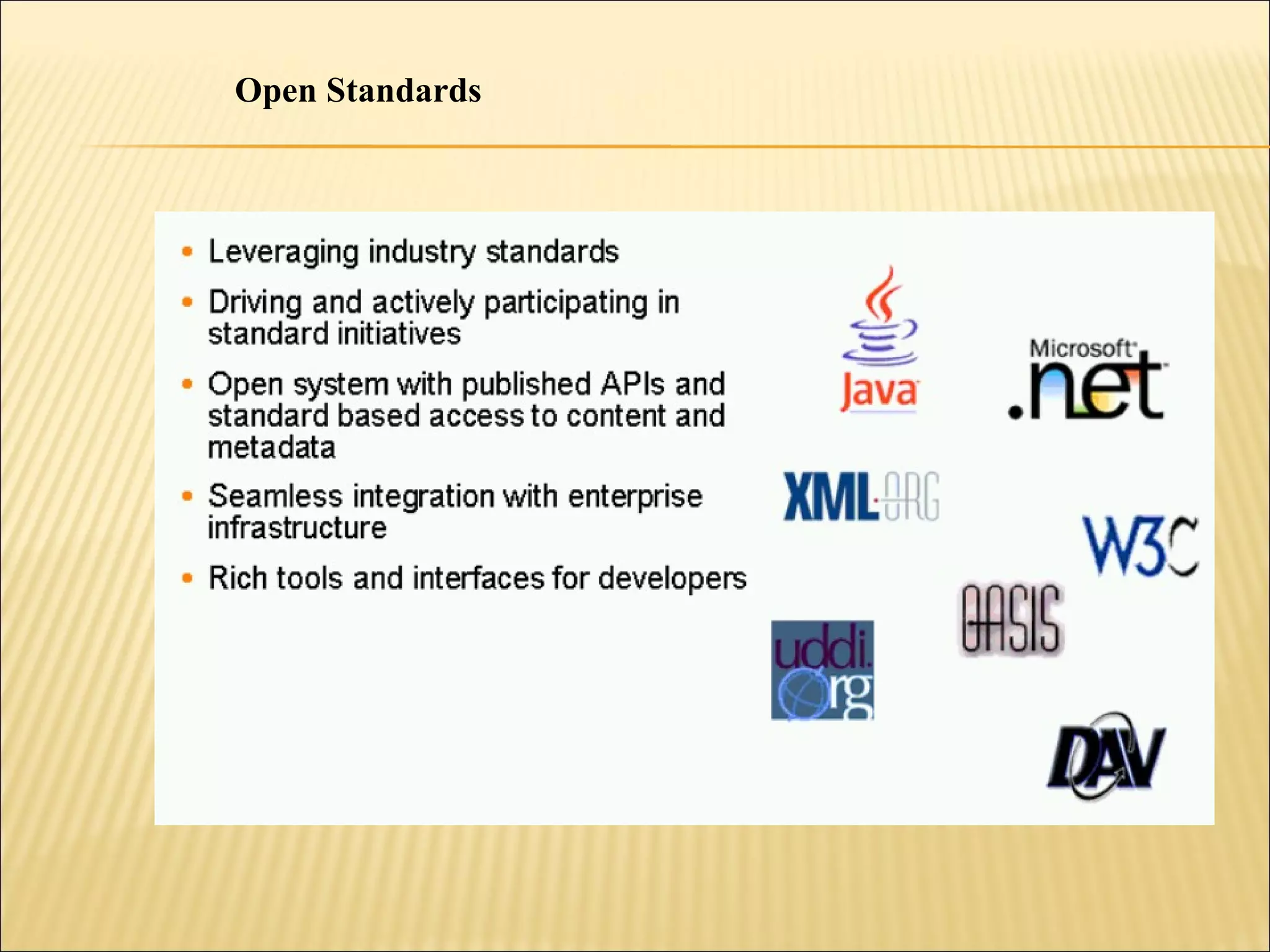
Open Standards
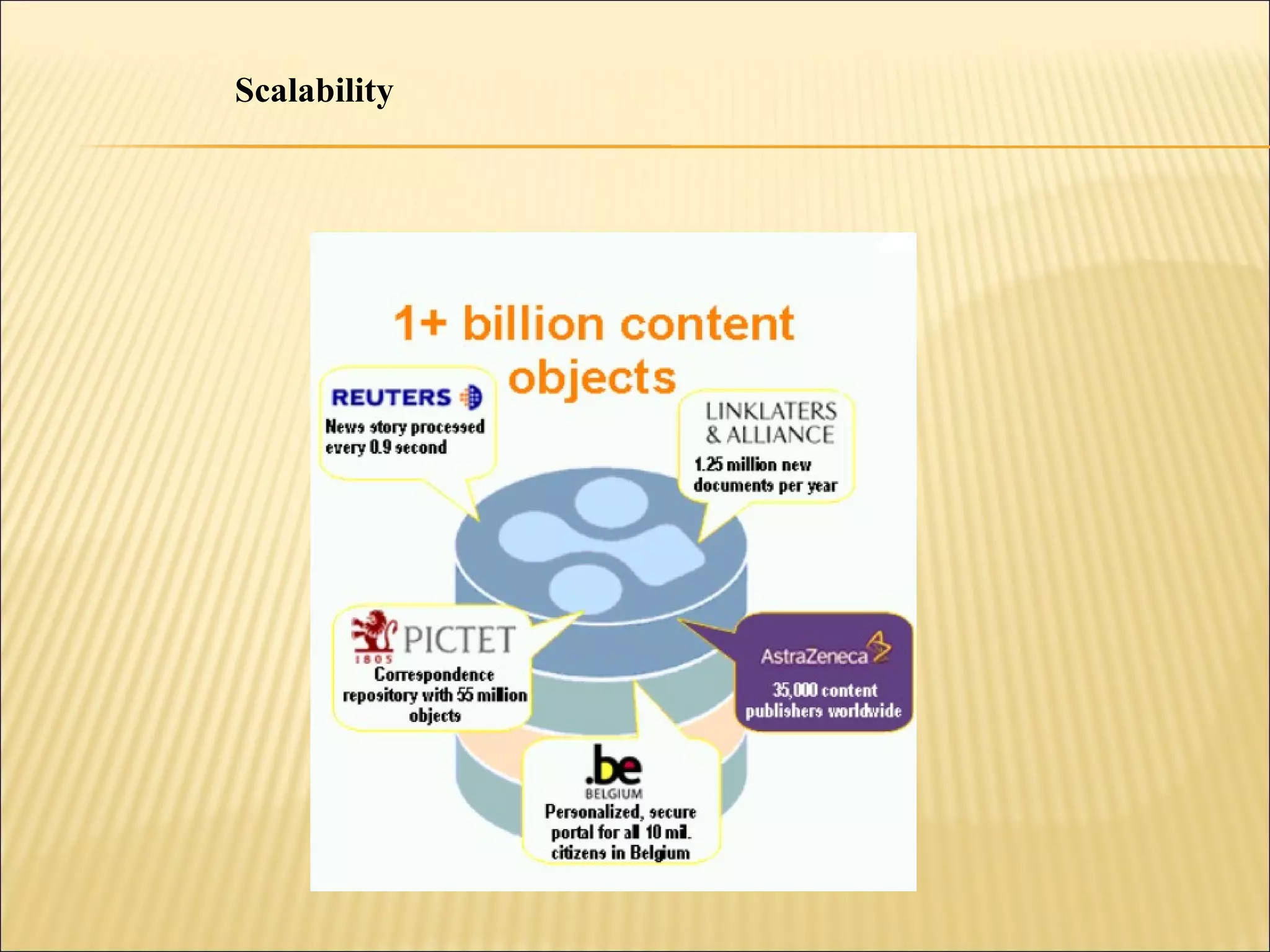
Scalability
Documentum enforces appropriate levels of security as organizations make their repository content available to a  wide range of contributors and users Sensitive information in the repository file stores can be encrypted.  It also supports electronic signatures and offers extensive auditing of all system activities. It secures roving content – documents and other objects that are moving around the network and beyond the purview of the repository Secure
Extensible Documentum incorporates service oriented architecture  that exploits the capabilities of web services for integrating with disparate enterprise applications.
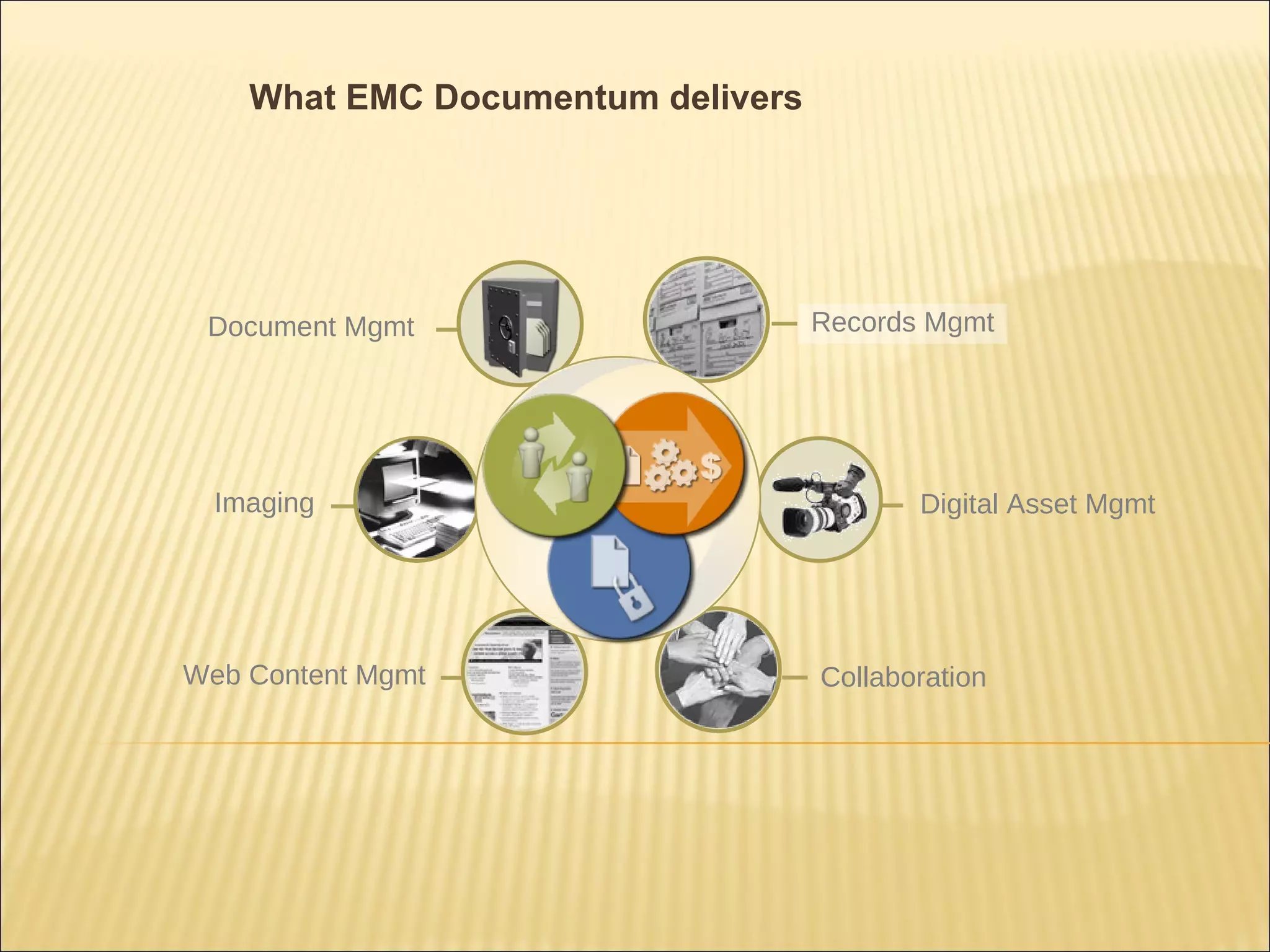
What EMC Documentum delivers Records Mgmt Digital Asset Mgmt Collaboration Web Content Mgmt Imaging Document Mgmt
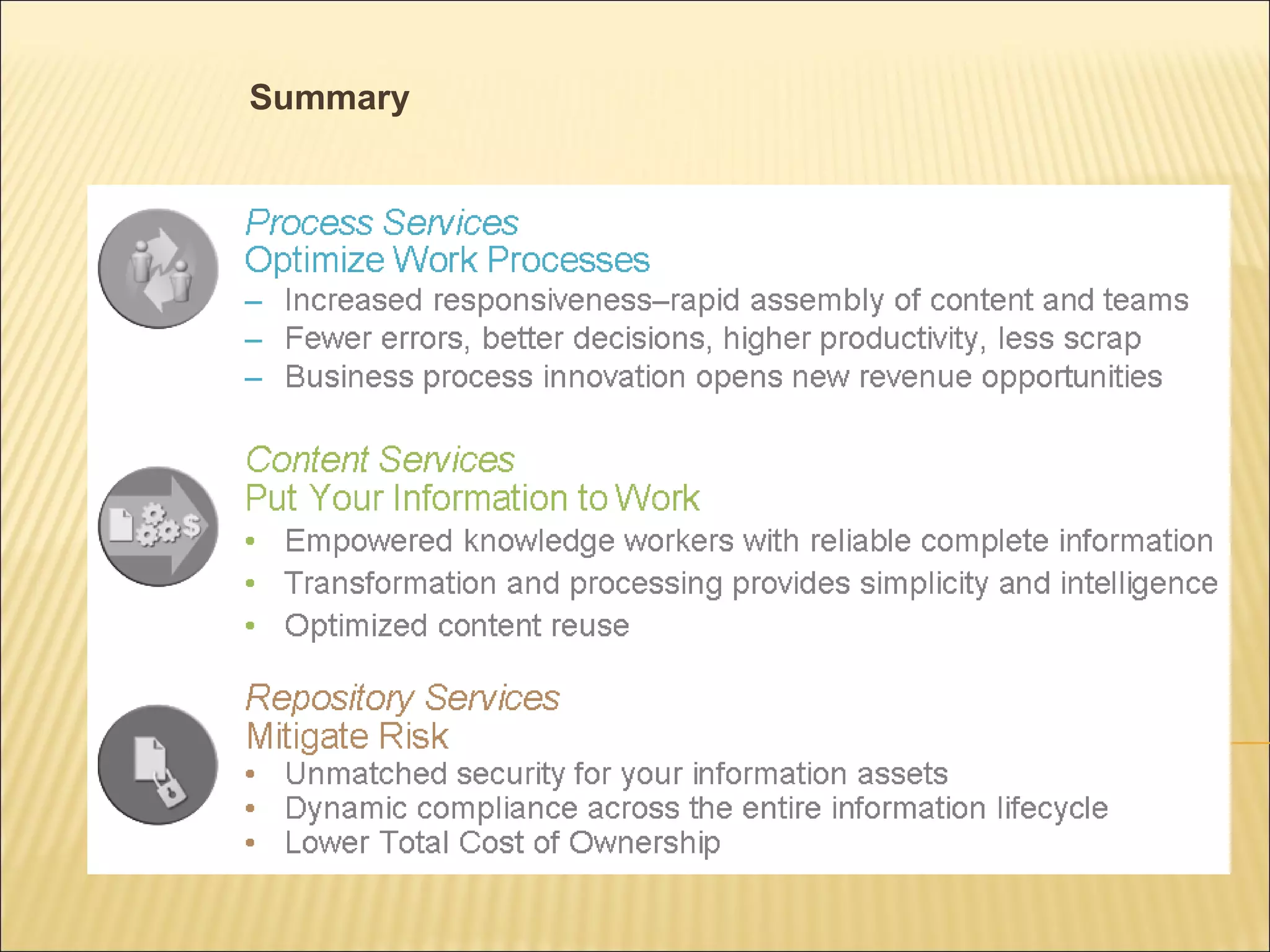
Summary
 

Overview of Documentum

  • 1.
  • 2.
    Agenda What isDocumentum ? Brief History of Documentum Architecture Kernel Application Services Experiences Tools How and What EMC Documentum delivers Summary
  • 3.
    What is Documentum? Documentum provides a unified environment for capturing, storing, accessing, organizing, controlling, retrieving and archiving any type of unstructured information within an enterprise. Documentum is product from the company Documentum EMC acquired Documentum in 2003 and now it is called as EMC Documentum
  • 4.
    Brief History ofDocumentum
  • 5.
  • 6.
    Architecture Kernel – It is a unified environment where content is stored, accessed and secured Repository Infrastructure Repository Services Security Services
  • 7.
    Content Objects Contentis stored in the repository as an object Objects comprise three parts: Content Assets or Source data Represent the core information stored in its native format. Content Attributes or Metadata Describe the content assets with descriptors such as keywords, owner, version, links and creation date. Methods or Operations Instructions to be performed on the content assets, such as transform, notify and display.
  • 8.
    Repository Infrastructure Documentumrepository consists of four main components: A file store containing the content assets. Attribute tables within a relational database. Full-text Indexes (Text based content assets) All words of the content assets stored within the repository. All keywords and other content attributes (or metadata) that describe the content assets. Directory Services A networked service from which info can be looked-up and retrieved about available resources, including info about groups, individuals, printers etc.
  • 9.
    Repository Services –Content Server The repository can only be accessed via the Content Server. It provides two storage-specific services: Content Storage Services add a storage policy engine to the Documentum repository that enables event triggered, ad hoc, and batch execution of storage allocation and migration polices. Content Services for EMC Centra is the bridge between Documentum repository and Centra, an EMC content-addressed storage (CAS) system that ensures fast, easy, online access with assured content authenticity and petabyte scalability.
  • 10.
    Repository Services -Content Documentum repository stores content in a consistent manner regardless of content type, file size or file format. Content types include but are not limited to the following: Document Web page XML document Report Executable Engineering drawing Scanned image Audio or video file Thumbnail file Corporate Record
  • 11.
    It uses LDAPto synchronize user and group identities enterprise-wide. Assigns authorization rules through access control lists (ACL), which are automatically applied to all repository objects when the objects are created. Every Operation performed by the Documentum Repository can be recorded in an auditable record. Security Services – Core Services Auditing Authentication Authorization Single sign-on
  • 12.
    Security Services –Trusted Content Services Documentum platform adds Trusted Content Services to tackle application-specific security situations beyond the authentication and authorization provided by the core security services of the content platform Trusted Services include Encrypted File Stores Digital Shredding of deleted items Support for electronic signatures. Digital Shredding Encryption Electronic Signatures
  • 13.
    Security Services –Information Rights Management Services IRM services extend the security and access controls on documents and other types of content beyond the boundaries of content platform. IRM Services secure “Roving Content” that require persistent protection across the network and wherever the content is located and stored. IRM services add on IRM policy server to the enterprise information environment to secure the content that is no longer managed by documentum content server
  • 14.
    Architecture Application ServicesGroup – Provides various application- level services for organizing, controlling, sequencing and delivering content to, and from the repository. Compliance Services Content Services Process Services
  • 15.
    Compliance Services –Retention Policy Services Compliance Services provide capabilities for retaining content and managing content as records. These are Retention Policy Services Records Manager RPS specify and enforce the retention of objects in the documentum repository by attaching one or more retention policies to the objects. The objects cannot be changed or deleted for the duration of the retention policy. RPS enhances the standard documentum controls along three important dimensions: Notifications Auditing Reporting
  • 16.
    Compliance Services –Records Manager Records Manager architecture provides recordkeeping functionality as services that can be used for electronic and physical records alike. Records Management capabilities support electronic documents, e-mail and paper based documents as managed records. These capabilities leverage the complementary offerings of the overall documentum platform Records Manager leverages RPS and the capabilities of the documentum platform to provide records management capabilities in a modular fashion.
  • 17.
    Content Services –Library Services - Versioning When a document is modified it is stored in the repository as a new version Each version is represented by a unique set of properties and content Each version has a unique version number The initial version number is 1.0 By default, users access the most recent or current version Check-in/Check-out capabilities ensure users with editing privileges do not overwrite one-another’s versions or make incompatible updates.
  • 18.
    A Content filecan be associated with one or more renditions A rendition is a read-only representation of the content that differs from the original in some way i.e. different format, language, resolutions etc. A Content file and its renditions are managed as a single document in the repository. Content Service – Library Services - Renditions
  • 19.
    Content Services –Workflow Services Documentum workflow automates business activities and policies for repository content. A workflow is defined by a model, the sequence of steps that comprise the process, and the actions that must occur at each step. A workflow can be serial with activities occurring one after another, or parallel, with all activities occurring simultaneously
  • 20.
    Content Services –Lifecycle Services Documentum platform defines, maps and implements flexible content lifecycle rules according to the business policies established by the enterprise. Lifecycle services assign a lifecycle stage to the content object, and then manage the object’s transition from one stage to another. Each content object has only a single lifecycle
  • 21.
    Content Services –XML Services Integrated XSLT (transformation engine). Unlimited stylesheets stored in repository. Facilitates multi-channel publishing.
  • 22.
    Content Services –Enterprise Content Integration Services Integration with heterogeneous repositories Enterprise Content Integration (ECI) Services enable extending services to other repositories Adapter framework and ADK Search Broker
  • 23.
    Content Services –Content Transformation Services Documentum provides a suite of CTS for changing various kinds of content such as documents, photos, video and medical images into different formats and resolutions. It also provides content analysis, metadata extraction and thumb nailing for rich media content types. Some of modules are: Document Transformation services Advanced document transformation services XML transformation services Media transformation services Audio / Video transformation services
  • 24.
    Content Services –Content Delivery Services Documentum platform provides sophisticated content deployment and delivery services to supply content to web server farms, enterprise portals and servers. Documentum platform can be integrated with a wide variety of network accessible application, personalization, portal and e-commerce servers from enterprise vendors such as BEA, IBM, MS, Oracle. Site Caching Services It adds flexibility for distributing content to disparate delivery environments. Site Deployment Services It complements site caching services by automatically delivering content to multiple external web servers. If the content cannot be delivered as scheduled, these services also support rollback with self-repair.
  • 25.
    Content Services –Content Delivery Services Documentum platform can cache predefined sets of documents or other content objects including both the content and content attributes or metadata on intermediate servers in a high speed optimized cached repository. Applications can then access these attributes and assets to automatically personalize and incorporate enterprise managed content.
  • 26.
    Process Services –Collaborative Services Process Services capabilities includes Collaborative Services, managing shared workspaces, as well as Business process management, a set of products for managing business process across the enterprise.
  • 27.
    Process Services –Business Process Management Documentum provides a complete suite of BPM products that manages the complete lifecycle of business processes across the enterprise. Business Activity Monitoring (BAM) engine monitors critical aspects of the business processes and provides up-to-date reports. Business Process Engine runs and manages the end-to-end processes and integrates with external applications through a SOA framework. All of content is stored and managed with the repository.
  • 28.
    Process Services –Business Process Management Process Engine Business Process Manager Business Process Services BAM Reporting Simulation Process Forms Rules Engine Web Clients Content Server
  • 29.
    Tools Group – Provides capabilities for developing and deploying content applications. It also provides web services for integrating Content related objects with external enterprise applications. Architecture
  • 30.
    Tools Group –Enterprise Content Services and Documentum API Documentum Foundation Classes (DFC) is the published and supported programming interface for accessing the functionality of the documentum Platform. It provides Java and COM class libraries that expose the functions that drive the documentum platform. Documentum Foundation Services (DFS) are an SOA development framework and API. They are based on web services, and designed to support interoperable machine-to-machine interaction over a network. Documentum Platform also includes Business Framework Object (BOF). BOF provides a framework and a methodology to develop reusable business logic components called Business Objects. This framework is built into DFC and accessible from applications written using DFC. It can implement business logic in reusable business object components that can be plugged into middle-tier or client applications.
  • 31.
    Tools Group –Enterprise Content Services and Documentum API
  • 32.
    Experiences Group – Provide the framework and interfaces enabling users to process and use content management functionality in desktop or Browser based applications. Architecture
  • 33.
    Experiences Group –WDK Framework Documentum platform includes a Web Development Kit (WDK), an application development framework for developing web based clients and user applications. WDK is used to provide a series of application connectors for integrating documentum functionality within Word, Excel, PowerPoint and documentum client for outlook as well as portlets for exposing documentum functionality from within a portal. WDK framework provides a set of WDK services that run locally on a client-side device either within a browser or a desktop applications and interact with server-side business objects.
  • 34.
    Experiences Group –Client Applications Users interact with content server repository through client applications. Documentum Clients Application Integration Custom Client applications
  • 35.
  • 36.
  • 37.
  • 38.
  • 39.
  • 40.
    Documentum enforces appropriatelevels of security as organizations make their repository content available to a wide range of contributors and users Sensitive information in the repository file stores can be encrypted. It also supports electronic signatures and offers extensive auditing of all system activities. It secures roving content – documents and other objects that are moving around the network and beyond the purview of the repository Secure
  • 41.
    Extensible Documentum incorporatesservice oriented architecture that exploits the capabilities of web services for integrating with disparate enterprise applications.
  • 42.
    What EMC Documentumdelivers Records Mgmt Digital Asset Mgmt Collaboration Web Content Mgmt Imaging Document Mgmt
  • 43.
  • 44.