Module 7
Managing Service
Promises
1
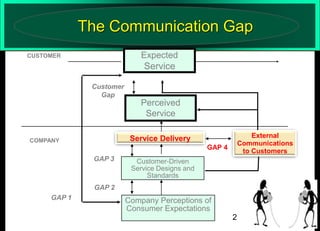
The Communication Gap
Expected

CUSTOMER

Service
Customer
Gap

Perceived
Service
External
Communications
to Customers

Service Delivery

COMPANY

GAP 4
GAP 3

Customer-Driven
Service Designs and
Standards

GAP 2
GAP 1

Company Perceptions of
Consumer Expectations
2
Module 7(a)

Integrated Service Marketing
Communication

3
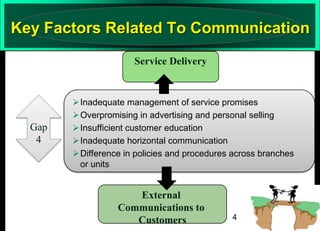
Key Factors Related To Communication
Service Delivery

Gap
4

Inadequate management of service promises
Overpromising in advertising and personal selling
Insufficient customer education
Inadequate horizontal communication
Difference in policies and procedures across branches
or units

External
Communications to
Customers

4
Learning Objectives
 Discuss the key reasons for provider GAP 4 that relates to
marketing communication.
 Present strategies for managing customer expectations.
 Present five categories of strategies for matching service

delivery with promises.

5
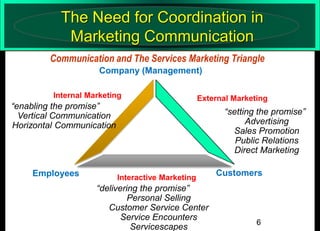
The Need for Coordination in
Marketing Communication
Communication and The Services Marketing Triangle
Company (Management)
Internal Marketing

“enabling the promise”
Vertical Communication
Horizontal Communication

Employees

External Marketing

“setting the promise”
Advertising
Sales Promotion
Public Relations
Direct Marketing
Interactive Marketing

“delivering the promise”
Personal Selling
Customer Service Center
Service Encounters
Servicescapes

Customers

6
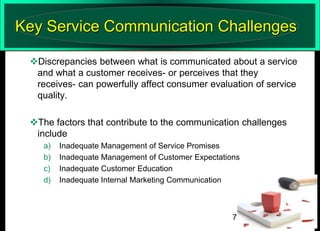
Key Service Communication Challenges
Discrepancies between what is communicated about a service
and what a customer receives- or perceives that they
receives- can powerfully affect consumer evaluation of service
quality.

The factors that contribute to the communication challenges
include
a)
b)
c)
d)

Inadequate Management of Service Promises
Inadequate Management of Customer Expectations
Inadequate Customer Education
Inadequate Internal Marketing Communication

7
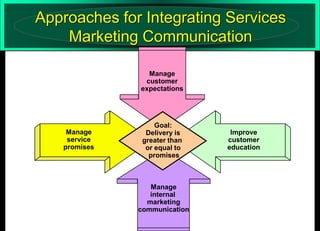
Approaches for Integrating Services
Marketing Communication
Manage
customer
expectations

Manage
service
promises

Goal:
Delivery is
greater than
or equal to
promises

Manage
internal
marketing
communication

Improve
customer
education
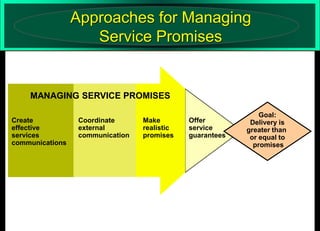
Approaches for Managing
Service Promises

MANAGING SERVICE PROMISES
Create
effective
services
communications

Coordinate
external
communication

Make
realistic
promises

Offer
service
guarantees

Goal:
Delivery is
greater than
or equal to
promises
Approaches for Managing
Service Promises
1. Create Effective Service Advertising
 Guidelines for service advertising effectiveness
 Use narratives to demonstrate the service experience like vasan
eye care
 Present vivid information, evoke strong emotions like airtel
 Use interactive imagery like LIC, ICICI Prudential, Mcdonalds
 Focus on the tangibles like ICICI Bank or ITC Hotels
 Feature service employee in communication Chevrolet CEO
 Promise what is possible
 Encourage WOM communication
 Feature Service Customers eg LIC customer testimonials
10
Approaches for Managing
Service Promises
2. Coordinate External Communication
 Manage brand image through all the external communication
vehicles like advertising, websites, sales promotion, public
relations, direct marketing and personal selling

3. Make Realistic Promises
4. Offer Service Guarantees
Approaches for Managing
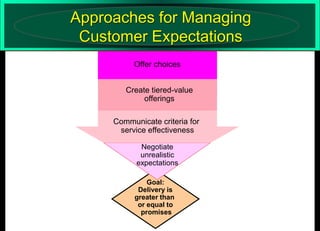
Customer Expectations
Offer choices
Create tiered-value
offerings

Communicate criteria for
service effectiveness
Negotiate
unrealistic
expectations
Goal:
Delivery is
greater than
or equal to
promises
Approaches for Improving Customer
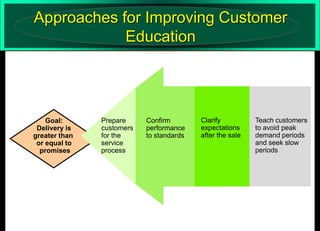
Education

Goal:
Delivery is
greater than
or equal to
promises

Prepare
customers
for the
service
process

Confirm
performance
to standards

Clarify
expectations
after the sale

Teach customers
to avoid peak
demand periods
and seek slow
periods
Approaches for Managing Internal
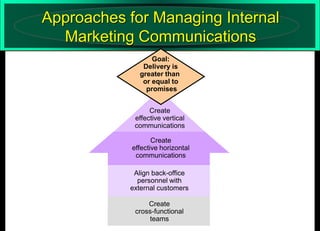
Marketing Communications
Goal:
Delivery is
greater than
or equal to
promises

Create
effective vertical
communications
Create
effective horizontal
communications

Align back-office
personnel with
external customers
Create
cross-functional
teams
Module 7 (b)

Pricing of
Services
15
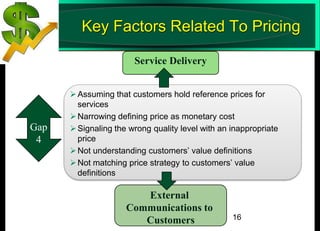
Key Factors Related To Pricing
Service Delivery

Gap
4

 Assuming that customers hold reference prices for
services
 Narrowing defining price as monetary cost
 Signaling the wrong quality level with an inappropriate
price
 Not understanding customers’ value definitions
 Not matching price strategy to customers’ value
definitions

External
Communications to
Customers

16
Learning Objectives
 Three major ways that service prices are perceived
differently from goods prices by customers.
 Key ways that pricing of services differs from pricing of
goods from a company’s perspective.
 What value means to customer and the role that price
plays in value.

17
Most service organizations use artless and unsophisticated

approach to pricing without regard to :
 Underlying shifts in demand
 The rate that supply can be expanded
 Prices of available substitutes
 Consideration of the price-volume relationship

 Availability of future substitutes

18
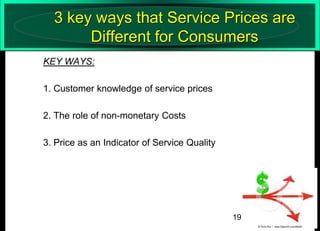
3 key ways that Service Prices are
Different for Consumers
KEY WAYS:
1. Customer knowledge of service prices
2. The role of non-monetary Costs
3. Price as an Indicator of Service Quality

19
1. Customer Knowledge of Service
Prices
To what extent do customer use price as a criterion in
selecting services?
How much do customer know about the cost of services?

20
Customer Knowledge…
Service variability limits knowledge
 Variety of combinations (eg. Life insurance)
 Different features

Providers are unable to estimate prices in advance (e.g. Legal
services)
Individual customer needs vary (e.g. Beauty salon)
Collection of price information is difficult in services

Prices are not visible (e.g. Financial Services)
21
Reference Prices
 It is a price point in memory for a good or a service and
consists of :
 The price last paid
 The price most frequently paid
 The average of all prices customer have paid for similar
offerings.

 Generally consumers are quite uncertain about their

knowledge of the prices of services than of goods.
22
2. The Role of Non-monetary Costs
 Demand for a service is not just a function of monetary price but is

influenced by other cost as well. Such as :
 Time costs (participation is required)
 Search costs
 Convenience costs
Psychological costs
Fear of not understanding(insurance), rejection(bank loans, credit
cards), outcomes (medical diagnoses)
Reducing Nonmonetary Costs
23
3. Price as an Indicator of
Service Quality
 Customer uses price as an indicator of both service costs and service
quality
Some cues used by customers other than price:
 When service cues to quality are readily accessible
 When brand names provide evidence of a company’s reputation
 When the level of advertising communicates the belief in the brand

24
Reason
Reason for this is risk associated with the service purchase.
High risk situation(e.g medical), customer takes price as a
surrogate for quality.

25
Approaches to Pricing Services
There are three approaches -:

 Cost-Based Pricing
 Competition Based Pricing
 Demand Based Pricing

26
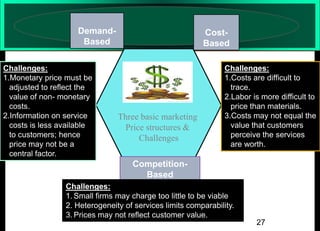
DemandBased
Challenges:
1.Monetary price must be
adjusted to reflect the
value of non- monetary
costs.
2.Information on service
costs is less available
to customers; hence
price may not be a
central factor.

CostBased

Three basic marketing
Price structures &
Challenges

Challenges:
1.Costs are difficult to
trace.
2.Labor is more difficult to
price than materials.
3.Costs may not equal the
value that customers
perceive the services
are worth.

CompetitionBased
Challenges:
1. Small firms may charge too little to be viable
2. Heterogeneity of services limits comparability.
3. Prices may not reflect customer value.
27
Cost-Based Pricing
In Cost - Based Pricing, the company determines expenses
from raw materials and labor, adds amount or percentages for

overhead and profit, thereby arrives at the price.

Price = Direct costs + Overhead costs + Profit margin

28
Cost-Based Pricing…
Direct costs involve materials and labor that are associated
with delivering the service
Overhead costs are a share of fixed costs

Profit margin is a %age of full costs( direct + overhead)
Industries using cost-based pricing are construction,
engineering, advertising etc.

29
Problems with Cost - Based
Pricing
Costs are difficult to trace.

Labor is more difficult to price than materials.
Costs may not equal the value the customers perceive the services

are worth

30
Examples of Cost - Based Pricing
Cost-plus pricing - Cost-plus pricing is the simplest pricing
method. The firm calculates the cost of producing the product

and adds on a percentage (profit) to that price to give the selling
price. This method although simple has two flaws; it takes no
account of demand and there is no way of determining if
potential customers will purchase the product at the calculated
price.
Fee for Service - Hourly fee usually charged for consultancy or
by lawyers.
31
Competition- Based Pricing
Focuses on the prices charged by other firms in the same

industry and market.

This approach usually works where -:
Services are standard (e.g. dry- cleaning)
Where there are oligopolies (a few large service providers,

as in airlines)

32
Problems with Competition-Based
Pricing
Small firms may charge too little and not make margins high enough to
remain in business. Thus, many small establishments cannot deliver
services at the low prices charged by chain operators.

 Heterogeneity of services across and within providers also makes it
difficult for a firm to follow this approach. (e.g. different banks have
different charges for making DD’s)

33
Examples of Competition-Based
Pricing
Price signaling – It occurs in a market with a high concentration of
sellers. Any price offered by one company will be matched by
competitors to avoid giving a low- cost seller an advantage e.g. airlines.

Going - rate pricing – It involves charging the most prevalent rate in the

market. ( e.g. mobile service providers).

34
The Two Approaches
Cost-based pricing
Competition-based pricing

Are based on the company and its competitors rather than on
customers.
Neither approach takes into consideration that customers may lack
reference prices
May be sensitive to nonmonetary prices
May judge quality on the basis of price
All the above factors can and should be accounted for in a
company’s pricing decisions.
35
Demand Based Pricing
Setting prices consistent with customer perceptions of value
Prices are based on what customers will pay for the services
provided
Nonmonetary costs and beliefs must be factored into the

calculation of perceived value to the customer.
When services require time, inconvenience, psychological and
search costs the monetary prices must be adjusted to
compensate.

36
Demand Based…..
Services save time, inconvenience, psychic and search costs,
the customer is likely willing to pay a higher monetary price.
Information on service based costs may be less available to
customers, making monetary price not as large or salient a
factor in initial service selection as it is in goods purchasing.

37
VALUE
One of the most appropriate ways that companies process
their services is basing the price on the perceived value of the
service to the customer. A service marketer needs to ask the
following questions
What do customers mean by value?
How can it be quantified in rupees so that appropriate price is
fixed?
Is the meaning of value similar across consumers and services?
How can value perceptions be influenced?
 To Understand demand-based pricing approaches, it is must to
fully understand what value means to customers.
 Not a simple task
 Consumers discuss value, they use the term in many different
ways and talk about a myriad of attributes or components

38
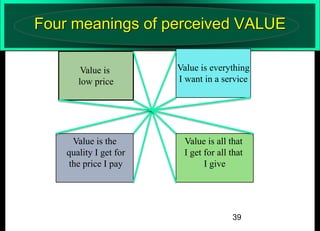
Four meanings of perceived VALUE
Value is
low price

Value is everything
I want in a service

Value is the
quality I get for
the price I pay

Value is all that
I get for all that
I give

39
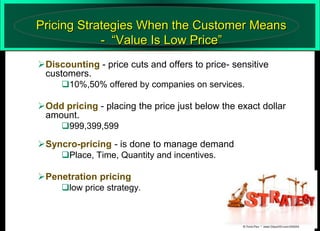
Pricing Strategies When the Customer Means
- “Value Is Low Price”
Discounting - price cuts and offers to price- sensitive
customers.
10%,50% offered by companies on services.

Odd pricing - placing the price just below the exact dollar
amount.
999,399,599

Syncro-pricing - is done to manage demand
Place, Time, Quantity and incentives.

Penetration pricing
low price strategy.
40
Value is Low Price
Equate value with low price
Money is most salient in their perceptions of value
Fast food restaurant : “service is a value, when coupons
are used”
Airline travel : “value is when airline tickets are discounted”

Dry Cleaning: “Value means the lowest price”

41
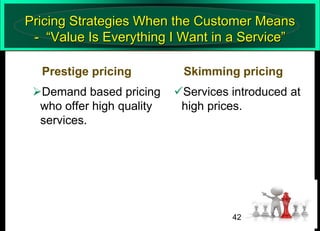
Pricing Strategies When the Customer Means
- “Value Is Everything I Want in a Service”
Prestige pricing
Demand based pricing
who offer high quality
services.

Skimming pricing
Services introduced at
high prices.

42
Value is Whatever I Want in a Product or
Service
Emphasize the benefits they receive from a service or product
Price is far less important than the quality or features
Ex. : Insurance industry
MBA degree : “value is very best education”
Medical service : “value is high quality”
Rock concert : “value is the best performance”

43
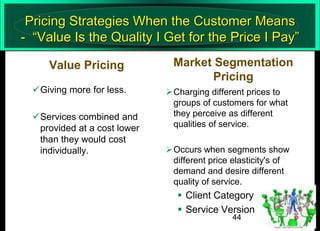
Pricing Strategies When the Customer Means
- “Value Is the Quality I Get for the Price I Pay”
Value Pricing
Giving more for less.
Services combined and
provided at a cost lower
than they would cost
individually.

Market Segmentation
Pricing
Charging different prices to
groups of customers for what
they perceive as different
qualities of service.
Occurs when segments show
different price elasticity's of
demand and desire different
quality of service.

 Client Category
 Service Version
44
Value is the Quality I Get for the
Price I Pay
Trade off between the money they give and the quality they receive.
Hotel for vacation : “ value is price first and quality second ”
Hotel for business travel : “ value is the lowest price for a quality
brand ”

Computer services contract : “value is the same as quality. No –value
is affordable quality”

45
Pricing Strategies When the Customer Means
- “Value Is All That I Get for All That I give”
Includes not just the money spent on the service, but also the
time and effort.
Price Framing : 1994 Olympics broadcast
Price Bundling :
 Mixed Bundling : a bunch of services offered at lower
price than its individual costs.

 Mixed Leader Bundling : Discount on additional related
products. Eg: TV cable connections
 Mixed Joint Bundling: single service is formed for the
combined set of services to increase demand for both the
services by packaging them together. 46
Complementary Pricing
Captive Pricing : the cost
is divided into initial fixed
cost and future recurrent
variable costs.

Result Based Pricing

Contingency Pricing : the
pricing is based on the end
result of the service, as a
percentage of the outcome.
Eg : Lawyer’s fee.
Loss Leadership : one
Partial Contingency Pricing :
product is priced lowest in
the pricing is done in two
the market to attract
parts , one initial fee
customer attention and
(nominal amount) and the
drive them to the store .
secondly a contingency
The remaining products
price for the service.
are normal or high priced.
Eg : PayPerClick strategy
adopted by Google and
47
Yahoo for advertisements
Value is what I get for what I give
All the benefits they receive as well as all sacrifice
components (money, effort, time) when describing value

Housekeeping service : “value is how many rooms I can get
cleaned for what the price is”

Hair stylist : “value is what I pay in cost and time for the look I
get”
48
End Of Module 7
49

Module 7

  • 1.
  • 2.
    The Communication Gap Expected CUSTOMER Service Customer Gap Perceived Service External Communications toCustomers Service Delivery COMPANY GAP 4 GAP 3 Customer-Driven Service Designs and Standards GAP 2 GAP 1 Company Perceptions of Consumer Expectations 2
  • 3.
    Module 7(a) Integrated ServiceMarketing Communication 3
  • 4.
    Key Factors RelatedTo Communication Service Delivery Gap 4 Inadequate management of service promises Overpromising in advertising and personal selling Insufficient customer education Inadequate horizontal communication Difference in policies and procedures across branches or units External Communications to Customers 4
  • 5.
    Learning Objectives  Discussthe key reasons for provider GAP 4 that relates to marketing communication.  Present strategies for managing customer expectations.  Present five categories of strategies for matching service delivery with promises. 5
  • 6.
    The Need forCoordination in Marketing Communication Communication and The Services Marketing Triangle Company (Management) Internal Marketing “enabling the promise” Vertical Communication Horizontal Communication Employees External Marketing “setting the promise” Advertising Sales Promotion Public Relations Direct Marketing Interactive Marketing “delivering the promise” Personal Selling Customer Service Center Service Encounters Servicescapes Customers 6
  • 7.
    Key Service CommunicationChallenges Discrepancies between what is communicated about a service and what a customer receives- or perceives that they receives- can powerfully affect consumer evaluation of service quality. The factors that contribute to the communication challenges include a) b) c) d) Inadequate Management of Service Promises Inadequate Management of Customer Expectations Inadequate Customer Education Inadequate Internal Marketing Communication 7
  • 8.
    Approaches for IntegratingServices Marketing Communication Manage customer expectations Manage service promises Goal: Delivery is greater than or equal to promises Manage internal marketing communication Improve customer education
  • 9.
    Approaches for Managing ServicePromises MANAGING SERVICE PROMISES Create effective services communications Coordinate external communication Make realistic promises Offer service guarantees Goal: Delivery is greater than or equal to promises
  • 10.
    Approaches for Managing ServicePromises 1. Create Effective Service Advertising  Guidelines for service advertising effectiveness  Use narratives to demonstrate the service experience like vasan eye care  Present vivid information, evoke strong emotions like airtel  Use interactive imagery like LIC, ICICI Prudential, Mcdonalds  Focus on the tangibles like ICICI Bank or ITC Hotels  Feature service employee in communication Chevrolet CEO  Promise what is possible  Encourage WOM communication  Feature Service Customers eg LIC customer testimonials 10
  • 11.
    Approaches for Managing ServicePromises 2. Coordinate External Communication  Manage brand image through all the external communication vehicles like advertising, websites, sales promotion, public relations, direct marketing and personal selling 3. Make Realistic Promises 4. Offer Service Guarantees
  • 12.
    Approaches for Managing CustomerExpectations Offer choices Create tiered-value offerings Communicate criteria for service effectiveness Negotiate unrealistic expectations Goal: Delivery is greater than or equal to promises
  • 13.
    Approaches for ImprovingCustomer Education Goal: Delivery is greater than or equal to promises Prepare customers for the service process Confirm performance to standards Clarify expectations after the sale Teach customers to avoid peak demand periods and seek slow periods
  • 14.
    Approaches for ManagingInternal Marketing Communications Goal: Delivery is greater than or equal to promises Create effective vertical communications Create effective horizontal communications Align back-office personnel with external customers Create cross-functional teams
  • 15.
    Module 7 (b) Pricingof Services 15
  • 16.
    Key Factors RelatedTo Pricing Service Delivery Gap 4  Assuming that customers hold reference prices for services  Narrowing defining price as monetary cost  Signaling the wrong quality level with an inappropriate price  Not understanding customers’ value definitions  Not matching price strategy to customers’ value definitions External Communications to Customers 16
  • 17.
    Learning Objectives  Threemajor ways that service prices are perceived differently from goods prices by customers.  Key ways that pricing of services differs from pricing of goods from a company’s perspective.  What value means to customer and the role that price plays in value. 17
  • 18.
    Most service organizationsuse artless and unsophisticated approach to pricing without regard to :  Underlying shifts in demand  The rate that supply can be expanded  Prices of available substitutes  Consideration of the price-volume relationship  Availability of future substitutes 18
  • 19.
    3 key waysthat Service Prices are Different for Consumers KEY WAYS: 1. Customer knowledge of service prices 2. The role of non-monetary Costs 3. Price as an Indicator of Service Quality 19
  • 20.
    1. Customer Knowledgeof Service Prices To what extent do customer use price as a criterion in selecting services? How much do customer know about the cost of services? 20
  • 21.
    Customer Knowledge… Service variabilitylimits knowledge  Variety of combinations (eg. Life insurance)  Different features Providers are unable to estimate prices in advance (e.g. Legal services) Individual customer needs vary (e.g. Beauty salon) Collection of price information is difficult in services Prices are not visible (e.g. Financial Services) 21
  • 22.
    Reference Prices  Itis a price point in memory for a good or a service and consists of :  The price last paid  The price most frequently paid  The average of all prices customer have paid for similar offerings.  Generally consumers are quite uncertain about their knowledge of the prices of services than of goods. 22
  • 23.
    2. The Roleof Non-monetary Costs  Demand for a service is not just a function of monetary price but is influenced by other cost as well. Such as :  Time costs (participation is required)  Search costs  Convenience costs Psychological costs Fear of not understanding(insurance), rejection(bank loans, credit cards), outcomes (medical diagnoses) Reducing Nonmonetary Costs 23
  • 24.
    3. Price asan Indicator of Service Quality  Customer uses price as an indicator of both service costs and service quality Some cues used by customers other than price:  When service cues to quality are readily accessible  When brand names provide evidence of a company’s reputation  When the level of advertising communicates the belief in the brand 24
  • 25.
    Reason Reason for thisis risk associated with the service purchase. High risk situation(e.g medical), customer takes price as a surrogate for quality. 25
  • 26.
    Approaches to PricingServices There are three approaches -:  Cost-Based Pricing  Competition Based Pricing  Demand Based Pricing 26
  • 27.
    DemandBased Challenges: 1.Monetary price mustbe adjusted to reflect the value of non- monetary costs. 2.Information on service costs is less available to customers; hence price may not be a central factor. CostBased Three basic marketing Price structures & Challenges Challenges: 1.Costs are difficult to trace. 2.Labor is more difficult to price than materials. 3.Costs may not equal the value that customers perceive the services are worth. CompetitionBased Challenges: 1. Small firms may charge too little to be viable 2. Heterogeneity of services limits comparability. 3. Prices may not reflect customer value. 27
  • 28.
    Cost-Based Pricing In Cost- Based Pricing, the company determines expenses from raw materials and labor, adds amount or percentages for overhead and profit, thereby arrives at the price. Price = Direct costs + Overhead costs + Profit margin 28
  • 29.
    Cost-Based Pricing… Direct costsinvolve materials and labor that are associated with delivering the service Overhead costs are a share of fixed costs Profit margin is a %age of full costs( direct + overhead) Industries using cost-based pricing are construction, engineering, advertising etc. 29
  • 30.
    Problems with Cost- Based Pricing Costs are difficult to trace. Labor is more difficult to price than materials. Costs may not equal the value the customers perceive the services are worth 30
  • 31.
    Examples of Cost- Based Pricing Cost-plus pricing - Cost-plus pricing is the simplest pricing method. The firm calculates the cost of producing the product and adds on a percentage (profit) to that price to give the selling price. This method although simple has two flaws; it takes no account of demand and there is no way of determining if potential customers will purchase the product at the calculated price. Fee for Service - Hourly fee usually charged for consultancy or by lawyers. 31
  • 32.
    Competition- Based Pricing Focuseson the prices charged by other firms in the same industry and market. This approach usually works where -: Services are standard (e.g. dry- cleaning) Where there are oligopolies (a few large service providers, as in airlines) 32
  • 33.
    Problems with Competition-Based Pricing Smallfirms may charge too little and not make margins high enough to remain in business. Thus, many small establishments cannot deliver services at the low prices charged by chain operators.  Heterogeneity of services across and within providers also makes it difficult for a firm to follow this approach. (e.g. different banks have different charges for making DD’s) 33
  • 34.
    Examples of Competition-Based Pricing Pricesignaling – It occurs in a market with a high concentration of sellers. Any price offered by one company will be matched by competitors to avoid giving a low- cost seller an advantage e.g. airlines. Going - rate pricing – It involves charging the most prevalent rate in the market. ( e.g. mobile service providers). 34
  • 35.
    The Two Approaches Cost-basedpricing Competition-based pricing Are based on the company and its competitors rather than on customers. Neither approach takes into consideration that customers may lack reference prices May be sensitive to nonmonetary prices May judge quality on the basis of price All the above factors can and should be accounted for in a company’s pricing decisions. 35
  • 36.
    Demand Based Pricing Settingprices consistent with customer perceptions of value Prices are based on what customers will pay for the services provided Nonmonetary costs and beliefs must be factored into the calculation of perceived value to the customer. When services require time, inconvenience, psychological and search costs the monetary prices must be adjusted to compensate. 36
  • 37.
    Demand Based….. Services savetime, inconvenience, psychic and search costs, the customer is likely willing to pay a higher monetary price. Information on service based costs may be less available to customers, making monetary price not as large or salient a factor in initial service selection as it is in goods purchasing. 37
  • 38.
    VALUE One of themost appropriate ways that companies process their services is basing the price on the perceived value of the service to the customer. A service marketer needs to ask the following questions What do customers mean by value? How can it be quantified in rupees so that appropriate price is fixed? Is the meaning of value similar across consumers and services? How can value perceptions be influenced?  To Understand demand-based pricing approaches, it is must to fully understand what value means to customers.  Not a simple task  Consumers discuss value, they use the term in many different ways and talk about a myriad of attributes or components 38
  • 39.
    Four meanings ofperceived VALUE Value is low price Value is everything I want in a service Value is the quality I get for the price I pay Value is all that I get for all that I give 39
  • 40.
    Pricing Strategies Whenthe Customer Means - “Value Is Low Price” Discounting - price cuts and offers to price- sensitive customers. 10%,50% offered by companies on services. Odd pricing - placing the price just below the exact dollar amount. 999,399,599 Syncro-pricing - is done to manage demand Place, Time, Quantity and incentives. Penetration pricing low price strategy. 40
  • 41.
    Value is LowPrice Equate value with low price Money is most salient in their perceptions of value Fast food restaurant : “service is a value, when coupons are used” Airline travel : “value is when airline tickets are discounted” Dry Cleaning: “Value means the lowest price” 41
  • 42.
    Pricing Strategies Whenthe Customer Means - “Value Is Everything I Want in a Service” Prestige pricing Demand based pricing who offer high quality services. Skimming pricing Services introduced at high prices. 42
  • 43.
    Value is WhateverI Want in a Product or Service Emphasize the benefits they receive from a service or product Price is far less important than the quality or features Ex. : Insurance industry MBA degree : “value is very best education” Medical service : “value is high quality” Rock concert : “value is the best performance” 43
  • 44.
    Pricing Strategies Whenthe Customer Means - “Value Is the Quality I Get for the Price I Pay” Value Pricing Giving more for less. Services combined and provided at a cost lower than they would cost individually. Market Segmentation Pricing Charging different prices to groups of customers for what they perceive as different qualities of service. Occurs when segments show different price elasticity's of demand and desire different quality of service.  Client Category  Service Version 44
  • 45.
    Value is theQuality I Get for the Price I Pay Trade off between the money they give and the quality they receive. Hotel for vacation : “ value is price first and quality second ” Hotel for business travel : “ value is the lowest price for a quality brand ” Computer services contract : “value is the same as quality. No –value is affordable quality” 45
  • 46.
    Pricing Strategies Whenthe Customer Means - “Value Is All That I Get for All That I give” Includes not just the money spent on the service, but also the time and effort. Price Framing : 1994 Olympics broadcast Price Bundling :  Mixed Bundling : a bunch of services offered at lower price than its individual costs.  Mixed Leader Bundling : Discount on additional related products. Eg: TV cable connections  Mixed Joint Bundling: single service is formed for the combined set of services to increase demand for both the services by packaging them together. 46
  • 47.
    Complementary Pricing Captive Pricing: the cost is divided into initial fixed cost and future recurrent variable costs. Result Based Pricing Contingency Pricing : the pricing is based on the end result of the service, as a percentage of the outcome. Eg : Lawyer’s fee. Loss Leadership : one Partial Contingency Pricing : product is priced lowest in the pricing is done in two the market to attract parts , one initial fee customer attention and (nominal amount) and the drive them to the store . secondly a contingency The remaining products price for the service. are normal or high priced. Eg : PayPerClick strategy adopted by Google and 47 Yahoo for advertisements
  • 48.
    Value is whatI get for what I give All the benefits they receive as well as all sacrifice components (money, effort, time) when describing value Housekeeping service : “value is how many rooms I can get cleaned for what the price is” Hair stylist : “value is what I pay in cost and time for the look I get” 48
  • 49.