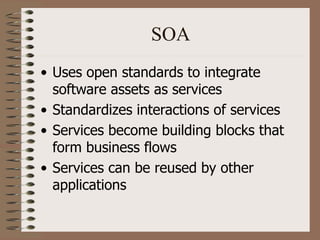
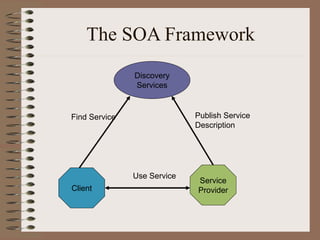
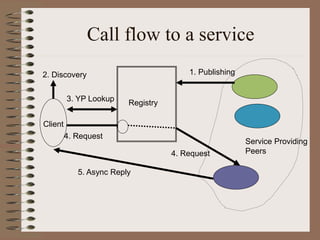
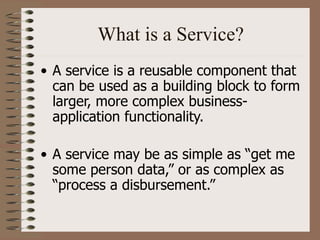
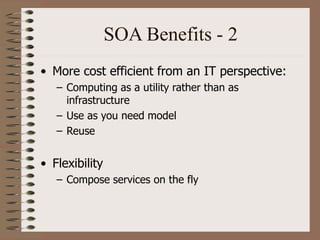
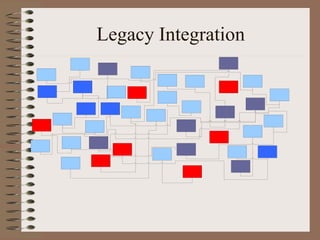
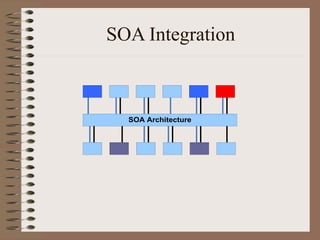
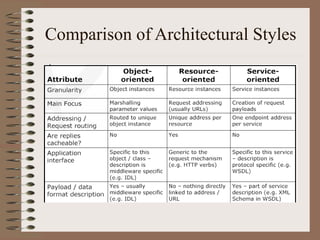
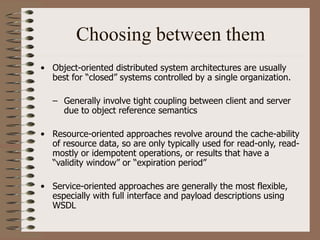
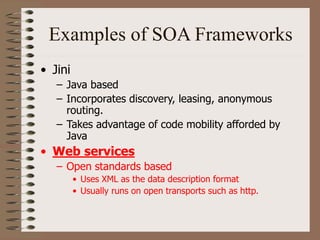
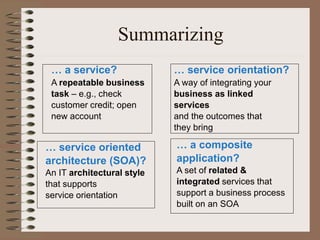
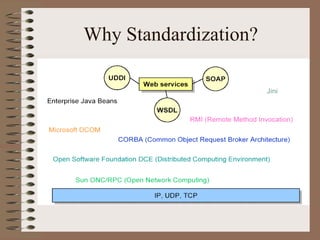
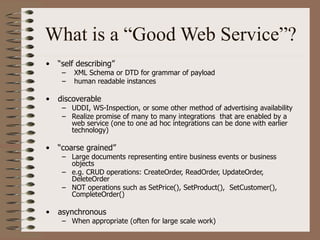
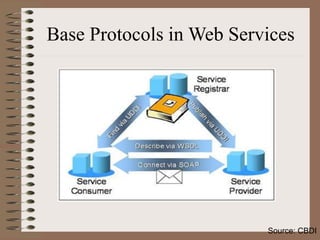
This document provides an overview of service orientation and service-oriented architecture (SOA) in three sessions. The first session introduces service orientation, contrasts it with other architectural styles like resource-oriented and object-oriented architectures, and provides examples of service-oriented architectures. It also discusses web services, their motivation and evolution. Key points covered are that service orientation models business needs better through loose coupling and dynamic binding. SOA allows flexibility, reuse, and cost efficiency. Legacy systems can be integrated using SOA. The document discusses characteristics of services, elements of SOA, and benefits of adopting SOA. Examples of SOA frameworks discussed are Jini and web services.

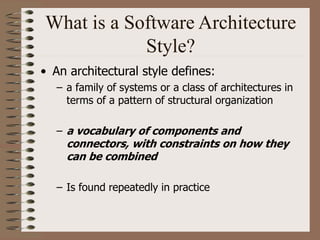
![Software Architectural Styles
• Popular styles:
– Resource oriented architectures
– Object oriented architectures
• References
– [Shaw & Garlan, “Software Architecture:
Perspectives on an Emerging Discipline”, 1996]
– [Clements, Kazman & Klein, “Evaluating Software
Architecture”, 2002]](https://image.slidesharecdn.com/soa1-background-231212193442-c1d6c7ea/85/SOA1-Background-ppt-SOFTWARE-ORIENTED-SERVICES-AND-ARCHITECTURE-5-320.jpg)