Q: A 28 years old male presents to the OPD
with severe pain in right side of the head,
nausea, and sensation of flashing light just
before the start of the headache. Gives history
of similar episodes once or twice in past. What
probable diagnosis can you conclude from this
history and what drugs are used for the
management?
Dr. Ankita Bist
Assistant Professor
Department of Pharmacology
Serotonin
• Serotonin or 5-Hydroxytryptamine (5-HT) is
biochemically derived from tryptophan.
• In CNS it acts as a neurotransmitter, while in
periphery it acts as an autocoid, involved in
function of smooth muscle, CVS, GIT and platelet
functions.
• Present in Intestinal mucosa (90%) along with platelets
and brain (10%)
• Stored in granules
• Also present in plants and insects
 Plants like tomato, banana & pineapple rich sources
 Lower animals- molluscs, arthropods, snake
and bee venom/sting
SynthesisandMetabolism
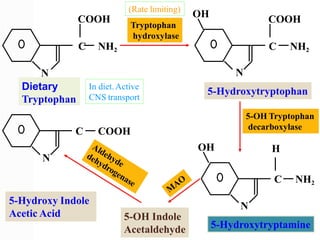
• Dietary tryptophan
 Converted to 5–Hydroxy– tryptophan by
tryptophan hydroxylase.
 Then to 5-HT by a non–specific decarboxylase
• Termination of action
 Reuptake
 Mainly monoamine oxidase (MAO–A > MAO–B)
 5–Hydroxyl Indole acetic acid (5-HIAA) excreted in
urine
N
COOH
C NH2
COOH
C NH2
OH
N
C NH2
OH H
Dietary
Tryptophan
5-Hydroxytryptophan
5-Hydroxytryptamine
N
C COOH
5-OH Indole
Acetaldehyde
5-Hydroxy Indole
Acetic Acid
Tryptophan
hydroxylase
5-OH Tryptophan
decarboxylase
(Rate limiting)
In diet.Active
CNS transport
N
Serotonin Uptake
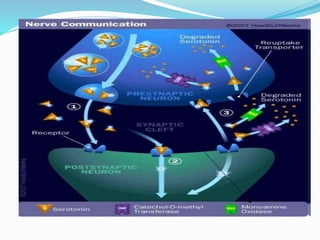
• Non-specific Decarboxylase produces 5-HT
• Amine pump (SERT) actively takes up Serotononin (like
CA) in serotonergic nerve endings.
• Inhibited by SSRIs and TCAs.
• Degrading enzyme MAO and COMT is common for both
catecholamine and serotonin.
• Platelets do not synthesize 5-HT (deficiency of tryptophan
hydroxylase) – but actively taken up by SERT – during
intestinal passage.
5-HT Receptors
Classically - Musculotropic (D type) and Neurotropic (M
type), blocked by Dibenzylline and Morphine
respectively.
Methysergide and cyproheptadine are classical blockers
– blocks D-type only
 Radiological binding studies – molecular
characterization and cloning
 FOUR FAMILIES - 5-HT1, 5-HT2, 5-HT3 and 5-HT4-7
 All are GPCRs except 5-HT3 (5-HT3 is a ligand gated
Na+ channel)
 All act through cAMP except 5-HT2 (IP3-DAG)
 5-HT1 inhibits cAMP and 5-HT4, 5-HT6 and 5- HT7
increases cAMP.
5-HT1 –Receptors
• Five Subtypes – A, B, D, E and F
• All acts as autoreceptors - inhibit firing of neurones or
release of 5-HT
• Also, activation of K+ channel and inhibits Ca++ channel
• 5-HT1A – Brainstem (Raphe nuclei) and hippocampus.
• 5-HT1D – Mediate release of Noradrenalin from
adrenergic nerve terminals.
• 5-HT1B/1D – Cranial Blood Vessels (for vasoconstriction –
sumatriptan – selective agonist)
• 5-HT1D & 5-HT1F – present in certain brain areas.
5-HT2
Mainly 3 subtypes all are Gq types – IP3/DAG
◦ 5-HT2A
 Widely distributed postjunctional (D-type)
 Located in all smooth muscles - vascular, visceral – also
platelets and cerebral neurons
 Mediates direct actions
 Vasoconstriction, intestinal, uterine and bronchial constrictions.
 Platelet aggregation and activation of cerebral neurones etc.
 Ketanserin - specific antagonist
◦ 5-HT2B – contracts smooth muscle of stomach
◦ 5-HT2c – vasodilatation through EDRF
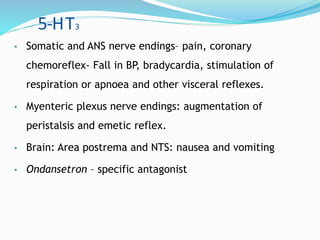
5-HT3
• Somatic and ANS nerve endings– pain, coronary
chemoreflex- Fall in BP, bradycardia, stimulation of
respiration or apnoea and other visceral reflexes.
• Myenteric plexus nerve endings: augmentation of
peristalsis and emetic reflex.
• Brain: Area postrema and NTS: nausea and vomiting
• Ondansetron – specific antagonist
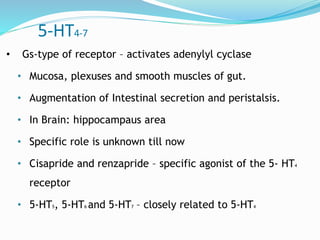
5-HT4-7
• Gs-type of receptor – activates adenylyl cyclase
• Mucosa, plexuses and smooth muscles of gut.
• Augmentation of Intestinal secretion and peristalsis.
• In Brain: hippocampaus area
• Specific role is unknown till now
• Cisapride and renzapride – specific agonist of the 5- HT4
receptor
• 5-HT5, 5-HT6 and 5-HT7 – closely related to 5-HT4
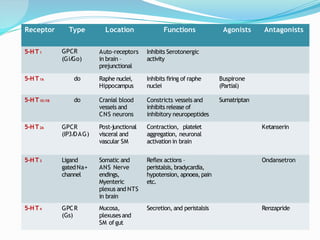
Receptor Type Location Functions Agonists Antagonists
5-HT1 GPCR
(Gi/
Go)
Auto-receptors
in brain –
prejunctional
Inhibits Serotonergic
activity
5-HT1A do Raphe nuclei,
Hippocampus
Inhibits firing of raphe
nuclei
Buspirone
(Partial)
5-HT1D /1B do Cranial blood
vessels and
CNS neurons
Constricts vessels and
inhibits release of
inhibitory neuropeptides
Sumatriptan
5-HT2A GPCR
(IP3/
DAG)
Post-junctional
visceral and
vascular SM
Contraction, platelet
aggregation, neuronal
activation in brain
Ketanserin
5-HT3 Ligand
gatedNa+
channel
Somatic and
ANS Nerve
endings,
Myenteric
plexus and NTS
in brain
Reflex actions –
peristalsis, bradycardia,
hypotension, apnoea,pain
etc.
Ondansetron
5-HT4 GPCR
(Gs)
Mucosa,
plexusesand
SM ofgut
Secretion, and peristalsis Renzapride
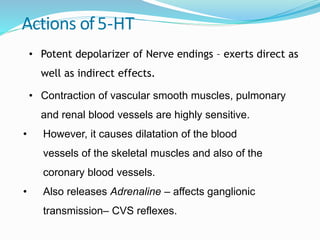
Actions of5-HT
• Potent depolarizer of Nerve endings – exerts direct as
well as indirect effects.
• Contraction of vascular smooth muscles, pulmonary
and renal blood vessels are highly sensitive.
• However, it causes dilatation of the blood
vessels of the skeletal muscles and also of the
coronary blood vessels.
• Also releases Adrenaline – affects ganglionic
transmission– CVS reflexes.
Actions of5-HT -CVS
• Heart: Isolated heart stimulation - direct ionotropic and
chronotropic effects
 Intact animal Heart: Bradycardia due to stimulation
coronary chemoreflex
 Overall bradycardia, hypotension and apnoea
• Blood Pressure: Triphasic response on BP
 Early sharp fall: Coronary chemoreflex
 Brief rise in BP: vasoconstriction and increased CO
 Prolonged fall in BP: arteriolar dilatation and
extravasation of fluid
Actions of 5-HT -Visceral SM
• GIT: Stimulator of GIT –↑ GIT motility- diarrhoea
• Bronchi: Constricts, but less potent than histamine
• Glands: Inhibits gastric acid and pepsin secretion, increase
mucus production- it has ulcer protective property
• Nerve endings and adrenal medulla: afferent nerve
endings activated – tingling sensation – also pain,
respiratory and CVS reflexes, nausea and vomiting
• Respiration: Brief stimulation of respiration–
hyperventilation. Large dose – apnoea.
• Platelet: 5-HT2A action – changes in shape and size of
platelets – but weak aggregator
• CNS: Poor entry to BBB – however it’s a transmitter –
INHIBITORY
• Direct Injection: Hunger, sleepiness, behavioural
changes
PathphysiologicalRoles – 5-HT
• Neurotransmitter: regulates sleep, temperature, thought
process, cognition, behaviour and mood, pain perception-
depression, psychosis
• Precursor of Melatonin: Pineal gland
• Nausea and Vomiting: 5-HT3
• Migraine: Vasoconstrictor phase of migraine –
Methysergide and vasodilatation phase Sumatriptan
• Haemostasis: Platelet aggregation
• Hyperthermia: Increased muscle contraction leads
to hyperthermia in case of serotonin syndrome
• Intestinal Motility: Regulates local reflex and
peristalsis in gut
• Carcinoid syndrome: Massive release – hypermotility and
bronchoconstriction.
Antagonists ofserotonin
• Ergot derivatives: Ergotamine, ergonovine and
methysergide.
• Alpha-blockers: Phenoxybenzamine
• Antihistaminics: Cyproheptadine, cinnarizine
• Phenothiazines: Chlorpromazine
• Ketanserin: used as antihypertensive
• Clozapine, olanzapine, risperidone: for schizophrenia
• Ondansetron, dolasetron and Granisetron are currently
available as anti-emetic for chemotherapy induced nausea
and vomiting.
Ergot Alkaloids andderivatives
• First isolated by Dale & Barger in 1906 from fungus
Claviceps purpurea- on rye and other grains.
• Ergotism- poisonings can produce gangrenous condition
in the limbs as a result of persistent peripheral
vasoconstriction, hallucinations, convulsions.
• They have long been recognized as abortifacients.
• Diverse pharmacological actions – agonist, antagonist and
partial agonist of serotonin, alpha-receptor and
dopaminergic receptors.
Classificationofergot alkaloids
1. Natural – Derivatives of the tetra-cyclic compounds
(lysergic acid)
Amine alkaloids– Ergometrine (ergonovine)- oxytotic
Amino acid alkaloids- Ergotamine, Ergotoxine-
Vasoconstrictor & α – blocker.
2. Semi-synthetic – Bromocriptine, Methysergide,
Dihydro-ergotamine (DHE)
3. Synthetic – (non lysergic acid derivative) Metergotine
Ergometrine
• Amine ergot alkaloid
• Partial agonist of 5-HT receptor in uterus, placenta and
umbilical blood vessels and some areas in brain.
• Weak agonist but no antagonistic effect of α receptor.
• Moderately potent antagonist of 5-HT2 in intestine.
• Less dopaminergic action in CTZ – no vomiting.
• Most prominent - Uterine myometrium
Ergotamine
• Amino acid alkaloid, Partial agonist and antagonist of α and
5-HT1 and 5-HT2 receptors.
• Most effective ergot alkaloid for migraine
• Actions:
 Sustained vasoconstriction, visceral smooth muscle contraction
and vasomotor centre depression
 Antagonizes action of NA and 5-HT in smooth muscles
 Potent emetic via CTZ
 Oxytotic
 Prolong use – vasoconstriction and damage endothelium
Dihydroergotamine (DHE)
• Hydrogenated ergotamine
• Less serotonergic action than ergotamine and less α -
adrenergic agonist action
• Better blocker of α-adrenergic receptor
• Less vasoconstrictor and so less endothelial damage
• Lesser oxytotic and emetic
• Pharmacokinetics: Poor bioavailability –1% - slow and
incomplete absorption plus high 1st pass metabolism
• Sublingual/rectal administration
• Metabolized in liver and excreted in bile
• Crosses BBB, half life – 2 Hrs
• ADRs: Nausea, vomiting, muscle cramps, weakness,
paraesthesia, vasospasm, chest pain etc.
• Contraindications: Sepsis, IHD, Peripheral
vascular disease, Hypertension, liver disease and
pregnancy
USES
 Migraine
 Postpartum haemorrhage
 Parkinson’s disease- Bromocriptine
 Carcinoid syndrome
What ismigraine
• Severe, throbbing, pulsating headache usually
unilateral headache (few hours to a few days in
duration)
• Associated with nausea, vomiting, sensitivity to light
and sound, flashes of light, loose motion and others
• Types:
• Classical -with aura visual/ sensory
• Without aura - common
 Pathophysiology: two phases
 First phase- short, vasoconstriction and ischaemia
 Second phase- long, Pulsatile vasodilatation and
headache
 Migraine attack associated with (based on histological
studies):
 sterile neurogenic perivascular edema
 inflammation (clinically effective antimigraine
medication reduce perivascular inflammation)
Pharmacotherapyof Migraine
• Three types: Mild, Moderate and Severe
• MILD: NSAIDS and Antiemetics (optional)
• Ibuprofen (400 mg 8 hrly)
• Paracetamol (500 mg 8 hrly)
• Naproxen (250 mg 8 hrly)
• Diclofenac (50 mg 8 Hrly)
Antiemetics:
• Metoclopramide (10 mg oral or IV)
• Domperidone (10 mg oral)
Migraine- Moderate
• Intense throbbing headache lasting for 6 – 24 Hrs,
nausea, vomiting and functionally impaired patient
 NSAIDs
 Antiemetics
 Specific drugs like ergots and others
(sumatriptan)
Migraine- Severe
• More than 2-3 attacks per month lasting for 12 – 48 hrs,
often vertigo, vomiting and patient is completely
incapacitated
 NSAIDS cannot relieve symptoms
 Specific antimigraine drugs like ergot alkaloids and
triptans
 Also prophylactic regimens
Sumatriptan
• Selective agonist of 5-HT1B/1D receptor.
• No interaction with other 5-HT receptors.
• No interaction with adrenergic, dopaminergic and
cholinergic receptors or GABA
MOA:
• Constriction of extracerebral blood vessel
• Constriction of arteriovenous shunt of carotid artery
• Inhibition of release of 5-HT and inflammatory
neuropeptides around the affected vessels – supression
of neurogenic inflammation
Kinetics:
 Poorly absorbed from GIT, bioavailability – 10 – 15% only
 Complete absorption after subcutaneous administration
 Metabolized by MAO-A and excreted in urine, t1/2 is 2-3 Hrs
Administration & Doses:
 Onset of acute attack
 Better tolerated than ergotamine
 Dose and repeated after 24 Hrs if required
 Should not be given if first dose fails.
• Adverse effects: Dose related - Tightness of chest,
feeling of heat, paresthesia of limbs, dizziness and
weakness (short lasting) – common with SC route.
• Risk of MI, seizure and death
• Contraindications: IHD, epilepsy, hypertension,
pregnancy, hepatic and renal impairment
(Rizatriptan, zolmitriptan, naratriptan, frovatriptan)
Prophylaxis of Migraine
• Necessary when attacks are 2 or more per month.
• Discontinue every 4 - 6 months and observe.
• Beta blockers – Propranolol (40 mg BD), timolol etc. (not
metoprolol or atenolol).
• TCAs: Amitryptylline (25 – 50 mg BD)
• Calcium channel blockers: Verapamil – not used now
(flunarizine – weak Ca channel blocker is effective)
• Anticonvulsants: Valproic acid, gabapentin and
topiramate are effective
Thank you

Serotonin and migraine

  • 1.
    Q: A 28years old male presents to the OPD with severe pain in right side of the head, nausea, and sensation of flashing light just before the start of the headache. Gives history of similar episodes once or twice in past. What probable diagnosis can you conclude from this history and what drugs are used for the management?
  • 2.
    Dr. Ankita Bist AssistantProfessor Department of Pharmacology
  • 3.
    Serotonin • Serotonin or5-Hydroxytryptamine (5-HT) is biochemically derived from tryptophan. • In CNS it acts as a neurotransmitter, while in periphery it acts as an autocoid, involved in function of smooth muscle, CVS, GIT and platelet functions. • Present in Intestinal mucosa (90%) along with platelets and brain (10%) • Stored in granules
  • 4.
    • Also presentin plants and insects  Plants like tomato, banana & pineapple rich sources  Lower animals- molluscs, arthropods, snake and bee venom/sting
  • 5.
    SynthesisandMetabolism • Dietary tryptophan Converted to 5–Hydroxy– tryptophan by tryptophan hydroxylase.  Then to 5-HT by a non–specific decarboxylase • Termination of action  Reuptake  Mainly monoamine oxidase (MAO–A > MAO–B)  5–Hydroxyl Indole acetic acid (5-HIAA) excreted in urine
  • 6.
    N COOH C NH2 COOH C NH2 OH N CNH2 OH H Dietary Tryptophan 5-Hydroxytryptophan 5-Hydroxytryptamine N C COOH 5-OH Indole Acetaldehyde 5-Hydroxy Indole Acetic Acid Tryptophan hydroxylase 5-OH Tryptophan decarboxylase (Rate limiting) In diet.Active CNS transport N
  • 7.
    Serotonin Uptake • Non-specificDecarboxylase produces 5-HT • Amine pump (SERT) actively takes up Serotononin (like CA) in serotonergic nerve endings. • Inhibited by SSRIs and TCAs. • Degrading enzyme MAO and COMT is common for both catecholamine and serotonin. • Platelets do not synthesize 5-HT (deficiency of tryptophan hydroxylase) – but actively taken up by SERT – during intestinal passage.
  • 9.
    5-HT Receptors Classically -Musculotropic (D type) and Neurotropic (M type), blocked by Dibenzylline and Morphine respectively. Methysergide and cyproheptadine are classical blockers – blocks D-type only
  • 10.
     Radiological bindingstudies – molecular characterization and cloning  FOUR FAMILIES - 5-HT1, 5-HT2, 5-HT3 and 5-HT4-7  All are GPCRs except 5-HT3 (5-HT3 is a ligand gated Na+ channel)  All act through cAMP except 5-HT2 (IP3-DAG)  5-HT1 inhibits cAMP and 5-HT4, 5-HT6 and 5- HT7 increases cAMP.
  • 11.
    5-HT1 –Receptors • FiveSubtypes – A, B, D, E and F • All acts as autoreceptors - inhibit firing of neurones or release of 5-HT • Also, activation of K+ channel and inhibits Ca++ channel • 5-HT1A – Brainstem (Raphe nuclei) and hippocampus. • 5-HT1D – Mediate release of Noradrenalin from adrenergic nerve terminals. • 5-HT1B/1D – Cranial Blood Vessels (for vasoconstriction – sumatriptan – selective agonist) • 5-HT1D & 5-HT1F – present in certain brain areas.
  • 12.
    5-HT2 Mainly 3 subtypesall are Gq types – IP3/DAG ◦ 5-HT2A  Widely distributed postjunctional (D-type)  Located in all smooth muscles - vascular, visceral – also platelets and cerebral neurons  Mediates direct actions  Vasoconstriction, intestinal, uterine and bronchial constrictions.  Platelet aggregation and activation of cerebral neurones etc.  Ketanserin - specific antagonist ◦ 5-HT2B – contracts smooth muscle of stomach ◦ 5-HT2c – vasodilatation through EDRF
  • 13.
    5-HT3 • Somatic andANS nerve endings– pain, coronary chemoreflex- Fall in BP, bradycardia, stimulation of respiration or apnoea and other visceral reflexes. • Myenteric plexus nerve endings: augmentation of peristalsis and emetic reflex. • Brain: Area postrema and NTS: nausea and vomiting • Ondansetron – specific antagonist
  • 14.
    5-HT4-7 • Gs-type ofreceptor – activates adenylyl cyclase • Mucosa, plexuses and smooth muscles of gut. • Augmentation of Intestinal secretion and peristalsis. • In Brain: hippocampaus area • Specific role is unknown till now • Cisapride and renzapride – specific agonist of the 5- HT4 receptor • 5-HT5, 5-HT6 and 5-HT7 – closely related to 5-HT4
  • 15.
    Receptor Type LocationFunctions Agonists Antagonists 5-HT1 GPCR (Gi/ Go) Auto-receptors in brain – prejunctional Inhibits Serotonergic activity 5-HT1A do Raphe nuclei, Hippocampus Inhibits firing of raphe nuclei Buspirone (Partial) 5-HT1D /1B do Cranial blood vessels and CNS neurons Constricts vessels and inhibits release of inhibitory neuropeptides Sumatriptan 5-HT2A GPCR (IP3/ DAG) Post-junctional visceral and vascular SM Contraction, platelet aggregation, neuronal activation in brain Ketanserin 5-HT3 Ligand gatedNa+ channel Somatic and ANS Nerve endings, Myenteric plexus and NTS in brain Reflex actions – peristalsis, bradycardia, hypotension, apnoea,pain etc. Ondansetron 5-HT4 GPCR (Gs) Mucosa, plexusesand SM ofgut Secretion, and peristalsis Renzapride
  • 16.
    Actions of5-HT • Potentdepolarizer of Nerve endings – exerts direct as well as indirect effects. • Contraction of vascular smooth muscles, pulmonary and renal blood vessels are highly sensitive. • However, it causes dilatation of the blood vessels of the skeletal muscles and also of the coronary blood vessels. • Also releases Adrenaline – affects ganglionic transmission– CVS reflexes.

  • 17.
    Actions of5-HT -CVS •Heart: Isolated heart stimulation - direct ionotropic and chronotropic effects  Intact animal Heart: Bradycardia due to stimulation coronary chemoreflex  Overall bradycardia, hypotension and apnoea • Blood Pressure: Triphasic response on BP  Early sharp fall: Coronary chemoreflex  Brief rise in BP: vasoconstriction and increased CO  Prolonged fall in BP: arteriolar dilatation and extravasation of fluid
  • 18.
    Actions of 5-HT-Visceral SM • GIT: Stimulator of GIT –↑ GIT motility- diarrhoea • Bronchi: Constricts, but less potent than histamine • Glands: Inhibits gastric acid and pepsin secretion, increase mucus production- it has ulcer protective property • Nerve endings and adrenal medulla: afferent nerve endings activated – tingling sensation – also pain, respiratory and CVS reflexes, nausea and vomiting • Respiration: Brief stimulation of respiration– hyperventilation. Large dose – apnoea.
  • 19.
    • Platelet: 5-HT2Aaction – changes in shape and size of platelets – but weak aggregator • CNS: Poor entry to BBB – however it’s a transmitter – INHIBITORY • Direct Injection: Hunger, sleepiness, behavioural changes
  • 20.
    PathphysiologicalRoles – 5-HT •Neurotransmitter: regulates sleep, temperature, thought process, cognition, behaviour and mood, pain perception- depression, psychosis • Precursor of Melatonin: Pineal gland • Nausea and Vomiting: 5-HT3 • Migraine: Vasoconstrictor phase of migraine – Methysergide and vasodilatation phase Sumatriptan • Haemostasis: Platelet aggregation
  • 21.
    • Hyperthermia: Increasedmuscle contraction leads to hyperthermia in case of serotonin syndrome • Intestinal Motility: Regulates local reflex and peristalsis in gut • Carcinoid syndrome: Massive release – hypermotility and bronchoconstriction.
  • 22.
    Antagonists ofserotonin • Ergotderivatives: Ergotamine, ergonovine and methysergide. • Alpha-blockers: Phenoxybenzamine • Antihistaminics: Cyproheptadine, cinnarizine • Phenothiazines: Chlorpromazine • Ketanserin: used as antihypertensive • Clozapine, olanzapine, risperidone: for schizophrenia • Ondansetron, dolasetron and Granisetron are currently available as anti-emetic for chemotherapy induced nausea and vomiting.
  • 23.
    Ergot Alkaloids andderivatives •First isolated by Dale & Barger in 1906 from fungus Claviceps purpurea- on rye and other grains. • Ergotism- poisonings can produce gangrenous condition in the limbs as a result of persistent peripheral vasoconstriction, hallucinations, convulsions. • They have long been recognized as abortifacients. • Diverse pharmacological actions – agonist, antagonist and partial agonist of serotonin, alpha-receptor and dopaminergic receptors.
  • 24.
    Classificationofergot alkaloids 1. Natural– Derivatives of the tetra-cyclic compounds (lysergic acid) Amine alkaloids– Ergometrine (ergonovine)- oxytotic Amino acid alkaloids- Ergotamine, Ergotoxine- Vasoconstrictor & α – blocker. 2. Semi-synthetic – Bromocriptine, Methysergide, Dihydro-ergotamine (DHE) 3. Synthetic – (non lysergic acid derivative) Metergotine
  • 25.
    Ergometrine • Amine ergotalkaloid • Partial agonist of 5-HT receptor in uterus, placenta and umbilical blood vessels and some areas in brain. • Weak agonist but no antagonistic effect of α receptor. • Moderately potent antagonist of 5-HT2 in intestine. • Less dopaminergic action in CTZ – no vomiting. • Most prominent - Uterine myometrium
  • 26.
    Ergotamine • Amino acidalkaloid, Partial agonist and antagonist of α and 5-HT1 and 5-HT2 receptors. • Most effective ergot alkaloid for migraine • Actions:  Sustained vasoconstriction, visceral smooth muscle contraction and vasomotor centre depression  Antagonizes action of NA and 5-HT in smooth muscles  Potent emetic via CTZ  Oxytotic  Prolong use – vasoconstriction and damage endothelium
  • 27.
    Dihydroergotamine (DHE) • Hydrogenatedergotamine • Less serotonergic action than ergotamine and less α - adrenergic agonist action • Better blocker of α-adrenergic receptor • Less vasoconstrictor and so less endothelial damage • Lesser oxytotic and emetic
  • 28.
    • Pharmacokinetics: Poorbioavailability –1% - slow and incomplete absorption plus high 1st pass metabolism • Sublingual/rectal administration • Metabolized in liver and excreted in bile • Crosses BBB, half life – 2 Hrs • ADRs: Nausea, vomiting, muscle cramps, weakness, paraesthesia, vasospasm, chest pain etc. • Contraindications: Sepsis, IHD, Peripheral vascular disease, Hypertension, liver disease and pregnancy
  • 29.
    USES  Migraine  Postpartumhaemorrhage  Parkinson’s disease- Bromocriptine  Carcinoid syndrome
  • 30.
    What ismigraine • Severe,throbbing, pulsating headache usually unilateral headache (few hours to a few days in duration) • Associated with nausea, vomiting, sensitivity to light and sound, flashes of light, loose motion and others • Types: • Classical -with aura visual/ sensory • Without aura - common
  • 31.
     Pathophysiology: twophases  First phase- short, vasoconstriction and ischaemia  Second phase- long, Pulsatile vasodilatation and headache  Migraine attack associated with (based on histological studies):  sterile neurogenic perivascular edema  inflammation (clinically effective antimigraine medication reduce perivascular inflammation)
  • 32.
    Pharmacotherapyof Migraine • Threetypes: Mild, Moderate and Severe • MILD: NSAIDS and Antiemetics (optional) • Ibuprofen (400 mg 8 hrly) • Paracetamol (500 mg 8 hrly) • Naproxen (250 mg 8 hrly) • Diclofenac (50 mg 8 Hrly) Antiemetics: • Metoclopramide (10 mg oral or IV) • Domperidone (10 mg oral)
  • 33.
    Migraine- Moderate • Intensethrobbing headache lasting for 6 – 24 Hrs, nausea, vomiting and functionally impaired patient  NSAIDs  Antiemetics  Specific drugs like ergots and others (sumatriptan)
  • 34.
    Migraine- Severe • Morethan 2-3 attacks per month lasting for 12 – 48 hrs, often vertigo, vomiting and patient is completely incapacitated  NSAIDS cannot relieve symptoms  Specific antimigraine drugs like ergot alkaloids and triptans  Also prophylactic regimens
  • 35.
    Sumatriptan • Selective agonistof 5-HT1B/1D receptor. • No interaction with other 5-HT receptors. • No interaction with adrenergic, dopaminergic and cholinergic receptors or GABA MOA: • Constriction of extracerebral blood vessel • Constriction of arteriovenous shunt of carotid artery • Inhibition of release of 5-HT and inflammatory neuropeptides around the affected vessels – supression of neurogenic inflammation
  • 36.
    Kinetics:  Poorly absorbedfrom GIT, bioavailability – 10 – 15% only  Complete absorption after subcutaneous administration  Metabolized by MAO-A and excreted in urine, t1/2 is 2-3 Hrs Administration & Doses:  Onset of acute attack  Better tolerated than ergotamine  Dose and repeated after 24 Hrs if required  Should not be given if first dose fails.
  • 37.
    • Adverse effects:Dose related - Tightness of chest, feeling of heat, paresthesia of limbs, dizziness and weakness (short lasting) – common with SC route. • Risk of MI, seizure and death • Contraindications: IHD, epilepsy, hypertension, pregnancy, hepatic and renal impairment (Rizatriptan, zolmitriptan, naratriptan, frovatriptan)
  • 38.
    Prophylaxis of Migraine •Necessary when attacks are 2 or more per month. • Discontinue every 4 - 6 months and observe. • Beta blockers – Propranolol (40 mg BD), timolol etc. (not metoprolol or atenolol). • TCAs: Amitryptylline (25 – 50 mg BD) • Calcium channel blockers: Verapamil – not used now (flunarizine – weak Ca channel blocker is effective) • Anticonvulsants: Valproic acid, gabapentin and topiramate are effective
  • 39.