Drug Dispensing and
Distribution System in Hospital
Dr. Sangameshwar B. Kanthale
Rajarshi Shahu College of Pharmacy
Buldana
D & D System in Indian Hospitals
 Age old tradition system
Dosage forms
Requirement
Skill and knowledge
Techniques
 Replaced by current medicines and dosage forms
 Industrial era coupled with development of drugs
 Drug distribution by Indent System
 Hospitals are managed by Central and State Govt.
(This aspect of Pharmacy is under the supervision
of Junior Medical Officer)
Different Drug Distribution System
 Four systems for drug distributions
1. Individual Prescription order system
2. Complete floor stock system
3. Combination of 1 and 2
4. Unit dose system
1. Individual Prescription order system
 Physician write the prescription to individual patient
 Drug can be purchased from any store by paying own
charges
 Followed by small and private hospitals due to reduced
manpower and desirability of patient.
Advantages ?
2. Complete floor stock system
 In this system drugs are given to the patients through
the nursing station and supplied from pharmacy unit
under the classification
1. Charged floor stock drugs
2. Non Charged floor stock drugs
Charged floor stock drugs: Medicines stocks on nursing
station at all the time and charged to the patients
account after they have been administered to them.
Non Charged floor stock drugs: Medicines stocks on
nursing station for which there may be no direct charged
to the patients account (included in the per day cost)
Advantage and Disadvantaged of Complete floor
stock system
Advantages:
1. Easy and fast availability of drugs
2. Elimination of returns to the store of pharmacy
3. Reduction in number of drug transcription
Disadvantages:
1. Medication errors will increases
2. Chances of Pilferage
3. Increased drug inventory in the ward
4. Drug deterioration
5. Lack of proper storage
6. Greater load upon the nurse time
Prescribing of Floor stock system
Three different modes are followed to dispatch
1. Prescription order is written out on a separate block by
the treating doctors
2. Carbon or other copy of chart order is sent to pharmacist
3. Chart order is transcribed by the person assigned to the
ward
Labeling of the Floor Stock Drugs:
 None of the medicine is labeled for charged and non
charged medicines
 Patient may be receiving same drug with different dosage
form and regimen.
 Specific information should be given.
Selection of charged stock drugs:
 Pharmacy and Therapeutic committee decide these
drugs
 Different representative from nursing, pharmacy and
administrative should be consulted for guidance and
advice.
 Reviewing of list by committee
Selection of non- charged stock drugs:
 Cost of preparation, frequency used, quantity, and
effect on hospital budget.
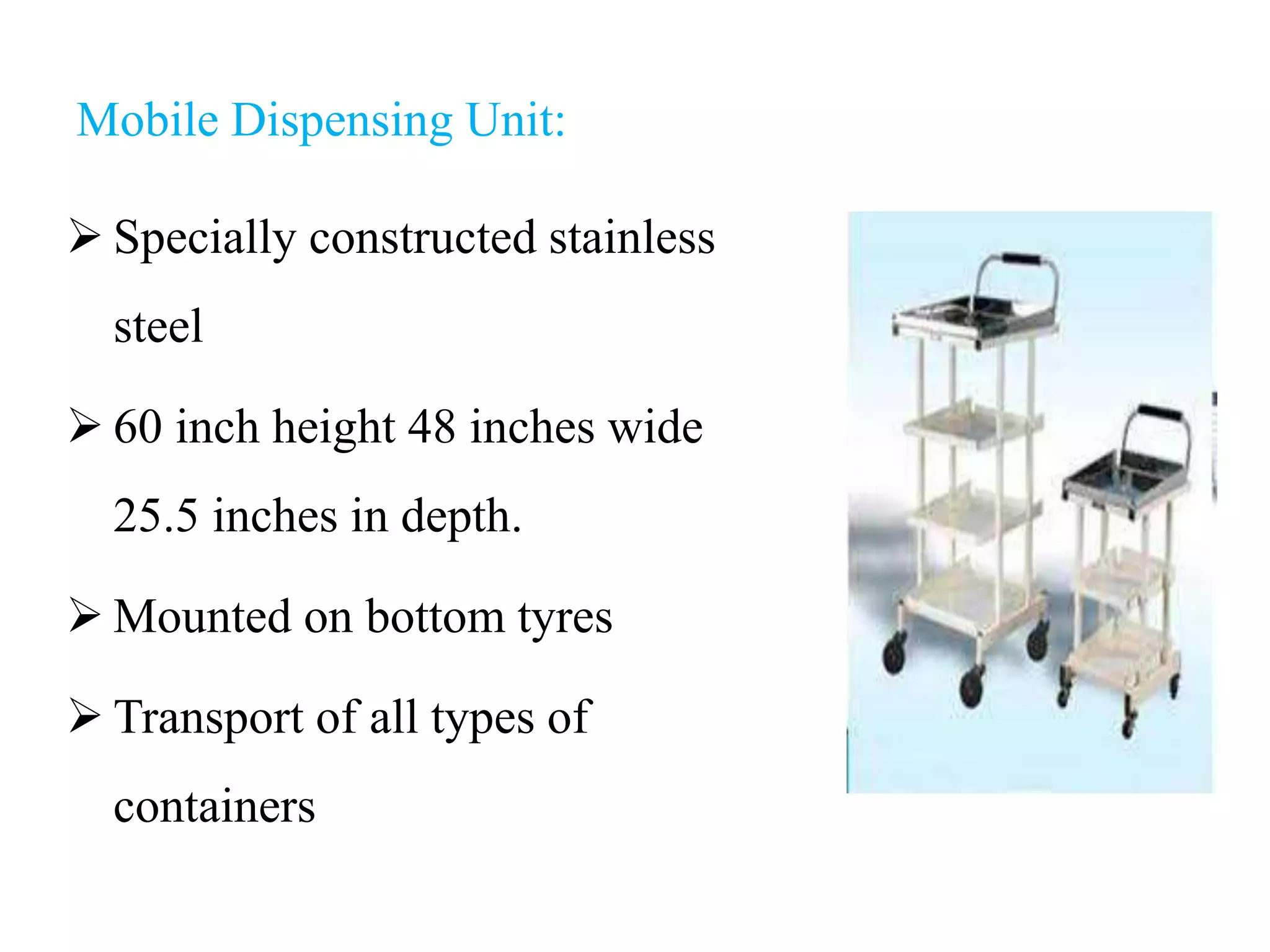
Drug Basket System:
 For stocking non charge floor,
stock drugs
 Nursing unit check the stock of
drug available
 Empty containers are placed in
basket and send to pharmacy for
new dosage forms.
 Pharmacy Staff fill out each
container and send return to
ward through messenger
services.
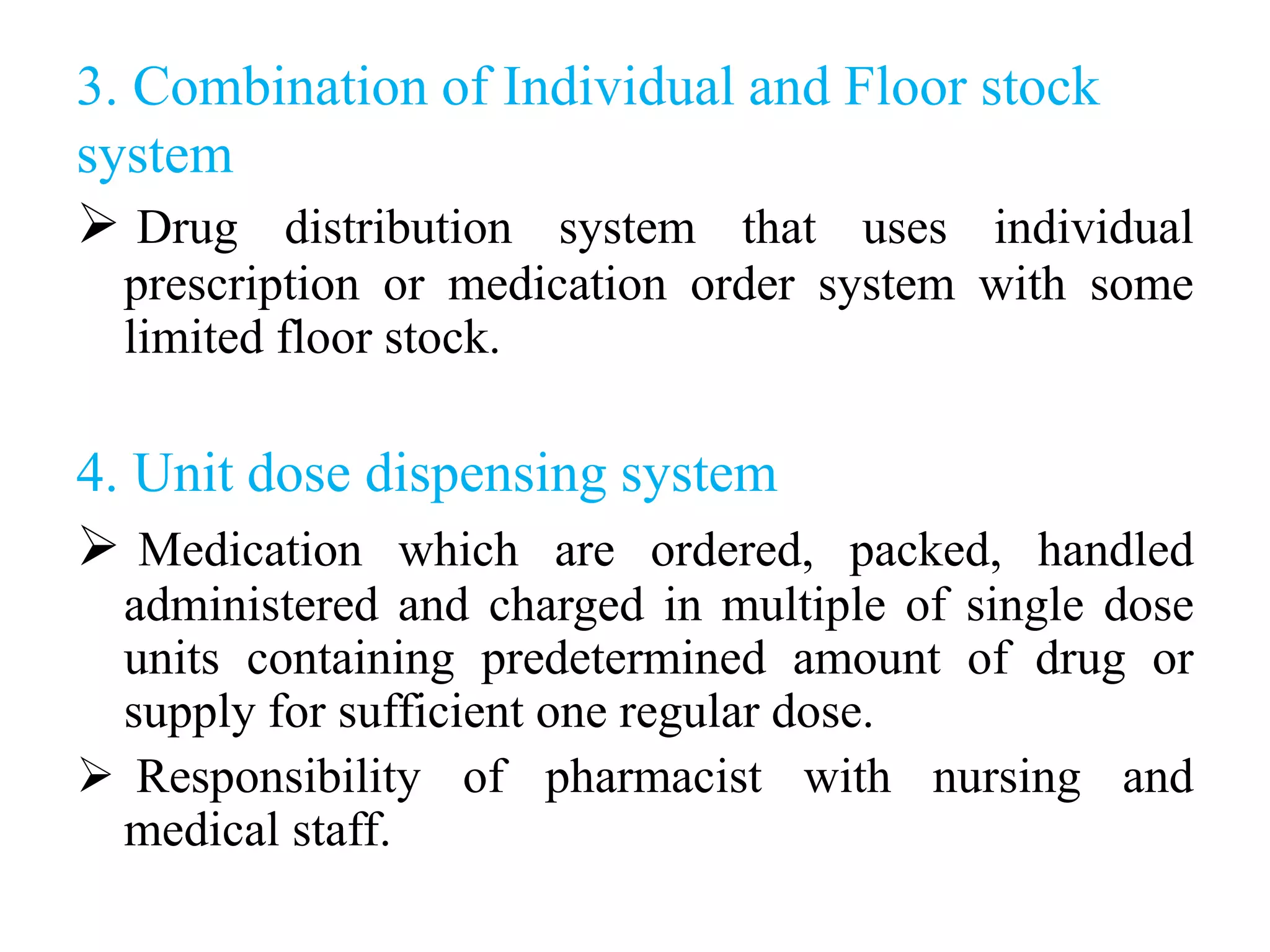
Mobile Dispensing Unit:
 Specially constructed stainless
steel
 60 inch height 48 inches wide
25.5 inches in depth.
 Mounted on bottom tyres
 Transport of all types of
containers
3. Combination of Individual and Floor stock
system
 Drug distribution system that uses individual
prescription or medication order system with some
limited floor stock.
4. Unit dose dispensing system
 Medication which are ordered, packed, handled
administered and charged in multiple of single dose
units containing predetermined amount of drug or
supply for sufficient one regular dose.
 Responsibility of pharmacist with nursing and
medical staff.
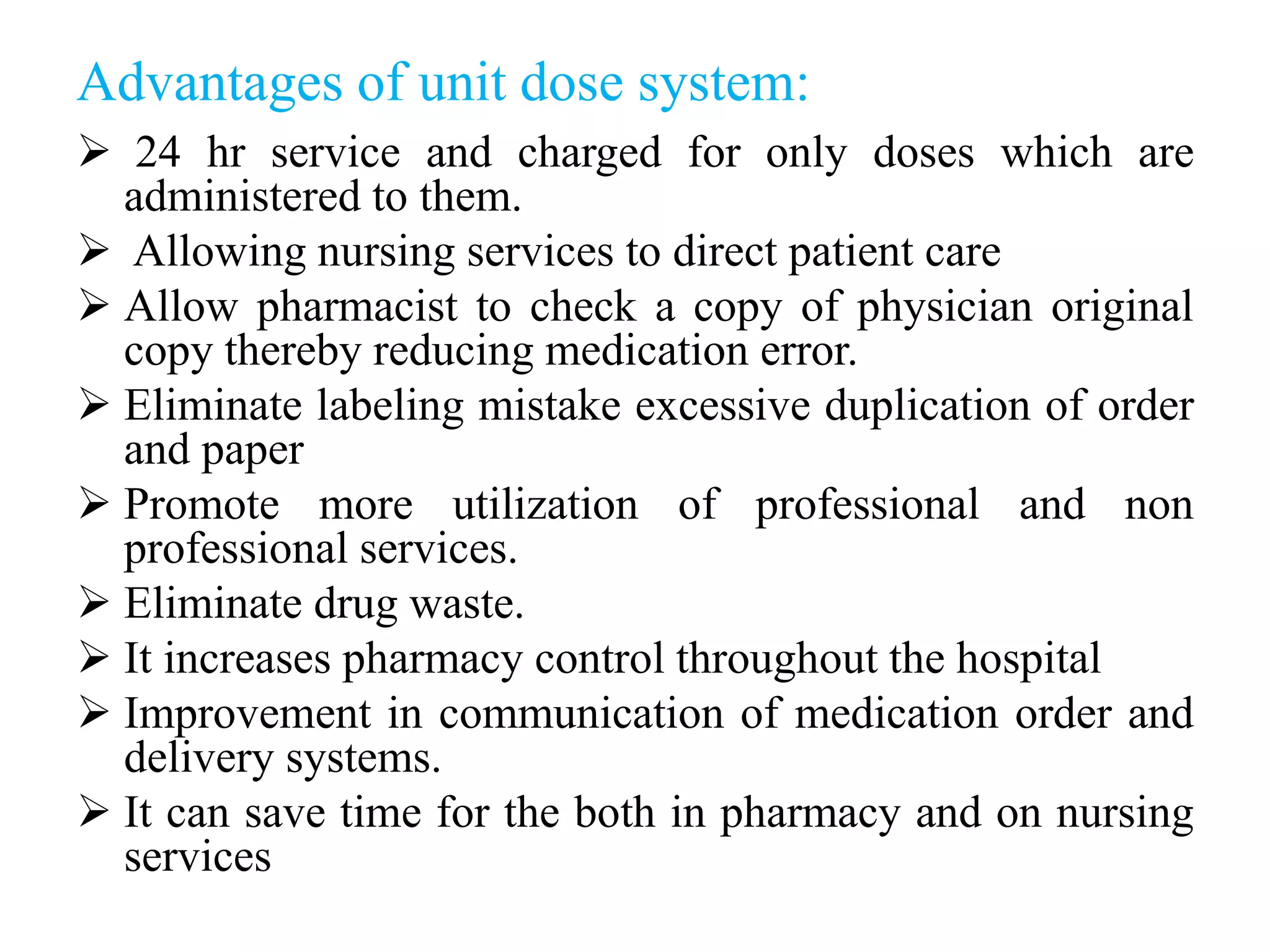
Advantages of unit dose system:
 24 hr service and charged for only doses which are
administered to them.
 Allowing nursing services to direct patient care
 Allow pharmacist to check a copy of physician original
copy thereby reducing medication error.
 Eliminate labeling mistake excessive duplication of order
and paper
 Promote more utilization of professional and non
professional services.
 Eliminate drug waste.
 It increases pharmacy control throughout the hospital
 Improvement in communication of medication order and
delivery systems.
 It can save time for the both in pharmacy and on nursing
services
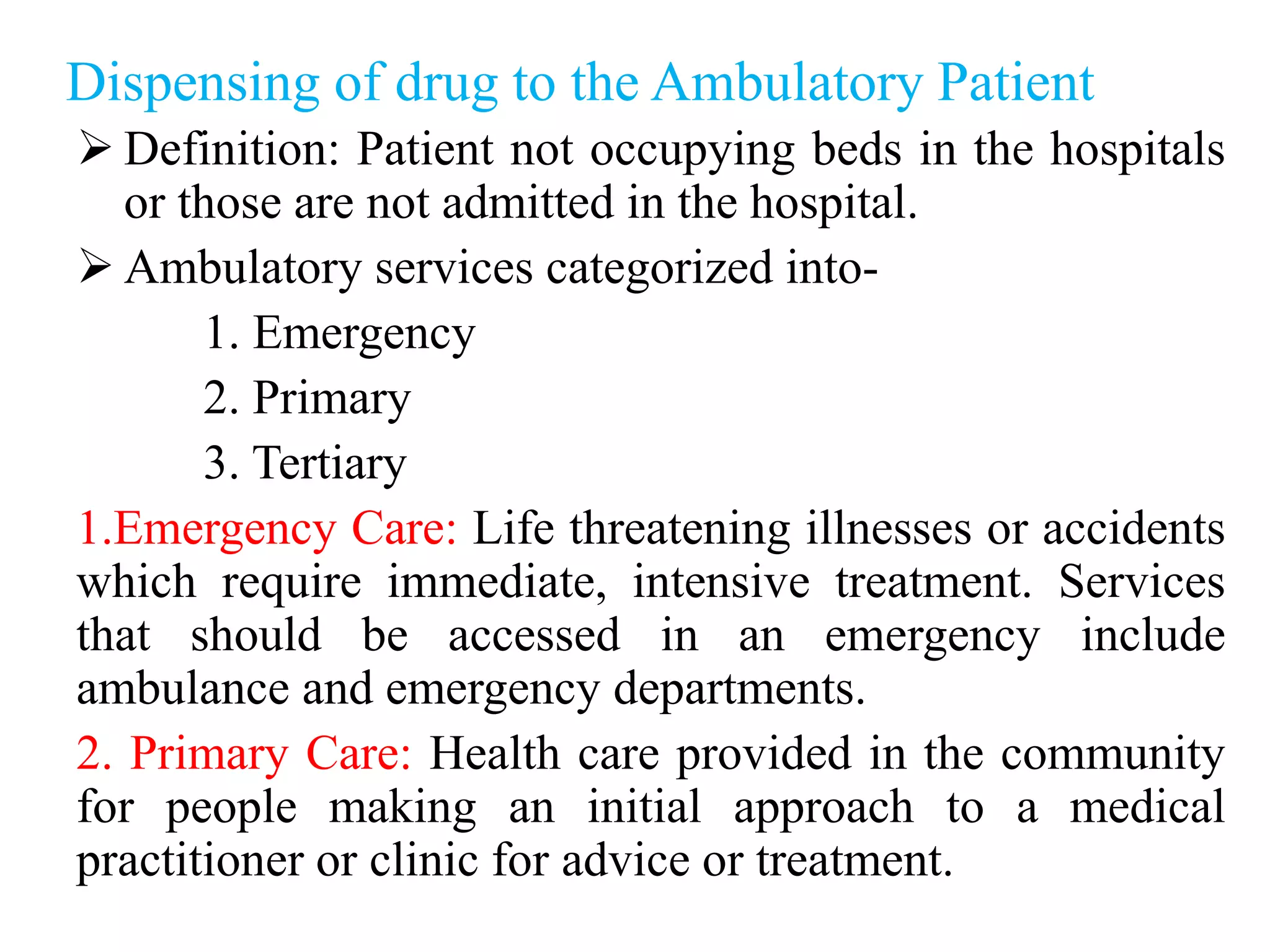
Dispensing of drug to the Ambulatory Patient
 Definition: Patient not occupying beds in the hospitals
or those are not admitted in the hospital.
 Ambulatory services categorized into-
1. Emergency
2. Primary
3. Tertiary
1.Emergency Care: Life threatening illnesses or accidents
which require immediate, intensive treatment. Services
that should be accessed in an emergency include
ambulance and emergency departments.
2. Primary Care: Health care provided in the community
for people making an initial approach to a medical
practitioner or clinic for advice or treatment.
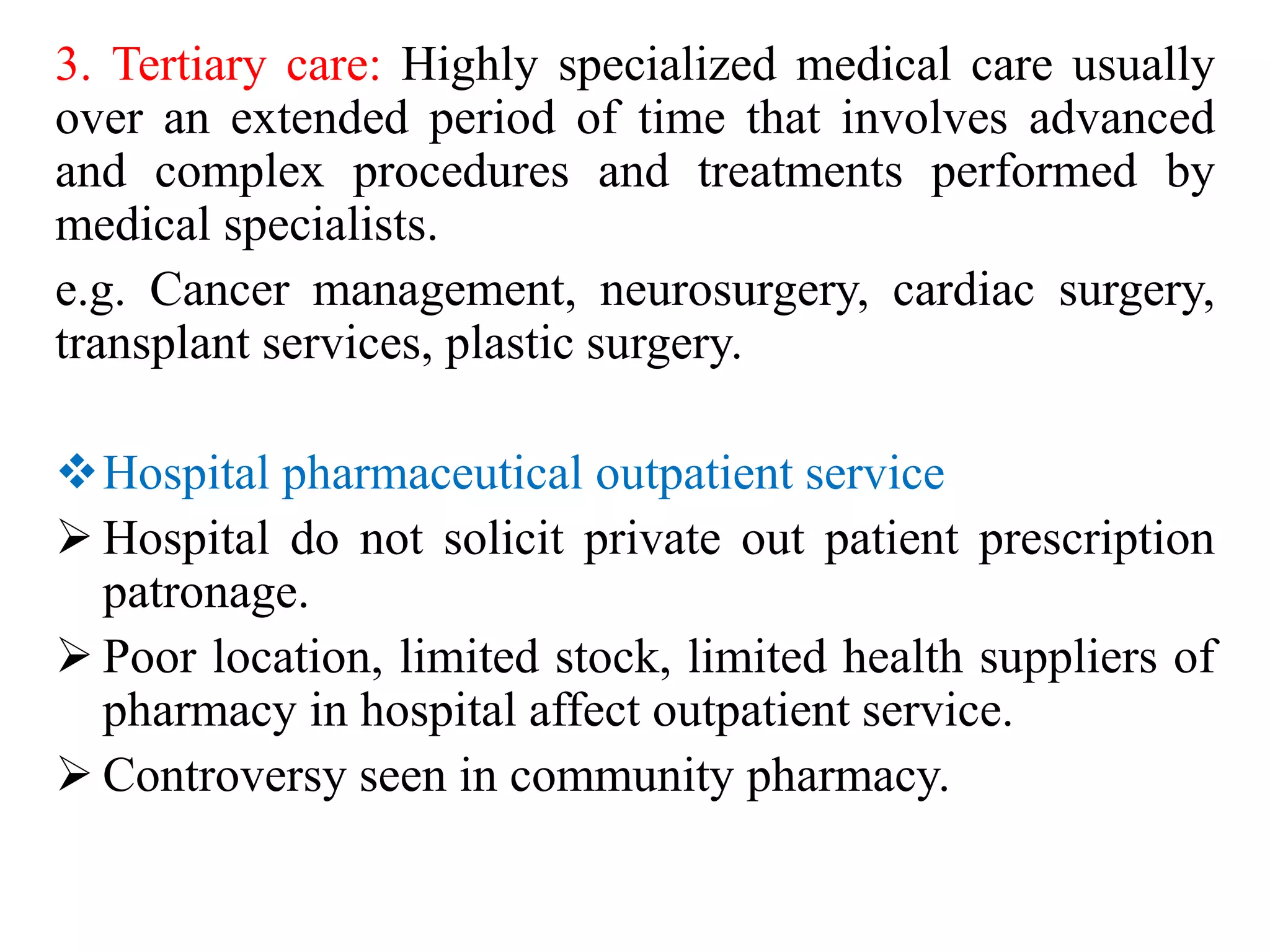
3. Tertiary care: Highly specialized medical care usually
over an extended period of time that involves advanced
and complex procedures and treatments performed by
medical specialists.
e.g. Cancer management, neurosurgery, cardiac surgery,
transplant services, plastic surgery.
Hospital pharmaceutical outpatient service
 Hospital do not solicit private out patient prescription
patronage.
 Poor location, limited stock, limited health suppliers of
pharmacy in hospital affect outpatient service.
 Controversy seen in community pharmacy.
Location of out patient dispensing:
 No rule as such
 Three provisions are made
1. A separate out patient pharmacy
2. A combined in and out patient service from same
window
3. A combined in and out patient service from
different window
 Advantages
 Disadvantages
 Types of prescription received:
1. Resident doctor attending outpatient clinics
2. General public employees
3. Patient discharged from hospital as in patient
 Dispensing Routine
 Prescriptions involving research
Dispensing to emergency patient
Dispensing of Narcotics and controlled
substances
Introduction
International convention was held at Geneva,1910
Dangerous drug act was passed in 1930
(Cultivation, collection, transport, possession,
dispensing and distribution)
Law has certain limitations regarding synthetic
products like LSD, Pethidine.
Drug and cosmetic act 1940
Narcotic and Psychotropic act 1985
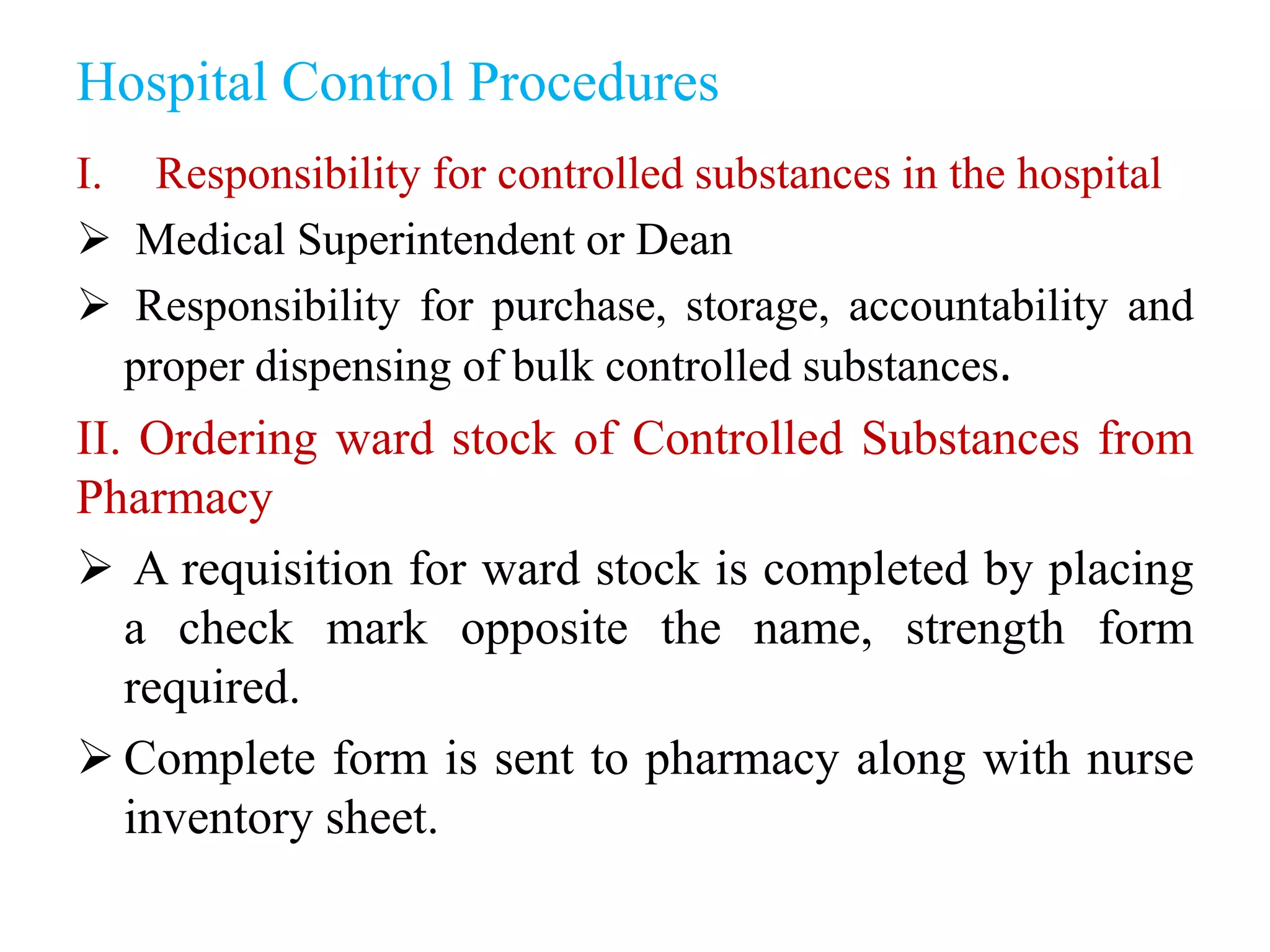
Hospital Control Procedures
I. Responsibility for controlled substances in the hospital
 Medical Superintendent or Dean
 Responsibility for purchase, storage, accountability and
proper dispensing of bulk controlled substances.
II. Ordering ward stock of Controlled Substances from
Pharmacy
 A requisition for ward stock is completed by placing
a check mark opposite the name, strength form
required.
 Complete form is sent to pharmacy along with nurse
inventory sheet.
III Ordering Non-ward Stock Controlled Drug from
Pharmacy
 Ordered from pharmacy on written prescription only
with Doctors sign only.
 Prescription must have following information
Patients full name
Patients hospital number
Date
Name and strength of drug described
Total amount of drug to be dispensed
Registration number of the physician
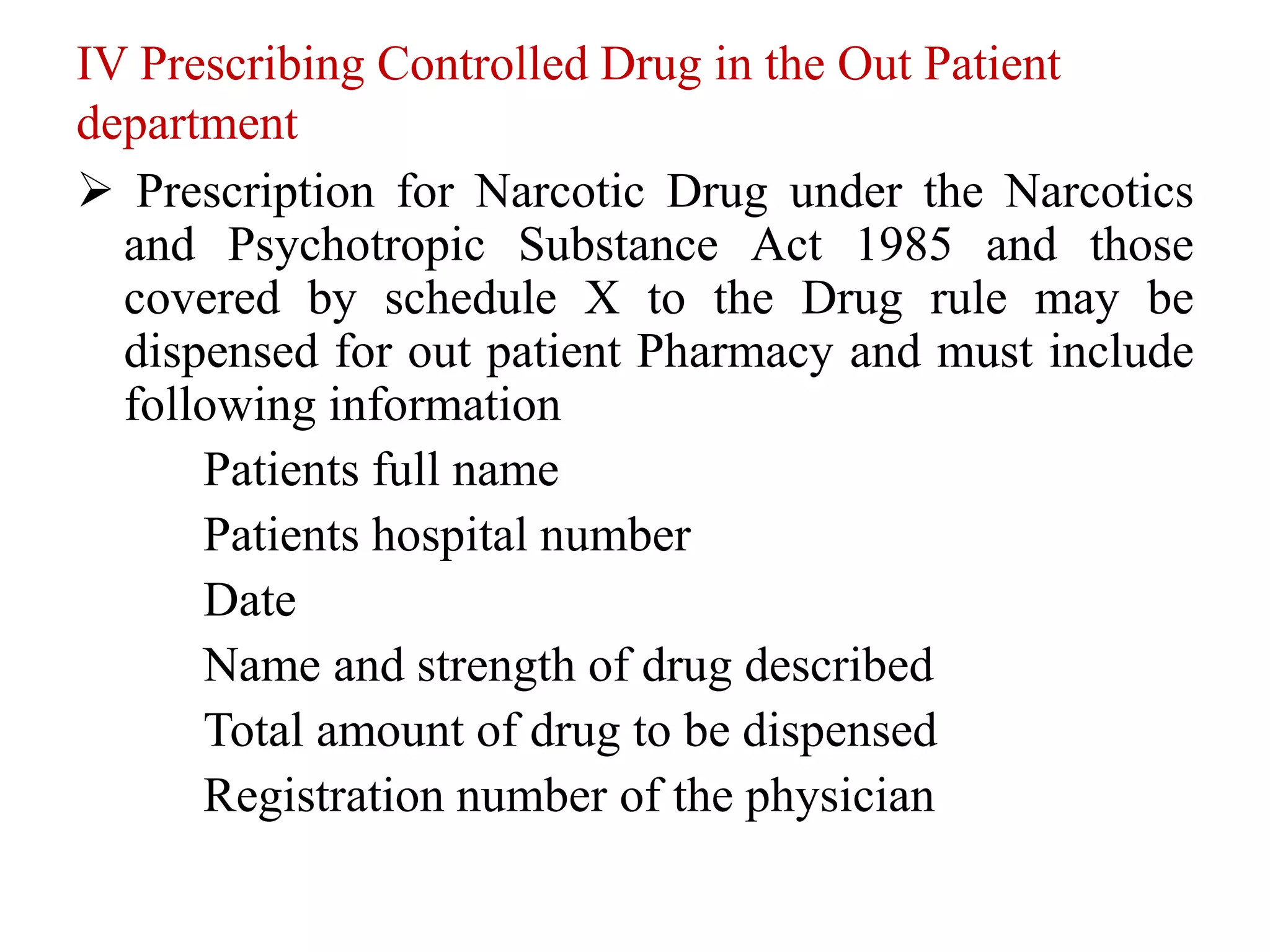
IV Prescribing Controlled Drug in the Out Patient
department
 Prescription for Narcotic Drug under the Narcotics
and Psychotropic Substance Act 1985 and those
covered by schedule X to the Drug rule may be
dispensed for out patient Pharmacy and must include
following information
Patients full name
Patients hospital number
Date
Name and strength of drug described
Total amount of drug to be dispensed
Registration number of the physician
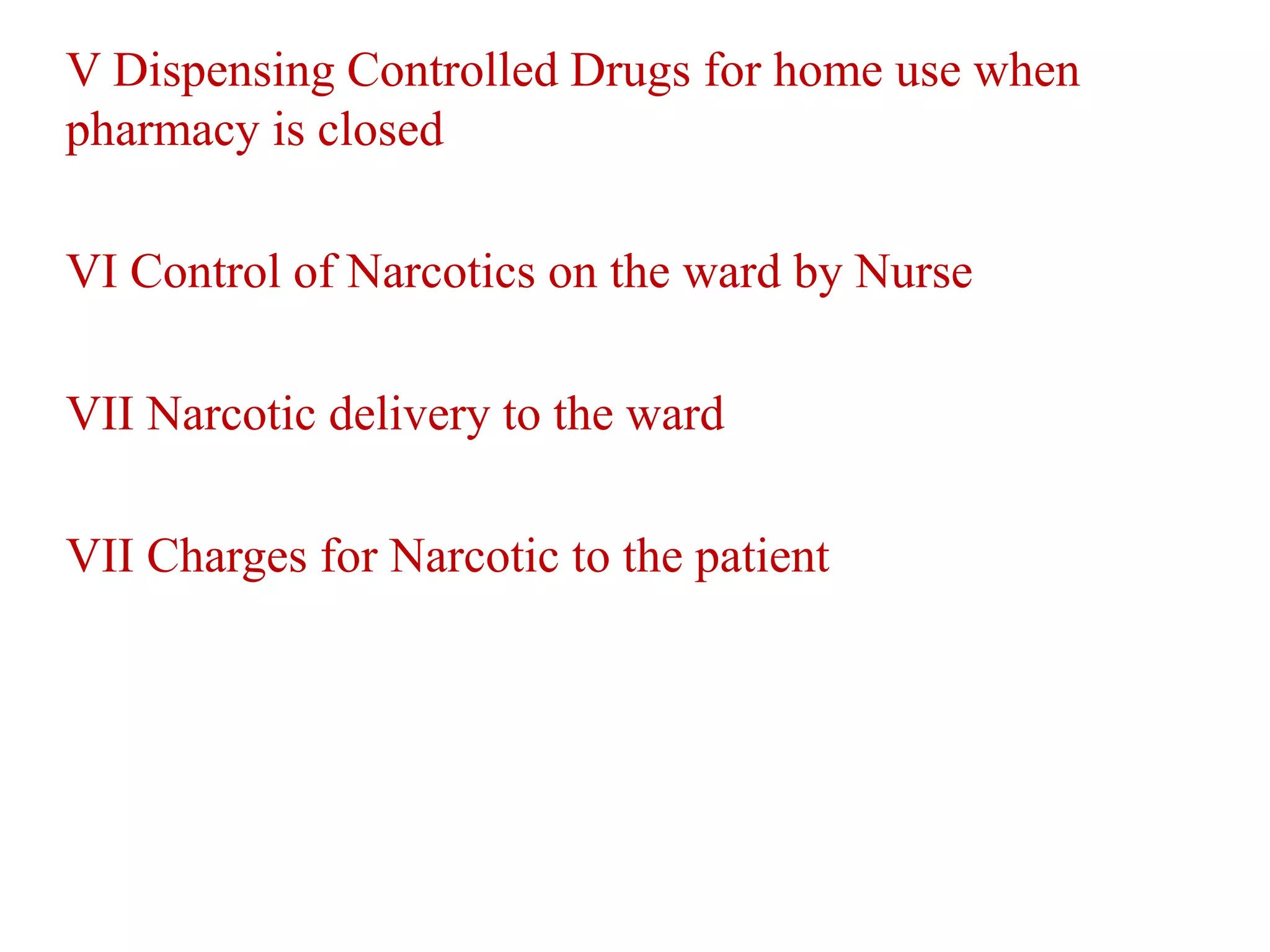
V Dispensing Controlled Drugs for home use when
pharmacy is closed
VI Control of Narcotics on the ward by Nurse
VII Narcotic delivery to the ward
VII Charges for Narcotic to the patient
Drug Dispensing and Distribution.pptx

Drug Dispensing and Distribution.pptx

  • 1.
    Drug Dispensing and DistributionSystem in Hospital Dr. Sangameshwar B. Kanthale Rajarshi Shahu College of Pharmacy Buldana
  • 2.
    D & DSystem in Indian Hospitals  Age old tradition system Dosage forms Requirement Skill and knowledge Techniques  Replaced by current medicines and dosage forms  Industrial era coupled with development of drugs  Drug distribution by Indent System  Hospitals are managed by Central and State Govt. (This aspect of Pharmacy is under the supervision of Junior Medical Officer)
  • 3.
    Different Drug DistributionSystem  Four systems for drug distributions 1. Individual Prescription order system 2. Complete floor stock system 3. Combination of 1 and 2 4. Unit dose system 1. Individual Prescription order system  Physician write the prescription to individual patient  Drug can be purchased from any store by paying own charges  Followed by small and private hospitals due to reduced manpower and desirability of patient. Advantages ?
  • 4.
    2. Complete floorstock system  In this system drugs are given to the patients through the nursing station and supplied from pharmacy unit under the classification 1. Charged floor stock drugs 2. Non Charged floor stock drugs Charged floor stock drugs: Medicines stocks on nursing station at all the time and charged to the patients account after they have been administered to them. Non Charged floor stock drugs: Medicines stocks on nursing station for which there may be no direct charged to the patients account (included in the per day cost)
  • 5.
    Advantage and Disadvantagedof Complete floor stock system Advantages: 1. Easy and fast availability of drugs 2. Elimination of returns to the store of pharmacy 3. Reduction in number of drug transcription Disadvantages: 1. Medication errors will increases 2. Chances of Pilferage 3. Increased drug inventory in the ward 4. Drug deterioration 5. Lack of proper storage 6. Greater load upon the nurse time
  • 6.
    Prescribing of Floorstock system Three different modes are followed to dispatch 1. Prescription order is written out on a separate block by the treating doctors 2. Carbon or other copy of chart order is sent to pharmacist 3. Chart order is transcribed by the person assigned to the ward Labeling of the Floor Stock Drugs:  None of the medicine is labeled for charged and non charged medicines  Patient may be receiving same drug with different dosage form and regimen.  Specific information should be given.
  • 7.
    Selection of chargedstock drugs:  Pharmacy and Therapeutic committee decide these drugs  Different representative from nursing, pharmacy and administrative should be consulted for guidance and advice.  Reviewing of list by committee Selection of non- charged stock drugs:  Cost of preparation, frequency used, quantity, and effect on hospital budget.
  • 8.
    Drug Basket System: For stocking non charge floor, stock drugs  Nursing unit check the stock of drug available  Empty containers are placed in basket and send to pharmacy for new dosage forms.  Pharmacy Staff fill out each container and send return to ward through messenger services.
  • 9.
    Mobile Dispensing Unit: Specially constructed stainless steel  60 inch height 48 inches wide 25.5 inches in depth.  Mounted on bottom tyres  Transport of all types of containers
  • 10.
    3. Combination ofIndividual and Floor stock system  Drug distribution system that uses individual prescription or medication order system with some limited floor stock. 4. Unit dose dispensing system  Medication which are ordered, packed, handled administered and charged in multiple of single dose units containing predetermined amount of drug or supply for sufficient one regular dose.  Responsibility of pharmacist with nursing and medical staff.
  • 11.
    Advantages of unitdose system:  24 hr service and charged for only doses which are administered to them.  Allowing nursing services to direct patient care  Allow pharmacist to check a copy of physician original copy thereby reducing medication error.  Eliminate labeling mistake excessive duplication of order and paper  Promote more utilization of professional and non professional services.  Eliminate drug waste.  It increases pharmacy control throughout the hospital  Improvement in communication of medication order and delivery systems.  It can save time for the both in pharmacy and on nursing services
  • 12.
    Dispensing of drugto the Ambulatory Patient  Definition: Patient not occupying beds in the hospitals or those are not admitted in the hospital.  Ambulatory services categorized into- 1. Emergency 2. Primary 3. Tertiary 1.Emergency Care: Life threatening illnesses or accidents which require immediate, intensive treatment. Services that should be accessed in an emergency include ambulance and emergency departments. 2. Primary Care: Health care provided in the community for people making an initial approach to a medical practitioner or clinic for advice or treatment.
  • 13.
    3. Tertiary care:Highly specialized medical care usually over an extended period of time that involves advanced and complex procedures and treatments performed by medical specialists. e.g. Cancer management, neurosurgery, cardiac surgery, transplant services, plastic surgery. Hospital pharmaceutical outpatient service  Hospital do not solicit private out patient prescription patronage.  Poor location, limited stock, limited health suppliers of pharmacy in hospital affect outpatient service.  Controversy seen in community pharmacy.
  • 14.
    Location of outpatient dispensing:  No rule as such  Three provisions are made 1. A separate out patient pharmacy 2. A combined in and out patient service from same window 3. A combined in and out patient service from different window  Advantages  Disadvantages
  • 15.
     Types ofprescription received: 1. Resident doctor attending outpatient clinics 2. General public employees 3. Patient discharged from hospital as in patient  Dispensing Routine  Prescriptions involving research Dispensing to emergency patient
  • 16.
    Dispensing of Narcoticsand controlled substances Introduction International convention was held at Geneva,1910 Dangerous drug act was passed in 1930 (Cultivation, collection, transport, possession, dispensing and distribution) Law has certain limitations regarding synthetic products like LSD, Pethidine. Drug and cosmetic act 1940 Narcotic and Psychotropic act 1985
  • 17.
    Hospital Control Procedures I.Responsibility for controlled substances in the hospital  Medical Superintendent or Dean  Responsibility for purchase, storage, accountability and proper dispensing of bulk controlled substances. II. Ordering ward stock of Controlled Substances from Pharmacy  A requisition for ward stock is completed by placing a check mark opposite the name, strength form required.  Complete form is sent to pharmacy along with nurse inventory sheet.
  • 18.
    III Ordering Non-wardStock Controlled Drug from Pharmacy  Ordered from pharmacy on written prescription only with Doctors sign only.  Prescription must have following information Patients full name Patients hospital number Date Name and strength of drug described Total amount of drug to be dispensed Registration number of the physician
  • 19.
    IV Prescribing ControlledDrug in the Out Patient department  Prescription for Narcotic Drug under the Narcotics and Psychotropic Substance Act 1985 and those covered by schedule X to the Drug rule may be dispensed for out patient Pharmacy and must include following information Patients full name Patients hospital number Date Name and strength of drug described Total amount of drug to be dispensed Registration number of the physician
  • 20.
    V Dispensing ControlledDrugs for home use when pharmacy is closed VI Control of Narcotics on the ward by Nurse VII Narcotic delivery to the ward VII Charges for Narcotic to the patient