Interceptive Orthodontics
 History
 Concept
 Rationale
 Indications
 Contraindications
 Methods
 Special situations
 Advantages
 Disadvantages
 Conclusion
 “Malocclusion of teeth frequently constitutes
an indignity with profound mental and
physical stigma on our child patients. Their
well being is our challenging obligation.’’
 Introduced the concept of Serial Extraction
 Coined the term “Serial Extraction”
 The term serial extraction describes an
orthodontic treatment procedure that
involves the orderly removal of selected
deciduous and permanent teeth in a
predetermined sequence
 Nance popularized this technique and termed
it “planned & progressive extraction”.
 Hotz in 1970 called “active supervision” of
teeth by extraction.
 Anticipate
 Minimize deformity
 Records and analysis
 Technique
 Crowding
 Selection of cases
 Ideal timing – First permanent anterior tooth
erupts.
 X-rays
 Horizontal growth
 Time to align
 If distance of half or more premolar is
lacking in both sides of the lower arch
 From C – More than compensated by Canine
 From D –
 From E – Mesial drift of FPM
 Arch Length tooth material discrepancy
 Physiologic tooth movement
 Class 1 malocclusion with > 10 mm discrepancy
 No developmental spacing
 Aberrant eruption pattern
 Crowding with proclination
 Lingual eruption of lateral incisor
 Midline shift due to lateral incisor displacement
 Labial displacemnet of mandibular incisors
 Gingival recession of labially placed incisors
 Premature loss of primary canine
 Labially placed but unerupted permanent
canine
 Congenital absence of teeth
 Cleft lip palate patients
 Midline diastema
 Vertical discrepancy: deep bite or open bite
 Class 1 malocclusion with minimal discrepancy
 Class ll div ll
 Class lll
 Skeletal class lll
 Collapsed arch
 80% of class 1 crowded arches are not self
correcting.
 3rd molar impaction if lower incisors are
crowded
 Greater the discrepancy between tooth size
and basal bone… better is the prognosis of SE
 Earlier the extraction of the primary teeth
better is chance of self correction of
rotation.
Except
 Not very severe crowding and lower incisors
are lingually inclined. Deep bite.
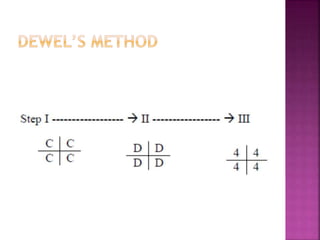
 Dewel’s method
 Tweed’s method
 Nance’s method
 Moyer’s method
 First: Deciduous canines: to permit eruption
and optimal alignment of lateral incisors.
 Second: First deciduous molars: to
accelerate eruption of first premolars ahead
of canine if possible.
 Third: Erupting first premolars: Before the
first premolars are extracted, all the
diagnostic criteria must again be evaluated.
7 ½ to 8 ½ years
 First: Around 8 years all ‘D’. Maintain ‘C’ to
retard eruption of permanent canines.
 Second: Extraction of ‘4’ and ‘C’ should be
done 4-6 months prior to eruption of
permanent canines when they erupt they
migrate posteriorly into good position.
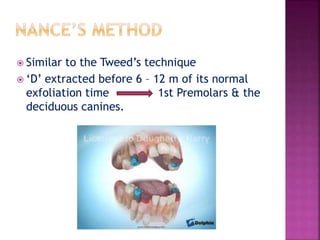
 Similar to the Tweed’s technique
 ‘D’ extracted before 6 – 12 m of its normal
exfoliation time 1st Premolars & the
deciduous canines.
When crowding is in central incisor region. After
eruption of lateral incisors.
 Stage I - B central incisors.
 Stage II - C after 7-8m lateral incisors
 Stage III – D Stimulates eruption of all first
premolars.
 Stage IV – 4 after 7-8m space for and
stimulation of eruption of canines.
 Earlier the extraction better the self
correction of rotation.
BUT
 If lowers are lingually inclined do not extract
early.
 Premature removal is not indicated
 Remove when ½ - 2/3 of root is formed
 Remove when canines have erupted first
 Extract erupting PM as early as possible
Time for posteriors to drift.
Any remaining primary incisor can be extracted
 In borderline cases 2nd PM can be extracted
 If position of canine is very abnormal it can
be extracted instead of PM
 If 2nd PM or 1st permanent molar have large
fillings they should be extracted in
preference to 1st PM
 Permanent first Molar!
 Less need of retention
 Less severe malocclusion
 Physiological tooth movement
 Deepening of overbite (Dewel 1967)
 Rotation of teeth
 Failure of complete space closure
 Lingual collapse of mandibular arch
 Patient cooperation and long follow up
(1) Developing dentition receives competent
supervision
(2) no teeth of any kind be removed prior to a
most precise and exacting case analysis
(3) case analysis be repeated preceding and
subsequent extraction
(4) that when indicated, competent
orthodontic treatment be provided
 Kjellgren, B. Serial extraction as a
corrective procedure in dental orthopedic
therapy. Trans. Europ. Orthod. Soc. 1947–
1948;:134–160.
 Hotz, R. Active supervision of the eruption
of teeth by extraction. Trans. Europ.
Orthod. Soc. 1947–1948;:34–47.i
 Manual of Pediatric dentistry; Sridhar
Premkumar
 Orthodontics ‘The art and science” Dr.
B.S.Iyyer.
Q1. Early extraction of primary first
molar can cause
a. Early eruption of permanent first molars
b. An Increase in overjet
c. Abnormal swallowing pattern
d. Worsening of deep bite
Q2. Disadvantage of serial extraction is
a. Supra eruption of antagonist tooth
b. Rotation of teeth
c. Increase in open bite
d. Greater need of retention following
treatment
Q3. The term ‘serial extraction’ was
coined by
a. Heath (1961)
b. Robert Bunon (1743)
c. Kjellgren (1929)
d. Dewel (1969)
Q4. In a case of moderate to severe
crowding permanent canine can be
extracted when
a. Inspite of serial extraction there is tooth
material excess
b. When the permanent canine is severly
malposed
c. Skeletal Class lll with mandibular excess
Q5. Early extraction of primary first
molar can cause
a. Early eruption of permanent first molars
b. An Increase in overjet
c. Abnormal swallowing pattern
d. Worsening of deep bite

Serial extraction

  • 1.
  • 2.
     History  Concept Rationale  Indications  Contraindications  Methods  Special situations  Advantages  Disadvantages  Conclusion
  • 3.
     “Malocclusion ofteeth frequently constitutes an indignity with profound mental and physical stigma on our child patients. Their well being is our challenging obligation.’’
  • 4.
     Introduced theconcept of Serial Extraction  Coined the term “Serial Extraction”
  • 5.
     The termserial extraction describes an orthodontic treatment procedure that involves the orderly removal of selected deciduous and permanent teeth in a predetermined sequence
  • 6.
     Nance popularizedthis technique and termed it “planned & progressive extraction”.  Hotz in 1970 called “active supervision” of teeth by extraction.
  • 7.
     Anticipate  Minimizedeformity  Records and analysis
  • 8.
  • 9.
     Selection ofcases  Ideal timing – First permanent anterior tooth erupts.  X-rays  Horizontal growth  Time to align
  • 10.
     If distanceof half or more premolar is lacking in both sides of the lower arch
  • 11.
     From C– More than compensated by Canine  From D –  From E – Mesial drift of FPM
  • 12.
     Arch Lengthtooth material discrepancy  Physiologic tooth movement
  • 13.
     Class 1malocclusion with > 10 mm discrepancy  No developmental spacing  Aberrant eruption pattern  Crowding with proclination  Lingual eruption of lateral incisor
  • 15.
     Midline shiftdue to lateral incisor displacement  Labial displacemnet of mandibular incisors  Gingival recession of labially placed incisors  Premature loss of primary canine  Labially placed but unerupted permanent canine
  • 16.
     Congenital absenceof teeth  Cleft lip palate patients  Midline diastema  Vertical discrepancy: deep bite or open bite
  • 17.
     Class 1malocclusion with minimal discrepancy  Class ll div ll  Class lll  Skeletal class lll  Collapsed arch
  • 18.
     80% ofclass 1 crowded arches are not self correcting.  3rd molar impaction if lower incisors are crowded  Greater the discrepancy between tooth size and basal bone… better is the prognosis of SE
  • 19.
     Earlier theextraction of the primary teeth better is chance of self correction of rotation. Except  Not very severe crowding and lower incisors are lingually inclined. Deep bite.
  • 20.
     Dewel’s method Tweed’s method  Nance’s method  Moyer’s method
  • 23.
     First: Deciduouscanines: to permit eruption and optimal alignment of lateral incisors.  Second: First deciduous molars: to accelerate eruption of first premolars ahead of canine if possible.  Third: Erupting first premolars: Before the first premolars are extracted, all the diagnostic criteria must again be evaluated.
  • 24.
    7 ½ to8 ½ years  First: Around 8 years all ‘D’. Maintain ‘C’ to retard eruption of permanent canines.  Second: Extraction of ‘4’ and ‘C’ should be done 4-6 months prior to eruption of permanent canines when they erupt they migrate posteriorly into good position.
  • 27.
     Similar tothe Tweed’s technique  ‘D’ extracted before 6 – 12 m of its normal exfoliation time 1st Premolars & the deciduous canines.
  • 28.
    When crowding isin central incisor region. After eruption of lateral incisors.  Stage I - B central incisors.  Stage II - C after 7-8m lateral incisors  Stage III – D Stimulates eruption of all first premolars.  Stage IV – 4 after 7-8m space for and stimulation of eruption of canines.
  • 31.
     Earlier theextraction better the self correction of rotation. BUT  If lowers are lingually inclined do not extract early.
  • 32.
     Premature removalis not indicated  Remove when ½ - 2/3 of root is formed  Remove when canines have erupted first  Extract erupting PM as early as possible Time for posteriors to drift.
  • 33.
    Any remaining primaryincisor can be extracted
  • 34.
     In borderlinecases 2nd PM can be extracted  If position of canine is very abnormal it can be extracted instead of PM  If 2nd PM or 1st permanent molar have large fillings they should be extracted in preference to 1st PM  Permanent first Molar!
  • 35.
     Less needof retention  Less severe malocclusion  Physiological tooth movement
  • 36.
     Deepening ofoverbite (Dewel 1967)  Rotation of teeth  Failure of complete space closure  Lingual collapse of mandibular arch  Patient cooperation and long follow up
  • 38.
    (1) Developing dentitionreceives competent supervision (2) no teeth of any kind be removed prior to a most precise and exacting case analysis (3) case analysis be repeated preceding and subsequent extraction (4) that when indicated, competent orthodontic treatment be provided
  • 39.
     Kjellgren, B.Serial extraction as a corrective procedure in dental orthopedic therapy. Trans. Europ. Orthod. Soc. 1947– 1948;:134–160.  Hotz, R. Active supervision of the eruption of teeth by extraction. Trans. Europ. Orthod. Soc. 1947–1948;:34–47.i  Manual of Pediatric dentistry; Sridhar Premkumar  Orthodontics ‘The art and science” Dr. B.S.Iyyer.
  • 42.
    Q1. Early extractionof primary first molar can cause a. Early eruption of permanent first molars b. An Increase in overjet c. Abnormal swallowing pattern d. Worsening of deep bite
  • 43.
    Q2. Disadvantage ofserial extraction is a. Supra eruption of antagonist tooth b. Rotation of teeth c. Increase in open bite d. Greater need of retention following treatment
  • 44.
    Q3. The term‘serial extraction’ was coined by a. Heath (1961) b. Robert Bunon (1743) c. Kjellgren (1929) d. Dewel (1969)
  • 45.
    Q4. In acase of moderate to severe crowding permanent canine can be extracted when a. Inspite of serial extraction there is tooth material excess b. When the permanent canine is severly malposed c. Skeletal Class lll with mandibular excess
  • 46.
    Q5. Early extractionof primary first molar can cause a. Early eruption of permanent first molars b. An Increase in overjet c. Abnormal swallowing pattern d. Worsening of deep bite