Serial extraction
Dr. Rajeev Singh, pediatric dental surgeon
Kd dental college, Mathura
Contents
• Introduction
• History
• Definitions
• Diagnosis
• Dental development
• Skeletal development
• Muscular development
• Rationale
• Treatment Objective
• Evaluation of the patient
• Total space analysis
• Indications
• Contra-indications
• Advantages of serial extraction
• Disadvantages of serial extraction
• Sequence of extractions
• Treatment
• Orthodontic Appliance
• Conclusion
• Reference
Introduction
• Removal of primary and permanent - definite
sequence
• Thorough understanding of orofacial growth
and development.
• Lack of understanding and knowledge has
created disastrous results
History
• Bunon and Boudet (1743) – first to recommend
extraction of teeth in order to relieve crowding
• Linderer (1851) – wrote about extraction to
relieve crowding
• Kjellgren (1929) – introduced the term “serial
extraction”
• Nance (1940) – father of serial extraction in USA
• Heath (1949) – “planned minimum
orthodontic treatment ”
• Dewel (1954), Tweed (1966) – “Pre-
orthodontic guidance”
• Hotz (1970) – “Guidance of eruption”
Definitions
• Dewel -The orderly removal of selected
primary and permanent teeth in a
predetermined sequence.
• Profitt - Serial extraction is the planned
sequence of tooth removal that can reduce
crowding and irregularity during the transition
from primary to permanent dentition.
• Shoba Tandon - The correctly timed, planned
removal of certain deciduous and permanent
teeth in mixed dentition cases with dentoalveolar
disproportion i.e., teeth to supporting bone
imbalance in order to:
a) Alleviate crowding of the incisor teeth .
b) Allow unerupted teeth to guide themselves into
improved positions.
c) Lessen the period of active appliance therapy or
eliminate it .
Diagnosis
• Case selection is the most crucial factor.
• Graber (1971) – The clinician has to assess the
interrelationship between three systems
– Dental.
– Skeletal.
– Neuromuscular systems.
Dental development
Incisor liability :
• Mayne & Dale (1969) – it as the discrepancy in
widths between 4 permanent incisors and their
primary counterparts
• Max. teeth - 7.6mm
• Mand. teeth is about 6mm .
• Corrected by combination by 4 factors -
– Interdental spacing of the primary incisor teeth
– Intercanine arch width growth
– Intercanine arch length increases through labial
positioning of the erupting permanent incisors
– favorable variations in size ratio between the
permanent and primary teeth
Leeway space :
• Nance – the size difference between the primary canine & molars and the
permanent canine & premolars as leeway space.
• 1.8mm in max. and 3.4mm in the mand.
• leeway space is utilized during Mesial drifting of the mand. first molars
(class I molar relationship)
• Spaced primary dentition (early mesial shift)
• Closed primary dentition (late mesial shift)
Skeletal development
• Cephalometric analysis for all cases.
• Hand wrist radiograph – enable the clinician
to predict remaining growth & anticipated
developmental adjustments.
• The functional articulation between basal
bones to each other & their relationship to
the cranial base has to be within normal
limits.
Muscular development
• Imbalances in musculature should be noted.
• Strain, hypotonicity, hypertonicity, unusual lip
lines or markings.
• Adverse oral habits – thumb sucking.
Rationale
• Aduss et al (1977) – predict with a fair degree of certainity that
there will not be enough space for the permanent teeth to erupt.
• Graber (1971) –after eruption of the first molars there is no
increase in arch length & also increased arch length by expansion is
not very stable.
• Kluemper et al (2000) – early removal of teeth will allow for more
physiologic unassisted movement of adjacent teeth into more
favorable positions.
Treatment Objective
• Performed in different ways
(1) A period of interceptive guidance extending
approximately 5 yrs( 71/2 to 121/2 )
(2) An initial period of interceptive guidance
extending approximately 4 yrs (71/2 to 111/2) plus
second period of multibanded treatment
extending approximate 1 yr. ( 111/2 to 121/2).
Class I and specific types of class II fall into this
category.
(3) An initial period of interceptive treatment
extending approximate 1 yr (81/2 to 91/2 ),period of
interceptive guidance extending approximate 2
yrs (91/2 to 111/2) and second period of
multibanded treatment extending approximate
11/2 . ( 111/2 to 13).
Class II and class III malocclusions fall primarily
into this category.
4) A period of multibanded treatment
extending for 11/2 to 3 yrs ( 111/2 to 141/2 ).
• Serial extraction is not involved in this
treatment wherever possible.
• Avoid extensive treatment in teenage period .
Evaluation of the patient
Intraoral radiographs :
• Complete series of periapical radiographs
/panoramic radiograph.
• Detection of congenital absence of teeth.
• Detection of supernumerary teeth.
• Evaluation of permanent teeth.
• Detection of pathologic conditions in the early
stages.
• Assessment of trauma to the teeth.
• Detection of evidence of a true hereditary tooth- size
jaw-size discrepancy.
• Determination of size, shape and relative position of
unerupted permanent teeth.
• Determination of dental age of the patient.
• Calculation of total space analysis.
• Detection of root resorption before ,during and after
treatment.
• Evaluation of third molars before, during and after
treatment.
• Final appraisal of the dental health after orthodontic
treatment.
Cephalometric analysis :
• Evaluation of craniofacial relationships prior to
treatment.
• Assessment of soft tissue.
• Classification of facial pattern.
• Calculation of tooth-size jaw-size discrepancies
(total space analysis).
• Determination of mandibular rest position.
• Prediction of growth and development.
• Monitoring of skeletodental relationships during
treatment.
• Detection of pathologic conditions before ,during
and after treatment.
Facial photographs :
• Evaluation of craniofacial relationships prior to
treatment.
• Assessment of soft tissue profile.
• Proportional facial analysis.
• Total space analysis.
• Occlusal curve analysis.
• Monitoring of treatment progress.
• Study of relationships.
Study models :
• Calculate total space analysis.
• Assess and record the dental anatomy.
• Assess and record the intercuspation.
• Assess and record arch form.
• Assess and record the curve of occlusion.
• Evaluate occlusion with aid of articulators.
• Measure progress during treatment.
• Detect abnormalities.
Total space analysis
• Moyer's mixed dentition analysis
• Tanaka and Johnson analysis
Indications
• Crowding
Mild Crowding:
A true arch length discrepancy of 0-2mm may be manifested
as mild irregularities in the incisor region. Observation is
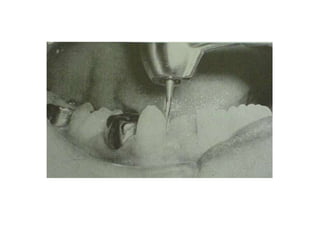
usually the best course .If treatment is required proximal
slicing or disking can be done with;
i) Hand- held strip,
ii) Sand paper disk in a slow speed hand piece,
iii) Tapered bur in a high speed hand piece
Moderate crowding:
• Arch length discrepancy of less than 5mm
• is based on the facial profile, incisor protrusion,
crowding
• small amount of expansion is done to
accommodate all the teeth if space loss is 3mm or
less
• the adjacent tooth is tipped into position with
either a removable appliance or an active lingual
arch.
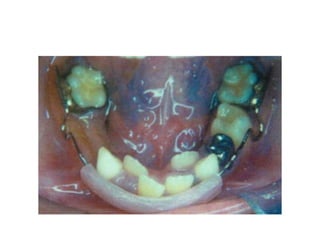
Severe Crowding:
• crowding is so severe (>10mm/arch)
• in the mixed dentition arch expansion is not
feasible
• serial extraction is necessary
• A midline displacement of mand. Incisor due to
premature exfoliation of primary canine on
crowded teeth
• Crowded mand.lateral incisors that have
commenced resorbing the roots of the primary
canines
• Ectopic eruption of permanent max. first molar
indicating a lack of development in the tuberosity
area
• facial pattern that is orthognathic /with slight
alveolodental protrusion
Contra-indications
• Mild to moderate crowding caused by
environmental factors & there is not a substantial
lack of space
• Increased overjet or reverse overjet
• Deep overbite or an open bite
• Permanent teeth congenitally missing from the
dental arch
• Gross mal-position of teeth ,rotation & crossbite
• Spaced dentition
• Midline diastema
• Extensive caries of Ist permanent molar requireing their
removal
• Severe class II,III of dental / skeletal origin
• Cleft lip & palate cases
Advantages of serial extraction
• Mayne(1969) – less potential for iatrogenic
orthodontic damage to tooth roots
• Maj (1970) – psychologically ,the child will benefit
from earlier correction of esthetics as the
anterior teeth spontaneously align themselves
• Yoshihara et al (1999) – aimed at encouraging a
measure of self correction in order to shorten the
time & complexity of mechanotherapy
• Yoshihara et al (1999) – under appropriate
conditions can be used on handicapped patients
• Dale (2000) – retention requirements in serial
extraction cases are lessened
• Dale (2000) – reduces appliance treatment time
,the cost of treatment
• Intercepts the developing mal-occlusion as early
as possible so as to reduce ,or in rare cases avoid
orthodontic treatment
Disadvantages of serial extraction
• Aduss et al (1977) – increase in overbite
,lingual tipping of mand.incisors thereby
decreasing arch length & fixed appliance
therapy after a long period of follow up
• Jacobs (1987) – early extractions can lead to
space loss and delayed eruption of the
Sequence of extractions
• Bunon (1743) – primary canines, first primary
molars and first premolars
• Dewels method – C D 4
• Tweeds method – D 4 C
• Nance method – D4 C
• Most satisfactory order
• Removal of first primary molars is sometimes
advocated to promote earlier eruption of first
Serial extraction – Class I treatment:
Anterior discrepancy : crowding
• Primary canines – to relieve incisor crowding
after eruption of lateral incisor
• Ist primary molar – performed after incisor
crowding has improved and the extn site is
reduced in size
• When the permanent canines have developed
Anterior discrepancy : alveolodental protrusion
• Primary Ist molars
• Premolars have to be extracted at half root
formation in order encourage their early
eruption ahead of canines
• Next the primary canines and Ist premolars
are extracted to encourage lingual tipping of
Middle discrepancy : impacted canines
• There may already be premature exfoliation of
the primary canines
• The incisors may be splayed out due to
crowding in the apical region
• The Ist primary molars should be removed to
encourage the premolars to erupt early (at
about half root development)
• The premolars are then extracted so that the
impacted permanent max. canine will have
space to migrate away from the apices of
Tooth germ enucleation in the mandible :
• Extraction of the Ist primary molars with
subsequent enucleation of the first premolars
• Indicated when the canine appear to be
erupting before the Ist premolars
• This allows distal migration of the erupting
Tooth germ enucleation in the maxilla and
mandible
• On rare occasions ,in both the max. and mand,
the permanent canines will erupt before the
premolars
• Extraction of the primary canines followed by
the first molars and enucleation of Ist
premolars
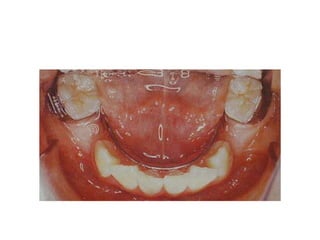
Orthodontic Appliance Following
Serial Extraction ProcedureThe most frequently used appliances with serial extractions are;
a) lingual arch,
b) fixed or fixed removable head gears,
c) removable Hawley’s appliance,
d) fixed appliance
Growth spurts
• periods of sudden acceleration of growth
• This sudden increase in growth is termed as
growth spurts.
• physiological alteration in hormonal secretion
is believed to be the cause
• The following are the timing of growth spurts –
• Just before birth
• One year after birth
• Mixed dentition growth spurt
– Boys: 8-11yr
– Girls: 7-9yr
• Adolescent growth spurts
– Boys: 14-16yr
– Girls: 11-13yr
• Pre pubescent take off stage – moderate
increment in height velocity
• Pubescent phase – very rapid growth phase
• Post pubescent phase – decelerating of height
velocity
Growth trends
• proposed by tweed
• According to the growth trends he divided
individuals into following groups
• Type A
• The maxilla and mandible grow together thus
the ANB angle remains unchanged. This is
accompanied with cl-l relationship and in
mixed dentition, it does not exceed 4.5˚. No
treatment is indicated in this case
• Type A subdivision
• In this condition maxilla is protruding with the
ANB angle more than 4.5˚. The treatment is to
restrict the growth of maxilla allowing the
mandible to catch up. The prognosis is good,
but at times requires the extraction of
premolars
• Type B
• The maxilla and mandible are found to grow
forward and downwards with the growth of
maxilla exceeding that of the mandible. This
type of growth trends have a poor prognosis.
Growth of the middle and lower face is
predominantly in the vertical directions. This
growth trend has poor prognosis.
• Type B subdivision
• The ANB angle is large and continuous to
grow, indicating an unfavourable growth trend
• Type C
• The maxilla and mandible grow forwards and
downwards, with mandible growing forward
more rapidly than the maxilla. The ANB angle
seen to be decreasing , with the middle
catching up with the maxilla. Treatment is not
indicated until the eruption of canine
• Type C subdivision
• Mandible is found to be growing more
forward to compare with maxilla. With the
mandibular incisors touch the lingual surface
of maxillary incisors.
•
Conclusion
• Establishment of normal functional occlusion
in balance with supporting structures
occasionally requires the reduction of one or
more teeth.
• The nature of malocclusion and the age of the
patient may be important factors in deciding
whether or not to resort to extraction.
• Pedodontist and Orthodontist are mutually
dependent on each others skills and their rolls
should be viewed as not what is good for the
Pedodontist or Orthodontist but what is good
Reference
• Orthodontics – the current principles and
techniques by THOMAS M GRABER &
BRAINERD F SWAIN
• Orthodontic principles and practice by
GRABER T M
• Pediatric dentistry – scientific foundation and
clinical practice by RAY E STEWART, THOMAS K
BARBER, KENNATH C TROUTMAN, STEPHAN H
Y WEI.
• Text book of pedodontics by SHOBA TANDON

Dr. Rajeev,serial extraction

  • 1.
    Serial extraction Dr. RajeevSingh, pediatric dental surgeon Kd dental college, Mathura
  • 2.
    Contents • Introduction • History •Definitions • Diagnosis • Dental development • Skeletal development • Muscular development • Rationale • Treatment Objective • Evaluation of the patient • Total space analysis
  • 3.
    • Indications • Contra-indications •Advantages of serial extraction • Disadvantages of serial extraction • Sequence of extractions • Treatment • Orthodontic Appliance • Conclusion • Reference
  • 4.
    Introduction • Removal ofprimary and permanent - definite sequence • Thorough understanding of orofacial growth and development. • Lack of understanding and knowledge has created disastrous results
  • 5.
    History • Bunon andBoudet (1743) – first to recommend extraction of teeth in order to relieve crowding • Linderer (1851) – wrote about extraction to relieve crowding • Kjellgren (1929) – introduced the term “serial extraction” • Nance (1940) – father of serial extraction in USA
  • 6.
    • Heath (1949)– “planned minimum orthodontic treatment ” • Dewel (1954), Tweed (1966) – “Pre- orthodontic guidance” • Hotz (1970) – “Guidance of eruption”
  • 7.
    Definitions • Dewel -Theorderly removal of selected primary and permanent teeth in a predetermined sequence. • Profitt - Serial extraction is the planned sequence of tooth removal that can reduce crowding and irregularity during the transition from primary to permanent dentition.
  • 8.
    • Shoba Tandon- The correctly timed, planned removal of certain deciduous and permanent teeth in mixed dentition cases with dentoalveolar disproportion i.e., teeth to supporting bone imbalance in order to: a) Alleviate crowding of the incisor teeth . b) Allow unerupted teeth to guide themselves into improved positions. c) Lessen the period of active appliance therapy or eliminate it .
  • 9.
    Diagnosis • Case selectionis the most crucial factor. • Graber (1971) – The clinician has to assess the interrelationship between three systems – Dental. – Skeletal. – Neuromuscular systems.
  • 10.
    Dental development Incisor liability: • Mayne & Dale (1969) – it as the discrepancy in widths between 4 permanent incisors and their primary counterparts • Max. teeth - 7.6mm • Mand. teeth is about 6mm .
  • 11.
    • Corrected bycombination by 4 factors - – Interdental spacing of the primary incisor teeth – Intercanine arch width growth – Intercanine arch length increases through labial positioning of the erupting permanent incisors – favorable variations in size ratio between the permanent and primary teeth
  • 12.
    Leeway space : •Nance – the size difference between the primary canine & molars and the permanent canine & premolars as leeway space. • 1.8mm in max. and 3.4mm in the mand. • leeway space is utilized during Mesial drifting of the mand. first molars (class I molar relationship) • Spaced primary dentition (early mesial shift) • Closed primary dentition (late mesial shift)
  • 13.
    Skeletal development • Cephalometricanalysis for all cases. • Hand wrist radiograph – enable the clinician to predict remaining growth & anticipated developmental adjustments. • The functional articulation between basal bones to each other & their relationship to the cranial base has to be within normal limits.
  • 14.
    Muscular development • Imbalancesin musculature should be noted. • Strain, hypotonicity, hypertonicity, unusual lip lines or markings. • Adverse oral habits – thumb sucking.
  • 15.
    Rationale • Aduss etal (1977) – predict with a fair degree of certainity that there will not be enough space for the permanent teeth to erupt. • Graber (1971) –after eruption of the first molars there is no increase in arch length & also increased arch length by expansion is not very stable. • Kluemper et al (2000) – early removal of teeth will allow for more physiologic unassisted movement of adjacent teeth into more favorable positions.
  • 16.
    Treatment Objective • Performedin different ways (1) A period of interceptive guidance extending approximately 5 yrs( 71/2 to 121/2 )
  • 17.
    (2) An initialperiod of interceptive guidance extending approximately 4 yrs (71/2 to 111/2) plus second period of multibanded treatment extending approximate 1 yr. ( 111/2 to 121/2). Class I and specific types of class II fall into this category.
  • 18.
    (3) An initialperiod of interceptive treatment extending approximate 1 yr (81/2 to 91/2 ),period of interceptive guidance extending approximate 2 yrs (91/2 to 111/2) and second period of multibanded treatment extending approximate 11/2 . ( 111/2 to 13). Class II and class III malocclusions fall primarily into this category.
  • 19.
    4) A periodof multibanded treatment extending for 11/2 to 3 yrs ( 111/2 to 141/2 ). • Serial extraction is not involved in this treatment wherever possible. • Avoid extensive treatment in teenage period .
  • 20.
    Evaluation of thepatient Intraoral radiographs : • Complete series of periapical radiographs /panoramic radiograph. • Detection of congenital absence of teeth. • Detection of supernumerary teeth. • Evaluation of permanent teeth. • Detection of pathologic conditions in the early stages. • Assessment of trauma to the teeth.
  • 21.
    • Detection ofevidence of a true hereditary tooth- size jaw-size discrepancy. • Determination of size, shape and relative position of unerupted permanent teeth. • Determination of dental age of the patient. • Calculation of total space analysis. • Detection of root resorption before ,during and after treatment. • Evaluation of third molars before, during and after treatment. • Final appraisal of the dental health after orthodontic treatment.
  • 22.
    Cephalometric analysis : •Evaluation of craniofacial relationships prior to treatment. • Assessment of soft tissue. • Classification of facial pattern. • Calculation of tooth-size jaw-size discrepancies (total space analysis). • Determination of mandibular rest position. • Prediction of growth and development. • Monitoring of skeletodental relationships during treatment. • Detection of pathologic conditions before ,during and after treatment.
  • 23.
    Facial photographs : •Evaluation of craniofacial relationships prior to treatment. • Assessment of soft tissue profile. • Proportional facial analysis. • Total space analysis. • Occlusal curve analysis. • Monitoring of treatment progress. • Study of relationships.
  • 24.
    Study models : •Calculate total space analysis. • Assess and record the dental anatomy. • Assess and record the intercuspation. • Assess and record arch form. • Assess and record the curve of occlusion. • Evaluate occlusion with aid of articulators. • Measure progress during treatment. • Detect abnormalities.
  • 25.
    Total space analysis •Moyer's mixed dentition analysis • Tanaka and Johnson analysis
  • 26.
    Indications • Crowding Mild Crowding: Atrue arch length discrepancy of 0-2mm may be manifested as mild irregularities in the incisor region. Observation is usually the best course .If treatment is required proximal slicing or disking can be done with; i) Hand- held strip, ii) Sand paper disk in a slow speed hand piece, iii) Tapered bur in a high speed hand piece
  • 28.
    Moderate crowding: • Archlength discrepancy of less than 5mm • is based on the facial profile, incisor protrusion, crowding • small amount of expansion is done to accommodate all the teeth if space loss is 3mm or less • the adjacent tooth is tipped into position with either a removable appliance or an active lingual arch.
  • 30.
    Severe Crowding: • crowdingis so severe (>10mm/arch) • in the mixed dentition arch expansion is not feasible • serial extraction is necessary
  • 31.
    • A midlinedisplacement of mand. Incisor due to premature exfoliation of primary canine on crowded teeth • Crowded mand.lateral incisors that have commenced resorbing the roots of the primary canines • Ectopic eruption of permanent max. first molar indicating a lack of development in the tuberosity area • facial pattern that is orthognathic /with slight alveolodental protrusion
  • 32.
    Contra-indications • Mild tomoderate crowding caused by environmental factors & there is not a substantial lack of space • Increased overjet or reverse overjet • Deep overbite or an open bite • Permanent teeth congenitally missing from the dental arch
  • 33.
    • Gross mal-positionof teeth ,rotation & crossbite • Spaced dentition • Midline diastema • Extensive caries of Ist permanent molar requireing their removal • Severe class II,III of dental / skeletal origin • Cleft lip & palate cases
  • 34.
    Advantages of serialextraction • Mayne(1969) – less potential for iatrogenic orthodontic damage to tooth roots • Maj (1970) – psychologically ,the child will benefit from earlier correction of esthetics as the anterior teeth spontaneously align themselves • Yoshihara et al (1999) – aimed at encouraging a measure of self correction in order to shorten the time & complexity of mechanotherapy
  • 35.
    • Yoshihara etal (1999) – under appropriate conditions can be used on handicapped patients • Dale (2000) – retention requirements in serial extraction cases are lessened • Dale (2000) – reduces appliance treatment time ,the cost of treatment • Intercepts the developing mal-occlusion as early as possible so as to reduce ,or in rare cases avoid orthodontic treatment
  • 36.
    Disadvantages of serialextraction • Aduss et al (1977) – increase in overbite ,lingual tipping of mand.incisors thereby decreasing arch length & fixed appliance therapy after a long period of follow up • Jacobs (1987) – early extractions can lead to space loss and delayed eruption of the
  • 37.
    Sequence of extractions •Bunon (1743) – primary canines, first primary molars and first premolars • Dewels method – C D 4 • Tweeds method – D 4 C • Nance method – D4 C • Most satisfactory order • Removal of first primary molars is sometimes advocated to promote earlier eruption of first
  • 38.
    Serial extraction –Class I treatment: Anterior discrepancy : crowding • Primary canines – to relieve incisor crowding after eruption of lateral incisor • Ist primary molar – performed after incisor crowding has improved and the extn site is reduced in size • When the permanent canines have developed
  • 40.
    Anterior discrepancy :alveolodental protrusion • Primary Ist molars • Premolars have to be extracted at half root formation in order encourage their early eruption ahead of canines • Next the primary canines and Ist premolars are extracted to encourage lingual tipping of
  • 41.
    Middle discrepancy :impacted canines • There may already be premature exfoliation of the primary canines • The incisors may be splayed out due to crowding in the apical region • The Ist primary molars should be removed to encourage the premolars to erupt early (at about half root development) • The premolars are then extracted so that the impacted permanent max. canine will have space to migrate away from the apices of
  • 42.
    Tooth germ enucleationin the mandible : • Extraction of the Ist primary molars with subsequent enucleation of the first premolars • Indicated when the canine appear to be erupting before the Ist premolars • This allows distal migration of the erupting
  • 43.
    Tooth germ enucleationin the maxilla and mandible • On rare occasions ,in both the max. and mand, the permanent canines will erupt before the premolars • Extraction of the primary canines followed by the first molars and enucleation of Ist premolars
  • 44.
    Orthodontic Appliance Following SerialExtraction ProcedureThe most frequently used appliances with serial extractions are; a) lingual arch, b) fixed or fixed removable head gears, c) removable Hawley’s appliance, d) fixed appliance
  • 46.
    Growth spurts • periodsof sudden acceleration of growth • This sudden increase in growth is termed as growth spurts. • physiological alteration in hormonal secretion is believed to be the cause
  • 47.
    • The followingare the timing of growth spurts – • Just before birth • One year after birth • Mixed dentition growth spurt – Boys: 8-11yr – Girls: 7-9yr • Adolescent growth spurts – Boys: 14-16yr – Girls: 11-13yr
  • 48.
    • Pre pubescenttake off stage – moderate increment in height velocity • Pubescent phase – very rapid growth phase • Post pubescent phase – decelerating of height velocity
  • 49.
    Growth trends • proposedby tweed • According to the growth trends he divided individuals into following groups • Type A • The maxilla and mandible grow together thus the ANB angle remains unchanged. This is accompanied with cl-l relationship and in mixed dentition, it does not exceed 4.5˚. No treatment is indicated in this case
  • 50.
    • Type Asubdivision • In this condition maxilla is protruding with the ANB angle more than 4.5˚. The treatment is to restrict the growth of maxilla allowing the mandible to catch up. The prognosis is good, but at times requires the extraction of premolars
  • 51.
    • Type B •The maxilla and mandible are found to grow forward and downwards with the growth of maxilla exceeding that of the mandible. This type of growth trends have a poor prognosis. Growth of the middle and lower face is predominantly in the vertical directions. This growth trend has poor prognosis.
  • 52.
    • Type Bsubdivision • The ANB angle is large and continuous to grow, indicating an unfavourable growth trend
  • 53.
    • Type C •The maxilla and mandible grow forwards and downwards, with mandible growing forward more rapidly than the maxilla. The ANB angle seen to be decreasing , with the middle catching up with the maxilla. Treatment is not indicated until the eruption of canine
  • 54.
    • Type Csubdivision • Mandible is found to be growing more forward to compare with maxilla. With the mandibular incisors touch the lingual surface of maxillary incisors. •
  • 55.
    Conclusion • Establishment ofnormal functional occlusion in balance with supporting structures occasionally requires the reduction of one or more teeth. • The nature of malocclusion and the age of the patient may be important factors in deciding whether or not to resort to extraction. • Pedodontist and Orthodontist are mutually dependent on each others skills and their rolls should be viewed as not what is good for the Pedodontist or Orthodontist but what is good
  • 56.
    Reference • Orthodontics –the current principles and techniques by THOMAS M GRABER & BRAINERD F SWAIN • Orthodontic principles and practice by GRABER T M • Pediatric dentistry – scientific foundation and clinical practice by RAY E STEWART, THOMAS K BARBER, KENNATH C TROUTMAN, STEPHAN H Y WEI. • Text book of pedodontics by SHOBA TANDON