Chapter 1 Invitation to Biology (Sections 1.1 - 1.4)
1.1 The Secret Life of Earth Biology  is the systematic study of life  We have encountered only a fraction of the organisms that live on Earth, in part because we have explored only a fraction of its inhabited regions
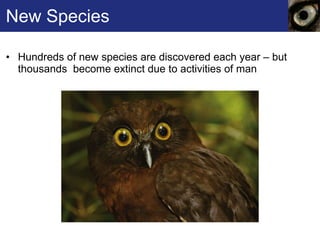
New Species Hundreds of new species are discovered each year – but thousands  become extinct due to activities of man
1.2 The Science of Nature Biologists  think about life at different levels of organization Emergent properties  appear at successively higher levels Life   emerges at the cellular level
Key Terms biology  The scientific study of life emergent property  A characteristic of a system that does not appear in any of the system’s component parts
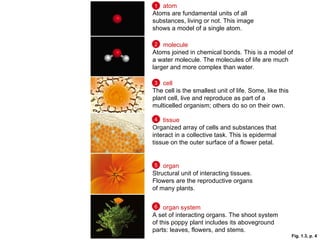
A Pattern in Life’s Organization All matter consists of  atoms , which combine as  molecules Organisms  are individuals that consist of one or more  cells Cells of larger multicelled organisms are organized as  tissues ,  organs , and  organ systems
Key Terms atom   Fundamental building block of all matter molecule  An association of two or more atoms cell  Smallest unit of life organism   Individual that consists of one or more cells
Key Terms tissue   In multicelled organisms, specialized cells organized in a pattern that allows them to perform a collective function organ  In multicelled organisms, a grouping of tissues that perform a collective function organ system  In multicelled organisms, set of tissues and cells engaged in a collective function that keeps the body functioning properly
Organization Among Organisms A  population  is a group of individuals of a species in a given area A  community  is all populations of all species in a given area  An  ecosystem  is a community interacting with its environment The  biosphere  includes all regions of Earth that hold life
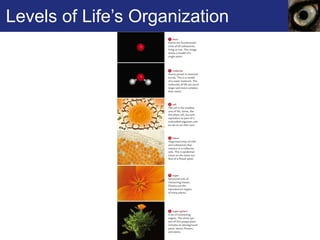
Levels of Life’s Organization
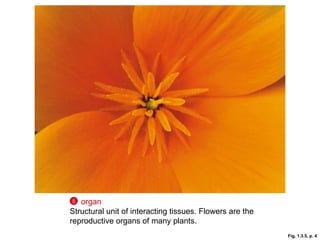
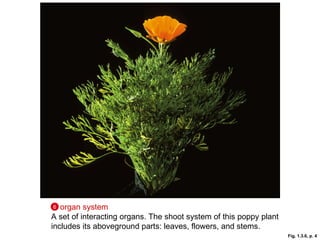
Fig. 1.3, p. 4 molecule   Atoms joined in chemical bonds. This is a model of a water molecule. The molecules of life are much larger and more complex than water.  organ   Structural unit of interacting tissues. Flowers are the reproductive organs of many plants. atom   Atoms are fundamental units of all substances, living or not. This image shows a model of a single atom. organ system   A set of interacting organs. The shoot system of this poppy plant includes its aboveground parts: leaves, flowers, and stems. cell   The cell is the smallest unit of life. Some, like this plant cell, live and reproduce as part of a multicelled organism; others do so on their own. tissue   Organized array of cells and substances that interact in a collective task. This is epidermal tissue on the outer surface of a flower petal. 1 2 3 4 5 6
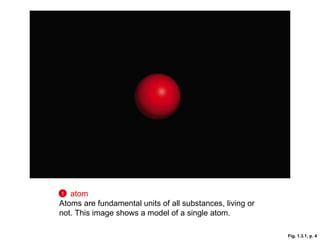
Fig. 1.3.1, p. 4 atom   Atoms are fundamental units of all substances, living or not. This image shows a model of a single atom. 1
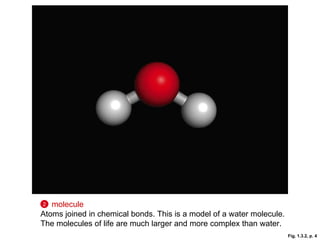
Fig. 1.3.2, p. 4 molecule   Atoms joined in chemical bonds. This is a model of a water molecule. The molecules of life are much larger and more complex than water.  2
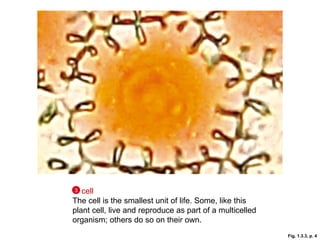
Fig. 1.3.3, p. 4 cell   The cell is the smallest unit of life. Some, like this plant cell, live and reproduce as part of a multicelled organism; others do so on their own. 3
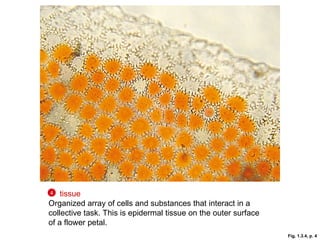
Fig. 1.3.4, p. 4 tissue   Organized array of cells and substances that interact in a collective task. This is epidermal tissue on the outer surface of a flower petal. 4
Fig. 1.3.5, p. 4 organ   Structural unit of interacting tissues. Flowers are the reproductive organs of many plants. 5
Fig. 1.3.6, p. 4 organ system   A set of interacting organs. The shoot system of this poppy plant includes its aboveground parts: leaves, flowers, and stems. 6
ANIMATION: Life's levels of organization To play movie you must be in Slide Show Mode PC Users: Please wait for content to load, then click to play Mac Users:  CLICK HERE
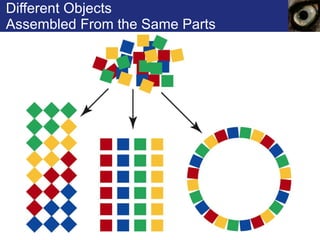
Different Objects  Assembled From the Same Parts
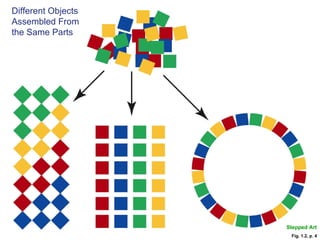
Fig. 1.2, p. 4 Stepped Art Different Objects  Assembled From the Same Parts
ANIMATION: Building blocks of life To play movie you must be in Slide Show Mode PC Users: Please wait for content to load, then click to play Mac Users:  CLICK HERE
Key Concepts The Science of Nature We understand life by studying it at different levels of organization, which extend from atoms and molecules to the biosphere  The quality we call “life” emerges at the level of cells
1.3 How Living Things Are Alike Life has underlying unity: All living things have similar characteristics Continual inputs of energy and cycling of materials maintain life’s complex organization  Organisms sense and respond to change All organisms use information in DNA inherited from parents to function and reproduce
(1) Organisms Require Energy and Nutrients All organisms require  energy  and  nutrients  to sustain themselves energy  The capacity to do work nutrient  Substance that an organism needs for growth and survival, but cannot make for itself
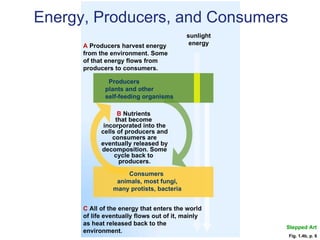
Producers and Consumers Producers  harvest energy from the environment to make their own food by processes such as  photosynthesis Consumers  eat other organisms, or their wastes and remains
Key Terms producer  Organism that makes its own food using energy and simple raw materials from the environment photosynthesis   Process by which producers use light energy to make sugars from carbon dioxide and water consumer  Organism that gets energy and nutrients by feeding on tissues, wastes, or remains of other organisms
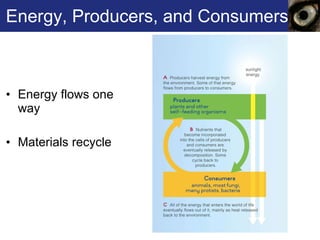
Energy, Producers, and Consumers Energy flows one way Materials recycle
Fig. 1.4b, p. 6 C  All of the energy that enters the world of life eventually flows out of it, mainly as heat released back to the environment. Stepped Art Energy, Producers, and Consumers sunlight energy A  Producers harvest energy from the environment. Some of that energy flows from producers to consumers. Producers  plants and other  self-feeding organisms Consumers  animals, most fungi, many protists, bacteria B  Nutrients  that become  incorporated into the cells of producers and consumers are eventually released by decomposition. Some cycle back to  producers.
ANIMATION: One-way energy flow and materials cycling To play movie you must be in Slide Show Mode PC Users: Please wait for content to load, then click to play Mac Users:  CLICK HERE
(2) Organisms Sense and Respond to Change Organisms keep conditions in their internal environment within ranges cells tolerate—a process called  homeostasis homeostasis   Set of processes by which an organism keeps its internal conditions within tolerable ranges Includes body fluid composition and temperature
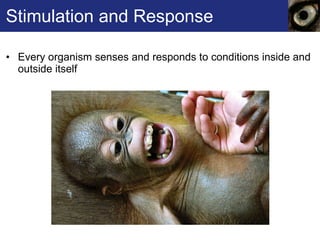
Stimulation and Response Every organism senses and responds to conditions inside and outside itself
(3) Organisms Use DNA DNA  contains information that guides all of an organism’s metabolic activities, including  growth ,  development , and  reproduction Small variations in DNA  structure give rise to differences between species and individuals The passage of DNA from parents to offspring is  inheritance
Key Terms DNA   Deoxyribonucleic acid; carries hereditary information that guides growth and development growth   In multicelled species, an increase in the number, size, and volume of cells development  Multistep process by which the first cell of a new individual becomes a multicelled adult
Key Terms reproduction  Processes by which parents produce offspring inheritance  Transmission of DNA from parents to offspring
Key Concepts Life’s Unity  All organisms consist of one or more cells that take in energy and raw materials to stay alive All sense and respond to stimuli All function and reproduce with the help of DNA
1.4 How Living Things Differ Different types of organisms differ greatly in details of body form and function Biodiversity  is the sum of differences among living things  biodiversity   Variation among living organisms
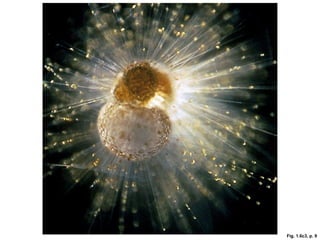
Diversity of Life Bacteria  and  archaeans  are single-celled, and their DNA is not contained within a  nucleus   Eukaryotes   ( protists ,  plants ,  fungi , and  animals ) can be single-celled or multicelled, and their DNA is contained within a nucleus
Key Terms bacterium   Member of a large group of single-celled organisms archaean   Member of a group of single-celled organisms that differ from bacteria nucleus  Double-membraned sac that encloses a cell’s DNA eukaryote  Organism whose cells characteristically have a nucleus
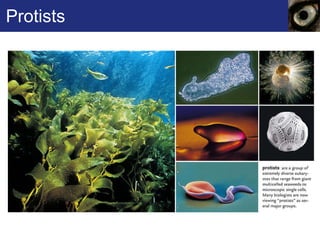
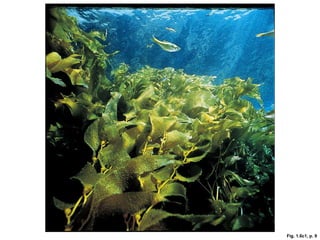
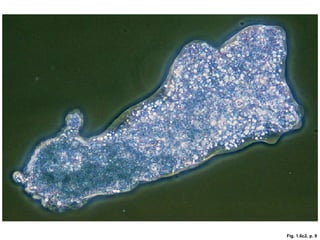
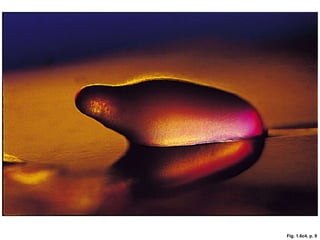
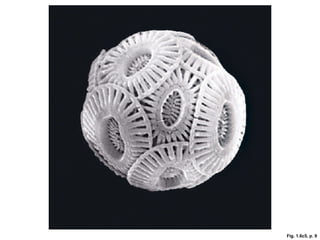
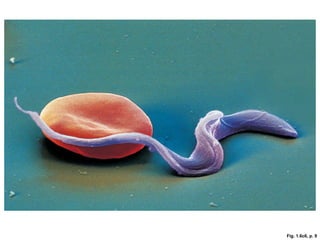
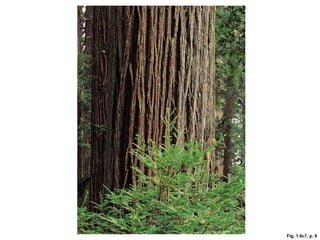
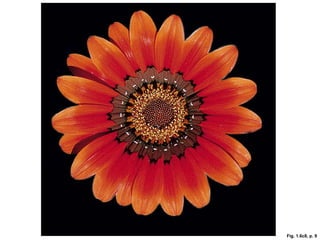
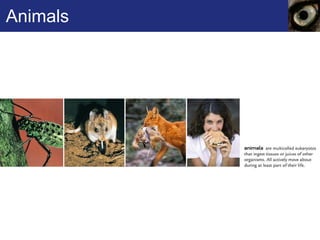
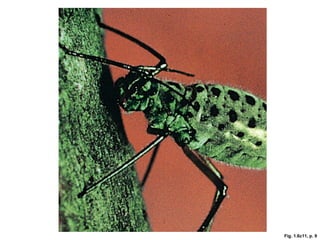
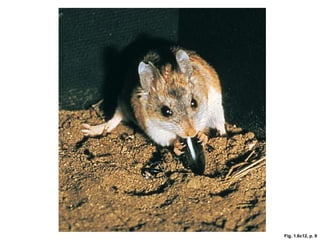
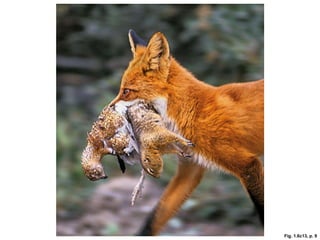
Eukaryotes Protists  are the simplest eukaryotes, ranging from amoebas to giant kelps Many  fungi  are decomposers, including mushrooms Most  plants  are photosynthetic producers that provide food for most other organisms Animals  eat other organisms; they include herbivores, carnivores,  scavengers,  and parasites
Key Terms protist  Diverse group of simple eukaryotes fungus  Type of eukaryotic consumer that obtains nutrients by digestion and absorption outside the body plant  A multicelled, typically photosynthetic producer animal Multicelled consumer that develops through a series of stages and moves about during part or all of its life cycle
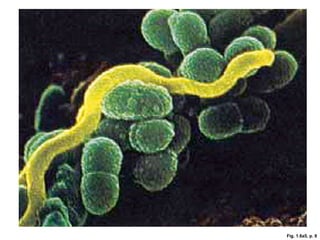
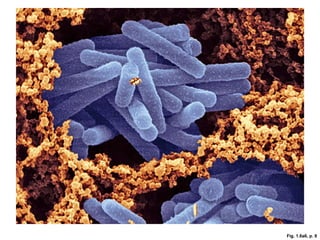
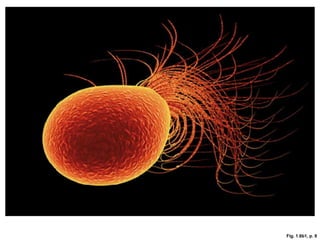
Bacteria
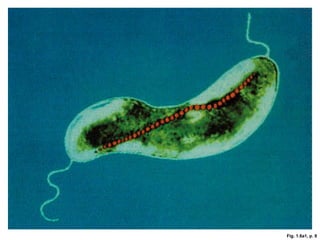
Fig. 1.6a1, p. 8
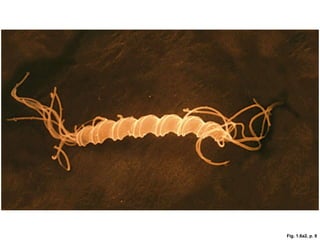
Fig. 1.6a2, p. 8
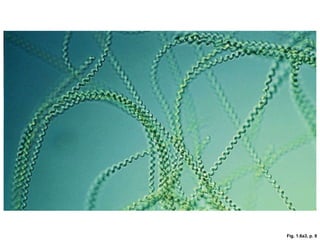
Fig. 1.6a3, p. 8
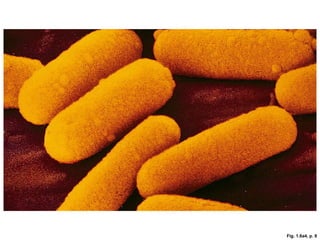
Fig. 1.6a4, p. 8
Fig. 1.6a5, p. 8
Fig. 1.6a6, p. 8
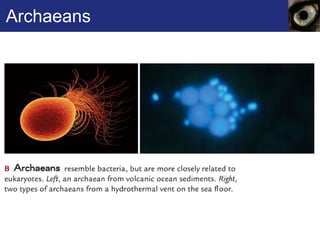
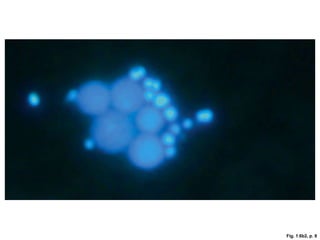
Archaeans
Fig. 1.6b1, p. 8
Fig. 1.6b2, p. 8
Protists
Fig. 1.6c1, p. 9
Fig. 1.6c2, p. 9
Fig. 1.6c3, p. 9
Fig. 1.6c4, p. 9
Fig. 1.6c5, p. 9
Fig. 1.6c6, p. 9
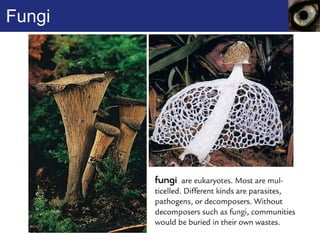
Fungi
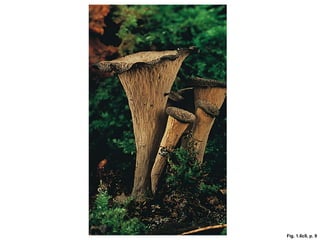
Fig. 1.6c9, p. 9
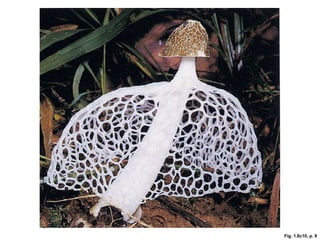
Fig. 1.6c10, p. 9
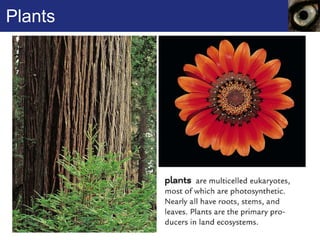
Plants
Fig. 1.6c7, p. 9
Fig. 1.6c8, p. 9
Animals
Fig. 1.6c11, p. 9
Fig. 1.6c12, p. 9
Fig. 1.6c13, p. 9
Fig. 1.6c14, p. 9
ANIMATION: Life's diversity To play movie you must be in Slide Show Mode PC Users: Please wait for content to load, then click to play Mac Users:  CLICK HERE
Key Concepts Life’s Diversity  Observable characteristics vary tremendously among organisms  Various classification systems help us keep track of the differences
ANIMATION: Three Domains To play movie you must be in Slide Show Mode PC Users: Please wait for content to load, then click to play Mac Users:  CLICK HERE

Chapter1 sections 1-4

  • 1.
    Chapter 1 Invitationto Biology (Sections 1.1 - 1.4)
  • 2.
    1.1 The SecretLife of Earth Biology is the systematic study of life We have encountered only a fraction of the organisms that live on Earth, in part because we have explored only a fraction of its inhabited regions
  • 3.
    New Species Hundredsof new species are discovered each year – but thousands become extinct due to activities of man
  • 4.
    1.2 The Scienceof Nature Biologists think about life at different levels of organization Emergent properties appear at successively higher levels Life emerges at the cellular level
  • 5.
    Key Terms biology The scientific study of life emergent property A characteristic of a system that does not appear in any of the system’s component parts
  • 6.
    A Pattern inLife’s Organization All matter consists of atoms , which combine as molecules Organisms are individuals that consist of one or more cells Cells of larger multicelled organisms are organized as tissues , organs , and organ systems
  • 7.
    Key Terms atom Fundamental building block of all matter molecule An association of two or more atoms cell Smallest unit of life organism Individual that consists of one or more cells
  • 8.
    Key Terms tissue In multicelled organisms, specialized cells organized in a pattern that allows them to perform a collective function organ In multicelled organisms, a grouping of tissues that perform a collective function organ system In multicelled organisms, set of tissues and cells engaged in a collective function that keeps the body functioning properly
  • 9.
    Organization Among OrganismsA population is a group of individuals of a species in a given area A community is all populations of all species in a given area An ecosystem is a community interacting with its environment The biosphere includes all regions of Earth that hold life
  • 10.
    Levels of Life’sOrganization
  • 11.
    Fig. 1.3, p.4 molecule Atoms joined in chemical bonds. This is a model of a water molecule. The molecules of life are much larger and more complex than water. organ Structural unit of interacting tissues. Flowers are the reproductive organs of many plants. atom Atoms are fundamental units of all substances, living or not. This image shows a model of a single atom. organ system A set of interacting organs. The shoot system of this poppy plant includes its aboveground parts: leaves, flowers, and stems. cell The cell is the smallest unit of life. Some, like this plant cell, live and reproduce as part of a multicelled organism; others do so on their own. tissue Organized array of cells and substances that interact in a collective task. This is epidermal tissue on the outer surface of a flower petal. 1 2 3 4 5 6
  • 12.
    Fig. 1.3.1, p.4 atom Atoms are fundamental units of all substances, living or not. This image shows a model of a single atom. 1
  • 13.
    Fig. 1.3.2, p.4 molecule Atoms joined in chemical bonds. This is a model of a water molecule. The molecules of life are much larger and more complex than water. 2
  • 14.
    Fig. 1.3.3, p.4 cell The cell is the smallest unit of life. Some, like this plant cell, live and reproduce as part of a multicelled organism; others do so on their own. 3
  • 15.
    Fig. 1.3.4, p.4 tissue Organized array of cells and substances that interact in a collective task. This is epidermal tissue on the outer surface of a flower petal. 4
  • 16.
    Fig. 1.3.5, p.4 organ Structural unit of interacting tissues. Flowers are the reproductive organs of many plants. 5
  • 17.
    Fig. 1.3.6, p.4 organ system A set of interacting organs. The shoot system of this poppy plant includes its aboveground parts: leaves, flowers, and stems. 6
  • 18.
    ANIMATION: Life's levelsof organization To play movie you must be in Slide Show Mode PC Users: Please wait for content to load, then click to play Mac Users: CLICK HERE
  • 19.
    Different Objects Assembled From the Same Parts
  • 20.
    Fig. 1.2, p.4 Stepped Art Different Objects Assembled From the Same Parts
  • 21.
    ANIMATION: Building blocksof life To play movie you must be in Slide Show Mode PC Users: Please wait for content to load, then click to play Mac Users: CLICK HERE
  • 22.
    Key Concepts TheScience of Nature We understand life by studying it at different levels of organization, which extend from atoms and molecules to the biosphere The quality we call “life” emerges at the level of cells
  • 23.
    1.3 How LivingThings Are Alike Life has underlying unity: All living things have similar characteristics Continual inputs of energy and cycling of materials maintain life’s complex organization Organisms sense and respond to change All organisms use information in DNA inherited from parents to function and reproduce
  • 24.
    (1) Organisms RequireEnergy and Nutrients All organisms require energy and nutrients to sustain themselves energy The capacity to do work nutrient Substance that an organism needs for growth and survival, but cannot make for itself
  • 25.
    Producers and ConsumersProducers harvest energy from the environment to make their own food by processes such as photosynthesis Consumers eat other organisms, or their wastes and remains
  • 26.
    Key Terms producer Organism that makes its own food using energy and simple raw materials from the environment photosynthesis Process by which producers use light energy to make sugars from carbon dioxide and water consumer Organism that gets energy and nutrients by feeding on tissues, wastes, or remains of other organisms
  • 27.
    Energy, Producers, andConsumers Energy flows one way Materials recycle
  • 28.
    Fig. 1.4b, p.6 C All of the energy that enters the world of life eventually flows out of it, mainly as heat released back to the environment. Stepped Art Energy, Producers, and Consumers sunlight energy A Producers harvest energy from the environment. Some of that energy flows from producers to consumers. Producers plants and other self-feeding organisms Consumers animals, most fungi, many protists, bacteria B Nutrients that become incorporated into the cells of producers and consumers are eventually released by decomposition. Some cycle back to producers.
  • 29.
    ANIMATION: One-way energyflow and materials cycling To play movie you must be in Slide Show Mode PC Users: Please wait for content to load, then click to play Mac Users: CLICK HERE
  • 30.
    (2) Organisms Senseand Respond to Change Organisms keep conditions in their internal environment within ranges cells tolerate—a process called homeostasis homeostasis Set of processes by which an organism keeps its internal conditions within tolerable ranges Includes body fluid composition and temperature
  • 31.
    Stimulation and ResponseEvery organism senses and responds to conditions inside and outside itself
  • 32.
    (3) Organisms UseDNA DNA contains information that guides all of an organism’s metabolic activities, including growth , development , and reproduction Small variations in DNA structure give rise to differences between species and individuals The passage of DNA from parents to offspring is inheritance
  • 33.
    Key Terms DNA Deoxyribonucleic acid; carries hereditary information that guides growth and development growth In multicelled species, an increase in the number, size, and volume of cells development Multistep process by which the first cell of a new individual becomes a multicelled adult
  • 34.
    Key Terms reproduction Processes by which parents produce offspring inheritance Transmission of DNA from parents to offspring
  • 35.
    Key Concepts Life’sUnity All organisms consist of one or more cells that take in energy and raw materials to stay alive All sense and respond to stimuli All function and reproduce with the help of DNA
  • 36.
    1.4 How LivingThings Differ Different types of organisms differ greatly in details of body form and function Biodiversity is the sum of differences among living things biodiversity Variation among living organisms
  • 37.
    Diversity of LifeBacteria and archaeans are single-celled, and their DNA is not contained within a nucleus Eukaryotes ( protists , plants , fungi , and animals ) can be single-celled or multicelled, and their DNA is contained within a nucleus
  • 38.
    Key Terms bacterium Member of a large group of single-celled organisms archaean Member of a group of single-celled organisms that differ from bacteria nucleus Double-membraned sac that encloses a cell’s DNA eukaryote Organism whose cells characteristically have a nucleus
  • 39.
    Eukaryotes Protists are the simplest eukaryotes, ranging from amoebas to giant kelps Many fungi are decomposers, including mushrooms Most plants are photosynthetic producers that provide food for most other organisms Animals eat other organisms; they include herbivores, carnivores, scavengers, and parasites
  • 40.
    Key Terms protist Diverse group of simple eukaryotes fungus Type of eukaryotic consumer that obtains nutrients by digestion and absorption outside the body plant A multicelled, typically photosynthetic producer animal Multicelled consumer that develops through a series of stages and moves about during part or all of its life cycle
  • 41.
  • 42.
  • 43.
  • 44.
  • 45.
  • 46.
  • 47.
  • 48.
  • 49.
  • 50.
  • 51.
  • 52.
  • 53.
  • 54.
  • 55.
  • 56.
  • 57.
  • 58.
  • 59.
  • 60.
  • 61.
  • 62.
  • 63.
  • 64.
  • 65.
  • 66.
  • 67.
  • 68.
  • 69.
    ANIMATION: Life's diversityTo play movie you must be in Slide Show Mode PC Users: Please wait for content to load, then click to play Mac Users: CLICK HERE
  • 70.
    Key Concepts Life’sDiversity Observable characteristics vary tremendously among organisms Various classification systems help us keep track of the differences
  • 71.
    ANIMATION: Three DomainsTo play movie you must be in Slide Show Mode PC Users: Please wait for content to load, then click to play Mac Users: CLICK HERE

Editor's Notes

  • #12 Figure 1.3 Levels of life’s organization.
  • #13 Figure 1.3 Levels of life’s organization.
  • #14 Figure 1.3 Levels of life’s organization.
  • #15 Figure 1.3 Levels of life’s organization.
  • #16 Figure 1.3 Levels of life’s organization.
  • #17 Figure 1.3 Levels of life’s organization.
  • #18 Figure 1.3 Levels of life’s organization.
  • #21 Figure 1.2 Example of how different objects can be assembled from the same parts. Roundness is an emergent property of the rightmost object.
  • #29 Figure 1.4 The one-way flow of energy and the cycling of materials in the world of life. The photo shows a producer acquiring energy and nutrients from the environment, and consumers acquiring energy and nutrients by eating the producer.
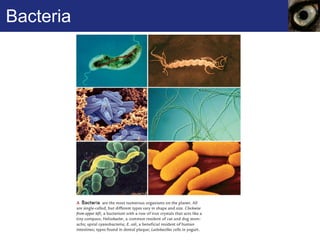
  • #43 Figure 1.6 Representatives of life’s diversity. A Bacteria are the most numerous organisms on the planet. All are single-celled, but different types vary in shape and size. Clockwise from upper left , a bacterium with a row of iron crystals that acts like a tiny compass; Helicobacter , a common resident of cat and dog stomachs; spiral cyanobacteria; E. coli , a beneficial resident of human intestines; types found in dental plaque; Lactobacillus cells in yogurt.
  • #44 Figure 1.6 Representatives of life’s diversity. A Bacteria are the most numerous organisms on the planet. All are single-celled, but different types vary in shape and size. Clockwise from upper left , a bacterium with a row of iron crystals that acts like a tiny compass; Helicobacter , a common resident of cat and dog stomachs; spiral cyanobacteria; E. coli , a beneficial resident of human intestines; types found in dental plaque; Lactobacillus cells in yogurt.
  • #45 Figure 1.6 Representatives of life’s diversity. A Bacteria are the most numerous organisms on the planet. All are single-celled, but different types vary in shape and size. Clockwise from upper left , a bacterium with a row of iron crystals that acts like a tiny compass; Helicobacter , a common resident of cat and dog stomachs; spiral cyanobacteria; E. coli , a beneficial resident of human intestines; types found in dental plaque; Lactobacillus cells in yogurt.

  • #46 Figure 1.6 Representatives of life’s diversity. A Bacteria are the most numerous organisms on the planet. All are single-celled, but different types vary in shape and size. Clockwise from upper left , a bacterium with a row of iron crystals that acts like a tiny compass; Helicobacter , a common resident of cat and dog stomachs; spiral cyanobacteria; E. coli , a beneficial resident of human intestines; types found in dental plaque; Lactobacillus cells in yogurt.
  • #47 Figure 1.6 Representatives of life’s diversity. A Bacteria are the most numerous organisms on the planet. All are single-celled, but different types vary in shape and size. Clockwise from upper left , a bacterium with a row of iron crystals that acts like a tiny compass; Helicobacter , a common resident of cat and dog stomachs; spiral cyanobacteria; E. coli , a beneficial resident of human intestines; types found in dental plaque; Lactobacillus cells in yogurt.
  • #48 Figure 1.6 Representatives of life’s diversity. A Bacteria are the most numerous organisms on the planet. All are single-celled, but different types vary in shape and size. Clockwise from upper left , a bacterium with a row of iron crystals that acts like a tiny compass; Helicobacter , a common resident of cat and dog stomachs; spiral cyanobacteria; E. coli , a beneficial resident of human intestines; types found in dental plaque; Lactobacillus cells in yogurt.
  • #50 Figure 1.6 Representatives of life’s diversity. B Archaeans resemble bacteria, but are more closely related to eukaryotes. Left, an archaean from volcanic ocean sediments. Right, two types of archaeans from a hydrothermal vent on the sea floor.
  • #51 Figure 1.6 Representatives of life’s diversity. B Archaeans resemble bacteria, but are more closely related to eukaryotes. Left, an archaean from volcanic ocean sediments. Right, two types of archaeans from a hydrothermal vent on the sea floor.
  • #53 Figure 1.6 Representatives of life’s diversity. protists are a group of extremely diverse eukaryotes that range from giant multicelled seaweeds to microscopic single cells. Many biologists are now viewing “protists” as several major groups.
  • #54 Figure 1.6 Representatives of life’s diversity. protists are a group of extremely diverse eukaryotes that range from giant multicelled seaweeds to microscopic single cells. Many biologists are now viewing “protists” as several major groups.
  • #55 Figure 1.6 Representatives of life’s diversity. protists are a group of extremely diverse eukaryotes that range from giant multicelled seaweeds to microscopic single cells. Many biologists are now viewing “protists” as several major groups.
  • #56 Figure 1.6 Representatives of life’s diversity. protists are a group of extremely diverse eukaryotes that range from giant multicelled seaweeds to microscopic single cells. Many biologists are now viewing “protists” as several major groups.
  • #57 Figure 1.6 Representatives of life’s diversity. protists are a group of extremely diverse eukaryotes that range from giant multicelled seaweeds to microscopic single cells. Many biologists are now viewing “protists” as several major groups.
  • #58 Figure 1.6 Representatives of life’s diversity. protists are a group of extremely diverse eukaryotes that range from giant multicelled seaweeds to microscopic single cells. Many biologists are now viewing “protists” as several major groups.
  • #60 Figure 1.6 Representatives of life’s diversity. Fungi are eukaryotes. Most are multicelled. Different kinds are parasites, pathogens, or decomposers. Without decomposers such as fungi, communities would be buried in their own wastes
  • #61 Figure 1.6 Representatives of life’s diversity. Fungi are eukaryotes. Most are multicelled. Different kinds are parasites, pathogens, or decomposers. Without decomposers such as fungi, communities would be buried in their own wastes
  • #63 Figure 1.6 Representatives of life’s diversity. plants are multicelled eukaryotes, most of which are photosynthetic. Nearly all have roots, stems, and leaves. Plants are the primary producers in land ecosystems.
  • #64 Figure 1.6 Representatives of life’s diversity. plants are multicelled eukaryotes, most of which are photosynthetic. Nearly all have roots, stems, and leaves. Plants are the primary producers in land ecosystems.
  • #66 Figure 1.6 Representatives of life’s diversity. Animals are multicelled eukaryotes that ingest tissues or juices of other organisms. All actively move about during at least part of their life.
  • #67 Figure 1.6 Representatives of life’s diversity. Animals are multicelled eukaryotes that ingest tissues or juices of other organisms. All actively move about during at least part of their life
  • #68 Figure 1.6 Representatives of life’s diversity. Animals are multicelled eukaryotes that ingest tissues or juices of other organisms. All actively move about during at least part of their life
  • #69 Figure 1.6 Representatives of life’s diversity. Animals are multicelled eukaryotes that ingest tissues or juices of other organisms. All actively move about during at least part of their life