NATIONAL ART GUIDELINES
PRESENTED BY
DR SHASHANK AGRAWAL
NATIONAL ART GUIDELINES
 globally 35 million people sufer at the end of
2013
 India is the third highest no.of estimate
people with HIV in world
 in 2011 20.9 lakhs 86 % off where in 15 to 49
years of age
 children less than 15 year accounted 7 %
now declining trend is observed
due to
a. effective prevention.
b. care and treatment strategies of NACO.
c. decrease In death due to anti retroviral
therapy.
goals of ART-
 CLINICAL GOALS
 improve quality of life.
 to reduce HIV related morbidity and mortality.
 to provide maximal and durable suppresser of
viral load.
 to restore and preserve immune function.
 the goal achieved by completely suppressing
viral replication for as long as possible using well
tolerated and sustainable treatment.
the programmatic goals
are:-
-To provide long term ART to eligible patients
-To increase life span by at least 3 years.
-50 % of patient engaged in overcome
returning to their previous employment.
-To encounter and report treatment and
course on a quarterly basis.
-To attain individual drug adharence rate of 95
% or more.
ART drugs are also used for
 decrease risk of transmission of HIV from
infected another to her child.
 transmission after an accidental end needle
stick injury from infected patient.
 cause of sexual assault/rape etc.
Continue…..
 Continuous high level of replication of HIV
take place in the body regret from the early
stage of infection.HIV destroy CD4 cells, the
progressive immune system damage
resulting susceptibility to differences of
malignancies, neurological diseases, wastage
& ultimately death
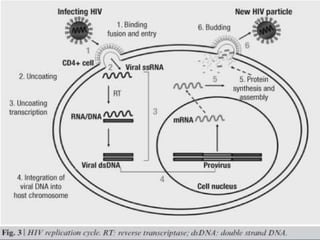
 Antiviral drugs act on various stage of
replication of the on HIV in the body interrupt
in the process of viral replication.
when to start treatment……
 Before ART clinical assessment to be performed
to determine
 classical staging of HIV infection
 identify history of past illness specially related
to HIV
 identify currently HIV related illness
requirement to treat
 determining need for ART prophylaxis's
 identify coexisting medical condition of patient
that cause interference of choice of therapy
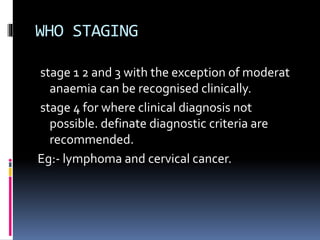
WHO STAGING
stage 1 2 and 3 with the exception of moderat
anaemia can be recognised clinically.
stage 4 for where clinical diagnosis not
possible. definate diagnostic criteria are
recommended.
Eg:- lymphoma and cervical cancer.
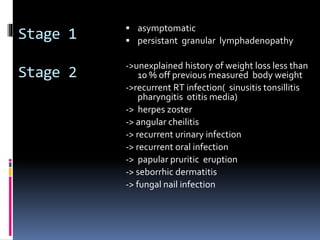
Stage 1
Stage 2
 asymptomatic
 persistant granular lymphadenopathy
->unexplained history of weight loss less than
10 % off previous measured body weight
->recurrent RT infection( sinusitis tonsillitis
pharyngitis otitis media)
-> herpes zoster
-> angular cheilitis
-> recurrent urinary infection
-> recurrent oral infection
-> papular pruritic eruption
-> seborrhic dermatitis
-> fungal nail infection
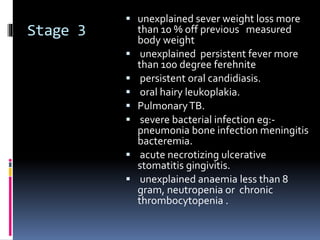
Stage 3
 unexplained sever weight loss more
than 10 % off previous measured
body weight
 unexplained persistent fever more
than 100 degree ferehnite
 persistent oral candidiasis.
 oral hairy leukoplakia.
 PulmonaryTB.
 severe bacterial infection eg:-
pneumonia bone infection meningitis
bacteremia.
 acute necrotizing ulcerative
stomatitis gingivitis.
 unexplained anaemia less than 8
gram, neutropenia or chronic
thrombocytopenia .
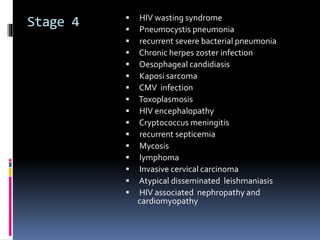
Stage 4  HIV wasting syndrome
 Pneumocystis pneumonia
 recurrent severe bacterial pneumonia
 Chronic herpes zoster infection
 Oesophageal candidiasis
 Kaposi sarcoma
 CMV infection
 Toxoplasmosis
 HIV encephalopathy
 Cryptococcus meningitis
 recurrent septicemia
 Mycosis
 lymphoma
 Invasive cervical carcinoma
 Atypical disseminated leishmaniasis
 HIV associated nephropathy and
cardiomyopathy
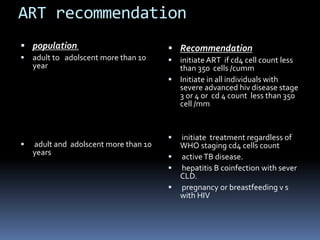
ART recommendation
 population.
 adult to adolscent more than 10
year
 adult and adolscent more than 10
years
 Recommendation
 initiate ART if cd4 cell count less
than 350 cells /cumm
 Initiate in all individuals with
severe advanced hiv disease stage
3 or 4 or cd 4 count less than 350
cell /mm
 initiate treatment regardless of
WHO staging cd4 cells count
 activeTB disease.
 hepatitis B coinfection with sever
CLD.
 pregnancy or breastfeeding v s
with HIV
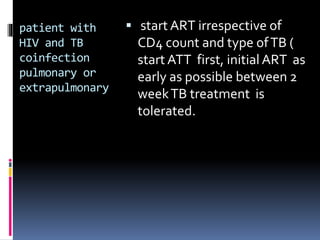
patient with
HIV and TB
coinfection
pulmonary or
extrapulmonary
 start ART irrespective of
CD4 count and type ofTB (
start ATT first, initial ART as
early as possible between 2
weekTB treatment is
tolerated.
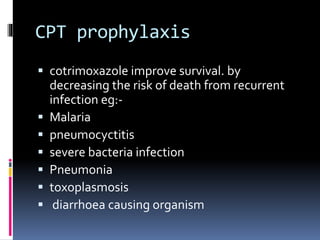
CPT prophylaxis
 cotrimoxazole improve survival. by
decreasing the risk of death from recurrent
infection eg:-
 Malaria
 pneumocyctitis
 severe bacteria infection
 Pneumonia
 toxoplasmosis
 diarrhoea causing organism
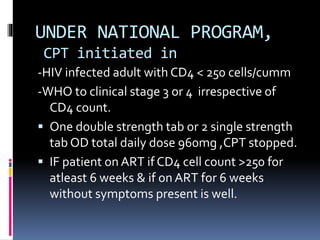
UNDER NATIONAL PROGRAM,
CPT initiated in
-HIV infected adult with CD4 < 250 cells/cumm
-WHO to clinical stage 3 or 4 irrespective of
CD4 count.
 One double strength tab or 2 single strength
tab OD total daily dose 960mg ,CPT stopped.
 IF patient on ART if CD4 cell count >250 for
atleast 6 weeks & if on ART for 6 weeks
without symptoms present is well.
Continue…
 If come below 250 reintroduce secondary
prophylaxiss is nedded to prevent recurrent
OIS
 Cotrimoxazole prophylaxis- to every one with
CD4 cell count < 350 cells/cumm or with
staging 3&4.
ART agents and optional regime
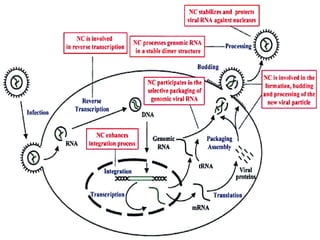
 Different classes of art drugs act on different
stages on HIV late cycle .Theoretically ART
drugs can act on following ways during
different stages of viral replication
These include:-
 Block bounding of HIV virus to target cells
( fusion inhibitors)
Block viral RNA cleavage and one that inhibit
reverse transcriptase
Continue…..
 Block the enzyme integrase which help in the
incorporation of the proviral DNA into host
cell chromosome (integrase inhibitor).
 Block the RNA to prevent viral protein
production.
 Inhibit the budding of viral from host cells.
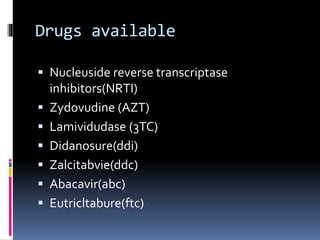
Drugs available
 Nucleuside reverse transcriptase
inhibitors(NRTI)
 Zydovudine (AZT)
 Lamividudase (3TC)
 Didanosure(ddi)
 Zalcitabvie(ddc)
 Abacavir(abc)
 Eutricltabure(ftc)
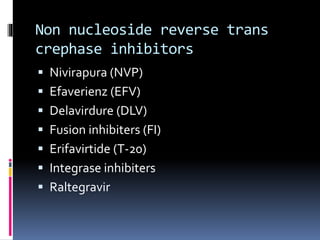
Non nucleoside reverse trans
crephase inhibitors
 Nivirapura (NVP)
 Efaverienz (EFV)
 Delavirdure (DLV)
 Fusion inhibiters (FI)
 Erifavirtide (T-20)
 Integrase inhibiters
 Raltegravir
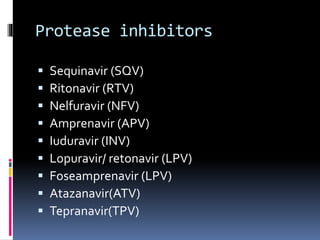
Protease inhibitors
 Sequinavir (SQV)
 Ritonavir (RTV)
 Nelfuravir (NFV)
 Amprenavir (APV)
 Iuduravir (INV)
 Lopuravir/ retonavir (LPV)
 Foseamprenavir (LPV)
 Atazanavir(ATV)
 Tepranavir(TPV)
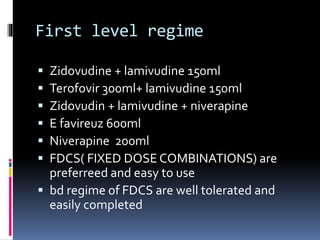
First level regime
 Zidovudine + lamivudine 150ml
 Terofovir 300ml+ lamivudine 150ml
 Zidovudin + lamivudine + niverapine
 E favireuz 600ml
 Niverapine 200ml
 FDCS( FIXED DOSE COMBINATIONS) are
preferreed and easy to use
 bd regime of FDCS are well tolerated and
easily completed
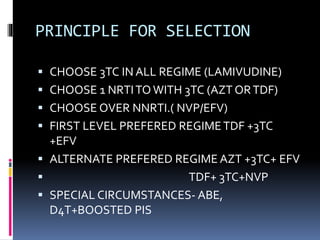
PRINCIPLE FOR SELECTION
 CHOOSE 3TC IN ALL REGIME (LAMIVUDINE)
 CHOOSE 1 NRTITO WITH 3TC (AZT ORTDF)
 CHOOSE OVER NNRTI.( NVP/EFV)
 FIRST LEVEL PREFERED REGIMETDF +3TC
+EFV
 ALTERNATE PREFERED REGIME AZT +3TC+ EFV
 TDF+ 3TC+NVP
 SPECIAL CIRCUMSTANCES- ABE,
D4T+BOOSTED PIS
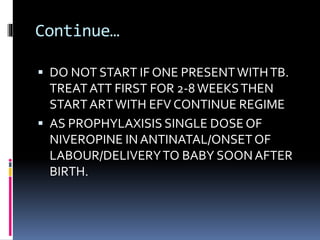
Continue…
 DO NOT START IF ONE PRESENTWITHTB.
TREATATT FIRST FOR 2-8WEEKSTHEN
STARTARTWITH EFV CONTINUE REGIME
 AS PROPHYLAXISIS SINGLE DOSE OF
NIVEROPINE IN ANTINATAL/ONSETOF
LABOUR/DELIVERYTO BABY SOONAFTER
BIRTH.
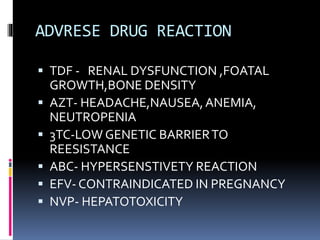
ADVRESE DRUG REACTION
 TDF - RENAL DYSFUNCTION ,FOATAL
GROWTH,BONE DENSITY
 AZT- HEADACHE,NAUSEA,ANEMIA,
NEUTROPENIA
 3TC-LOW GENETIC BARRIERTO
REESISTANCE
 ABC- HYPERSENSTIVETY REACTION
 EFV- CONTRAINDICATED IN PREGNANCY
 NVP- HEPATOTOXICITY
Follow up patient on ART
 FOLLOW UP 15 DAY,1MONTH, 2MONTH, 6
MONTH
 INVERSE RECONSTITUTION
INFLAMMATORY SYNDROME
 IRIS- OCCURANCEOR MANIFESTATIONOF
NEW OIS OR EXISTING OISWITH IN SIX
WEEKSTO SIX MONTHAFTERWATCHING
ARTWITH AN INCREASE IN CD4 COUNT.
Follow up patient on ART
 Base line
 1. symptoms
 2.screen forT.B
 3. physical exam
 4.X-ray chest
 Behaviour, psychosocial assassment
educational level, emplyoment, financial
resourse
 Social and family support
 Disclosure status
 Nutritional assessment
 Family members
 Use of condom
Routine blood ,urine , b.sugar , LFT, RFT, CD4
cell count
Pregnancy test, HBV,HCV screening
15th day- clinical and adherence counselling .
Hb, weight, LFT
1st month –do-
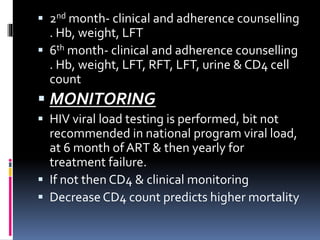
 2nd month- clinical and adherence counselling
. Hb, weight, LFT
 6th month- clinical and adherence counselling
. Hb, weight, LFT, RFT, LFT, urine & CD4 cell
count
 MONITORING
 HIV viral load testing is performed, bit not
recommended in national program viral load,
at 6 month of ART & then yearly for
treatment failure.
 If not then CD4 & clinical monitoring
 Decrease CD4 count predicts higher mortality
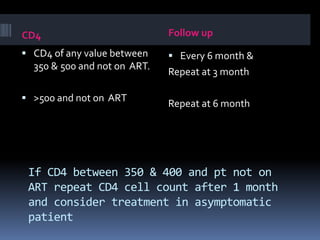
If CD4 between 350 & 400 and pt not on
ART repeat CD4 cell count after 1 month
and consider treatment in asymptomatic
patient
CD4 Follow up
 CD4 of any value between
350 & 500 and not on ART.
 >500 and not on ART
 Every 6 month &
Repeat at 3 month
Repeat at 6 month
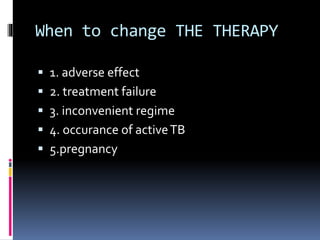
When to change THE THERAPY
 1. adverse effect
 2. treatment failure
 3. inconvenient regime
 4. occurance of activeTB
 5.pregnancy
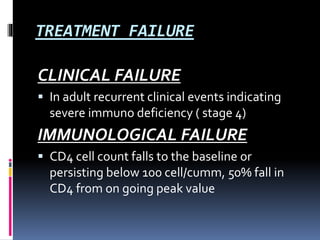
TREATMENT FAILURE
CLINICAL FAILURE
 In adult recurrent clinical events indicating
severe immuno deficiency ( stage 4)
IMMUNOLOGICAL FAILURE
 CD4 cell count falls to the baseline or
persisting below 100 cell/cumm, 50% fall in
CD4 from on going peak value
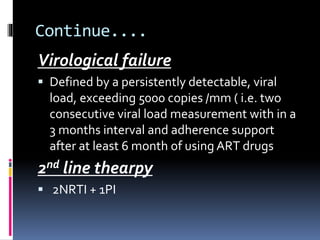
Continue....
Virological failure
 Defined by a persistently detectable, viral
load, exceeding 5000 copies /mm ( i.e. two
consecutive viral load measurement with in a
3 months interval and adherence support
after at least 6 month of using ART drugs
2nd line thearpy
 2NRTI + 1PI
Thank you

Hiv.ppt

  • 1.
    NATIONAL ART GUIDELINES PRESENTEDBY DR SHASHANK AGRAWAL
  • 2.
    NATIONAL ART GUIDELINES globally 35 million people sufer at the end of 2013  India is the third highest no.of estimate people with HIV in world  in 2011 20.9 lakhs 86 % off where in 15 to 49 years of age  children less than 15 year accounted 7 %
  • 3.
    now declining trendis observed due to a. effective prevention. b. care and treatment strategies of NACO. c. decrease In death due to anti retroviral therapy.
  • 4.
    goals of ART- CLINICAL GOALS  improve quality of life.  to reduce HIV related morbidity and mortality.  to provide maximal and durable suppresser of viral load.  to restore and preserve immune function.  the goal achieved by completely suppressing viral replication for as long as possible using well tolerated and sustainable treatment.
  • 5.
    the programmatic goals are:- -Toprovide long term ART to eligible patients -To increase life span by at least 3 years. -50 % of patient engaged in overcome returning to their previous employment. -To encounter and report treatment and course on a quarterly basis. -To attain individual drug adharence rate of 95 % or more.
  • 6.
    ART drugs arealso used for  decrease risk of transmission of HIV from infected another to her child.  transmission after an accidental end needle stick injury from infected patient.  cause of sexual assault/rape etc.
  • 8.
    Continue…..  Continuous highlevel of replication of HIV take place in the body regret from the early stage of infection.HIV destroy CD4 cells, the progressive immune system damage resulting susceptibility to differences of malignancies, neurological diseases, wastage & ultimately death  Antiviral drugs act on various stage of replication of the on HIV in the body interrupt in the process of viral replication.
  • 9.
    when to starttreatment……  Before ART clinical assessment to be performed to determine  classical staging of HIV infection  identify history of past illness specially related to HIV  identify currently HIV related illness requirement to treat  determining need for ART prophylaxis's  identify coexisting medical condition of patient that cause interference of choice of therapy
  • 10.
    WHO STAGING stage 12 and 3 with the exception of moderat anaemia can be recognised clinically. stage 4 for where clinical diagnosis not possible. definate diagnostic criteria are recommended. Eg:- lymphoma and cervical cancer.
  • 11.
    Stage 1 Stage 2 asymptomatic  persistant granular lymphadenopathy ->unexplained history of weight loss less than 10 % off previous measured body weight ->recurrent RT infection( sinusitis tonsillitis pharyngitis otitis media) -> herpes zoster -> angular cheilitis -> recurrent urinary infection -> recurrent oral infection -> papular pruritic eruption -> seborrhic dermatitis -> fungal nail infection
  • 12.
    Stage 3  unexplainedsever weight loss more than 10 % off previous measured body weight  unexplained persistent fever more than 100 degree ferehnite  persistent oral candidiasis.  oral hairy leukoplakia.  PulmonaryTB.  severe bacterial infection eg:- pneumonia bone infection meningitis bacteremia.  acute necrotizing ulcerative stomatitis gingivitis.  unexplained anaemia less than 8 gram, neutropenia or chronic thrombocytopenia .
  • 13.
    Stage 4 HIV wasting syndrome  Pneumocystis pneumonia  recurrent severe bacterial pneumonia  Chronic herpes zoster infection  Oesophageal candidiasis  Kaposi sarcoma  CMV infection  Toxoplasmosis  HIV encephalopathy  Cryptococcus meningitis  recurrent septicemia  Mycosis  lymphoma  Invasive cervical carcinoma  Atypical disseminated leishmaniasis  HIV associated nephropathy and cardiomyopathy
  • 14.
    ART recommendation  population. adult to adolscent more than 10 year  adult and adolscent more than 10 years  Recommendation  initiate ART if cd4 cell count less than 350 cells /cumm  Initiate in all individuals with severe advanced hiv disease stage 3 or 4 or cd 4 count less than 350 cell /mm  initiate treatment regardless of WHO staging cd4 cells count  activeTB disease.  hepatitis B coinfection with sever CLD.  pregnancy or breastfeeding v s with HIV
  • 15.
    patient with HIV andTB coinfection pulmonary or extrapulmonary  start ART irrespective of CD4 count and type ofTB ( start ATT first, initial ART as early as possible between 2 weekTB treatment is tolerated.
  • 16.
    CPT prophylaxis  cotrimoxazoleimprove survival. by decreasing the risk of death from recurrent infection eg:-  Malaria  pneumocyctitis  severe bacteria infection  Pneumonia  toxoplasmosis  diarrhoea causing organism
  • 17.
    UNDER NATIONAL PROGRAM, CPTinitiated in -HIV infected adult with CD4 < 250 cells/cumm -WHO to clinical stage 3 or 4 irrespective of CD4 count.  One double strength tab or 2 single strength tab OD total daily dose 960mg ,CPT stopped.  IF patient on ART if CD4 cell count >250 for atleast 6 weeks & if on ART for 6 weeks without symptoms present is well.
  • 18.
    Continue…  If comebelow 250 reintroduce secondary prophylaxiss is nedded to prevent recurrent OIS  Cotrimoxazole prophylaxis- to every one with CD4 cell count < 350 cells/cumm or with staging 3&4.
  • 19.
    ART agents andoptional regime  Different classes of art drugs act on different stages on HIV late cycle .Theoretically ART drugs can act on following ways during different stages of viral replication These include:-  Block bounding of HIV virus to target cells ( fusion inhibitors) Block viral RNA cleavage and one that inhibit reverse transcriptase
  • 20.
    Continue…..  Block theenzyme integrase which help in the incorporation of the proviral DNA into host cell chromosome (integrase inhibitor).  Block the RNA to prevent viral protein production.  Inhibit the budding of viral from host cells.
  • 22.
    Drugs available  Nucleusidereverse transcriptase inhibitors(NRTI)  Zydovudine (AZT)  Lamividudase (3TC)  Didanosure(ddi)  Zalcitabvie(ddc)  Abacavir(abc)  Eutricltabure(ftc)
  • 23.
    Non nucleoside reversetrans crephase inhibitors  Nivirapura (NVP)  Efaverienz (EFV)  Delavirdure (DLV)  Fusion inhibiters (FI)  Erifavirtide (T-20)  Integrase inhibiters  Raltegravir
  • 24.
    Protease inhibitors  Sequinavir(SQV)  Ritonavir (RTV)  Nelfuravir (NFV)  Amprenavir (APV)  Iuduravir (INV)  Lopuravir/ retonavir (LPV)  Foseamprenavir (LPV)  Atazanavir(ATV)  Tepranavir(TPV)
  • 25.
    First level regime Zidovudine + lamivudine 150ml  Terofovir 300ml+ lamivudine 150ml  Zidovudin + lamivudine + niverapine  E favireuz 600ml  Niverapine 200ml  FDCS( FIXED DOSE COMBINATIONS) are preferreed and easy to use  bd regime of FDCS are well tolerated and easily completed
  • 26.
    PRINCIPLE FOR SELECTION CHOOSE 3TC IN ALL REGIME (LAMIVUDINE)  CHOOSE 1 NRTITO WITH 3TC (AZT ORTDF)  CHOOSE OVER NNRTI.( NVP/EFV)  FIRST LEVEL PREFERED REGIMETDF +3TC +EFV  ALTERNATE PREFERED REGIME AZT +3TC+ EFV  TDF+ 3TC+NVP  SPECIAL CIRCUMSTANCES- ABE, D4T+BOOSTED PIS
  • 27.
    Continue…  DO NOTSTART IF ONE PRESENTWITHTB. TREATATT FIRST FOR 2-8WEEKSTHEN STARTARTWITH EFV CONTINUE REGIME  AS PROPHYLAXISIS SINGLE DOSE OF NIVEROPINE IN ANTINATAL/ONSETOF LABOUR/DELIVERYTO BABY SOONAFTER BIRTH.
  • 28.
    ADVRESE DRUG REACTION TDF - RENAL DYSFUNCTION ,FOATAL GROWTH,BONE DENSITY  AZT- HEADACHE,NAUSEA,ANEMIA, NEUTROPENIA  3TC-LOW GENETIC BARRIERTO REESISTANCE  ABC- HYPERSENSTIVETY REACTION  EFV- CONTRAINDICATED IN PREGNANCY  NVP- HEPATOTOXICITY
  • 29.
    Follow up patienton ART  FOLLOW UP 15 DAY,1MONTH, 2MONTH, 6 MONTH  INVERSE RECONSTITUTION INFLAMMATORY SYNDROME  IRIS- OCCURANCEOR MANIFESTATIONOF NEW OIS OR EXISTING OISWITH IN SIX WEEKSTO SIX MONTHAFTERWATCHING ARTWITH AN INCREASE IN CD4 COUNT.
  • 30.
    Follow up patienton ART  Base line  1. symptoms  2.screen forT.B  3. physical exam  4.X-ray chest  Behaviour, psychosocial assassment educational level, emplyoment, financial resourse
  • 31.
     Social andfamily support  Disclosure status  Nutritional assessment  Family members  Use of condom Routine blood ,urine , b.sugar , LFT, RFT, CD4 cell count Pregnancy test, HBV,HCV screening 15th day- clinical and adherence counselling . Hb, weight, LFT 1st month –do-
  • 32.
     2nd month-clinical and adherence counselling . Hb, weight, LFT  6th month- clinical and adherence counselling . Hb, weight, LFT, RFT, LFT, urine & CD4 cell count  MONITORING  HIV viral load testing is performed, bit not recommended in national program viral load, at 6 month of ART & then yearly for treatment failure.  If not then CD4 & clinical monitoring  Decrease CD4 count predicts higher mortality
  • 33.
    If CD4 between350 & 400 and pt not on ART repeat CD4 cell count after 1 month and consider treatment in asymptomatic patient CD4 Follow up  CD4 of any value between 350 & 500 and not on ART.  >500 and not on ART  Every 6 month & Repeat at 3 month Repeat at 6 month
  • 34.
    When to changeTHE THERAPY  1. adverse effect  2. treatment failure  3. inconvenient regime  4. occurance of activeTB  5.pregnancy
  • 35.
    TREATMENT FAILURE CLINICAL FAILURE In adult recurrent clinical events indicating severe immuno deficiency ( stage 4) IMMUNOLOGICAL FAILURE  CD4 cell count falls to the baseline or persisting below 100 cell/cumm, 50% fall in CD4 from on going peak value
  • 36.
    Continue.... Virological failure  Definedby a persistently detectable, viral load, exceeding 5000 copies /mm ( i.e. two consecutive viral load measurement with in a 3 months interval and adherence support after at least 6 month of using ART drugs 2nd line thearpy  2NRTI + 1PI
  • 37.