SEPTIC ARTHRITIS
(INFECTIOUS ARTHRITIS)
DR. ALBERTO JAVEL
SEPTIC
ARTHRITIS
(INFECTIOUS
ARTHRITIS)
 Summary
 Etiology
 Clinical features
 Subtypes and variants
 Diagnostics
 Differential diagnoses
 Treatment
 Complications
 References
SUMMARY
Septic (infectious) arthritis is a bacterial infection of the joint space.
Contamination occurs either via the bloodstream, iatrogenically, or
by local extension (e.g., penetrating trauma) and patients with
damaged (e.g., patients with rheumatoid arthritis) or
prosthetic joints have an increased risk. Patients usually present with
an acutely swollen, painful joint, limited range of motion, and
a fever. Suspected infectious arthritis requires
prompt arthrocentesis for diagnosis. In addition to the
immediate broad-spectrum antibiotic therapy, surgical drainage
and debridement may be necessary to prevent cartilage destruction
and sepsis.
ETIOLOGY
 Mechanism of infection
 Hematogenous spread (most common)
 From a distant site (e.g., abscesses, wound infection, septicemia)
 Direct contamination
 Trauma (e.g., open wounds around the joint, penetrating trauma)
 Risk factors
 Prosthetic implant
 Interventions
 Immunosuppressed state
 Diabetes mellitus
 Age > 80 years
 IV drug use
 Causative organisms
 Staphylococcus aureus - most common, in adults and children > 2 years
 Streptococci
 N. gonorrhea
 Gram-negative rods esp. E. coliand P. aeruginosa
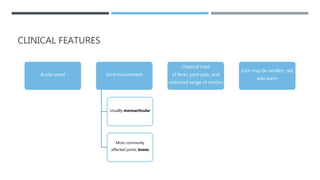
CLINICAL FEATURES
Acute onset Joint involvement
Usually monoarticular
Most commonly
affected joints: knees
Classical triad
of fever, joint pain, and
restricted range of motion
Joint may be swollen, red,
and warm
SUBTYPES AND
VARIANTS
 Prosthetic joint infection
 Etiology [4]
 Early onset (< 3 months of placement); most commonly S. aureus
 Delayed onset (3–12 months of placement); particularly S. epidermidis
 most commonly S. aureus
 Clinical findings
 Usually prolonged, low-grade course
 Can present acutely
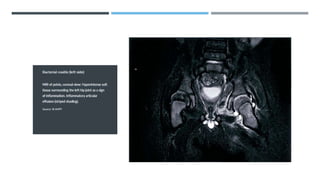
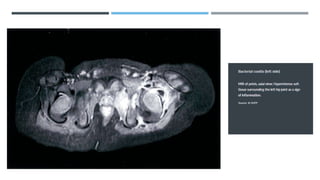
Bacterial coxitis (septic arthritis of the hip)
Bacterial coxitis is an orthopedic emergency!
Gonococcal arthritis
See purulent gonococcal arthritis and arthritis-dermatitis
syndrome.
Gonococcal arthritis is the most common form of arthritis
in sexually active young adults! In a young, sexually active
adult presenting with classic symptoms
of septic arthritis, gonococcal infection must be ruled out!
Lyme disease
See Lyme arthritis.
DIAGNOSTICS
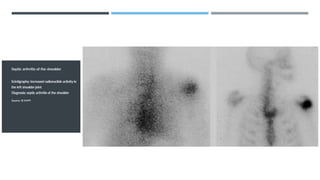
 If septic arthritis is suspected, arthrocentesis should be
conducted for synovial fluid analysis.
 Ultrasound-guided arthrocentesis: Definitive diagnosis requires
detection of bacteria in the synovial fluid.
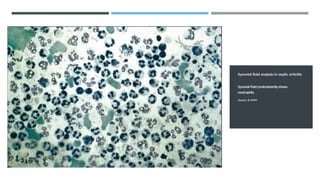
 To conduct synovial fluid analysis, gram stain, and culture
 ↑ Synovial fluid WBC and dominance of polymorphonuclear (PMN) cells
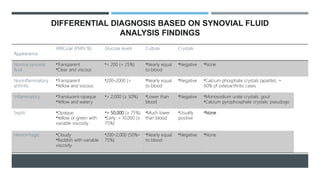
 Cell count: > 50,000 WBC/μl (neutrophil predominant) points
to septic arthritis (can be as low as > 10,000 in early disease).
Appearance
WBCs/μl (PMN %) Glucose levels Culture Crystals
Normal synovial
fluid
•Transparent
•Clear and viscous
•< 200 (< 25%) •Nearly equal
to blood
•Negative •None
Noninflammatory
arthritis
•Transparent
•Yellow and viscous
•200–2000 (< •Nearly equal
to blood
•Negative •Calcium phosphate crystals (apatite): ∼
60% of osteoarthritis cases
Inflammatory •Translucent-opaque
•Yellow and watery
•> 2,000 (≥ 50%) •Lower than
blood
•Negative •Monosodium urate crystals: gout
•Calcium pyrophosphate crystals: pseudogo
Septic •Opaque
•Yellow or green with
variable viscosity
•> 50,000 (≥ 75%)
•Early: > 10,000 (≥
75%)
•Much lower
than blood
•Usually
positive
•None
Hemorrhagic •Cloudy
•Reddish with variable
viscosity
•200–2,000 (50%–
75%)
•Nearly equal
to blood
•Negative •None
DIFFERENTIAL DIAGNOSIS BASED ON SYNOVIAL FLUID
ANALYSIS FINDINGS
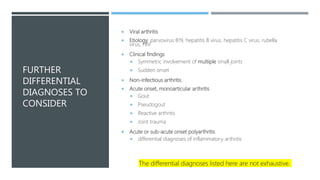
FURTHER
DIFFERENTIAL
DIAGNOSES TO
CONSIDER
 Viral arthritis
 Etiology: parvovirus B19, hepatitis B virus, hepatitis C virus, rubella
virus, HIV
 Clinical findings
 Symmetric involvement of multiple small joints
 Sudden onset
 Non-infectious arthritis
 Acute onset, monoarticular arthritis
 Gout
 Pseudogout
 Reactive arthritis
 Joint trauma
 Acute or sub-acute onset polyarthritis
 differential diagnoses of inflammatory arthritis
The differential diagnoses listed here are not exhaustive.
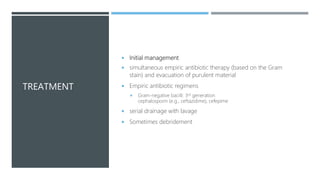
TREATMENT
 Initial management
 simultaneous empiric antibiotic therapy (based on the Gram
stain) and evacuation of purulent material
 Empiric antibiotic regimens
 Gram-negative bacilli: 3rd generation
cephalosporin (e.g., ceftazidime), cefepime
 serial drainage with lavage
 Sometimes debridement
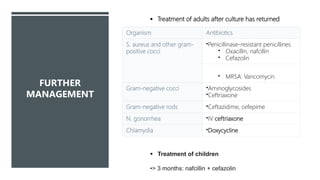
FURTHER
MANAGEMENT
Organism Antibiotics
S. aureus and other gram-
positive cocci
•Penicillinase-resistant penicillines
• Oxacillin, nafcillin
• Cefazolin
• MRSA: Vancomycin
Gram-negative cocci •Aminoglycosides
•Ceftriaxone
Gram-negative rods •Ceftazidime, cefepime
N. gonorrhea •IV ceftriaxone
Chlamydia •Doxycycline
 Treatment of adults after culture has returned
 Treatment of children
•> 3 months: nafcillin + cefazolin
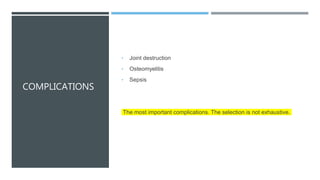
COMPLICATIONS
• Joint destruction
• Osteomyelitis
• Sepsis
The most important complications. The selection is not exhaustive.
REFERENCES
 1.Goldenberg DL, Sexton DJ. Septic arthritis in adults. In: Post TW,
ed. UpToDate. Waltham, MA: UpToDate. https://www.uptodate.com/contents/septic-
arthritis-in-
adults?source=search_result&search=septic%20arthritis&selectedTitle=1~150. Last
updated December 14, 2016. Accessed February 18, 2017.
 2.Brusch JL. Septic Arthritis. In: Stuart Bronze M Septic Arthritis. New York,
NY: WebMD. http://emedicine.medscape.com/article/236299. October 20, 2016.
Accessed February 28, 2017.
 3.Robbins R. Gonococcal Arthritis. In: Gonococcal Arthritis. New York, NY: WebMD.
http://emedicine.medscape.com/article/333612-overview. August 11, 2016.
Accessed April 9, 2017.
 4.Berbari E, Baddour LM. Prosthetic joint infection: Epidemiology, clinical
manifestations, and diagnosis. In: Post TW, ed. UpToDate. Waltham, MA: UpToDate.
https://www.uptodate.com/contents/prosthetic-joint-infection-epidemiology-clinical-
manifestations-and-diagnosis. Last updated April 22, 2019. Accessed July 7, 2019.
 5.Fischer C. Master the Boards USMLE Step 2 CK. New York, NY: Kaplan Publishing;
2015
 6.Tande AJ, Patel R. Prosthetic joint infection. Clin Microbiol Rev. 2014; 27(2): p.302-
345. doi: 10.1128/CMR.00111-13.

Septic arthritis

  • 1.
  • 2.
    SEPTIC ARTHRITIS (INFECTIOUS ARTHRITIS)  Summary  Etiology Clinical features  Subtypes and variants  Diagnostics  Differential diagnoses  Treatment  Complications  References
  • 3.
    SUMMARY Septic (infectious) arthritisis a bacterial infection of the joint space. Contamination occurs either via the bloodstream, iatrogenically, or by local extension (e.g., penetrating trauma) and patients with damaged (e.g., patients with rheumatoid arthritis) or prosthetic joints have an increased risk. Patients usually present with an acutely swollen, painful joint, limited range of motion, and a fever. Suspected infectious arthritis requires prompt arthrocentesis for diagnosis. In addition to the immediate broad-spectrum antibiotic therapy, surgical drainage and debridement may be necessary to prevent cartilage destruction and sepsis.
  • 4.
    ETIOLOGY  Mechanism ofinfection  Hematogenous spread (most common)  From a distant site (e.g., abscesses, wound infection, septicemia)  Direct contamination  Trauma (e.g., open wounds around the joint, penetrating trauma)  Risk factors  Prosthetic implant  Interventions  Immunosuppressed state  Diabetes mellitus  Age > 80 years  IV drug use  Causative organisms  Staphylococcus aureus - most common, in adults and children > 2 years  Streptococci  N. gonorrhea  Gram-negative rods esp. E. coliand P. aeruginosa
  • 5.
    CLINICAL FEATURES Acute onsetJoint involvement Usually monoarticular Most commonly affected joints: knees Classical triad of fever, joint pain, and restricted range of motion Joint may be swollen, red, and warm
  • 6.
    SUBTYPES AND VARIANTS  Prostheticjoint infection  Etiology [4]  Early onset (< 3 months of placement); most commonly S. aureus  Delayed onset (3–12 months of placement); particularly S. epidermidis  most commonly S. aureus  Clinical findings  Usually prolonged, low-grade course  Can present acutely
  • 7.
    Bacterial coxitis (septicarthritis of the hip) Bacterial coxitis is an orthopedic emergency! Gonococcal arthritis See purulent gonococcal arthritis and arthritis-dermatitis syndrome. Gonococcal arthritis is the most common form of arthritis in sexually active young adults! In a young, sexually active adult presenting with classic symptoms of septic arthritis, gonococcal infection must be ruled out! Lyme disease See Lyme arthritis.
  • 8.
    DIAGNOSTICS  If septicarthritis is suspected, arthrocentesis should be conducted for synovial fluid analysis.  Ultrasound-guided arthrocentesis: Definitive diagnosis requires detection of bacteria in the synovial fluid.  To conduct synovial fluid analysis, gram stain, and culture  ↑ Synovial fluid WBC and dominance of polymorphonuclear (PMN) cells  Cell count: > 50,000 WBC/μl (neutrophil predominant) points to septic arthritis (can be as low as > 10,000 in early disease).
  • 14.
    Appearance WBCs/μl (PMN %)Glucose levels Culture Crystals Normal synovial fluid •Transparent •Clear and viscous •< 200 (< 25%) •Nearly equal to blood •Negative •None Noninflammatory arthritis •Transparent •Yellow and viscous •200–2000 (< •Nearly equal to blood •Negative •Calcium phosphate crystals (apatite): ∼ 60% of osteoarthritis cases Inflammatory •Translucent-opaque •Yellow and watery •> 2,000 (≥ 50%) •Lower than blood •Negative •Monosodium urate crystals: gout •Calcium pyrophosphate crystals: pseudogo Septic •Opaque •Yellow or green with variable viscosity •> 50,000 (≥ 75%) •Early: > 10,000 (≥ 75%) •Much lower than blood •Usually positive •None Hemorrhagic •Cloudy •Reddish with variable viscosity •200–2,000 (50%– 75%) •Nearly equal to blood •Negative •None DIFFERENTIAL DIAGNOSIS BASED ON SYNOVIAL FLUID ANALYSIS FINDINGS
  • 15.
    FURTHER DIFFERENTIAL DIAGNOSES TO CONSIDER  Viralarthritis  Etiology: parvovirus B19, hepatitis B virus, hepatitis C virus, rubella virus, HIV  Clinical findings  Symmetric involvement of multiple small joints  Sudden onset  Non-infectious arthritis  Acute onset, monoarticular arthritis  Gout  Pseudogout  Reactive arthritis  Joint trauma  Acute or sub-acute onset polyarthritis  differential diagnoses of inflammatory arthritis The differential diagnoses listed here are not exhaustive.
  • 16.
    TREATMENT  Initial management simultaneous empiric antibiotic therapy (based on the Gram stain) and evacuation of purulent material  Empiric antibiotic regimens  Gram-negative bacilli: 3rd generation cephalosporin (e.g., ceftazidime), cefepime  serial drainage with lavage  Sometimes debridement
  • 17.
    FURTHER MANAGEMENT Organism Antibiotics S. aureusand other gram- positive cocci •Penicillinase-resistant penicillines • Oxacillin, nafcillin • Cefazolin • MRSA: Vancomycin Gram-negative cocci •Aminoglycosides •Ceftriaxone Gram-negative rods •Ceftazidime, cefepime N. gonorrhea •IV ceftriaxone Chlamydia •Doxycycline  Treatment of adults after culture has returned  Treatment of children •> 3 months: nafcillin + cefazolin
  • 18.
    COMPLICATIONS • Joint destruction •Osteomyelitis • Sepsis The most important complications. The selection is not exhaustive.
  • 19.
    REFERENCES  1.Goldenberg DL,Sexton DJ. Septic arthritis in adults. In: Post TW, ed. UpToDate. Waltham, MA: UpToDate. https://www.uptodate.com/contents/septic- arthritis-in- adults?source=search_result&search=septic%20arthritis&selectedTitle=1~150. Last updated December 14, 2016. Accessed February 18, 2017.  2.Brusch JL. Septic Arthritis. In: Stuart Bronze M Septic Arthritis. New York, NY: WebMD. http://emedicine.medscape.com/article/236299. October 20, 2016. Accessed February 28, 2017.  3.Robbins R. Gonococcal Arthritis. In: Gonococcal Arthritis. New York, NY: WebMD. http://emedicine.medscape.com/article/333612-overview. August 11, 2016. Accessed April 9, 2017.  4.Berbari E, Baddour LM. Prosthetic joint infection: Epidemiology, clinical manifestations, and diagnosis. In: Post TW, ed. UpToDate. Waltham, MA: UpToDate. https://www.uptodate.com/contents/prosthetic-joint-infection-epidemiology-clinical- manifestations-and-diagnosis. Last updated April 22, 2019. Accessed July 7, 2019.  5.Fischer C. Master the Boards USMLE Step 2 CK. New York, NY: Kaplan Publishing; 2015  6.Tande AJ, Patel R. Prosthetic joint infection. Clin Microbiol Rev. 2014; 27(2): p.302- 345. doi: 10.1128/CMR.00111-13.