Lesson 2.2
Separation of Mixtures
Contents
Introduction 1
Learning Objectives 2
Warm Up 2
Learn about It! 5
Separating Mixtures 5
Separating Homogeneous Mixtures 5
Evaporation 6
Recrystallization 7
Distillation 7
Chromatography 9
Separating Heterogeneous Mixtures 11
Manual Separation 11
Filtration 13
Sedimentation and Decantation 15
Centrifugation 17
Applications of Separation Methods 18
Key Points 20
Check Your Understanding 21
Challenge Yourself 23
Photo Credits 24
Bibliography 24
Unit 2: Separating Mixtures
Lesson 2.2
Separation of Mixtures
Introduction
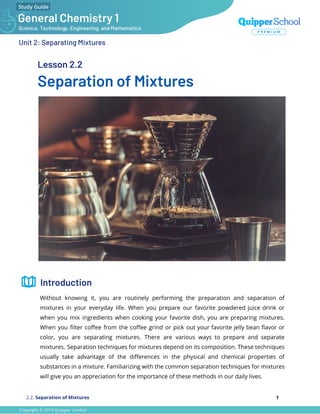
Without knowing it, you are routinely performing the preparation and separation of
mixtures in your everyday life. When you prepare our favorite powdered juice drink or
when you mix ingredients when cooking your favorite dish, you are preparing mixtures.
When you filter coffee from the coffee grind or pick out your favorite jelly bean flavor or
color, you are separating mixtures. There are various ways to prepare and separate
mixtures. Separation techniques for mixtures depend on its composition. These techniques
usually take advantage of the differences in the physical and chemical properties of
substances in a mixture. Familiarizing with the common separation techniques for mixtures
will give you an appreciation for the importance of these methods in our daily lives.
2.2. Separation of Mixtures 1
Unit 2: Separating Mixtures
Learning Objectives
In this lesson, you should be able to do the
following:
● Demonstrate the different methods of
separating the components of a
homogeneous mixture and a
heterogeneous mixture.
● Explain the importance of these
methods in the preparation of certain
products.
DepEd Competency
Use properties of matter to identify
substances and to separate them
(STEM_GC11MP-Ia-b-5).
Warm Up
Oil and Water 15 minutes
Oil and water are two commonly known substances that do not mix. They form distinct
layers when combined in the same vessel. In this activity, you will be asked to perform an
experiment on separating two immiscible liquids, oil and water.
Materials
● cooking oil
● water
● droppers
● separatory funnel, 100 mL
● beakers, 100 mL
● iron ring or utility clamp
● iron stand
● ice bath
2.2. Separation of Mixtures 2
Unit 2: Separating Mixtures
Procedure
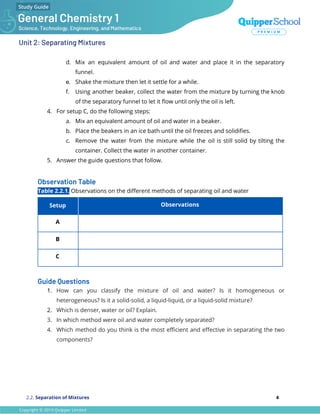
1. Prepare three setups for this activity. You may perform this in three big groups.
2. For setup A, do the following steps:
a. Fill half of the beaker with water.
b. Then, add oil with an equivalent volume to water in the beaker
c. Observe the resulting mixture. Then, tilt the container to remove the oil on
top of the water as much as possible. Collect the oil in another beaker.
3. For setup B, do the following steps:
a. Place the oil and water mixture inside the separatory funnel.
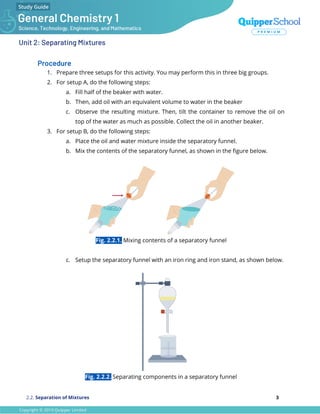
b. Mix the contents of the separatory funnel, as shown in the figure below.
Fig. 2.2.1. Mixing contents of a separatory funnel
c. Setup the separatory funnel with an iron ring and iron stand, as shown below.
Fig. 2.2.2. Separating components in a separatory funnel
2.2. Separation of Mixtures 3
Unit 2: Separating Mixtures
d. Mix an equivalent amount of oil and water and place it in the separatory
funnel.
e. Shake the mixture then let it settle for a while.
f. Using another beaker, collect the water from the mixture by turning the knob
of the separatory funnel to let it flow until only the oil is left.
4. For setup C, do the following steps:
a. Mix an equivalent amount of oil and water in a beaker.
b. Place the beakers in an ice bath until the oil freezes and solidifies.
c. Remove the water from the mixture while the oil is still solid by tilting the
container. Collect the water in another container.
5. Answer the guide questions that follow.
Observation Table
Table 2.2.1. Observations on the different methods of separating oil and water
Setup Observations
A
B
C
Guide Questions
1. How can you classify the mixture of oil and water? Is it homogeneous or
heterogeneous? Is it a solid-solid, a liquid-liquid, or a liquid-solid mixture?
2. Which is denser, water or oil? Explain.
3. In which method were oil and water completely separated?
4. Which method do you think is the most efficient and effective in separating the two
components?
2.2. Separation of Mixtures 4
Unit 2: Separating Mixtures
Learn about It!
Separating Mixtures
From the previous lesson, you learned that mixtures are combinations of two or more pure
substances in which each substance retains its own composition and properties. They can
be classified into two, homogeneous and heterogeneous. A homogeneous mixture is a
combination of two or more substances that cannot be distinguished from each other. It
has uniform composition and properties. Homogeneous solutions are also called solutions.
On the other hand, a heterogeneous mixture is a combination of two or more substances
that can be distinguished from each other. It has varying composition and properties.
Heterogeneous mixtures can be further classified either as suspensions or colloids. A
suspension is a heterogeneous mixture whose solutes do not completely dissolve. The
insoluble particles settle into clumps or layers when left undisturbed. A colloid is a
heterogeneous mixture whose solute-like particles are dispersed in a medium.
Each substance in a mixture has its own characteristic properties that are different from the
set of properties of any other substance. And so, these properties can be taken advantage
of in separating the components of a mixture from each other. In this lesson, you will learn
about the different methods of separation for homogeneous and heterogeneous mixtures.
Separating Homogeneous Mixtures
Almost every sample of matter that you ordinarily encounter every day is a mixture. The
combined substances in mixtures can be mixed in varied proportions. For a homogeneous
mixture, its uniform appearance could suggest that it is “pure” in terms of composition.
However, its one-phase appearance is due to the uniform distribution of its components all
throughout. This kind of mixture can be separated into simpler components. Since
homogeneous mixtures are prepared without any chemical reactions, its components can
be separated by physical means. In this section, some separation techniques that can be
employed in separating the components of homogeneous mixtures will be discussed.
2.2. Separation of Mixtures 5
Unit 2: Separating Mixtures
What techniques can be done to separate the
components of a homogeneous mixture?
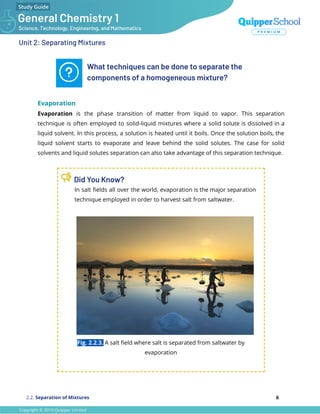
Evaporation
Evaporation is the phase transition of matter from liquid to vapor. This separation
technique is often employed to solid-liquid mixtures where a solid solute is dissolved in a
liquid solvent. In this process, a solution is heated until it boils. Once the solution boils, the
liquid solvent starts to evaporate and leave behind the solid solutes. The case for solid
solvents and liquid solutes separation can also take advantage of this separation technique.
Did You Know?
In salt fields all over the world, evaporation is the major separation
technique employed in order to harvest salt from saltwater.
Fig. 2.2.3. A salt field where salt is separated from saltwater by
evaporation
2.2. Separation of Mixtures 6
Unit 2: Separating Mixtures
Recrystallization
Recrystallization is a separation technique based on the difference in solubilities of
substances in an appropriate solvent at an elevated temperature. Solubility refers to the
amount of substance that can be dissolved in a given solvent at a certain temperature.
Recrystallization is often applied as a purification technique for solid mixtures.
The method requires dissolving the solid compound in an appropriate solvent at an
elevated temperature. The elevated temperature increases the solubility of the solute. This
separates the solute of interest with another solute, which has low solubility in the solvent.
Then, the solute starts to recrystallize as the solution cools down and being saturated by the
solute. In the slow formation of the crystal lattice, the impurities are excluded. The collection
of the crystals is then performed by another separation technique, filtration, which will be
discussed further later.
The choice of solvent is important in performing recrystallization as a separation technique.
An ideal solvent for recrystallization must have the solute be soluble at high temperatures
but only sparingly soluble at room or lower temperatures. The impurities must be insoluble
in the solvent. Also, no reaction must occur between the solute and the solvent. An ideal
solvent is moderately volatile, and its boiling point is lower than the melting point of the
solute.
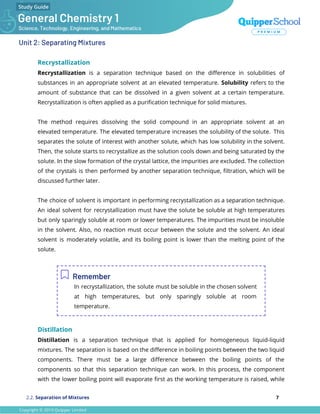
Remember
In recrystallization, the solute must be soluble in the chosen solvent
at high temperatures, but only sparingly soluble at room
temperature.
Distillation
Distillation is a separation technique that is applied for homogeneous liquid-liquid
mixtures. The separation is based on the difference in boiling points between the two liquid
components. There must be a large difference between the boiling points of the
components so that this separation technique can work. In this process, the component
with the lower boiling point will evaporate first as the working temperature is raised, while
2.2. Separation of Mixtures 7
Unit 2: Separating Mixtures
the other remains as a liquid. The vapor then condenses and is collected in another
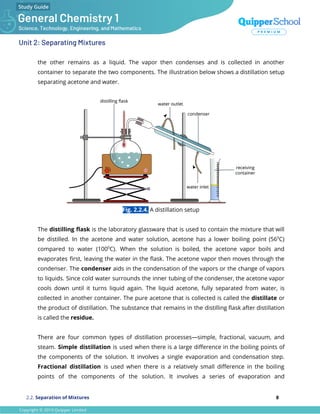
container to separate the two components. The illustration below shows a distillation setup
separating acetone and water.
Fig. 2.2.4. A distillation setup
The distilling flask is the laboratory glassware that is used to contain the mixture that will
be distilled. In the acetone and water solution, acetone has a lower boiling point (560
C)
compared to water (1000
C). When the solution is boiled, the acetone vapor boils and
evaporates first, leaving the water in the flask. The acetone vapor then moves through the
condenser. The condenser aids in the condensation of the vapors or the change of vapors
to liquids. Since cold water surrounds the inner tubing of the condenser, the acetone vapor
cools down until it turns liquid again. The liquid acetone, fully separated from water, is
collected in another container. The pure acetone that is collected is called the distillate or
the product of distillation. The substance that remains in the distilling flask after distillation
is called the residue.
There are four common types of distillation processes—simple, fractional, vacuum, and
steam. Simple distillation is used when there is a large difference in the boiling points of
the components of the solution. It involves a single evaporation and condensation step.
Fractional distillation is used when there is a relatively small difference in the boiling
points of the components of the solution. It involves a series of evaporation and
2.2. Separation of Mixtures 8
Unit 2: Separating Mixtures
condensation steps. For compounds with very high boiling points, vacuum distillation is
used. Steam distillation is used for compounds that are heat-sensitive. This enables the
separation of the components before any components decompose.
Remember
There must be a large difference in the boiling points of the liquid
components in order to perform distillation as a separation
technique for liquid mixtures.
Chromatography
Another way to separate liquid-liquid mixtures is through chromatography. It is a
separation technique that relies on the differential partition of the components between the
two important phases in chromatography: the mobile phase and the stationary phase. The
mobile phase is the solvent in chromatography that carries the components throughout
the stationary phase, an adsorbent material that holds the solutes still when interactions
are favored. These two phases must have opposite polarities.
Chromatography can be classified based on the polarity of its phases. In normal-phase
chromatography, the mobile phase is nonpolar, and the stationary phase is polar. On the
other hand, in reversed-phase chromatography, the mobile phase is polar, and the
stationary phase is nonpolar.
The separation is determined by the two competing processes: the adsorption onto the
stationary phase and the solubility in the mobile phase. As the mobile phase runs through
the stationary phase, the components of the mixture separate based on these competing
processes. Whichever process is predominantly experienced by a molecule is dependent on
the strength of its interaction with the stationary phase or the mobile phase. Solutes that
have high solubility in the mobile phase will go along with the mobile phase as it travels on
the stationary phase. On the other hand, solutes that have low solubility will tend to remain
where they are.
2.2. Separation of Mixtures 9
Unit 2: Separating Mixtures
Remember
In normal-phase chromatography, the mobile phase is nonpolar,
and the stationary phase is polar. In reversed-phase
chromatography, the mobile phase is polar, and the stationary
phase is nonpolar. You may use the mnemonics NPSP for Normal
Phase Stationary phase Polar.
Chromatography can also be classified based on the structure of the stationary phase. In
column chromatography, the stationary phase is held in a column. The mobile phase
passes through the stationary phase by gravity or by applying pressure. In planar
chromatography, the stationary phase is supported on a flat plate. The mobile phase
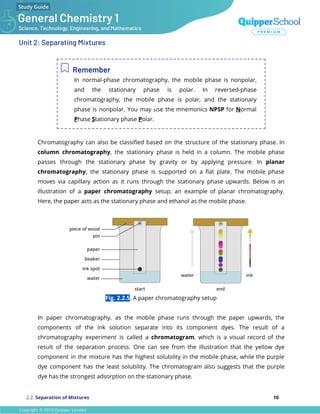
moves via capillary action as it runs through the stationary phase upwards. Below is an
illustration of a paper chromatography setup, an example of planar chromatography.
Here, the paper acts as the stationary phase and ethanol as the mobile phase.
Fig. 2.2.5. A paper chromatography setup
In paper chromatography, as the mobile phase runs through the paper upwards, the
components of the ink solution separate into its component dyes. The result of a
chromatography experiment is called a chromatogram, which is a visual record of the
result of the separation process. One can see from the illustration that the yellow dye
component in the mixture has the highest solubility in the mobile phase, while the purple
dye component has the least solubility. The chromatogram also suggests that the purple
dye has the strongest adsorption on the stationary phase.
2.2. Separation of Mixtures 10
Unit 2: Separating Mixtures
Remember
In paper chromatography, the farther the solute travels in a
chromatogram, the more it is soluble in the mobile phase. The
shorter distance the solute travels means that it is more strongly
adsorbed in the stationary phase.
Separating Heterogeneous Mixtures
Unlike solutions, heterogeneous mixtures have components that are visually distinct from
each other. This is the reason why heterogeneous mixtures may be separated manually into
its components. In this section, some separation techniques that can be employed in
separating the components of heterogeneous mixtures will be discussed.
What techniques can be done to separate the
components of a heterogeneous mixture?
Manual Separation
Heterogeneous mixtures with large, visible components may be separated into its
components through manual separation techniques. Manual picking using your hands or
tongs can be done in separating the components of these kinds of mixtures. They may be
separated into various containers by picking them individually. For instance, you do manual
picking when separating different non-biodegradables in a trash bin.
Did You Know?
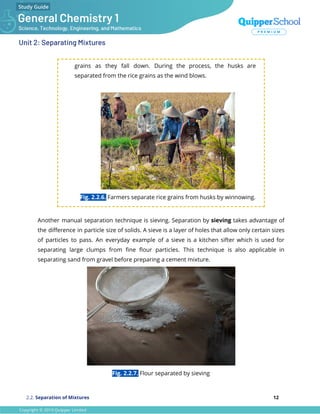
Another example of a manual separation technique is winnowing.
In some provinces, not all farmers have the machinery to separate
rice grains from husks. Instead, they separate the hard covering of
rice grains through winnowing. In this method, the rice grains with
husks are placed into a bilao or any flat pan. The mixture is thrown
up in the air over and over again. The pan is used to catch the rice
2.2. Separation of Mixtures 11
Unit 2: Separating Mixtures
grains as they fall down. During the process, the husks are
separated from the rice grains as the wind blows.
Fig. 2.2.6. Farmers separate rice grains from husks by winnowing.
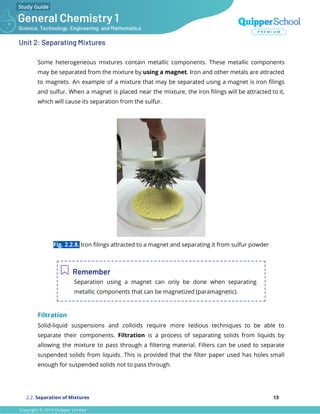
Another manual separation technique is sieving. Separation by sieving takes advantage of
the difference in particle size of solids. A sieve is a layer of holes that allow only certain sizes
of particles to pass. An everyday example of a sieve is a kitchen sifter which is used for
separating large clumps from fine flour particles. This technique is also applicable in
separating sand from gravel before preparing a cement mixture.
Fig. 2.2.7. Flour separated by sieving
2.2. Separation of Mixtures 12
Unit 2: Separating Mixtures
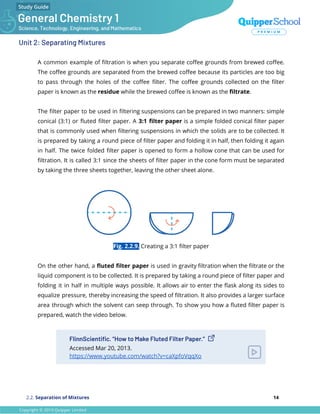
Some heterogeneous mixtures contain metallic components. These metallic components
may be separated from the mixture by using a magnet. Iron and other metals are attracted
to magnets. An example of a mixture that may be separated using a magnet is iron filings
and sulfur. When a magnet is placed near the mixture, the iron filings will be attracted to it,
which will cause its separation from the sulfur.
Fig. 2.2.8. Iron filings attracted to a magnet and separating it from sulfur powder
Remember
Separation using a magnet can only be done when separating
metallic components that can be magnetized (paramagnetic).
Filtration
Solid-liquid suspensions and colloids require more tedious techniques to be able to
separate their components. Filtration is a process of separating solids from liquids by
allowing the mixture to pass through a filtering material. Filters can be used to separate
suspended solids from liquids. This is provided that the filter paper used has holes small
enough for suspended solids not to pass through.
2.2. Separation of Mixtures 13
Unit 2: Separating Mixtures
A common example of filtration is when you separate coffee grounds from brewed coffee.
The coffee grounds are separated from the brewed coffee because its particles are too big
to pass through the holes of the coffee filter. The coffee grounds collected on the filter
paper is known as the residue while the brewed coffee is known as the filtrate.
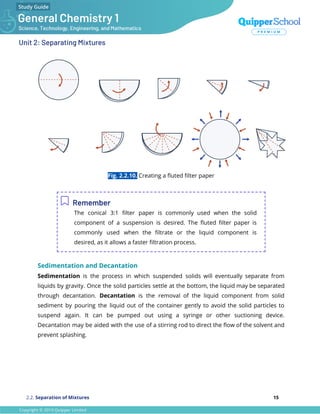
The filter paper to be used in filtering suspensions can be prepared in two manners: simple
conical (3:1) or fluted filter paper. A 3:1 filter paper is a simple folded conical filter paper
that is commonly used when filtering suspensions in which the solids are to be collected. It
is prepared by taking a round piece of filter paper and folding it in half, then folding it again
in half. The twice folded filter paper is opened to form a hollow cone that can be used for
filtration. It is called 3:1 since the sheets of filter paper in the cone form must be separated
by taking the three sheets together, leaving the other sheet alone.
Fig. 2.2.9. Creating a 3:1 filter paper
On the other hand, a fluted filter paper is used in gravity filtration when the filtrate or the
liquid component is to be collected. It is prepared by taking a round piece of filter paper and
folding it in half in multiple ways possible. It allows air to enter the flask along its sides to
equalize pressure, thereby increasing the speed of filtration. It also provides a larger surface
area through which the solvent can seep through. To show you how a fluted filter paper is
prepared, watch the video below.
FlinnScientific. “How to Make Fluted Filter Paper.”
Accessed Mar 20, 2013.
https://www.youtube.com/watch?v=caXpfoVqqXo
2.2. Separation of Mixtures 14
Unit 2: Separating Mixtures
Fig. 2.2.10. Creating a fluted filter paper
Remember
The conical 3:1 filter paper is commonly used when the solid
component of a suspension is desired. The fluted filter paper is
commonly used when the filtrate or the liquid component is
desired, as it allows a faster filtration process.
Sedimentation and Decantation
Sedimentation is the process in which suspended solids will eventually separate from
liquids by gravity. Once the solid particles settle at the bottom, the liquid may be separated
through decantation. Decantation is the removal of the liquid component from solid
sediment by pouring the liquid out of the container gently to avoid the solid particles to
suspend again. It can be pumped out using a syringe or other suctioning device.
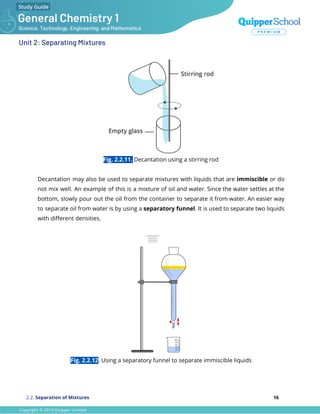
Decantation may be aided with the use of a stirring rod to direct the flow of the solvent and
prevent splashing.
2.2. Separation of Mixtures 15
Unit 2: Separating Mixtures
Fig. 2.2.11. Decantation using a stirring rod
Decantation may also be used to separate mixtures with liquids that are immiscible or do
not mix well. An example of this is a mixture of oil and water. Since the water settles at the
bottom, slowly pour out the oil from the container to separate it from water. An easier way
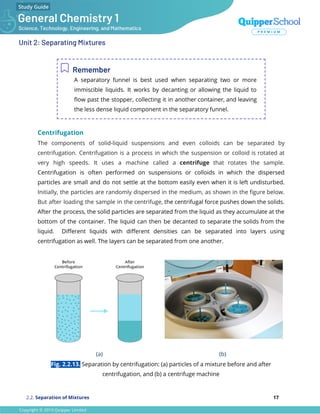
to separate oil from water is by using a separatory funnel. It is used to separate two liquids
with different densities.
Fig. 2.2.12. Using a separatory funnel to separate immiscible liquids
2.2. Separation of Mixtures 16
Unit 2: Separating Mixtures
Remember
A separatory funnel is best used when separating two or more
immiscible liquids. It works by decanting or allowing the liquid to
flow past the stopper, collecting it in another container, and leaving
the less dense liquid component in the separatory funnel.
Centrifugation
The components of solid-liquid suspensions and even colloids can be separated by
centrifugation. Centrifugation is a process in which the suspension or colloid is rotated at
very high speeds. It uses a machine called a centrifuge that rotates the sample.
Centrifugation is often performed on suspensions or colloids in which the dispersed
particles are small and do not settle at the bottom easily even when it is left undisturbed.
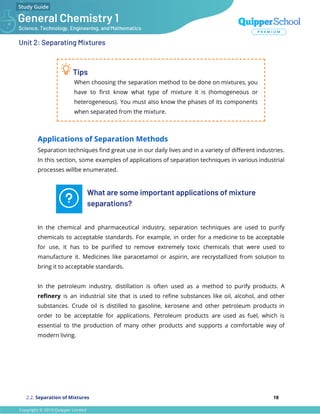
Initially, the particles are randomly dispersed in the medium, as shown in the figure below.
But after loading the sample in the centrifuge, the centrifugal force pushes down the solids.
After the process, the solid particles are separated from the liquid as they accumulate at the
bottom of the container. The liquid can then be decanted to separate the solids from the
liquid. Different liquids with different densities can be separated into layers using
centrifugation as well. The layers can be separated from one another.
(a) (b)
Fig. 2.2.13. Separation by centrifugation: (a) particles of a mixture before and after
centrifugation, and (b) a centrifuge machine
2.2. Separation of Mixtures 17
Unit 2: Separating Mixtures
Tips
When choosing the separation method to be done on mixtures, you
have to first know what type of mixture it is (homogeneous or
heterogeneous). You must also know the phases of its components
when separated from the mixture.
Applications of Separation Methods
Separation techniques find great use in our daily lives and in a variety of different industries.
In this section, some examples of applications of separation techniques in various industrial
processes willbe enumerated.
What are some important applications of mixture
separations?
In the chemical and pharmaceutical industry, separation techniques are used to purify
chemicals to acceptable standards. For example, in order for a medicine to be acceptable
for use, it has to be purified to remove extremely toxic chemicals that were used to
manufacture it. Medicines like paracetamol or aspirin, are recrystallized from solution to
bring it to acceptable standards.
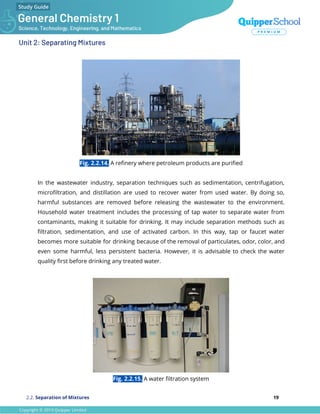
In the petroleum industry, distillation is often used as a method to purify products. A
refinery is an industrial site that is used to refine substances like oil, alcohol, and other
substances. Crude oil is distilled to gasoline, kerosene and other petroleum products in
order to be acceptable for applications. Petroleum products are used as fuel, which is
essential to the production of many other products and supports a comfortable way of
modern living.
2.2. Separation of Mixtures 18
Unit 2: Separating Mixtures
Fig. 2.2.14. A refinery where petroleum products are purified
In the wastewater industry, separation techniques such as sedimentation, centrifugation,
microfiltration, and distillation are used to recover water from used water. By doing so,
harmful substances are removed before releasing the wastewater to the environment.
Household water treatment includes the processing of tap water to separate water from
contaminants, making it suitable for drinking. It may include separation methods such as
filtration, sedimentation, and use of activated carbon. In this way, tap or faucet water
becomes more suitable for drinking because of the removal of particulates, odor, color, and
even some harmful, less persistent bacteria. However, it is advisable to check the water
quality first before drinking any treated water.
Fig. 2.2.15. A water filtration system
2.2. Separation of Mixtures 19
Unit 2: Separating Mixtures
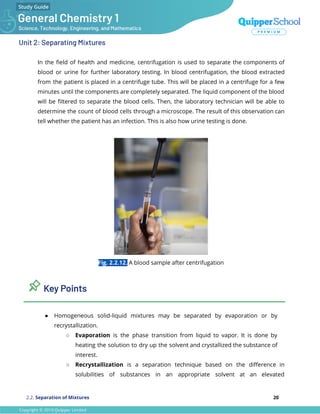
In the field of health and medicine, centrifugation is used to separate the components of
blood or urine for further laboratory testing. In blood centrifugation, the blood extracted
from the patient is placed in a centrifuge tube. This will be placed in a centrifuge for a few
minutes until the components are completely separated. The liquid component of the blood
will be filtered to separate the blood cells. Then, the laboratory technician will be able to
determine the count of blood cells through a microscope. The result of this observation can
tell whether the patient has an infection. This is also how urine testing is done.
Fig. 2.2.12. A blood sample after centrifugation
Key Points
___________________________________________________________________________________________
● Homogeneous solid-liquid mixtures may be separated by evaporation or by
recrystallization.
○ Evaporation is the phase transition from liquid to vapor. It is done by
heating the solution to dry up the solvent and crystallized the substance of
interest.
○ Recrystallization is a separation technique based on the difference in
solubilities of substances in an appropriate solvent at an elevated
2.2. Separation of Mixtures 20
Unit 2: Separating Mixtures
temperature.
● Homogeneous liquid-liquid mixtures may be separated by distillation or by
chromatography.
○ Distillation is a separation technique based on the difference of boiling
points between two liquid components.
○ Chromatography is a separation technique that relies on the differential
partition of the components between the two important phases in
chromatography: the mobile phase and the stationary phase.
● Different methods can be used to separate heterogeneous solid-solid mixtures.
Components of some mixtures of this type can be separated by manual picking,
sieving, or by using a magnet.
● Different methods can be used to separate heterogeneous solid-liquid mixtures
such as filtration, sedimentation, decantation, and centrifugation.
○ Filtration is a process of separating solids from liquids by allowing the
mixture to pass through a filtering material.
○ Sedimentation is the process in which suspended solids will eventually
separate from liquids by gravity.
○ Decantation is the removal of the liquid component from the solid
sediment by pouring the liquid out of the container gently to avoid the solid
particles to suspend again.
○ Centrifugation is a process in which the suspension is rotated at very high
speeds, allowing the components to separate into layers based on their
densities or particle size.
___________________________________________________________________________________________
Check Your Understanding
A. Match the separation technique in column A to the description in
column B.
Column A Column B
2.2. Separation of Mixtures 21
Unit 2: Separating Mixtures
_______ 1. evaporation a. It involves a mobile phase and a stationary
phase.
_______ 2. distillation b. It is a separation technique based on the
difference in solubilities of substances in an
appropriate solvent at an elevated temperature.
_______ 3. recrystallization c. It is a method where the difference in boiling
points of the components of the mixture is used
to separate them.
_______ 4. chromatography d. It is the phase transition from liquid to vapor.
_______ 5. manual picking e. It involves the use of a high speed rotating
machine to separate components.
_______ 6. filtration f. It is a separation technique that involves tilting
the container and removing the liquid on top.
_______ 7. decantation g. It is an easy way to separate magnetic metals
from other materials
_______ 8. sieving h. It is a way to separate solid mixtures with
different particle sizes
_______ 9. use of magnet i. It is the separation of components using hands
or tongs.
______ 10. centrifugation j. It is the separation of liquid and solid by passing
the mixture through a filtering material.
B. Write yes if the separation technique is appropriate for the given
mixture. If not, identify what separation technique is applicable to
separate the components of the mixture.
___________________________ 1. colored clothes from white clothes : filtration
___________________________ 2. chalk and water : filtration
___________________________ 3. boiled noodles in water : recrystallization
___________________________ 4. sand and gravel : decantation
2.2. Separation of Mixtures 22
Unit 2: Separating Mixtures
___________________________ 5. baby oil and water : evaporation
___________________________ 6. blood and blood plasma : centrifugation
___________________________ 7. pineapple chunks from pizza : manual picking
___________________________ 8. ethanol and water : chromatography
___________________________ 9. plant pigments : chromatography
__________________________ 10. salt and water : filtration
C. Suggest a separation method to be done on the following mixture
to separate its components.
Mixture Separation Method
1. perfume
2. cartridge ink
3. crude oil
4. rock salt and cornstarch
5. saltwater and sand
Challenge Yourself
Answer the following.
1. Outline the separation of a mixture of potassium chloride, water, and acetone.
2. Medicinal components in plants may be separated using chromatography. Outline a
reason why evaporation or distillation is not employed in separating these
components.
2.2. Separation of Mixtures 23
Unit 2: Separating Mixtures
3. A bunch of needles fell on a basket of feathers. What is the best method to do to
separate the needles from the feathers without hurting yourself? Explain.
4. What are the key differences between decantation and filtration?
5. An oil refinery separates the components of crude fossil fuel. How does a refinery
helps various industries that are dependent on fossil fuel?
Photo Credits
Fig. 2.2.2. Scheidetrichter zwei Phasen brauner Hintergrund by HaJo88 is licensed under CC
BY-SA 3.0 via English Wikipedia.
Fig. 2.2.8. Fe-S mixture 01 by Asoult is licensed under Creative Commons Attribution 4.0
International via Wikimedia Commons.
Fig. 2.2.15. Milli-Q Water Filtration Station by Proaudio55 is licensed under CC BY-SA 3.0 via
Wikimedia Commons.
Bibliography
Amrita University. “Separation of Mixtures Using Different Techniques”. Accessed 08 May
2017. http://amrita.olabs.edu.in/?sub=73&brch=2&sim=96&cnt=1
Brown, Theodore L. 2004. Chemistry: The Central Science (11th ed). Singapore: Pearson
Education (Asia) Pte Ltd. Print.
Education Services Australia. “Mixing and Separating. Accessed 08 May 2017.
http://scienceweb.asta.edu.au/verve/_resources/asta_5-1-1_bi_mixing_yr7_v1_2.pdf
Petrucci, Ralph H. General Chemistry: Principles and Modern Applications. Toronto, Ont.:
Pearson Canada, 2011. Print.
Silberberg, Martin S. 2009. Chemistry: The Molecular Nature of Matter and Change (5th ed).
New York: McGraw-Hill.
Whitten, Kenneth W. Chemistry (10th ed). Boston: Cengage Learning, 2013. Print.
2.2. Separation of Mixtures 24

saddddddddddddddddddddddddddddddddddddasd

  • 1.
    Lesson 2.2 Separation ofMixtures Contents Introduction 1 Learning Objectives 2 Warm Up 2 Learn about It! 5 Separating Mixtures 5 Separating Homogeneous Mixtures 5 Evaporation 6 Recrystallization 7 Distillation 7 Chromatography 9 Separating Heterogeneous Mixtures 11 Manual Separation 11 Filtration 13 Sedimentation and Decantation 15 Centrifugation 17 Applications of Separation Methods 18 Key Points 20 Check Your Understanding 21 Challenge Yourself 23 Photo Credits 24 Bibliography 24
  • 2.
    Unit 2: SeparatingMixtures Lesson 2.2 Separation of Mixtures Introduction Without knowing it, you are routinely performing the preparation and separation of mixtures in your everyday life. When you prepare our favorite powdered juice drink or when you mix ingredients when cooking your favorite dish, you are preparing mixtures. When you filter coffee from the coffee grind or pick out your favorite jelly bean flavor or color, you are separating mixtures. There are various ways to prepare and separate mixtures. Separation techniques for mixtures depend on its composition. These techniques usually take advantage of the differences in the physical and chemical properties of substances in a mixture. Familiarizing with the common separation techniques for mixtures will give you an appreciation for the importance of these methods in our daily lives. 2.2. Separation of Mixtures 1
  • 3.
    Unit 2: SeparatingMixtures Learning Objectives In this lesson, you should be able to do the following: ● Demonstrate the different methods of separating the components of a homogeneous mixture and a heterogeneous mixture. ● Explain the importance of these methods in the preparation of certain products. DepEd Competency Use properties of matter to identify substances and to separate them (STEM_GC11MP-Ia-b-5). Warm Up Oil and Water 15 minutes Oil and water are two commonly known substances that do not mix. They form distinct layers when combined in the same vessel. In this activity, you will be asked to perform an experiment on separating two immiscible liquids, oil and water. Materials ● cooking oil ● water ● droppers ● separatory funnel, 100 mL ● beakers, 100 mL ● iron ring or utility clamp ● iron stand ● ice bath 2.2. Separation of Mixtures 2
  • 4.
    Unit 2: SeparatingMixtures Procedure 1. Prepare three setups for this activity. You may perform this in three big groups. 2. For setup A, do the following steps: a. Fill half of the beaker with water. b. Then, add oil with an equivalent volume to water in the beaker c. Observe the resulting mixture. Then, tilt the container to remove the oil on top of the water as much as possible. Collect the oil in another beaker. 3. For setup B, do the following steps: a. Place the oil and water mixture inside the separatory funnel. b. Mix the contents of the separatory funnel, as shown in the figure below. Fig. 2.2.1. Mixing contents of a separatory funnel c. Setup the separatory funnel with an iron ring and iron stand, as shown below. Fig. 2.2.2. Separating components in a separatory funnel 2.2. Separation of Mixtures 3
  • 5.
    Unit 2: SeparatingMixtures d. Mix an equivalent amount of oil and water and place it in the separatory funnel. e. Shake the mixture then let it settle for a while. f. Using another beaker, collect the water from the mixture by turning the knob of the separatory funnel to let it flow until only the oil is left. 4. For setup C, do the following steps: a. Mix an equivalent amount of oil and water in a beaker. b. Place the beakers in an ice bath until the oil freezes and solidifies. c. Remove the water from the mixture while the oil is still solid by tilting the container. Collect the water in another container. 5. Answer the guide questions that follow. Observation Table Table 2.2.1. Observations on the different methods of separating oil and water Setup Observations A B C Guide Questions 1. How can you classify the mixture of oil and water? Is it homogeneous or heterogeneous? Is it a solid-solid, a liquid-liquid, or a liquid-solid mixture? 2. Which is denser, water or oil? Explain. 3. In which method were oil and water completely separated? 4. Which method do you think is the most efficient and effective in separating the two components? 2.2. Separation of Mixtures 4
  • 6.
    Unit 2: SeparatingMixtures Learn about It! Separating Mixtures From the previous lesson, you learned that mixtures are combinations of two or more pure substances in which each substance retains its own composition and properties. They can be classified into two, homogeneous and heterogeneous. A homogeneous mixture is a combination of two or more substances that cannot be distinguished from each other. It has uniform composition and properties. Homogeneous solutions are also called solutions. On the other hand, a heterogeneous mixture is a combination of two or more substances that can be distinguished from each other. It has varying composition and properties. Heterogeneous mixtures can be further classified either as suspensions or colloids. A suspension is a heterogeneous mixture whose solutes do not completely dissolve. The insoluble particles settle into clumps or layers when left undisturbed. A colloid is a heterogeneous mixture whose solute-like particles are dispersed in a medium. Each substance in a mixture has its own characteristic properties that are different from the set of properties of any other substance. And so, these properties can be taken advantage of in separating the components of a mixture from each other. In this lesson, you will learn about the different methods of separation for homogeneous and heterogeneous mixtures. Separating Homogeneous Mixtures Almost every sample of matter that you ordinarily encounter every day is a mixture. The combined substances in mixtures can be mixed in varied proportions. For a homogeneous mixture, its uniform appearance could suggest that it is “pure” in terms of composition. However, its one-phase appearance is due to the uniform distribution of its components all throughout. This kind of mixture can be separated into simpler components. Since homogeneous mixtures are prepared without any chemical reactions, its components can be separated by physical means. In this section, some separation techniques that can be employed in separating the components of homogeneous mixtures will be discussed. 2.2. Separation of Mixtures 5
  • 7.
    Unit 2: SeparatingMixtures What techniques can be done to separate the components of a homogeneous mixture? Evaporation Evaporation is the phase transition of matter from liquid to vapor. This separation technique is often employed to solid-liquid mixtures where a solid solute is dissolved in a liquid solvent. In this process, a solution is heated until it boils. Once the solution boils, the liquid solvent starts to evaporate and leave behind the solid solutes. The case for solid solvents and liquid solutes separation can also take advantage of this separation technique. Did You Know? In salt fields all over the world, evaporation is the major separation technique employed in order to harvest salt from saltwater. Fig. 2.2.3. A salt field where salt is separated from saltwater by evaporation 2.2. Separation of Mixtures 6
  • 8.
    Unit 2: SeparatingMixtures Recrystallization Recrystallization is a separation technique based on the difference in solubilities of substances in an appropriate solvent at an elevated temperature. Solubility refers to the amount of substance that can be dissolved in a given solvent at a certain temperature. Recrystallization is often applied as a purification technique for solid mixtures. The method requires dissolving the solid compound in an appropriate solvent at an elevated temperature. The elevated temperature increases the solubility of the solute. This separates the solute of interest with another solute, which has low solubility in the solvent. Then, the solute starts to recrystallize as the solution cools down and being saturated by the solute. In the slow formation of the crystal lattice, the impurities are excluded. The collection of the crystals is then performed by another separation technique, filtration, which will be discussed further later. The choice of solvent is important in performing recrystallization as a separation technique. An ideal solvent for recrystallization must have the solute be soluble at high temperatures but only sparingly soluble at room or lower temperatures. The impurities must be insoluble in the solvent. Also, no reaction must occur between the solute and the solvent. An ideal solvent is moderately volatile, and its boiling point is lower than the melting point of the solute. Remember In recrystallization, the solute must be soluble in the chosen solvent at high temperatures, but only sparingly soluble at room temperature. Distillation Distillation is a separation technique that is applied for homogeneous liquid-liquid mixtures. The separation is based on the difference in boiling points between the two liquid components. There must be a large difference between the boiling points of the components so that this separation technique can work. In this process, the component with the lower boiling point will evaporate first as the working temperature is raised, while 2.2. Separation of Mixtures 7
  • 9.
    Unit 2: SeparatingMixtures the other remains as a liquid. The vapor then condenses and is collected in another container to separate the two components. The illustration below shows a distillation setup separating acetone and water. Fig. 2.2.4. A distillation setup The distilling flask is the laboratory glassware that is used to contain the mixture that will be distilled. In the acetone and water solution, acetone has a lower boiling point (560 C) compared to water (1000 C). When the solution is boiled, the acetone vapor boils and evaporates first, leaving the water in the flask. The acetone vapor then moves through the condenser. The condenser aids in the condensation of the vapors or the change of vapors to liquids. Since cold water surrounds the inner tubing of the condenser, the acetone vapor cools down until it turns liquid again. The liquid acetone, fully separated from water, is collected in another container. The pure acetone that is collected is called the distillate or the product of distillation. The substance that remains in the distilling flask after distillation is called the residue. There are four common types of distillation processes—simple, fractional, vacuum, and steam. Simple distillation is used when there is a large difference in the boiling points of the components of the solution. It involves a single evaporation and condensation step. Fractional distillation is used when there is a relatively small difference in the boiling points of the components of the solution. It involves a series of evaporation and 2.2. Separation of Mixtures 8
  • 10.
    Unit 2: SeparatingMixtures condensation steps. For compounds with very high boiling points, vacuum distillation is used. Steam distillation is used for compounds that are heat-sensitive. This enables the separation of the components before any components decompose. Remember There must be a large difference in the boiling points of the liquid components in order to perform distillation as a separation technique for liquid mixtures. Chromatography Another way to separate liquid-liquid mixtures is through chromatography. It is a separation technique that relies on the differential partition of the components between the two important phases in chromatography: the mobile phase and the stationary phase. The mobile phase is the solvent in chromatography that carries the components throughout the stationary phase, an adsorbent material that holds the solutes still when interactions are favored. These two phases must have opposite polarities. Chromatography can be classified based on the polarity of its phases. In normal-phase chromatography, the mobile phase is nonpolar, and the stationary phase is polar. On the other hand, in reversed-phase chromatography, the mobile phase is polar, and the stationary phase is nonpolar. The separation is determined by the two competing processes: the adsorption onto the stationary phase and the solubility in the mobile phase. As the mobile phase runs through the stationary phase, the components of the mixture separate based on these competing processes. Whichever process is predominantly experienced by a molecule is dependent on the strength of its interaction with the stationary phase or the mobile phase. Solutes that have high solubility in the mobile phase will go along with the mobile phase as it travels on the stationary phase. On the other hand, solutes that have low solubility will tend to remain where they are. 2.2. Separation of Mixtures 9
  • 11.
    Unit 2: SeparatingMixtures Remember In normal-phase chromatography, the mobile phase is nonpolar, and the stationary phase is polar. In reversed-phase chromatography, the mobile phase is polar, and the stationary phase is nonpolar. You may use the mnemonics NPSP for Normal Phase Stationary phase Polar. Chromatography can also be classified based on the structure of the stationary phase. In column chromatography, the stationary phase is held in a column. The mobile phase passes through the stationary phase by gravity or by applying pressure. In planar chromatography, the stationary phase is supported on a flat plate. The mobile phase moves via capillary action as it runs through the stationary phase upwards. Below is an illustration of a paper chromatography setup, an example of planar chromatography. Here, the paper acts as the stationary phase and ethanol as the mobile phase. Fig. 2.2.5. A paper chromatography setup In paper chromatography, as the mobile phase runs through the paper upwards, the components of the ink solution separate into its component dyes. The result of a chromatography experiment is called a chromatogram, which is a visual record of the result of the separation process. One can see from the illustration that the yellow dye component in the mixture has the highest solubility in the mobile phase, while the purple dye component has the least solubility. The chromatogram also suggests that the purple dye has the strongest adsorption on the stationary phase. 2.2. Separation of Mixtures 10
  • 12.
    Unit 2: SeparatingMixtures Remember In paper chromatography, the farther the solute travels in a chromatogram, the more it is soluble in the mobile phase. The shorter distance the solute travels means that it is more strongly adsorbed in the stationary phase. Separating Heterogeneous Mixtures Unlike solutions, heterogeneous mixtures have components that are visually distinct from each other. This is the reason why heterogeneous mixtures may be separated manually into its components. In this section, some separation techniques that can be employed in separating the components of heterogeneous mixtures will be discussed. What techniques can be done to separate the components of a heterogeneous mixture? Manual Separation Heterogeneous mixtures with large, visible components may be separated into its components through manual separation techniques. Manual picking using your hands or tongs can be done in separating the components of these kinds of mixtures. They may be separated into various containers by picking them individually. For instance, you do manual picking when separating different non-biodegradables in a trash bin. Did You Know? Another example of a manual separation technique is winnowing. In some provinces, not all farmers have the machinery to separate rice grains from husks. Instead, they separate the hard covering of rice grains through winnowing. In this method, the rice grains with husks are placed into a bilao or any flat pan. The mixture is thrown up in the air over and over again. The pan is used to catch the rice 2.2. Separation of Mixtures 11
  • 13.
    Unit 2: SeparatingMixtures grains as they fall down. During the process, the husks are separated from the rice grains as the wind blows. Fig. 2.2.6. Farmers separate rice grains from husks by winnowing. Another manual separation technique is sieving. Separation by sieving takes advantage of the difference in particle size of solids. A sieve is a layer of holes that allow only certain sizes of particles to pass. An everyday example of a sieve is a kitchen sifter which is used for separating large clumps from fine flour particles. This technique is also applicable in separating sand from gravel before preparing a cement mixture. Fig. 2.2.7. Flour separated by sieving 2.2. Separation of Mixtures 12
  • 14.
    Unit 2: SeparatingMixtures Some heterogeneous mixtures contain metallic components. These metallic components may be separated from the mixture by using a magnet. Iron and other metals are attracted to magnets. An example of a mixture that may be separated using a magnet is iron filings and sulfur. When a magnet is placed near the mixture, the iron filings will be attracted to it, which will cause its separation from the sulfur. Fig. 2.2.8. Iron filings attracted to a magnet and separating it from sulfur powder Remember Separation using a magnet can only be done when separating metallic components that can be magnetized (paramagnetic). Filtration Solid-liquid suspensions and colloids require more tedious techniques to be able to separate their components. Filtration is a process of separating solids from liquids by allowing the mixture to pass through a filtering material. Filters can be used to separate suspended solids from liquids. This is provided that the filter paper used has holes small enough for suspended solids not to pass through. 2.2. Separation of Mixtures 13
  • 15.
    Unit 2: SeparatingMixtures A common example of filtration is when you separate coffee grounds from brewed coffee. The coffee grounds are separated from the brewed coffee because its particles are too big to pass through the holes of the coffee filter. The coffee grounds collected on the filter paper is known as the residue while the brewed coffee is known as the filtrate. The filter paper to be used in filtering suspensions can be prepared in two manners: simple conical (3:1) or fluted filter paper. A 3:1 filter paper is a simple folded conical filter paper that is commonly used when filtering suspensions in which the solids are to be collected. It is prepared by taking a round piece of filter paper and folding it in half, then folding it again in half. The twice folded filter paper is opened to form a hollow cone that can be used for filtration. It is called 3:1 since the sheets of filter paper in the cone form must be separated by taking the three sheets together, leaving the other sheet alone. Fig. 2.2.9. Creating a 3:1 filter paper On the other hand, a fluted filter paper is used in gravity filtration when the filtrate or the liquid component is to be collected. It is prepared by taking a round piece of filter paper and folding it in half in multiple ways possible. It allows air to enter the flask along its sides to equalize pressure, thereby increasing the speed of filtration. It also provides a larger surface area through which the solvent can seep through. To show you how a fluted filter paper is prepared, watch the video below. FlinnScientific. “How to Make Fluted Filter Paper.” Accessed Mar 20, 2013. https://www.youtube.com/watch?v=caXpfoVqqXo 2.2. Separation of Mixtures 14
  • 16.
    Unit 2: SeparatingMixtures Fig. 2.2.10. Creating a fluted filter paper Remember The conical 3:1 filter paper is commonly used when the solid component of a suspension is desired. The fluted filter paper is commonly used when the filtrate or the liquid component is desired, as it allows a faster filtration process. Sedimentation and Decantation Sedimentation is the process in which suspended solids will eventually separate from liquids by gravity. Once the solid particles settle at the bottom, the liquid may be separated through decantation. Decantation is the removal of the liquid component from solid sediment by pouring the liquid out of the container gently to avoid the solid particles to suspend again. It can be pumped out using a syringe or other suctioning device. Decantation may be aided with the use of a stirring rod to direct the flow of the solvent and prevent splashing. 2.2. Separation of Mixtures 15
  • 17.
    Unit 2: SeparatingMixtures Fig. 2.2.11. Decantation using a stirring rod Decantation may also be used to separate mixtures with liquids that are immiscible or do not mix well. An example of this is a mixture of oil and water. Since the water settles at the bottom, slowly pour out the oil from the container to separate it from water. An easier way to separate oil from water is by using a separatory funnel. It is used to separate two liquids with different densities. Fig. 2.2.12. Using a separatory funnel to separate immiscible liquids 2.2. Separation of Mixtures 16
  • 18.
    Unit 2: SeparatingMixtures Remember A separatory funnel is best used when separating two or more immiscible liquids. It works by decanting or allowing the liquid to flow past the stopper, collecting it in another container, and leaving the less dense liquid component in the separatory funnel. Centrifugation The components of solid-liquid suspensions and even colloids can be separated by centrifugation. Centrifugation is a process in which the suspension or colloid is rotated at very high speeds. It uses a machine called a centrifuge that rotates the sample. Centrifugation is often performed on suspensions or colloids in which the dispersed particles are small and do not settle at the bottom easily even when it is left undisturbed. Initially, the particles are randomly dispersed in the medium, as shown in the figure below. But after loading the sample in the centrifuge, the centrifugal force pushes down the solids. After the process, the solid particles are separated from the liquid as they accumulate at the bottom of the container. The liquid can then be decanted to separate the solids from the liquid. Different liquids with different densities can be separated into layers using centrifugation as well. The layers can be separated from one another. (a) (b) Fig. 2.2.13. Separation by centrifugation: (a) particles of a mixture before and after centrifugation, and (b) a centrifuge machine 2.2. Separation of Mixtures 17
  • 19.
    Unit 2: SeparatingMixtures Tips When choosing the separation method to be done on mixtures, you have to first know what type of mixture it is (homogeneous or heterogeneous). You must also know the phases of its components when separated from the mixture. Applications of Separation Methods Separation techniques find great use in our daily lives and in a variety of different industries. In this section, some examples of applications of separation techniques in various industrial processes willbe enumerated. What are some important applications of mixture separations? In the chemical and pharmaceutical industry, separation techniques are used to purify chemicals to acceptable standards. For example, in order for a medicine to be acceptable for use, it has to be purified to remove extremely toxic chemicals that were used to manufacture it. Medicines like paracetamol or aspirin, are recrystallized from solution to bring it to acceptable standards. In the petroleum industry, distillation is often used as a method to purify products. A refinery is an industrial site that is used to refine substances like oil, alcohol, and other substances. Crude oil is distilled to gasoline, kerosene and other petroleum products in order to be acceptable for applications. Petroleum products are used as fuel, which is essential to the production of many other products and supports a comfortable way of modern living. 2.2. Separation of Mixtures 18
  • 20.
    Unit 2: SeparatingMixtures Fig. 2.2.14. A refinery where petroleum products are purified In the wastewater industry, separation techniques such as sedimentation, centrifugation, microfiltration, and distillation are used to recover water from used water. By doing so, harmful substances are removed before releasing the wastewater to the environment. Household water treatment includes the processing of tap water to separate water from contaminants, making it suitable for drinking. It may include separation methods such as filtration, sedimentation, and use of activated carbon. In this way, tap or faucet water becomes more suitable for drinking because of the removal of particulates, odor, color, and even some harmful, less persistent bacteria. However, it is advisable to check the water quality first before drinking any treated water. Fig. 2.2.15. A water filtration system 2.2. Separation of Mixtures 19
  • 21.
    Unit 2: SeparatingMixtures In the field of health and medicine, centrifugation is used to separate the components of blood or urine for further laboratory testing. In blood centrifugation, the blood extracted from the patient is placed in a centrifuge tube. This will be placed in a centrifuge for a few minutes until the components are completely separated. The liquid component of the blood will be filtered to separate the blood cells. Then, the laboratory technician will be able to determine the count of blood cells through a microscope. The result of this observation can tell whether the patient has an infection. This is also how urine testing is done. Fig. 2.2.12. A blood sample after centrifugation Key Points ___________________________________________________________________________________________ ● Homogeneous solid-liquid mixtures may be separated by evaporation or by recrystallization. ○ Evaporation is the phase transition from liquid to vapor. It is done by heating the solution to dry up the solvent and crystallized the substance of interest. ○ Recrystallization is a separation technique based on the difference in solubilities of substances in an appropriate solvent at an elevated 2.2. Separation of Mixtures 20
  • 22.
    Unit 2: SeparatingMixtures temperature. ● Homogeneous liquid-liquid mixtures may be separated by distillation or by chromatography. ○ Distillation is a separation technique based on the difference of boiling points between two liquid components. ○ Chromatography is a separation technique that relies on the differential partition of the components between the two important phases in chromatography: the mobile phase and the stationary phase. ● Different methods can be used to separate heterogeneous solid-solid mixtures. Components of some mixtures of this type can be separated by manual picking, sieving, or by using a magnet. ● Different methods can be used to separate heterogeneous solid-liquid mixtures such as filtration, sedimentation, decantation, and centrifugation. ○ Filtration is a process of separating solids from liquids by allowing the mixture to pass through a filtering material. ○ Sedimentation is the process in which suspended solids will eventually separate from liquids by gravity. ○ Decantation is the removal of the liquid component from the solid sediment by pouring the liquid out of the container gently to avoid the solid particles to suspend again. ○ Centrifugation is a process in which the suspension is rotated at very high speeds, allowing the components to separate into layers based on their densities or particle size. ___________________________________________________________________________________________ Check Your Understanding A. Match the separation technique in column A to the description in column B. Column A Column B 2.2. Separation of Mixtures 21
  • 23.
    Unit 2: SeparatingMixtures _______ 1. evaporation a. It involves a mobile phase and a stationary phase. _______ 2. distillation b. It is a separation technique based on the difference in solubilities of substances in an appropriate solvent at an elevated temperature. _______ 3. recrystallization c. It is a method where the difference in boiling points of the components of the mixture is used to separate them. _______ 4. chromatography d. It is the phase transition from liquid to vapor. _______ 5. manual picking e. It involves the use of a high speed rotating machine to separate components. _______ 6. filtration f. It is a separation technique that involves tilting the container and removing the liquid on top. _______ 7. decantation g. It is an easy way to separate magnetic metals from other materials _______ 8. sieving h. It is a way to separate solid mixtures with different particle sizes _______ 9. use of magnet i. It is the separation of components using hands or tongs. ______ 10. centrifugation j. It is the separation of liquid and solid by passing the mixture through a filtering material. B. Write yes if the separation technique is appropriate for the given mixture. If not, identify what separation technique is applicable to separate the components of the mixture. ___________________________ 1. colored clothes from white clothes : filtration ___________________________ 2. chalk and water : filtration ___________________________ 3. boiled noodles in water : recrystallization ___________________________ 4. sand and gravel : decantation 2.2. Separation of Mixtures 22
  • 24.
    Unit 2: SeparatingMixtures ___________________________ 5. baby oil and water : evaporation ___________________________ 6. blood and blood plasma : centrifugation ___________________________ 7. pineapple chunks from pizza : manual picking ___________________________ 8. ethanol and water : chromatography ___________________________ 9. plant pigments : chromatography __________________________ 10. salt and water : filtration C. Suggest a separation method to be done on the following mixture to separate its components. Mixture Separation Method 1. perfume 2. cartridge ink 3. crude oil 4. rock salt and cornstarch 5. saltwater and sand Challenge Yourself Answer the following. 1. Outline the separation of a mixture of potassium chloride, water, and acetone. 2. Medicinal components in plants may be separated using chromatography. Outline a reason why evaporation or distillation is not employed in separating these components. 2.2. Separation of Mixtures 23
  • 25.
    Unit 2: SeparatingMixtures 3. A bunch of needles fell on a basket of feathers. What is the best method to do to separate the needles from the feathers without hurting yourself? Explain. 4. What are the key differences between decantation and filtration? 5. An oil refinery separates the components of crude fossil fuel. How does a refinery helps various industries that are dependent on fossil fuel? Photo Credits Fig. 2.2.2. Scheidetrichter zwei Phasen brauner Hintergrund by HaJo88 is licensed under CC BY-SA 3.0 via English Wikipedia. Fig. 2.2.8. Fe-S mixture 01 by Asoult is licensed under Creative Commons Attribution 4.0 International via Wikimedia Commons. Fig. 2.2.15. Milli-Q Water Filtration Station by Proaudio55 is licensed under CC BY-SA 3.0 via Wikimedia Commons. Bibliography Amrita University. “Separation of Mixtures Using Different Techniques”. Accessed 08 May 2017. http://amrita.olabs.edu.in/?sub=73&brch=2&sim=96&cnt=1 Brown, Theodore L. 2004. Chemistry: The Central Science (11th ed). Singapore: Pearson Education (Asia) Pte Ltd. Print. Education Services Australia. “Mixing and Separating. Accessed 08 May 2017. http://scienceweb.asta.edu.au/verve/_resources/asta_5-1-1_bi_mixing_yr7_v1_2.pdf Petrucci, Ralph H. General Chemistry: Principles and Modern Applications. Toronto, Ont.: Pearson Canada, 2011. Print. Silberberg, Martin S. 2009. Chemistry: The Molecular Nature of Matter and Change (5th ed). New York: McGraw-Hill. Whitten, Kenneth W. Chemistry (10th ed). Boston: Cengage Learning, 2013. Print. 2.2. Separation of Mixtures 24