Separation of mixtures
Grade 8
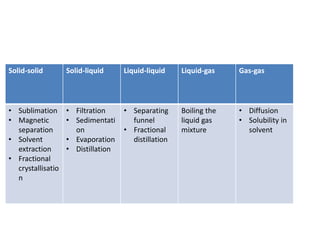
Solid-solid Solid-liquid Liquid-liquid Liquid-gas Gas-gas
• Sublimation
• Magnetic
separation
• Solvent
extraction
• Fractional
crystallisatio
n
• Filtration
• Sedimentati
on
• Evaporation
• Distillation
• Separating
funnel
• Fractional
distillation
Boiling the
liquid gas
mixture
• Diffusion
• Solubility in
solvent
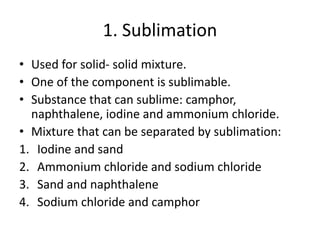
1. Sublimation
• Used for solid- solid mixture.
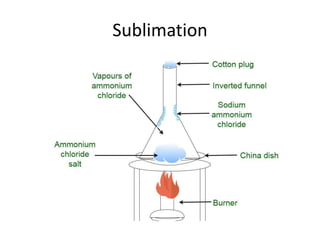
• One of the component is sublimable.
• Substance that can sublime: camphor,
naphthalene, iodine and ammonium chloride.
• Mixture that can be separated by sublimation:
1. Iodine and sand
2. Ammonium chloride and sodium chloride
3. Sand and naphthalene
4. Sodium chloride and camphor
Sublimation
2. Magnetic Separation
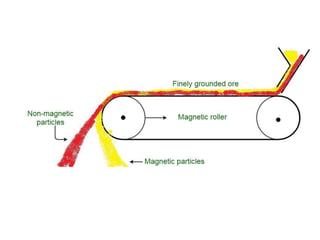
• Used for solid- solid mixture.
• One of the components is magnetic in nature.
• Iron, cobalt, nickel.
• Mixture that can be separated by Magnetic
Separation:
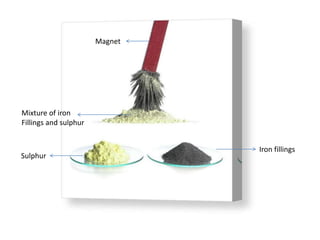
Iron and sulphur
Iron and sand
Sulphur
Iron fillings
Mixture of iron
Fillings and sulphur
Magnet
3. Solvent Extraction
• When one of the components of a mixture is
soluble in a particular liquid. ( water/any
solvent)
• Other component is insoluble.
• Sodium chloride and calcium chloride in water.
• Sulphur and charcoal in carbon disulphide.
4.Fractional crystallisation
• When solubility of components of a mixture is
different in the same solvent.
• Potassium nitrate and potassium chlorate
• Potassium nitrate and sodium chloride.
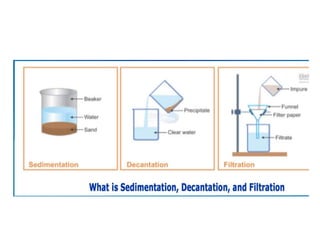
5. Filtration
• Separating insoluble solid component from
solid-liquid mixture using filter paper.
Calcium carbonate from water.
Sand and water
Clay or mud and water
Sawdust and water
Filters : filter paper, glass wool, layer of sand.
6. Sedimentation and decantation
• Heavier, insoluble solid component settle
down at the bottom.
• Sand and water.
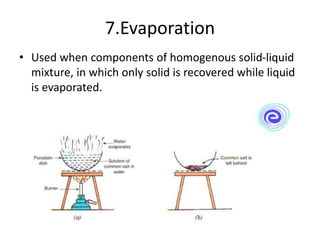
7.Evaporation
• Used when components of homogenous solid-liquid
mixture, in which only solid is recovered while liquid
is evaporated.
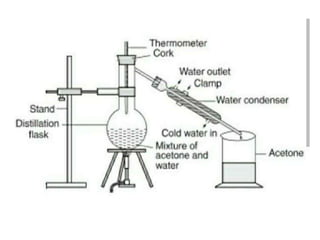
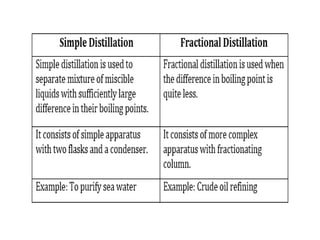
8.Distillation
• Separating liquid-liquid mixture.
• The separation of a mixture of liquids based on
the physical property of boiling point.
• Evaporation with subsequent condensation.
• Tap water is purified.
• Iodine and alcohol.
• http://www.footprints-
science.co.uk/index.php?module=2&type=Distilla
tion&section=Section1&info=10
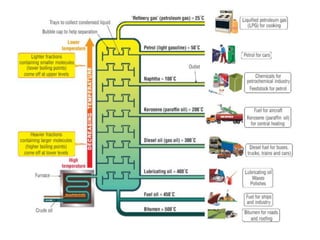
9.Fractional distillation
• separation of miscible liquids.
• The process involves repeated distillations
and condensations.
• https://www.footprints-
science.co.uk/index.php?type=Fractional_disti
llation
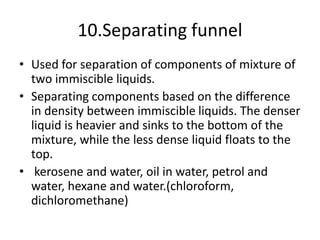
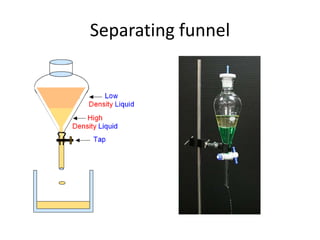
10.Separating funnel
• Used for separation of components of mixture of
two immiscible liquids.
• Separating components based on the difference
in density between immiscible liquids. The denser
liquid is heavier and sinks to the bottom of the
mixture, while the less dense liquid floats to the
top.
• kerosene and water, oil in water, petrol and
water, hexane and water.(chloroform,
dichloromethane)
Separating funnel
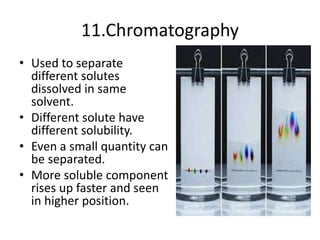
11.Chromatography
• Used to separate
different solutes
dissolved in same
solvent.
• Different solute have
different solubility.
• Even a small quantity can
be separated.
• More soluble component
rises up faster and seen
in higher position.
12. Centrifugation
• Separating using centrifugal force.
• Denser particle move down and lighter
components move up.
• Used to separate cream from milk.
• Blood testing.
• Washing machines to squeeze water.
Liquid gas mixture
1. Boiling : dissolved gas will escape from the
liquid.
• Solubility of gas in liquid decreases with
increase in temperature.
Gas-gas mixture
1. Diffusion: based on difference in the densities of
gases. The lighter gas will diffuse more rapidly leaving
behind the heavier one.
• Mixture of hydrogen and oxygen.
2. Solvent extraction : some gases dissolve in water or
any other solvent, some are less soluble while some do
not dissolve at all.
• Mixture of carbon dioxide and carbon monoxide.
• Carbon dioxide is highly soluble in water.
3. Liquefaction :some gases (ammonia, carbon dioxide)
liquify easily at high pressure and low temperature.
• Mixture of ammonia and nitrogen.
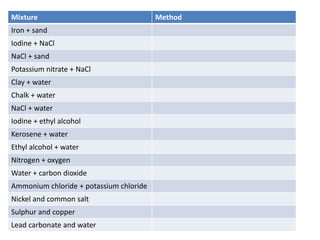
Mixture Method
Iron + sand
Iodine + NaCl
NaCl + sand
Potassium nitrate + NaCl
Clay + water
Chalk + water
NaCl + water
Iodine + ethyl alcohol
Kerosene + water
Ethyl alcohol + water
Nitrogen + oxygen
Water + carbon dioxide
Ammonium chloride + potassium chloride
Nickel and common salt
Sulphur and copper
Lead carbonate and water
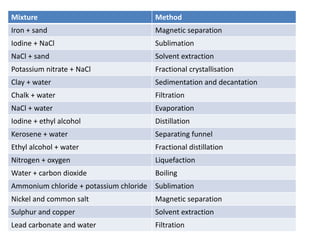
Mixture Method
Iron + sand Magnetic separation
Iodine + NaCl Sublimation
NaCl + sand Solvent extraction
Potassium nitrate + NaCl Fractional crystallisation
Clay + water Sedimentation and decantation
Chalk + water Filtration
NaCl + water Evaporation
Iodine + ethyl alcohol Distillation
Kerosene + water Separating funnel
Ethyl alcohol + water Fractional distillation
Nitrogen + oxygen Liquefaction
Water + carbon dioxide Boiling
Ammonium chloride + potassium chloride Sublimation
Nickel and common salt Magnetic separation
Sulphur and copper Solvent extraction
Lead carbonate and water Filtration
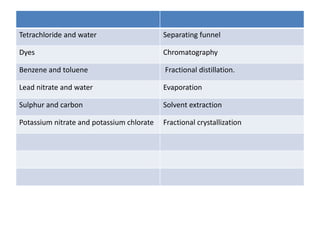
Tetrachloride and water Separating funnel
Dyes Chromatography
Benzene and toluene Fractional distillation.
Lead nitrate and water Evaporation
Sulphur and carbon Solvent extraction
Potassium nitrate and potassium chlorate Fractional crystallization

seperation techniques for mixtures..pptx

  • 1.
  • 2.
    Solid-solid Solid-liquid Liquid-liquidLiquid-gas Gas-gas • Sublimation • Magnetic separation • Solvent extraction • Fractional crystallisatio n • Filtration • Sedimentati on • Evaporation • Distillation • Separating funnel • Fractional distillation Boiling the liquid gas mixture • Diffusion • Solubility in solvent
  • 3.
    1. Sublimation • Usedfor solid- solid mixture. • One of the component is sublimable. • Substance that can sublime: camphor, naphthalene, iodine and ammonium chloride. • Mixture that can be separated by sublimation: 1. Iodine and sand 2. Ammonium chloride and sodium chloride 3. Sand and naphthalene 4. Sodium chloride and camphor
  • 4.
  • 5.
    2. Magnetic Separation •Used for solid- solid mixture. • One of the components is magnetic in nature. • Iron, cobalt, nickel. • Mixture that can be separated by Magnetic Separation: Iron and sulphur Iron and sand
  • 6.
    Sulphur Iron fillings Mixture ofiron Fillings and sulphur Magnet
  • 8.
    3. Solvent Extraction •When one of the components of a mixture is soluble in a particular liquid. ( water/any solvent) • Other component is insoluble. • Sodium chloride and calcium chloride in water. • Sulphur and charcoal in carbon disulphide.
  • 9.
    4.Fractional crystallisation • Whensolubility of components of a mixture is different in the same solvent. • Potassium nitrate and potassium chlorate • Potassium nitrate and sodium chloride.
  • 10.
    5. Filtration • Separatinginsoluble solid component from solid-liquid mixture using filter paper. Calcium carbonate from water. Sand and water Clay or mud and water Sawdust and water Filters : filter paper, glass wool, layer of sand.
  • 11.
    6. Sedimentation anddecantation • Heavier, insoluble solid component settle down at the bottom. • Sand and water.
  • 13.
    7.Evaporation • Used whencomponents of homogenous solid-liquid mixture, in which only solid is recovered while liquid is evaporated.
  • 14.
    8.Distillation • Separating liquid-liquidmixture. • The separation of a mixture of liquids based on the physical property of boiling point. • Evaporation with subsequent condensation. • Tap water is purified. • Iodine and alcohol. • http://www.footprints- science.co.uk/index.php?module=2&type=Distilla tion&section=Section1&info=10
  • 16.
    9.Fractional distillation • separationof miscible liquids. • The process involves repeated distillations and condensations. • https://www.footprints- science.co.uk/index.php?type=Fractional_disti llation
  • 19.
    10.Separating funnel • Usedfor separation of components of mixture of two immiscible liquids. • Separating components based on the difference in density between immiscible liquids. The denser liquid is heavier and sinks to the bottom of the mixture, while the less dense liquid floats to the top. • kerosene and water, oil in water, petrol and water, hexane and water.(chloroform, dichloromethane)
  • 20.
  • 21.
    11.Chromatography • Used toseparate different solutes dissolved in same solvent. • Different solute have different solubility. • Even a small quantity can be separated. • More soluble component rises up faster and seen in higher position.
  • 22.
    12. Centrifugation • Separatingusing centrifugal force. • Denser particle move down and lighter components move up. • Used to separate cream from milk. • Blood testing. • Washing machines to squeeze water.
  • 23.
    Liquid gas mixture 1.Boiling : dissolved gas will escape from the liquid. • Solubility of gas in liquid decreases with increase in temperature.
  • 24.
    Gas-gas mixture 1. Diffusion:based on difference in the densities of gases. The lighter gas will diffuse more rapidly leaving behind the heavier one. • Mixture of hydrogen and oxygen. 2. Solvent extraction : some gases dissolve in water or any other solvent, some are less soluble while some do not dissolve at all. • Mixture of carbon dioxide and carbon monoxide. • Carbon dioxide is highly soluble in water. 3. Liquefaction :some gases (ammonia, carbon dioxide) liquify easily at high pressure and low temperature. • Mixture of ammonia and nitrogen.
  • 25.
    Mixture Method Iron +sand Iodine + NaCl NaCl + sand Potassium nitrate + NaCl Clay + water Chalk + water NaCl + water Iodine + ethyl alcohol Kerosene + water Ethyl alcohol + water Nitrogen + oxygen Water + carbon dioxide Ammonium chloride + potassium chloride Nickel and common salt Sulphur and copper Lead carbonate and water
  • 26.
    Mixture Method Iron +sand Magnetic separation Iodine + NaCl Sublimation NaCl + sand Solvent extraction Potassium nitrate + NaCl Fractional crystallisation Clay + water Sedimentation and decantation Chalk + water Filtration NaCl + water Evaporation Iodine + ethyl alcohol Distillation Kerosene + water Separating funnel Ethyl alcohol + water Fractional distillation Nitrogen + oxygen Liquefaction Water + carbon dioxide Boiling Ammonium chloride + potassium chloride Sublimation Nickel and common salt Magnetic separation Sulphur and copper Solvent extraction Lead carbonate and water Filtration
  • 27.
    Tetrachloride and waterSeparating funnel Dyes Chromatography Benzene and toluene Fractional distillation. Lead nitrate and water Evaporation Sulphur and carbon Solvent extraction Potassium nitrate and potassium chlorate Fractional crystallization